Whether you’re looking for outdoor movies to enjoy those warm summer evenings, or indoor movie clubs for those hot summer mornings when you really just need some A/C, or a drive-in movie, here are some options in the Seattle / King County area for summer 2025.
Kids’ Summer Movie Clubs
As you may remember from your own childhood, these are probably the cheapest, easiest way to entertain your kids for two hours on a summer morning…
Regal Summer Movie Express, Tuesdays and Wednesdays, 11 am. $1. June 10 – Aug. 6. The website doesn’t explicitly say which theaters are participating, but in the past, it’s included ,Bella Bottega, Redmond; Crossroads, Bellevue; Thornton Place, Seattle; Meridian, Seattle; Issaquah Highlands; The Landing in Renton; Alderwood, Tukwila.
Outdoor Movies
Below, I list all the outdoor movie series in King County. All information is current as of 6/9/25- but check individual websites for updates or changes!
Note: all outdoor movies start around “dusk”. In the Pacific Northwest, that means starting around 9 – 9:30 pm in July and 8:30 – 9 in August, so outdoor movies aren’t compatible with early bedtimes.
Get some handy tips / etiquette advice for outdoor movies here and here. Top tips are: go early for good seating location, bring a sweatshirt and blankets, as the weather cools quickly after dark, and if you bring a chair, make sure it’s a low profile chair so you don’t block anyone’s view. It doesn’t hurt to have a flashlight to find your way to the bathroom or port-a-potty – just be sure to shine it only at the ground in front of you.
Tuesdays
Movies in the Park at Bellevue’s Downtown Park on Tuesday evenings, from July 15-August 19. Pre-movie entertainment will begin at 7 p.m. and movies will begin at dusk. Free. July 15, Moana 2; July 22, Detective Pikachu; July 29, Grinch, 8/5 Cars; 8/12 Miracle, 8/19 Monster U.
Wednesdays and Thursdays
Movies at Marymoor Park in Redmond. 7/2 – 8/20. $10 per person (5 and under free), $5 to park. Seating opens at 7:30 early in the season and 6:30 later on. Live entertainment, trivia, food trucks, vendors. Movies include: 7/2 Goonies, 7/9 Lilo and Stitch (original), 7/16 Legally Blonde, 7/24 Wild Robot, 7/31 Guardians of the Galaxy, 8/6 Up, 8/13 Pirates of the Car, 8/20 Wicked
Thursdays
Movies in the Park in Crossroads Park on Thursday evenings, from July 31 – Aug 21. Pre-movie entertainment will begin at 7 p.m. and movies will begin at dusk. Free. 7/31 Cool Runnings, 8/7 American Tail, 8/14 Wicked, 8/21 Wild Robot.
Fridays
Sail-In Cinema – Everett. Watch from your boat or the shore! 7/25 – 8/22/25. Free. Details TBA.
Movies at the Mural at Seattle Center. FREE. 7/25 Ratatouile, 8/1 Princess Bride, 8/8 ET, 8/15 Say Anything, 8/22 Wicked
Movies in the Park, Pierce County. Meridian Habitat Park, Puyallup. Food Trucks. 7 pm. FREE, 7/11 Mufasa, 7/18 Wild Robot, 7/25 Dog Man
Saturdays
Cinema Under the Stars – Columbia City / Seattle. 8/9. Food bank donations accepted. Rainier Arts Center
Movies in the Park, Marysville. FREE. Jennings Park. 711 Capt. America Brave New World, 7/18 Fall Guy, 7/25 Inside Out 2, 8/1 Moana 2, 8/8 Snow White
Outdoor Summer Movies. Kirkland. Note: they have a super bright screen, so they can start before dusk, which makes this a good option for younger kids – double features show at 6 pm and 8 pm. Juanita Beach. 7/12 Despicable Me 3 and Wonka; 7/19 Migration and Madame Web, 7/26 Kung Fu Panda 4 and the Marvels. Free
Movies start at dusk… see note above. If you go to a drive-in, PLEASE spend lots of money at concessions!!! That’s what will keep these classic theaters open in future summers!!
If you’re looking for advice on whether a particular movie is kid appropriate, check out Common Sense Media which provides reviews of movies, books, TV shows, games, apps and websites. In their movie reviews, they look at educational value, positive role models, positive messages, violence and scariness level, sexy stuff, language, consumerism and substances, providing information so parents can make their own informed decisions about what’s right for their child.
Kids in Mind also offers film reviews which rate, on a scale of 1 – 10, the level of sex/nudity, violence/gore, profanity and substance use in a movie. They also give detailed descriptions of each incident they counted, for parents to consider.
I also wrote a post on “When to Introduce Your Child To ______” which talks about things to consider when deciding whether your child is ready yet for favorite series like the MCU, Star Wars, and more.
For school year activities, if you have kids age birth to 7, check out info about fabulous parent education classes at local community colleges that are great for kids AND include parent education for you – register now for fall, before they fill up!!
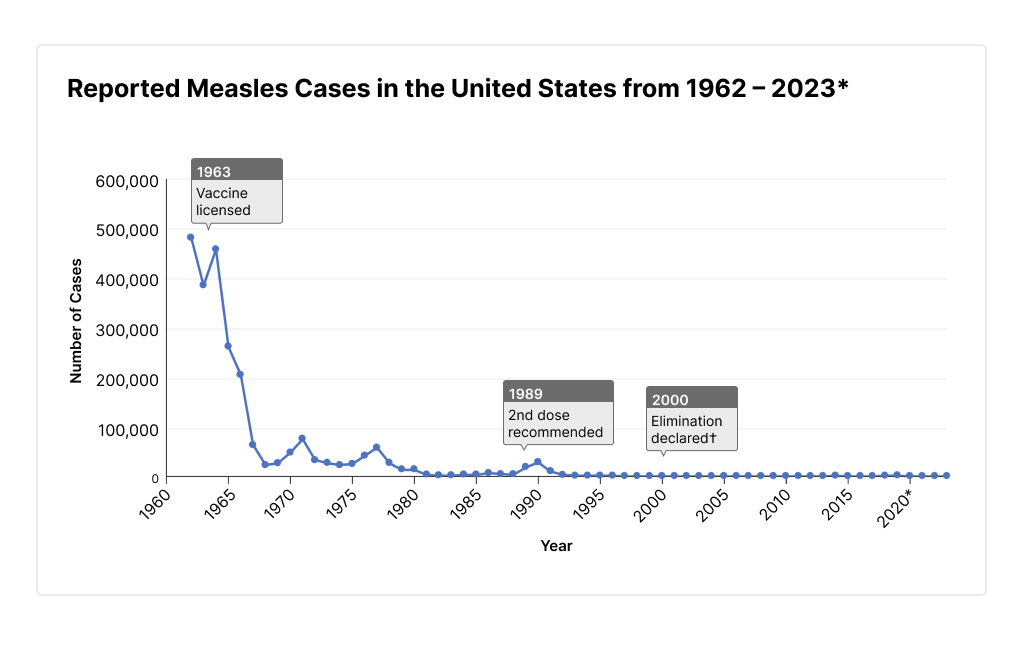
In 2025, as of early June, there were 1168 cases of measles in the United States, the majority in children. (In all of 2024, there were only 285 cases.) There have been 3 deaths from measles. The first deaths in the United States in a decade.
There is an outbreak of measles in Texas with 744 cases as of 6/13 (plus 81 in New Mexico and 19 in Oklahoma), most of them in children.
So it’s time for an update on measles: what is it, how contagious is it, and how to prevent the spread (hint: the measles vaccine substantially reduces your risk.)
What is Measles?
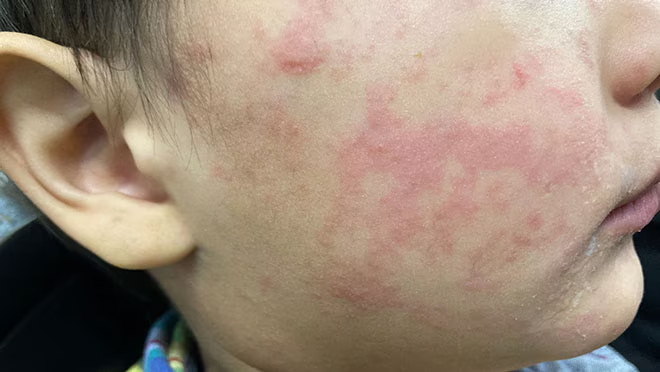
Measles symptoms appear 7 to 14 days after contact with the virus. Measles typically begins with: High fever (may spike to more than 104°), cough, runny nose, red, watery eyes.
2 – 3 days after symptoms begin, white spots in the mouth may develop.
3 – 5 days after symptoms begin, the measles rash appears: beginning as flat red spots that appear on the face at the hairline, then spread downward to the neck, trunk, arms, legs and feet. Small raised bumps may appear on top of the flat red spots. The spots may join together as they spread. The fever may spike to more than 104.
Measles can also cause serious problems, including ear infections (1 in 10 people with measles), pneumonia (1 in 20), and encephalitis (1 in 1000) which can cause permanent brain damage. About 1 in 4 people who get measles in the U.S. will be hospitalized. Even after recovery, it has a long-term effect on your immune system, making you more vulnerable to other diseases.
You may hear some people say “measles can be treated with vitamin A” as if to imply that it is a minor and easily treatable illness where you pop a few vitamins and it’s resolved. Although vitamin A does have significant benefits in reducing mortality in children who have measles (especially in countries with high levels of vitamin A deficiency), preventing a child from getting measles in the first place is a far better way to reduce measles mortality. Vitamin A does not protect someone from infection with measles (it’s not preventative), and if a child does have measles, parents should not self-treat with vitamin A without consulting a physician.
Is measles deadly?
No, not for most people. (For example, I learned today from looking at my health records that I had measles as a baby, in 1967.) However, for every 10,000 people who get measles, 10 to 30 children will die.
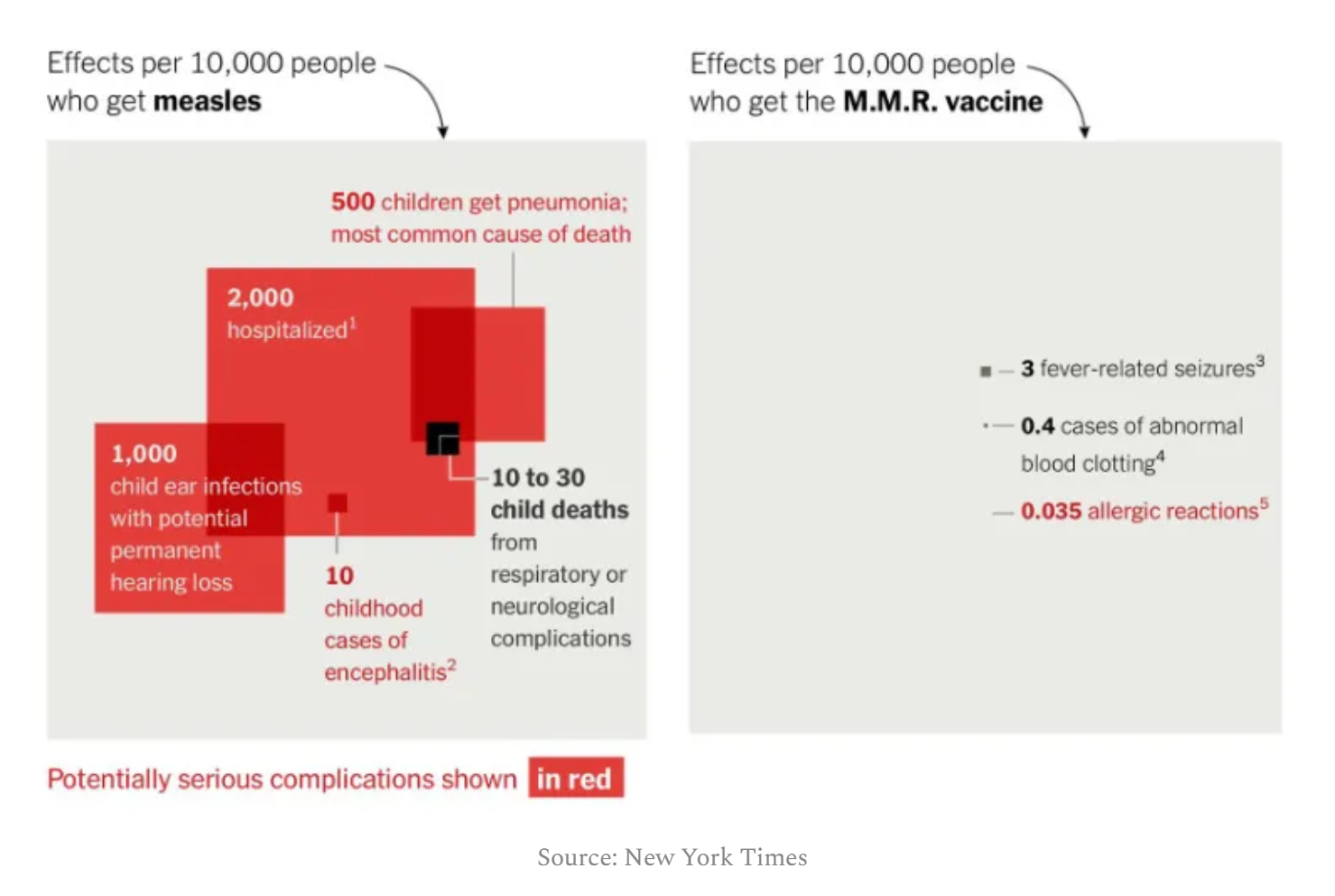
You may hear some people say things like “a lot more people die of flu each year than measles”, with the implication that measles is not that risky. No. The reason is that since measles vaccines became available, measles has become a fairly rare disease. Before the measles vaccine existed, there were 3 to 4 million cases per year in the US and 400-500 people died. Now, with the majority of people vaccinated, measles cases are rare, and death is rarer. In 2024, there were only 285 cases in the US and no deaths. Versus in the 23-24 flu season, there were 40 million flu-related illnesses, so of course there were more flu deaths.
Now, before the end of May 2025, less than 1/2 of the way through the year, we already have 1100+ measles cases, many due to an outbreak in an area where lots of families chose not to vaccinate their children.
When someone has the measles, they may develop fever and other symptoms before the characteristic rash appears. (They may be infectious for 4 days before the rash appears.) So they may not realize they have measles, and may be out in public – in school, restaurants, shops, buses or medical clinics. If they cough or sneeze, they produce infected droplets, that can remain active in the air or on surfaces for up to two hours. If people who are not vaccinated / immune are exposed to the contaminated air / surfaces, the chance they will develop measles is 9 out of 10.
On average, every person with measles will spread it to 12 – 18 unvaccinated people.
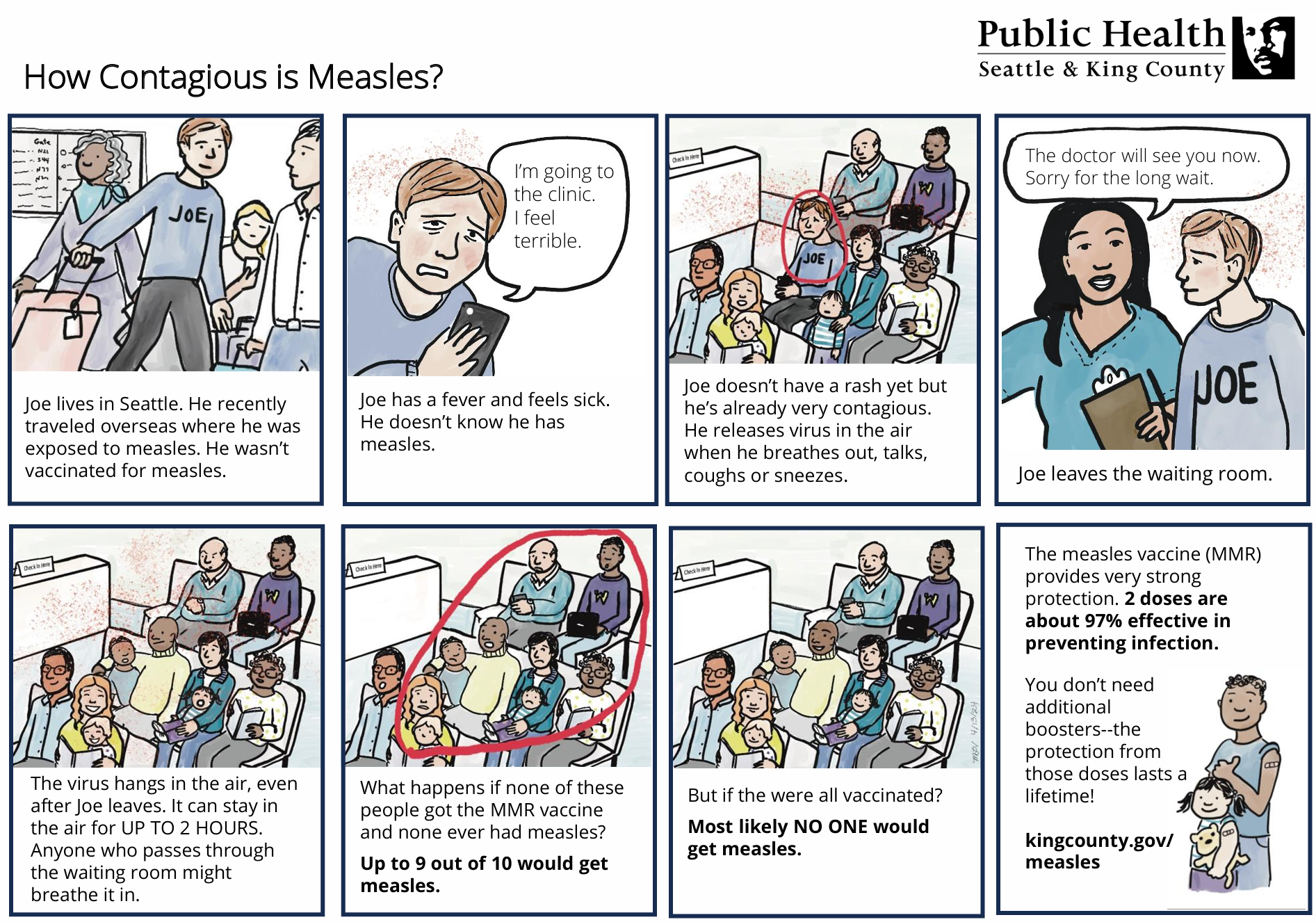
If you or your child has been exposed to measles, contact your doctor.
Protecting against Measles
For those who are fully vaccinated, their chance of getting infected at all is about 1 – 3 in 100 (vs. 9 in 10 for unvaccinated). And, even if they are in that 1 – 3% that does get an infection, it will be much milder, with many fewer complications and be less infectious than in someone who is not vaccinated.
The more people in a community who are vaccinated, the lower the risk of an outbreak. If at least 95% are vaccinated, that’s considered herd immunity or community immunity and that reduces the risk of the spread in that community.
In King County, Washington, 97% of our 6th/7th graders are vaccinated against measles, but only 92% of kindergarteners are, and only 87% of 2 year olds. (And, 0% of babies under 6 months old.)
It is recommended that children receive a dose of the MMR vaccine (which includes measles) at 12 to 15 months. [If your community is having an outbreak (3 or more related cases) or you are traveling internationally, they can receive that dose as early as 6 months. Learn more about protecting infants.] That provides 93% protection against infection. They should have the second dose at 4 – 6 years, which brings them up to the 97% protection. If your child is not vaccinated, you can get them vaccinated at any time. Learn more. You can also get vaccinated yourself if you are not – check for contraindications (e.g. you can’t get the MMR vaccine while pregnant.)
Even if you have already been exposed to the measles virus, getting a vaccine shot within 72 hours of exposure (or an immunoglobulin medicine within 6 days of exposure) will help reduce the chance of infection / the severity of the illness.
Vaccination is the single best way to reduce risk of infection. You can also reduce risk with all the usual things: handwashing, hand sanitizer, and limit exposure to people who show signs of illness.
Am I Immune?
You are presumed to be immune (and thus don’t need a vaccine) if you have:
written documentation of your past vaccines (children age 1 – 3 should have one dose, age 4 – 18 two doses, for most adults one dose is enough but healthcare providers and international travelers should have two)
a lab test that shows immunity
laboratory confirmation of disease
were born before 1957 (it’s assumed that most people born before 1957 had the illness at some point)
If you received a LIVE measles vaccine in the 1960’s you do not need to be revaccinated. But, if you received an inactivated measles vaccine between 1963 and 1967, it was not effective and you should be revaccinated.
If you’re unsure: You can ask your doctor for a blood test to check for immunity, or just get the vaccine. The MMR vaccine is safe. There’s no harm in getting another dose.
Is the vaccine safe? What are the side effects?
Common side effects are: Soreness, redness, or swelling where the vaccine was given, fever, mild rash, and temporary pain and stiffness in the joints. More serious side effects, such as a high fever or a febrile seizure are rare. The MMR vaccine does not cause autism.
KidsQuest Children’s Museum in Bellevue, WA has just moved to a new location – from Factoria to downtown Bellevue, into the building next to the library that used to be the doll museum (1116 108th Ave NE Bellevue, WA 98004). The grand opening was today, but we were able to check it out last Thursday night. Here’s what we saw (Note: you can click on any picture for a larger view)
Climbing Sculpture
When you enter, you pass by the gift shop and the front desk – within moments of entering the building, my son was already trying out the new climber.
There’s one path for the littler kids (age 4 and under). The entrance looks like this, and it leads to a little path that tucks around the corner into a little nook – I think it’s all walkable by a toddler, and looks like a parent could follow them in. (My 6 year old didn’t spend much time in there, so I don’t know details.)
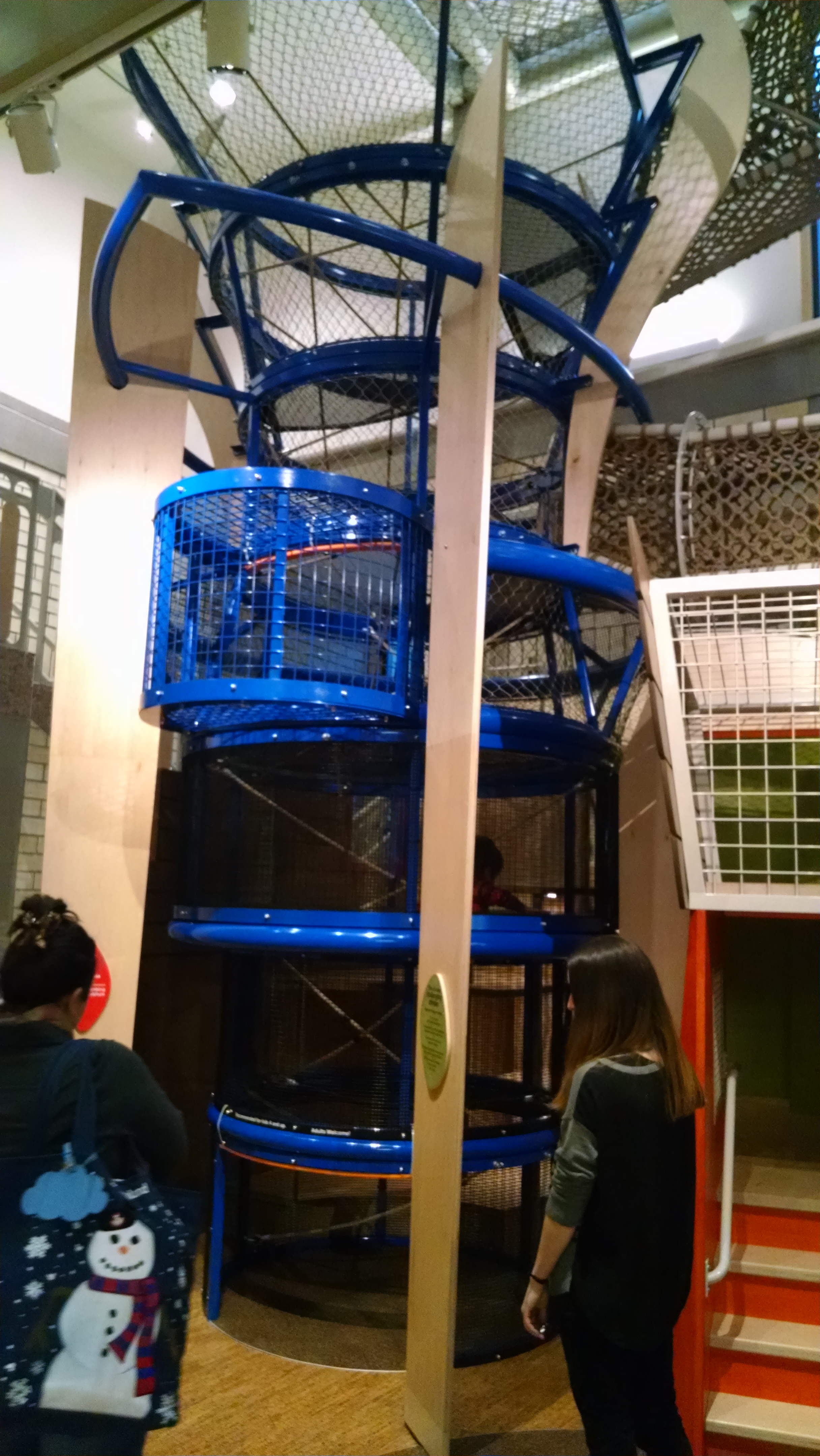
The main climbing structure is much more adventurous! It says on the bottom that it is a challenging climber for ages 4 and up, and that’s definitely true. When they enter, they have to step onto ropes to make their way up the tower, till they reach the mesh tunnels. The tunnels carry them up to a mesh platform far above the lobby:
My son (a big climbing fan) LOVED this climber! It was hard to get him out of it!
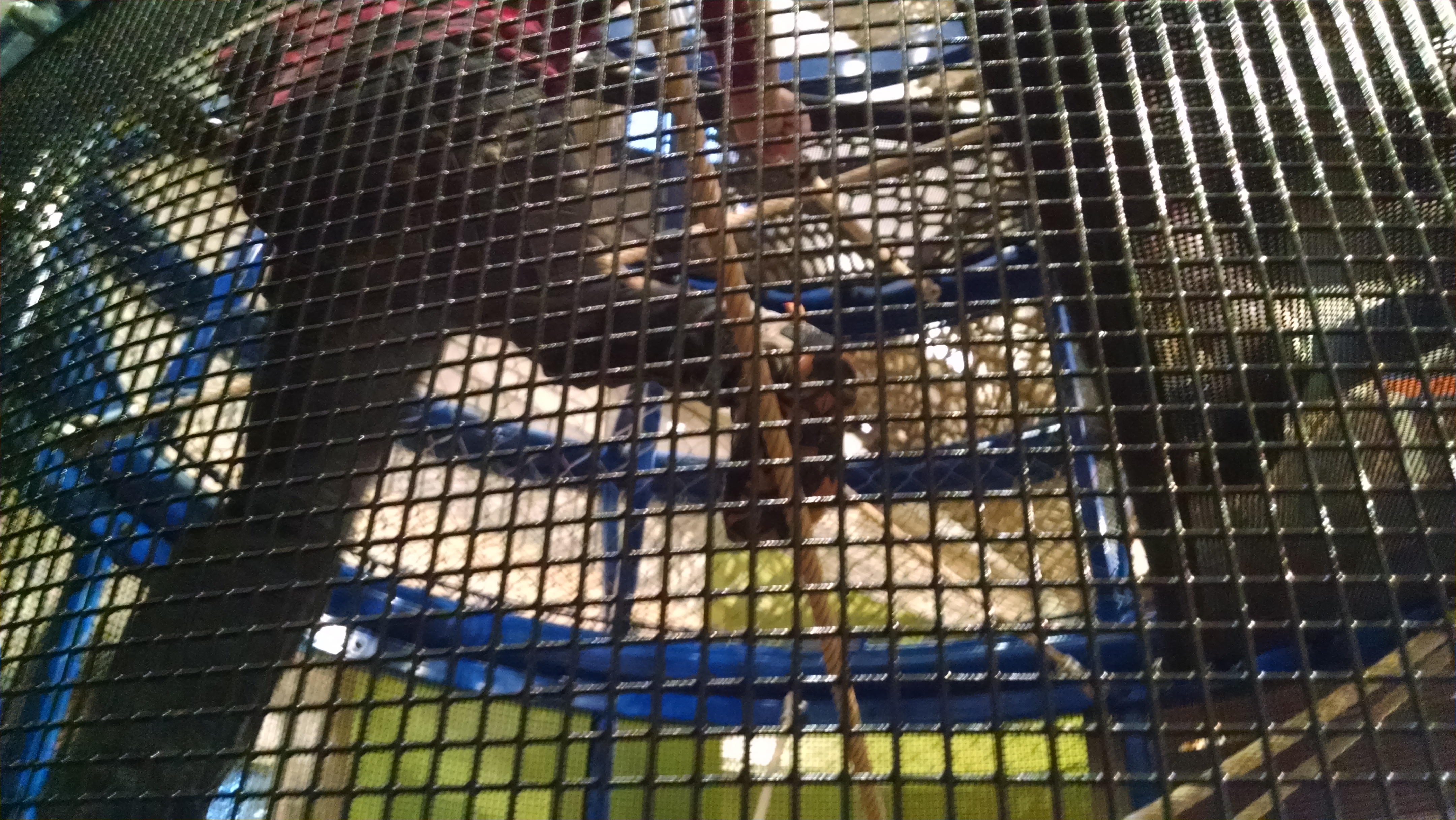
I have to confess that I, as a mother, felt a little nervous seeing him 25 – 30 feet above me… partially because I couldn’t see what the tops of those mesh tubes looked like… when you’re walking around on the platform, is it obvious where they are so no one just accidentally steps in the hole? And if they step in the hole, what would happen? Is the slope of the tube gentle enough to catch them? I’m sure it’s fine, really. My husband wasn’t worried at all… but I’d feel a little better if when I’m at the bottom I could see a photo of what it looks like from the top. They did have an employee up on the platform all evening helping keep an eye on things.
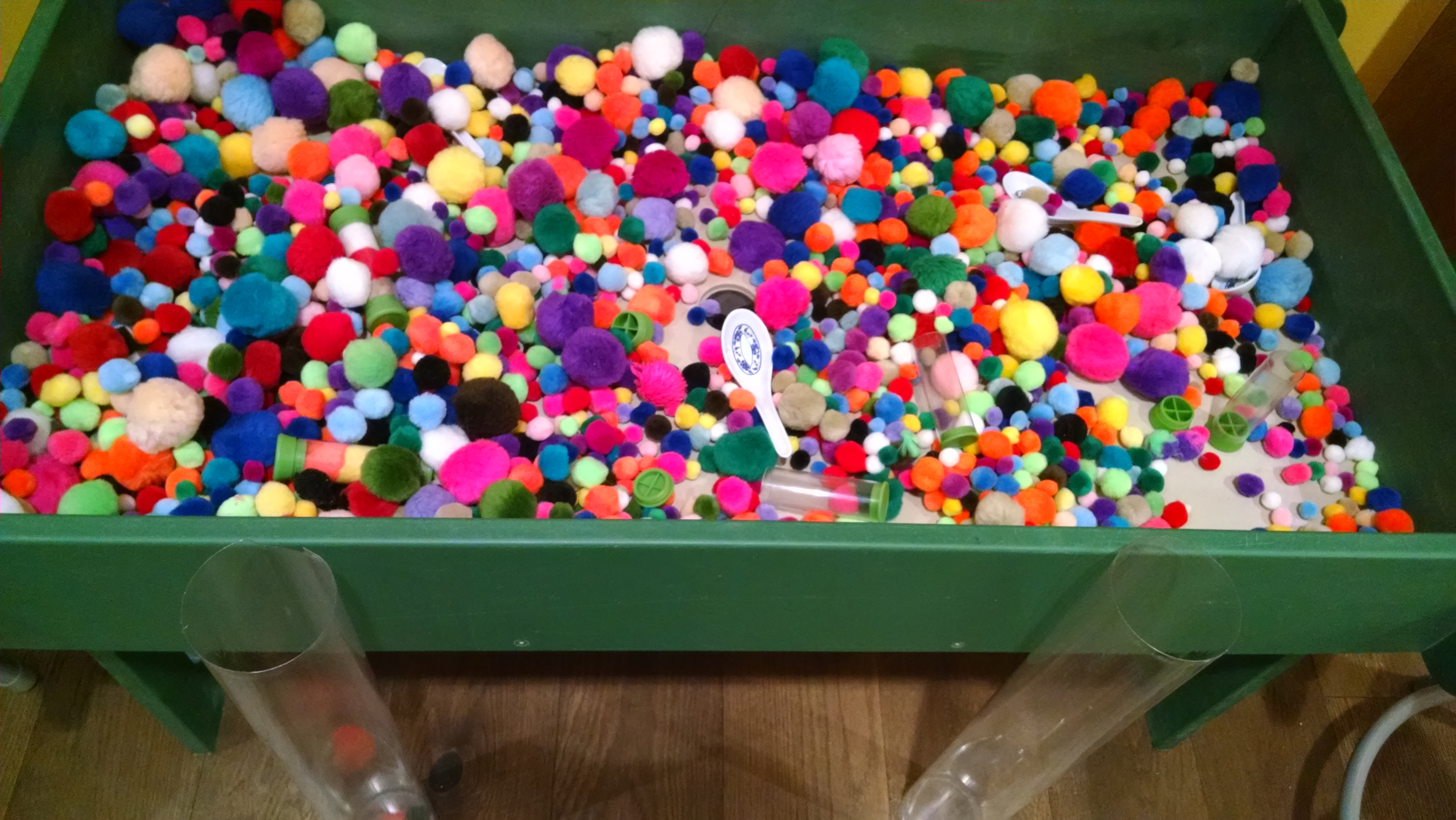
While he was on the climber, I took a quick peek at the classroom / birthday room (I think they called it the learning lab). They had a few toys set out now, and a sensory tub filled with pompoms. It looks like a nice class space.
Then it was on to….
The Water Zone.
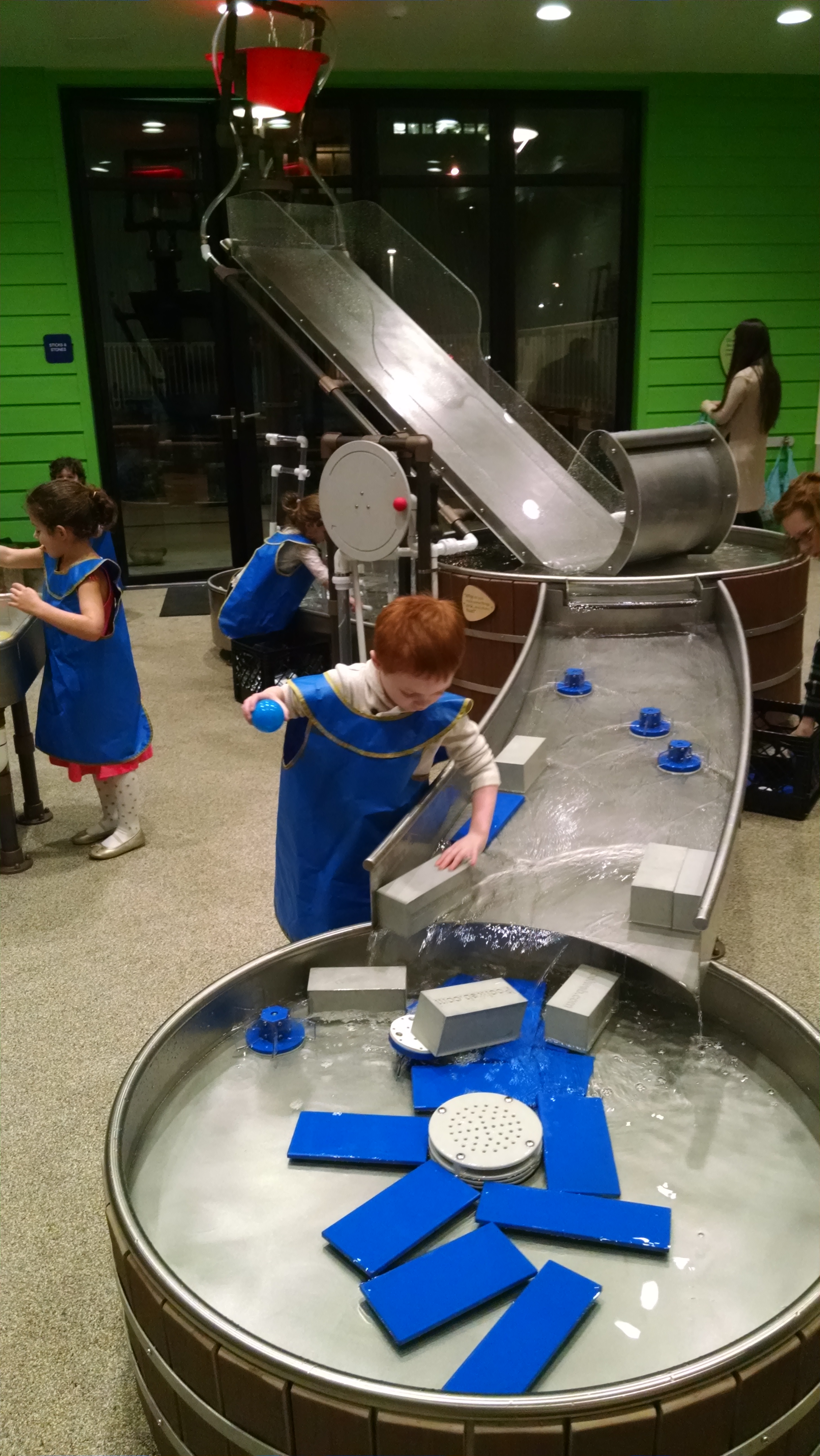
Stream Table and the Big Splash. There’s a bucket at the top that fills and dumps, making a giant flood down the chute. The lower part has a stream that you can add dams and such to in order to change the flow of the water. I only played with this for a moment and wasn’t able to get it working well – I look forward to spending more time tinkering there in the future.
Magnetic Water Wall – This has lots of chutes, funnels and spinners to channel water through. They are mounted on magnets, so you can take them off and re-arrange them. This is similar to the idea for the Ball Wall in the old museum (see below). One cool thing is that the flow of the water is adjustable. I imagine that will allow for more variation in set-up. It’s another thing I look forward to exploring more.
Water Music: with this exhibit, you press the button, and it shoots a jet of water at the bottom of a drum. Kids who love loud things will love this!
There’s a “Fountain Making Table” – imagine a chocolate fountain, but with water… there’s pictures of it on their website.
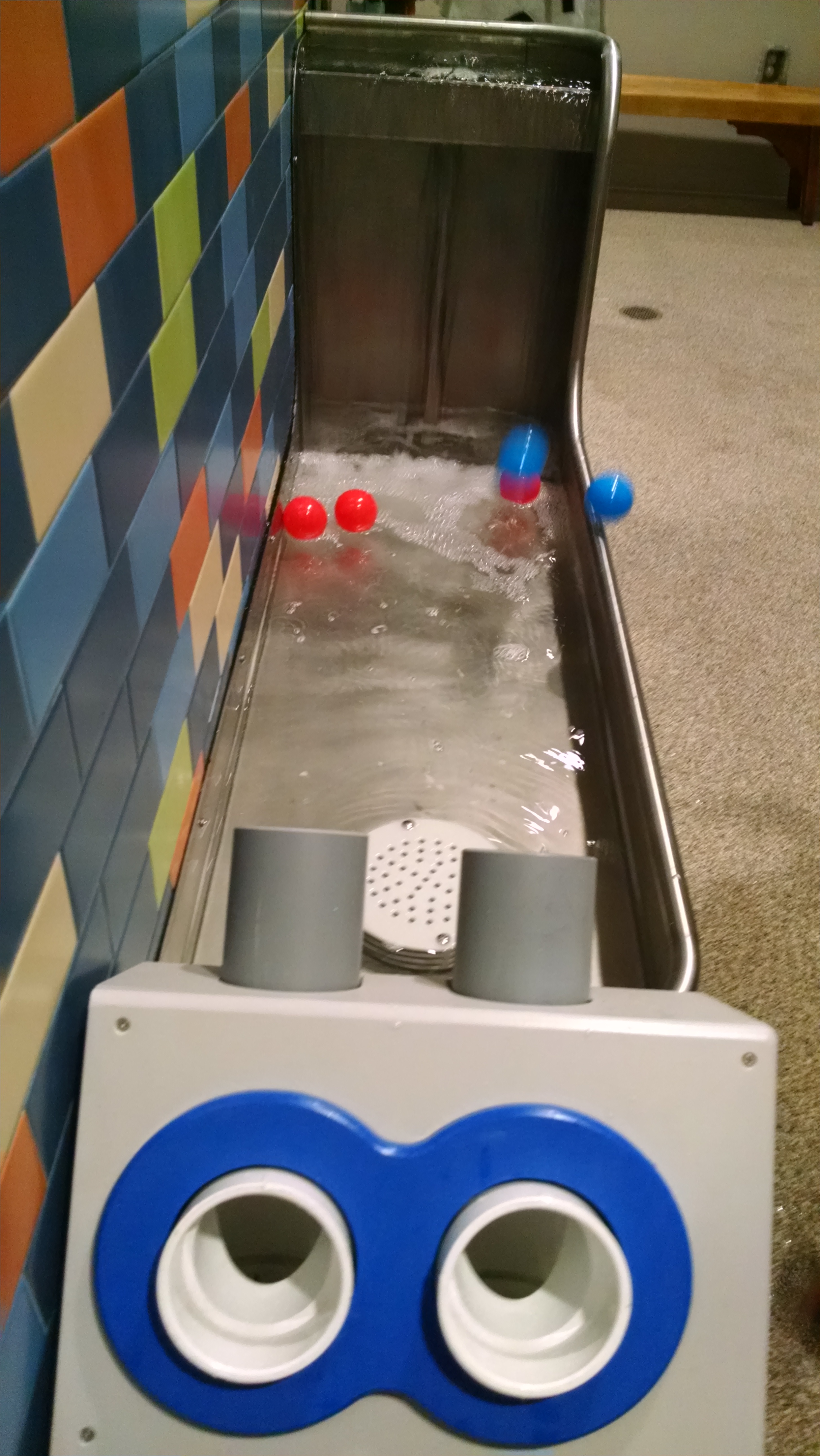
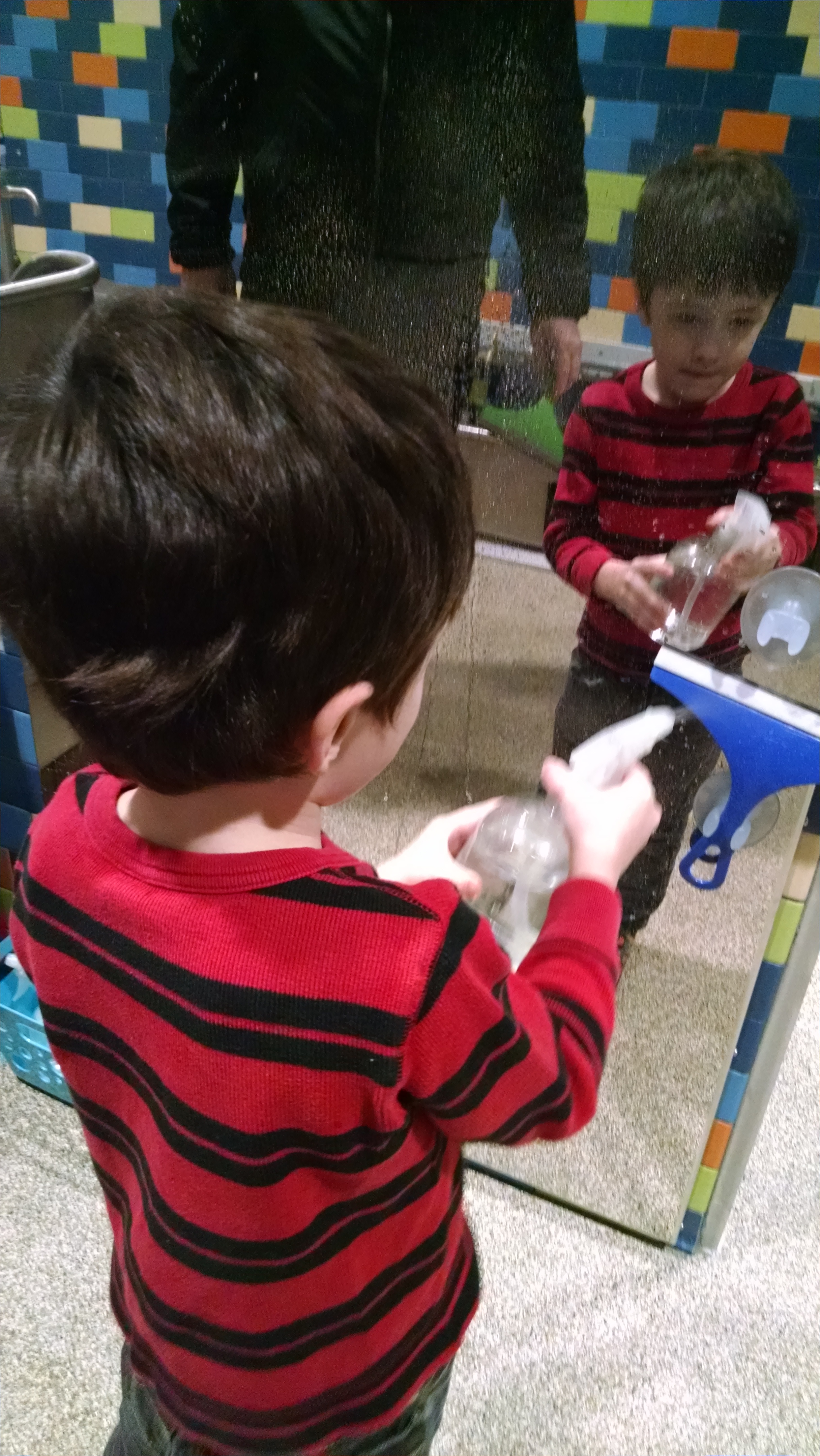
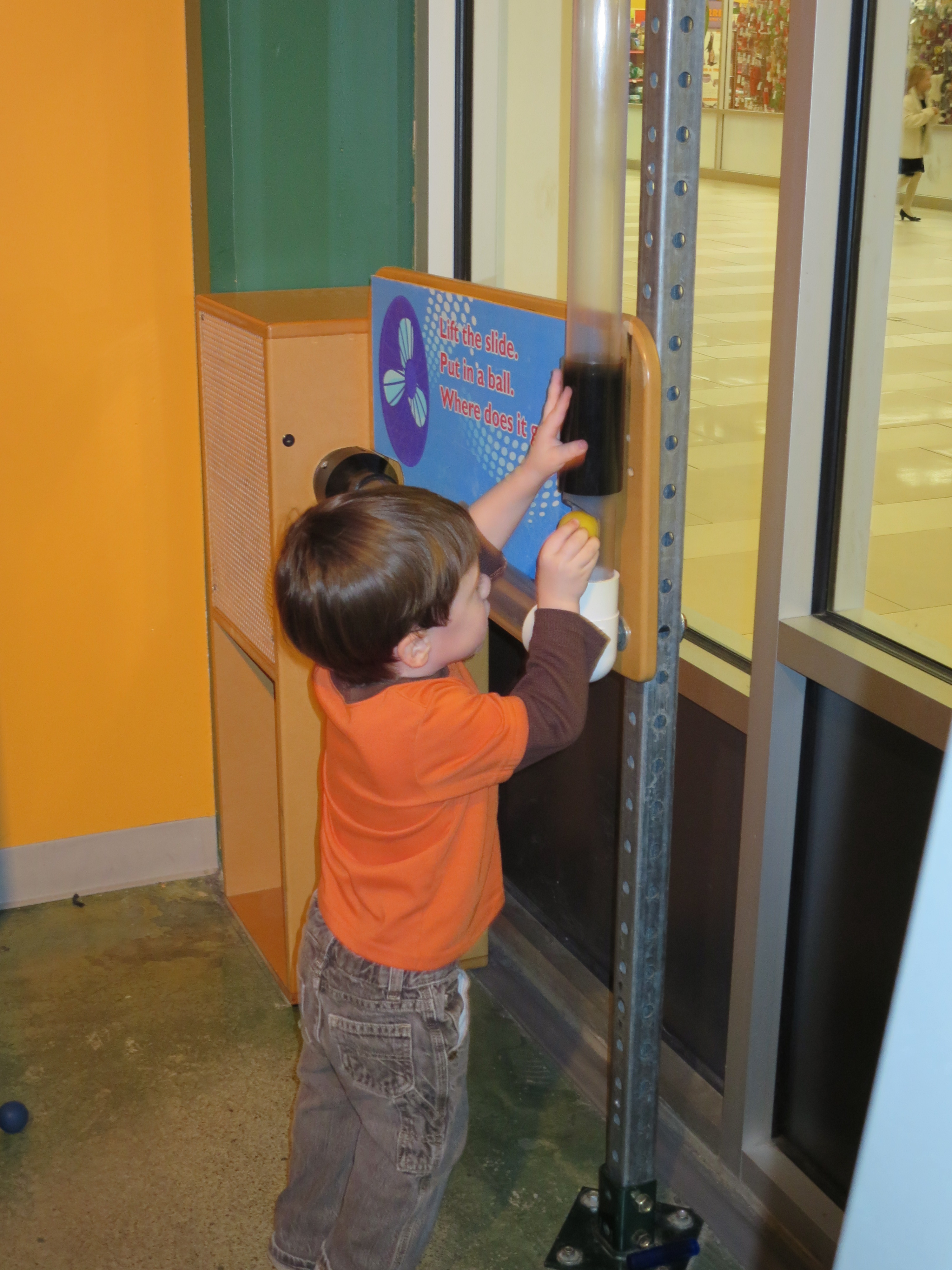
These pictures show a ball launcher (insert plastic balls in the blue holes, and fans shoot them out across the water… fairly gently… my son loved this… he loves any ball launcher! There’s a pump which works much better than most other pumps that my son has encountered. There’s a delightfully simple kid activity of a mirror with spray bottles full of water and squeegees – could keep some kids entertained for hours, and a very low basin called the tot splash, which is a great toddler sensory experience of glass rocks embedded in it to feel, and slowly dribbling water to fill the buckets with – didn’t appeal to my 6 year old at all, but the 1 – 2 year olds I work with would LOVE It.
Our favorite water activity was the vortex – at the old museum, they had this, but it was up too high for kids to reach (I had to lift my son up to it MANY times over the years.) Now they’ve put it down within reach. The water in the tank swirls around – you can drop beribboned beads into it, and they swirl and slip through the hole at the bottom, or you can drop balls in and they swirl or they block the opening till you release them… it’s really fun, but hard to explain. I got a bit of video, but it’s a lousy video… we were too busy playing… but at least it will give you an idea:
On The Go
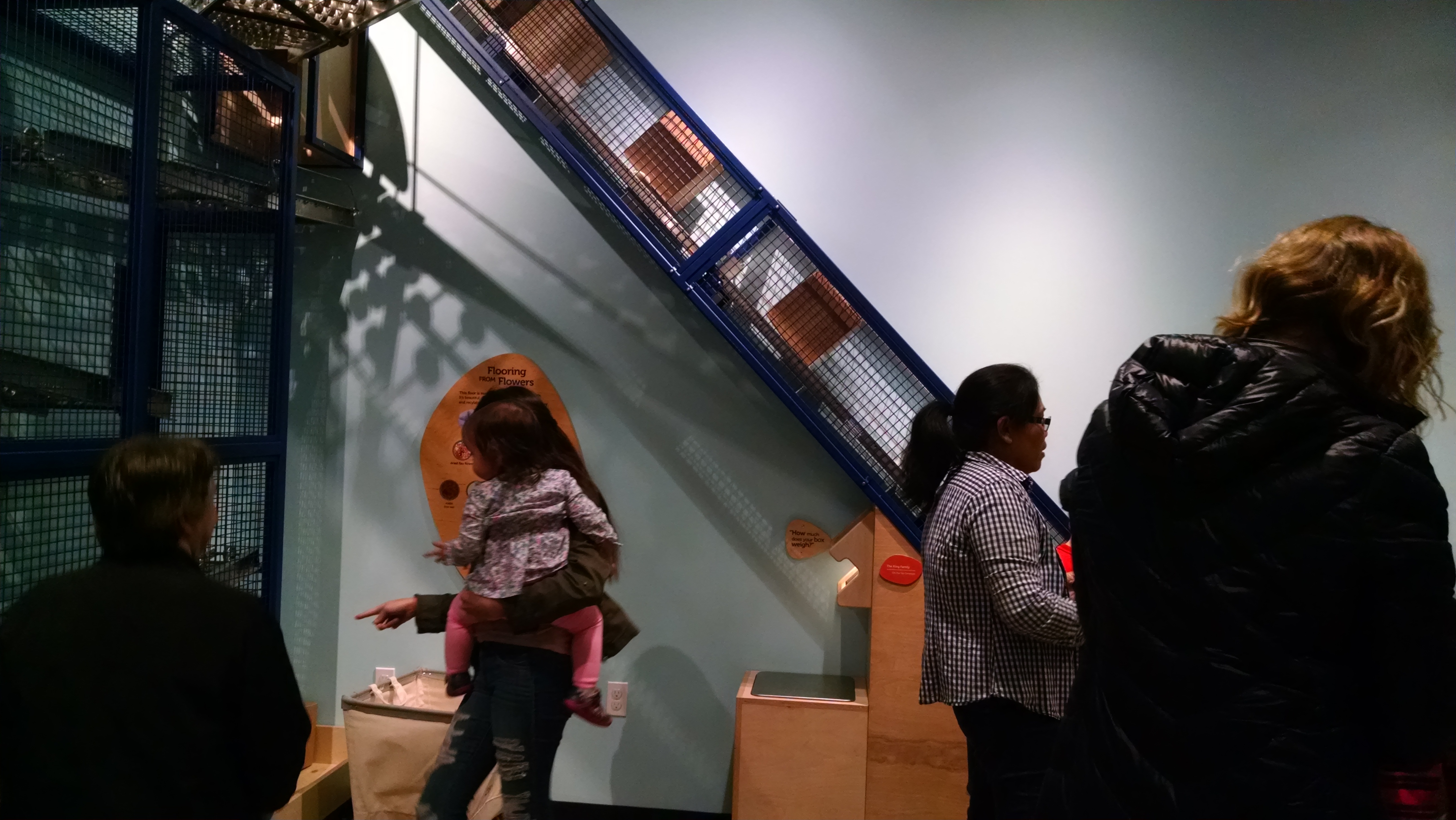
Conveyor System: Oh, this is so cool!! Load the boxes, wind the crank, it carries the boxes up a tall ramp. At the top, they get sorted to either go down one path, or across a ramp high above our heads to the other side of the room. They also have places to weigh the boxes, and an “x-ray” that shows pictures of what’s inside. Love it! It’s not perfect yet, as we did see some boxes get jammed up at the top, and to get them unjammed a parent has to help the kids at the bottom back up the belt while wiggling some boxes out of tight jams. So, tricky. But cool!
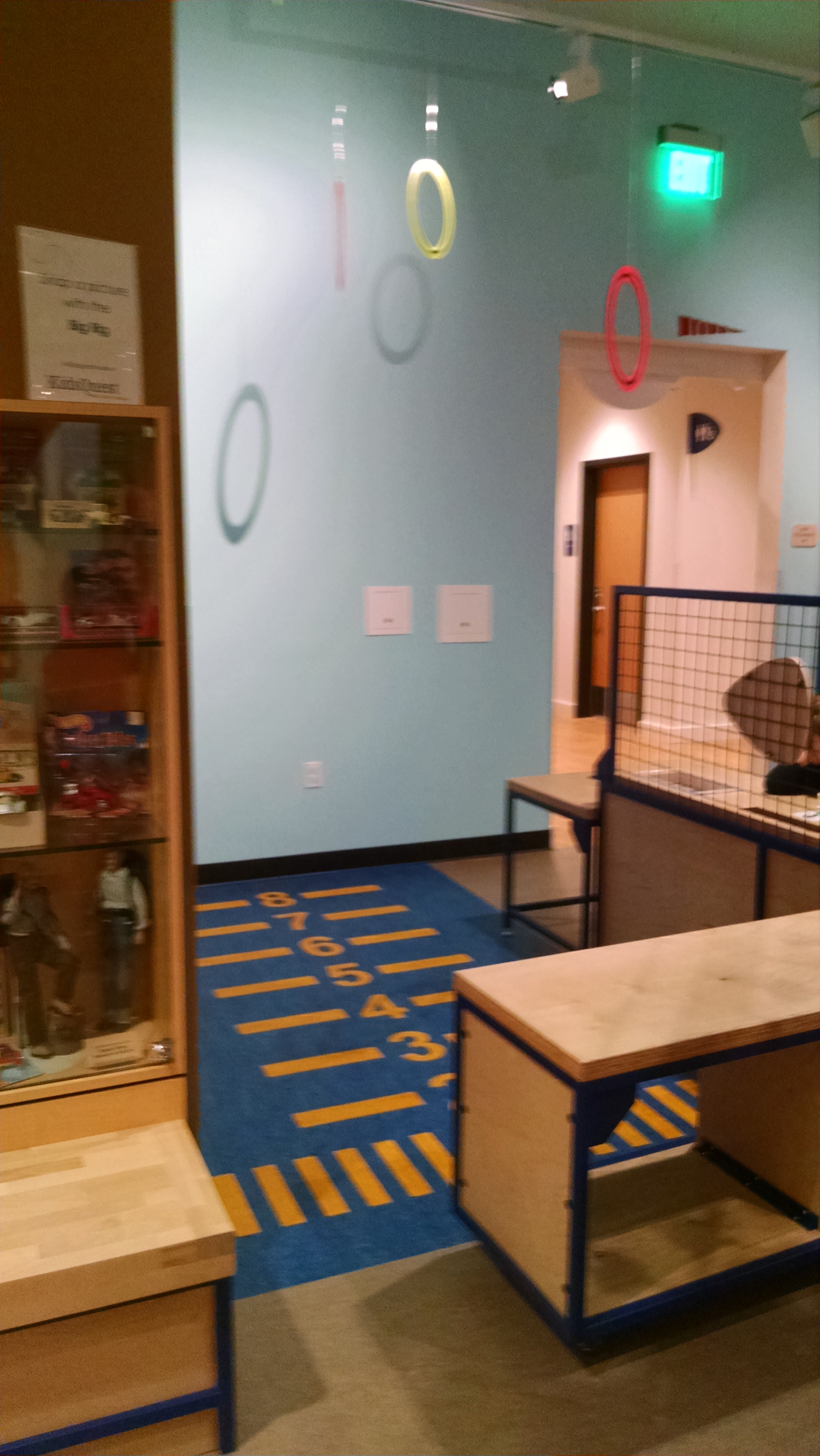
There’s a test area for folding paper airplanes, seeing how far they fly and how accurate they are (i.e. can they fly through a hanging hoop), some of the car ramps from the old museum (but not the cool permanently installed one) and the car display case with the variable LED lighting that they’d added to the old museum in the past year, and an exhibit of old toys inherited from the old doll museum.
Big Rig – there’s a new Paccar truck exhibit. My son liked it just as much as the old one, but I liked it SO MUCH better! I didn’t like the truck, because I use crutches and it was hard for me to get in and out of it, and from the outside I could barely even see if my son was in there, and since he could go in and out on either side, there were times where I “lost” him because I didn’t know he had left the exhibit. This one has a window low in the door of the cab so you can see into the cab without getting in! And on the other side, you can step up onto the step by the door to get a good view in. This added visibility would have been a big reassurance to me when he was 2 and 3.
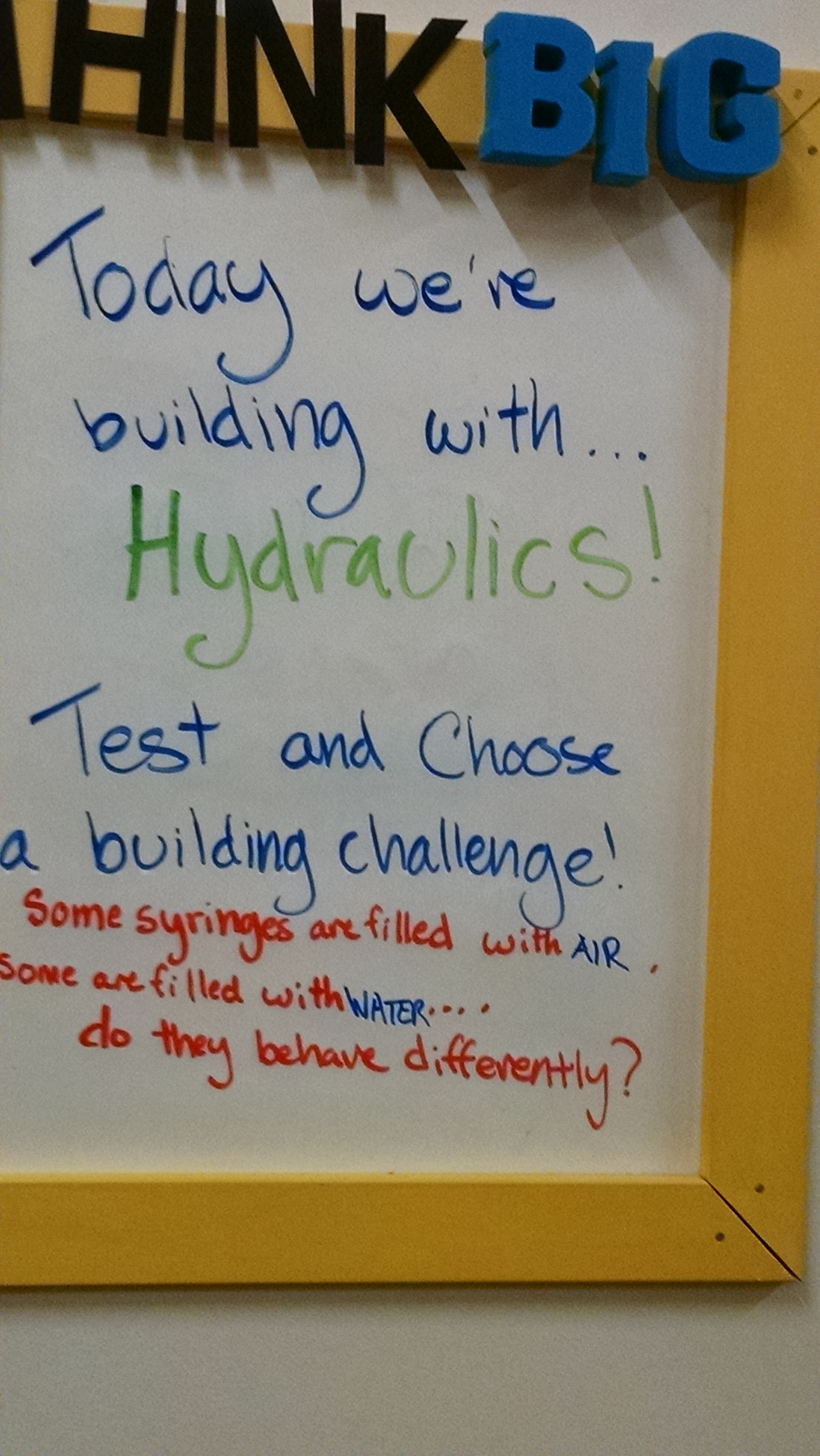
Recycle / Rebuild. This is another party room you can rent. What it had in it that night: Building materials for hydraulics projects:
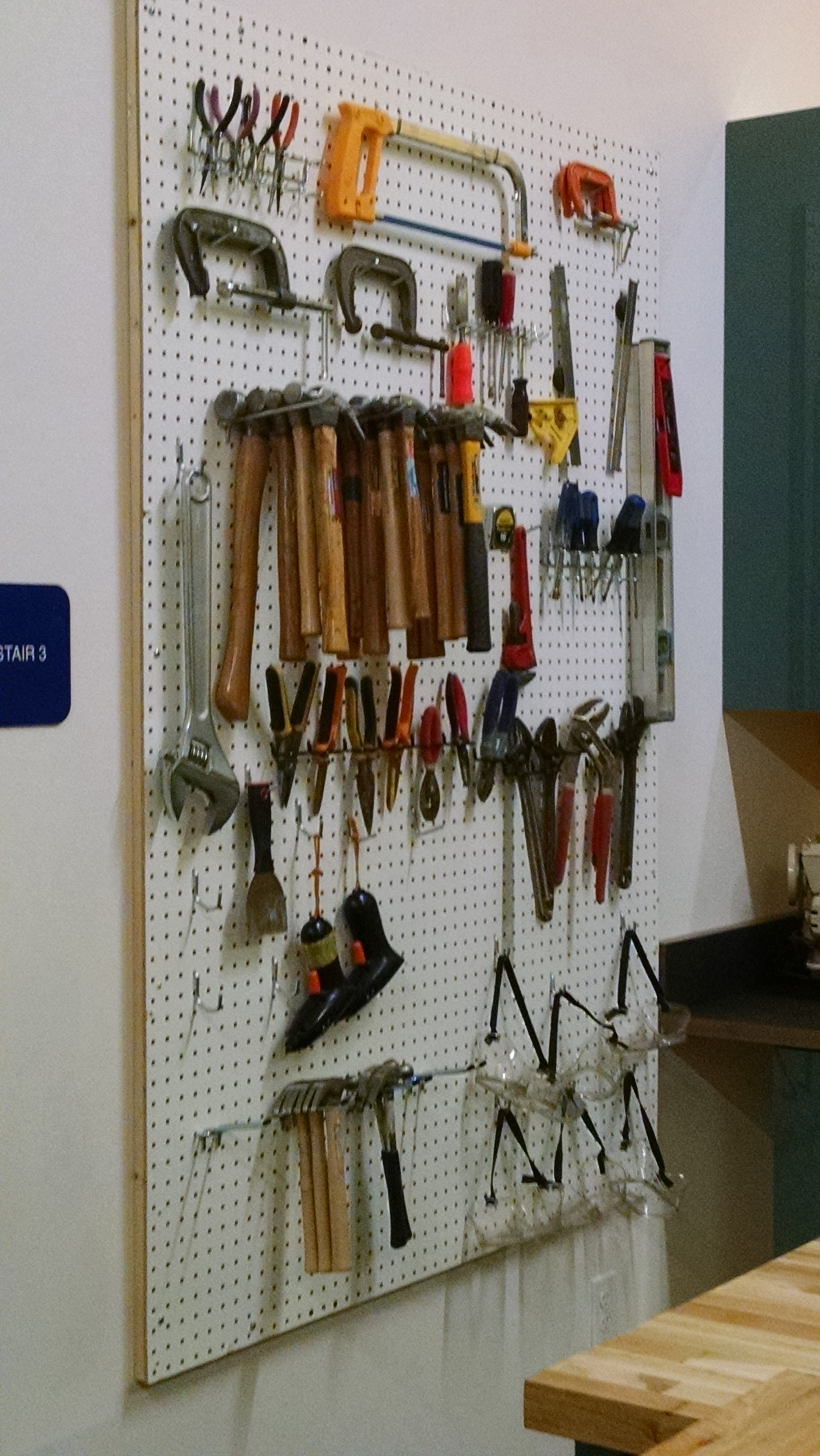
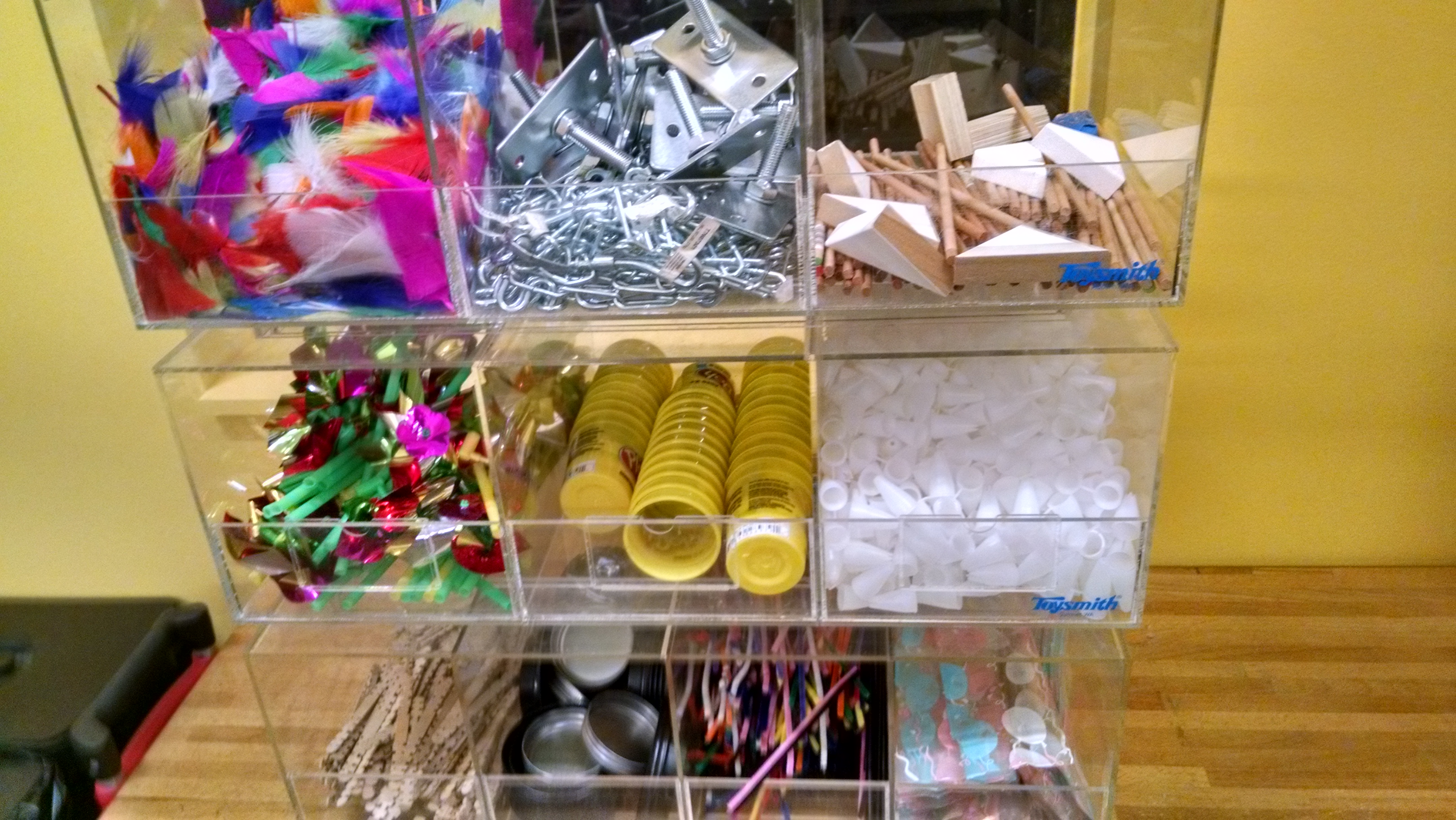
Tools, bins of recycled items to build with, and collection bins for recyclables that guests bring in:
At least with the materials in here today, this struck me as a room aimed at kids age 6 and up, which is interesting because the old KidsQuest didn’t have a lot for the older kid. My son is 6 and we were thinking he would “age out” of finding the old museum interesting, but there’s definitely some things here that will continue to appeal for a few more years.
Now let’s head upstairs…
Bellevue Mercantile – a farm, yard, and store from 100 years ago.
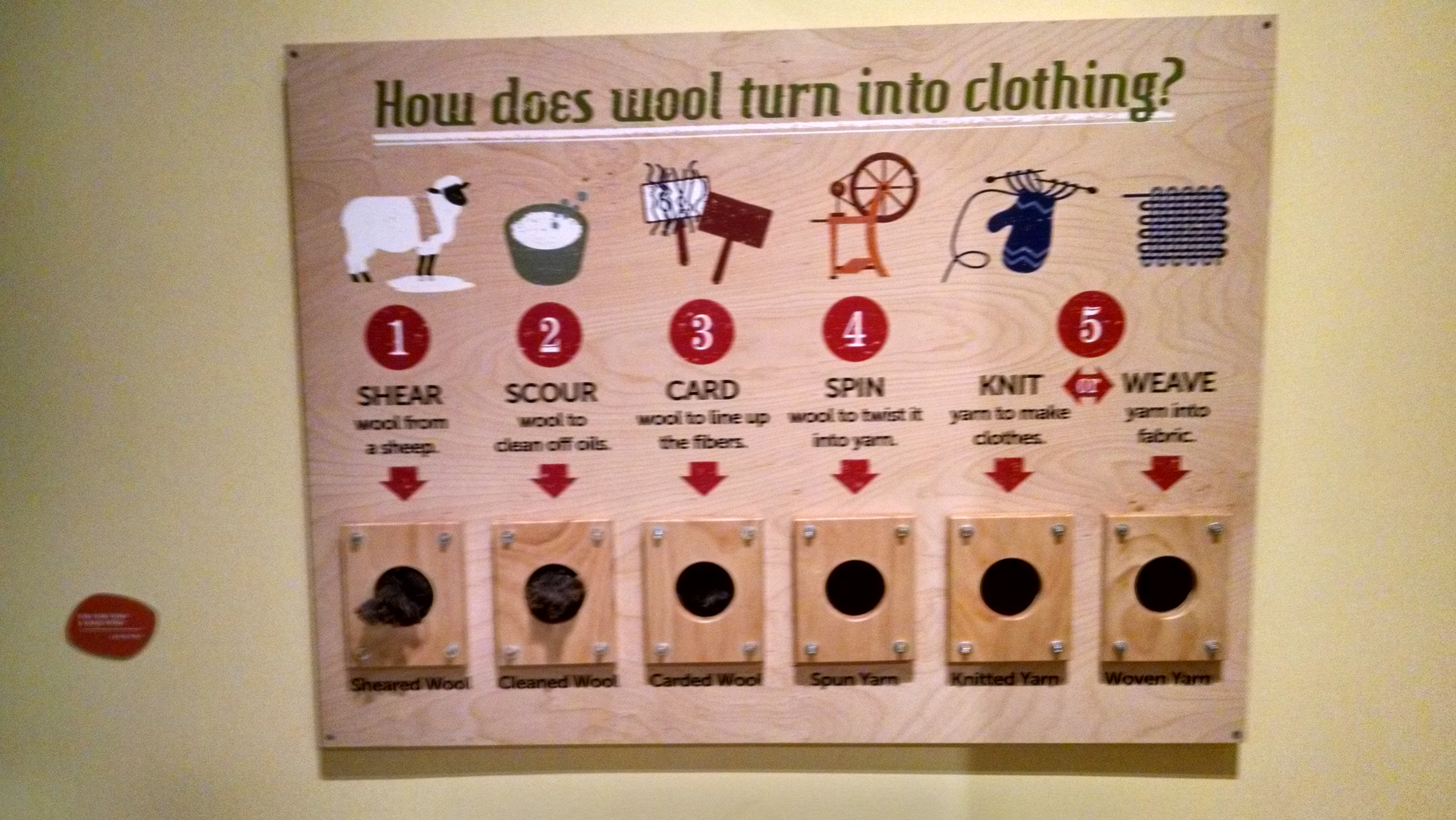
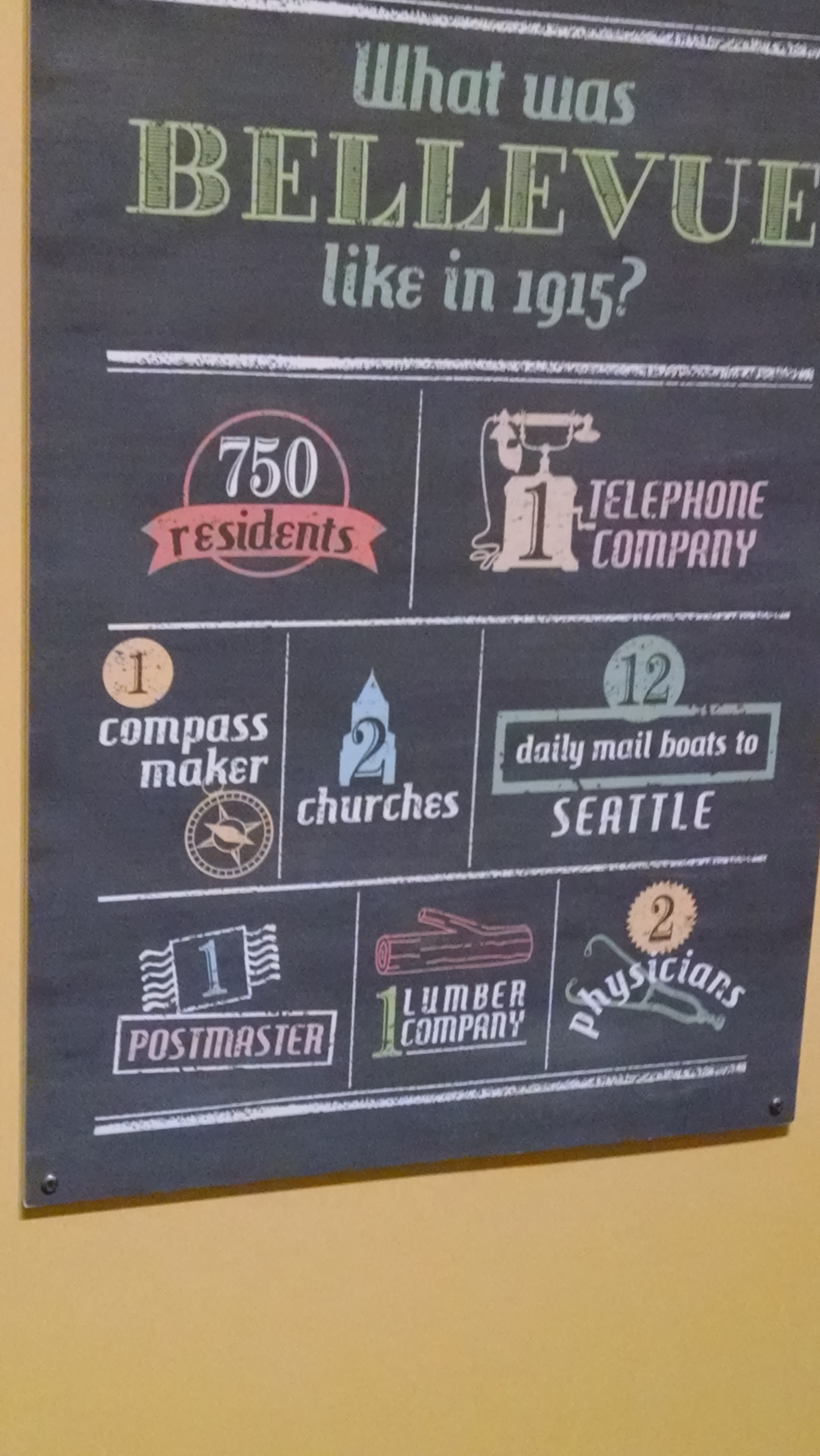
Cow Wash – you can blow dry this cow with a big hose; Sheep that you can comb the wool of, information about how wool is made into clothing, a Chicken Coop where you can reach in and find wooden eggs, then sort them into the right size hole, and a sign about Bellevue 100 years ago.
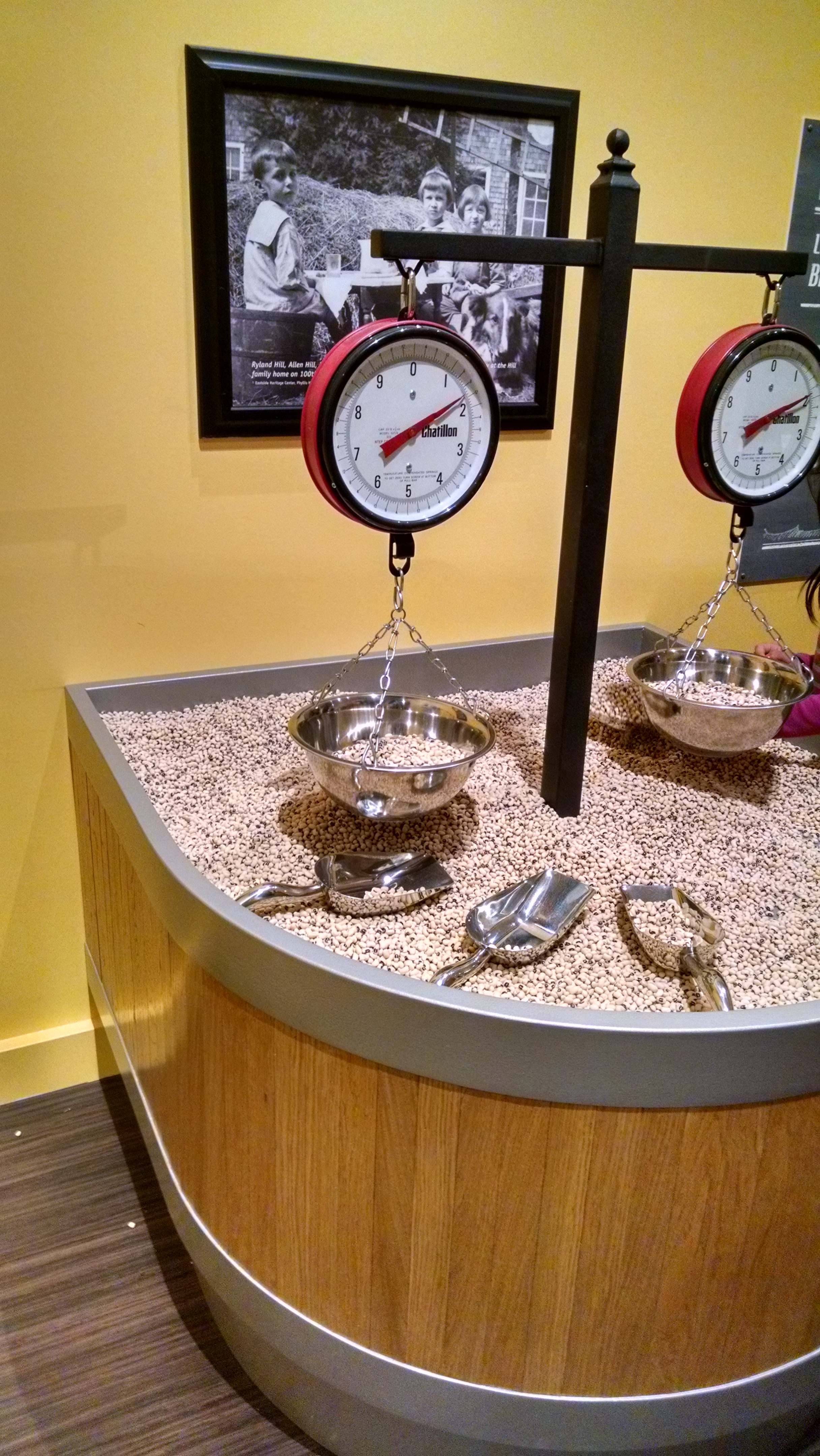
Mercantile – a big bin of beans to scoop and weigh, fabric ice cream cones and scoops of ice cream, and a display of toys from the period. Many children’s museums have grocery stores with baskets, cash registers and fake plastic food. I liked this twist on that idea where they had wooden trays to gather things in, and wooden milk bottles, and some plastic fruits. Still all the fun of a “grocery store” for pretend play, but a little different.
Cityscape.
City and train table: a much bigger train table, with some Seattle specific features (Space Needle), drawbridges and wooden boats, and a great Seattle mural.
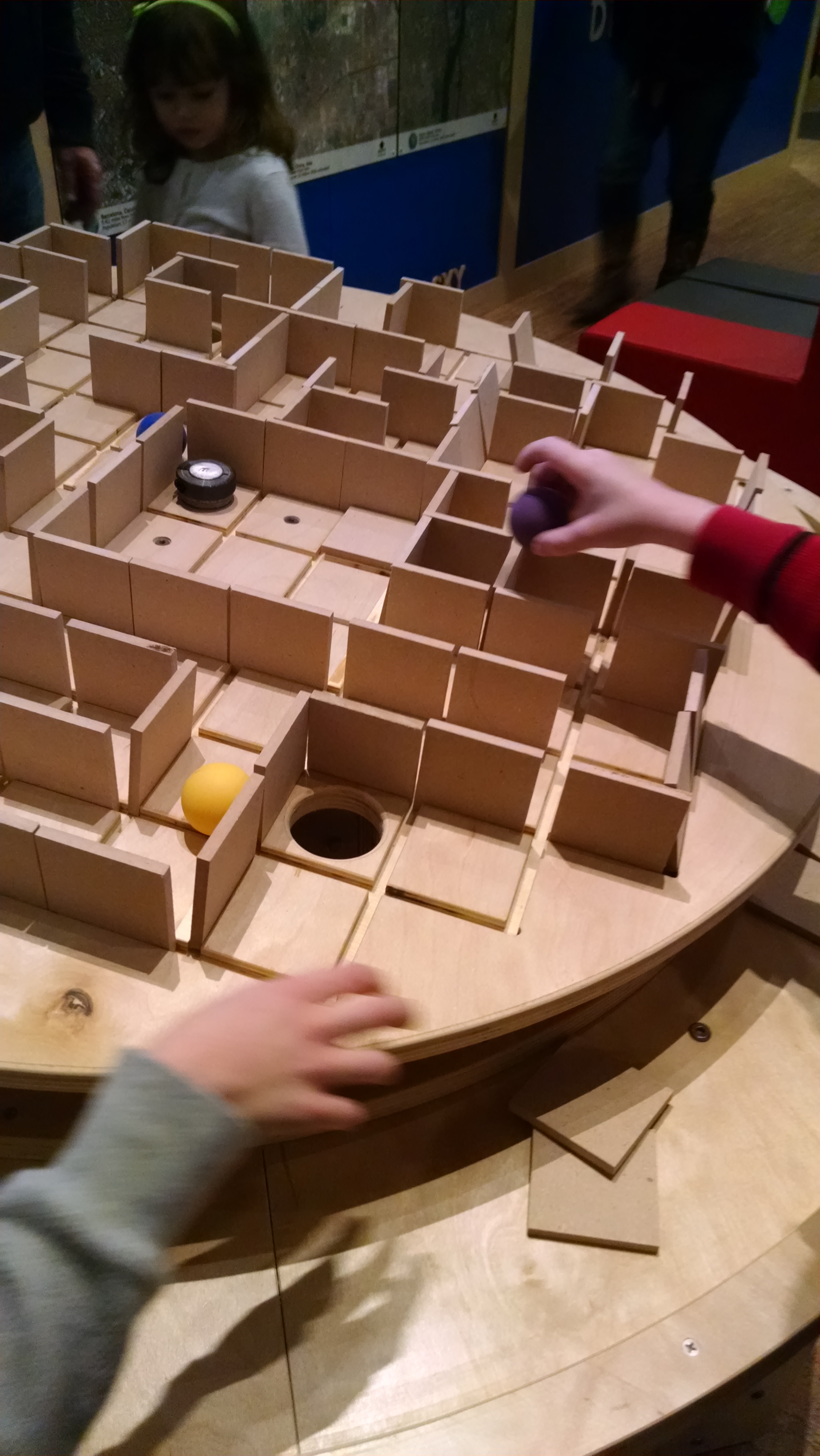
City wall – with videos of construction and demolition; a mirrored table with Keva blocks to build with, and this really cool tilting table that you can build a maze on and then steer a ball through.
Connections – between Cityscape and Story Tree, there’s a big open space that can be used for gatherings, performances, and temporary exhibits.
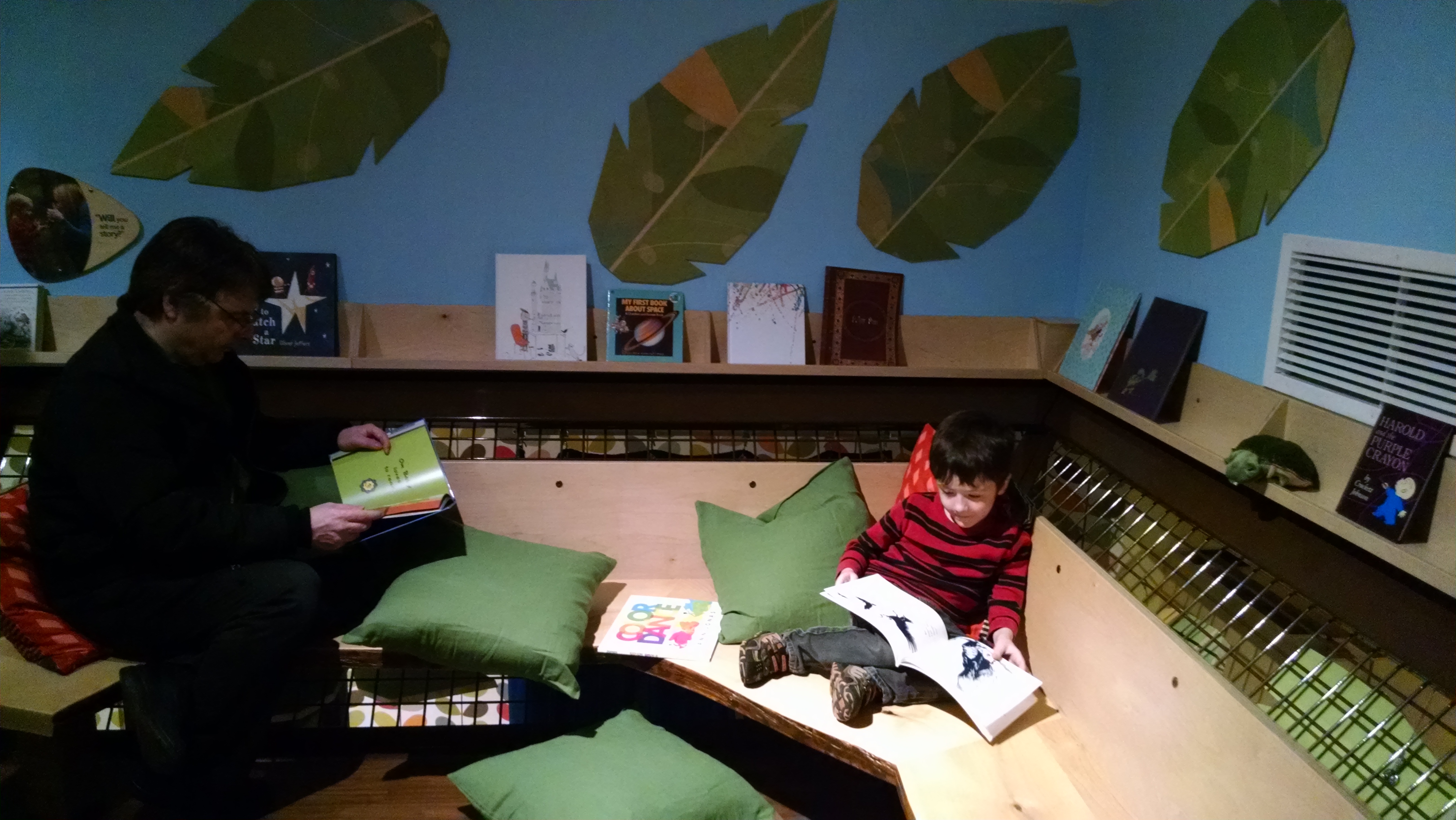
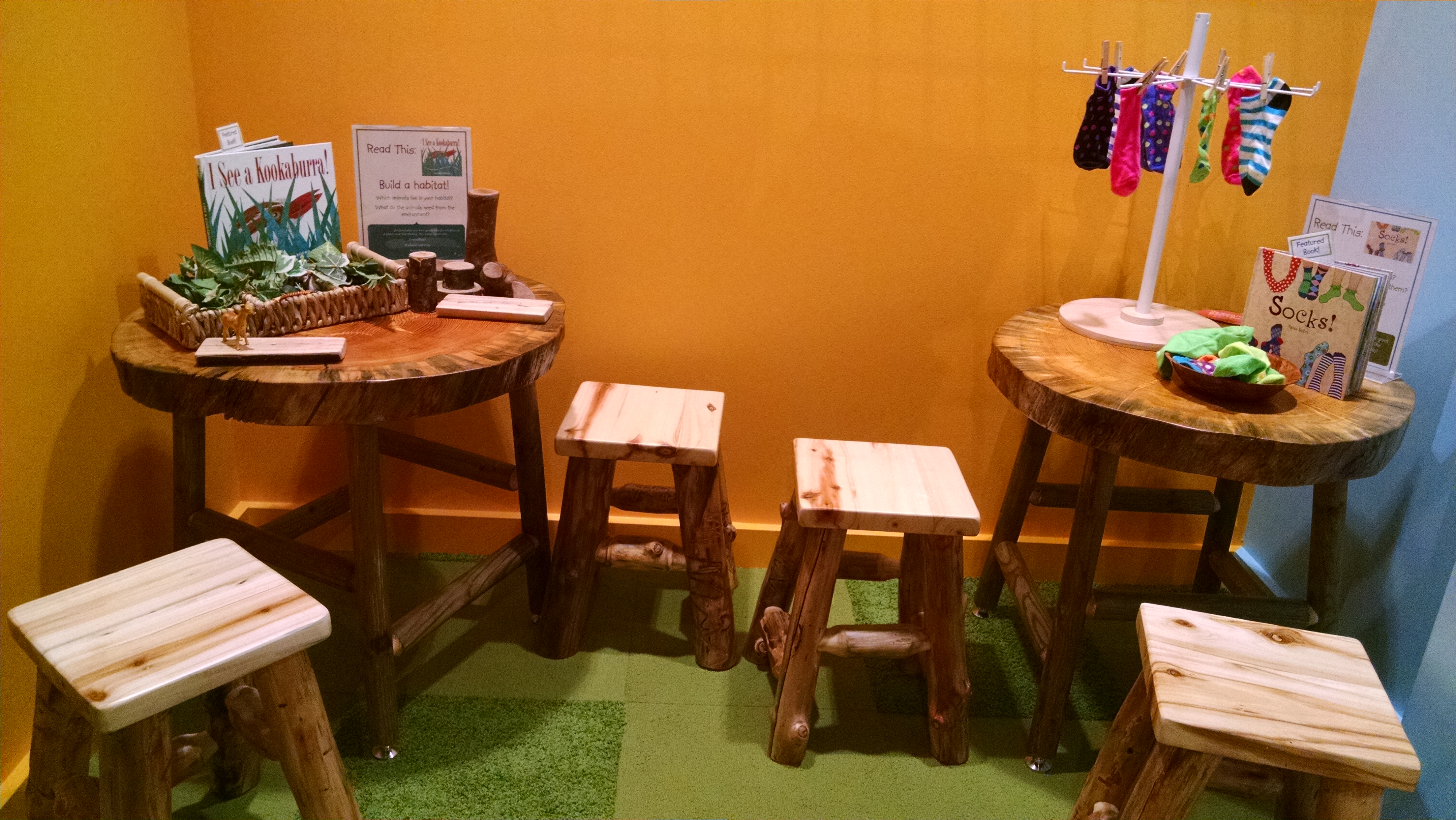
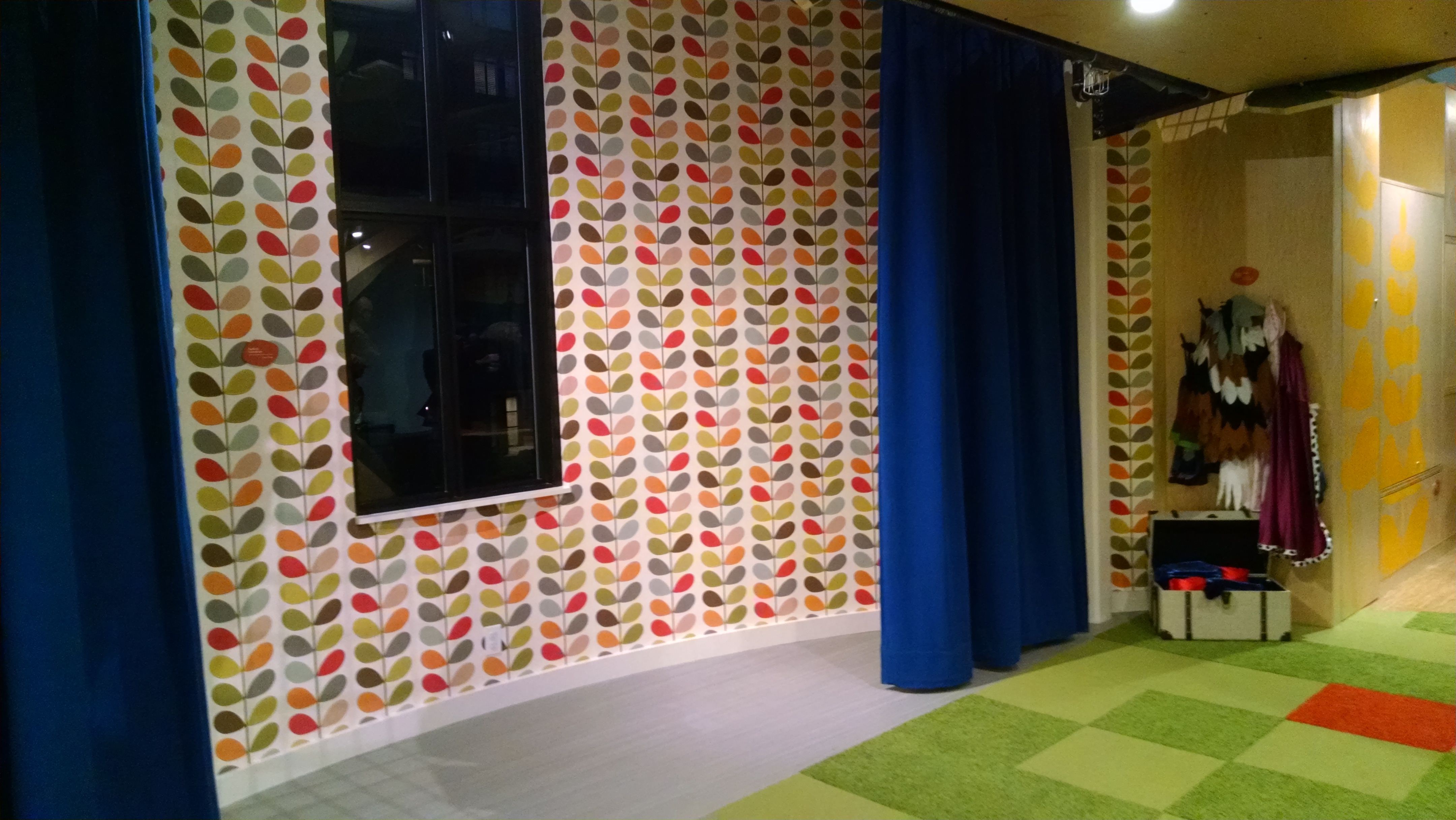
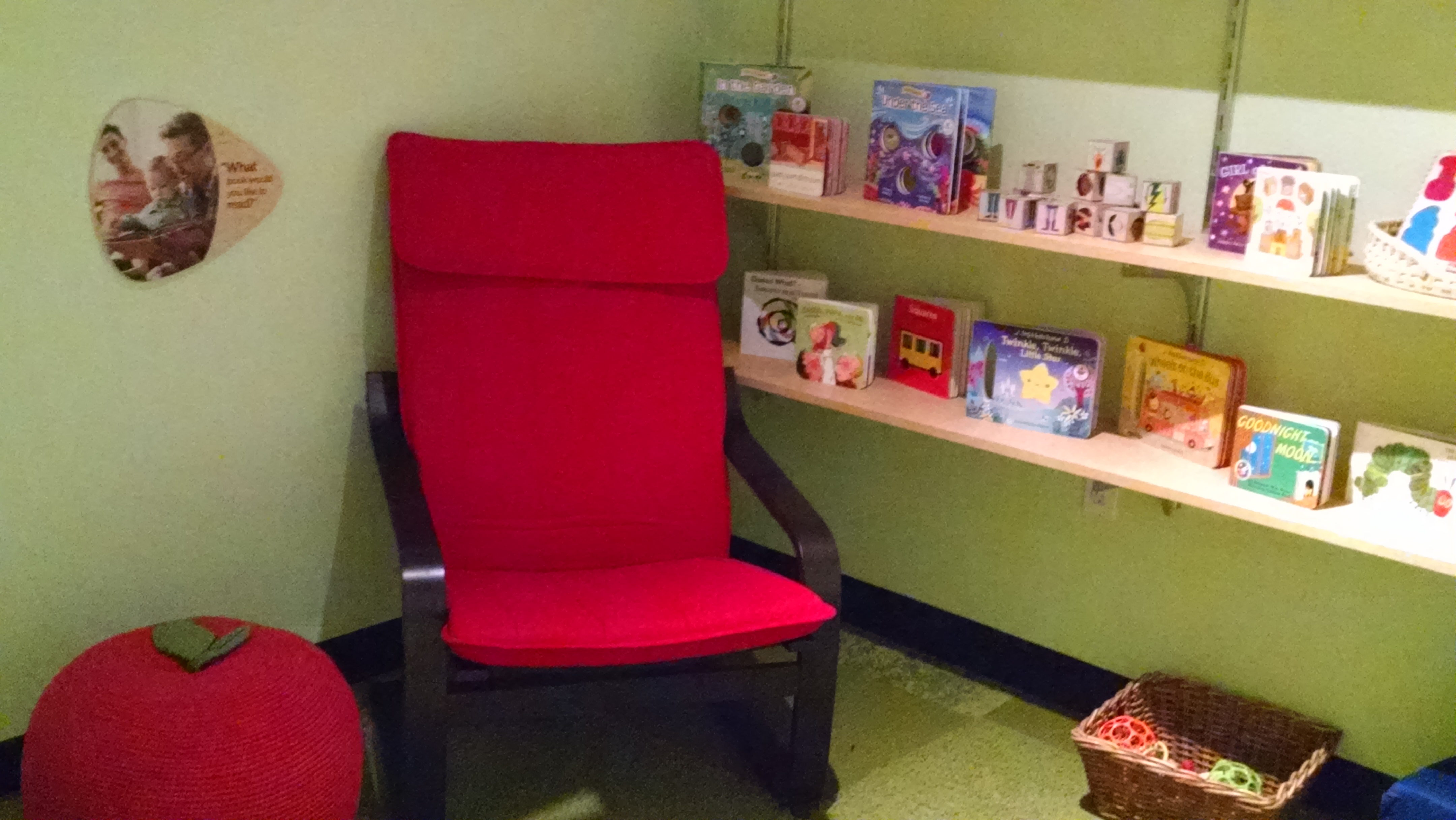
Story Tree – This is a lovely space, which really honors the magic of books and reading. I didn’t get a good picture of the whole tree, or the fabulous quotes that are on it. Check out their website for those pictures…. Here you see the really nice reading room at the top of the tree (up an easily climbed flight of stairs, which is more accessible than the ladder access to the old tree house) – this is a great space for relaxing and reading! Downstairs they have a great activity table area… KidsQuest has always done a nice job with developing special activities to go with a book of the week, but in the past, the places these got displayed made them feel like second-class activities… this space will help make it clearer how delightful they are. There’s also a nice book collection there, and a “stage” space with dress-up clothes… a really impressively compact way of achieving a stage environment for pretend play.
Art Studio – when we were there, this room was being used for food, drinks, and cake, so I was distracted by all of that, and didn’t get the chance to really explore it as an art room. But there was a kiln, and lots of shelves with art supplies.
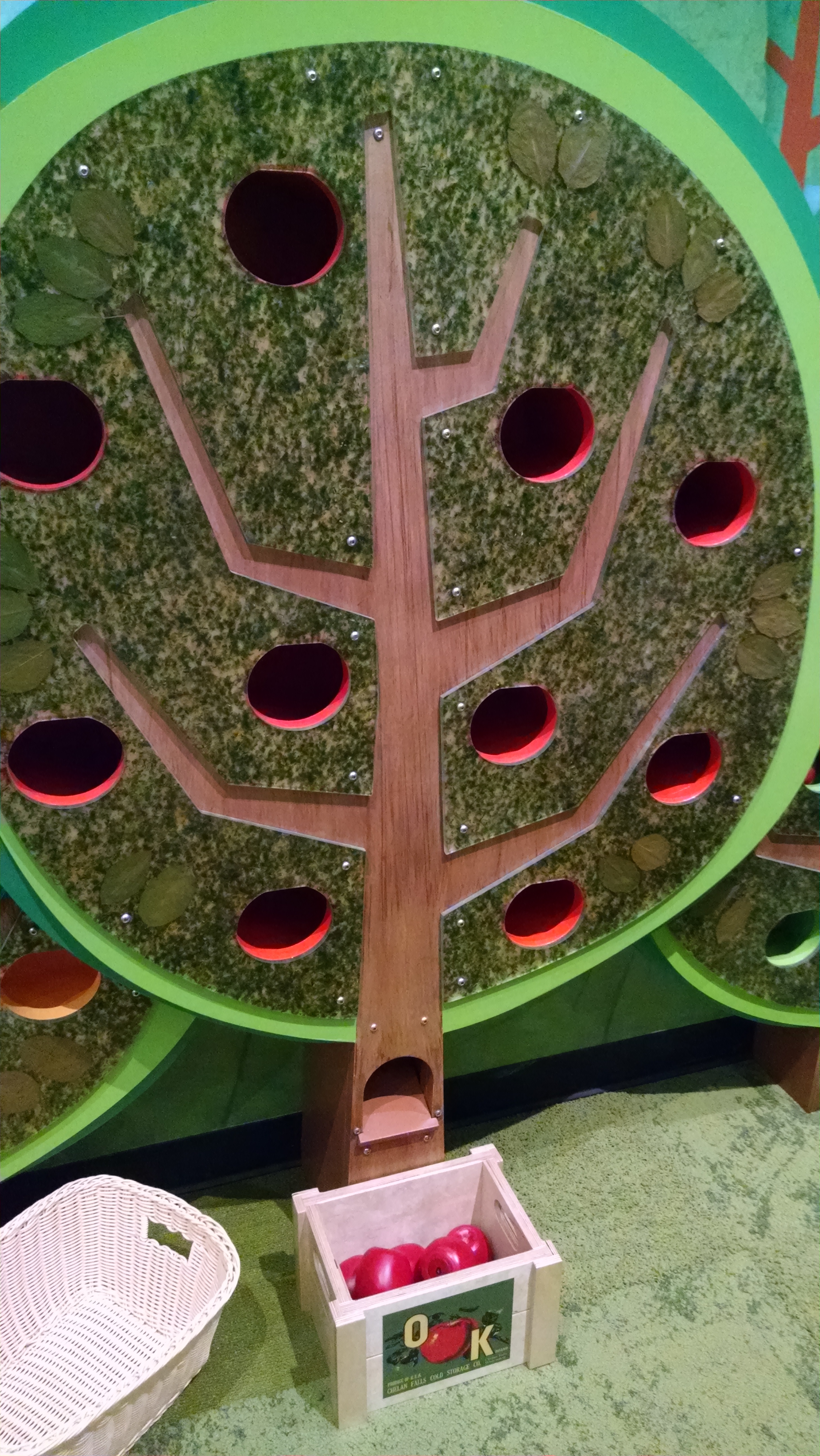
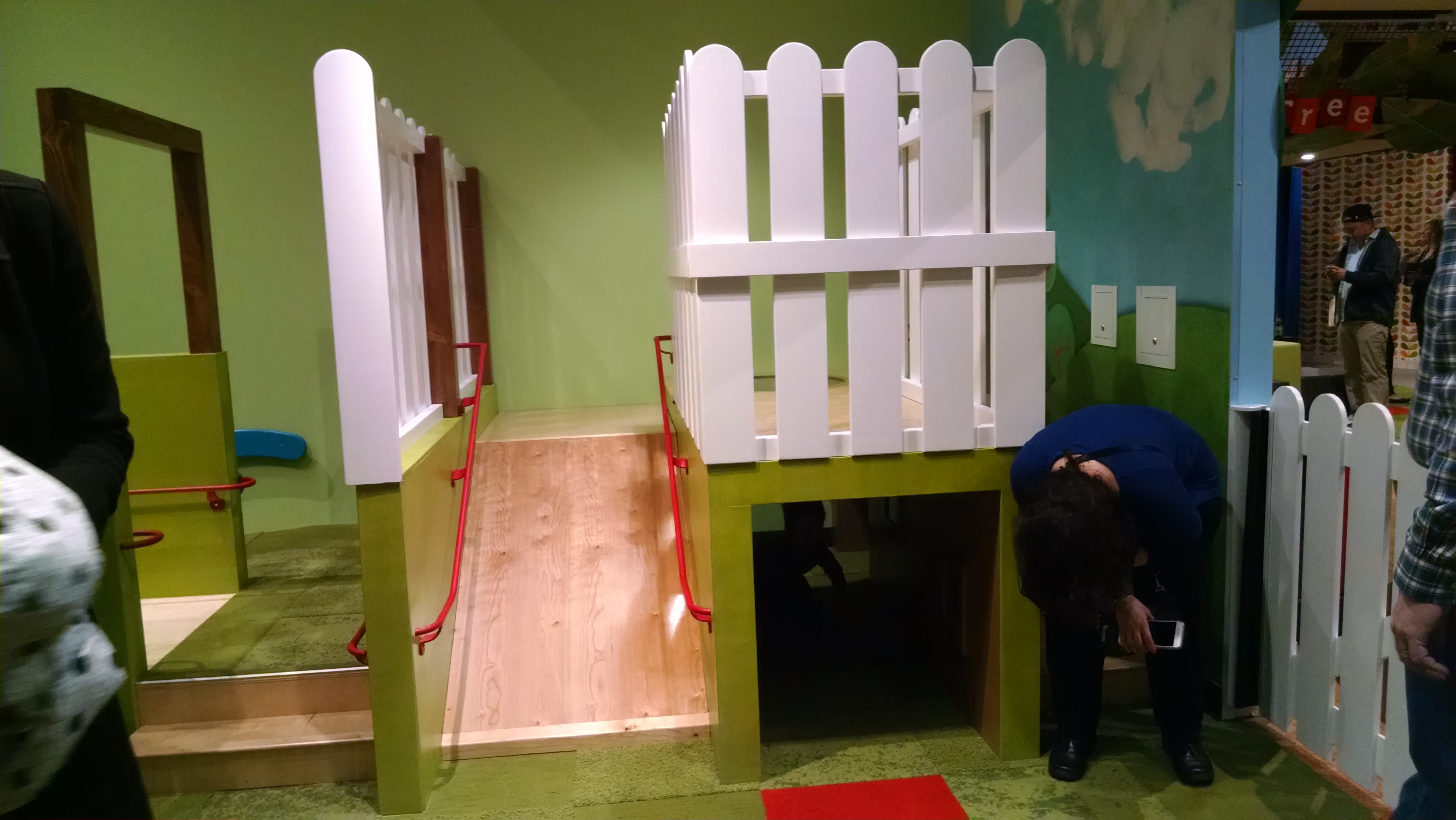
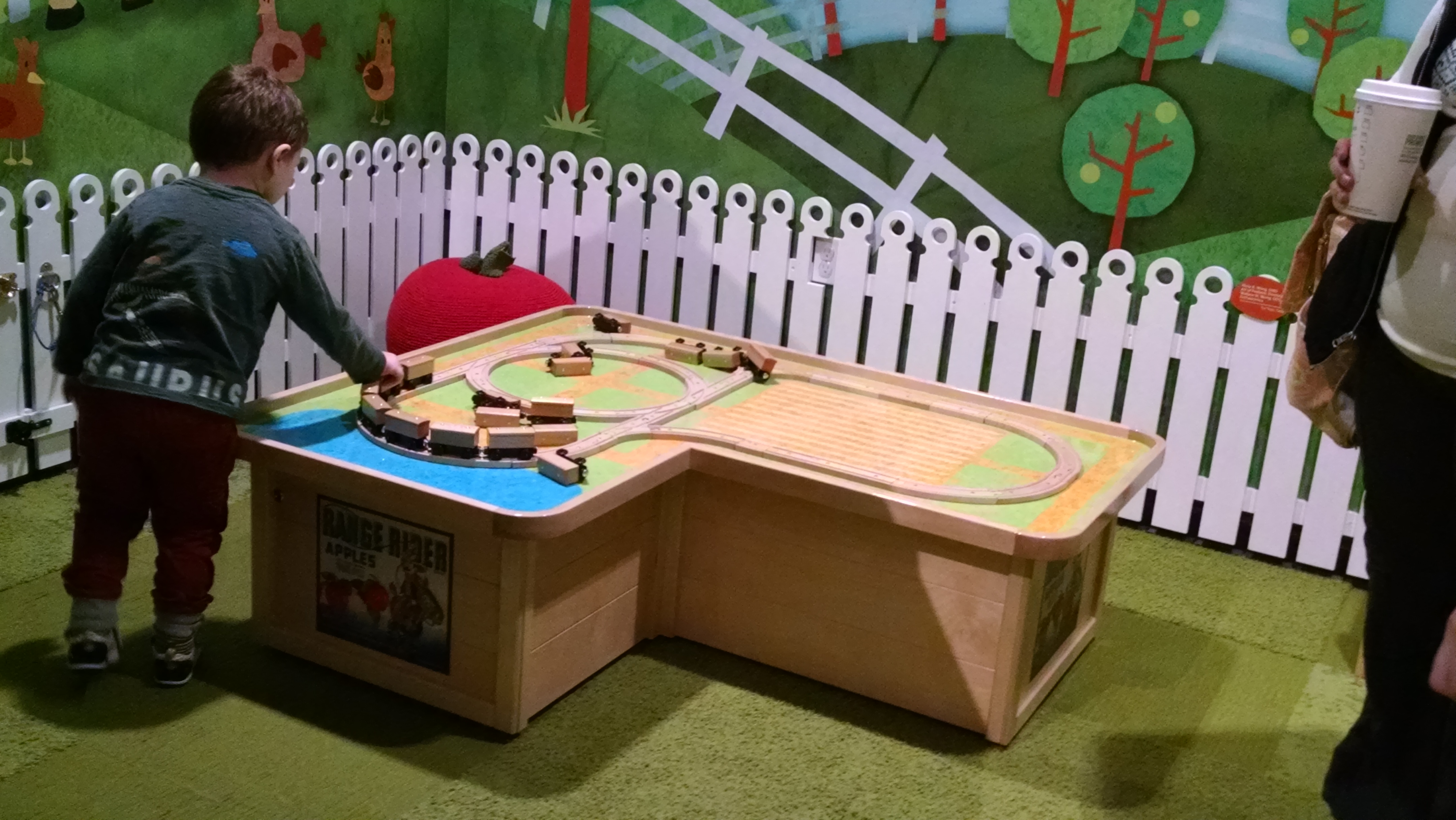
Tot Orchard – this is the special area for ages 3 and under so I had to sneak in without my son (he was probably on the climber). There were: toy flowers to pick and plant, locks to unlock and latches to latch, wooden apples to pick, a tractor to “drive”, an area for climbing up, sliding down, and hiding in, a train area where you don’t have to compete with the big kids for a train, a picnic table and an outdoorsy / campground type kitchen (if you had a really upscale campground) for kitchen style pretend play, an area with open close doors with fun vegetable faces hiding behind them, and two faces with wooden pieces you can turn around to make various faces – happy, sad, mad. (This exhibit made me laugh, because about two years ago, I pinned this image to my Pinterest page, and it’s been my most often re-pinned pin ever… far more the any of my pins of my own posts, ironically, and now here’s a recreation of it on the wall of KidsQuest. :-))
And, off to the side of the Tot Orchard, in its own quiet little alcove, is the SHHH Station – a quiet space for nursing or cuddling a little one who needs some downtime.
What was missing
There were some exhibits that did not come over from the old building and were not replaced by a similar exhibit in the new building, such as the giant Lite Brite wall. Sadly, this includes my son’s favorite two exhibits:
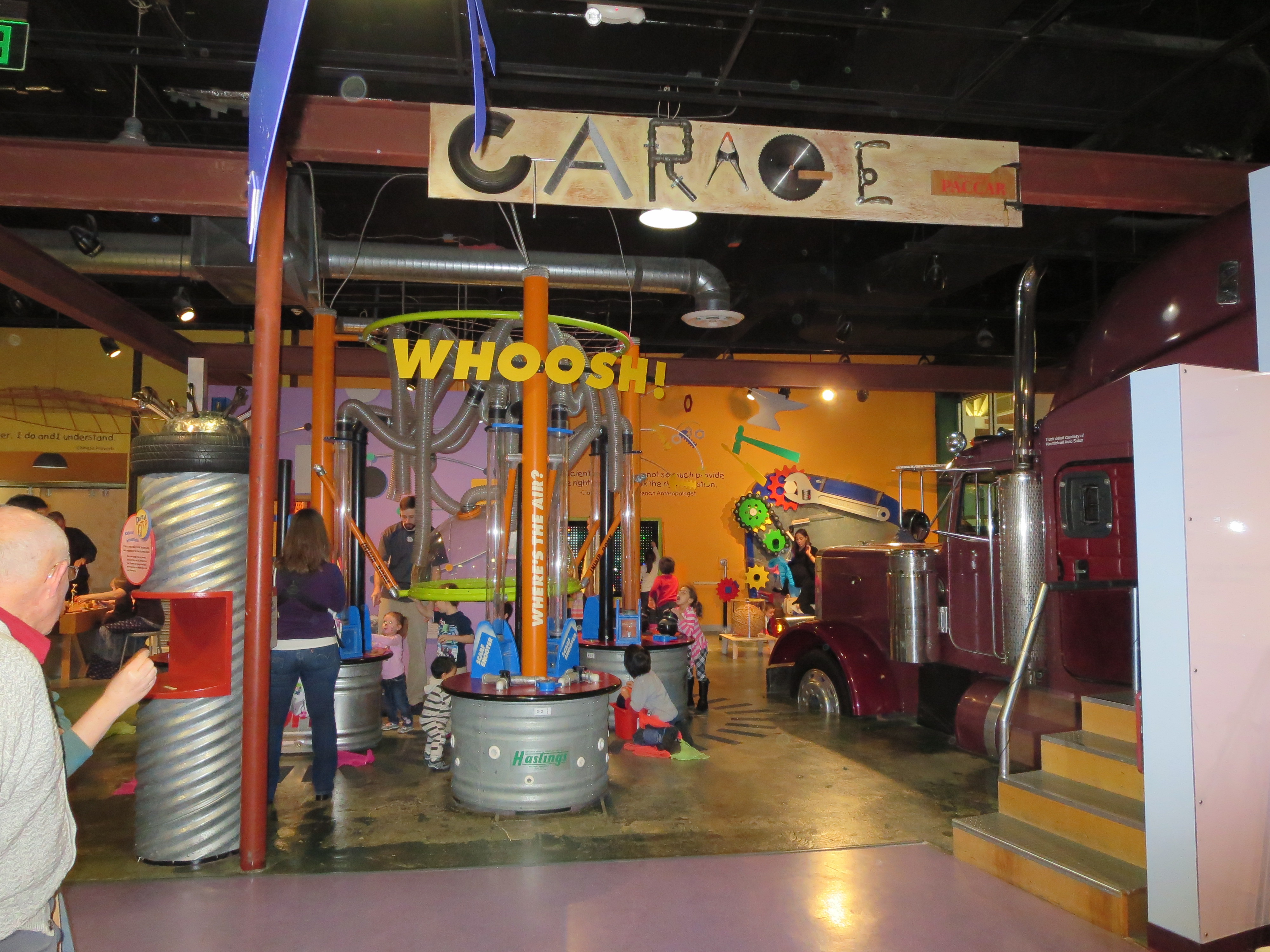
The Whoosh: what we called the “scarf poof” – where you load scarves into tubes, and a fan sucks them up and shoots them out another tube. It also had an area where you could “levitate” a ball above a fan. Luckily Imagine Children’s Museum in Everett has a great scarf poof, and Pacific Science Center has a ball levitator and we’ve made a scarf cannon to use at home which can do both these things. But we’ll still miss the Whoosh.
The ball wall – that’s where you load the balls into a pneumatic tube, and it launches them at the top of the wall where they then fall down the wall through the maze that you set up. We’ve made our own ball wall and tried out lots of ball walls / marble mazes in our time, and the water wall at the new KidsQuest will capture some of this tinkering magic. But again, we’ll miss the KidsQuest ball wall, where we spent MANY hours of our son’s childhood.
Summary and Tips for Your Visit
Lots of great stuff at this new facility! As I said, my 6 year old was on the verge of outgrowing the old museum, but now I’m planning to renew our membership for a few more years because there’s plenty to engage him here. If you have a child anywhere between 1 – 5, the whole museum is a great fit.
It’s $12 per person per visit. If you’re attending with one child, you’ll break even on the membership after 4 visits. When my son was younger, we went to KidsQuest easily 3 times every month – it was one of our standard near-weekly activities from September to June and as a toddler, he never tired of it.
Parking might be an issue at the new place, so they give tips in advance on what to do. I think we’ll plan to bus it most of the time. Options are:
KidsQuest Parking Lot: Limited space on a first come, first serve basis
Ashwood Parking Lot: Free parking off NE 12th St (pass through library lot, but keep in mind the library garage is for library patrons only)
929 Garage: Paid parking 1½ blocks south of KidsQuest at 929 108th Ave NE
KidsQuest is also conveniently located near several bus routes. Please visit King County Metro for more information.
For more information about the museum, check out their website.
If you live in the Seattle area, then check out the programs offered by the parent education departments of your local community colleges! They offer programs for families with children from birth to age 7. Each class offers play-based, developmentally appropriate learning activities for the child which aids them in all areas of development (large motor, small motor, language / literacy, music, art, and social skills). AND they offer parent education and support to guide you in helping your child grow and develop. Programs meet weekly during the academic year – they’re taking registrations for next year already, or you can join a class right now if there’s space available in it! Read more and find links to all the program here: https://gooddayswithkids.com/2016/08/02/parent_education/.
Click on the “Toddler Date” category in the right hand sidebar (or the bottom of the page on mobile devices) for links to reviews of local parks and activities plus my “Cheap Dates with Toddlers” series for ideas of easy, free or cheap activities that kids age 1 – 4 enjoy.
For activities to do at home with your child, check out activities for toddlers based around themes, or read my other blog, www.InventorsOfTomorrow.com for tons of ideas for easy, hands-on science experiments and engineering projects for 3 – 7 year olds that you can do with materials you have at home!
Once a month, our Family Inventors’ Lab meets at Robinswood Park in Bellevue. We go out for a hike in the woods, and we learn about native plants, cycles of nature, insects, habitats and more.
There are plenty of benefits to spending time outdoors, including less vitamin D deficiency, better vision, higher activity. Getting to know local plants helps your child feel more at home in their world, helps them gain a sense of competency (there’s something really fun about being able to identify all the plants they see), teaches vocabulary and science, and teaches observation skills – discerning the difference between a trailing blackberry and a Himalayan blackberry teaches your child how to observe small details, a skill which is helpful in almost all their pursuits!
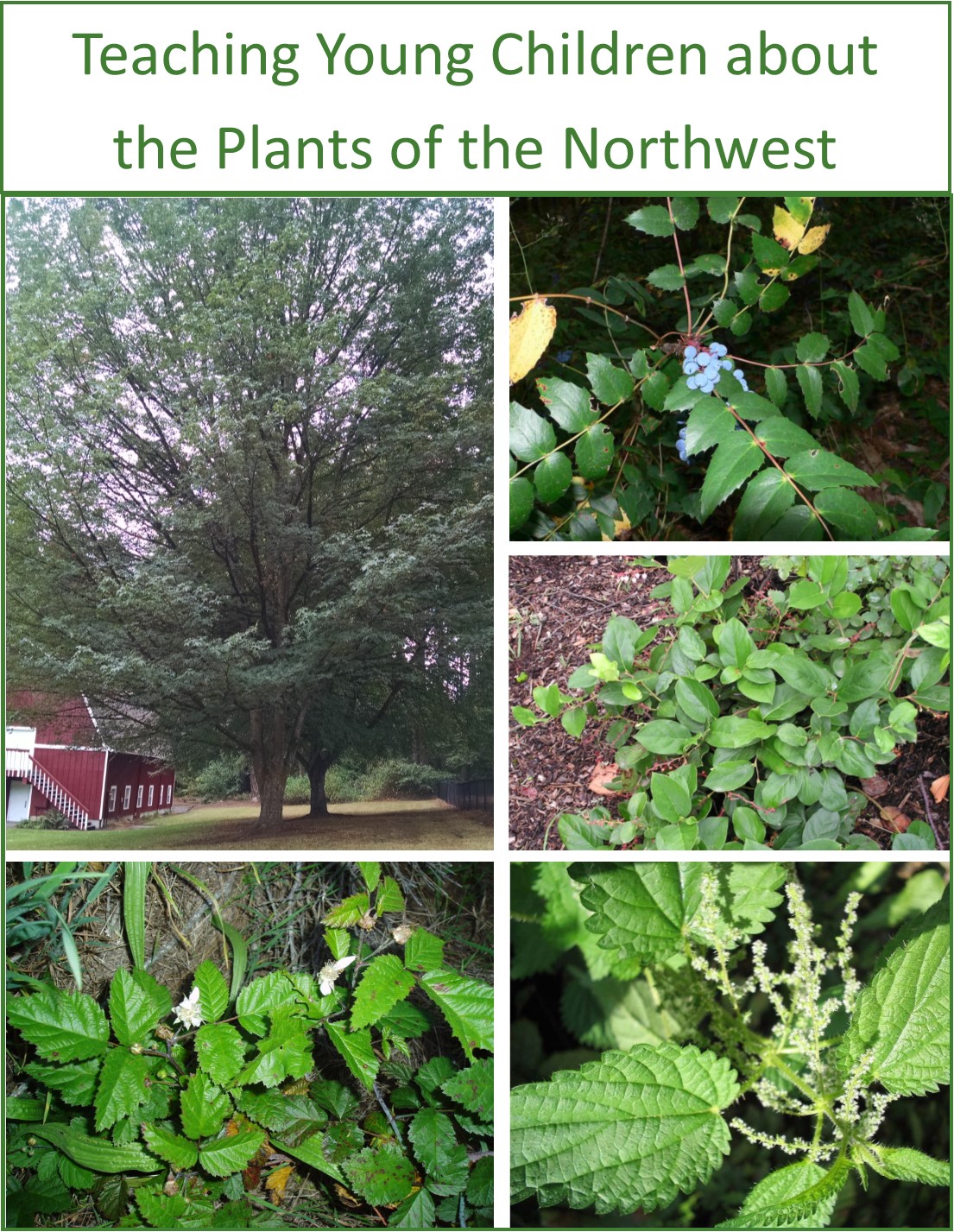
I found a great song about Pac NW plants, and I added to it to make a really memorable way for introducing preschoolers to 8 common plants – find it and related materials here.
We have a “plant of the month” curriculum and on this page, I’ll share the materials I’ve developed, so you can use them with your family. All of the plants can be found in most of the wooded areas and parks trails in the King County area.
This free printable Plant Guide combines all the plants listed into one guide. Although it refers to Robinswood Park, you’ll see most of these plants on almost any hiking trail in King County.
Big Leaf Maple. (PDF) This is the second most common tree in the Pacific NW, so it’s a great ones for kids to learn because then they can find it everywhere they go. Help them count the points on the leaves – there’s always 5. (A vine maple has many more points.) It’s great to introduce kids to a big leaf in the spring, so they can watch “their” tree go through the changes from buds in the spring, to green leaves, to fall color, to winter. Also help them find helicopter seeds to drop and let spin to the ground.
Blackberries. (PDF) Get to know all your blackberry types: if it trails along the ground, and has clusters of 3 leaves, it’s Trailing Blackberry, which are native to the Northwest. If there’s a big thicket of blackberries with clusters of 5 leaves, it’s the Himalayan blackberry, an invasive species. (If you have some invading your yard, look here for tips on removal.) The Evergreen Blackberry, another non-native, looks very different from the others – its alternate name “Cut-leaf blackberry” describes its unique leaves. All these plants produce plenty of tasty edible berries from July to September.
This handout also includes information on Stinging Nettles, so you know to watch out for them in woods. We’re blessed in this area to have few truly dangerous plants or animals in our woods, but stinging nettles can be an annoyance.
Douglas Fir. (PDF) Very common throughout the Pacific Northwest. Tall trees with bare trunks for much of the height of the tree, branches full of needles up higher on the tree. Rough bark.
Holly. (PDF) Holly can be found in all 50 states, and is common in Christmas decorations and art, so its distinctive spiny leaves and red berries (visible in winter) are recognizable to most people. Its berries are NOT edible! They can make pets and children quite sick.
Indian plum. (PDF) A Northwest native flowering shrub. One of the first plants to leaf out and bloom each spring. Also called osoberry for its edible (but not tasty) berries, or skunk bush for the smell of the male flowers (you have to put your nose right up to them to smell them.
Ivy. (PDF) English Ivy is not native – it’s an invasive noxious weed – if you have any on your property, its best to replace it with native plants. If it’s climbing your trees, be sure to remove it. Children can easily identify ivy, and you can show them how it spreads across the ground until it finds anything vertical, then it climbs as high as it can.
Oregon Grape. (PDF) Oregon grape is a native plant. Adults sometimes mistake it for holly, but your child should be able to easily learn to tell them apart. The fruit is edible, but far too tart for most people’s taste – some use it in jelly.
Salal. (PDF) Salal is another native plant, with glossy green leaves, which is very common throughout our woods, and in landscaping everywhere. It also produces an edible berry that some people dry to use in cakes, or use in jelly.
Vinca. (PDF) A non-native evergreen. The glossy green leaves and purple flowers that bloom for much of the year make this a lovely, low maintenance ground cover.
Western Red Cedar. (PDF) Easily distinguished from the common Douglas fir. Branches start much lower to the ground, flat sail-like needles form spray-like branches. Very small cones. Stringy bark that can be pulled off in long strips.
If you’re working with a young child (3 or 4 years old), you want to focus on only one plant at a time. I’ve created postcards which show pictures of just one plant per card. Hand a card to your child to carry as you hike through the woods, and encourage them to tell you every time they find a plant that matches that card.
Once your child is familiar with many of these plants, try challenging them with a Scavenger Hunt (PDF) – This includes pictures of 14 plants to find in the woods. (For younger kids, you could also use the postcards as a scavenger hunt challenge.)
For older kids (age 6 and up), here’s a dichotomous key they can use to try to figure out what kind of plant they see. You could also use this key as a basis for a 20 questions style game on a hike. (Learn more about 20 questions and what the game teaches here.)
If you want to check out the woods at Robinswood Park, it’s an easy park to start on with young hikers. There’s over a mile of trails, so enough to explore for a little one, but you’re never far from the parking lot. Here’s a trail map, with one of our favorite trails through the woods marked out on it.