Tag Archives: toddler

Great New Resource for Kids Songs

Let’s Play Music is a phenomenal resource!
http://www.letsplaykidsmusic.com/free-kids-songs-directory/

The site is developed by Sara Mullett, who has 15 years of experience teaching kid’s music classes. There are over 150 songs on the site, and for each, she includes lyrics, sheet music, videos of her playing the tune on a xylophone, circle time ideas including puppets, movement games, etc.

You can also follow her page on Facebook at www.facebook.com/personalisedlullaby, where she shares her own posts and also puts links to other helpful resources on the web.

For my other favorite resources for kids songs, look here, and for links to lyrics for, and videos of, my favorite kids songs, look here.

DIY Water Wall

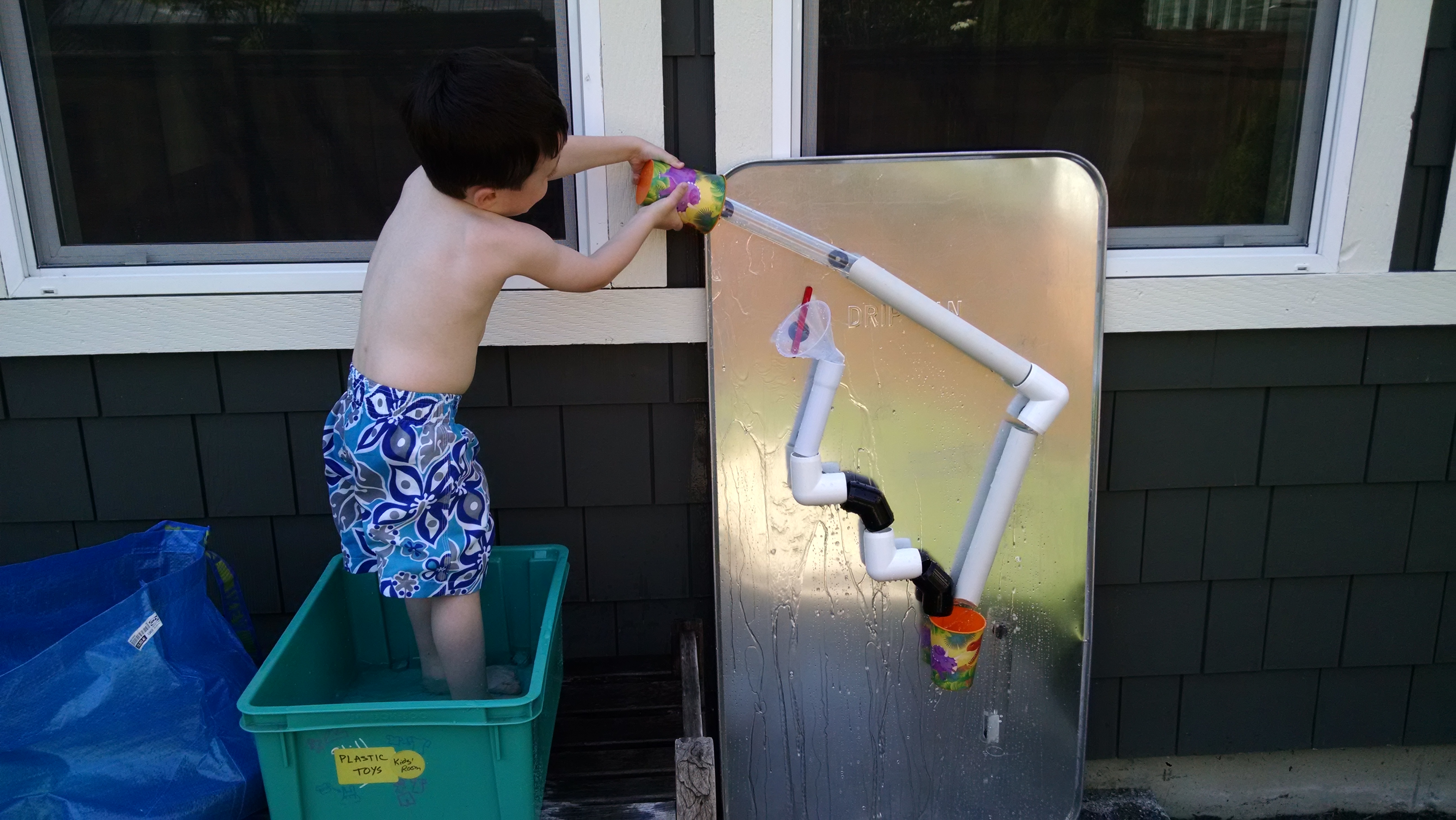
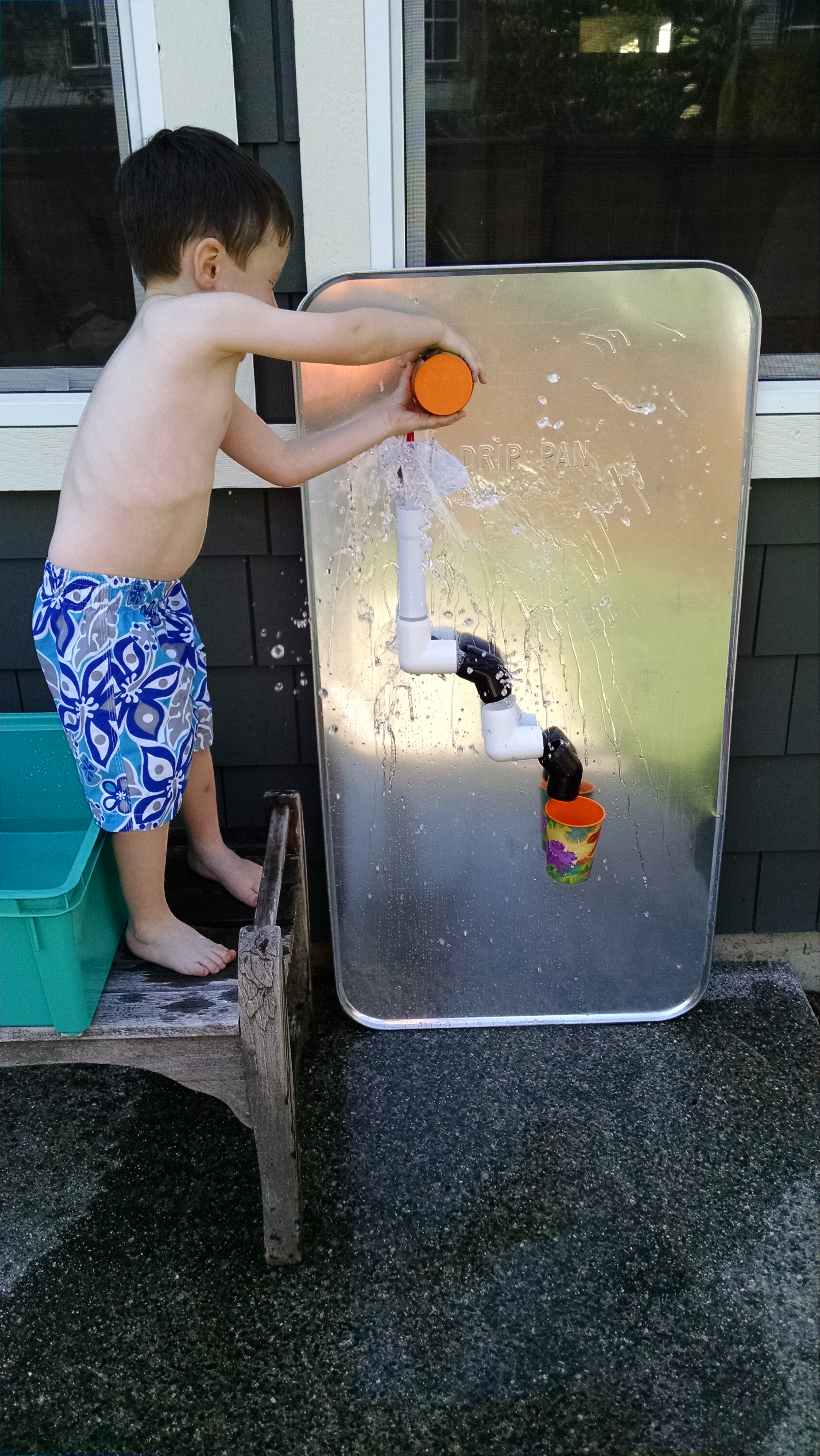
pourWhen I built our ball wall / marble run, my goal was to have a flexible design so the pieces could also be used for water play and for a sensory table. With this week’s nice weather, we were able to test the theory, and it was a great success in terms of fun!

You can see there is some leaking that happens around the joints when two same-dimension connectors or pipes are next to each other (which was fine with my son – he liked that there was water coming out everywhere), but probably 50 – 60% of the volume of the water made it all the way through the maze.

splashThe water works work better when you pour slowly, but my son liked the splash effect he got from pouring quickly.

The end point of our water maze was a plastic cup with two magnets glued on it. Whenever it filled up, we replaced it with the other cup, and poured the captured water back through the maze – we also had a tub full of water nearby.

The best part: when the cup fills up all the way with water, the weight is more than the magnets can support, so it slides to the ground. “Level complete!”

DIY Ball Wall

ballwall

marble run

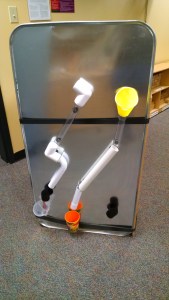
The theme for this week’s Inventors’ Lab was gravity, so I made a ball wall (aka marble run). This is like those exhibits you find in most children’s museums where where are pipes and joints mounted on magnets. The children can re-arrange them to make any path they choose, then run a marble through them to test their path. They may find that the ball shoots off-course at some point, and need to re-adjust the pipes for the ball to reach its goal. Just playing with these is a great exercise in tinkering and hands-on engineering. My son can play with these for hours, so we decided to make one for home and for class.

I got my original idea from Frugal Fun for Boys.

This was a really easy project once I got the supplies. About three-quarters of the effort was deciding which supplies to buy in what size (and what strength of magnets), so down below, I’ll include my full list, with affiliate links, and the lessons I learned to hopefully make your life easier if you want to replicate. In class, the kids definitely had fun with it!

Note: This marble run is designed for repeated use by lots of kids. I will also be adapting parts of it as the year goes on for water play and sensory play. There are lots of easier / cheaper ways to build a marble run for short term use at home, so I’ll include links to those at the bottom.
ballwall2

Ball wall

Supply List

On Frugal Fun she used regular size marbles, so I needed to adapt her materials a little. In our class, we have children as young as 2.5, so I wanted to use the bigger shooter marbles instead to make them less swallowable.

The materials I used: oil drip pans, 1 1/4 inch PVC joints (45 and 90 degree elbows), 1 1/4 inch PVC pipe, 1 1/4 inch OD clear polycarbonate tubing, a tube with a curved end – it’s part of a p-trap (you can buy the piece separately but I don’t know what it’s called), ceramic magnets, glue, shooter marbles, miscellaneous funnels 1, 2, 3 And a couple dinosaur party cups to catch the balls at the end of the run.

Technical notes / things I learned in the tinkering process

Pipes and joints: Important lesson – 1 1/4 inch PVC pipes are not 1.25 inches around! I think that’s their inside diameter. Outside diameter is 1.66  inches. These pipes and joints are bigger than you need for shooter marbles, You could go down one size, I think. The marbles run just fine through the clear tubing, which has an outside diameter of 1.25 inches, inner diameter of 1 1/8.

Marbles: I liked these shooter marbles (Note: don’t order these… they are regular small marbles, not shooters, despite the description) I also made marble size balls from Model Magic clay, which seemed like a fine idea in advance. They were pretty, they ran through the tubes just fine, and since they were lighter weight, they didn’t knock the tubes out of line as much. But, there were a couple problems. 1) If you mixed them with the marbles, the marbles were heavy enough that if they fell on top of a model magic ball, they’d squish it out of its nice round shape, and then it would start getting caught in tubes. 2) if you step on the model magic balls, they squish flat, and 3) after this accidental discovery, a certain three year old in the class took great pleasure is stepping on all the balls and squishing them flat. If you squish them once or twice, I can re-roll them into a round ball, but after that, they’re pretty much useless.

Funnels: I ordered the widest mouth funnels I could find, but none of these funnels had a wide enough neck for the shooter marble to go through… I sawed the end off the yellow one so a marble would go through, then I taped it to a pipe because at that time I didn’t have a file to file off the rough edges of the cut.)

Magnets: I wanted some that were strong enough that the pipes wouldn’t slip out of place every time you sent a marble through. But, they couldn’t be too strong, as I wanted it to be possible for a three year old to pull the pipe off the metal pan and move it around. The magnets I ordered (linked above) are perfect. I put one on the back of each 45 degree joint, 2 on the back of most items, and three on the 2′ long segment of PVC.

One issue I hadn’t foreseen is that you can’t just lean the pans up against a wall and let the kids play. The first time they grab hold of a pipe to pull it off the metal pan, the metal pan would fall on their head. I could try to teach them to brace with one hand and pull with the other – but that’s not really gonna happen. So, you have to secure the pan. Lots of Pinterest folks who use drip pans for magnet activities mount them on their wall permanently (putting screws through them into the wall) or semi-permanently by putting wide velcro strips on the wall. Neither was an option for me in my classroom, so I used ratchet straps to tie them to a bookcase. The only problem was then you have straps going across the front of the pan. I’m betting you could also use bungee cords… there’s enough of a rim around the pans that the bungee cord could hook to it. But since bungees come in specific lengths, you’d have to know in advance what length you needed.

Or, for home use, don’t buy a drip pan. You can just use your refrigerator to mount your ball wall… just be sure that the marbles can’t roll under the fridge.

This was a very quick and easy project, except for sawing the PVC pipe and clear tubes into the lengths I wanted. Using a hack saw and files to smooth the rough edges was perfectly do-able, but took 15 – 20 minutes per cut, I would guess. Then I learned about Ratcheting PVC Cutters which make the job SO MUCH EASIER!!!

I have also bought some flexible tubing and some T-joints, and plan to experiment with using these items in a water wall and for sensory table play, with either rice or beans.

Easier ways to do a ball wall, and other ideas

Use toilet paper tubes, paper towel tubes and masking tape like Lemon Lime Adventures and Tinkerlab.

Or those same tubes and magnets, like Growing a Jeweled Rose or Teach Preschool.

Or water bottles and magnets, mounted on the fridge instead of a drip pan.

Build a hand-held marble maze in a shoe box lid with craft sticks.

Here’s a collection of links to good options, both DIY and store-bought.

Resource for STEM activities

If you’re looking for 100’s of ideas for hands-on activities to teach science, engineering, and math, check out my other blog, www.InventorsOfTomorrow.com.
What to Do with Plastic Eggs

eggDo you suddenly have an abundance of plastic Easter eggs in your life? Don’t throw them in the trash!

They can be washed and re-used again and again – Just throw them in a sink (or big bowl) full of soapy water to wash – it takes minutes. Then they can be stored and re-used again the next year. So much easier on the environment than land-filling dozens of plastic eggs per kid per year.

But, beyond just re-using them in one year, there are so many other fun things you can do with plastic eggs! Try some of these before you pack your eggs away for the year.

Egg Hunts: Egg hunts are a fabulous activity year round! (Read my post from last year on what your child can learn by hunting for eggs – counting and math skills, persistence, delayed gratification, observation skills, and more.) Check out this post from Hands On as We Grow, where she links to ideas on spicing up your egg hunts with new challenges. I like this one from Sugar Aunts – the kids have to search for things to fill the eggs with – something yellow for the yellow egg, something red for the red egg… this is just good for color learning, but also a great spatial intelligence builder as they have to think about whether things are small enough to fit in an egg, and fine motor skill builder as they learn how to fill and close eggs.

Shaker Eggs: You can use eggs to make musical shakers by filling with a variety of small objects. (Tape or glue closed if you have little ones who still put small things in their mouths.) Family Sponge has a great post on this, and they and Motherhood on a Dime also suggest a sound `matching game you can do: make pairs of eggs (two with kidney beans in them, two with rice, etc.) Have your child match the eggs – great practice at sound discrimination. Here’s a sound discrimination and math game in one. Fill eggs with objects. Have the child shake and listen and guess what might be inside by the sound. Then open it up and count the objects.

Egg Critters. You can add googly eyes, sequins, pipe cleaners and other decor to create little animals and make paper bag nests.

IMG_20170415_111218784

Sink or Float: Here’s a Sink or Float experiment from No Time for Flashcards where you fill the eggs with various items and see if they will float. If they sink, add salt to the water – does the egg float now?  Try an experiment where you build a mini, watertight submarine from an Easter egg.

Writing on the Eggs: On I Can Teach My Child, she posted 20 ideas for what to do with eggs. My favorite was Posh Lil Divas word family eggs. eggs   You could also write numbers on one half egg, and then on its partner, draw a number of dots to correspond to that number. Children have to match the 7 dots egg to the number 7 egg.

Filling the Eggs: You can make your own “Kinder Surprise Eggs” by filling eggs with toys and surprises for your child. If you’re ambitious, you could also then cover the egg up with playdough so your child has to peel away the playdough first, then open the egg. (There are countless YouTube videos about surprise eggs…. ) You can also get creative by filling the eggs with materials that lead into an activity.

  • Get a Lego set and divide it up, with the 5 blocks needed for the first step in one egg labelled one, and the blocks for the next step in an egg labelled two, and so on. Do the egg hunt first, then your child can assemble the kit.
  • Divide up jigsaw puzzle pieces between several eggs. After all the eggs are found, assemble the puzzle.
  • Take the magnetic letters off the fridge. Divide them up in 26 eggs. As your child finds them, they put them in alphabetical order, and if any are missing, they know they haven’t found all the eggs yet.
  • Make a lunch of finger food snacks (cheerios, crackers, raisins, blueberries, and so on) and hide them around the house – your child gets to eat lunch as they hunt.
  • Fill the eggs with stickers or beads or other supplies for a craft project.
  • Put finger puppets (or toy dinosaurs or whatever) in the eggs, and each time your child finds an egg, they open it up, and you tell a story about the puppets and the adventures they’re having.

Drop the eggs – engineering challenge: Put a bouncy ball (or similar weight object) inside the egg. Drop it – it will break open, as a real egg would. Now try putting it inside a plastic bag filled with packing materials. Drop it again. Does it break? Continue to design containers and test them (do a search for “egg drop challenge” for lots of ideas.) Once your child has perfected a container, test it with a hard-boiled egg, or if you’re brave, test it with a real one. For lots more egg science activities, check out my Inventors of Tomorrow blog.

Egg Balancing: Frugal Fun had a fun idea: take a cardboard box, mount sturdy straws, dowels or pencils standing upright, and put out with a collection of plastic eggs. Kids can balance eggs on the sticks – it’s a surprisingly challenging motor skills game.

What do you do with plastic eggs?

credit for photo at top: IMG_3987 via photopin (license)

Stranger Danger vs. Social Skills

handshakeParents of adolescents and college age kids tell me that their kids have a hard time with the basic social interactions of life: ordering food in a restaurant, asking for help finding something in a store, making a phone call to register for a class, interviewing for college or for a job. They try to avoid those encounters whenever they can, and ask for parents’ help when it’s unavoidable. (And likely miss out on opportunities because of the anxiety related to this.) The parents wonder how to teach their kids to talk to people.

Here’s the problem… those same parents often spent their children’s early years teaching them not to do this. They spent years saying “don’t talk to strangers” and are now saying “would you please talk to that stranger??”

When we talk about stranger danger, what are parents afraid of? The “stereotypical” kidnapping where a stranger grabs a child and disappears with them. Does that happen? Yes, there are around 100 – 200 cases of that per year in the United States and yes, that’s a tragedy when it happens. But there are over 70 million children living in the United States! The chance that a stranger will kidnap your child is very VERY small. The chance that your child will grow up into an adult who needs to regularly interact with other people, some of whom will be strangers to them – well, pretty much guaranteed.

The chance that the stranger you encounter is a creepy, dangerous person? Pretty darn small. The chance that they are a perfectly lovely person who could have a pleasant neighborly conversation with you and your child? Pretty darn high.

So, I would encourage us to switch around our approach to assuming that most people are safe to talk to, teaching social skills for basic encounters, and, as they get older, teaching them safety limits.

  • When we have a baby or toddler, we can model smiling, chatting, waving hello with store clerks, waitresses, bus drivers, and people we pass on the street. Our children follow our social cues here and will do the same. However, if we’re waiting for a bus or walking through a “dodgier” neighborhood, we might not engage with anyone around us. Again, our kids will follow our cues. We don’t have to act fearful of the strangers or tell our child to be scared of them – we can just have a few more social barriers up.
  • When we have a preschooler, we can start talking about social skills and when/who to engage. For example:
    • it’s OK to talk to strangers when mom or dad are right there with you, but if your parents aren’t there, don’t talk to the stranger. (There may be exceptions to that rule, like “it’s OK to talk to all the grown-ups at preschool” or “it’s OK to talk to all the grown-ups at church, even if I’m not there with you.”)
    • It’s OK to talk to people who are working in places we go (the librarian, the lifeguard at the pool, and so on.) But, we should keep our conversations with them short, as they have work to do, and may not have time to hear all the details of our day.
    • If your parents aren’t talking with the people around them, probably you shouldn’t either. Later on, you can ask your parents to explain.
    • If an adult makes you uncomfortable, you don’t have to speak to them. Mama or Daddy can help you handle the situation.
  • When we have children who are old enough to be out and about without us nearby, then is the time we introduce the idea that all people are not safe, and we teach guidelines to help keep them safe.
    • Again, it’s OK to speak to adults who are working in a place, especially if you need help with something.
    • It’s OK to nod and say hello to people as you pass, but if a stranger tries to engage you in a conversation, move away from them, and to where there are safe adults.
    • If a strange adult says they need help (with directions, with finding a lost puppy, etc.) then go to a trusted adult and let them know.
    • Never go anywhere with a strange adult unless a trusted adult has explicitly explained this to you in advance.
    • Be sure your children know their full names, their parents’ phone numbers, and where the trusted adults are near their home.
  • Also, as kids get older, ask them to use their social skills. If they’re trying to find something in a store or library, teach them to ask for help. If there’s something they need to make a phone call to do, help coach them through it, rather than doing it for them. If they will be doing an interview for college or a job, role play it with them ahead of time.

For more info on teaching about ‘stranger danger’, click here.