Tag Archives: toddler

Water Beads

Let’s talk about one of my favorite sensory items. On Pinterest and blogs, you’ll find lots of posts about “water beads” and using them as a sensory item for toddlers and preschoolers. For safety reasons, I don’t recommend them for children under three. (See safety note below.)

What are water beads?

Water beads are a water absorbing polymer designed to be used in flower vases. They look like tiny plastic balls till you put them in water for 6 – 8 hours, then they swell up to gelatinous marbles. They stay hydrated for days, even uncovered.

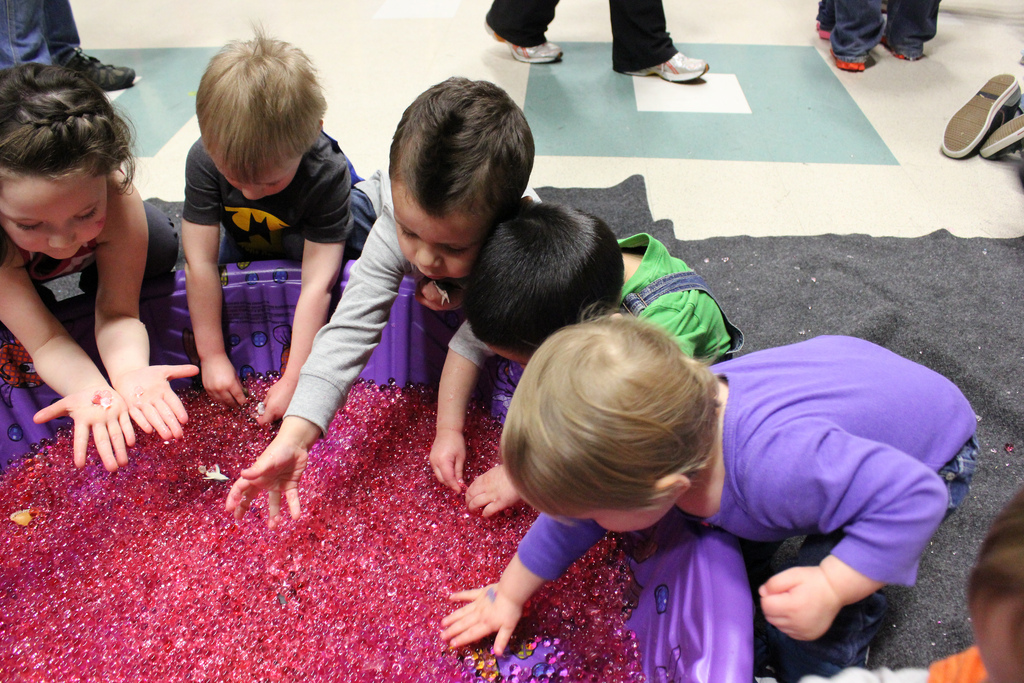
They are really interesting and appealing to touch – they feel cool, wet, squishy but not squash-able (resilient), malleable. Fun to just run your fingers through. They’re interesting to look at – really beautiful – brightly colored, shiny, reflective, and they pick up all the light in the room (they look great on light tables). They bounce. Luckily, they don’t taste like anything at all or smell like anything yummy, so not a lot of motivation to eat, which is good. (See safety note below.)
water bead tub

We usually use them in containers by themselves and let the kids sift their hands through them, but they’re also fun in a water table (use fish nets to catch them!).We’ve also used them with the marble maze.

img_20160326_132519369  img_20170204_134548438

Where do you get them?

They are sold in floral departments of stores, or at dollar stores, or can be ordered online (search for “water beads” or one site said to search for “polymers”). Orbeez is a good brand. I ordered  MarvelBeads Water Beads Rainbow Mix, 8 oz (20,000 beads) and have been working my way through the package for a few years! (One ounce of beads makes one gallon when they’re full size, so I usually only use a small amount per class.) They can be re-used. (see below)

Important Safety Note

Water beads are non-toxic, but that doesn’t mean they’re good to eat! If a child swallowed dry ones, they could swell in their belly.

You should never give a child jumbo size water beads! (Those that are the size of a marble when dry and swell to the size of a pingpong or golf ball.) These can cause intestinal blockages which can require surgery or can be deadly. (Some jumbo beads were recalled in 2012 but they continue to be sold. Learn more about the hazards.)

So, you should only use the beads that start out tiny and only swell to marble size. They should only be used with close supervision. If your child is under age 3 or an older child who tends to mouth things, avoid them or consider some of the more baby-proofed options for water bead play described on Playing and Learning Begins at Home, such as putting them inside a transparent plastic container with a lid. Or, make edible boba (tapioca beads) instead… see this post for my comparison. Or, Fun at Home with Kids recommends basil seed.

Set-Up, Containing Mess, and Clean-Up

They do need to be soaked before use. For class, we tend to start soaking them about 90 minutes before class starts. (They get bigger if you soak them 6 hours, but they’re a little sturdier when they’re not full size.)

They do bounce and they do roll. Some parents say that their kids dump the container all over the floor and it’s a pain to clean them up. My son kept them all up on the counter, and if one dropped to the floor, he would scramble down to rescue it and return it to the container as soon as possible. In my classes, I find most kids try to keep them in the sensory bin / water table but there’s always a few escapees that we try to chase down before they get stepped on and squished. Some parents at home have had success with putting the container of water beads inside another container (like a bowl of beads inside a cake pan) and that helps catch some of the strays.

If you soak these beads for a very long time (like leaving them in water for a few days) they do get a lot more fragile and start to break apart. So if I’m using them in the water table at class, I scoop them out of the water and let them dry a bit overnight. (Apparently some brands are always pretty fragiles and kids squish them into mushy blobs. The Biogel is more resilient than that.)

If you leave them in an open bowl, they’ll stay wet / expanded for days (weeks in humid Seattle.) If you want to dry them out to store, you need to spread them out on a cookie sheet so they aren’t touching each other and it still takes days to lose all the moisture.

Play Value

When my son was three, I got our first package, and they were a huge hit! They sat in a container on the kitchen counter all week, and every breakfast and snack time, he played with them – mostly moving them from one container to another and back again. Sometimes pretending that they’re dinosaurs chatting each other up. Sometimes just rolling them around with one hand while he reads a book, or running his fingers through them when watching a video. He used tongs and spoons to move them back and forth. For very little money, they were entertainment that lasted a long time. They’re also great in classes.

Want to see lots of posts on water beads and sensory play?

Just search online! Or, go to our BC Parent Ed Pinterest board of water bead ideas.

My favorite summary is on Artful Parent. And here’s “10 Ways to play with Water Beads

Photo credit, beads in hand: 10MFH via photopin; Tub: LizMarie_AK via photopin

Tinkering

tinker

At an in-service last week, after seeing this poster, I had a great conversation with one of my class’ teachers about the word “tinkering” and how great it is when parents allow their kids to tinker around, exploring, testing, fixing, breaking, and fixing again. So many skills are learned by this kind of hands-on exploration.

So, what is “tinkering”? Let’s ignore the definitions that say things like “unskillful or clumsy worker.” I like:

Children at play,  discovering new materials, and exploring new uses for familiar materials are Tinkers. People who were allowed to tinker a lot as children often become engineers, or scientists, because of that approach of “what happens if I try this? Oh cool! Now, what if I do that? Ooh, even better!”

People who were allowed to tinker a lot as children also become chefs, woodworkers, architects, computer designers, graphic artists, fashion designers, and builders. Learning early on the joys of building and creating and refining sets a lifelong passion for hands-on work in a variety of fields. (Check out this great post on The Importance of Learning to Make Things.)

How do you encourage your children to tinker? Give them lots of open-ended materials (cardboard boxes, toilet paper tubes, tape, string) and time to experiment. Talk to them about their creations, asking about the process and what they learned along the way. Ask them what they want to do next with their experiment.

I like this post from Kids Stuff World on Ten Powerful Life Lessons from TInkerlab. A couple of her lessons are:

  • The results are not as important as the process.
  • The more exposure you have to a material, the more you will learn what you can do with it.
  • Think of everything as an experiment.

Allowing your child to play, and tinker, and putter around, helps to ensure that as they get older, they meet this definition of Tinker: “somebody good at many tasks: somebody able to do many different kinds of work successfully.” (Bing dictionary)

Check out this Forbes article: Today’s Tinkerers are Tomorrow’s Inventors.

If you’re in the Seattle area, and want to do some tinkering with your child, join our Family Inventors Lab!

Benefits of Multi-Age Classrooms

multi-ageAs fall rolls around, you may be looking for a preschool, or scheduling other activities for your little ones. One thing you may encounter is preschools with a “multi-age” classroom, or activities with a wide range of ages: where some programs are limited to children born within a few months of each other (age 2 – 2.5), others are open to children from toddler to kindergarten (age 2 – 5).

The advantages to close age groupings is that all activities can be tailored to the exact developmental capabilities of that age group. My kids have had lots of great experiences in these types of programs.

But, I also like to be sure my kids have exposure both to formal / facilitated programs that are multi-age and to opportunities for free play with kids of wide ranging ages. I think there’s a lot to be learned in these experiences.

A Historical / Evolutionary Perspective

Historically, children were more likely to be from large families, sharing a home with siblings of a wide range of ages. In the U.S. today, we tend to have much smaller families. Amongst women born in 1935 (parenting from approximately 1955 – 1985), 37% raised four or more children. Of women born in 1960, only 11% had four or more children. In 2010, only 9% of households had three or more children. (20% of kids are only children.) So, children used to have a multi-age experience in their own home, and are much less likely to have that now.

Also, through much of human history, we have lived in small tribes or, later, small towns. With a small community, there are only so many children, so it’s likely that those children represent a wide age range. Think of rural “one room school houses” that might serve 15 children ranging in age from 5 to 18. So, in the community, formal education and informal play was almost always ‘multi-age.’ Now we put thirty 5-year-olds in one room for kindergarten. Or, in recent years in the Seattle area, we had one “freshman campus” school that was for 9th graders only – putting approximately 1000 kids of the same age into one building. In The Benefits of Mixed Age Grouping (1995), Katz wrote “Although humans are not usually born in litters, we seem to insist that they be educated in them.”

So, historically, most kids have interacted with kids of all ages. Currently, many kids spend most of their time with their age cohort. Is anything lost by doing that? Here’s an examination of some of the benefits of multi-age education and play.

What is a multi-age classroom?

A class where students range in age, with an age span of 2 or more years. Typically, children stay in the classroom for a few years. For example, in a multi-age preschool serving ages 3 – 5, children typically enter at 3 and are the younger ones that year, then stay on for a second year as the older ones. In their second year, they may attend more days a week than they did as a 3 year old.

The goal of a multi-age classroom is heterogeneity. You want a wide range in experience, knowledge, skills, and interests. The teacher uses a variety of techniques, including individual work, small groups, and large group exercises to ensure that each individual child is receiving an education that is stimulating and effective while not being overwhelming.

Note: in this post, I am not referring to an accidental multi-grade classroom, where due to budgetary constraints, space limitations, or a limited student population, multiple ages of kids have been thrown together in a classroom with a teacher who may or may not be prepared to handle this. I’m talking about intentional multi-age programs where the curriculum is set up to maximize the strengths of the diverse grouping.

Benefits of Multi-Age Classrooms

  • If you have two children of different ages, they can be in the same class together, which might be reassuring to them and is definitely easier for your daily logistics.
  • Knowledge-Building and Skill Development: Younger children learn from older children. Older children reinforce and deepen their own understanding of a topic or skill by teaching it to the younger kids. This knowledge is passed on in a variety of ways:
    • Unintended modelling – when an older child is just doing something they want or need to do, not attempting to teach (like using the potty or drawing a picture of a dog). The older child may not even be aware the younger child is observing and absorbing. “Nothing is more interesting to a child than another child who has the skills that he or she wants to acquire” (Merrick, cited in Panko)
    • Social play: The younger ones are exposed to things like better emotional regulation and more sophisticated problem-solving which helps them learn these skills earlier.
    • Casual mentoring. When an older child wants the younger one to participate in a game or activity, she will just quickly explain it to the younger one so they can have fun together. When the older one is slowed down by the younger one’s lack of knowledge, sometimes they move in to help rather than waiting for the teacher to help. (Like putting on boots so they can go outside for recess.) Also, younger children learn which classmates they can go to for help with various tasks, and may seek out their help before asking a teacher. (At one lunch, kids were given fortune cookies. All the non-readers went straight to the kids who could read to ask for a quick answer to ‘what does this say?’)
    • Intentional teaching. Sometimes teachers will ask a child who has mastered a skill to teach it to a child who hasn’t yet mastered it. (Sometimes this is an older child teaching a younger child, but it can also be the other way around, as children gain skills at diverse ages.) The learner benefits by gaining information in a way that may be more fun and more confidence-building than learning from an adult. The child who is teaching has the chance to review his own knowledge from a new perspective, and practice mastering skills.
    • If older kids give incorrect information, the teacher can correct it, and both kids benefit – the teacher has discovered the older child’s misconception, which she otherwise might not have known about and makes sure both kids know the correct info. (This can remind the younger child that we’re all learners, and we can all make mistakes.)
  • Individualized curriculum, tailored to children’s unique skills, not just their age
    • A good multi-age program is child centered. Projects and assignments are tailored to the needs and interests of the children as individuals.
    • Children are more able to learn at their own pace, making continuous progress rather than having to “wait till second grade, when we cover that.”
  • Children stay with the same teacher for multiple years.
    • The teacher gets to know the child’s strengths and weaknesses, and is better able to tailor the lesson plan to meet that child’s unique needs.
    • There is a stronger parent-teacher relationship.
    • For the child, there’s the benefit of consistency, and a sense of safety and security in the classroom which enables better learning. (Assuming the teacher and child are a good match – if not, then your child could be stuck in a non-ideal situation for a while.)
    • Benefits in year-to-year transition: youngers have less anxiety about moving up, because they can see what comes next. Olders gain confidence as they can see how far they’ve come. Big kids feel like “grown ups.”
  • Less competition / labeling.
    • In a single age classroom, it’s easy to compare kids and say that some are gifted, some are delayed. In a mixed age classroom, it may be clearer that there’s a range of development: the one who does best in math class may have the hardest time in music class, regardless of age.
    • A child who struggles more with social skills might be ostracized by their age peers, but might find companionship in the younger kids in the classroom.
  • Better for a variety of kids:
    • Better for those August / September birthdays. In single grade groupings, parents end up deciding at age 5 whether their child will always be the youngest or the oldest in a classroom. In a multi-age program they have the opportunity to be in the younger half one year, and the older the next.
    • Better for gifted children. They can be pushed to achieve their potential with an individualized curriculum.
    • Better for children with learning challenges. Challenged students may have more self-esteem because don’t always feel like “the dumb one” in the class.
  • A more cooperative, caring learning environment.
    • Older kids learn to be patient, nurturing, responsible. (With guidance from the adults!)
    • Role-modelling. The older children learn how to set a good example.
    • Less misbehavior: Students are less likely to misbehave in multiage groups than in single-age classrooms (Logue, 2006 as cited in Song, et al 2009) “When the teacher asked the older children who were not observing the class rules to remind the younger ones what the rules were, the older children’s own “self-regulatory behavior” improved.” (Katz)
  • Prepares children for work in the “real world” where co-workers are varying ages and experience levels.
  • Research consistently shows that on standardized testing, children from multi-age classrooms perform as well or better than their peers in single-grade classrooms.

Questions to Ask:

Why is the class multi-aged? If it’s for philosophical reasons – because the school believes in the benefits of multi-aged classrooms–that’s a good sign. If it’s for budgetary reasons, or limited student population, or limited classroom space – that’s not a good sign.

Has the teacher taught a multi-age class before? That’s best. Or, has the teacher at least worked in the past with children of all the ages she will have in the classroom? Or at least received training in how to do it?

How does the teacher adjust the curriculum to meet all students’ needs? You’re hoping to hear that each child’s learning is individualized… one child might be in the ‘advanced math’ group and the ‘still working on reading skills’ group. If the teacher teaches the kids as two separate grades, taking turns between the ‘third graders’ and the ‘fourth graders’, that’s not good…

Does the teacher want to be there? The majority of teachers are opposed to multi-age classrooms, often because they doubt their ability to juggle the needs of the diverse learners in their classroom. But some teachers love this environment, and are passionate about the benefits of multi-age.

Is the whole school multi-age, or just a few classrooms? It tends to work best if multi-age is the assumption at the school, and all the programs are set up to work with that plan.

How do they assign kids? It does not work well to place low-performing older students with high-performing younger students. This tends to lead to labeling of the ‘dumb kids’ and the ‘smart kids’ and the self-esteem and social stigma that come with those labels. It’s better when there’s a wide range of achievement and skills in all the kids, so diversity is valued.

What else to consider:

Even more than in a single-grade classroom, the success of a multi-aged class depends upon the skills of the teacher.

Teachers need to be well-organized, knowledgeable, and flexible. They need to do frequent and holistic assessments of learning to make sure all the students are well-served, challenged, but not overwhelmed. Teachers need to have appropriate expectations for the youngers, not asking more than they are capable of. They also need appropriate expectations of the olders, giving them challenges that help to build their skills.

As the parent, you may be more closely involved than you would be in a single-grade classroom, just because many schools that believe in multi-age also believe in parent involvement and will ask more of you. You will also appreciate closer involvement. If you have a younger child, it’s exciting to see where they’ll be in a year. If you have an older child, it’s exciting to see how far they’ve come!

Sources:

Multi-Age Education: http://arobi77.files.wordpress.com/2012/02/the-multiage-concept-explained.pdf. Collects several articles, originally published 2006 – 2011. Includes:

  • The Multiage Classroom, by Marion Leier.
  • A Multi-Aged Approach. Marion Leier.
  • My Thesis. Michelle Panko.
  • Benefits of Mixed Age Grouping. Lillian Katz. 1995
  • Interview with Tim Laner, 1998

The Advantages and Disadvantages of Multiage Classrooms in the Era of NCLB Accountability. CEEP Education Policy Brief. Song, Spradlin, and Plucker. Volume 7, Number 1, Winter 2009. http://ceep.indiana.edu/projects/PDF/PB_V7N1_Winter_2009_EPB.pdf

photo credit: theirhistory via photopin cc

10 Types of Toys

letters

In other posts, I have talked about reasons why it might be OK to own fewer toys, and how to choose the best toys, and shared a link to my handout on choosing toys and activities which build a variety of skills and multiple intelligences. I’ll share here some examples of how this plays out in our home with our three-year-old.

(Note: I’ve included Amazon Affiliate links in case you want to buy any of these items, but truly, I’m advocating for NOT buying much stuff!)

Word Play (Linguistic / Verbal Intelligence)

We only own about 20 kids’ books – filtered down over 20 years of parenting to the ones that we love the best and want to have in the house at all times. But we go to the library a lot! (Multiple times a week, picking up a big stack of books every time. And we end up reading them all multiple times. My boy loves to be read to, and loves to read to himself.) And we go to story-time at the library every week.

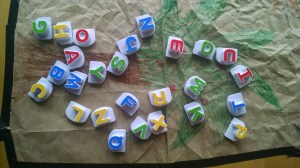
We also have magnetic letters for the refrigerator (which we use all over the house) and duplo letters. Lately, my son has been using the letters and a big drawing of a coconut tree  to re-enact one of his favorite books (Chicka Chicka Boom Boom) over and over again. You can see the picture above…. the drawing is nothing “fancy” – I think his grandparents just pulled some packing paper out of the recycle bin and drew on it with crayons – but it’s kept him entertained for hours, and when he’s done, it’s back to the bin.

We have a Kindle Fire tablet with Kindle FreeTime installed, so he plays lots of ABC games, and watches educational videos (and not so educational videos) about the alphabet.

Our best language tools? His abuela (grandmother) who speaks to him in Spanish. And his Belo (grandpa) who reads to him for hours on end. And they both spend a lot of time practicing writing numbers and letters with him and other hands-on learning games.

Doing the Numbers (Logical – Mathematical Intelligence)

Everything we have more than one of is a math toy! We can count how many blocks we have, figure out whether we have more trains than balls, and so on.

We have 12 rubber ducks that have appeared in our lives over 20 years of parenting (I don’t think I bought a single one). These are great for bath time math time. We sang “Five Little Ducks went out one day” lots of times – it’s a good way to learn the basics of subtraction – one duck doesn’t come back – now there’s four little ducks…

The only special math tools we have are:

    • a set of Duplo numbers, which we’ve used for counting, number recognition, and a number line – we had a library book called Hopping on the Number Line which led to the game of having toys hop back and forth on the number line as we did the math problems out loud (if froggy starts on 2, and hops 3 spaces, where will he land?),
    • Unifix Cubes, which are a fabulous math teaching tool, though so far all he does with them is sort them into 10 stacks of 10 matching cubes, then lines those up in spectrographic order red-yellow-orange, etc. (My boy is a big fan of order and repetition.)
    • Some numbers we shaped out of pipe cleaners
    • Some old birthday candles – you know the candles shaped like the #1 and the #2 and so on that when you put them on the birthday cake and blow them out 20 seconds later, barely any wax has melted so you keep them instead of throwing them away? My son found those and loves them!
    • A great app called Bedtime Math. Every night at bedtime, we read a story problem and solve some math puzzles related to that story.

Putting the Pieces Together (Spatial Intelligence)

We have a couple of kids’ wooden puzzles and a couple of jigsaw puzzles. We have a big bin of duplos (notice how our letters and numbers listed above do dual duty as part of the Duplo collection?), and wooden train tracksto assemble (and a big collection of wooden trains – half are used and abused – purchased at a consignment store and the others shiny and new purchased by Grandpa). At many of our local libraries, they have puzzles that he works with when we visit, and at his BC classes, they have lots of shape sorters, puzzles, and small manipulables to practice with.

We also “find” lots of things for him to learn spatial skills with: mixing bowls, measuring cups, plastic dishes for practice nesting things; sticks and rocks to stack into tall towers, an empty bottle from the recycling bin and some dry beans to drop in….

Moving & Grooving (Bodily – Kinesthetic Intelligence)

We own 5 balls of varying sizes, a kids’ baseball bat, a Strider bike, and a climber built of QUADROthat was a hand-me-down from a friend (Quadro is a fabulous combination of building toy and playground equipment! We’ve had ours for 20 years now, in near constant use.) We also go swimming at least once a week, and go on one or two one-mile hikes a week and go to the playground a lot. When we’re out in the woods, he happily balances on logs and climbs trees and scales rocks.

Playing Well With Others (Interpersonal Intelligence)

Imaginary play and telling stories with characters is one way to build interpersonal intelligence. So we’ve got a few stuffed animals, but he doesn’t play with them a lot. We have a collection of finger puppets that we tell stories with and that he also uses at naptime to tell stories to himself. We have a toy picnic basket with fake food, but we don’t use it a lot, so I think it will soon go to our Buy Nothing group. He’s just as happy to say that a rock is a chocolate cupcake and a handful of bark is french fries.We also make things… one of this week’s library books was Trouble at the Dinosaur Cafe, and we made Model Magic dinosaurs to go with it – he mixes the colors and I do the sculpting.dino

We also make sure he gets lots of interaction with other kids – we spend lots of time at the playground, in free play with new kids, and meet friends for a weekly play-date which is all kid-guided, non-facilitated free play. (Kids learn a lot more about getting along with others and about conflict resolution when parents back off!)

Learning about Myself and How I Feel (Intrapersonal Intelligence)

As I say in the handout, this category of intelligence isn’t about tangible stuff. It’s more about interaction and emotion coaching, and also making sure your child has time for quiet contemplation and down time. When we go on hikes in the woods, there’s a lot of quiet reflective time as well as song-singing, story-telling, nature-teaching time. He also has “nap time” every day. He stopped sleeping at nap time a few months ago, but still will play quietly in his room for 90 minutes every day. OK, not necessarily quietly – he plays his piano, and reads his books out loud with LOTS of feeling and dramatic interpretation! But it’s a good solo time for him (and for me).

Song and Dance Routines (Musical Intelligence)music

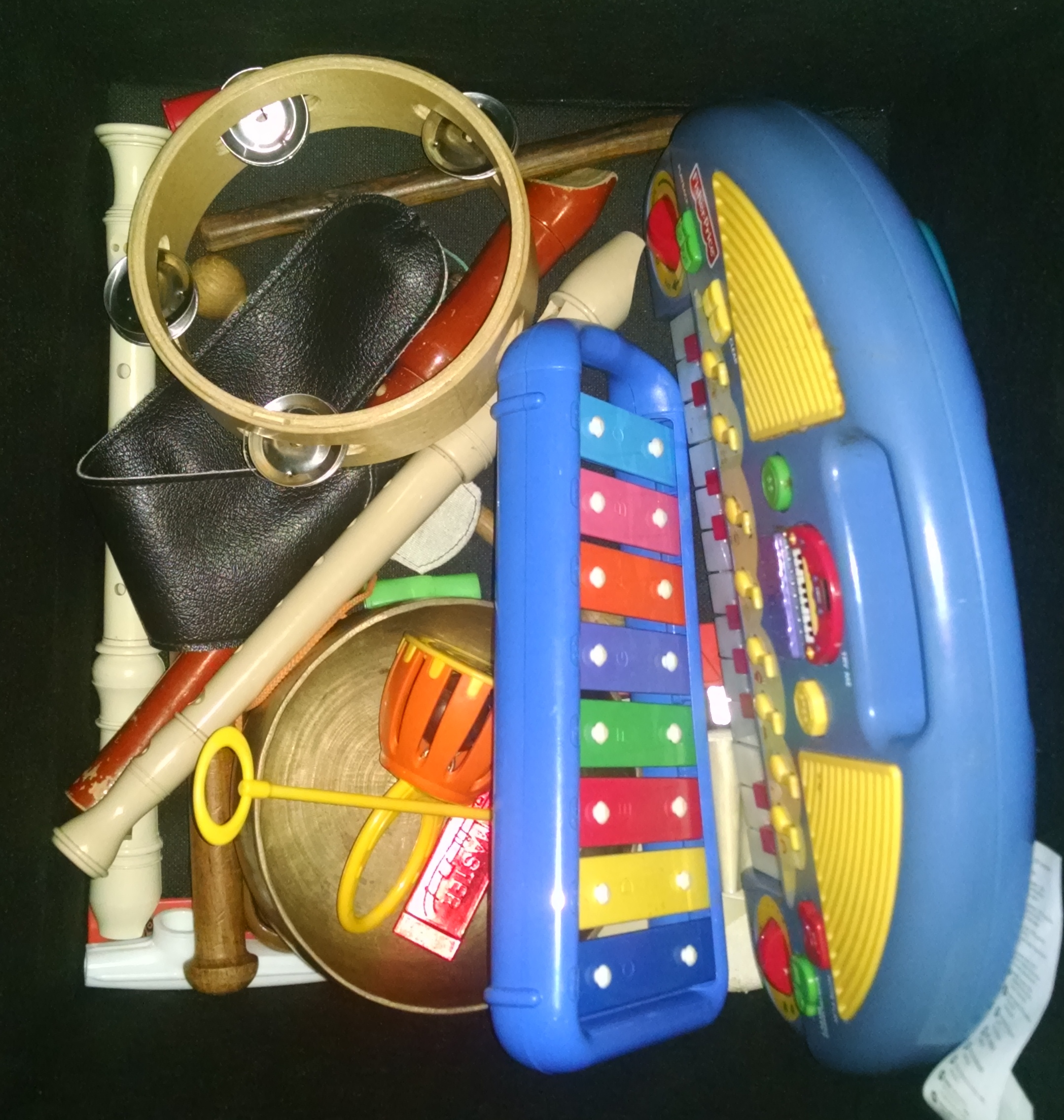
We have a box of miscellaneous musical instruments he can pull out anytime he wants. A few were purchased for him, but most are just items that have entered our lives over the years, like the plastic Yamaha recorder I had as a child, and the plastic Yamaha recorder I had to buy for my daughter’s class when I couldn’t find my old one… We also have a very old electric piano that’s in his room and he spends part of many “nap times” exploring the piano.

We listen to a lot of music together (one older sibling loves Broadway show tunes, one loves vintage jazz, Abuela loves classical and Spanish music) and sing songs A LOT, and enjoy circle-time songs at BC classes and library story times and hymns at church.

Fun with Flora and Fauna (Naturalistic Intelligence)

As you can guess if you’ve read other posts on my blog, we spend a lot of time outdoors. Camping, hikes, zoo trips, farmer’s markets, walks to the library and the pool. The only “tools” we use outdoors are a bucket and a shovel. (But, when we forget them, a stick and a rock can fill in as digging tools, and an empty Starbucks cup from the car makes a fine bucket.) Some day we’ll find our binoculars again, and pick up a new magnifying glass.

Expanding Horizons (Magic / Imagination / Religion / Cultures)

We have a big box of miscellaneous dress up – old Halloween costumes from his sisters, sunglasses, silly hats, etc. In all of our books and the videos we watch together, we aim for showing lots of diverse cultures and experiences, and we go to a church that talks a lot about diverse beliefs and appreciation of the sacred in all forms.

All the Pretty Colors (Artistic Skills and Appreciation)

This is the one area we have an abundance of STUFF.

One cabinet in the kitchen is over-flowing with art supplies: Model Magic clay, no-spill watercolors, pom poms, pipe cleaners, paint, paper, glitter glue, stickers, markers, crayons, beads, scissors, and so on. When he and I are in a relaxed, mellow mood, we pull these out and get to work.
I try not to do much art when I’m in a cranky mood, or when I won’t have time to deal with any mess that arises. I have to confess that I can have a hard time when he’s being really messy or “wasting” art supplies, or “messing up” art supplies – like when he dips the red-paint-covered paintbrush into the yellow paint. Because I know that about myself, I make sure that he has plenty of opportunity to do art in spaces that are designed for kids’ art and where it’s OK to make a mess. So, this year, he’s enrolled in Creative Development Lab, which is all about exploring and experimenting with art.

Do we have it right?

I feel like we have found a good balance… we have enough stuff at home that he is very capable of entertaining himself for a long time. And we make things a lot and find thins in nature, which gives him new toys and also shows ingenuity. Plus, we get out in the world a lot to explore the things we don’t have at home. I try to avoid owning “stupid” toys that I don’t like… they do enter our home sometimes if my kids go to a birthday party and come home with goody bags, or have lunch at McDonald’s with dad. But most of the toys we own I think are worthwhile.

William Morris once said “Have nothing in your houses that you do not know to be useful, or believe to be beautiful.” It’s a rule I try to live by for myself, and I think it also applies to my child’s things… but maybe there it’s something more like “Have nothing in your toy box that you do not know to be creativity-inspiring or believe to be a joy to play with.”

How Many Toys is Enough?

clutter

Parents often complain about the overwhelming clutter of toys in their home, and yet they have a hard time letting go of the toys they have and/or they keep acquiring more toys.

Let’s look at ways to think about the toys that we take into our homes, which we decide to keep, and how to decide when it’s time to let go.

Toys as a cure for boredom?

I often hear:

“My daughter gets bored of any toy after just a few minutes, so I need to keep getting new toys to keep her busy.”

Kids learn what they are taught. And the more we reinforce it, the more ingrained the learning. If every time your baby fusses, you give her a new toy to entertain her, you’ve trained her that the way to happiness is more new toys. And you’ve trained her that your job is to keep her entertained at all times.

On the other hand, if your child complains about being bored, and you don’t “rescue” her by offering new entertainment, she will learn that she can entertain herself. I know that many of my kids’ most creative moments followed after they said “I’m bored!” I didn’t fix it for them by handing them new toys. Instead I left them to their own devices to figure out a new game or project. Suddenly, the “same old toys” took on new life.

For young children, like toddlers and preschoolers, they may not be able to invent a new game on their own, but you can offer “invitations to play.” You can put out old toys in new combinations, or allow them to play with various household objects. For example, they may not have played with the blocks in the living room or the toy horses in their bedroom for a long time. But if you put those toys on the kitchen table, suddenly they’re building a stable, and when they want a ramp, they grab a wooden ruler from the desk.

Children throughout history and across cultures have had a fabulous time playing with whatever materials were available to them. And the fewer the materials, the more creative they have to be. What’s the best all-time toy? The stick. (Check it out – it’s in the Toy Hall of Fame and in this list of the 5 best toys of all time, and here’s a great blog post on all the things a stick can become.)

Could less be more?

I have worked with many parents who said things like:

“My child never focuses. He flits around the room, from one thing to another. I keep getting new toys, hoping to find one he likes enough to play with it for longer.”

I recommend that they instead put away half the toys in the room and see what happens. Almost always, they find that the child slows down, calms down, and focuses more.

Having lots of toys in their environment can be very over-stimulating for children. Feeling surrounded by choices can create an internal pressure to play with everything, and stress over choosing which thing to play with next.

If we add in auditory clutter (such as background TV) or visual clutter (whether it’s piles of unfolded laundry or carefully curated artwork and decorative displays), it’s even harder to focus. “Experiments show children who play in rooms where a TV is broadcasting… spend less time with individual toys and shift their attention more quickly from one activity to another…” (Source)  “…children in highly decorated classrooms were more distracted, spent more time off-task and demonstrated smaller learning gains than when the decorations were removed.” (Source)

Parents.com has a nice article on helping young children learn to focus. But an easy place to start can be having a calmer, more focused play space with a smaller number of quality toys, not a lot of décor, and some quiet time.

Can we learn to appreciate what we have?

“Their grandparents love to buy them things, and my sisters give me all their kids’ hand-me-downs, so there’s this never-ending flood of toys. I’m overwhelmed, but every time a relative comes over, my kids expect to get a toy.”


Another benefit of focusing less on acquiring more stuff can be more time to focus on  gratitude for what you do have, especially if we make gratitude a conscious focus of our family life.  (Find great tips for this on Hip Homeschool Moms and check out this post on Momastery titled “Give me gratitude or give me debt“, it’s about taking a moment to notice all the amazing things in our homes (running water!! a refrigerator with food in it!!) and worry less about all the things that magazines, catalogs, and advertisements tell us we need to be happy.

We’ve got a great little independent toy store in my home town. At least it looks great from the outside. But we’ve never been inside. My 3-year-old and I walk past it all the time on our way to the park, the farmer’s market, and the fountain that he likes to splash his hands in. I suspect that if we ever went in, then he would want all the toys in there, and would sob whenever we passed in the future. It’s easy to get captivated by consumer products – after all, that’s what makes our capitalist society run. But, he’s happy with the toys that we do have, and I’m grateful that we can walk to the park, the market, and the fountain – those are the memories of his childhood that I want.

If I decide we want new toys, then there’s always our Buy Nothing group to check with first. It’s a Facebook group where people freely give away anything they don’t need anymore. (Check their website to see if there’s one in your area!)

Some day, as your child gets older, they may notice that other kids have more toys than they do. This can result in some yelling and some tears and some “you’re so mean” moments. But, it also opens up an opportunity for discussions with your child about your family values, what you choose and why. It can also tie into financial literacy, and helping educate them about how to make consumer choices that work for them.

What about developmental stimulation?

“I worry that he’s not going to get all the stimulation he needs to reach his potential, so I buy all the stuff that’s supposed to help with brain development.”

One of the ways marketers convince us to buy their toys is by telling us a toy is “developmentally appropriate” or “stimulates language development” or “encourages creative thinking” or “will guarantee your kid will get into Harvard.”

I promise you… there does not exist “the one best toy that all kids need” in order to learn and grow. Our kids can, and do, learn from everything in their environment.

We do want to think about a diversity of experiences for our children. This is the best way to stimulate brain development.

As we choose toys and activities, it helps to think about choosing toys that help with all the areas of development. I also think about the theory of multiple intelligences to ensure my children and my students have opportunities to develop them all. Look at the toys you own: Does your child have toys that stimulate gross motor development? small motor development? Pretend play? Artistic expression? Musical appreciation?

Here is a handout on choosing toys to develop multiple intelligences. And here’s my post on how this theory plays out in real life – in other words, what toys does my three year old own for each category, and is that working for us?

Also, I don’t worry about having in my home everything my child needs to develop. Think about your community resources: the library (ours check out videos, CD’s, stuffed toys, and puzzles – not just books), indoor playgrounds (our local parks departments all host them in their gyms on winter weekday mornings – they set out lots of ride-upons, balls, and other great toys for big motor play), other parks programs, zoos and pet stores, and children’s museums. (Check out this great article on why we need children’s museums.)

Rotating Toys

“I spent all this money on special toys for Christmas, and she still hasn’t really played with any of them. But I’m going to hang on to them for a little while longer to see if they catch her interest. But we’ve just got too many toys now!”

A friend of mine is in the process of selling her house. So, she packed up most of her toddler’s toys to keep the clutter in the house at a minimum in case an agent wanted to show the house. She made 5 plastic tubs full of toys to store in the garage. She gets out one tub at a time, that has a small collection of toys in it. She says her toddler will happily play with that one small collection of toys for days on end without complaining or getting bored. And even better, she’s even started to put away all her own toys in the bin at the end of each play session. Every once in a while, they put those toys away and bring in a new bin. If there’s any one toy from bin #1 that’s really popular at the moment, then they keep it out, and swap one of the bin #2 toys into bin #1 to take its place.

My friend says that in the new house, she plans to continue this method, because it’s working so well for them.

More Resources

Also check out: Elizabeth Pantley’s advice on buying toys for babies and toddlers. These articles on Why Fewer Toys will Benefit Your Kids, and Seven Ways to Build Your Child’s Attention Span (which include minimal “entertainment” and more open-ended toys).  Dr. Toy is a helpful website that reviews toys.

photo credit: r0Kk via photopin cc, geirt.com via photopin