Tag Archives: preschool

More Good Birthdays

Are you looking for ideas to make sure your kids’ birthday parties are all fabulous occasions you look back on with fondness? I’ll share in this post my completely biased, non-research-based, experienced-mom’s opinion on birthday parties: Keep ’em small, keep ’em simple, personalize the party theme and activities to suit your unique child in that exact moment of time and let the kids play fun and simple party games they’ll enjoy.

What do I recommend for a first birthday?

This is a friends-of-the-family occasion. Invite your closest friends and family members for a low-key gathering, at a time of day your baby is likely to be awake and happy. (Sunday brunch is a much better bet than Friday at 7 pm). Let the baby play and do whatever she wants most of the time – when the time is convenient and she’s in a good mood, go ahead and give her some cake, and get the cake-smooshing pictures and sing the song so you have it all on video. Then go back to relaxing with your friends!

What do I recommend for birthdays age 2 – teenager?

Guest list: My rule is “one guest per year old.” So, the two year old has two little friends and their families. The five year old has five guests, etc. When my girls got older, and wanted to do sleepovers, the rule for sleepovers became “one overnight guest for every two years old.” So, we had 6 guests for a 12th birthday sleepover.

If you want to host a party at the skating rink or the trampoline place, where you invite the whole class or the whole soccer team, go for it! But I wouldn’t do that for a birthday party. I would do it for “hey, it’s a teacher in-service day and there’s no school – let’s go skating!” That way, if your kid ends up having a bad day, you could leave early, which you can’t do from your own birthday party. And, you don’t have to be nagging your kid to “Make sure you talk to everyone who came, since it’s your birthday party.” And the parents of the guests don’t have to buy gifts, and don’t have to remind their kids whose birthday it is.

Parents stay or drop-off? Whichever you choose, be really clear about it in the invitation! Under 5, I assume you want me to stay with my kid, but as the children get older, it gets harder to guess. We often said: “Parents are welcome to stay if desired, or leave if they choose. If you leave, please be back by 1:00.” The parents who were also our friends would often stay and help out. The ones who didn’t know us well would typically drop-off. More comfortable for everyone involved.

Time of Day: Please pick the time of day when your child is at his best! Often parents pick a bad time because “it was the only time the party room was available. It’s my child’s nap time, but I thought it would be OK…” That never goes well.

Keep parties short. A party for a child under 5 should be scheduled for under 90 minutes – could even be less than an hour. If it’s all going well, people can stay and play longer, but no one feels compelled to stay if it’s not going well.

Theme and Activities: I never choose my theme months in advance just because I can get a good deal at the party store. Kids’ interests can change, and it’s really lame to have a My Little Pony party when you’ve moved on to more mature interests. I wait until one or two months before the party, and think about what my child is most interested in right then. Again, I want the birthday party to honor who they are in that exact moment of their life. And it’s often not a packaged theme anyone can buy in a party store: one of my daughters did a zodiac theme and one did a write-your-own-musical theme.

Activities are our big focus, but we’re not talking hired entertainers or rented bounce houses or pony rides. Just fun kids’ games which tie into the theme. (See below.)

Decorations. I try to be pretty environmentally conscious most of the time and use re-useable goods. But, I do like some bright and pretty decorations for a birthday. I try to think about how much waste I’ll create. So, paper plates and a paper banner? Reasonable. 8 foot long plastic tablecloth with matching plastic plates and color coordinated plastic forks that you use once and throw away? Not so reasonable.

Goodie Bags. Over the past 20 years or so, it seems like goodie bags have become required staples of birthday parties. Over the years, my kids have come home with bag after bag of candy (which they don’t need), decorative pencils and erasers (which we already have way too many of), tacky little plastic toys (that end up in the trash) and other junk from the dollar store. They’re junk. And even kids figure that out pretty soon. Yet, kids get so conditioned to expect them that I’ve seen kids be very disappointed when they don’t get one. I’m hoping my son’s friends opt out of this consumerism.

If you feel compelled to do a goodie bag style take-home item for every kid, you can do a balloon bouquet for decorations, then send one home with each child. Or choose something simple, small, and ecologically friendly.

Gifts. This one is tricky for me. We know families who opt out of gifts and say so on the invitation. We know others where the child has asked all guests to give donations to their favorite charity in lieu of gifts. And, of course, we know other families who invite 20 guests and get 20 gifts which their child may or may not want because the parents buying the gift often don’t know the child well enough to choose an appropriate gift.

When our girls were growing up, we had small parties of kids who knew them well and would buy well-suited gifts. And we bought very few toys for them and very few gifts. So, we did gifts at their parties. And they opened them in front of the person who gave them the gift so they could say thank yous directly. We haven’t really decided what the tradition will be for our boy.

Examples of Themes

Putt Putt goes to the Zoo – 3rd birthday. Our daughter loved this game by Humongous Entertainment, so we re-created the game with family members playing the baby animals who needed to be rescued.

Dinosaurs – 4th birthday. Fun photos: Asked Grandma in Wyoming to make dinosaur tails to tie on. Asked Grandpa in Seattle to make dinosaur head kids could wear. Asked big sister to do face paint. Dino Dig – bury toy dinos in shredded paper for kids to dig up.

Cats – 4th birthday: My daughters had cat costumes from the last Halloween. Other kids were given home-made tails to tie on, cat ear headbands, and we did face painted nose and whiskers. We played cat and mouse hide and seek games, chased balls of yarn around the room, and lapped up milk out of bowls with our cake.

My Little Pony – 5th birthday. We had a friend style all the guests’ hair into “pony tails” with braids and ribbons. We had some horse races, a horse beauty pageant, and so on. I’d found some old ponies on Ebay, and those were decorations and take-home gift.

Pet Store – 6th birthday. We played lots of animal games. We ended by designing a pet store, where each child played a type of animal. When parents arrived for pick up, we gave them pretend money, and they had to buy their child to take them home.

Astrology and Mythology – 7th birthday. We got from each guest’s parents the birth-date and time of day they were born. We prepped stickers for each child with their western zodiac symbol, Chinese zodiac, a poem about the day of the week (Monday’s child is fair of face…) the flower for their birth month, the meaning of their name, and so on. We played games to earn the stickers and each assembled a personalized book.

Warriors themed 8th birthday. Based on the Warriors books by Erin Hunter about a clan of cats. We played cat & mouse game (hide & seek), hunted for birds (we hid bird toys around the house), and did “barnyard noises” game with cats, mice, and bird noises. We made a cake decorated with plastic cats – the cats were take home gifts for the guests.

Magic- 9th birthday. We learned magic tricks and performed for each other, watched a video of some magic shows, and had a top-hat shaped pinata we had made.

Spy Kids – 10th birthday party. (Our daughter was into Spy Kids, and Where in the World is Carmen San Diego, and had recently watched her first James Bond movies.)The guests were “spies in training” and played card games to learn bluffing skills, traveled through a laser beam maze made of yarn, and did driving simulators on the X-box. They were then given a series of clues to solve to save a kidnapped agent.

Write your own musical – 11th birthday. Before the party, we made CD’s with 15 or 20 of my daughter’s favorite songs from musicals and gave those to the guests as invitations. In the evening, the guests created characters and a plot line and found a way to weave in many of the songs. They rehearsed multiple times. In the morning, all the guests’ parents were treated to a performance of the musical.

Rock Band – 12th birthday. Guests were invited to dress up like rock stars. We played Rock Band on the Xbox all evening and ate junk food.

What kind of parties do I not recommend?

Often on Facebook groups, blogs, and the playground, I hear parents asking/saying things like “We’re looking for the right venue for our one year old’s party.” “The party isn’t for six months, but I’ve already bought all these adorable Minnie Mouse decorations.” “What entertainer do you recommend for a three year old’s party?” “We’ve got 25 kids coming – and since they’re all 4 years old, that means all their parents too, and the room we rented only fits 20 people.” “My daughter’s sixth birthday party is coming, and I have to put 22 goodie bags together by tomorrow – so I’m going to hit the dollar store – they’ll have something I can toss in.” “We didn’t want to leave anyone out, so we invited the whole class, and we’re getting a bouncy house for the yard.”

I don’t want those parties for my own child. But I also dread it when my kids get invited to one of those parties! I can tell you that over the 21 years I’ve been parenting, I’ve been to parties where the over-tired toddler guest of honor was in total meltdown for much of the party. I’ve been in those over-crowded party rooms where all the parents are miserable and all the kids over-stimulated. I’ve come home with all those little bags of stupid little throwaway toys that no one cares about and more candy than my kids need in a week, And I’ve been at the bouncy house parties where there are so many kids there that none of them really remember or care whose birthday they are celebrating.

So, for your sake, your child’s sake, and your guests’ sake, try small, simple, personalized parties that everyone can enjoy!

What do we know about spanking?

We know it can work to increase compliance in the moment.

Parents who use physical punishment often experience that result. Their child misbehaves, then they spank, then the child stops misbehaving. It’s very effective in the short term, so the parents continue to use it. And some parents discover that a tiny swat on the butt is not always effective, but hitting hard enough to inflict pain is really good at eradicating behavior over the long run.

But, physical discipline can have other unintended effects in the long-run.

Of course many individuals who were spanked as children turn out just fine. However, research shows that on average, people who were spanked are more likely to be aggressive, less verbal, more likely to abuse substances, more likely to experience anxiety, depression, and other mental illnesses, more likely to be obese and have cardiovascular disease, and more likely to abuse their spouse and children (they’ve learned big people can hurt smaller people). They have less gray matter development in their brains.

Read this excellent infographic / article on the Psychology of Spanking to learn more.

spank

Spanking and Brain Science

From studying brain development, we know: When children are happy and feel safe, they learn, grow, explore and their brains develop. When they are stressed or frightened, their brain goes into survival mode. They can definitely earn what not to do.  (i.e. when I do this behavior, my parent hurts me, so I shouldn’t do that behavior again.) But they’re not learning much else. Like what TO DO. (Or how to read, how to throw a ball, how to eat neatly… whatever it is the parent hopes they will learn soon. The survival mode brain doesn’t care about any of those things) Daniel Siegel has written about this neurological effect in The Whole Brain Child and No-Drama Discipline. Watch a video about it here.

Alternatives to Physical Punishment

85% of parents say they would rather not spank if they had a discipline alternative they believe would work. You can read my take on positive discipline here, or advice from the CDC here, or follow the recommendations in the Psychology of Spanking article [excerpts below…]

1) Develop a positive, supportive, loving relationship between parent and child:

  • Maintain a positive emotional tone in the home.
  • Pay attention to the child to increase positive behavior…
  • Be consistent in daily activities to reduce resistance and make negative experiences less stressful…
  • Be flexible by listening, negotiation, and involving the child in decision-making. This has been associated with long- term enhancement in moral judgment.

2) Use positive reinforcement strategies to increase desired behaviors…

  • Listen carefully and help them learn to use words to express their feelings.
  • Provide children with opportunities to make choices and to understand the consequences of their choice.
  • Reinforce desirable behaviors with frequent praise and ignore trivial misdeeds…

3) Remove reinforcements or apply punishment to reduce or eliminate undesired behaviors.

  • Be consistent with… removal of privileges (increases compliance from 25% to 80%)
  • Be clear about what the bad behavior is and what the consequences will be.
  • Deliver instruction and correction calmly and with empathy.
  • Provide a strong and immediate consequence when the bad behavior first occurs…
  • Give a reason for the consequence. This helps children learn appropriate behavior

Learn lots more options for discipline tools that help you to teach your child how to be a good person – which should be the final goal of disciplining a child – in the Discipline Toolbox.

Fun with Toddlers: Farm Theme

IMG_20140905_145903210Here’s a collection of fun farm-themed activities for toddlers and preschoolers.

Outings to Go On

Take your child to a farm park or petting zoo to see and interact with animals up close and in person. Click here for options in the Seattle/Bellevue area. In the fall, go to the fair! (state fair, county fair, etc.)

Take your child to u-pick farms. (Look here for listings of farms in the U.S., Canada, and more.) In Washington state, we pick berries June through September, apples in September and October, pumpkins in October, and more. Or join a CSA: Community Supported Agriculture farm that allows you to visit the farm.

Game to Play

Animal Sounds. Show your child pictures of animals, and teach your child animal sounds. Then ask your child “what noise does a cow make?” Praise them when they say moo. And so on. Children can often make recognizable animal sounds before they have much language, so it’s a fun way to see how much your child really understands. If you want your child to speak multiple languages, ask the question in other languages (like “Que dice la vaca?”). They will learn the answer is also moo. This helps them start making connections between meaning in the different languages.

Video of real farm animal sounds: www.youtube.com/watch?v=vuiwA4Ne_pU;
Fun animal sounds song: www.youtube.com/watch?v=t99ULJjCsaM

Science Activity

This can be done with real vegetables, toys, or pictures of vegetables. Teach your child the name of each vegetable. Ask them to describe the vegetable. What color is it? What shape? Big or small? Have them find matching vegetables. Sort vegetables by color. Sort by big or small. 

Snack to Make

Bread. Make yeast bread or a quick bread (banana, pumpkin, zucchini…. ) from scratch with your child helping to measure, pour and mix. (Note: cooking with kids takes a long time and makes a big mess – remember this is more about doing a fun activity with your child than about efficiently preparing food.) Or, choose the easy route and make refrigerator biscuits where all you do is pop the tube, put them on a pan and bake.

Butter. Buy whipping cream. Take a small empty glass jar (like a baby food jar or jelly jar) and lid and put it in the refrigerator till chilled. Then fill the cold jar about 1/3 of the way with cold whipping cream. Have your child shake it vigorously for about 15 minutes. (Little ones need your help to shake it enough.) When solid lumps of butter begin to form, pour off the liquid (buttermilk) and keep on shaking until it’s solid. Enjoy!  (See more details here.)

Options:

  • If you want it to turn to butter more quickly: refrigerate a glass marble along with the jar, and when you pour in the cream, add the marble. When you shake, the marble helps agitate (churn) the butter. Just don’t shake it so hard the marble breaks the jar!
  • If you like salted butter, just mix in a little salt at the end.(Or honey… or cinnamon…)
  • If you plan to keep the butter for a few days (we always eat ours right away), be sure to thoroughly drain and rinse the butter before refrigerating.

Songs to Sing

Old McDonald.
Video
Lyrics and Mp3: http://singwithourkids.com/songs/old-macdonald.htm.

Old McDonald had a farm. E I E I O
And on that farm there was a cow. E I E I O
With a moo moo here and a moo moo there.
Here a moo, there a moo, everywhere a moo moo.
Old McDonald had a farm. E I E I O
Repeat, replacing the animal names and sounds.

BINGO
Video: www.youtube.com/watch?v=9mmF8zOlh_g
There was a farmer had a dog, and BINGO was its name, oh.
B – I – N – G – O, B – I – N – G – O, B – I – N – G – O,
And Bingo was its name, oh!
Repeat. On first repeat, instead of saying the B when spelling it out, clap. On the second repeat, replace B and I with claps, and so on.

Activities to Do

animal match

Match the animal. If you have small plastic animals, then find pictures of those animals (in magazines or online) and make “flash cards.” Have your child match plastic animal to its picture. Source

milking-a-cow2Egg Hunts. Hunt for eggs anytime! It’s a fun, easy learning activity.

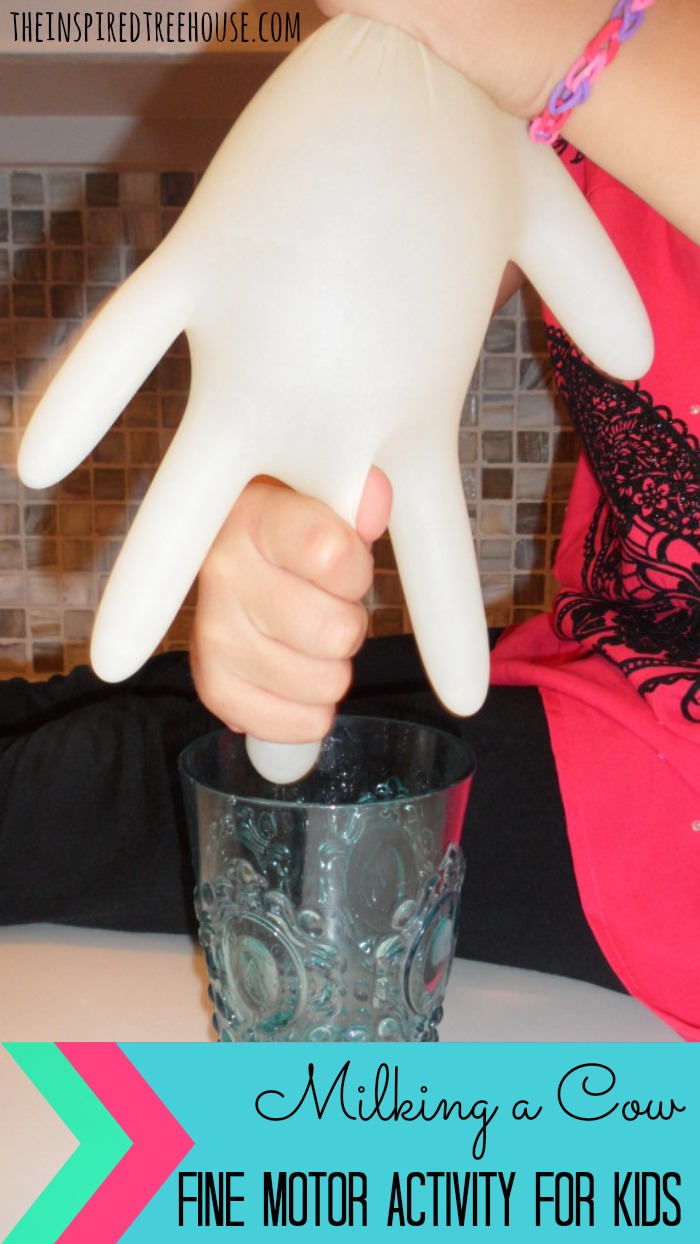
Milk a cow. Take a latex (or non-latex) glove. Fill with water (like a water balloon) and tie it closed. Then use a pin to prick holes in the tips of the fingers. Show your child how to “milk” the water out of the “udder.” (Sources: see Pinterest)

Books to Read

Big Red Barn by Margaret Wise Brown. Sweet bedtime book about a day on the farm, that winds down to bedtime. There are lots of details in the illustrations to talk about.

Farmer Duck by Martin Waddell. A story about a duck who does all the work till the animals rebel against a lazy farmer. Great rhythm. Just a fun story! (Even though my son is 25 now, if I just ask “How goes the work?” he replies “QUACK!” just like Farmer Duck says!)

The Little Rabbit Who Liked to Say MooAllen. Animals try out other animal’s sounds.

The Little Red HenThere are several book versions of this classic tale. Galdone‘s is nice. If you’re making bread, this is a nice tie-in to that activity.

Poke a Dot: Old MacDonald’s Farm. This is a counting book. Each page has plastic dots you can “pop”. I’m normally not a fan of “gimmicky” books, but I think this one is great for learning one-to-one correspondence, an essential math skill.

More fun on the farm ideas at: www.pinterest.com/bcparented

For my full collection of theme-based “Fun with Toddlers”, click on “Fun with Toddlers series” in the right hand side bar. Or if you would like them in printable handout form to share with students, click here.

Nature Connection Pyramid

pyramidi like this infographic from the Nature Kids’ Institute, which gives “recommended daily allowances” style of recommendations for getting your child outside. (They have a free five part series of short videos on “Let’s Bring Childhood Back Outside.”)

They talk about free, unstructured outdoor play once a day. This is about the little stuff, like finding some tree stumps in your neighborhood to climb and jump off of, or stopping at a local plant nursery, going on an autumn leaf hunt or a scavenger hunt in your neighborhood, or walking to the store, or playing in the backyard, or weeding the garden or digging in a sandbox. In the video, they say the best thing is an empty outdoor space with no toys or obvious activities so children get creative and invent their own play.

They suggest that once a week, you make a plan for a nature outing, like a trip to the dog park (whether or not you have a dog), a visit to a farm park or petting zoo, a hike to search for wildlife. You could even just visit the same woods or park every week, and make friends with a tree. At this time of year, try the pumpkin patch.

Once a month, check out a regional, state or national park. Here are some new favorites we found this summer. And once a year, go somewhere wild.

If you find yourself making excuses for why you “just can’t go outside today”, check out my post on overcoming the barriers to outside play.

Why do this? There are so many benefits to outdoor play! Increased creativity and self-direction, decrease in ADHD symptoms, large motor development, lower obesity rates, better vision, and more… As winter sets in, you’ll often feel like your child is “bouncing off the walls” inside. Bundle them up, take them outside, and let them play!

Have you gotten your recommended dose of nature today?

Fun with Toddlers: Fall Theme


fall
Here are a collection of fun toddler activities, crafts, and books related to autumn.

Songs to Sing / Rhymes to Say

Apple Tree
[Miming gestures here; video here]
Way up high in the apple tree.
Two little apples smiled  at me.
I shook that tree just as hard as I could.
Down came the apples
and mmm they were good.

5 Little Pumpkins
http://wiki.kcls.org/index.php/Five_Little_Pumpkins
Five little pumpkins sitting on a gate.
The first one says, “Oh, my.  It’s getting late!”
The second one says, “There are witches in the air!”
The third one says, “But I don’t care.”
The fourth one says, “Let’s run & run & run.”
The fifth one says, “We’re ready for some fun!”
Ooooooooooo went the wind, and OUT went the light,
and five little pumpkins rolled out of sight.

Pumpkin, Pumpkin (tune of Twinkle Twinkle)
Pumpkin, Pumpkin on the ground (crouch down)
How’d you get so big and round? (stretch arms to make a circle)
Once you were a seed so small (pretend to hold a seed)
Now you are a great big ball (make a big circle with hands)

Homemade Toys to Make:

Play-dough: There are LOTS of recipes for Play-dough available online. Here’s one I like: Mix 1 1/2 cups water and 1/2 cup salt. Heat to almost boiling. Remove from the heat and add 2 TBS. vegetable oil, 2 TBS alum*, food coloring. Cool & knead in 2 – 3 cups of flour.

* You can find alum in the spices section of the grocery store. Or you can substitute cream of tartar.

Felt Tree: Cut a tree, leaves & apples from felt. Let your child stick them to a felt board.

Activities / Games to Play:

Sticky spider web. Use painter’s tape / masking tape to make a spider’s web across the doorway. Your child can throw things at the tape and see if they stick. Try cotton balls or wadded up newspaper or whatever small lightweight things you have handy. Source

Leaf Hunt. Go for a walk and collect fall leaves. Talk about the different colors and the different shapes, count how many points they have, compare small to large, and notice smooth edges versus serrated edges. Point out which tree each leaf fell from.

Pumpkins and golf tees: Get a pumpkin, golf tees, and a toy hammer. Kids ages 3 and up can hammer the tees into the pumpkin. For toddlers, you can hammer several golf tees in – they can take the tees out and put them back in – great small motor practice!

Crafts to Do:

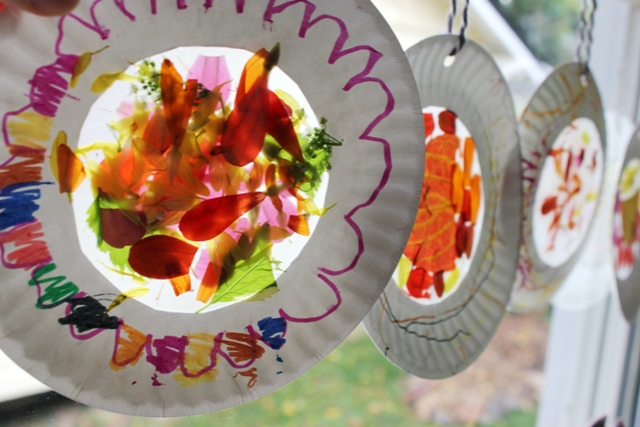
Leaf Suncatchers. (See photo at top of page.) Take the prettiest leaves from your leaf hunt and sandwich them between two layers of clear Con-Tact paper. Frame (if desired) with a paper plate rim or construction paper, and hang in the window. Source

Sticky Apple Tree. Cut out a tree shape from brown contact paper for the trunk. Cut green paper leaves and red paper apples (or use green and red pompoms). Hang the contact paper on the wall, with the sticky side facing out.  Let your child stick “leaves” and “apples” to the tree, take them off the tree, and stick on again. Inspiration

Apple prints. Put some paint on a tray. Cut an apple in half. Show your child how to make prints by dipping the apple in the paint, then pressing it on to a paper. Source

Pumpkin finger puppets. Make finger puppets to go with the five little pumpkins rhyme. You could make them with playdough or felt or mini post-it-notes stuck to your fingers.

Books to Read:

  • Owl Babies by Martin Waddell. One of our favorites!! A sweet story about three baby owls who worry when mama goes hunting. But of course mama comes back!
  • Five Little Pumpkins by Dan Yaccarino. An illustrated edition of the finger rhyme above.
  • Apples and Pumpkinsby Anne Rockwell. Simple book that features fall themes like apple picking, jack-o-lantern carving, and trick or treat.
  • Apple Farmer Annie by Monica Wellington. For kids 4 and up. Talks about apple picking, counting, sorting, baking, and selling at a farmer’s market.
  • The Very Busy Spider by Eric Carle. Lots of farm animal noises & repetitive lines for kids to join in on.
  • The Itsy Bitsy Spider by Iza Trapani. Builds on the classic and familiar song as the spider goes on further adventures around a house

Printable handout of these fall activities here.

More ideas (and source citations) for this topic at: http://www.pinterest.com/bcparented

For my full collection of theme-based “Fun with Toddlers”, click on “Fun with Toddlers series” in the right hand side bar. Or if you would like them in printable handout form to share with students, click here.

photo at top of page from: http://artfulparent.com/2011/09/fall-nature-suncatchers.html