Tag Archives: preschool

What children learn in a multi-age classroom

A while back, I wrote about mixed-age play and the benefits of multi-age classrooms. Today, I’ll describe what the learning experience is like for different ages of children at my Family Inventors’ class. We enroll children ages 3 – 7. When I say that to many preschool teachers, they are startled, saying “that’s a really wide range of developmental abilities! How does that work out?” We think it works great!

Why do we teach mixed age?

We want to be able to welcome a whole family in to participate. We are a parent co-op, which means that parents work in the classroom once a month, and they typically “stay and play” with their child on the days they’re not working. We want it to be possible for parents to be able to attend the class with all of their children. About a third of our families have two children in the class. We’ve had a couple families where three kids fit in our age range!

But it’s also because we believe in the benefits of multi-age classrooms: the younger kids tend to learn faster and learn more when they can observe the older children’s learning process. The older kids learn empathy and responsibility by interacting with the younger ones, but they also learn the academic concepts better through the process of explaining their ideas to the younger kids.

Can the little ones follow all the ideas you cover?

We are a STEM-based program. Some of our themes this year are: Chemistry – Solutions; Biology – Habitats; Building Towers, Tunnels and Bridges; and a multi-week unit on Simple Machines. We talk about these ideas in circle time and read books about them, but we also have lots of hands-on exercises to help children explore and discover some of the foundations of science. We expect that our 5 – 7 year olds will understand everything we teach. And they do. They’re able to understand the ideas, apply them to the class exercises, and extrapolate from them to a deeper understanding. They remember the concepts we talked about in circle.

Our pre-K age kids (age 4 – 5) get some of the ideas. They definitely understand the hands-on exercises and experience “gravity” and can describe to you what it is that they’ve learned about how gravity affects something. They don’t necessarily make any leaps beyond what we cover in class, and they may or may not remember the concept behind the exercises a few months later. (But, if you ask them to repeat an activity they learned in class… like asking “If I roll a toy car down this steep ramp and another one down this not-so-steep ramp, which will go faster”, they will remember that hands-on learning.) They definitely grasp more concepts by watching the older kids’ “a-ha moments” than they would grasp if the class was just adults telling them stuff.

Our littlest ones, the young 3’s, may not get the scientific concepts at all. And we don’t expect them to. What they get is a great preschool class with water play, sensory play, play-dough, building with blocks, stories, songs, and outdoor time – things that build small motor-skills, large motor skills, musical skills, language, and social development. They get exposed to lots of opportunities to play with how the world works. They rub balloons on their hair to make their hair stand up. We play with things that float on water and things that sink. We play with balls that roll down tracks. Some day, later in life, when someone talks to them about static electricity or buoyancy, or when they want to build their own marble maze, they’ll have this foundational knowledge in their brain, ready to be built upon.

What about the social dynamics?

In general, our olders play very well with our youngers. They naturally mentor them and help them out with simple tasks, like writing their names or tearing off a piece of tape. The children who are older siblings do especially well at this. But, for those who don’t have a younger sibling at home, it’s a great chance to practice interacting with someone who is younger and less knowledgeable than they are.

Our younger kids love having the big kids to follow around. They learn from them, play with them, imitate them. They may turn to an older child for help with things instead of always turning to adults for help, and learn more in the process.

For us as the teachers having this wide age range is definitely a challenge for curriculum planning. For each activity, we think about how each age of child can learn from it. For example, a simple activity might be setting out plastic bugs and containers on a table. The littlest children just play with the bugs and move them around and in and out of containers however they want (practicing small motor skills). The middle-ages may be encouraged to count them OR to taught the difference between beetles and spiders and flying bugs and asked to sort them. The oldest kids are asked to figure out what the three types of bugs are, then sort them into categories and then count how many of each category there are.

If we’re building pompom launchers with plastic spoons, rubber bands and craft sticks, we show the young ones how to build one (and help them as needed) then encourage them to play with them. For the older children, we let them figure out how to build one by looking at the prototype. We have them test it, then set a goal for themselves – do they want it to launch multiple pompoms? Or launch further? Or with more accuracy? We encourage them to tinker and adapt their designs using other available materials to achieve their goals.

We can’t assume that any of our students know how to read, but many of them do. And parents are always around to read for them if needed. So, we do put out signs at each activity that explain how it connects to the concepts of the day. And some weeks, like our “What is a Scientist” week, we put out worksheets that encourage children to do an experiment and record their results (like how many times a flipped coin lands heads-up or how many drops of water can they put on a penny). We’re hopeful that our oldest kids get some math and writing practice at those stations, but we figure our youngest kids get to learn how to flip a coin and notice that it has two different sides, and get to learn the fine motor skill of using an eye dropper and the hand-eye coordination of trying to get the drops to land on a penny. There is learning at every level.

When providing all this individualized learning, it helps a lot that we have a lot of adults in the room. In addition to our teachers, as a co-op, we also have some parents working in the classroom each week, and because we’re a Saturday class, the majority of parents actually stay-and-play each week. So, there’s always a grown-up around to help, but we also encourage the parents to sit back and let their children explore independently and support each other’s learning whenever possible.

The most exciting part is when kids come back year after year – we’ve had children join us for three or four years in a row. We see them go from the three year old who is splashing in the water table and finger painting to the 6 year old who is exploring our challenge projects, and stretching their learning to new levels of understanding. Although they may be doing the same activity they did the previous year, their level of skill mastery and understanding has stepped up a huge notch.

Mindport in Bellingham

mindportIn Bellingham, WA, there’s a fascinating place called Mindport.

It’s a little like an art gallery full of beautifully crafted exhibits… but unlike art galleries, you get to touch and interact with everything! It’s a little like a children’s museum where children are welcomed and can explore and play with everything… but the exhibits are intriguing enough that all the adults in the room were as engaged as the kids. It’s like a science museum with exhibits that illustrate scientific concepts – and binders that explain the details… but it’s prettier, and somehow more soothing and meditative, than any science museum I’ve been in.

Here’s how their website defines what they are:

MINDPORT (mind port) n.: 1. a museum of phenomena; 2.) a provocative blend of art and interactive exhibits; 3.) a place to spark your awareness and stimulate your thinking; 4.) a place to play and to observe.

Before going to Mindport, I read a review that said “everything about them is amazing… except their website.” I have to agree. The website only includes brief descriptions of a few of the exhibits, and a brief description of “what are we” is buried way down in the blog archives. Not enough to give you a good sense of what to expect. So, I’m going to give some detailed descriptions here of the experience and some of the exhibits, then offer a few more photos as “teasers” of what else you’ll discover here.

The Location

Mindport is in downtown Bellingham, WA. It’s in a retail storefront space, about the size of two typical stores, so not huge. Admission is only $2. There are lots of restaurants and other museums within walking distance. It was fairly busy for the first hour or two we were there (on July 3), but never crowded and never loud. By the end of our time there (mid-afternoon), we were the only family, and had some nice chats with a very friendly and helpful docent, and our son got to play the pipe organ, which they ask that only skilled musicians play when it’s crowded, as you can hear it throughout the museum.

The Exhibits

The first exhibit we came to (#1 in the photos above) was the deep sea divers. Pump a hand bulb and plastic divers descend down the tube toward you. Stop pumping, and they pop back up to the surface. Our four year old had a hard time pumping effectively, but a 6 year old did great. They both liked seeing the divers come down.

They had a ball wall (#2). As people who frequent children’s museums and science museums across the country, we are connoisseurs of ball walls, also known as marble runs. (For ideas on how to build your own, check out my post here.) I really liked this peg board system, and all the different sizes of tracks available (notice the rack to the left with all the tracks organized and ready to use.) It was very adjustable and we found lots of fun ways to build it then re-engineer it. (Which is why I love ball walls. I think they’re a fabulous way to teach your child the engineering method: build something – test it – adjust it so it works – test it – adjust it again to make it even better – test it again. Read my post here on how willingness to fail and try again is a key to success.) Only downside – they only had three marbles. I understand not having too many, because then kids don’t chase them down when they escape the ball run and other people step on them. But 5 would be nice so me and a couple kids could play at the same time.

The Aerotrack (#3) allows you to put a ball in a pneumatic tube, then air shoots it along a track and returns it to you. You can choose three tracks. One is very short and very fast. One takes the ball all the way up to ceiling height, then around several loops before returning it to you. My engineering-minded husband enjoyed figuring out where the switching point was and how it changed which track it went on. (I won’t tell you – we’ll leave that as an exercise for the reader.) This was one of our son’s favorite exhibits. The museum was small enough and mellow enough that we were able to leave him here playing while we explored other exhibits nearby, which I appreciated. (Unlike other times where I’ve been stuck at a ball wall or other exhibit for an hour while he played and I read Facebook on my phone… I mean, I like playing with him at an exhibit and all… but this boy has a LONG attention span and a greater joy in repetition than I apparently have…)

#4 is the Diabalique, a table that you tilt side to side to run balls through a maze. Read a short article on it here, or watch the “Making of” video.

#5 is “Burl Ives”, a piece of burl wood that when you rock it gently from side to side, it plays musical tones. So hard to explain – I wish I’d made a video, but very intriguing to play with, probably even more so for a very musically oriented person.

#6 and 7 are the Pneumatic Ping Pong. The majority of the exhibits have signs that explain how they work and binders that talk about either the design process or the scientific principles. The sign on this one says “Note: we only added instructions here because a visitor asked why there weren’t any. Please feel free to pretend there still aren’t. 1. Press the on button. 2. Play.” Here’s a brief video:

Playing with lightweight objects floating on air currents is just an on-going source of fun for kids (and yes, for me). We’ve built a wind tube (see more here), and what I call a “scarf poof” – like all those exhibits at children’s museums where you feed a scarf into a tube, and the air shoots it through and out the other end. (Some day I’ll write a blog post on how we built this…. it’s still a work in progress in our tinkering process.) And now this pneumatic ping pong is on my list of possible future projects…

This next video shows an exhibit with 100 compasses mounted on a lazy susan with a magnet suspended above… watch how the compass needles respond to the magnet:

This video shows a marble elevator. You turn the crank and the marbles go uphill, then roll down ramps. Like so many other exhibits, this and the compass exhibit show the melding between beautiful art – their woodworking is fabulous – and interactive experience.

But wait… there’s more.

They do have plenty of art on the walls, like GIANT TASKS / tiny people, which are quite nice. I’m a very kinesthetic, non-visual person, so I confess that I spent more time with the hands-on interactive items.

The joy of this place is when you see something and think: “that doesn’t look like much of anything”, your next thought is “hmmm…. maybe I should interact with it and see what it does.” On the left below, you’ll see a table that’s perfectly lovely, but a bit dull. But then when you spin it, you see wave patterns form inside it – see middle photo – you can click on the photos to see them full screen. (On their blog, Swirl is “a stand-alone sculpture featuring rheoscopic fluid under glass, [which] evokes air and ocean currents.”)

doessomethingThere’s also a picture with colored glass tiles in it, which again is lovely enough, but a little dull. But the video shows what happens when you wave a hand in front of it.

Here’s some more photos of other exhibits to inspire you to travel up to learn what they do! (Click on the pictures to see a full screen version.)

theresmore

Learn more:

There are more details about some of their exhibits in their blog archives: http://mindportexhibits.blogspot.com/, which also include some interesting long articles on the nature of things like science education (STEAHM… putting the Arts and Humanities into STEP education) and insights into the training and mindset of a tinkerer / inventor / maker: director Kevin Jones.

I enjoyed the place so much, I wanted to give them more money on the way out, but they didn’t have a donations box. When I got home, I looked at their website for a “donate here” button, but they didn’t have one. I did find a note in their blog archives that they are not a registered non-profit. But I would still be happy to contribute more to their work, and would suggest that they offer an easy opportunity to pay more than $2. I don’t know how many people would do it, but there’s probably other “crazy” people like me who would.

The trip to Bellingham

Overall, it’s a nice day-trip from the Seattle area. It’s well worth the 80 minute drive we did from Kirkland. It’s not an “all day” activity. Our family spent a little over two hours there and were actively engaged the whole time, but had explored it all by the end of that time. But since it’s so cheap, even if you just dropped by for an hour, there’s plenty more to explore in downtown Bellingham. I’d recommend it for children and adults, and particularly for students of my Family Inventors class. (Note: it’s great for age 4 on up. 3 year olds would likely do OK, but probably not worth a road trip if you have a toddler)

MIndport doesn’t open till noon on Fridays (and isn’t open at all on Mondays and Tuesdays, FYI), so we had a lunch beforehand at Mount Bakery a block away. The brie, apple, and pear crepe was fabulous, and they had great service. Our waitress saw that our son was really hungry, and brought his food out early, but held it up high where he couldn’t see and mouthed to us: “OK to give this to him now?” I appreciated having the chance to give the idea a thumbs up.

After Mindport, we stopped by the Comics Place, across the street, and picked up a comic book for our son to read in the car on the way home. There’s also lots of used book stores nearby, if you prefer.

On our next road trip to Bellingham, we look forward to a quiet morning exploring the FIG (Family Interactive Gallery) at Whatcom Museum, then a loud and exciting afternoon at the MegaZapper electrical show at the Spark Museum of Electrical Invention – only held on Saturdays and Sundays. (We LOVE the Theater of Electricity at the Boston Museum of Science.) We also plan to return to Mindport someday – I want to play with the ball wall some more!

Are your classes gender inclusive?

IMG_0671If you teach classes for children, what do you do to ensure that all genders feel welcome?

Many parents have had the experience of taking their child to a class that felt very biased toward girls or toward boys. (Read about my experience in my son’s dance class.) Some parents and kids stick it out even when all the messages say “you don’t belong here.” But many will drop out, looking for somewhere that they feel like they belong. What can teachers and administrators do to welcome all genders**?

Let’s examine some of the ways we can help.

How do you encourage all genders to enroll in your program? Think about:

  • Your class name: If you name your class “toddlers and tutus”, that pretty much implies it’s a girls-only class. If that’s what you intend, that’s fine. Say so. But if you’d like boys to enroll, think about a name change!
  • The words in your marketing: Whether it’s on brochures, posters, website, or social media, when you describe your program, do you talk about boys and girls and state that all are welcome?
  • The pictures in your marketing: Are there boys and girls and gender ambiguous kids? Boys and girls doing things together? If your photos show only girls playing dress-up and only boys climbing on play equipment, it’s easy to infer a gender bias.

How do you make your space welcoming to all genders? Think about:

  • The environment of your classroom: do pictures show both boys and girls doing a wide variety of activities? Are the colors gender neutral or diverse, or is it all pink ribbons or blue cars? Do you cluster all the “boy activities” in one area, and the “girl activities” in another area. (Cars and blocks here, kitchen and dress-up there.)
  • Your bathrooms: If you have single occupant bathrooms, are they labelled “boys” and “girls” (or “men” and “women”)? Why? Can’t you just label them both “restroom” or say explicitly “all gender restroom”?

How do you greet children and families into your classes? Think about:

  • The words you use when talking to parents: I prefer saying “kids” or “children” or “students” which includes everyone. If you want to say “sons” then also say “daughters.” If you say “girls” also say “boys.”
  • The words you use talking to the children: Instead of calling over the “boys and girls” for an activity, can you call them “kids”? Or even better: “dancers” or “artists” or “inventors” or  “everyone ready to play some soccer”? Not only is it gender inclusive, it allows them to take on the identity of a dancer or an artist and so on.
  • The way you react when a person of the less expected gender joins your program: Definitely welcome the person just as you welcome all others. But DON’T go way overboard in welcoming them, like “Oh, it’s so wonderful to have a girl in this class. I really wish more girls would enroll. I’m so delighted to have a girl.” All that tells them that you think it’s weird that they’re there.
  • How do you define which gender a child is? Well, the more gender neutral your practice is, the less this matters. But, when you have to guess, it’s fair to go by name, apparent biological sex, and apparent gender presentation. (For example, if you see someone who looks like a biological male, whose name is John, and who’s wearing a Spiderman t-shirt, you can guess boy.) But, if the child or the child’s family tell you the child’s gender, then honor that, even if it’s different from your initial assumption. If John in the Spiderman shirt says “I’m a girl, please say she and her when talking about me”, then do so! You can also invite parents and children to let you know what name they prefer to use, and what pronouns they use.

How do you make sure that daily life in your classroom is inclusive? Pay attention to:

  • The ways you divide up the group: Do you often go for the “boys on this side” and “girls on this side” way of splitting up the class for small group activities? Try mixing in “kids wearing white here” and “kids wearing blue” or “kids who like dogs best” and “kids who like cats best” and “kids who have birthdays in January through June” and “July through December.” Not only is this gender neutral, it also gets them mixing up a lot more and finding things they have in common with each other. (If we always groups divide into girls and boys, it can become an “us” and “them” mentality where the kids see the differences more than the similarities. We would NEVER divide kids up by race for a game, why is it seen as OK to divide them by gender?)
  • The books you read: Do they show both boys and girls, men and women, and androgynous folks doing a variety of things? In our Family Inventors’ Lab, we try to make sure that we read books about girls inventing, and boys studying animals, and so on. We’ll talk about Thomas Edison and Marie Curie.
  • Pay attention to labels: Use firefighter, not fireman. Flight attendant not stewardess.
  • Minimize stereotyped gender roles: When a group of children is playing house, don’t assume one will be the mother and cook and care for the baby. If children make that assumption, that’s OK but you shouldn’t place that assumption on them. Try not to say “wow – this is a woman astronaut… isn’t it great that women can be astronauts too?” It implies that this is a special case, not an equal opportunity.
  • Help soften their stereotypes. Around 2, children start defining things as “boy toys and girl toys“, around age 3 or 4, children start defining activities as “boys do this and girls do that” and around 4 to 6 they say “only boys can do this and only girls can do that.” (source)  You can remind them that anyone can choose any toy or activity, according to their own personal interests. But, don’t get too distressed by this. Stereotypes and sweeping generalizations is one way that kids make sense of their world.
  • Adjust your expectations of who will do each activity option: I confess that when I set up our classroom, in my head, I think “what’s my boy activity today.” By that, I really mean: I want to make sure I have an activity that will appeal to those kids who are full of physical energy and really need some big motor release. I need to come up with a new term for that, even in my own head. I’ve never said to anyone else “this is our boy activity” but I need to think of it in other terms myself to reduce my bias.
  • The way you react to the activities they choose: I still remember a coop preschool my middle child was in 14 years ago… one little boy in the class LOVED to dress up in pretty dresses and high heels and carry purses, and so on. Almost every parent volunteer who saw him do this tried to entice him either to choose different clothes (the firefighter helmet) or to choose a different activity (blocks or cars.) Although none of them said anything negative to him, there was definitely an undercurrent of “you shouldn’t do that.” In this case, the teacher gently modeled for all the parents that it was OK for the boy to do whatever activities he enjoyed.
  • How do you handle emotions: Are you sympathetic to a girl’s cries, but tell a boy to stop crying? Are you shocked when a girl shows anger, but act as though it’s normal when a boy does? Do you place similar limits on their behavior or do you let boys get away with more, because “boys will be boys.” Do you congratulate both boys and girls for sitting still and paying attention?
  • How you respond to bullying: If a child is being teased or bullied due to gender issues, be clear that it’s unacceptable in your classroom. But, don’t use this as a reason for punishment, instead use it as a reason to teach.

Check out this article on 6 ways to embrace gender differences and this one on 12 easy steps on the way to gender inclusiveness. Also, read my summary of what the research shows on innate gender differences vs. cultural influence, and on how to support both boys and girls in developing their strengths. If you want to learn more about transgender people, here is a nice overview. And here are pointers for Talking with Children about Gender Identity.

What other ideas do you have for welcoming all genders?

** I want to clarify why I’m saying “all genders” rather than “both genders.” In your classes, the majority of your kids may be cisgender: either girl-bodied-who-identify-as-girls or boy-bodied-who-identify-as-boys. But, you may also have transgender or gender queer or intersex children who don’t quite fit those straightforward binary definitions. Some of those kids won’t figure this out till adulthood, but some have the sense from very early in life that their assigned gender doesn’t fit. They and their families are already having a hard time sorting that out. If they go to a very gendered environment, it makes it even harder to know how they fit in and creates even more gender dysphoria (distress caused by the dissonance between how a person feels about their own identity versus how they are perceived / treated by others). If they are in a more gender neutral, gender inclusive environment, it’s easier for them to feel like the person they are is welcome there. Learn more about gender identity: https://gooddayswithkids.com/2018/05/02/gender-identity/

Photo: http://academyofmusicanddancenj.com/fall-2014-registration-dance-classes/

Boys in Dance Class

billyellrevI am working on a post about “how to make sure your classes are gender inclusive.” But first, I thought I’d share my story of why this topic is on my mind right now…

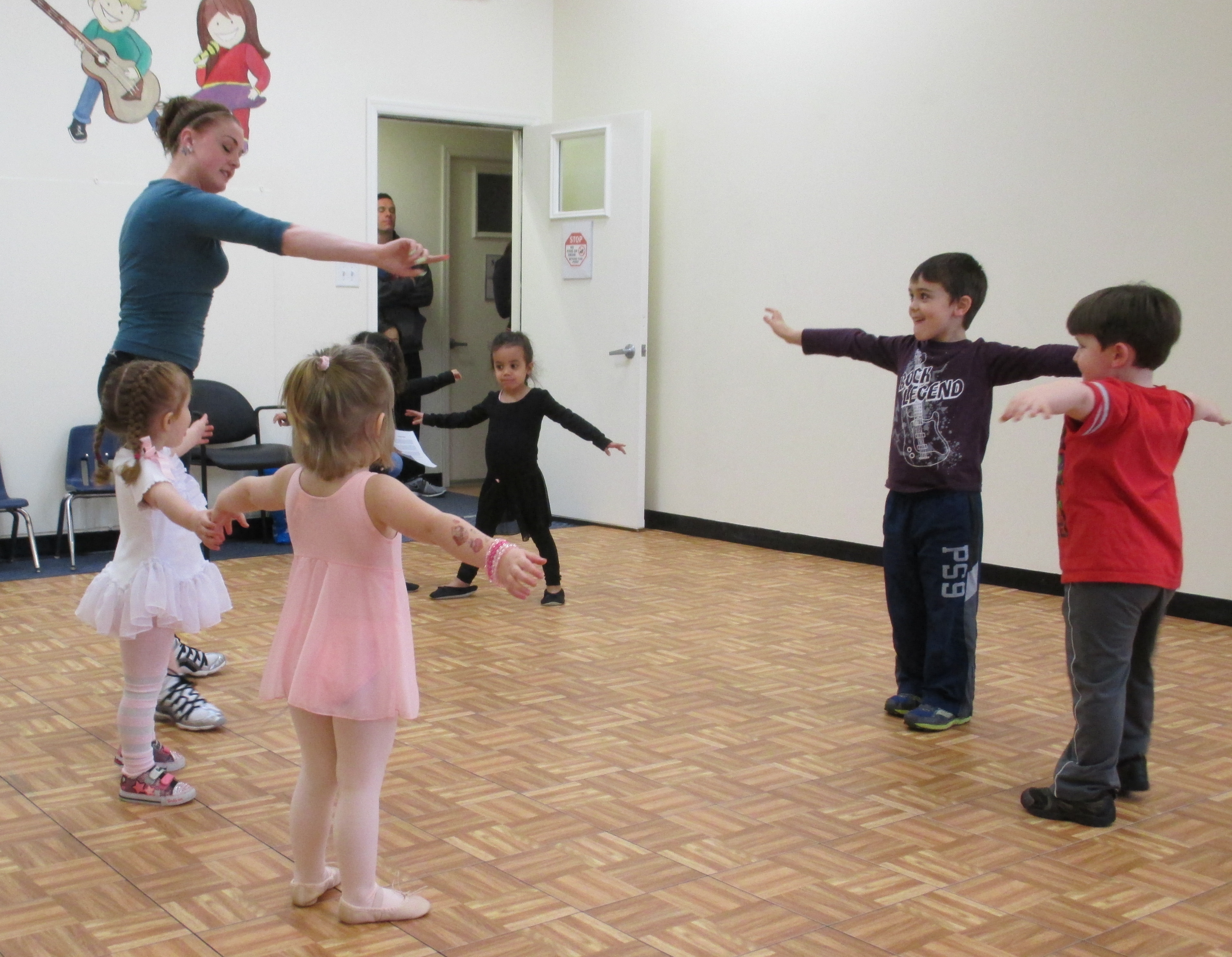
My 4-year-old son has recently started taking a ballet and tap dance class. Note: this is not advertised in any way as a girls’ dance class… in theory, it is open to all. Realistically, I knew Ben was likely to be the only boy. But even knowing that, it’s surprising to me just how girl-centric the class is.

On the first day, the teacher said “we have 10 girls enrolled in this class, so if you would like to move your daughter to a smaller class, you could do the 5:00 class”. Really, the class has 9 girls and one boy. The name Ben on the roster should have been a clue. And referring to our “daughters” when my son was sitting on my lap seemed odd.

Then she said “OK girls, come on over to dance.” And out run the girls in pink leotards and tiaras, and Ben in his blue shorts and Lego Star Wars t-shirt. (The class does not require any particular clothing. The other parents all chose leotards. I chose his favorite regular clothes.)

The teacher put on princess music (it’s all princess music… Little Mermaid, Frozen, etc.) and handed them all pink scarves, and they began to dance around the room. The walls  of the room are decorated with paintings and photos of girls in tutus. Not a single male dancer in sight.

And it’s not just this dance class. My older children took dance for years, and I know it’s pretty systemic. I’ve seen lots of pink leotards and paintings of ballerinas over the year. You can’t even buy boy’s dance shoes in my son’s size – manufacturers don’t make them – so he’s wearing pink ballet shoes and the least girly tap shoes I could order. In all the dance classes my daughters ever took, there was never more than one boy in their class. In recitals, boys are rare, and you can tell the instructor struggled to figure out what a boy costume should look like.

boyAnd it’s not just dance. With my older kids, it was rare to see boys in any of their  gymnastics classes. I’m told it’s the same in the equestrian world. And in all the theater activities my kids have done, the ratio is usually, at best, one-third boys and two-thirds girls. In pretty much any audition they’ve attended, my girls knew that every boy who auditioned would get a part. Some girls would get a girl part, some girls would get a boy part, and some girls would not get cast.

And, if boys do stick with dance as they get older, or do gymnastics or theater, what does our culture assume about their “manliness”, gender identity, and/or sexual orientation? If they’re straight, cisgender boys, then people talk about how “lovely” it is that they’ve stuck with their interest despite stereotypes. But all these attitudes show: They’re not generally viewed as “regular boys.”

The gender divide goes the other way in other extra-curricular activities. The STEM themed preschool-age class I teach tends to be two-thirds boys and one-third girls. I know from experience that the wilderness survival courses, aikido classes, computer programming classes, video gaming sessions and role-playing games (Dungeons & Dragons) that my daughters participated in had way more boys than girls.

And those girls are labeled tomboys, or, as they get older, butch. Or “a girl who excels in science.” The adults around them may be proud of how they are overcoming gender stereotypes. But again, they’re not viewed as “regular girls.”

Why is the gender divide still so clear in what activities are considered “boy things” and what are considered “girl things”?

I think if you asked most of the parents I encounter at these classes about their views on gender issues, they would talk a lot about the importance of equal access to all activities for all genders. I think they would all vehemently defend a boy’s right to take dance classes or a girl’s right to program computers. Many would share dismay over the fact that toy stores and clothing stores are so gendered.

Yet, when these same parents choose classes and camps to enroll their kids into, they perpetuate the gender roles.

Now, I know that the average boy may have different skills and interests than the average girl. The research shows it, as does anecdotal evidence. However, the researcthh shows that those differences are small, and that there is just as much difference between individual boys (the athlete, the brain, the criminal) as there is between an individual boy and an individual girl (the athlete and the princess).

Yes, boys are statistically more likely to like toy trains and cars than girls are. But that doesn’t mean there aren’t plenty of girls who would like trains, and plenty of boys who don’t really care. In choosing toys, I like to offer a variety of options without assuming what the child will like based on their gender. And when choosing activities for young children, I try a wide variety of activities, regardless of whether they are viewed as “boy things” or “girl things.” As  kids get older, they partially follow their inherent interests, but they will also be more likely to pursue activities where they feel like they “belong” and they “fit in.” Those male gymnasts, male ballet dancers, female programmers, and female wilderness guides all deserve some kudos for sticking with a passion even when the culture didn’t welcome them.

We can make it easier on the next generation. Parents can do their part by encouraging their children to try a wide variety of activities, and by not expressing surprise when a child of the “unexpected” gender is enrolled in those activities. Teachers and program administrators can also do a lot to make their classes gender inclusive.

We should all also remain aware that gender is not as clear-cut and binary as we were raised to believe. Any child in a class may not identify as the gender they were assigned at birth. Some transgender people don’t recognize this until adulthood. But some very young children have already figured out that they don’t fit the typical definition of “boy” or “girl.” It’s even harder for them to go into environments where assumptions are made about who belongs there, and who can participate based on gender labels. By making our cultural assumptions about gender more fluid, we make it easier for these children to find their place in the world. (More on gender identity: https://gooddayswithkids.com/2018/05/02/gender-identity/)

Just for the fun of it, I’ll conclude this post with a pointer to a playlist I’ve made on YouTube called Boys Can Dance, which features dances from Billy Elliot, West Side Story, Singing in the Rain, and lots more. https://www.youtube.com/watch?v=iOuZuAGvMRg&list=PLsMLXfBPSxoEF6nPQj13QjvAX-I53Ob2R  Or, if you’d like a little more modern / urban / less Broadway, check out the League of Extraordinary Dancers: https://www.youtube.com/watch?v=qVZyfsaKPS4&list=PLTXGCzZ9AAzPhEM_y-vudz1GbwsMhVL_0

Growing Up Wild Activity Book

See the source image

Project Wild offers a great resource for educators and parents with children aged 3 – 7. The Growing Up Wild book (order it here) covers 27 themes, including “Oh Deer (a habitat theme)”, “The Deep Blue Sea”, “Who Lives in a Tree”, and “Wildlife is Everywhere.” Each theme includes: several ideas for group activities, and for self-guided exploration stations, recommended books (fiction and non-fiction), songs and movement activities, outdoor exploration ideas, math activities, art projects, snack ideas, links to videos (listed here) and “take home” sheets with ideas for parents to try at home. (See sample theme here.)  Each theme also includes a list of numerical codes for which Head Start Domains and which NAEYC Accreditation Criteria are met by the activities, and warm up and wrap up activities to assess children’s prior knowledge and learning outcomes. (Learn more about the contents of the book here.)

I attended a training where we had the opportunity to try out several of these activities. Some samples:

  • Looking at Leaves. The instructor had collected 25 leaves, and given us each one. She asked us to look at our leaves and memorize them. You could ask children to think about how to describe their leaf: shape, color, texture, and so on. Then we put them all in a pile and mixed them up, then had to find our own. Simple, free, and great for teaching attention to detail, visual discrimination, and short-term memory. Easy to customize to age group, or to start a year with leaves that are very easy to tell apart, and over the course of time, have collections with more subtle differences. After the leaf match, you could take them outdoors to find the plant their leaf came from. You could also do leaf rubbings or leaf prints, then add the leaves to a collage.
  • Spider Web Wonders. Draw a spider, discussing its anatomy (head, abdomen, 8 eyes, 8 legs that attach to the “head”). Children create spiders with a variety of craft or snack materials. The math game is “how many legs”. The teacher holds up a sign saying 0, and asking what creatures have zero legs. After children guesses, turn over the card to show a picture of the answers. (Snake, worm, etc.) Then do 1, 2, 4, 6, 8, 14, 30+. A take home at Halloween time could be to check out Halloween decorations, and see how many of them get the spider anatomy wrong.
  • Hiding in Plain Sight. Gather a collection of toy animals (stuffed or plastic). Begin with a matched pair, and hide one in plain sight before the children arrive. Then show them the matching animal animal and see if they can spot the hidden one in the room. Talk about how it was hiding  in plain sight – for example, placed in front of a similar colored item it could blend into, or placed somewhere that’s visually very busy so it could “hide” in the clutter. Explain the basics of camouflage. Next, the teacher or some children “hide” more animals, either in the classroom or outdoors. BUT… they should be told to hide them in plain sight. Then take the other children out to search. Then, build camouflage collages: cut out photos of animals, have the child paste one onto paper, then surround it with tissue paper squares in the colors that would camouflage it. Play “freeze birds”, explaining that even when animals are camouflaged, they give themselves away if they move. The “hawk” closes his eyes while the “bluebirds” play. When you call out freeze, they freeze, and the hawk opens his eyes. If he sees anyone move, they become the hawk.

That’s just a small sampling of ideas. For educators this book could provide a full ready-made nature curriculum for  your class, or could provide lots of ideas you might sample as you build your own curriculum. For parents, there’s plenty of fun and easy ideas in here – you can try out any that seem fun to you.

To learn more about nature play, click on these links “Recommended Daily Allowance of Outdoor Time“, Benefits of Outdoor Play, and Overcoming the Barriers to Outside Play.