Tag Archives: play

Benefits of Multi-Age Classrooms

multi-ageAs fall rolls around, you may be looking for a preschool, or scheduling other activities for your little ones. One thing you may encounter is preschools with a “multi-age” classroom, or activities with a wide range of ages: where some programs are limited to children born within a few months of each other (age 2 – 2.5), others are open to children from toddler to kindergarten (age 2 – 5).

The advantages to close age groupings is that all activities can be tailored to the exact developmental capabilities of that age group. My kids have had lots of great experiences in these types of programs.

But, I also like to be sure my kids have exposure both to formal / facilitated programs that are multi-age and to opportunities for free play with kids of wide ranging ages. I think there’s a lot to be learned in these experiences.

A Historical / Evolutionary Perspective

Historically, children were more likely to be from large families, sharing a home with siblings of a wide range of ages. In the U.S. today, we tend to have much smaller families. Amongst women born in 1935 (parenting from approximately 1955 – 1985), 37% raised four or more children. Of women born in 1960, only 11% had four or more children. In 2010, only 9% of households had three or more children. (20% of kids are only children.) So, children used to have a multi-age experience in their own home, and are much less likely to have that now.

Also, through much of human history, we have lived in small tribes or, later, small towns. With a small community, there are only so many children, so it’s likely that those children represent a wide age range. Think of rural “one room school houses” that might serve 15 children ranging in age from 5 to 18. So, in the community, formal education and informal play was almost always ‘multi-age.’ Now we put thirty 5-year-olds in one room for kindergarten. Or, in recent years in the Seattle area, we had one “freshman campus” school that was for 9th graders only – putting approximately 1000 kids of the same age into one building. In The Benefits of Mixed Age Grouping (1995), Katz wrote “Although humans are not usually born in litters, we seem to insist that they be educated in them.”

So, historically, most kids have interacted with kids of all ages. Currently, many kids spend most of their time with their age cohort. Is anything lost by doing that? Here’s an examination of some of the benefits of multi-age education and play.

What is a multi-age classroom?

A class where students range in age, with an age span of 2 or more years. Typically, children stay in the classroom for a few years. For example, in a multi-age preschool serving ages 3 – 5, children typically enter at 3 and are the younger ones that year, then stay on for a second year as the older ones. In their second year, they may attend more days a week than they did as a 3 year old.

The goal of a multi-age classroom is heterogeneity. You want a wide range in experience, knowledge, skills, and interests. The teacher uses a variety of techniques, including individual work, small groups, and large group exercises to ensure that each individual child is receiving an education that is stimulating and effective while not being overwhelming.

Note: in this post, I am not referring to an accidental multi-grade classroom, where due to budgetary constraints, space limitations, or a limited student population, multiple ages of kids have been thrown together in a classroom with a teacher who may or may not be prepared to handle this. I’m talking about intentional multi-age programs where the curriculum is set up to maximize the strengths of the diverse grouping.

Benefits of Multi-Age Classrooms

  • If you have two children of different ages, they can be in the same class together, which might be reassuring to them and is definitely easier for your daily logistics.
  • Knowledge-Building and Skill Development: Younger children learn from older children. Older children reinforce and deepen their own understanding of a topic or skill by teaching it to the younger kids. This knowledge is passed on in a variety of ways:
    • Unintended modelling – when an older child is just doing something they want or need to do, not attempting to teach (like using the potty or drawing a picture of a dog). The older child may not even be aware the younger child is observing and absorbing. “Nothing is more interesting to a child than another child who has the skills that he or she wants to acquire” (Merrick, cited in Panko)
    • Social play: The younger ones are exposed to things like better emotional regulation and more sophisticated problem-solving which helps them learn these skills earlier.
    • Casual mentoring. When an older child wants the younger one to participate in a game or activity, she will just quickly explain it to the younger one so they can have fun together. When the older one is slowed down by the younger one’s lack of knowledge, sometimes they move in to help rather than waiting for the teacher to help. (Like putting on boots so they can go outside for recess.) Also, younger children learn which classmates they can go to for help with various tasks, and may seek out their help before asking a teacher. (At one lunch, kids were given fortune cookies. All the non-readers went straight to the kids who could read to ask for a quick answer to ‘what does this say?’)
    • Intentional teaching. Sometimes teachers will ask a child who has mastered a skill to teach it to a child who hasn’t yet mastered it. (Sometimes this is an older child teaching a younger child, but it can also be the other way around, as children gain skills at diverse ages.) The learner benefits by gaining information in a way that may be more fun and more confidence-building than learning from an adult. The child who is teaching has the chance to review his own knowledge from a new perspective, and practice mastering skills.
    • If older kids give incorrect information, the teacher can correct it, and both kids benefit – the teacher has discovered the older child’s misconception, which she otherwise might not have known about and makes sure both kids know the correct info. (This can remind the younger child that we’re all learners, and we can all make mistakes.)
  • Individualized curriculum, tailored to children’s unique skills, not just their age
    • A good multi-age program is child centered. Projects and assignments are tailored to the needs and interests of the children as individuals.
    • Children are more able to learn at their own pace, making continuous progress rather than having to “wait till second grade, when we cover that.”
  • Children stay with the same teacher for multiple years.
    • The teacher gets to know the child’s strengths and weaknesses, and is better able to tailor the lesson plan to meet that child’s unique needs.
    • There is a stronger parent-teacher relationship.
    • For the child, there’s the benefit of consistency, and a sense of safety and security in the classroom which enables better learning. (Assuming the teacher and child are a good match – if not, then your child could be stuck in a non-ideal situation for a while.)
    • Benefits in year-to-year transition: youngers have less anxiety about moving up, because they can see what comes next. Olders gain confidence as they can see how far they’ve come. Big kids feel like “grown ups.”
  • Less competition / labeling.
    • In a single age classroom, it’s easy to compare kids and say that some are gifted, some are delayed. In a mixed age classroom, it may be clearer that there’s a range of development: the one who does best in math class may have the hardest time in music class, regardless of age.
    • A child who struggles more with social skills might be ostracized by their age peers, but might find companionship in the younger kids in the classroom.
  • Better for a variety of kids:
    • Better for those August / September birthdays. In single grade groupings, parents end up deciding at age 5 whether their child will always be the youngest or the oldest in a classroom. In a multi-age program they have the opportunity to be in the younger half one year, and the older the next.
    • Better for gifted children. They can be pushed to achieve their potential with an individualized curriculum.
    • Better for children with learning challenges. Challenged students may have more self-esteem because don’t always feel like “the dumb one” in the class.
  • A more cooperative, caring learning environment.
    • Older kids learn to be patient, nurturing, responsible. (With guidance from the adults!)
    • Role-modelling. The older children learn how to set a good example.
    • Less misbehavior: Students are less likely to misbehave in multiage groups than in single-age classrooms (Logue, 2006 as cited in Song, et al 2009) “When the teacher asked the older children who were not observing the class rules to remind the younger ones what the rules were, the older children’s own “self-regulatory behavior” improved.” (Katz)
  • Prepares children for work in the “real world” where co-workers are varying ages and experience levels.
  • Research consistently shows that on standardized testing, children from multi-age classrooms perform as well or better than their peers in single-grade classrooms.

Questions to Ask:

Why is the class multi-aged? If it’s for philosophical reasons – because the school believes in the benefits of multi-aged classrooms–that’s a good sign. If it’s for budgetary reasons, or limited student population, or limited classroom space – that’s not a good sign.

Has the teacher taught a multi-age class before? That’s best. Or, has the teacher at least worked in the past with children of all the ages she will have in the classroom? Or at least received training in how to do it?

How does the teacher adjust the curriculum to meet all students’ needs? You’re hoping to hear that each child’s learning is individualized… one child might be in the ‘advanced math’ group and the ‘still working on reading skills’ group. If the teacher teaches the kids as two separate grades, taking turns between the ‘third graders’ and the ‘fourth graders’, that’s not good…

Does the teacher want to be there? The majority of teachers are opposed to multi-age classrooms, often because they doubt their ability to juggle the needs of the diverse learners in their classroom. But some teachers love this environment, and are passionate about the benefits of multi-age.

Is the whole school multi-age, or just a few classrooms? It tends to work best if multi-age is the assumption at the school, and all the programs are set up to work with that plan.

How do they assign kids? It does not work well to place low-performing older students with high-performing younger students. This tends to lead to labeling of the ‘dumb kids’ and the ‘smart kids’ and the self-esteem and social stigma that come with those labels. It’s better when there’s a wide range of achievement and skills in all the kids, so diversity is valued.

What else to consider:

Even more than in a single-grade classroom, the success of a multi-aged class depends upon the skills of the teacher.

Teachers need to be well-organized, knowledgeable, and flexible. They need to do frequent and holistic assessments of learning to make sure all the students are well-served, challenged, but not overwhelmed. Teachers need to have appropriate expectations for the youngers, not asking more than they are capable of. They also need appropriate expectations of the olders, giving them challenges that help to build their skills.

As the parent, you may be more closely involved than you would be in a single-grade classroom, just because many schools that believe in multi-age also believe in parent involvement and will ask more of you. You will also appreciate closer involvement. If you have a younger child, it’s exciting to see where they’ll be in a year. If you have an older child, it’s exciting to see how far they’ve come!

Sources:

Multi-Age Education: http://arobi77.files.wordpress.com/2012/02/the-multiage-concept-explained.pdf. Collects several articles, originally published 2006 – 2011. Includes:

  • The Multiage Classroom, by Marion Leier.
  • A Multi-Aged Approach. Marion Leier.
  • My Thesis. Michelle Panko.
  • Benefits of Mixed Age Grouping. Lillian Katz. 1995
  • Interview with Tim Laner, 1998

The Advantages and Disadvantages of Multiage Classrooms in the Era of NCLB Accountability. CEEP Education Policy Brief. Song, Spradlin, and Plucker. Volume 7, Number 1, Winter 2009. http://ceep.indiana.edu/projects/PDF/PB_V7N1_Winter_2009_EPB.pdf

photo credit: theirhistory via photopin cc
Mixed Age Play

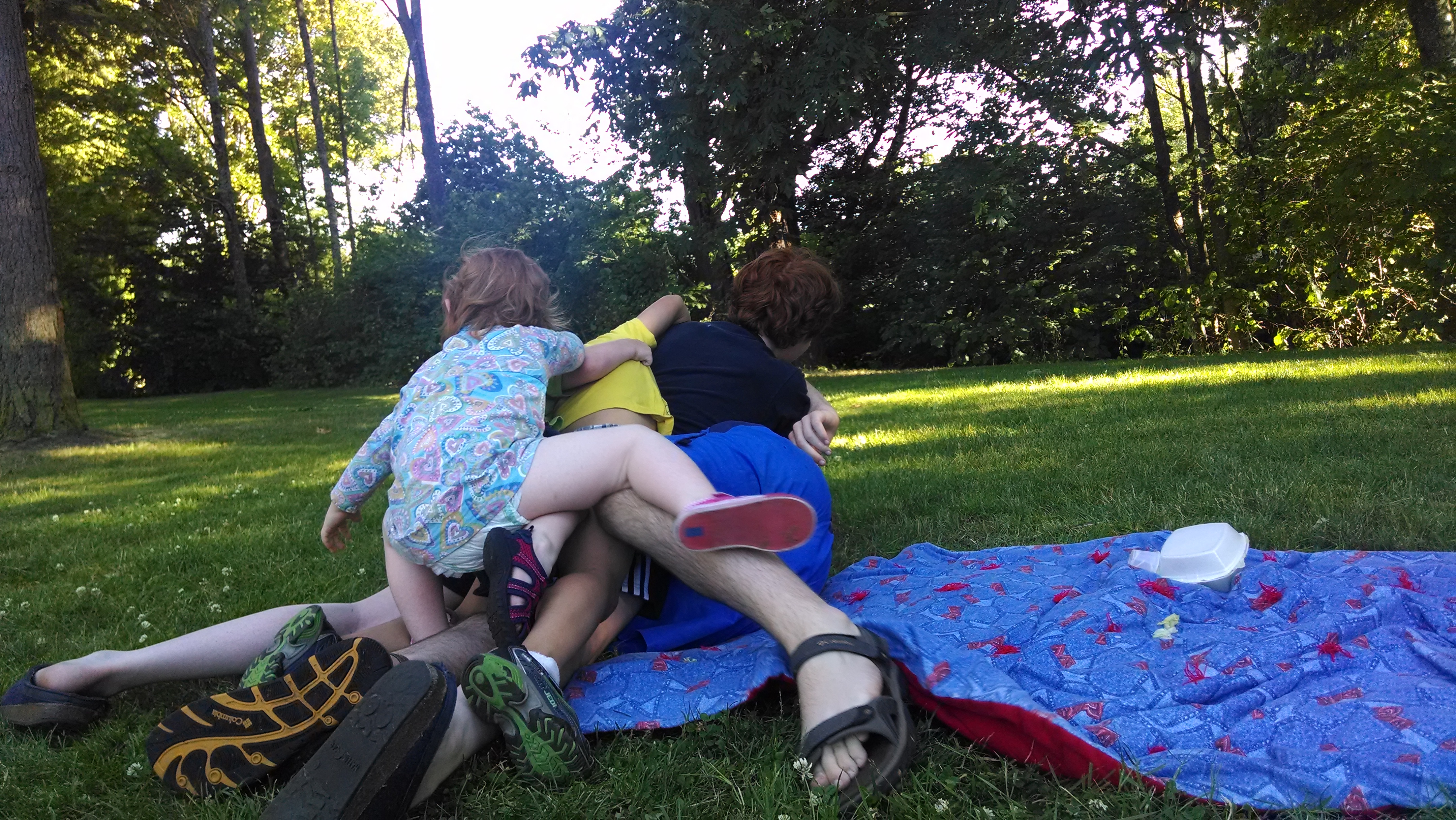
A 16 year old buried under a puppy pile of 7 year old, 3 year old, and 2 year old buddies...

A patient and tolerant 16 year old buried under a puppy pile of 12 year old, 7 year old, 3 year old, and 2 year old buddies…

I’m working now on a longer post about the benefits of multi-age classrooms. (To be posted September 2) but I wanted to share some observations from my recent personal experiences with multi-age play.

Modern American kids tend to spend much of their time in age segregated activities: schools, sports teams, and extra-curriculars where all the kids were born within a one year age span. During the school year, much of what my child does is with his own age cohort.

But this summer, my three-year-old has had lots of opportunities for mixed age play:

  • Lots of spontaneous play on public playgrounds with whatever strangers happen to be there… he tends to play most with kids age 2 – 6.
  • Monthly social for a club we’re involved in. We gather in a gym, and there tend to be about 5 kids…. last month they were 3, 5, 7, 9, and 12 years old. My son has played with each of them a few times before.
  • Play time on the playground at church. There’s usually about a dozen kids, ranging in age from 3 – 12. We’ve known them for six months.
  • “Dinner in the park with friends” – we gather with two other families once a week in the park. Our 7 kids are 20, 17, 16, 12, 7, 3, and 2 years old. And they’ve all known each other since birth.

As I watched him play in each of these settings, here’s what I observed (and also what is described by authors and researchers in this area.)

What do I love about mixed age play?

Benefits for younger kids:

  • They get exposed to new ways of thinking. My son doesn’t yet do a lot of imaginary play on his own, but when playing with older kids, suddenly, he’s talking about how they’re pirates on a pirate ship. Or he’s serving up “ice cream cones” made of bark.
  • They learn new ways of moving. My son has learned how to use all the playground equipment – even the challenging stuff – by watching the older kids do it. He learned how to do somersaults recently.
  • They learn new skills. My second child (like many younger siblings) learned to read, write, tie her shoes, dress herself, and more by watching her big sibling do it. I’ve heard countless stories of kids potty training after attending a camp or class where older kids routinely use the potty.

Benefits for older kids:

  • They learn to be flexible. At the social we attend, I watched the kids play an improvised ball game with invented rules. The older kids had teams, and were always trying to move the ball toward their team’s goal. But they understood that the younger ones couldn’t remember or follow the rules reliably. So, the littlest kids could kick the ball any direction they wanted to, and the older ones just worked with the chaos of that.
  • They learn to explain and enforce rules. But the older kids also did set limits sometimes on what was allowed and what wasn’t allowed. They had to figure out how to explain it so the little kids could understand.
  • They learn empathy, to be gentle and watch out for little ones. At church, I watched kids on the swings figure out that if big kids are walking near them, it’s OK because they know to be careful, but if little kids start to wander near, they call out a warning and they slow down their swings.

Benefits for parents:

  • Can give parents a break: If there are responsible (or semi-responsible) older kids around, the parents of the little ones may be able to sit back a little. For example, when we’re with our friends in the park, often the teens and tween supervise the 3 little ones while the parents relax and talk.

What can be challenging about mixed age play?

  • Kids get exposed to new ways of thinking: Sometimes things they might not have otherwise thought of…. In the movie Boyhood, there’s a scene where the 6-year-old and the older neighbor boy are flipping through a lingerie catalog ogling the models in their lacy bras. The 6-year-old probably would not have pursued “girly magazines” as young without that influence.
  • They learn new ways of moving: I still remember when my oldest was 6 or so, a girl who was probably 12 years old was shimmying up the pole of the swing-set till she was 15 feet in the air. My daughter watched her very intently, then pulled off her socks and shoes and scaled the pole. Something that would have never occurred to her to do on her own. And that was much higher in the air than I wanted her to be!
  • They learn new skills. I learned how to work pocket knives, matches, and other cool tools from my older brothers. Probably much younger than my parents might have wished I learned those skills.
  • Big kids aren’t always nice. We’ve had two incidents with my little guy this summer. One was at a playground where there was a group of 4 girls who were probably 9 or 10 years old. When we arrived, they played happily with my son and were having a great time. Then they decided they were bored of the “baby” and wanted him to go away. He had a hard time understanding what had changed. Another was at a different playground where there was a large group of older boys (age 7 or 8 maybe). My son was following them around, and laughing and engaged with them, but when we moved close we discovered that what was happening was they were asking him to say things like “I’m really stupid” and then laughing at him when he did. He didn’t get that it was mean – he thought it was a fun game. But clearly it was bullying and not appropriate behavior for those kids. (Their camp counselor was not providing sufficient supervision to even notice, much less intervene in the situation.)
  • Parents of older kids don’t always pay attention. When my child is the youngest one, he may be getting into situations that are more dangerous than he might typically be in (see above under “learn new ways of moving”). So, I have to supervise more closely than I normally would. But the parents of the older kids may be used to not having to do much supervision at all of their child, and may not realize that a) their child might need guidance on what is and is not appropriate play when younger kids are involved, and b) the parent who is supervising the youngest one then kind of gets stuck supervising all the kids by herself and managing all the needed interventions.
  • Unfair Expectations: In mixed age settings, it can be easy for adults to expect the younger children to have the same capabilities as the older children. When my younger daughter was 8, she was placed in a class where most of the kids were 10 years old. Academically, it was a good fit. She was one of the most advanced in the class. Socially, she did fine. She had a big sister, so she was used to playing with older kids. But emotionally it was hard. If something upset her, she had a hard time calming herself down. Parents who volunteered in the class sometimes had a hard time managing it, because they were used to their older children. Even the teacher failed to manage it well – reporting to us that our child was just much less emotionally mature than the other kids in the class. It was as if she’d forgotten that all those other kids had 25% more life experience than our daughter.

I think it’s important to be aware of these possible pitfalls, but don’t let it deter you from multi-age play.

I grew up as the youngest of four kids, with piles of kids of all ages in the neighborhood, at church, in 4-H, Girl Scouts, etc. I want my kids to have that experience of all the benefits  that mixed age play can give. And for that, I’m willing to take the challenges – think of them as learning experiences…

10 Types of Toys

letters

In other posts, I have talked about reasons why it might be OK to own fewer toys, and how to choose the best toys, and shared a link to my handout on choosing toys and activities which build a variety of skills and multiple intelligences. I’ll share here some examples of how this plays out in our home with our three-year-old.

(Note: I’ve included Amazon Affiliate links in case you want to buy any of these items, but truly, I’m advocating for NOT buying much stuff!)

Word Play (Linguistic / Verbal Intelligence)

We only own about 20 kids’ books – filtered down over 20 years of parenting to the ones that we love the best and want to have in the house at all times. But we go to the library a lot! (Multiple times a week, picking up a big stack of books every time. And we end up reading them all multiple times. My boy loves to be read to, and loves to read to himself.) And we go to story-time at the library every week.

We also have magnetic letters for the refrigerator (which we use all over the house) and duplo letters. Lately, my son has been using the letters and a big drawing of a coconut tree  to re-enact one of his favorite books (Chicka Chicka Boom Boom) over and over again. You can see the picture above…. the drawing is nothing “fancy” – I think his grandparents just pulled some packing paper out of the recycle bin and drew on it with crayons – but it’s kept him entertained for hours, and when he’s done, it’s back to the bin.

We have a Kindle Fire tablet with Kindle FreeTime installed, so he plays lots of ABC games, and watches educational videos (and not so educational videos) about the alphabet.

Our best language tools? His abuela (grandmother) who speaks to him in Spanish. And his Belo (grandpa) who reads to him for hours on end. And they both spend a lot of time practicing writing numbers and letters with him and other hands-on learning games.

Doing the Numbers (Logical – Mathematical Intelligence)

Everything we have more than one of is a math toy! We can count how many blocks we have, figure out whether we have more trains than balls, and so on.

We have 12 rubber ducks that have appeared in our lives over 20 years of parenting (I don’t think I bought a single one). These are great for bath time math time. We sang “Five Little Ducks went out one day” lots of times – it’s a good way to learn the basics of subtraction – one duck doesn’t come back – now there’s four little ducks…

The only special math tools we have are:

    • a set of Duplo numbers, which we’ve used for counting, number recognition, and a number line – we had a library book called Hopping on the Number Line which led to the game of having toys hop back and forth on the number line as we did the math problems out loud (if froggy starts on 2, and hops 3 spaces, where will he land?),
    • Unifix Cubes, which are a fabulous math teaching tool, though so far all he does with them is sort them into 10 stacks of 10 matching cubes, then lines those up in spectrographic order red-yellow-orange, etc. (My boy is a big fan of order and repetition.)
    • Some numbers we shaped out of pipe cleaners
    • Some old birthday candles – you know the candles shaped like the #1 and the #2 and so on that when you put them on the birthday cake and blow them out 20 seconds later, barely any wax has melted so you keep them instead of throwing them away? My son found those and loves them!
    • A great app called Bedtime Math. Every night at bedtime, we read a story problem and solve some math puzzles related to that story.

Putting the Pieces Together (Spatial Intelligence)

We have a couple of kids’ wooden puzzles and a couple of jigsaw puzzles. We have a big bin of duplos (notice how our letters and numbers listed above do dual duty as part of the Duplo collection?), and wooden train tracksto assemble (and a big collection of wooden trains – half are used and abused – purchased at a consignment store and the others shiny and new purchased by Grandpa). At many of our local libraries, they have puzzles that he works with when we visit, and at his BC classes, they have lots of shape sorters, puzzles, and small manipulables to practice with.

We also “find” lots of things for him to learn spatial skills with: mixing bowls, measuring cups, plastic dishes for practice nesting things; sticks and rocks to stack into tall towers, an empty bottle from the recycling bin and some dry beans to drop in….

Moving & Grooving (Bodily – Kinesthetic Intelligence)

We own 5 balls of varying sizes, a kids’ baseball bat, a Strider bike, and a climber built of QUADROthat was a hand-me-down from a friend (Quadro is a fabulous combination of building toy and playground equipment! We’ve had ours for 20 years now, in near constant use.) We also go swimming at least once a week, and go on one or two one-mile hikes a week and go to the playground a lot. When we’re out in the woods, he happily balances on logs and climbs trees and scales rocks.

Playing Well With Others (Interpersonal Intelligence)

Imaginary play and telling stories with characters is one way to build interpersonal intelligence. So we’ve got a few stuffed animals, but he doesn’t play with them a lot. We have a collection of finger puppets that we tell stories with and that he also uses at naptime to tell stories to himself. We have a toy picnic basket with fake food, but we don’t use it a lot, so I think it will soon go to our Buy Nothing group. He’s just as happy to say that a rock is a chocolate cupcake and a handful of bark is french fries.We also make things… one of this week’s library books was Trouble at the Dinosaur Cafe, and we made Model Magic dinosaurs to go with it – he mixes the colors and I do the sculpting.dino

We also make sure he gets lots of interaction with other kids – we spend lots of time at the playground, in free play with new kids, and meet friends for a weekly play-date which is all kid-guided, non-facilitated free play. (Kids learn a lot more about getting along with others and about conflict resolution when parents back off!)

Learning about Myself and How I Feel (Intrapersonal Intelligence)

As I say in the handout, this category of intelligence isn’t about tangible stuff. It’s more about interaction and emotion coaching, and also making sure your child has time for quiet contemplation and down time. When we go on hikes in the woods, there’s a lot of quiet reflective time as well as song-singing, story-telling, nature-teaching time. He also has “nap time” every day. He stopped sleeping at nap time a few months ago, but still will play quietly in his room for 90 minutes every day. OK, not necessarily quietly – he plays his piano, and reads his books out loud with LOTS of feeling and dramatic interpretation! But it’s a good solo time for him (and for me).

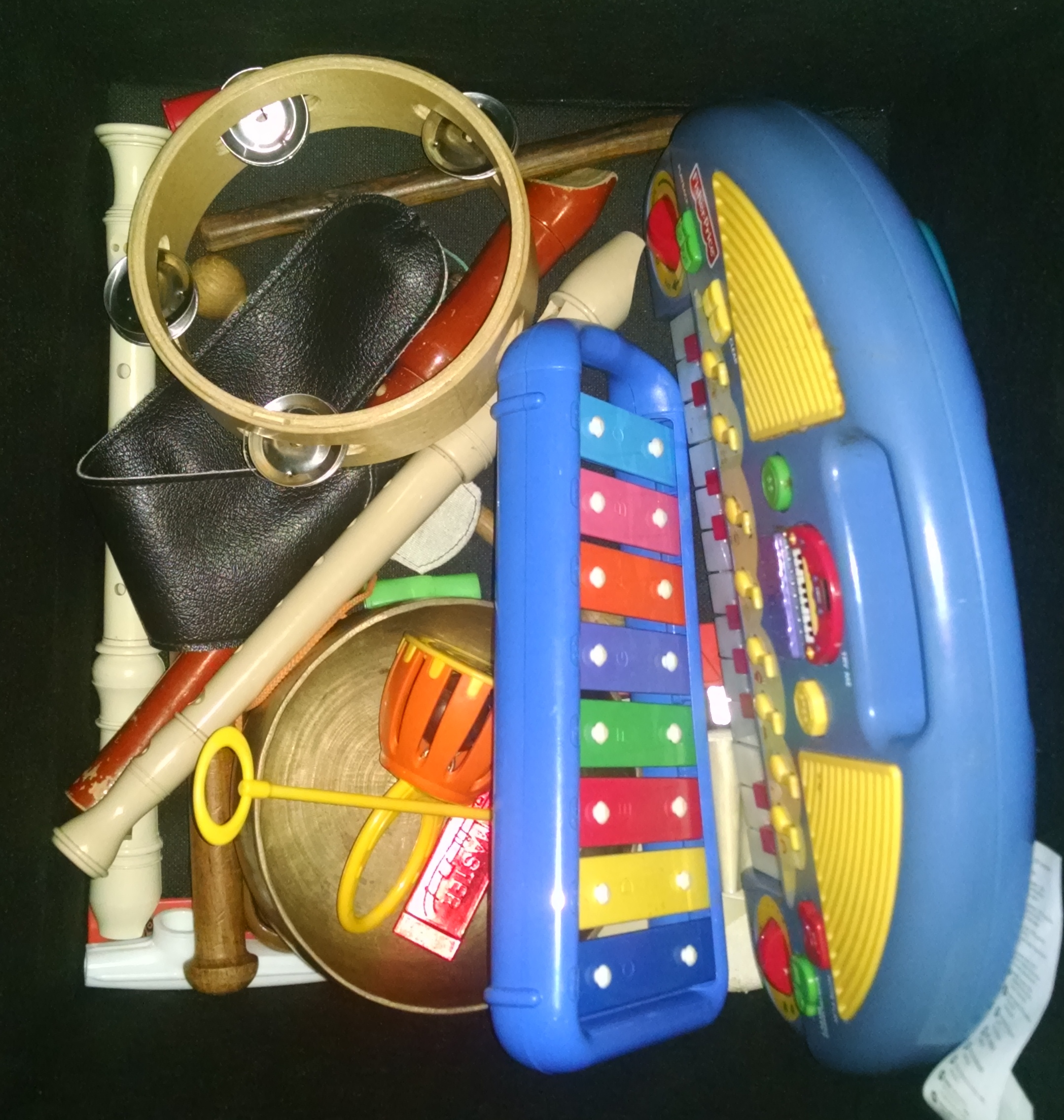
Song and Dance Routines (Musical Intelligence)music

We have a box of miscellaneous musical instruments he can pull out anytime he wants. A few were purchased for him, but most are just items that have entered our lives over the years, like the plastic Yamaha recorder I had as a child, and the plastic Yamaha recorder I had to buy for my daughter’s class when I couldn’t find my old one… We also have a very old electric piano that’s in his room and he spends part of many “nap times” exploring the piano.

We listen to a lot of music together (one older sibling loves Broadway show tunes, one loves vintage jazz, Abuela loves classical and Spanish music) and sing songs A LOT, and enjoy circle-time songs at BC classes and library story times and hymns at church.

Fun with Flora and Fauna (Naturalistic Intelligence)

As you can guess if you’ve read other posts on my blog, we spend a lot of time outdoors. Camping, hikes, zoo trips, farmer’s markets, walks to the library and the pool. The only “tools” we use outdoors are a bucket and a shovel. (But, when we forget them, a stick and a rock can fill in as digging tools, and an empty Starbucks cup from the car makes a fine bucket.) Some day we’ll find our binoculars again, and pick up a new magnifying glass.

Expanding Horizons (Magic / Imagination / Religion / Cultures)

We have a big box of miscellaneous dress up – old Halloween costumes from his sisters, sunglasses, silly hats, etc. In all of our books and the videos we watch together, we aim for showing lots of diverse cultures and experiences, and we go to a church that talks a lot about diverse beliefs and appreciation of the sacred in all forms.

All the Pretty Colors (Artistic Skills and Appreciation)

This is the one area we have an abundance of STUFF.

One cabinet in the kitchen is over-flowing with art supplies: Model Magic clay, no-spill watercolors, pom poms, pipe cleaners, paint, paper, glitter glue, stickers, markers, crayons, beads, scissors, and so on. When he and I are in a relaxed, mellow mood, we pull these out and get to work.

I try not to do much art when I’m in a cranky mood, or when I won’t have time to deal with any mess that arises. I have to confess that I can have a hard time when he’s being really messy or “wasting” art supplies, or “messing up” art supplies – like when he dips the red-paint-covered paintbrush into the yellow paint. Because I know that about myself, I make sure that he has plenty of opportunity to do art in spaces that are designed for kids’ art and where it’s OK to make a mess. So, this year, he’s enrolled in Creative Development Lab, which is all about exploring and experimenting with art.

Do we have it right?

I feel like we have found a good balance… we have enough stuff at home that he is very capable of entertaining himself for a long time. And we make things a lot and find thins in nature, which gives him new toys and also shows ingenuity. Plus, we get out in the world a lot to explore the things we don’t have at home. I try to avoid owning “stupid” toys that I don’t like… they do enter our home sometimes if my kids go to a birthday party and come home with goody bags, or have lunch at McDonald’s with dad. But most of the toys we own I think are worthwhile.

William Morris once said “Have nothing in your houses that you do not know to be useful, or believe to be beautiful.” It’s a rule I try to live by for myself, and I think it also applies to my child’s things… but maybe there it’s something more like “Have nothing in your toy box that you do not know to be creativity-inspiring or believe to be a joy to play with.”

Cheap Dates with Toddlers: Nature’s Playgrounds

stumps

Peter Kirk Park, Kirkland, WA. Click to enlarge photos

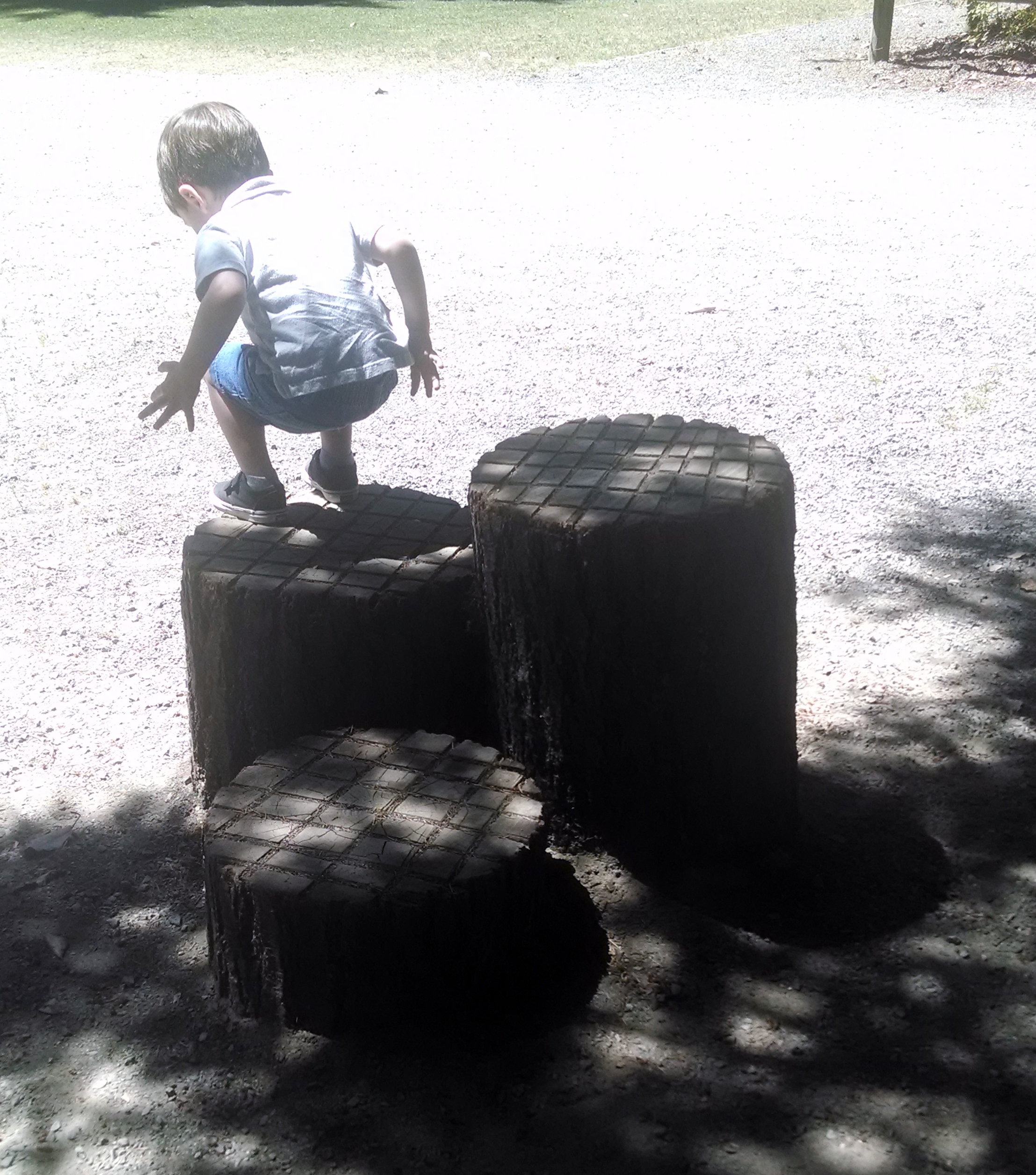
Sometimes, parks have to take out trees – they’re old, they’re damaged by insects or lightning or whatever. That’s always sad. But, when you’re really lucky, the park does this! At Peter Kirk Park in downtown Kirkland, when they took out a tree (or cluster of trees?) recently, they left the stumps behind, in a perfect toddler and kid playground adventure!

My three year old loves playing on these, but so do kids of all ages. Unlike modern playgrounds, they’re not standardized sizes and shapes, with the exact measured distance between objects and a scientifically designed surface beneath. They’re just four stumps, of different heights that you can climb up, perch on, jump off. Fabulous!

If you live in the area, come check them out (but be sure to park on the street or at the library – the shopping center says they’ll tow park users). If you’re not local look for similar lucky finds in your neighborhood!

We also found a great set of stumps at Bridle Trails Park in Bellevue, next to the arena.

Bridle Trails State Park, Bellevue, WA

Bridle Trails State Park, Bellevue, WA

To learn more about kids and nature, just click on ‘nature activities’ in the right hand side bar.


Getting Outside: Overcoming the Barriers

Spending time outside is great for kids’ physical health, mental health, and cognitive development. (Read about those benefits here). Plus, outdoor play is FUN!!

But although most parents say they would like their kids to have more outdoor time, they also see lots of barriers that prevent them from making it happen. How do we overcome those barriers and go play outside? Look below for tips on coping with: lack of access to nature, safety issues, lack of time, the inconvenience of muddy clothes, dressing for the weather, lack of interest in the outdoors (for child or parent!) and lack of playmates outside.

Perceived barrier: Lack of access to nature

(it’s too expensive, too far away, I lack the skills)

In several surveys, modern parents and children often say that there is no nature where they live. They say that outdoor recreation is too expensive, or that outdoor opportunities are too far away, or that they lack the knowledge and skills to participate in outdoor recreation. When asked to describe outdoor recreation, they often talk about things like national parks, ski areas, theme parks, water skiing, kayaking, and mountaineering. If you had asked a parent in the 1950’s where their kids play outside, they would have said: the backyard, the garden, the park, or the school yard. If you’d asked what activities their kids did outside, the first things that would come to mind would be: climb trees, dig in the dirt, and throw rocks.

Outdoor time doesn’t just mean a week-long camping trip in Yellowstone. It could mean just a little time outside every day on that little strip of grass at the corner of the apartment parking lot. It could be walking to school and noticing the plants, rocks and bugs in the neighbors’ yards. It could mean finding a little “patch of nature” that you can visit once a week. Maybe that’s a city park, but maybe it’s an empty lot in a residential neighborhood. (when my girls were little, we visited an empty lot two blocks from the Microsoft corporate campus, we saw coyotes, rabbits and snakes, and picked all the blackberries we could eat.) By looking further afield, you may find hiking trails, lakes, streams, arboretums, botanical gardens, farms, nature preserves, beaches, sandboxes, and other places to dig in the dirt. And for most of them, you can bring a picnic lunch and stay all day without spending any money.

For ideas for outdoor activities in an urban area, search online. Here’s a couple blog posts to get you started: http://projectwildthing.com/posts/view/296 and http://projectwildthing.com/posts/view/304.

If you feel like you lack the knowledge or skills for outdoor adventures, start small and simple with visits to the local park. When you’re ready, you can take on new challenges on your own. Or visit local outdoor supply stores to see if they offer classes, or check with your local parks department for classes and for group outings with an experienced guide.

You can also check out websites for lots of tips on outdoor activities with kids and how to make them successful. Try http://www.rei.com/learn/expert-advice/family.html

Perceived barrier: Safety (traffic, stranger danger, etc.)

Parents often say “it’s just not as safe for kids to play outdoors as it used to be.” But statistics actually show that the rate of abduction by strangers has stayed steady for many years, and the risk of car-pedestrian accidents has decreased significantly.

  • Traffic: Choose outdoor play areas and neighborhoods with minimal traffic risks. Teach your child pedestrian safety rules (crossing at crosswalks, looking both ways, not running out into the street after a ball, and so on). Don’t allow children to play in the street. Yes, many of us played in the street when we were young, but drivers expected that then and watched out for it… they don’t now.
  • Note: “children at play” signs are not shown to be helpful at reducing risk – they don’t have much impact on driver behavior, but they do lead parents and children to have a false sense of confidence – which then leads them to behavior that puts them at risk
  • If you have specific concerns about traffic in your neighborhood, try contacting your city to see if there’s anything they can do. (here’s an example from my hometown.)
  • Some basics: it’s OK to talk to strangers when mom or dad are right there with you, but your parents aren’t there, don’t talk to the stranger. If an adult says they need help (with directions, with finding a lost puppy, etc.) then go to a trusted adult and let them know. Be sure your children know their full names, parents’ phone numbers, and where the trusted adults are near their home.
  • Enlist your neighbors. Get to know your neighbors, and make sure your kids get to know them too. Tell them you’ll help look out for their kids. Encourage them to help keep an eye on your kids.
  • Child’s Age: some parents worry about taking babies outside – “they might get dirty”, “they might eat dirt.” Read this article on benefits of outdoor play for babies: www.janetlansbury.com/2014/06/your-babys-call-of-the-wild-guest-post-by-angela-hanscom/
  • Risk of injury in outdoor settings: Unlike a modern playground, a natural setting has not been intentionally designed to meet rigorous safety standards. There may be sharp edges and hard surfaces and thorns and stinging insects. Whenever you’re out in nature with your child, be aware of potential hazards, show them to your child, and educate her about how to be safe if she encounters those things on solo adventures. There’s no need to frighten, but it is a good idea to teach caution and a healthy respect for nature.
  • Although there are potential risks outdoors, parents should remember that developing the habit of staying indoors all the time also carries risks: increasing the long-term chances of obesity, heart disease, diabetes, etc.

Perceived barrier: No time in the schedule

  • Homework: Some parents say “my kid has so much homework to do, it takes him forever, and we don’t have time left to go outside.” If that child was allowed to run and play outdoors for a half hour after school, research indicates that would help him concentrate better when he did settle down to homework, thus perhaps reducing homework time.
  • Extracurriculars: Children certainly benefit from organized activities that teach specific skills (e.g. piano lessons, baseball team) but there are unique benefits to unstructured play time, especially if that takes place outdoors. Finding a balance in the week’s schedule that allows for some unstructured time is the best option for maximizing a child’s learning potential.
  • Can your time do double-duty? Instead of driving to a store across town, could you walk outdoors to a store nearby? Instead of sitting in the car with one child while you’re waiting to pick up the other one from school, can you go for a short walk or play outside? If you work out in a gym, could you take your exercise outside and do it while your child plays?
  • Consider looking for a nature-based preschool or “forest kindergarten” to do double duty between school and outdoor play. Don’t worry that your child will miss out on academic skills if they don’t spend their preschool hours sitting at desks with pencil and paper. Outdoor time is great for brain development and they will be very ready for school when it comes around.

Perceived barrier: Outdoor play is inconvenient

  • Dirty clothes and dirty kids: Outdoor play is definitely messy. Parents may need to increase their tolerance for mess. It also helps to plan ahead: carry a full extra set of clothes, including socks and shoes, in the car at all times. Some parents carry a washcloth and some water in case you need to scrub the child down before putting on the clean clothes. It also helps to have a towel to cover up the car seat if needed (or I also use the towel to dry off wet swings and slides on winter playgrounds.)
  • Parents’ responsibilities: Parents say it’s hard to get things done (like cooking dinner) if the child is playing outside and needs to be supervised.
    • Can the child play outside without supervision? (with clear boundaries and safety proofing set up in advance, of course)
    • Can you team up with another parent and take turns supervising?
    • Can you take any of your work outside? You may not be able to do laundry outside, but with modern technology, you may be able to make phone calls, read and respond to email, catch up on Facebook, or read materials for work while your child plays outdoors. (Note: make sure you don’t spend all your time wired to the screen – parents benefit from outdoor play too!)
    • Note: If you find your kids are often being wild indoors when you’re trying to work, try taking a break to go outside and play. When you return inside, they may settle down.

Perceived barrier: Kids say outside is uncomfortable

  • Too hot: Plan your outings for early in the morning, or late in the evening. Consider lightweight sun-protective clothing, and a lightweight hat with a brim.
  • Too cold / too wet: Teachers at outdoor preschools and forest kindergartens (go to YouTube to learn more about these!) often say “there’s no such thing as bad weather, just bad clothing choices.” It’s well worth investing in a good pair of waterproof boots (I love my son’s Bogs rain boots and snow boots– they cost more than I usually spend on kids’ clothes (I get all their clothes at consignment shops), but they are easy for him to walk in, unlike most boots that flop around on kids’ feet, and they’re so waterproof he can wade in streams without his socks getting wet) and rain gear. We liked our Oakiwear rain pants and rain jacket. A friend swears by the Muddy Buddy Overalls.  Here are some more tips for how to dress for the outdoors in winter: www.raisingwildones.com/2014/01/how-to-dress-kids-for-winter-outdoor-play.html and how to dress for rain: www.modernparentsmessykids.com/2012/10/outdoor-preschool-how-to-dress-for-hours-of-rain-cold.html
  • Some young children do not like getting their hands dirty. Offer them shovels and tools to use, or you might even offer lightweight gloves if needed.
  • Good shoes are important: flexible soles are nice for dexterity, but they need to be thick enough that the child can’t feel rocks and sticks through them. Avoid open sandals and clogs that let in (and then trap) sand, pebbles, and bark. (I like water shoes for summer days at the lake or beach, as they can wear them in and out of the water and protect their feet.)

Perceived barrier: Kids aren’t interested

  • Kids would rather stay inside and watch TV / play video games / use the computer.
    • Don’t assume this to be true. When surveyed, many kids say they prefer outdoor time.
    • This is less likely to be true for kids who have spent a lot of time outside since they were small. It’s more likely to be true for kids who haven’t had any significant positive experiences outside. Getting those kids out to have those experiences may help.
    • Sometimes transitions are the hard part – you may have to force the issue of turning off the screen and getting outside, but after a while outside they usually settle in.
  • “There’s nothing to do!” If you have been taking your child outside to play since he was young, you’re less likely to hear that complaint. But if you have a child who is used to the high intensity stimulation of video games and amusement parks, it can be hard to slow down to enjoy the quieter pleasures of the outdoors. Having ideas for what to do outdoors may help.
  • Try to allow your child some freedom outside. Kids who are given a little extra independence are more interested in going out to play.

Perceived barrier: There’s no one to play with

It’s often disappointing to kids if they go outside to play and discover they’re the only ones there. Here are some strategies:

  • Find families who are focused on spending time outdoors: Check out your local parks department, campgrounds, and outdoor supply stores for classes, camps, and guided hikes. When you attend, make an active effort to network with other parents and set up future activities together. You can also search online (Meetup.com, Facebook) for “children and nature” groups, or look for local outdoors clubs, or search for a Nature Club (or learn how to start your own) at www.childrenandnature.org/movement/naturalfamilies/clubs/
    • If your child takes outdoor sports classes near your home, try to connect with some of those families who live nearby. It could be they’d also enjoy unstructured playtime outdoors too.
  • Encourage your existing circle of friends to play outdoors: When it’s your turn to host a playdate, make it an outdoor one. When friends are planning a gathering, encourage them to consider an outdoor site. Even if you’ve invited a child over to play on a rainy day where most of your time will be inside, be sure to spend a little time outdoors. Having some fun, unique outdoor play options can sweeten the deal.
  • Connect with the neighbor kids and parents.
    • Let them know that you would love a neighborhood where kids play outside together. Talk about how to make that happen. Offer to supervise other children.
    • Don’t worry if the kids are a wide range of ages. One of the benefits of unstructured outdoor play is that it works really well for multi-aged groups.
    • Try setting an “outdoor hour” at least once a week (hopefully more) when everyone tries to get their kids out together and where kids can rotate between multiple yards.
    • Set one day a week as “walk to school” day. Or organize walk-pools where parents take turns escorting kids on a walk to school instead of all the parents driving alone.

Perceived barrier: “I’m just not an outdoors person…”

Some parents feel like they should get their kids outside more, because they have heard about the benefits of outdoor time. But they find themselves dreading outdoor time because they have not enjoyed it in the past. It’s OK to start small, and with simple things that seem manageable to you. Yes, some parents take their kids wilderness camping or mountain biking or white water rafting. Maybe you just take your child to the playground often, or walk at botanical gardens, or go to the zoo, or just notice nature around you as you shop downtown. Yes, some families spend hours outside every day and go on week-long campouts every summer. You may manage one hour a week of intentional outdoor time. Do what you can. You may find that as you start small and have experiences you enjoy you may become more of an outdoors person and look forward to these times.

What will you do?

Some experts recommend that parents commit to a “green hour” – one hour a day that their kids spend outside. Does that seem do-able to you? Could you make that a goal to shoot for, even if you know there’s lots of days you won’t make it? On the days you do, congratulate yourself!

By spending time with our kids outdoors, we can develop life-long habits of getting outside and being active. This will mean our kids experience less stress, high blood pressure, obesity, diabetes, ADHD and sensory issues, and depression. And they’ll probably do better in school. It’s well worth the effort!