Tag Archives: Parenting

Periods of Disequilibrium

Does it seem to you that there are periods of time when parenting is easy? That you’ve mastered it and you’re cruising along with a well-behaved child whose needs you understand? And are there other periods when it’s all really hard? When you feel like you’re incompetent, like your child is out of control, and you have no idea what they need and the things that used to work no longer work?

Did you know that’s totally normal?

And that all families experience this?

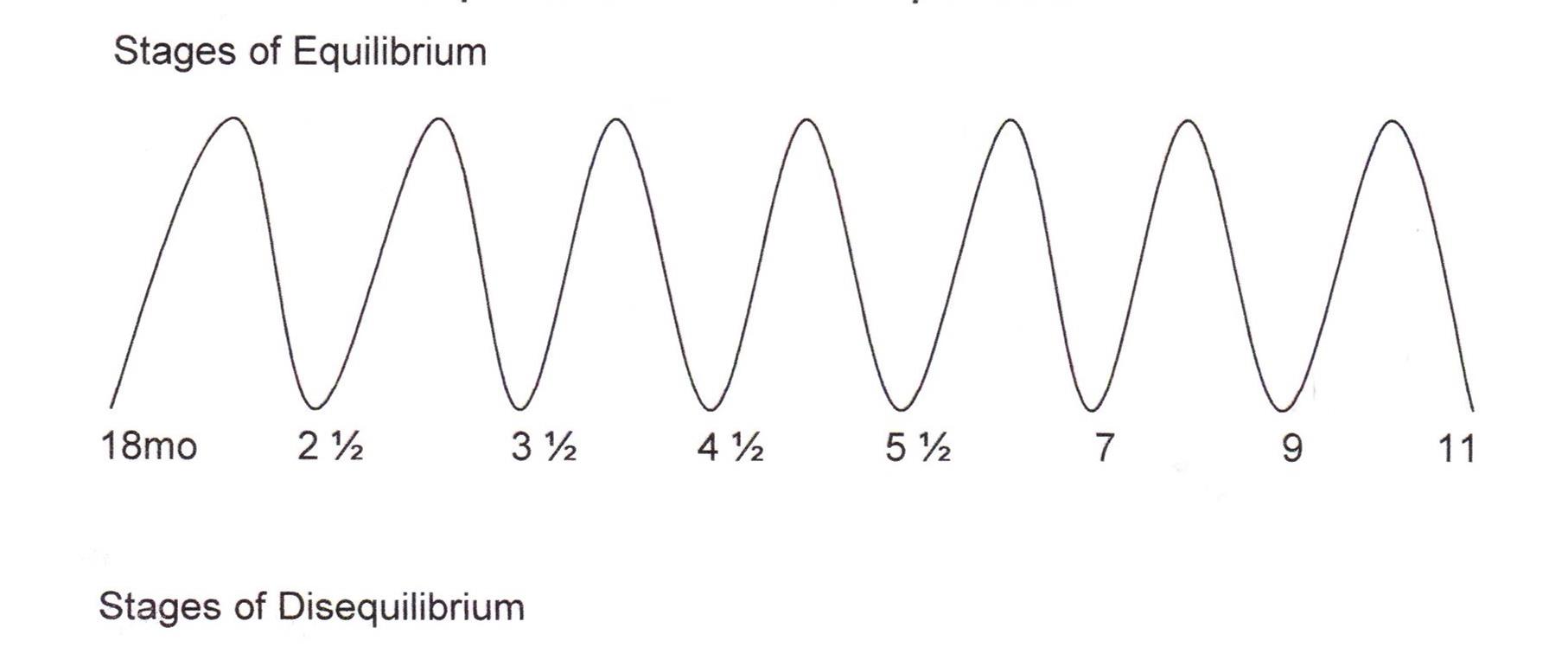
Children go through very predictable cycles, or developmental spurts. Sometimes they settle into a quiet period of equilibrium where they take time to incorporate all that they have learned and practice learned skills to the point of mastery. Whenever they’re on the verge of a new and exciting development, they go into a period of disequilibrium… there’s some new skill they can see and it’s just out of reach, and they are striving toward it with every part of their being and frustrated at everything else along the way.

One of the first developmental spurts is a 6 week old baby… they cry and cry and cry… and then…. they smile at your for the first time and really connect with another person. Lots of 6 month olds struggle with sleep – they’d much rather be figuring out how to crawl. Although we hear about the “terrible twos”, it’s really the one-and-a-halfs and the two-and-a-halfs. The 18 month old knows that other people talk and that helps them get what they want. And yet when she tries to speak, nobody understands! Meltdowns are common at this age. (Learn about toddler language development here.) At 2.5, they have discovered that you set rules and make them do things they don’t want to do. And they rebel against that. You’ll hear the word “No” a lot at this stage! And they get very angry or upset when you don’t do things like they want you to. (Something like cutting their sandwich into triangles when they wanted squares can lead to a huge tantrum.) The more you can follow routines and set clear limits the more manageable this period can be.

These cycles continue throughout our lives. But they get longer… we have longer periods of equilibrium and longer periods of disequilibrium… where that 6 week old baby was out of balance for a week or two, a midlife crisis could last a couple years. One of the most challenging situations is when multiple members of the household are in a disequilibrium stage at the same time!

Expect more hard times at 3.5, 4.5, 5.5, 7, 9, 11, 13, etc.

One hard time for kids is 4.5 years old. When my second child hit this stage, it was really hard. She had been on an easy cruise for a long time. And at 4.5, sometimes she was an absolute delight to be with – so many thoughts going on in her head, a great imagination, lots of budding passions and capabilities. And other times she was so exhausting to be around that I wanted someone to come and take her away!!

She was a rules negotiator and protester. She knew the rules – things like “only two sweets a day” (where a sweet equals a candy or a cookie or juice) and “you need to stay in your room at bedtime.” But, she would say “but today, I can have three sweets” or “tomorrow I’ll stay in my room.” And if I said no, she’d yell, hit, and more.

I thought “I need a book. A book about how to manage this.” I hadn’t felt like I needed to buy a parenting book in years, because I’d been feeling pretty competent. But now, I felt in over my head. So, I went looking for a book called something like “Your Five Year Old” that would tell me how to manage this.

And then, in the bookstore…  I realized I already owned that book.

I’d bought it when my first child was 4.5.

I’m not sure I really read it, because I think she may have moved out of that developmental stage into a period of equilibrium at about the same time as I bought that book. And we went into the smooth ease of parenting a five year old. Just remembering that I had bought the book and that she had moved on from that phase before I read it helped me realize I didn’t need to read a book to manage my second child… I just needed to be patient. It was, in fact, “just a phase”, and she soon moved through it.

And now, it’s child #3’s turn to be 4.5. He was sick about two weeks ago, and after that he became difficult to manage: some clinging, lots of wild behavior, lots of rule negotiating, lots of defying me when I enforce the rules (yesterday he head butted me when I said he couldn’t have a second bag of fruit snacks.) At first, we thought “well, it’s just because he’s been sick. It will get better soon.” But now, I’m coming to terms with the fact that no… it’s his period of disequilibrium. I’m trying to focus on all the joys of where he’s at developmentally (the language skills, the imagination, all the cool conclusions he’s coming to) and remember that “it’s just a phase… and this too shall pass….”

Read more:

Resources for Choosing Child Care

I’m often asked for advice on choosing a child care or choosing a preschool. Here are some great resources about what to look for, and questions to ask. They also offer referrals to child cares in your area.

https://www.naeyc.org/our-work/for-families – The National Association for the Education of Young Children. They have great resources on choosing child care (see the infographic at the bottom of the post). I like that they divide off sections on quality care for infants, toddlers, and preschoolers, because although you’re looking for many of the same things, there are also differences in what counts as quality child care for a 3 month old and a 3 year old. They also have a directory to search for NAEYC accredited child care centers and preschools.

https://www.childcareaware.org/families/choosing-quality-child-care/ Child Care Aware of America. They have great articles on choosing child care, and also a state-by-state list of: agencies that do referrals, child care licensing regulations, inspection reports, resources for children with special needs, and more. A fabulous resource!

There is also https://childcare.gov/consumer-education/find-and-choose-quality-child-care.

from naeyc.org
from naeyc.org

Living Up to Expectations

This post is about living up to expectations. Children… well, all human beings really… are good at doing what’s expected of them. But when the people around a child have limited expectations, they limit the possibilities for that child.

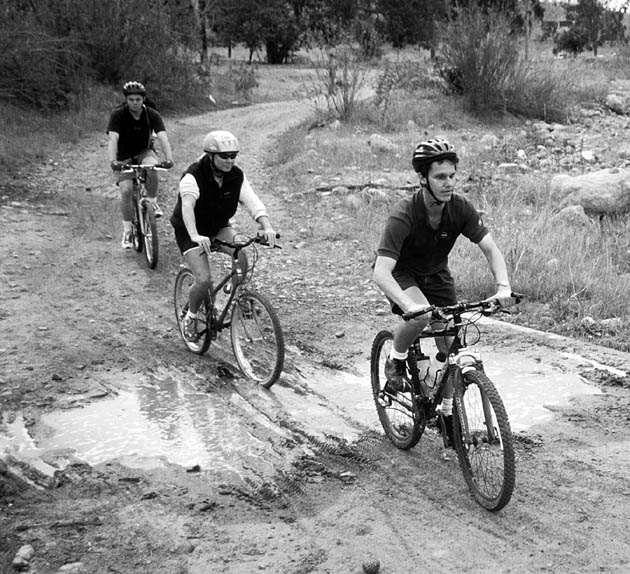
This week on the radio show This American Life, they had an episode called Batman. (Listen to it here. Or read the transcript.) They told the story of Daniel Kish, who has been blind since he was a toddler. The picture shows him – riding a bike. He navigates the world – hikes the woods, rides his bike, walks through cities – using echolocation. He clicks his tongue, and listens to how sound bounces back to determine what objects are nearby. This skill allows him to easily move about independently, with few limitations.

In the radio show, they interview author Robert Scott, who argues that blindness is a social construct. When we, as a society, have low expectations for what a blind person can accomplish, we limit what they can accomplish. He tells a story of a man who worked at a paint factory, then lost his vision. His co-workers told him: hey, we’d love for you to still work here. Go to an organization that serves the blind and get some training and come back. But the organization basically told him “blind people don’t do that” and offered him placement in a sheltered workshop for the blind. Robert Scott met him years later begging on a street. That’s what many people expect blind people to do.

This radio show was particularly striking to me because I have one leg. Technically, by just about any definition you can come up with, that makes me handicapped. But, I don’t really think of myself that way often. Certainly in my experience, handicaps are a social construct. I suppose I have to adapt things to do them, but truthfully, I rarely notice that I have to do anything differently than other people(other than finding a place to lean my crutches when I sit down). It doesn’t really limit my activities in any notable way. And I don’t see any reason why it should.

And yet… There’s a male amputee who hangs out on the 45th street on-ramp to I-5, asking for money, with his pant leg folded up to reveal his artificial leg and a sign saying he can’t work. There’s another one who hangs out by Bellevue Square. Same fashion choice. Same sign – “can’t work.” Here’s the thing. I seem to always see them as I’m driving to or from my work!

I just can’t understand why they think they can’t work. I have never had a problem finding a job. Now yes, I grasp that I came from a middle class background and went to a good college and grad school, and this helps in the job search. And I get that their job experience might be in fields that are harder to do with one leg. But what I don’t understand is their belief system. What is it that convinces them they can’t work?

Expectations. Handicaps as a social construct.

So how did I miss out on this societal message? I lost my leg to cancer when I was 15. I grew up in a military family in Wyoming which is a culture known for some fierce independence and a sincere desire never to be a burden to others. So, I had that influence going in to the experience. But also, after my amputation, I don’t remember ever really getting the message from anyone that I was now to be considered handicapped and incapable of an independent life. Now, maybe someone thought that about me along the way, but I never noticed if they did. It was just assumed, as far as I knew, that I would get healthy again, go back to high school, go on to college, go on to work, and marriage, and kids – all the same things that had been expected of me when I had two legs. There was no reason to change any of those expectations.

Since I’m a parent educator, and this is a blog about parenting, of course, I come around to thinking: And what lesson is there in all this for parents? And not just parents of kids with physical handicaps, but really for all parents.

Our children live up to our expectations. Maybe not always. Maybe not every day. And maybe not in every precise detail if you’re a person who gets really specific in your expectations… But over the long run, they live up to our big picture expectations.

I can’t just say “I expect my four year old to clean up his toys today” and then have that magically become reality. And I never set for my older ones a really specific expectation, like “I’ll only feel successful as  parent if she goes to Princeton and majors in physics.”

But I can tell you that over 21 years of parenting my eldest and 17 years with my second, that they have, in general lived up to our big picture expectations of them. They’re really good kids, with a strong ethical grounding, compassion for others, commitment to excellence and passion for learning.

We did have the broad expectation that they would do well in school, and go to college, and they have (well, my second child will start college next year…). “Research has shown that parental expectations for children’s academic achievement predict educational outcomes more than do other measures of parental involvement.” [Source]

I do think there’s a fine line with expectations. If we expect more of our kids than they are possibly capable of, and continually let them know that we’re disappointed at their failure to meet those expectations – well, that would be pretty miserable.

But we also don’t want to expect too little.

I confess – my oldest has done an excellent job of convincing us that she’s bad at washing dishes. So, we never ask her to do it. We just do it for her so it gets done “right.” But one does wonder how or when this pattern will ever change….

I think one of the things that limits what we ask of our kids is maybe a bit of parenting fatigue… it’s easier to do the dishes than ask her again to do them, or to show her again what we mean when we say clean…

But sometimes we try not to ask too much of our kids because we want to protect them. We want to protect them from the risk of failure.Yes, I told my children not to expect to be professional class or Olympics class athletes. Because I knew the statistical odds of them becoming that was really small, and I didn’t want them disappointed. But, did I also block any potential of them becoming that? Yeah, I did.

We also often limit our children to protect them from harm. We set limits on our expectations, and thus limits on our children because of a desire to keep them safe.

In the episode of This American Life, Daniel Kish tells this story… When Daniel was in fifth grade, he was a very independent kid – he walked to school, crossing major streets. He made his own breakfast and his own lunch. Then a new blind kid came to school. Adam. He was not independent – couldn’t do much of anything on his own. He had come from a school for the blind where people did everything for him – escorted him everywhere he went, carried his books, tied his shoes, made his lunch, brought it to him – because “blind kids can’t do those things.”

The people around Adam had done all those things for him to help him and to protect him from harm. On the episode, they interview Daniel Norris, who works for the Vermont Association for the Blind. He says that most parents of visually impaired kids have a hard time letting their kids risk trying things that “blind kids don’t do.”

Norris says “You can’t blame mom and dad for struggling and wanting to keep their child safe…They want their child to not suffer. And that’s very noble but holds the kids back.”

I try with my four-year-old to remain aware of developmental capabilities. What are reasonable things to expect of him? I try to expect that. And in the areas where he’s strongest, I stretch my expectations just a bit so he has to stretch just a bit. It’s in that pushing at the edge of his capabilities that he learns. But in the areas where he’s struggling a bit more, I try not to pressure him too much in the moment, while still holding the vision that someday he is going to get stronger in those areas too. In order for him to learn, I have to be willing to let him make mistakes, I have to let him sometimes fail so he learns how to get back up and try again. I have to be willing to let him take risks. I have to expect him to learn, change, grow, make reasonably smart choices, get a few bumps and bruises along the way, but be better for them in the long run. Because he’s likely to live up to those expectations.

On the radio show, host Lulu Miller says “And here’s where we get back to expectations. See, Daniel [Kish] thinks there is nothing amazing about him. He thinks that most blind people who don’t have other disabilities could do things like ride bikes. See, he thinks the reason that more blind people don’t [is] because the expectations that you or I are carrying around in our own heads about what blind people can do are simply way too low. Those expectations, those private thoughts in our heads, are extremely powerful things, because over time, they have the ability to change the blind person we are thinking about.”

If blindness is a social construct, and my “handicap” is a social construct, where else are we handicapping people through our beliefs and expectations… Where are you handicapping your child or other people you encounter?

How do you get your kid into college?

gradsParents often ask one key questions of experts in child development: “How do I get my kid into Harvard?”

Now, I’m not talking parents of high school juniors or seniors who want the nitty gritty of college admissions (although I could write plenty about that, having gone through the process with my oldest three years ago, and with my middle child working on applications this month!) I’m talking about parents of toddlers or preschoolers who want to know they’re starting their journey on the right path. Who want to know:  what is the most essential thing a parent needs to do to guarantee their child’s success in academics and hopefully in life.

All the child development experts have answers to the question, and some are based on good science. Richard Louv, author of Last Child in the Woods, says “tell them to go play outside.” Erika Christakis, a preschool director, and her husband Nicholas, professor at Harvard, say to choose a play-based preschool, not academics-based. The president of Harvard said “Make your children interesting!” He  recommended encouraging children to follow their passions as a way to develop an interesting personality. (There’s a nice article in this month’s Parent Map about helping kids find their passion.) John Medina, author of Brain Rules for Baby, has said to audience members: “You want to get your kid into Harvard? You really want to know what the data say? Go home and love your wife.”

These all seem like valid advice to me.

But what’s my best advice for academic success, in whatever form that takes?

Nurture a love for learning, and the belief that school is a great environment in which to feed that passion.

If you observe any baby or toddler, you see that they are driven by curiosity, and a desperate desire to learn more about their world, and master the skills they need to accomplish the tasks that are important to them. Some lucky adults still have that love for learning, intact from childhood.

Unfortunately, many children have that love for learning stomped on at some point in their life. Often in the school setting. Some examples:

  • A child who learns best by moving is placed in a school that has limited physical education and recess in order to focus on academic work at desks. That child comes to view school as a cage that they can’t wait to escape.
  • A child with a passion for some topic may be told “that’s not what we’re talking about now. You need to stop thinking about that and focus on this other topic that I think is more important.” That child suffers through school hours till she can get home and do the things that she cares about.
  • A child who learns best by interacting with others who is given worksheets and flash cards and drilled over and over in rote learning will believe that school is boring, then extend that to believing that learning is boring.
  • A child with learning disabilities is made to feel stupid and incompetent and has a hard time ever again believing otherwise.

I feel pretty blessed that our children have had access to schools* that fostered their love of learning.

When I first looked at kindergartens for my oldest child, we looked at the one within walking distance of our house. It was called Montessori, which I had the vague impression was a good brand name for a school. But when we looked at it, I saw a room of 5 and 6 year old kids sitting at desks filling out worksheets. Sure, a few of them were working with Montessori style manipulables to help them… but the main goal was completing the worksheet. When I asked about their day, it sounded like the way they did individualized education was that each child could work at their own pace through the same workbooks. They had only 10 minutes of recess in the morning and 10 in the afternoon – which might have worked for my daughter, who was just as happy to sit and read as to run around, but I couldn’t imagine it for a more active child. In their library, they had only non-fiction books. When I asked about fiction, they basically sniffed and said kids could waste their time on story books at home. That’s when I knew this was NOT the school for us. (My daughter’s deepest passion from about age 1 to 21 (so far) is stories. And I believe fiction is a great tool for teaching academic literacy, cultural literacy, imagination, empathy, and more. This school would have stomped on her passion for learning through story.)

We kept looking for the right school. The one we found had an emergent curriculum – an example of emergent learning is: if you have a first grader, you want them to learn to read. But it really doesn’t matter what they read. So, instead of making all the kids read the same books, you let the dinosaur boys read about dinosaurs, and the girls who love puppies read about dogs. If a kid asks a question about the classroom pet, you show him how to look up the answer in a book, and he learns that books are the way to learn the new things he cares about learning. Again, nurture a love for learning, and the belief that school is a great place to feed that passion.

Our girls went on to have a great educational experience that kept that love for learning alive. Another key aspect of a good school is one that understands the difference between building a fixed mindset vs. a growth mindset, which “thrives on challenge and sees failure not as evidence of unintelligence but as a heartening springboard for growth and for stretching our existing abilities.” (Read more.)

My middle child is in her senior year of high school, and totally jazzed about her comparative government class – she can’t stop talking about economics, human rights, and governmental policies! When she had the opportunity to visit some college classes last week, she was looking through the list, and gushing with enthusiasm “oh wow, political sociology! Theory of cognitive linguistics! Biochemistry! How do I choose??” When she had a college admissions interview, she gushed at the interviewer about how much she loves her post-modern literature class. She takes free online college classes about nutrition and food science in her free time.

I love seeing in her what I hope to see in all kids. She TRULY loves to learn. She is really excited about new ideas. She sees school as a great venue for feeding that.

Now, my kid is an academic. Your child might not be an academic in quite the same way. College in general is not right for all kids, and getting into Harvard specifically is certainly not possible for many, and not the right match for some kids for whom it is possible.

But… whatever your child’s talents, whatever his or her passions, I have faith that the best way to help them reach their potential is to keep that toddler’s love for learning alive. Model for them your own excitement over learning new things. Support their passion for discovery. Seek out schools that support it. That’s how to get your kid into college…
photo credit: pcutler via photopin