Category Archives: Seattle area

Bainbridge and the Kids’ Discovery Museum


Are you looking for a great car-free day trip from the Seattle area, perfect for kids age 1 – 7?

Ride the bus to the ferry terminal, then hop on a ferry to Bainbridge Island, check out the Kids’ Discovery Museum, stroll into town for a snack, and catch the ferry and bus back home. (See travel tips below.) From downtown Kirkland, we can do the full trip in as little as 6 hours. Last week, we got on a bus at 11:30 am, and were back home at 7:30 pm after a great leisurely day of travel and fun.

The Kids’ Discovery Museum

The museum is a short walk from the ferry terminal. (directions below) They’re open Monday through Saturday 10 – 4, Sundays 12 -4. Admission is $8 for adults and children (babies under 1 year are free), with discounts for senior and military. The Museums for All rate is $1 per person with proof of participation in EBT, CHIP, Provider One or WIC. (Info current as of July 2018.) You could see / do everything in the museum in an hour. We relaxed and settled in and played for a long time and were there for about 2.5 hours. It is best aimed at 3 – 6 year olds, as are all Children’s Museums, but fine for toddlers and still engaging for my 7 year old.

Entry Zone

Just inside the entrance, you’ll find a small gift shop area and this climber.

Tucked behind it is a dress up zone, currently stocked with firefighter costumes and books.

This is the toddler area, with toys, story books , musical instruments, and a playhouse.

The Bank

The first room is bank themed. It included play money, an abacus, a world map, and clocks set to different world time zones.

There was a memory game where you had to find and match a picture of the front of a type of money with a picture of the back of it.

The bank also included this board for talking about what causes to donate money to,

an “ATM” – I don’t think the screen did anything, but you could pull “money” out of the slots, and re-insert it,

and this “roulette wheel”.

You start with $20, and when you spin, you may earn a few dollars (by gathering recyclables, washing cars, or caring for a cat) or spend a few dollars (buying a gift for a friend, or repairing something you’ve broken). Some of the wedges were about making a choice about whether or not  to buy an optional item, and you spun the middle spinner to decide. Our son was engaged for quite a while, and has talked about this often in the days since the trip as he makes real decisions about whether to spend his allowance or not.

The Doctor’s Office

There are posters and rugs showing the different systems of the body (skeletal, digestive, etc.), a pretend sink and fake teeth with information on the importance of hand-washing and teeth-brushing, and an exam table with a doll patient and pretend medical equipment.

There’s an eye chart, a waiting room chair with books to read, and a food pyramid where there’s play food to velcro to it, which you sort into the correct food group category.

There’s a scale, a lab coat, and an apron your child can put on where you can attach stuffed organs (liver, heart, etc.) to the right place on the apron.

Transportation Zone

This features a small electric car they can climb into and pretend to drive, and little plastic cars they can paddle around in.

Plus a pretend ferry boat to capture the island experience.

Building Zone

This featured Fort Blocks, which I hadn’t seen before. The cool thing about them is they are big, and you can build pretty big structures with them. The down side is that even for our seven year old who has experience with a lot of building tools, they were a little tricky to assemble… he could build a wall of them, but couldn’t really figure out how to get them together to form a 3D cube.

Grocery Shopping and the Mail

My son LOVED the grocery area when he was four. At age 7, he passed it by. But it’s a nice grocery area, with plenty of plastic foods and food boxes to weigh, to load in your bag or cart, and to check out at the cash register.

Outside the store was a mailbox, with pretend letters to put in and take out, and there were several residential style mailboxes on walls nearby so your child could “deliver the mail.” I can see a three year old loving this play opportunity!

Outdoors

They have a climbing wall, gravel to load into buckets and dump trucks and transport around the area, and a water table.

Upstairs

There’s a giant Lite Brite board (where you push the colored pegs into the board and they glow) which appeals to ages from toddler to adult.

At the Magnifying Madness station, you place a card under a microscope and the image is projected on the screen. We had fun bringing up a family photo on our phone and placing that under the microscope to project.

They have a small train table for free building tracks on,

and then a large track layout for playing on.

There’s a puppet theater for putting on a show, with books nearby for inspiration.

And blue foam blocks for building.

Motion Madness

The remainder of the upstairs area is Motion Madness – Fun with Physics where there are several different exhibits to explore motion with golf balls. This is our favorite part! There’s this tower, where you simply place golf balls on the track at the top, and they roll down.

There’s a gravity well, where you drop the balls in and they spin round and round before falling through the hole in the middle.

A skee-ball style ramp game.

Another ramp that has a rotating platform at the bottom, where you have to time your ball drop just perfectly in order to get the ball in the cup.

A ball maze that you can take apart and re-build. (I LOVE ball mazes – I think they are a great place for kids to explore the idea of tinkering – you build it, test it, adjust it till it works, test it more, then re-build it to be even cooler.)

And, my favorite… a tall platform you climb stairs to get to. There’s a basket on a pulley that you can load up with balls at the bottom, then use the rope to haul it up to the top.

From the top, there’s a giant ramp to send the balls down.

Treats in Town

When you finish at the museum, it’s easy to take a short walk into town (Winslow) for treats. We saw a pizza place, many lovely looking restaurants, wine-tasting venues, and a bakery. (Here’s a dining guide.) We decided on ice cream at Mora. There was a huge line outside, but they had seven people on staff, and moved us through quickly. And the ice cream was great! We had the dulce de leche and the strawberry cheesecake. Next door to Mora was a crepe place, and we were tempted to try that… maybe next time. After ice cream, we did the 0.5 mile walk back to the ferry for our trip home.

Other Activities on the Island

Next door to the Children’s Museum is the Bainbridge Island Museum of Art, which offers free admission. In the downtown area, there are also many art galleries and gift shops, which looked quite nice, but we’re not really a shopping family. (Although Eagle Harbor Books was a very tempting option.) If you choose to bring a car and/or stay longer, you’ll find lots of info about lodging and activities at www.bainbridgeisland.com.

Getting There

Use Transit to the Ferry Terminal

Use Metro Trip planner (or Google Maps or whatever) for directions to the ferry terminal in downtown Seattle (Colman dock). In our case, the easiest route is to take a bus to the Pioneer Square station in the bus tunnel, then walk 0.3 miles to the terminal.

The bus fare is $2.75 for adults, $1.50 for kids age 6 – 18, and free for those under 6. If you don’t often take the bus, read How to Ride Metro. Buses can be delayed off schedule, so I also find it helpful to download the One Bus Away app to my phone, which gives up-to-the minute updates on when to expect your bus to arrive.

We usually bring a couple books along in case our child gets antsy on the bus. But often he’s happy to just look out the window for the ride.

Now, obviously you could drive to downtown Seattle and park, but that would be pricey! Or you could drive to Seattle and take your car on the ferry – but then  you have to be there much longer before ferry departure time, and it’s more money and more effort, and makes this trip actually MORE complicated than just walking on the ferry and walking into town.

Taking the Ferry

You can find the ferry schedule here. The ferry runs approximately every hour, but the schedule varies greatly, so be sure to check it if you’re picky about your timing. As a walk-on passenger you only need to arrive ten-ish minutes before a ferry time. There is no need to make a reservation to walk-on, as there’s usually plenty of room for passengers. When you arrive, buy your tickets, or use your Orca card. Fares are $8.35 round trip for adults, $4.15 for kids 6 – 18. Here’s a FAQ with more info.

The ferry trip is a lovely little cruise across Puget Sound. If you want a preview of what the trip will look like, just go to YouTube and search for Seattle to Bainbridge ferry, and you’ll find lots of videos of varying quality.

If you haven’t taken a ferry before, you should! My husband and I had a conversation on this trip, and we think that if someone is visiting Seattle for a few days, the 5 most quintessentially Seattle experience you could have are: Pike Place Market, the Underground Tour in Pioneer Square, seeing the view from the top of the Space Needle, riding the monorail to MoPoP, and taking a ferry. Not that we don’t also love the zoo, and the science center, the aquarium and more, but we think those 5 are the things most unique to Seattle.

The ferry crossing is only 35 minutes. We eat lunch on the ferry (Ivar’s chowder and hot pretzels!) and you pretty much have to go straight to the restaurant as soon as you board, get your food, sit and eat, and you’ve arrived. On a nice day, you might instead opt to stand outside on the deck and enjoy the view. If it’s a rainy day, bring along a deck of cards, or you can often find a public jigsaw puzzle in process somewhere on the boat.

Getting to the Museum

When the ferry arrives, just walk off with everyone else… this puts you on a road walking straight into town. (Here’s a map to orient you.) In about 1/4 mile, you’ll come to the first real intersection. That’s Winslow Way East. Look across the street to the northwest corner of the intersection – you’ll see the art museum there.

There’s a path between the art museum and the building to the west of it. Walk down that path and you’ll come to Ki-Di-Mu.

Costs:

For our family – 2 adults and a 7 year old, it was $7 each way for the bus, ~21 for the ferry, $24 for the museum, plus the cost of lunch on the ferry and ice cream.

More Summer Fun

Looking for other ideas for fun activities with kids in the Seattle area? For another day trip to a museum, read about Mindport in Bellingham or check out KidsQuest in Bellevue. For a unique experience for kids age 5 and up, go build forts with hammers and nails at the Adventure Playground on Mercer Island. Explore parks in Kenmore or Kirkland. See an outdoor play or outdoor movie. Or check out my series on Cheap Dates with Toddlers.

For school year fun and learning (for you and your child), consider taking a parent-child class (for ages birth to 7) sponsored by the parent education program at one of our local community colleges. We offer everything from parent-baby classes to coop preschools to art and science enrichment for elementary age kids.

The New KidsQuest Children’s Museum

KidsQuest Children’s Museum in Bellevue, WA has just moved to a new location – from Factoria to downtown Bellevue, into the building next to the library that used to be the doll museum (1116 108th Ave NE Bellevue, WA 98004). The grand opening was today, but we were able to check it out last Thursday night. Here’s what we saw (Note: you can click on any picture for a larger view)

Climbing Sculpture

When you enter, you pass by the gift shop and the front desk – within moments of entering the building, my son was already trying out the new climber. img_20170126_165839952

There’s one path for the littler kids (age 4 and under). The entrance looks like this, and it leads to a little path that tucks around the corner into a little nook – I think it’s all walkable by a toddler, and looks like a parent could follow them in. (My 6 year old didn’t spend much time in there, so I don’t know details.)

The main climbing structure is much more adventurous! It says on the bottom that it is a challenging climber for ages 4 and up, and that’s definitely true. When they enter, they have to step onto ropes to make their way up the tower, till they reach the mesh tunnels. The tunnels carry them up to a mesh platform far above the lobby:

img_20170126_165832194  img_20170126_165957994  img_20170126_170105905_hdr  img_20170126_170135308_hdr

My son (a big climbing fan) LOVED this climber! It was hard to get him out of it!

I have to confess that I, as a mother, felt a little nervous seeing him 25 – 30 feet above me… partially because I couldn’t see what the tops of those mesh tubes looked like… when you’re walking around on the platform, is it obvious where they are so no one just accidentally steps in the hole? And if they step in the hole, what would happen? Is the slope of the tube gentle enough to catch them? I’m sure it’s fine, really. My husband wasn’t worried at all… but I’d feel a little better if when I’m at the bottom I could see a photo of what it looks like from the top. They did have an employee up on the platform all evening helping keep an eye on things.

While he was on the climber, I took a quick peek at the classroom / birthday room (I think they called it the learning lab). They had a few toys set out now, and a sensory tub filled with pompoms. It looks like a nice class space.

img_20170126_170500462 img_20170126_170514202

Then it was on to….

The Water Zone.

img_20170126_184359635

Stream Table and the Big Splash. There’s a bucket at the top that fills and dumps, making a giant flood down the chute. The lower part has a stream that you can add dams and such to in order to change the flow of the water. I only played with this for a moment and wasn’t able to get it working well – I look forward to spending more time tinkering there in the future.


img_20170126_184409230_hdrMagnetic Water Wall – This has lots of chutes, funnels and spinners to channel water through. They are mounted on magnets, so you can take them off and re-arrange them. This is similar to the idea for the Ball Wall in the old museum (see below). One cool thing is that the flow of the water is adjustable. I imagine that will allow for more variation in set-up. It’s another thing I look forward to exploring more.

Water Music: with this exhibit, you press the button, and it shoots a jet of water at the bottom of a drum. Kids who love loud things will love this!

There’s a “Fountain Making Table” – imagine a chocolate fountain, but with water… there’s pictures of it on their website.

These pictures show a ball launcher (insert plastic balls in the blue holes, and fans shoot them out across the water… fairly gently… my son loved this… he loves any ball launcher! There’s a pump which works much better than most other pumps that my son has encountered. There’s a delightfully simple kid activity of a mirror with spray bottles full of water and squeegees – could keep some kids entertained for hours, and a very low basin called the tot splash, which is a great toddler sensory experience of glass rocks embedded in it to feel, and slowly dribbling water to fill the buckets with – didn’t appeal to my 6 year old at all, but the 1 – 2 year olds I work with would LOVE It.

img_20170126_171930838 img_20170126_171940285_hdr img_20170126_172106824 img_20170126_172111740_hdr

Our favorite water activity was the vortex – at the old museum, they had this, but it was up too high for kids to reach (I had to lift my son up to it MANY times over the years.) Now they’ve put it down within reach. The water in the tank swirls around – you can drop beribboned beads into it, and they swirl and slip through the hole at the bottom, or you can drop balls in and they swirl or they block the opening till you release them… it’s really fun, but hard to explain. I got a bit of video, but it’s a lousy video… we were too busy playing… but at least it will give you an idea:

On The Go

Conveyor System: Oh, this is so cool!! Load the boxes, wind the crank, it carries the boxes up a tall ramp. At the top, they get sorted to either go down one path, or across a ramp high above our heads to the other side of the room. They also have places to weigh the boxes, and an “x-ray” that shows pictures of what’s inside. Love it! It’s not perfect yet, as we did see some boxes get jammed up at the top, and to get them unjammed a parent has to help the kids at the bottom back up the belt while wiggling some boxes out of tight jams. So, tricky. But cool!

img_20170126_173703051 img_20170126_173754649_hdr

There’s a test area for folding paper airplanes, seeing how far they fly and how accurate they are (i.e. can they fly through a hanging hoop), some of the car ramps from the old museum (but not the cool permanently installed one) and the car display case with the variable LED lighting that they’d added to the old museum in the past year, and an exhibit of old toys inherited from the old doll museum.

img_20170126_174833502 img_20170126_174339438 img_20170126_174326371_hdr img_20170126_174846516

Big Rig – there’s a new Paccar truck exhibit. img_20170126_174223302My son liked it just as much as the old one, but I liked it SO MUCH better! I didn’t like the truck, because I use crutches and it was hard for me to get in and out of it, and from the outside I could barely even see if my son was in there, and since he could go in and out on either side, there were times where I “lost” him because I didn’t know he had left the exhibit. This one has a window low in the door of the cab so you can see into the cab without getting in! And on the other side, you can step up onto the step by the door to get a good view in. This added visibility would have been a big reassurance to me when he was 2 and 3.

Recycle / Rebuild. This is another party room you can rent. What it had in it that night: Building materials for hydraulics projects:

img_20170126_174922206 img_20170126_174945076 img_20170126_174939544 img_20170126_175018929

Tools, bins of recycled items to build with, and collection bins for recyclables that guests bring in:

img_20170126_174930945 img_20170126_174912340_hdr img_20170126_175000350_hdr

At least with the materials in here today, this struck me as a room aimed at kids age 6 and up, which is interesting because the old KidsQuest didn’t have a lot for the older kid. My son is 6 and we were thinking he would “age out” of finding the old museum interesting, but there’s definitely some things here that will continue to appeal for a few more years.

Now let’s head upstairs…

Bellevue Mercantile – a farm, yard, and store from 100 years ago.

Cow Wash – you can blow dry this cow with a big hose; Sheep that you can comb the wool of, information about how wool is made into clothing, a Chicken Coop where you can reach in and find wooden eggs, then sort them into the right size hole, and a sign about Bellevue 100 years ago.

img_20170126_172658896 img_20170126_172838393_hdr img_20170126_172714841 img_20170126_180634469

Mercantile – a big bin of beans to scoop and weigh, fabric ice cream cones and scoops of ice cream, and a display of toys from the period. Many children’s museums have grocery stores with baskets, cash registers and fake plastic food. I liked this twist on that idea where they had wooden trays to gather things in, and wooden milk bottles, and some plastic fruits. Still all the fun of a “grocery store” for pretend play, but a little different.

img_20170126_172818694_hdr img_20170126_172811295 img_20170126_172803041 img_20170126_180547445

Cityscape.

City and train table: a much bigger train table, with some Seattle specific features (Space Needle), drawbridges and wooden boats, and a great Seattle mural.

img_20170126_172430830 img_20170126_172606890_hdr img_20170126_181116037_hdr

City wall – with videos of construction and demolition; a mirrored table with Keva blocks to build with, and this really cool tilting table that you can build a maze on and then steer a ball through.

img_20170126_172911706_hdr img_20170126_172352494

Connections – between Cityscape and Story Tree, there’s a big open space that can be used for gatherings, performances, and temporary exhibits.

Story Tree – This is a lovely space, which really honors the magic of books and reading. I didn’t get a good picture of the whole tree, or the fabulous quotes that are on it. Check out their website for those pictures…. Here you see the really nice reading room at the top of the tree (up an easily climbed flight of stairs, which is more accessible than the ladder access to the old tree house) – this is a great space for relaxing and reading! Downstairs they have a great activity table area… KidsQuest has always done a nice job with developing special activities to go with a book of the week, but in the past, the places these got displayed made them feel like second-class activities… this space will help make it clearer how delightful they are. There’s also a nice book collection there, and a “stage” space with dress-up clothes… a really impressively compact way of achieving a stage environment for pretend play.

img_20170126_181902701 img_20170126_173004719 img_20170126_173014095 img_20170126_173035367

Art Studio – when we were there, this room was being used for food, drinks, and cake, so I was distracted by all of that, and didn’t get the chance to really explore it as an art room. But there was a kiln, and lots of shelves with art supplies.

Tot Orchard – this is the special area for ages 3 and under so I had to sneak in without my son (he was probably on the climber). There were: toy flowers to pick and plant, locks to unlock and latches to latch, wooden apples to pick, a tractor to “drive”, an area for climbing up, sliding down, and hiding in, a train area where you don’t have to compete with the big kids for a train, a picnic table and an outdoorsy / campground type kitchen (if you had a really upscale campground) for kitchen style pretend play, an area with open close doors with fun vegetable faces hiding behind them, and two faces with wooden pieces you can turn around to make various faces – happy, sad, mad. (This exhibit made me laugh, because about two years ago, I pinned this image to my Pinterest page, and it’s been my most often re-pinned pin ever… far more the any of my pins of my own posts, ironically, and now here’s a recreation of it on the wall of KidsQuest. :-))

img_20170126_173415791 img_20170126_173357032 img_20170126_173159286 img_20170126_173115356 img_20170126_173134057 img_20170126_173305013 img_20170126_173315219img_20170126_173244613 img_20170126_173225869

And, off to the side of the Tot Orchard, in its own quiet little alcove, is the SHHH Station – a quiet space for nursing or cuddling a little one who needs some downtime.

img_20170126_173330431

What was missing

There were some exhibits that did not come over from the old building and were not replaced by a similar exhibit in the new building, such as the giant Lite Brite wall. Sadly, this includes my son’s favorite two exhibits:

  • The Whoosh: whooshwhat we called the “scarf poof” – where you load scarves into tubes, and a fan sucks them up and shoots them out another tube. It also had an area where you could “levitate” a ball above a fan. Luckily Imagine Children’s Museum in Everett has a great scarf poof, and Pacific Science Center has a ball levitator and we’ve made a scarf cannon to use at home which can do both these things. But we’ll still miss the Whoosh.
  • The ball wallballwall1ballwall2that’s where you load the balls into a pneumatic tube, and it launches them at the top of the wall where they then fall down the wall through the maze that you set up. We’ve made our own ball wall and tried out lots of ball walls / marble mazes in our time, and the water wall at the new KidsQuest will capture some of this tinkering magic. But again, we’ll miss the KidsQuest ball wall, where we spent MANY hours of our son’s childhood.

Summary and Tips for Your Visit

Lots of great stuff at this new facility! As I said, my 6 year old was on the verge of outgrowing the old museum, but now I’m planning to renew our membership for a few more years because there’s plenty to engage him here. If you have a child anywhere between 1 – 5, the whole museum is a great fit.

It’s $12 per person per visit. If you’re attending with one child, you’ll break even on the membership after 4 visits. When my son was younger, we went to KidsQuest easily 3 times every month – it was one of our standard near-weekly activities from September to June and as a toddler, he never tired of it.

Parking might be an issue at the new place, so they give tips in advance on what to do. I think we’ll plan to bus it most of the time. Options are:

  • KidsQuest Parking Lot: Limited space on a first come, first serve basis
  • Ashwood Parking Lot: Free parking off NE 12th St (pass through library lot, but keep in mind the library garage is for library patrons only)
  • 929 Garage: Paid parking 1½ blocks south of KidsQuest at 929 108th Ave NE
  • KidsQuest is also conveniently located near several bus routes. Please visit King County Metro for more information.

For more information about the museum, check out their website.

Check out more KidsQuest reviews at: https://www.parentmap.com/article/kids-eye-review-of-the-new-kidsquest-childrens-museum-Bellevue and http://www.marcieinmommyland.com/home/kidsquest-museum-grand-opening-in-bellevue

Other fun local activities with little ones

If you live in the Seattle area, then check out the programs offered by the parent education departments of your local community colleges! They offer programs for families with children from birth to age 7. Each class offers play-based, developmentally appropriate learning activities for the child which aids them in all areas of development (large motor, small motor, language / literacy, music, art, and social skills). AND they offer parent education and support to guide you in helping your child grow and develop. Programs meet weekly during the academic year – they’re taking registrations for next year already, or you can join a class right now if there’s space available in it! Read more and find links to all the program here: https://gooddayswithkids.com/2016/08/02/parent_education/.

Click on the “Toddler Date” category in the right hand sidebar (or the bottom of the page on mobile devices) for links to reviews of local parks and activities plus my “Cheap Dates with Toddlers” series for ideas of easy, free or cheap activities that kids age 1 – 4 enjoy.

For activities to do at home with your child, check out activities for toddlers based around themes, or read my other blog, www.InventorsOfTomorrow.com for tons of ideas for easy, hands-on science experiments and engineering projects for 3 – 7 year olds that you can do with materials you have at home!

Adventure Playground on Mercer Island

[This is a post from 2017. Note for 2019 – the adventure playground will not be open this year, but they are offering an Adventure Playground Summer Camp!]

overview

At Deane Children’s Park on Mercer Island (part of Island Crest Park – 5801 Island Crest Way) there’s an Adventure playground, where children are given hammers and nails, and encouraged to go build, play, explore, and discover. Here’s how Red Tricycle describes it:

an ever-changing carpentry wonderland that’s completely kid-built, poised to capture the imagination… What’s been created so far will surely inspire your lil’ builder to add her own touches or modify a current design. In fact, the organic, continually-evolving nature of this park is part of its cool-appeal. Each day the park is open, new structures pop up simply by adding, removing or connecting to the existing forts, bridges, ladders, ramps and swings.

This is a land where children build their own playground! They build tree forts, add makeshift slides and swings, and add in fun imaginative details like mailboxes and chairs. When they tire of building, they explore other structures, climbing up high on rickety bridges, ducking low into hideouts, and clambering across the hillside. It’s very fun!!!

There are lots of things I LOVE about the Adventure Playground, which I’ll share below. But, there are some definite safety risks there, and it’s not for a parent who is faint of heart. And it’s NOT appropriate for kids under 4. Be sure to read the cautions below.

When to Go

This Tuesday and Wednesday (Aug 30 & 31), they’re open 1 – 4 pm. Then they’re open on Sundays 9/11, 9/18, and 9/25 from 1 – 4 pm. Admission is free, but please donate! (JayMarc Homes is sponsoring the playground this year, but support from participants is important to showing Mercer Island parks that we appreciate this opportunity!) It can be closed for inclement weather.

What to Expect

It’s ESSENTIAL to wear good, solid, closed toe shoes with sturdy soles!! There are nails and other hazards everywhere you step. It would be best to wear long pants, probably – we were there on a high 80’s day but it’s very wooded, so it doesn’t get very hot. Bringing a water bottle would also be a good idea and many parents bring snacks.

When you arrive, the parent must sign a waiver. You’re given a copy of the rules: basically keep track of your tools, respect others, do not take down existing structures, be safe, and report injuries or emergencies. Kids 12 and under must be accompanied by an adult.

Then they check out a toolbox to your child. It contains items like a kid size hammer, a screwdriver, a level, safety glasses, nails, screws, a big pencil. and a measuring tape. Some might have a saw. You can also pick up a construction helmet. Wood scraps are scattered everywhere on the ground – you scavenge around for what you need. Occasionally there are specialty items: deck railings, bed frames, playground slides. When I went in 2015, I wished there were rope, because it really increases the building possibilities.  In 2016, we found some ropes we were able to use to make a swing.

In the future, I plan to bring an adult size hammer – sometimes we needed more leverage to pound or pull a nail than you can get with a kid size hammer. We could have also used a pocket knife to cut a rope with.

ToolBox

What you’ll Find

The playground opened July 5th, so at this point in the season, you’ll find lots of established structures that have been built by the kids who came before you. The photos below are from 2015 and 2016. Click on any photo for a larger view.

Some of the existing structures are quite impressive: solid, stable, serious pieces of construction:

stable1 stable2 stable3

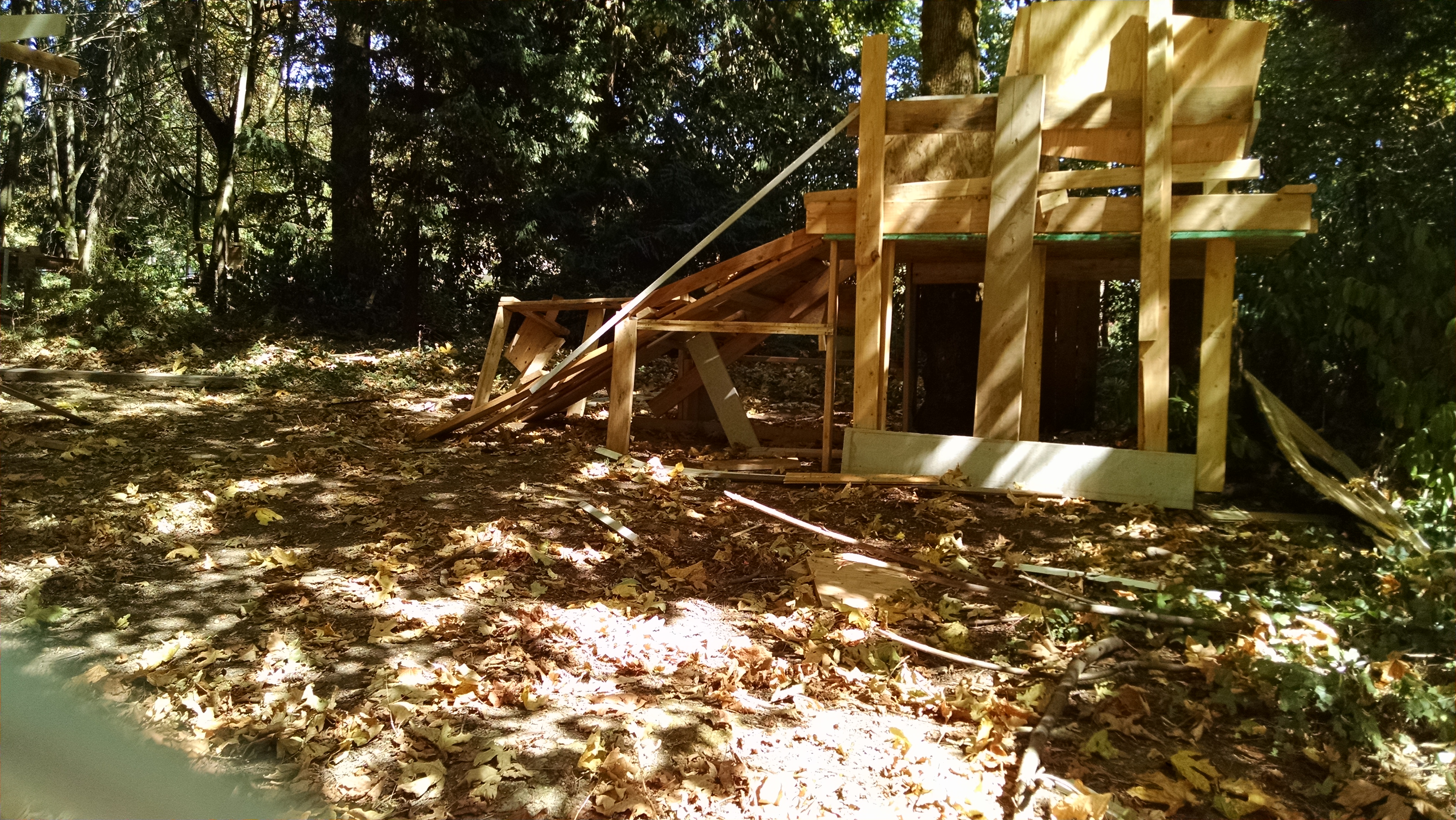
Some are a little more rickety and haphazard.

rickety4 rickety3 rickety2 rickety1

Some kids have added warning signs, some label their creations, and some create whimsical details:

sign2 sign1

My son loves running around and exploring what’s there – just like any playground he goes to, the first things he wants to do are: climb ladders, run up ramps, slide down slides, get as high up as he can, and swing on the swing. He was having a fabulous time just playing and exploring till we got to the swing… The existing swing he found was really a disappointment – it didn’t hang straight, and didn’t swing well. So, it was time to start building! We worked together to build a swing. (See a video of the swing here.)

ramp slide high swing installation

The Inspiration

The playground is inspired by free play advocates, and advocates for the benefits of risk-taking for kids and the benefits of allowing kids to tinker and build real things with their hands and real tools. There are several adventure playgrounds in England and Europe and the trend is moving to America. Learn more about the movement here:

What Kids Learn

There is so much to be learned in this environment!!

  • Creativity. As a child plays and explores what is already there, they learn about the range of possibilities, and start creating their own vision of what they would like to see in this world, and then set about making that vision a reality.
  • Construction skills. Kids learn about hammers, nails, saws. They learn about measuring, rope tying, adding in shims to stabilize something. So many skills that they discover the need for in the moment of building.
  • Safety assessment. They learn to test their work to see if it’s stable and safe, and re-build as needed.
  • Failure and trying again in a new way. Not everything they attempt works! I was watching a mom and daughter try to fit a bed railing in between two existing uprights. It kept tipping backwards, so they added support boards behind it. But then it was tipping forwards, so they added more boards, and it still tipped, so they had to figure out how to build a better stabilizer to hold it in place.
  • Teamwork. When installing an 8 foot long plank on a 4 foot tall platform, you need help. You can’t do it alone. So, you ask for help, you explain what you’re trying to do. You work together with someone. If they have different ideas, you might need to learn some conflict resolution skills.
  • Satisfaction in a job well done. The kids had just even more fun playing here than they would in any regular playground, but beyond that, they had a whole other layer of pride, sense of competence, and boosted confidence. They all left the playground bragging about what they had created together.

Read more about what kids learn here, where I share more photos, and stories from our trip.

Safety Issues

There are definite safety issues. Many of the ramps are shaky, there are lots of high platforms without rails, and narrow wobbly bridges several feet in the air. There’s lots of potential for falls. Also, the kids are working with hammers, nails, and saws. Some have clearly gotten safety coaching. Others have clearly not.

sawing

When I was there in 2015, if my memory is correct, most of the wood was stacked up in a wood pile near the front gate. This year, the wood was randomly scattered EVERYWHERE across the site. This made it much easier to build… when you had an inspiration, you just searched the ground nearby and you’d find a board you needed, or a branch or a rope. But this means you better pay close attention when you walk! And if you fell, you’d be as likely to land on a board as on the soft ground of the woods. And most boards on the ground have nails sticking up out of them. (Remember those sturdy shoes!)

boards2 boards1 nails2

There were also LOTS of loose nails on the ground. This is what I picked up just from under the platform where we built our handrail and swing.

nails

Another issue is that there’s LOTS of places where kids pounded a 3 – 4 inch nail through a 1 – 2 inch thick board, and that means there’s a section of nail sticking out on the other side… so watch out for protruding nails on the backs of ladders and on the bottoms of platforms.

I believe kids can stay safe there, but only if you emphasize to your child the importance of caution. An article in Seattle’s Child says that there have been few injuries, and most of those have been adults, because the kids are being more cautious.

I certainly taught my child how to be careful there!  I let him explore, but I made sure he knew to watch the ground when he walked (no running), test to be sure something is stable before going on it, check to be sure there’s no nails poking out before you put your hand there, and so on.

I LOVE the free play aspect of this playground, but I also think that with great freedom should come great responsibility. I wish that all parents would give their kids some basic education on the way in, not just about how to move safely through the playground and how to use tools safely, but how to be responsible for keeping it safe for others. I wish they were taught to be sure their structures were as stable as possible before walking away and leaving them for other kids to play on. I wish kids were encouraged to stack all their scrap wood in tidy piles, near worksites, but not directly in the range or where someone could fall. I wish they were encouraged to pick up any nails they drop, and to also scan their worksite for any hazards before leaving for the day. I wish that when kids or parents noticed nails sticking out on the back of a handrail, they take out their hammer and quickly pound it down to keep others safe.

I’m definitely a product of a girl scout / boy scout childhood, and have firmly engrained the idea of “leave the site cleaner than you found it.” I feel the users of the playground could use that message, though maybe here it’s “leave the playground safer than you found it.”

Age Guidelines

I personally would not take any child under the age of four here. I think it would be hard to keep them safe. If you have a little one, it’s much better to stick to the traditional safety-tested playground and Deane park has four fabulous play areas not counting the adventure playground! (Read my full review here.)

I took my son last year when he was four. (And I should note, we spend LOTS of time at playgrounds and hiking outdoors and climbing rocks and climbing trees, so he has a lot of physical skills and learned caution from those environments.) I kept a very close eye on him the whole time as he played, and actively educated him about how to stay safe and we didn’t attempt to build anything because I didn’t want to get distracted. We did carry a hammer around with us, and did pound in some loose nails we found.

This year, he’s five, and my husband came too, so we had two sets of eyes to make sure he was safe. So, this year we were able to balance building and supervising him. But I didn’t really have any “sit down and relax” time.

We observed other parents and grandparents with a range of ages, and definitely the 6 – 9 year olds had an adult working closely with them. For the 10-12 year olds, a few parents would sit on a log and read while keeping a vague eye on the kids and calling out suggestions. There weren’t any kids there alone that I noticed, but 12 and ups are allowed to be there without an adult.

If you’d like a building adventure, check it out soon! They’ll dismantle this year’s constructions on September 25th.


Great Classes for Kids AND Parents: Parent Education & Coop Preschools

Classrooms in the Bellevue College Program

Classrooms in the Bellevue College Program – click for larger view

Are you a parent of a baby, toddler, or preschool age child? Are you looking for:

  • A place where your child can explore toys, do art, hear stories, sing songs, and make friends? (And use up some energy on a cold winter day?)
  • A fun activity to do with your child where s/he learns new skills and you get new ideas?
  • Opportunities to meet other families and build community?
  • Expert advice and research-based information about parenting and child development?
  • Support from professionals and other parents for the challenges of life with a little one?

You can find all these great opportunities in one place!

In the Seattle area, our community colleges sponsor parent education programs, including parent-child programs and cooperative preschools, which are a fabulous resource for families. For children, classes offer hands-on learning, discovery and play. For adults, they offer on-going education on all topics related to parenting, plus connections to other parents.

What is the children’s experience like?

The programs are play-based, because research shows children learn best through hands-on exploration in places where they feel safe and free to explore. Each classroom has several stations around the room, with developmentally appropriate activities to help kids build the skills they need. Children are encouraged to move around and explore at their own pace. In parent-child programs (aka “mommy and me classes”) for babies and toddlers, parents play along with their children. In coop preschools, working parents are assigned to a station. Activities vary by age, but might include:

  • Art activities: play-dough to roll, easels to paint at, markers for learning to write
  • Sensory activities: tubs of water or rice or beans to scoop, pour, stir, and run fingers through
  • Large motor: mats for tumbling, tunnels to crawl through, climbers and slides, balls to throw, dancing and movement games
  • Small motor: blocks to stack, puzzles to assemble, shape sorters to solve, beads to thread, and building toys for construction
  • Imaginary play: dress up zone for trying on new roles, dolls to care for, kitchen for “cooking”
  • Science and nature experiences: seeds to plant, tadpoles to watch, items from nature to explore
  • Snack time: a place to practice social skills and table manners and to discover new foods
stations

click for larger view

Classes also include “circle time” or “music class” where the teacher leads the class in singing songs, dancing, playing musical instruments, and reading stories. This is a chance for children to practice sitting still, listening to a teacher, and participating in a group activity, all essential skills for kindergarten readiness. Academic skill-building (reading, writing, pre-math skills) is integrated into all types of activities.

What makes these children’s programs different from other programs?

Diverse Experiences in One Familiar Setting: Most children’s programs focus on one domain of learning: dance class, art class, story time, music class, or tumbling. These programs do it all. And they do it in a known space where the child feels safe and comfortable. Some of the same toys activities reappear from week to week to provide reassurance and routine, and some new toys and activities rotate in to encourage children to explore and try new things.

Long-Term Relationships: Lots of programs run in short sessions of 4 – 6 classes. Parent ed programs run for the full school year. Seeing the same children week after week allows kids to build friendships.

Close parental involvement: Parents are always welcome in the classroom.

What are they like from the parent perspective: how do they work?

Each program works a bit differently, so check to be sure of the details, but here is the general idea:

Parent-infant Classes and Parent-Toddler Classes: Meet weekly for two hours. Every other week, the parents attend a one hour parent education session. In infant classes (for babies birth to one year old), the baby remains with the parent for parent ed. In toddler classes (for one-year-old and two-year-old toddlers), children are encouraged to play in one room with the children’s teachers and other parents while their parent attends parent ed.

Staffing and Parents’ Role: Each class is staffed by a parent educator and one or two children’s teachers. Parents provide snacks for the class on a rotating basis. Each family may bring snacks 1 – 3 times a year. Parents may also be asked to help tidy up the toys at the end of the class.

Cooperative Preschools:Three-year-olds may attend 2 or 3 days a week, four-year-olds attend 3 or 4 days a week. Typically, the parent stays with the child and works in the classroom one day per week, and the other days are “drop-off” preschool for that family. Classes may be 2 – 3 hours long.

Staffing: There is a preschool teacher, trained in early childhood education, who is responsible for planning and coordinating the children’s activities, and leading group times. A parent educator observes / consults during some class sessions, and offers a monthly parent education session plus one-on-one expert parenting advice.

Parents contribute by working in the classroom once a week. They also help with the running of the school by: providing snacks, fundraising support, helping with end-of-year cleanings, serving on the board (chair, treasurer, secretary, etc.), or as class photographer, play-dough maker, etc.

Length of program: Most classes (parent-child and coops) meet for the full school year – September through May. [Note: you may be able to enroll mid-year, if there are spaces available. Check with the programs to find out.] Some have summer programs.

What do Programs Cost?

For some programs, you pay by the month, some by the quarter, some by the year. If you look at the cost for a quarter (11 weeks) or year (33 weeks), it may look like a lot compared to other children’s activities in the community. So, to compare apples to apples, it’s best to look at it as cost-per-hour. Infant and toddler groups at our local community colleges range from $7.50 – 11.50 per hour. For comparison’s sake, here’s what a sample of other programs cost on an hourly basis:

  • Big motor activities: Gymboree $30, Gymnastics East $20, Northwest Aerials $13
  • Parent education and support: Mommy Matters $22 plus child care costs. Baby Peppers $10.
  • Art programs: Kidsquest $17 per hour. Kirkland Parks $13. Kirkland Arts Center $10.
  • Music programs: Kindermusik $22, Kirkland Parks $11. Bellevue Parks $21.

Cooperative preschools in these programs range from $7.50 – 10.00 an hour. For comparison sake:

  • Bellevue public schools, $10 per hour. Bellevue Boys & Girls Club $10. Bellevue Christian School $11. Bellevue Montessori $18. Jewish Day School $19. Villa Academy $18. Seattle Waldorf $22. Cedar Crest $24.
  • Note: most preschools have an adult/child ratio ranging from 1:6 – 1:9. At a coop, the ratio may be 1:3 or 1:4.

All the parent education programs and cooperative preschools offer scholarships to lower income families which can further reduce the cost.

What makes these programs different from other programs?

College credit and student privileges: Parent education programs are college classes, and parents receive college credit for attending. They can also receive student ID cards, which depending on the school may give access to services such as fitness center or gym access. They may also allow you to get student discounts at a wide variety of local and online businesses.

Parent Education: Experienced professional educators offer information that is current and research-based but also relevant to the day-to-day reality of parenting little ones. Topics are tailored to the age and needs of the families, but may include: daily routines, discipline, child development, early learning, nutrition, potty training, emotional intelligence, kindergarten readiness, and self-care for parents.

Individualized Advice: Parent educators and children’s teachers have the opportunity to get to know each child as an individual, and also get to know parents well. This allows them to answer questions in a highly personalized way. They can also refer on for additional services when needed.

Parent Involvement: Participating in your child’s classroom from day one encourages you to think of yourself as an active participant in your child’s learning and an advocate for them in future classrooms. You’ll know the other children and can help your child learn about them. You’ll know what happened in class, so you can later reinforce the learning. Seeing classroom activities may give you new ideas for what you can do at home to enhance your child’s development. Having the opportunity to observe other children each week helps give you a deeper understanding of child development, and seeing parents respond to their children shows you options for parenting style.

Peer Support and Long-Term Relationships: Parents meet with other parents over the course of many months, which allows for long-term connections. Working together on projects strengthens those bonds, as does the peer support gained when parents discuss and share the joys and challenges of caring for kids.

Programs offer classes for families with children from birth through age 5, so instead of having to search for new classes every month or every year, you always know where you can find a fun and educational class for you and your child.

Learn More about Programs Near You and Register Now!

All the most current contact information for these programs can be found at the bottom of this page: https://gooddayswithkids.com/parent-ed-at-colleges/

Carillon Woods Park – Kirkland

IMG_20160628_111202529

Carillon Woods, at 5429 106th Ave NE is a lovely wooded park with nice play equipment and plenty of trails through the woods. It’s tucked away in a neighborhood about a quarter mile east of Carillon Point, and just west of Northwest College.

The sign shown above is in the midst of the butterfly garden which had lots of bees gathering pollen and some butterflies on the day we were there. It also has an interpretive sign about the butterfly life cycle.

The play structure is a nice one for ages 3 – 9. It’s got lots of ways to climb up: regular stairs, two ladders up the centers of each tower, a climbing rock, tricky stairs (the fourth picture below), and loop ladders up the sides. For ways down, it has a pair of toddler size slides, and a mid-size slide. There’s a long “bridge” connecting the two towers.

IMG_20160628_111243431

IMG_20160628_111313924  IMG_20160628_111331693 IMG_20160628_111341377

The playground was partially in the sun partially in the shade at 11 am. It was a fairly hot day, but all the dense greenery of the park helped the shady areas feel quite cool.

Around the corner, you’ll find a nice climbing rock with some comfy benches to sit on and watch your child climb. It’s an artificial rock, and you can definitely tell by the hollow sounds it makes when you climb on it, but with several years of moss and dirt on it, it looks surprisingly realistic. The wood chips around it are deep and soft – as my husband walked on it, you could see the chips sink down an inch or so, and slowly raise back up as he moved on.

IMG_20160628_112805730

Around the corner from there are swings. They’re both kid style swings – no toddler bucket. The climbing rock and swings are very shady, so good for a hot day.

IMG_20160628_114316391

Then there are the trails – there’s a short paved loop (plenty long enough for a tricycle outing) that takes you around the play equipment and back to this interpretive sign about water, and a bench.

IMG_20160628_114126484_HDR

Then there’s lots of other trails through the woods. We wandered along some of them, but didn’t fully investigate. The park is almost 9 acres, and the developed area with the play equipment is maybe an acre of that, so there’s lots more to explore. (2 acres is off limits to the public as it’s an unstable slope, and contains a pump house and active wells.)

IMG_20160628_114305163 IMG_20160628_114151699 IMG_20160628_114118117

There are no bathrooms at the park.

We were there from about 10:30 – 12:30 on a sunny Tuesday, and saw one man walking his dogs, one grandma with a toddler, and one other family arrived just as we were leaving. I don’t know if that’s typical usage or not. If you’re looking for a busy park packed with kids, this may not be it.

But, if you’re looking for a quiet and really lovely park, where you’re surrounded by lush green foliage, this is a great park for you!

IMG_20160628_111058954

Note: this park is not as well maintained as we’re used to in Kirkland. The playground could really use a pressure washing (especially where the moss is growing on the roof) and there’s lots of weeding to be done. But there’s no trash or anything – so the users keep it tidy.

More info at: Kirkland Views (a great write-up), Active Rain, and My Parks