Category Archives: Fun Activities

Nature Connection Pyramid

pyramidi like this infographic from the Nature Kids’ Institute, which gives “recommended daily allowances” style of recommendations for getting your child outside. (They have a free five part series of short videos on “Let’s Bring Childhood Back Outside.”)

They talk about free, unstructured outdoor play once a day. This is about the little stuff, like finding some tree stumps in your neighborhood to climb and jump off of, or stopping at a local plant nursery, going on an autumn leaf hunt or a scavenger hunt in your neighborhood, or walking to the store, or playing in the backyard, or weeding the garden or digging in a sandbox. In the video, they say the best thing is an empty outdoor space with no toys or obvious activities so children get creative and invent their own play.

They suggest that once a week, you make a plan for a nature outing, like a trip to the dog park (whether or not you have a dog), a visit to a farm park or petting zoo, a hike to search for wildlife. You could even just visit the same woods or park every week, and make friends with a tree. At this time of year, try the pumpkin patch.

Once a month, check out a regional, state or national park. Here are some new favorites we found this summer. And once a year, go somewhere wild.

If you find yourself making excuses for why you “just can’t go outside today”, check out my post on overcoming the barriers to outside play.

Why do this? There are so many benefits to outdoor play! Increased creativity and self-direction, decrease in ADHD symptoms, large motor development, lower obesity rates, better vision, and more… As winter sets in, you’ll often feel like your child is “bouncing off the walls” inside. Bundle them up, take them outside, and let them play!

Have you gotten your recommended dose of nature today?

Fun with Toddlers: Fall Theme


fall
Here are a collection of fun toddler activities, crafts, and books related to autumn.

Songs to Sing / Rhymes to Say

Apple Tree
[Miming gestures here; video here]
Way up high in the apple tree.
Two little apples smiled  at me.
I shook that tree just as hard as I could.
Down came the apples
and mmm they were good.

5 Little Pumpkins
http://wiki.kcls.org/index.php/Five_Little_Pumpkins
Five little pumpkins sitting on a gate.
The first one says, “Oh, my.  It’s getting late!”
The second one says, “There are witches in the air!”
The third one says, “But I don’t care.”
The fourth one says, “Let’s run & run & run.”
The fifth one says, “We’re ready for some fun!”
Ooooooooooo went the wind, and OUT went the light,
and five little pumpkins rolled out of sight.

Pumpkin, Pumpkin (tune of Twinkle Twinkle)
Pumpkin, Pumpkin on the ground (crouch down)
How’d you get so big and round? (stretch arms to make a circle)
Once you were a seed so small (pretend to hold a seed)
Now you are a great big ball (make a big circle with hands)

Homemade Toys to Make:

Play-dough: There are LOTS of recipes for Play-dough available online. Here’s one I like: Mix 1 1/2 cups water and 1/2 cup salt. Heat to almost boiling. Remove from the heat and add 2 TBS. vegetable oil, 2 TBS alum*, food coloring. Cool & knead in 2 – 3 cups of flour.

* You can find alum in the spices section of the grocery store. Or you can substitute cream of tartar.

Felt Tree: Cut a tree, leaves & apples from felt. Let your child stick them to a felt board.

Activities / Games to Play:

Sticky spider web. Use painter’s tape / masking tape to make a spider’s web across the doorway. Your child can throw things at the tape and see if they stick. Try cotton balls or wadded up newspaper or whatever small lightweight things you have handy. Source

Leaf Hunt. Go for a walk and collect fall leaves. Talk about the different colors and the different shapes, count how many points they have, compare small to large, and notice smooth edges versus serrated edges. Point out which tree each leaf fell from.

Pumpkins and golf tees: Get a pumpkin, golf tees, and a toy hammer. Kids ages 3 and up can hammer the tees into the pumpkin. For toddlers, you can hammer several golf tees in – they can take the tees out and put them back in – great small motor practice!

Crafts to Do:

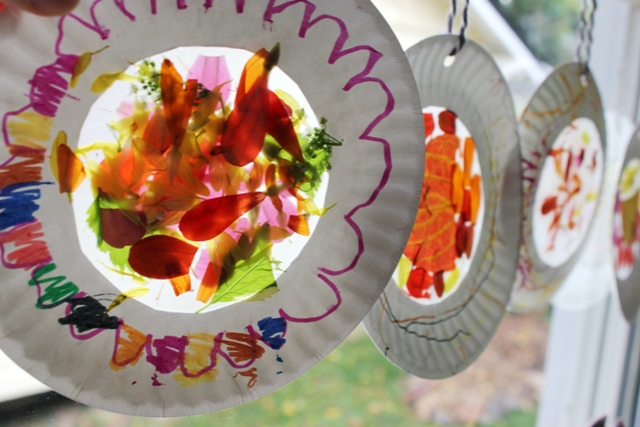
Leaf Suncatchers. (See photo at top of page.) Take the prettiest leaves from your leaf hunt and sandwich them between two layers of clear Con-Tact paper. Frame (if desired) with a paper plate rim or construction paper, and hang in the window. Source

Sticky Apple Tree. Cut out a tree shape from brown contact paper for the trunk. Cut green paper leaves and red paper apples (or use green and red pompoms). Hang the contact paper on the wall, with the sticky side facing out.  Let your child stick “leaves” and “apples” to the tree, take them off the tree, and stick on again. Inspiration

Apple prints. Put some paint on a tray. Cut an apple in half. Show your child how to make prints by dipping the apple in the paint, then pressing it on to a paper. Source

Pumpkin finger puppets. Make finger puppets to go with the five little pumpkins rhyme. You could make them with playdough or felt or mini post-it-notes stuck to your fingers.

Books to Read:

  • Owl Babies by Martin Waddell. One of our favorites!! A sweet story about three baby owls who worry when mama goes hunting. But of course mama comes back!
  • Five Little Pumpkins by Dan Yaccarino. An illustrated edition of the finger rhyme above.
  • Apples and Pumpkinsby Anne Rockwell. Simple book that features fall themes like apple picking, jack-o-lantern carving, and trick or treat.
  • Apple Farmer Annie by Monica Wellington. For kids 4 and up. Talks about apple picking, counting, sorting, baking, and selling at a farmer’s market.
  • The Very Busy Spider by Eric Carle. Lots of farm animal noises & repetitive lines for kids to join in on.
  • The Itsy Bitsy Spider by Iza Trapani. Builds on the classic and familiar song as the spider goes on further adventures around a house

Printable handout of these fall activities here.

More ideas (and source citations) for this topic at: http://www.pinterest.com/bcparented

For my full collection of theme-based “Fun with Toddlers”, click on “Fun with Toddlers series” in the right hand side bar. Or if you would like them in printable handout form to share with students, click here.

photo at top of page from: http://artfulparent.com/2011/09/fall-nature-suncatchers.html

Engineering and Preschoolers

Engineering challengeI loved this post on “The Educator’s Spin on It” which gave an idea for an engineering experiment to try with a preschool age child, and also included broader tips on how to build Engineer-Thinking skills in your child, book recommendations about engineering, and so on. But when I read it yesterday, I didn’t expect to try the experiment today!

Then today, we had one hour before nap-time, and needed a new idea for an activity. My son asked for fizzy science experiments, and we played for a while with vinegar and baking soda. Then he asked for a new science experiment.

I remembered the post, and said: “Let’s build a rain shelter.” We made a bunny-like object out of a paper towel and talked about how we could keep it dry. First, I asked my son how to keep dry, and his first idea was to wear a raincoat and rain pants. (He goes to an outdoor preschool in Seattle, so is well practiced in this method!)  We put bunny in a ziploc bag (aka his raincoat – my son is not quite savvy enough to realize how bad a plan a ziploc would be if the bunny actually needed to breathe!). And then we ran bunny under the faucet. Sure enough the “raincoat” kept him dry.

Then we took off the raincoat, and practiced having bunny hide under a flat roof. (The lid off a bistro box from Starbucks.) That worked for a little “rain” but when we had a lot of rain the flat roof spilled over. But the “roof” we were using had “gutters”, so we cut out a section and added a straw for a downspout. (Then we had lots of chances to sing the Itsy Bitsy Spider and talk about waterspouts.) We then folded the lid in half to see the advantage of peaked roofs over flat roofs.

Then we made a “tree” out of shredded up plastic bag… that also shielded our bunny till there was just too much rain and the “ground” (the plate the bunny was on) got so wet there were big puddles that ran under the “tree” and soaked the bunny.

After that we walked around our house and looked at our gutters and rainspouts. We tracked where the rain would flow out of the spout, down the driveway, out to the road and down the street to the storm drain, and talked about how it goes to the lake from there. We looked at the flat roofs and peaked roofs in the neighborhood.

In the end, it was a fabulous hour of interactive discovery inspired by a blog post I read yesterday morning. I would have never thought of this project on my own, and am so glad that I get to benefit from the shared creativity of other educators and parents!


Fun with Toddlers: Babies & Families Theme

learning-about-emotions-diy-toyAt my toddler classes, we organize the kids’ activities and room decor around a series of themes. Each theme runs for 3 – 5 weeks. This year, I will be writing a series call “Fun with Toddlers” with ideas for activities parents can do at home: songs, games, crafts, and books. Our first theme of the year is Families and Babies, and lots of my activity ideas tie into learning about the parts of the body.

Songs to Sing

One Two (I have two eyes, so do you…)
Find lyrics, sheet music and an mp3 at: http://nancymusic.com/SOM/2008/one-two.htm

Two Little Eyes (tune: Twinkle Twinkle)

Two Little Eyes to Look Around
Two Little Ears to Hear Each Sound
One Little Nose to Smell What’s Sweet
One Little Mouth that Likes to Eat
Eyes and Ears and Nose and Mouth

Head, Shoulders, Knees and Toes

Homemade Toys to Make:

Happy/Sad Face: Use cardboard and paper fasteners to make the face shown in the picture at the top of this post. Spin the features to make happy faces, sad faces, and more. Directions at www.mrprintables.com/learning-about-emotions.html

Family Magnets. Take photos of family members. Glue onto magnets. Let your child play with them on the fridge. You could draw a family tree with pictures on it and have your child match magnets up to names and photos on the tree.

Sensory Activities to Do:

Baby Doll Bath Time. Put a doll and washcloth in a sink full of soapy water. As your child bathes the doll, name each body part.

Games to Play:

Body Part Flash Cards. Find photos of eyes, hands, and so on. Glue to index cards, and write labels. Your child could explore these on their own. Or you can call out a body part and ask your child to find the matching card. Or you can put tape on the back of each one and have your child label your body – sticking each card to the right part of you.

Put Your Finger On… Ask your child to “Put your finger on your nose. Put your finger on your toes” and so on.

Books to Read:

Where Is Baby’s Belly Button?(or others by Karen Katz)

Ten Little Fingers and Ten Little Toesby Mem Fox

I Can (or other books by Helen Oxenbury)

[This section contains Amazon Associate links.]

More ideas (and source citations):

www.pinterest.com/bcparented/family-and-babies-theme/

Water Beads vs. Boba (Edible Tapioca Balls)

Water beads are FABULOUS to play with (see my last post) but bad to ingest (non-toxic, but not healthy, even potentially deadly…. again, see my last post). So, if you’ve got a little one who ALWAYS puts everything in their mouth and swallows it, they’re not a safe option.

I’d seen a recommendation to use boba – tapioca pearls like are used in bubble tea. I decided to do a side-by-side comparison.

The products

My water beads were BioGel from Creation Station. The boba was Rainbow Tapioca Pearls, ordered from Amazon. On a pound-for-pound basis, the boba was half the cost, but I had to buy a larger quantity than I would need for sensory play for one kid.

Ease of Preparation

Boba – boil water, add boba, cook for five minutes or more, drain.

Water beads – put them in water. Let them sit for six hours.

Water beads win, but both pretty easy.

Appearance

boba

Boba for sensory play

water beads

Water beads for sensory play

As you can see, water beads are MUCH prettier than the boba. The boba was fine on its own – interesting shape, some shine, nice color. But doesn’t begin to compare to the beauty of the water beads!

Play-ability

Boba – they’re pretty sticky – stick to your hands and stick to each other – so easier to play with if you float some in water. Interesting to touch, fun to “chase” around the water and catch, fun to squish between your fingers into blobs of goop. Held my son’s attention for about 5 minutes – if he’d used these before the water beads, they might have been more interesting.

Water beads – VERY fun to play with – on their own or in water. Can be scooped, poured, picked up with tongs, and so on. (See my other post, or ideas on Pinterest.) Kept my son’s attention for a week of on-going play and exploration.

Again, the water beads are the clear winner.

Taste

Boba – bland but chewy – I told my son they were edible but the water beads absolutely were not. He popped a couple in his mouth and ate them, but not a lot. (He loves them in bubble tea, but not as much in this context, which is probably a good thing. (I generally try to keep “sensory items” and “food” in separate categories to minimize confusion.)

Water beads – tasteless and no smell, so no motivation to eat, luckily. Note: my son did not taste them, because I told him they were not edible. I did taste them (licked one), for the purposes of this review – I wanted to know if they would appeal to toddlers. FWIW: My dog also was unimpressed. We dropped one on the floor, he picked it up, carried it in his mouth for a few seconds and spit it out. This is a dog who eats lots of stuff he shouldn’t (like socks), so these must really be unappealing.

Mess and clean-up

Boba – need to wash your hands and whatever surface you played on after use – starchy, gooey.

Water beads – no clean-up needed. I dry my hands after playing with them. But my son (who is a kid who HATES being wet after water play) doesn’t even bother to dry his damp hands when he’s done.

Storage

Boba – we didn’t have them around for long – they just weren’t interesting enough to keep around. I imagine they dry out and stick together, may go bad?

Water beads – they’ve been sitting uncovered on the counter for a week, no maintenance needed.  I rinsed them after a week, just for kicks. Don’t know if they were dirty.

Conclusion

Water beads are a far superior sensory material. For me, personally, with my child I will use them in the future, and not boba. If you’ve got a kid who mouths and eats everything, then the boba may be a better option for you.

Update: here are alternate directions for making tapioca water beads… I have not tested it, but it’s worth taking a look at, because they claim it works for them: https://thecraftathomefamily.com/edible-water-beads/?fbclid=IwAR3oXVvI1TUktv3l824wwp_8FT6h4aLmbhYRCBHxIAVboD4zb3RhpZaCcRw