Category Archives: For Parent Educators

The Economics of Parenting Style

I’ve written before about the four parenting styles, about other parenting labels like helicopter parents, free range, and tiger moms, and how parenting style might affect how we handle choices in our families.

Yesterday, there was an article in the NY Times called Is Education No Longer the Great Equalizer, and it quoted extensively from “The Economics of Parenting,” by Doepke, Sorrenti, and Zilibotti, that is a fascinating way to think about parenting through an economists’ lens. They say the “basic parent-child conflict is that the parent attaches a higher weight to the future utility of the child” versus the child places a higher weight on their “full enjoyment” of the moment.

They say that parenting styles “come down to whether, and how, parents interfere with the child’s choice.” The permissive parent lets the child have their way, and may go out of their way to offer a wide range of choices. The authoritative parent attempts to shape the child’s preferences, by offering choices but also educating about why they believe particular choices are the best ones for the child’s long-term well-being. The authoritarian parent offers few choices, dictating what will be done. Their emphasis is on what children do, not what they think, so there’s no need to persuade them that it’s the right option… it’s the only option.

They also state that permissive parents value either independence or imagination, authoritative parents value hard work, and authoritarian parents value obedience.

Doepke, Sorrenti, and Zillibotti then look at the interaction between the economy and parenting styles. In societies with a wide array of career opportunities and a low degree of income inequality, “the gap between the top and the bottom is small… Parents are less concerned about children’s effort, and thus there is little scope for disagreement between parents and children. Therefore, most parents adopt a permissive parenting style, namely, they keep young children happy and foster their sense of independence so that they can discover what they are good at in their adult life.” If parents believe that their child can be financially successful no matter what, it’s easy to let them pursue their talents and their joys.

In societies where there’s little social mobility, where most children will have the same profession as their parents, the parents have little incentive to be permissive and let their children discover something they’re good at (they may see talent as irrelevant in a world where there aren’t career choices available) and or to be authoritative and convince their child of anything. If the parents’ experience is that you need to do whatever work that is available to survive, they tend to be authoritarian – conveying ideas like “you just have to follow the rules – you don’t have to like it.”

In a society with a high degree of income inequality, the choices a child makes could have a big impact on their economic well-being. The parents know their children have a wide array of job opportunities and want to persuade them to choose the one that will give them the best chance of success. So, a larger share of parents are authoritative. They also tend to be highly involved, ensuring that the child is taking the best advantage of any available opportunity and learning to make “good choices” (as the parent defines them). The authors acknowledge that authoritative parenting requires more effort on the parents’ part than the other options.

The parents’ current economic status also influences parenting style. “richer parents can use monetary rewards to persuade their children to comply with their wishes. Poor parents lack the resources… and may be more likely to resort to authoritarian methods such as corporal punishment.”

Doepke, Sorrenti, and Zillibotti were discussing how this might be see on a country by country basis, but it clearly also comes into play in micro-societies of neighborhoods – for example, a neighborhood with few economic opportunities might tend toward authoritarian values.

For parent educators and others who work with families, I think these ideas add to a deeper understanding of influences on parenting style. Understanding a family’s culture and socioeconomic class, especially if it is different from our own, increases our empathy and ability to communicate.

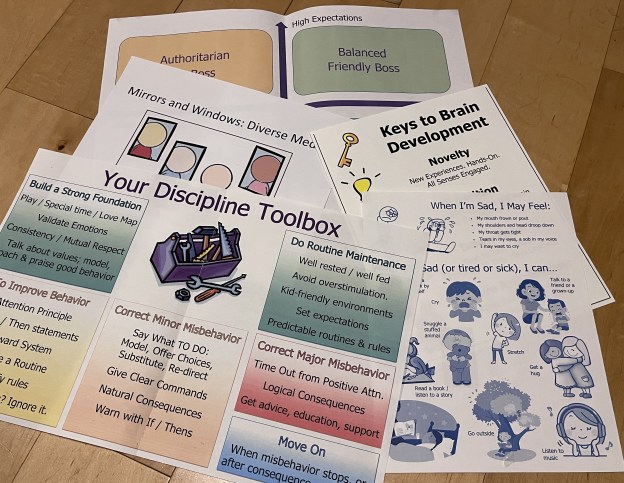
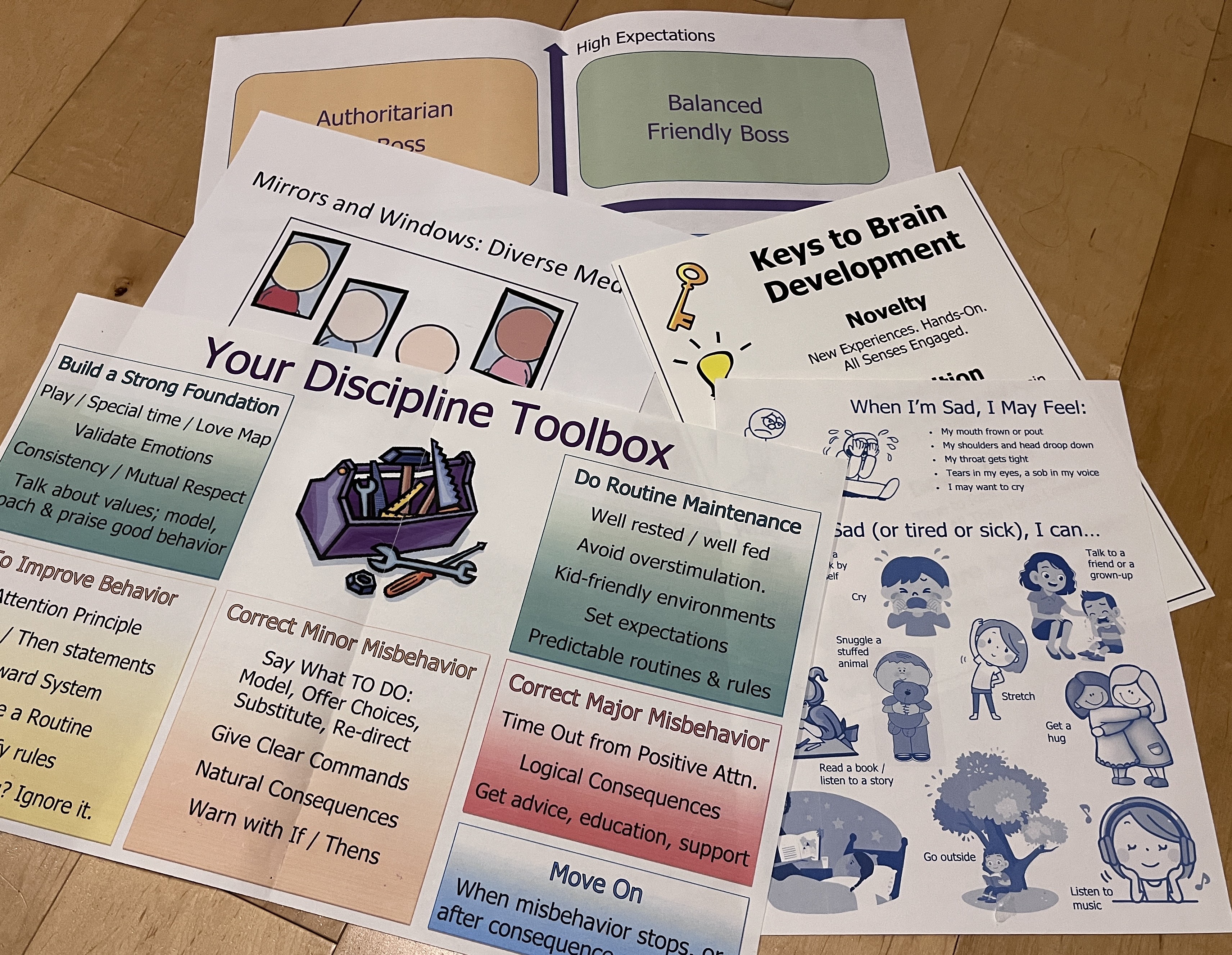
Parent Educators, here’s a handout you can share to introduce parenting style.

Ages & Stages Questionnaire

How ASQ works

The Ages & Stages Questionnaire, or ASQ, is simply one of the best tools available for developmental screenings of children from birth to age 5. It has been in development for about 40 years and tested by tens of thousands of participants.

You can purchase questionnaires, or it is now available as a free* online screening tool at https://osp.uoregon.edu/home/checkDevelopment.  A parent may complete it by themselves, or it can be done with a professional. (Parent educator, social worker, child care worker, physician…)

Completing the questionnaire

First, you choose the correct questionnaire for the child’s age: they’re in two month increments for the first two years (2 months, 4 months…. 24 months), then every 3 months (27, 30, 33, 36), then every 6 months (42, 48, 54, 60).

The parent fills out the questionnaire. It asks six questions in each of five realms of child development: communication (what child understands and what they can say), gross motor (running, climbing, throwing), fine motor (hand and finger coordination), problem solving, personal-social (self-help skills and interactions with others).

The form asks simple questions, like “If you point to a picture of a ball (kitty, cup, hat, etc.) and ask your child, ‘What is this?’ does your child correctly name at least one picture?” The parent answers the questions yes, sometimes, or not yet. They are encouraged to try things out with their child as they go through the questionnaire, so they can see what their child’s abilities are for sure.

There is an additional optional questionnaire called ASQ:SE which assesses social-emotional development, such as autonomy, compliance (ability to follow directions), adaptive functioning (sleeping, eating, toileting), self-regulation, emotional affect, interaction (ability or willingness to respond to others), social communication.

Results (and how they’re calculated)

With the online questionnaire, the parent receives a report which lists which categories their child is “on schedule” with, where they should “monitor” and if there are any categories where the child is “not on schedule.”

To give professionals a little more insight into the calculations that lead to these categorizations: The results are scored 10 points for every yes, 5 for sometimes, 0 for not yet, so a maximum of 60 points per category. On the written test, you would then tally it on a table similar to this:

tally

If the child scored as we would expect for a child of this age (on the example above, this would be a score of 40 or higher on problem-solving, shown in the white/un-shaded area of that row), then the child’s development appears to be on schedule. If they scored close to the cut-off (in the gray area, shown as 35 or 40 points on the personal-social row), that would be something to monitor. If they score below the cut-off (a unique number for each category of each questionnaire), then further assessment by a professional is recommended.

This is a screening tool, not a diagnostic tool. If all looks well for the child (all scores are in the white area or the online tool says “on schedule”) then we can be assured that they are likely well on track. If they’re in the gray area / “monitor”, then we ask more questions to figure out why. If there’s a good explanation, then the score probably is not a cause for worry, but you could recommend adding activities to build the child’s skills in those areas and re-screening in a few months. If they’re in the black area / “not on schedule” consider referrals to more resources. The Oregon website offers this helpful ASQ Review Guide to help you determine next steps.

These videos for providers offer more information about how to use the ASQ with parents.

Follow-Up

It’s most effective when this tool is used as the beginning of a conversation with parents. After completing the tool, what do they see as their child’s strengths? Do they have any concerns about their child’s development? Did the screening reduce those concerns (they discovered the child is actually on track) or increase them (child is shown as monitor or not on schedule)? What are some next steps they can do to help their child’s development?

On my post for parents about how to complete the ASQ, you can see how I talk with parents about interpreting their results – whether to worry, how to seek help, etc.

If they completed the online questionnaire, their emailed test results will include links to age appropriate learning activities and play activities.

* The screening is free for parents. Since I know the ASQ is a product that is sold, and is fairly pricey, I wanted to be sure I wasn’t violating copyright by promoting use of the online tool. The website is for the Oregon Screening project, so  I have looked for legal terms on the site to see whether they limit its use to Oregon residents or in any other way, and all I have found is “This site is open to all parents of children ages 1 month up to 72 months.”

The screening is also available free at Easter Seals: www.easterseals.com/mtffc/asq/. I prefer the Oregon screening project, because Easter Seals asks for all of the family’s contact information and will add them to their mailing list.
Questions Posters

I created a new set of posters for the classroom on “Questions to Ask to Extend Learning.”

Educators frequently encourage parents and teachers to ask “open ended questions” as part of a facilitated learning process. But it may be hard for parents and teachers to think of good questions as they’re playing with a child in a classroom or at home.

Often, they end up asking yes / no questions, or quizzing kids for “the right answer.”

On Teacher Tom’s blog, he writes: “They say there’s no such thing as a stupid question, but I beg to differ. We hear stupid questions almost every time adults and young children are together. Here’s [an] example: a child is playing with marbles, exploring gravity, motion and momentum. An adult picks up a handful of marbles and asks, “How many marbles do I have?” The adult already knows the answer. The child probably does as well… [These] questions take a child who is engaged in testing her world, which is her proper role, and turns her into a test taker, forced to answer other people’s questions rather than pursue the answers to her own.”

So, I designed these posters to hang around the classroom to inspire parents with some good open-ended questions. They offer ideas of what to ask that will take the child’s learning to a new level. Click here for a PDF file and you can print your own.

Sources for these ideas:


Twenty Recommended Parenting Books

Today, I put together a handout on 20 Recommended Parenting Books. Click above for a printable handout, or check out the list below.

Title Author topic
And Baby Makes Three Gottman relationship skills
The Baby Book Sears overview of infant care
Becoming the Parent You Want to Be Davis parenting style
Brain Rules for Baby Medina brain development
Breastfeeding Made Simple Mohrbacher nutrition
Child of Mine Satter nutrition
Elevating Child Care: A Guide to Respectful Parenting Lansbury parenting (infant/toddler)
Heart Tending: Creating rituals that nurture you and those you love Watson daily routines and rituals
It’s OK Not to Share and Other Renegade Rules… Shumaker discipline
Last Child in the Woods Louv activities: nature
Mind in the Making Galinski development
The No-Cry Sleep Solution Pantley sleep
No-Drama Discipline Siegel discipline
NurtureShock Bronson & Merryman development
Our Babies, Ourselves Small culture of parenting
Parenting Without Borders Gross-Loh culture of parenting
Pregnancy, Childbirth, and the Newborn Simkin, et al pregnancy & birth
Raising An Emotionally Intelligent Child Gottman emotional devel
Simplicity Parenting Payne parenting style
Tinkerlab: A Hands-On Guide for Little Inventors Doorley activities: STEM

Are your classes gender inclusive?

IMG_0671If you teach classes for children, what do you do to ensure that all genders feel welcome?

Many parents have had the experience of taking their child to a class that felt very biased toward girls or toward boys. (Read about my experience in my son’s dance class.) Some parents and kids stick it out even when all the messages say “you don’t belong here.” But many will drop out, looking for somewhere that they feel like they belong. What can teachers and administrators do to welcome all genders**?

Let’s examine some of the ways we can help.

How do you encourage all genders to enroll in your program? Think about:

  • Your class name: If you name your class “toddlers and tutus”, that pretty much implies it’s a girls-only class. If that’s what you intend, that’s fine. Say so. But if you’d like boys to enroll, think about a name change!
  • The words in your marketing: Whether it’s on brochures, posters, website, or social media, when you describe your program, do you talk about boys and girls and state that all are welcome?
  • The pictures in your marketing: Are there boys and girls and gender ambiguous kids? Boys and girls doing things together? If your photos show only girls playing dress-up and only boys climbing on play equipment, it’s easy to infer a gender bias.

How do you make your space welcoming to all genders? Think about:

  • The environment of your classroom: do pictures show both boys and girls doing a wide variety of activities? Are the colors gender neutral or diverse, or is it all pink ribbons or blue cars? Do you cluster all the “boy activities” in one area, and the “girl activities” in another area. (Cars and blocks here, kitchen and dress-up there.)
  • Your bathrooms: If you have single occupant bathrooms, are they labelled “boys” and “girls” (or “men” and “women”)? Why? Can’t you just label them both “restroom” or say explicitly “all gender restroom”?

How do you greet children and families into your classes? Think about:

  • The words you use when talking to parents: I prefer saying “kids” or “children” or “students” which includes everyone. If you want to say “sons” then also say “daughters.” If you say “girls” also say “boys.”
  • The words you use talking to the children: Instead of calling over the “boys and girls” for an activity, can you call them “kids”? Or even better: “dancers” or “artists” or “inventors” or  “everyone ready to play some soccer”? Not only is it gender inclusive, it allows them to take on the identity of a dancer or an artist and so on.
  • The way you react when a person of the less expected gender joins your program: Definitely welcome the person just as you welcome all others. But DON’T go way overboard in welcoming them, like “Oh, it’s so wonderful to have a girl in this class. I really wish more girls would enroll. I’m so delighted to have a girl.” All that tells them that you think it’s weird that they’re there.
  • How do you define which gender a child is? Well, the more gender neutral your practice is, the less this matters. But, when you have to guess, it’s fair to go by name, apparent biological sex, and apparent gender presentation. (For example, if you see someone who looks like a biological male, whose name is John, and who’s wearing a Spiderman t-shirt, you can guess boy.) But, if the child or the child’s family tell you the child’s gender, then honor that, even if it’s different from your initial assumption. If John in the Spiderman shirt says “I’m a girl, please say she and her when talking about me”, then do so! You can also invite parents and children to let you know what name they prefer to use, and what pronouns they use.

How do you make sure that daily life in your classroom is inclusive? Pay attention to:

  • The ways you divide up the group: Do you often go for the “boys on this side” and “girls on this side” way of splitting up the class for small group activities? Try mixing in “kids wearing white here” and “kids wearing blue” or “kids who like dogs best” and “kids who like cats best” and “kids who have birthdays in January through June” and “July through December.” Not only is this gender neutral, it also gets them mixing up a lot more and finding things they have in common with each other. (If we always groups divide into girls and boys, it can become an “us” and “them” mentality where the kids see the differences more than the similarities. We would NEVER divide kids up by race for a game, why is it seen as OK to divide them by gender?)
  • The books you read: Do they show both boys and girls, men and women, and androgynous folks doing a variety of things? In our Family Inventors’ Lab, we try to make sure that we read books about girls inventing, and boys studying animals, and so on. We’ll talk about Thomas Edison and Marie Curie.
  • Pay attention to labels: Use firefighter, not fireman. Flight attendant not stewardess.
  • Minimize stereotyped gender roles: When a group of children is playing house, don’t assume one will be the mother and cook and care for the baby. If children make that assumption, that’s OK but you shouldn’t place that assumption on them. Try not to say “wow – this is a woman astronaut… isn’t it great that women can be astronauts too?” It implies that this is a special case, not an equal opportunity.
  • Help soften their stereotypes. Around 2, children start defining things as “boy toys and girl toys“, around age 3 or 4, children start defining activities as “boys do this and girls do that” and around 4 to 6 they say “only boys can do this and only girls can do that.” (source)  You can remind them that anyone can choose any toy or activity, according to their own personal interests. But, don’t get too distressed by this. Stereotypes and sweeping generalizations is one way that kids make sense of their world.
  • Adjust your expectations of who will do each activity option: I confess that when I set up our classroom, in my head, I think “what’s my boy activity today.” By that, I really mean: I want to make sure I have an activity that will appeal to those kids who are full of physical energy and really need some big motor release. I need to come up with a new term for that, even in my own head. I’ve never said to anyone else “this is our boy activity” but I need to think of it in other terms myself to reduce my bias.
  • The way you react to the activities they choose: I still remember a coop preschool my middle child was in 14 years ago… one little boy in the class LOVED to dress up in pretty dresses and high heels and carry purses, and so on. Almost every parent volunteer who saw him do this tried to entice him either to choose different clothes (the firefighter helmet) or to choose a different activity (blocks or cars.) Although none of them said anything negative to him, there was definitely an undercurrent of “you shouldn’t do that.” In this case, the teacher gently modeled for all the parents that it was OK for the boy to do whatever activities he enjoyed.
  • How do you handle emotions: Are you sympathetic to a girl’s cries, but tell a boy to stop crying? Are you shocked when a girl shows anger, but act as though it’s normal when a boy does? Do you place similar limits on their behavior or do you let boys get away with more, because “boys will be boys.” Do you congratulate both boys and girls for sitting still and paying attention?
  • How you respond to bullying: If a child is being teased or bullied due to gender issues, be clear that it’s unacceptable in your classroom. But, don’t use this as a reason for punishment, instead use it as a reason to teach.

Check out this article on 6 ways to embrace gender differences and this one on 12 easy steps on the way to gender inclusiveness. Also, read my summary of what the research shows on innate gender differences vs. cultural influence, and on how to support both boys and girls in developing their strengths. If you want to learn more about transgender people, here is a nice overview. And here are pointers for Talking with Children about Gender Identity.

What other ideas do you have for welcoming all genders?

** I want to clarify why I’m saying “all genders” rather than “both genders.” In your classes, the majority of your kids may be cisgender: either girl-bodied-who-identify-as-girls or boy-bodied-who-identify-as-boys. But, you may also have transgender or gender queer or intersex children who don’t quite fit those straightforward binary definitions. Some of those kids won’t figure this out till adulthood, but some have the sense from very early in life that their assigned gender doesn’t fit. They and their families are already having a hard time sorting that out. If they go to a very gendered environment, it makes it even harder to know how they fit in and creates even more gender dysphoria (distress caused by the dissonance between how a person feels about their own identity versus how they are perceived / treated by others). If they are in a more gender neutral, gender inclusive environment, it’s easier for them to feel like the person they are is welcome there. Learn more about gender identity: https://gooddayswithkids.com/2018/05/02/gender-identity/

Photo: http://academyofmusicanddancenj.com/fall-2014-registration-dance-classes/