Tag Archives: toddler

Hands On is Brains On

I recently did a presentation at Kidsquest Children’s Museum in Bellevue, WA on how kids learn, titled Hands On is Brains On.

It combines information on the basics of brain development, ideas about the important of offering a balance of learning opportunities, the benefits of free play, and the parent/teacher’s role in play-based learning.

You can check out the powerpoint handout here, or, if you’re a parent educator, you can download a powerpoint presentation that you could edit and use in your own classroom.

Car Seats – Don’t Hurry to the Next Stage

Motor vehicle accidents are the second leading cause of child death in the United States. Proper use of the proper car seat can hugely reduce the risks. There are four stages of car safety restraints. To maximize safety, keep your child in each level of seat as long as possible, until they reach the maximum height and weight for that seat. Each stage provides less protection. Don’t move your child to the next stage until you have to. This is NOT one of the places where we want to rush our kids along to the next developmental milestone!

Note: To choose the right level seat for your child, it is more important to consider their height and weight than their age. (So, if your child is small for their age, they may be in a seat longer than age recommendations say.)

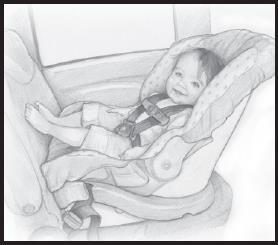
Rear-Facing. (Birth to age 2 or beyond)rear-facing car seat
Infant Seat. Weight from 4 pounds to 22 – 35 pounds and height up to 29 – 32 inches, depending on the seat. Convertible Seat. Weight from 5 or 20 pounds minimum to 45 pounds maximum rear-facing, maximum height 40 inches.

The American Academy of Pediatrics says “All infants and toddlers should ride in a rear-facing car safety seat (CSS) until they are 2 years of age or until they reach the highest weight or height allowed by the manufacturer of their CSS.” Riding rear-facing helps to protect a child’s fragile neck and spinal cord, and reduces the risk of severe injury by 75%.

Many parents notice that as their toddler grows, there is less room for their legs, and they have to bend their legs or sit cross-legged in order to fit. They wonder if they should turn the child forward. As a car seat technician told me: “yes, there’s a minor risk of broken legs in an accident. But, broken legs are much easier to heal from then a broken neck, which is more likely if they’re forward facing.”

forward-facing car seatForward-Facing Car Seat with a 5-point Harness. (Age 2 to 7)
Should never be used for a child less than 20 pounds or less than one year old.
Maximum weight 35 – 70 pounds. Max height up to 50 inches.

These seats are equipped with a 5 point harness. In a crash, that harness keeps the child in the seat and helps distribute the force of the crash to the strongest parts of the child’s body. Use for as long as possible, as they provide more support and protection than a booster seat. Your child is ready for a booster when he reaches the top weight and height allowed for his car seat (shoulders are above the top harness slots and his ears have reached the top of the seat.)

You may find as your child gets older that they are riding in other people’s cars more often (for field trips, playdates, and so on). Make sure the person who is transporting your child knows how to install the seat or booster properly.  Some parents choose to use an easy-to-install booster for these occasional trips once their child hits the minimum size, while continuing to use a forward-facing car seat with a 5-point harness in their own car for the majority of car rides.

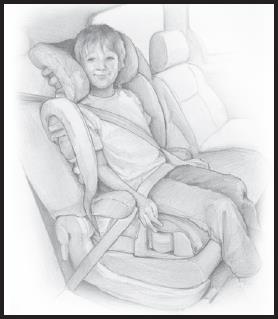
boostBooster Seat. (Age 4 – 8 or beyond)
Up to 100 – 120 pounds. Maximum heights from 34 – 63”.

Washington requires that children use a safety seat until they’re at least 8 years old or taller than 4’9” (57”) whichever comes first. (Note: Less than 5% of kids are taller than 4’9” at 8 years old. 25% don’t reach 4’9” until they are almost 12 years old.)

Boosters properly position the adult lap and shoulder belt for a child, so it provides proper restraint in case of an accident.

Your car must have a lap and shoulder belt to use a booster. If your car only has lap belts, you can use a forward-facing car seat with a harness or see if shoulder belts can be installed in your car. There are backless booster seats, which are generally less expensive and easier to carry. There are high-back boosters, which should be used in cars without head rests or with low seat backs.

Seat Belt. (Age 8 or older)
If your child is 8 – 12 years old or at least 4 feet 9 inches tall, AND you can answer yes to these questions, then they’re ready to move out of a booster seat.

  • When the child is sitting all the way back against the vehicle seat, do the child’s knees Seat beltbend comfortably at the edge of the vehicle seat?
  • Does the lap belt stay on the top of the child’s thighs, not on their belly?
  • Is the shoulder belt centered on the child’s chest and shoulder (and not on the neck or throat)?

Can the child stay seated this way for the whole trip? Without putting the shoulder part of their seat belt under their arm or behind their back?

Front Seat. By Washington law, all children should ride in the back seat until age 13.
(Exceptions for: pickup trucks or sports cars with no back seat, or if the back seat is filled with younger children)

Air bags are very dangerous to children riding in rear-facing car seats. If your vehicle has a front passenger air bag, infants in rear-facing seats must ride in the back. If a young child must ride in the front seat of the car, check your vehicle owner’s manual to learn how to turn off the air bag.

Choosing a Car Seat: Choose a car seat that is easy for you to use, so that you will use it right every time. NHTSA offers ease of use ratings for all the car seats on the market: http://www.nhtsa.gov/nhtsa_eou/

If your child is likely to be tall or heavy for their age, choose a seat with higher maximum weight and height to allow your child to use that car seat as long as possible.

Install the Car Seat Properly. For a car seat to work correctly, it must be installed correctly. Check the web resources below for information on car seat installation, and read your car seat manual and your vehicle manual for tips. Once you’ve installed a seat, you can have it checked for free. See www.800bucklup.org/carseat/inspections.asp for a list of inspectors.

Clothing. If a child is dressed in bulky clothing, the car seat may not properly restrain them in case of a crash. In the winter time, buckle your child into the seat without a coat on, and then place the coat or a blanket over the harness for warmth.

Other Objects. In case of an accident, loose objects in the car can fly around and strike passengers, and if your child is holding a hard object, it could hit them, causing injury. Keep this in mind as you do your best to keep your car tidy and consider what your child has access to in the car.

Be a Good Role Model. Always buckle up yourself. Always encourage all the other adults in the car to buckle up. Practice safe driving practices with minimal distractions. Your children will be driving themselves in just a few years, and they will have learned a lot about driving by watching you from the back seat. Make sure you are showing the behavior you want them to learn.

I think of motor vehicle safety as what I call a “red light” issue. When I teach safety skills to children, or talk to parents about safety skills, I think about “green light” situations with no risk of harm, “yellow lights” where we just let them know to be careful, “orange lights” where we only allow them to do something with very close adult supervision, and “red lights” which are absolute rules, set by the parents, and followed all the time in order to keep the child safe. Riding in the proper seat, properly buckled is mandatory. (To learn more about my thoughts on teaching safety skills, click here. And to learn about letting a child take reasonable risks as a learning experience, click here.)

More info: www.800bucklup.org; www.safercar.gov/parents; www.healthychildren.org

In this post, I reference Washington State laws. To learn the laws in your state, visit: http://www.ghsa.org/html/stateinfo/laws/childsafety_laws.html

For a printable handout of this information, click here.

Illustrations from healthychildren.org

Resolution

hugThis is my final post in a week-long series about Parental Anger.

It’s about picking up the pieces and moving on after you had a parental meltdown

If you were angry in front of your child,then when you’re calmed down later on, talk about that situation. Explain that you were angry, but it wasn’t their fault. Apologize if needed. Say it was OK that you have that emotion, but the way you were expressing it was not OK. Tell them you will try to handle it better in the future. (For older children: ask them for ideas on how they calm themselves down.) This helps them see that we all make mistakes.

If you were angry at your child, apologize for directing anger at them. However, if they had misbehaved, and it was appropriate for you to set a limit for them, you can and should still set that limit. You just do it from a calmer place… In other words, you don’t change the rules because you feel guilty for being angry! You calmly reinforce the rule, saying “I’m sorry that I yelled at you, but what you did was against our family rules and I can’t let you do that.”

If you fought with your partner in front of your child, be sure to let them know that you have resolved the argument and that things are OK now between you and your partner.

Re-connect. Do something fun or relaxing with your family to heal the stress.

———

illustration: http://www.freeimages.com/photo/1386612

Fighting in Front of the Kids

fight[This is part of a week long series on Parental Anger.]

Many of today’s parents grew up in families (or knew families) who didn’t handle conflict well and they want to learn how to handle conflict better around their kids.

It is unhealthy for kids to be around their parents’ fights if the parents are hostile or threatening, insulting each other, dragging up every example of wrong-doing from the whole relationship, or storming away in anger. This sort of family conflict is associated with guilt and shame, depression, withdrawal, anxiety disorders, aggression and impulse control issues. Sulking, the silent treatment and the cold shoulder are just as hard on kids. They sense the tension and know something is wrong, but they don’t know what is wrong, and whether it’s their fault. If you’re in a relationship where these kinds of fights are common, your children would benefit from you seeking counseling and support now to resolve some of these issues.

On the other hand, if parents have a healthy relationship and argue in a healthy way, that can actually benefit the kids. If you’re respectful and loving toward each other even in an argument, if you stay focused on the current issue, and if you resolve things before walking away, this can show your kids that people can disagree, even when they love and respect each other, and then work out their differences in a constructive manner. They learn that negotiation, compromise, and resolution are possible.

Things to keep in mind:

  • Some topics are off-limits in front of the kids (like your romantic / sexual relationship.)
  • Don’t argue about the kids or about parenting issues in front of the kids. It’s very important to resolve issues out of their view so you can present a united front to them.
  • If you notice that your arguments start off civil, and then escalate upwards, make a plan. Set an anger cut-off point. On an anger scale of one to ten, when do you start to lose control and behave inappropriately? If you’re in a disagreement with your partner, and notice you’re nearing that cut-off point, call a time-out. Table the argument for another time. Or set a time limit on arguments, after which you walk away to calm down and come back to it later. Watch your children for cues that it’s too much: they cry, become clingy, freeze in place, look withdrawn or depressed. They may also misbehave to draw you away from the argument, or try to peace keep. If you do call a time-out, be sure to go back to it later, resolve the argument, and let your kids know that you resolved it.
  • Children interpret your arguments within the full context of your relationship. If you have a warm, supportive, loving relationship despite arguments, that will shine through.

Family that Fights Together: www.wsj.com/articles/SB10001424052702304213904579093151181560622

When Mom and Dad Disagree: www.nbcnews.com/id/29959807/ns/health-childrens_health/t/how-dare-you-when-mom-dad-disagree/#.VVwUcUY2ekI

For ideas for relationship skills for building a healthy relationship, check out: https://gooddayswithkids.com/category/parenting-skills/relationships/

Photo: http://www.freeimages.com/photo/1185567

What if you’re angry at your child?

screamThis is part of a week-long series on Parental Anger.

People often tell me that when they get angry at their kids, they feel like bad parents.

It’s important for parents to realize: It’s normal and OK for you to sometimes get mad at almost anyone – and especially at people who you spend many hours a week with and who often make unreasonable demands of you!

Here are some things to think about when you find yourself angry at your child:

  • Are your expectations appropriate? If you find yourself saying “Kids your age are supposed to do X. Why don’t you?” or “no matter how hard I try, I can’t make my kid do Y…” that shows you have an assumption about what they’re developmentally capable of. Check resources on child development to make sure you’re right and not holding them to an impossible standard.
    • For example, the leading trigger for child abuse is potty training accidents. Parents often think their child should be potty trained much younger than they are really developmentally capable. The average child doesn’t potty train till around 30 months, yet every year there are many reports of toileting related abuse at 20 – 24 months. It’s unfair to expect more out of a child than they’re capable of!
    • Also know that children’s developmental capabilities regress when they’re upset. Although your three year old might normally understand language quite well and might normally be capable of making a choice between 3 options, you may find that when they’re in the middle of an emotional meltdown, they can’t understand words and they can’t make choices.
  • Is this a phase? There are predictable periods in children’s lives where they are going through lots of developmental changes – called “periods of disequilibrium”. They tend to be pretty hard to live with at these times. Seek extra support to help you through this rough patch.
  • Are they testing you? It’s normal for all kids, especially toddlers and teenagers, to test their limits. It’s how they learn the rules. But it can be exhausting and infuriating when they do the same thing over and over even when “they know it’s wrong”. Over-reacting to this testing and getting angry may make the testing worse, as they discover they have power over you and can make you lose your cool. Instead, calmly and consistently reinforce limits. Describe the consequences they will face if the behavior repeats, and then follow through.
  • What’s your attitude toward discipline? If you think it’s about making the child do whatever you tell them to do, you’re setting yourself up for some battles of will. If you think of it as guiding your child to behave as well as possible, and having high expectations, but also knowing that some days they won’t meet them, you may be more successful.
  • Is your child just trying to get your attention? How does your child feel right now? Are they angry themselves? Scared? Lonely? Try to empathize with what the need.
  • Are you really angry at your child or are you angry at someone / something else? We sometimes have “spill over” anger. We’re mad at our partners, or mad about something at work, or mad that we’re late due to a traffic jam. And our child does something minor that makes us explode and take out our anger on them. Try to catch this when it’s happening, and if you can’t, go back to your child later and apologize to them.

If you have let your anger out and yelled at your child, there’s some healing and resolution to do. Check out this post.

Learn more about handling anger at a child: http://www.ahaparenting.com/parenting-tools/positive-discipline/handling-anger

Photo: http://www.freeimages.com/photo/579286