Tag Archives: toddler

Types of Preschools

When you start looking at preschools, you discover a whole world of jargon you never knew: play-based, emergent, teacher led, benchmarks, coop, Waldorf, Reggio Emilia, and so on. It can be overwhelming. And to make it more confusing, different people use words differently.. two schools that both call themselves “child-led” or “play-based” may look very different in practice.

A couple big picture ideas:

Structured vs. Play-Based: A structured preschool might use group time, worksheets, and individual projects to teach particular skills. Students may be drilled in the basics, or asked to practice things over and over. All the children are expected to be engaged in the same activity at the same time – they are all working on a craft project together or it’s math time for everyone. (Think of your elementary school education – structured preschools are using similar methods moved down to a younger group).

A play-based preschool typically has multiple stations set up and allows children to move between things when they choose, spending as long as they want at an activity. The teacher moves around the room, making suggestions and observations to further the learning. (Here is a research summary about play-based learning: https://www.easternct.edu/center-for-early-childhood-education/about-us/publications-documents/science-in-support-of-play.pdf) Most play-based preschools include circle time to provide some balance between structure and free play. Learn more about play-based preschool and activity stations at a play-based preschool, and how play-based compares to academic.

Teacher-Led vs. Child-Led: A teacher-led curriculum (may also be called didactic or standards-based) means the teacher always prepares the lessons in advance (it might be their own creation or they may use a curriculum written by someone else) and sticks to it. The teacher is active, the children are passive.

A child-led curriculum (may also be called emergent or constructivist) follows the children’s interests. So, for example, the teacher may know the math concept of the week is more than/less than. But instead of teaching that in a formal scheduled way, she asks the children playing with trains whether there are more blue trains or red trains, then asks the children playing with blocks which tower has more blocks in it, and asks the child who loves dinosaurs whether they think velociraptors ate more than T-rexes or less.

Brand Name Teaching Methods

Here is my summary of the methods. You can find many more descriptions online, including helpful comparisons at https://www.pbs.org/parents/thrive/comparing-preschool-philosophies-montessori-waldorf-and-more and www.privateschoolreview.com/articles/180. But remember that the actual practice of a school may differ from the theory of “the brand”.

  • Classic Montessori: The teacher sets up learning centers around the room, with “self-correcting” materials (e.g. a puzzle where the child can tell if they’ve done it right or wrong and thus can work to fix it themselves if it’s wrong.) Children work independently at their own pace, and are in a multi-age classroom.
    • Note: Montessori schools can range in quality and in how tightly they adhere to Montessori methods. The word Montessori is not tightly controlled, and anyone can use it, no matter what teaching methods they use. Some schools use it because it’s a known brand name that “sells” well, but the classroom experience may only have a very loose connection to Montessori practices.
  • Rudolf Steiner/ Waldorf – Nurturing, predictable structure and routines. Natural materials, with time outdoors, baking bread, working with wool, wood, and wax materials, no plastic. Lots of imagination and oral story-telling, but no electronic media (families are discouraged from having any screen time at home). Reading is not taught until age 7. Learn more www.youtube.com/watch?v=CoW0pCIG-FM and www.youtube.com/watch?v=tZmAX5adCl0 and www.movementforchildhood.com/uploads/2/1/6/7/21671438/heardaboutwaldorf.pdf
    Note: Waldorf requires all teachers and schools to be certified, so there’s much more consistency between schools with the Waldorf name.
  • Reggio Emilia. Child-led investigations. Project-based: when the children come up with an idea for a project, the class focuses for a few weeks on it, finding out together what they need to know to make it happen (including pre-reading and math.) They document projects with photos and journals. www.youtube.com/watch?v=XVv5ZL9nlgs
  • Nature-based or “forest kindergartens“. Common in northern Europe, they are newer to the States. There are several available on the Eastside of Seattle (My son attended Tiny Treks). Children spend most, or all of their time outdoors (yes, even in the winter). Child-led, play-based, emergent curriculum where teachers respond to children’s interests, rolling in math and science where it fits logically, often doing story-time, snack, and circle outdoors. To learn more, search for “forest kindergarten” on YouTube or check out www.youtube.com/watch?v=JBoXaQKoWL0
  • Academic preschools. There are preschools that have an academic focus that are taught in developmentally appropriate ways. But there are also schools which drill rote facts into children. That may mean the children will in fact learn to read words younger than they might otherwise have done, but this doesn’t appear to give them a long-term advantage. An occasional worksheet is a good experience for kids as preparation for future school experiences, but a worksheet-based curriculum is not appropriate for a 3 year old. (Read more: https://gooddayswithkids.com/2016/01/07/academic-preschools/)
  • Cooperative preschools. Most  are balanced programs with time split between play-based learning at learning centers (e.g. dress-up area, block area, art, sensory), circle time (includes story time, literacy skills, and concepts like days, seasons, colors, etc.) and outdoor or big motor play. There is a professional teacher who plans the curriculum and leads structured activities. What distinguishes co-ops is parent involvement. For a 3 year old, they might attend preschool three mornings a week. On some of those days, the parent drops off. On one morning, the parent stays and works in the classroom with the children. This means there is a very high adult to student ratio. Co-op isn’t the best answer for a parent who needs child care so they can work or do other activities. However, for parents who have the time available, many report that they enjoy the time spent in the classroom, and like knowing more about what their child does at preschool and who the other children are in the class. Parents also have the opportunity to build friendships with other parents. Note: Cooperative preschools tend to be much lower cost than other options.
  • Head Start. For families whose income is less than 130% of the federal poverty level (i.e. less than $25,000 in 2013). Provides preschool for child, but also: medical, dental and mental health screenings, meals for the children, and support for the parents. Fact sheet: http://wsa.iescentral.com/fileLibrary/file_71.pdf. To register for Head Start: http://eclkc.ohs.acf.hhs.gov/hslc/tta-system/family/for-families/Inside%20Head%20Start/Frequently%20Asked%20Questions%20%28FAQs%29/HowdoIapplyfo.htm

When considering which method you prefer, it’s worth keeping in mind what we know about brain development (see this post): Children learn best through hands-on experiences with tangible materials, through interaction with engaged human beings, and in environments where they feel safe and happy.

Can We Do Sensory Bins In Class During COVID?

I’m about to return to in-person teaching of toddlers and preschoolers for the first time in 18 months. I have many questions about sensory bins, shared toys, and craft supplies. I don’t have a lot of answers, but here’s what I’ve found.

Official Recommendations for Child Care Settings

Safest Options: Here are some recommended Sensory Ideas from King County public health. These are from May 2020, when worries about surface transmission were high, so the fact that these were considered safe then means they would definitely fit under current recommendations.

  • Individual sensory items in containers. To clean, just wipe down the outside.
    • Double-bagged ziplocks, sealed with tape. Fill with slime, gak, water beads, hair gel, etc. Kids hold and squish around.
    • Fill rubber gloves with sand, lentils, etc. Tie off.
    • Water bottles filled with colored water, oil, sequins, shells, etc. Tape or glue lids.
  • Individual sensory bins in plastic tubs. Each child has their own bin they use each week, filled with rice, beans or other material. Swap tools each week: cups, scoops, toys that can be cleaned.
  • Play-dough in individual containers for each child. For play, put them on a tray, or tape off part of a table. Give the child tools to play with – like cookie cutters. When done, put child’s playdough back in their bag, and clean tools before another child uses them.
  • Give child their own containers of finger paint. Use plastic handled paintbrushes, and clean before another child uses them.

Guidelines specific to sensory bins and shared items in childcare settings

The current recommendations from the Washington DOH (they’re supposedly releasing new recommendations soon) and the CDC, were originally developed when there was high concern about surface transmission.

DOH says (https://www.doh.wa.gov/Portals/1/Documents/1600/coronavirus/DOH-OSPI-DYCF-SchoolsChildCareGuidance.pdf)

  • “Children should have their own set of items to limit the sharing of supplies or equipment.
  • Some items cannot be cleaned and sanitized. This includes things like playdough and some items in sensory bins or tables, stuffed animals, and dress up clothes. Remove these items from the program unless they are individually assigned and labeled.
  • If using sensory materials, use items that can be disinfected or discarded and replaced between sessions…. All sensory table activities should be supervised for toddlers and preschool children. Hands should be washed before and after sensory table use.
  • Books and other paper-based materials are not high risk for spreading the virus and do not need to be cleaned more than normal.”

CDC adds “Machine washable cloth toys should be used by one person at a time or should not be used at all. These toys should be laundered before being used by another child.” https://www.cdc.gov/coronavirus/2019-ncov/community/schools-childcare/guidance-for-childcare.html

What is known, but not yet reflected in the guidelines

Does the type of surface matter?

Viruses live a different amount of time on different surfaces. There were studies in the NEJM that looked at half-life – how long till it’s reduced in half and Lancet that looked at how long it took before the virus was undetectable. Department of Homeland Security has a page that addresses estimated surface decay. (Here’s a plain language summary of the research.)

When first “deposited” – like if an infected person without a mask just sneezed droplets on a surface – there’s more virus there. As time passes, the amount of virus drops, till there’s no longer any detectable. (Imagine a puddle on a sidewalk – at first it might be two feet across, then it gets smaller, and then the pavement is just damp, and eventually the pavement is pretty much dry… the water is undetectable.)

When the virus was intentionally deposited on surfaces, it’s virtually gone from paper in a few hours, from cardboard in 24 hours, wood and cloth in 2 days, glass in 4 days, and steel and plastic in 3 – 7 days.

So, that’s how long some small amount of virus might be capable of living (if not cleaned with soap and water, or sanitized with bleach, or disinfected.)

So… if we had someone in class with active coronavirus, and virus was deposited on a surface and we didn’t clean it, there is some small amount of virus on that surface the next day. The question is – how likely is it that someone who is masked and washing hands frequently would catch COVID from that?

What do we now know about surface transmission?

  • In April 2021, the CDC released a brief (https://www.cdc.gov/coronavirus/2019-ncov/more/science-and-research/surface-transmission.html) which stated: “… surface transmission is not the main route by which SARS-CoV-2 spreads, and the risk is considered to be low. The principal mode by which people are infected with SARS-CoV-2 is through exposure to respiratory droplets carrying infectious virus. The risk of fomite transmission can be reduced by wearing masks consistently and correctly, practicing hand hygiene, cleaning, and taking other measures to maintain healthy facilities.” “… the risk of SARS-CoV-2 infection via the fomite transmission route is low, and generally less than 1 in 10,000….” “Routine cleaning … with soap or detergent, at least once per day, can substantially reduce virus levels on surfaces. When focused on high-touch surfaces, cleaning with soap or detergent should be enough to further reduce the relatively low transmission risk from fomites in situations when there has not been a suspected or confirmed case of COVID-19 indoors.” “Disinfection is recommended in indoor community settings where there has been a suspected or confirmed case of COVID-19 within the last 24 hours.”

How much does cleaning reduce risk?

“From studies of cleaning focused on other microbes, a 90–99.9% reduction of microbe levels could be possible depending on the cleaning method and the surface being cleaned.”

So, if a different group of people is entering the classroom within 24 hours, then cleaning does get you a substantial reduction in risk.

The Context of Our Classrooms

Child care can look like lots of things – there are some 24 hour child cares that are back-up emergency care for essential workers – those might be more likely to have a higher load of any virus, and may be harder to clean between children. A full-time child care with unvaccinated workers might be more likely to have virus, and harder to clean between children.

In the context of my classes, things might look very different and might lead to different decision making. Here are the layers of protection we have in place to reduce the possible viral loads in our classrooms:

  • We require all adults to be vaccinated. (Also, on the Eastside, over 90% of adults have received at least one dose of the vaccine.) We will ask them to do temperature checks, and symptom and exposure checks before coming. This reduces the risk that families will bring the virus to class.
  • We will require adults to wear masks and recommend that children do so. We will also increase ventilation. These practices reduce droplets and the risk of airborne transmission.
  • We will practice frequent hand-washing and hand sanitizing which reduces the risks of fomites being transferred to surfaces.
  • We have much higher adult to child ratios than a typical child care (between 1:1 and 1:5) and can provide closer supervision.
  • Some of our classrooms are only used once a week by one group of families.

Questions there aren’t official answers for

  • If an item is used by one child for a brief period of time, then put away for a week before being used again (like maracas or jingle bells at group time), does it need special cleaning?
  • Given frequent hand cleaning protocols, would it be reasonable to share materials like scissors and markers between children, or is it essential to have a system like a bin of clean markers, and then a bin for dirty markers where any marker that has been used by a child is placed?
  • If children hand sanitize before and after, is a shared sensory bin reasonable? Should it be filled only with materials that can be cleaned with soap and water and sanitized with bleach solution? Could some items (like rice and lentils) maybe be disinfected after class by stirring in alcohol? If health guidelines for child cares allow for sandbox play outdoors (they do) – what about sand in an indoor sensory bin?

These are the things I’m thinking about. If you have additional insight into this, let me know in the comments!

(Re)Adapting to In-Person Classes

This fall, many young children may be returning to in-person classes or preschool after a long time away, and some toddlers may be joining their first group activities with peers. Parents may worry about how their child will adapt. We can support the transition by: getting ourselves ready, choosing the right program for the moment, preparing children by teaching social skills and self-help skills at home plus talking to them about what to expect and what will be expected of them, then supporting them through all the new experiences in the first few weeks of class. We should expect that it will not all go smoothly and all children will have some rough days at school – because that has always been the case!

I know this feels like an unprecedented situation, and yes, COVID is unprecedented. But parents have always worried about sending their child off to school and wondered how they can help with the process. Those steps that parents have been following for decades all apply here, and we’ll throw in a couple COVID specific tips in our suggestions about what you can do to increase the chances that the transition to in-person learning will go smoothly.

Prepare Yourself

If you are anxious, your child will pick up on that, and they’ll be anxious too. So, before you start talking to them about going to classes, do whatever you need to do to build your own confidence that it will be OK. Get support from others if needed.

If you’re worried about COVID – remind yourself that even if children catch COVD, they typically have mild cases. (Yes, there are exceptions – some children who get very sick – but the chances are small.) The American Academy of Pediatrics recommends a return to in-person school. You can also think about layers of protection – all the things you can do to reduce the risk for your child. [If you’re evaluating whether or not to return to in-person classes, here are factors to consider.]

If you’re worried your child won’t adapt well to being around other children, listening to other adults, or being away from you, keep in mind that children are very resilient – they often adapt to things much easier than adults do.

Ideally, you should work on your worries out of sight of your child. But, if your child notices your anxiety, then trying to pretend it’s not there can actually cause them more worry than if you just calmly say “I’m feeling worried now – here’s what I’m doing to calm myself.”

Planning for Success

Jumping from social isolation at home to a full-time program could be overwhelming for some children. Some parents are choosing to start small with a program that meets for only a few hours a week, and gradually build up to more. Some are choosing to start with a parent-child class or a cooperative preschool where they can stay with their child in the new setting to help make the transition to being with other kids and adults easier. Some will choose full-time school but simplify the rest of the child’s schedule to keep things manageable.

When looking at programs, I would consider their COVID protocols: Vaccines for the adults, masking for everyone over age 2, increased ventilation / more outside time, and social distancing can all reduce the risk.

I would also look more broadly at their approach to scheduling and rules. I would look for one that has a nice balance between providing structure with predictable routines and a little flexibility to adapt to your child’s needs of the moment. Our children really need both predictable routines at this time and responsiveness to their needs as they re-adapt.

Preparing Your Child

While returning from COVID is new, asking kids to adapt to new situations is not new. So there are a lot of things we know to do to ease transitions into toddler classes, daycare or preschool.

  • Teach self-help skills. Help your child learn how to put on their coat, take off their coat and hang it up. Help them learn how to open their string cheese or yogurt containers by themselves. Teach handwashing skills, and also practice how to use hand sanitizer.
    • During COVID, teach them how to wear a mask, how to take it off to eat, and put it back on, and what to do if their mask gets wet or dirty. (Early in COVID, many parents wondered if they could ever teach their child to do something “as weird” as wearing a mask – but remember, that’s not weird to a kid. It’s no weirder or harder to learn than how to wear pants in public.)
  • Teach and practice social skills: how to make friends, how to invite someone to play with you, how to ask to play with a toy someone else is using, taking turns, and so on. Set up playdates where your child can practice these skills.
    • During COVID, teach them about “giving space” around them rather than crowding other kids. In dance classes and sports classes, teachers have long used the idea of “bubbles” – imagine you have a big invisible bubble around you and so does everyone else and you can’t bump inside anyone else’s bubble. You can teach and practice this. Be careful not to give your child the message that it will always be dangerous / scary to be close to other people. Just say that right now with COVID we need to make extra space.
    • It always helps to teach emotional literacy skills – how you can tell how someone else is feeling. During COVID, be sure teach your child to watch for body language and tone of voice since they can’t see facial expression for people who are masked.
  • Create routines. What routines can you establish at home to make it easier to get out the door in the morning? If you’ll need to be up earlier in the morning than you’re used to, do you need to adjust bedtime? Learn about what routines they use at school and try to have similar practices at home. (For example, washing hands before snack time.) If your child will use new tools at school – like a backpack or a lunchbox or water bottle – get them early and practice.

Preparing them for Class

Talk about what to expect at their class, and what will be expected of them.

  • There are lots of great books and TV episodes about starting preschool. Some good book options include “Rosie goes to Preschool” by Karen Katz. (video) “Maisy Goes to Preschool” by Lucy Cousins (video), Lola Goes to School by McQuinn (video), Pete the Kitty’s First Day of Preschool by James Dean (video). Or watch “Learn what happens when Sadie starts school.” These provide good starting points for conversations and for pretend play.
    • Note: Many books address separation anxiety and other fears. If your child is already fearful, these can be reassuring. But if your child is feeling confident, don’t read these books – you don’t want to introduce anxiety! Some examples: Bye Bye Time by Verdick (video) is great for kids who are just a little anxious – it helps you develop a ritual for goodbye time and a plan for them for what to do if things are hard. “Llama Llama Misses Mama” by Anna Dewdney (video) is about a llama who has a really rough first day at school – it’s a perfect book to read after your child has a rough day. “The Kissing Hand” by Audrey Penn (video) is about a raccoon child who is very reluctant to go to school – if your child is already reluctant, it offers good tools. Or watch Daniel Tiger Goes to School.
    • Here are recommendations for kids starting kindergarten or first grade: https://www.thoughtco.com/childrens-picture-books-about-starting-school-627520
  • Talk about what to expect at their school. Visit the school, if possible. Or, at least look at pictures or a video tour if available. Visit the outside of the building and walk around. Show your child pictures of the teacher. Get some materials like they’ll have in the classroom – like markers – and practice using them at home. There’s an idea called a social story which was created for kids with autism – where you create your own little book with pictures that clearly describes what to expect, what’s expected of them, and what they’ll do if something is challenging – I find these can benefit any child, so you could create one for your child.
  • Teach and practice how to interact with a teacher. Explain that the teacher is there to help them and will take care of them. Explain that the teacher is in charge. Teach how to get the teacher’s attention and how to ask for help. Teach them that sometimes they have to wait for a grown-up to be available to help them. Play listening games (like Simon Says, Red Light Green Light, or Copy the Rhythm I Clap).
  • Pretend play. Pretend to be going to school – who will play the parent? The child? The teacher? Play at things like: waiting in line (with stuffed animals), doing circle time, taking turns, asking the teacher for help, saying goodbye at drop-off time.

When Classes Begin

  • Don’t make too big a deal of the first day. That anticipation and excitement can turn into anxiety.
  • Don’t introduce all new clothes and shoes and backpack on the first day. Let them wear familiar and comfortable items. Pack their favorite foods, and pack the exact same lunch for the first several days so they know exactly what to expect. Ask your school’s policy about “transitional objects” – for some children, having a toy from home or a picture of family or favorite book, can help them adjust to all the new things around them.
    • Note: pre-COVID, this was often a stuffed animal, but during COVID, only send things to school that can be easily cleaned.
  • Allow extra time to get there – you want time to relax beforehand, remind your child what to expect, and get there with everyone calm. (Note: this is especially true if you have a child you think of as shy – I call them “slow to warm up.” These children do best when they can arrive a little early, before most of the other children and settle in. They don’t do well running in frantic and late to a full and busy classroom.
  • Build a relationship with the teacher(s), other kids, and other parents. When your child sees that you feel comfortable interacting with them all, they will feel comfortable too. Let the teacher know what things most engage and calm your child. (When my child was three, I told his teacher(s) that any time Ben was feeling worried, all they had to do was ask him about the planets, and give him nine objects to line up to show which was closest to the sun and which was furthest… it was guaranteed to calm him any time!)
  • For drop-off programs, ask if it’s possible to stay a while at drop off time in the early days. (It may not be possible during COVID.)
  • When it’s time to leave, keep your goodbyes brief, radiate confidence that they will be OK. Do say goodbye – don’t try to sneak our when they’re not looking. Tell them what they will be doing while you’re gone, and when you’ll return. (Be sure to honor that promise, and be prompt and predictable for your return.)
  • Make your goodbye ritual simple and sweet. Make sure your child is either settled into an activity or knows that to do next, or hand them off to an adult for care so that when you walk out the door, your child has something else they’re focused on other than your absence.
  • Remember that fear of strangers is developmentally normal for all children 7 months and up, and that separation anxiety is common in all toddlers around 18 months. If you see them, they’re likely not due to coronavirus or anything you did or didn’t do. And any advice that you can find for separation anxiety at any time will apply, whether or not it’s COVID specific.
  • Resist the rescue. If your child is sad/crying when it’s time for you to go, be caring and validate their feelings but stick to the plan and leave. Trust the teachers to be the professionals they are and manage the common challenges of separation anxiety. Typically a child who cries at drop off times cries only briefly and will soon calm down.
  • After class, give your child a chance to debrief and talk about how the day went.

Handling the Challenges

You may be one of the lucky few parents that everything goes well for and your child sails on through with no challenges. Or you may have a toddler who bites his classmates. If that happens, it’s not your fault and it’s not because of COVID isolation – it’s because sometimes toddlers bite their classmates. If your seven month old cries when strangers hold them, it’s good to know that 7 month olds have always been prone to fear of strangers. If you have a child who has a hard time sitting still for story time – maybe it’s because they didn’t have to sit still during quarantine… however, there have always been children who had a hard time sitting still! And the teachers will work with your family through the challenges, as they always have.

Be careful not to catastrophize. If your response to every setback is stress, anxiety, and “why does everything always go wrong?” that makes it worse. Try to have a resilience approach – “this is hard right now, but we’ve faced hard things in the past, and we’ve made it through, and look how much we learned.”

Some things to be aware of: if your child is having big feelings, it’s important to acknowledge them, not just try to distract them away. Regression is normal – for example, a child who was potty trained may have accidents – don’t punish or shame, just acknowledge the issue and say “let’s try to do better tomorrow.” If your child is really clingy, maybe they just need more snuggling for a while – soothe and reassure them. If they are misbehaving, remind yourself: children who are loved will always try to do well if they can. If they are misbehaving, ask yourself – is there a skill or support that they are lacking? If so, help them build it. Ask yourself – could it be that they have an underlying need that is driving the misbehavior? If so, meeting that need may resolve the issue.

Be patient and remember that any challenges are just a phase. Just keep doing your best every day and encourage them to do their best, and you’ll make your way through to the other side of this challenging time.

More Ideas

Circle Time for Toddlers

music-play-youth-musical-instrument-children-sports-sound-music-group-human-positions-music-garden-995658

I teach a parent-child class where the toddlers are 12 – 30 months in September. Each week, we do a circle time for music and stories. I tell the parents that not only does music have many benefits for children’s learning, and not only do rhymes and songs help teach language skills, circle time is also a chance for children to begin to practice key skills for kindergarten readiness: the ability to sit still, to listen to a teacher, to notice and do what the other people around them are doing, and to stop doing something when asked. (We do the shaker song every week, “oh you shake and you shake and you shake and you stop” and I talk about how huge this is for practicing impulse control.) My secret agenda is that teaching parents things to do with their children builds connections. Plus, of course, circle time is fun!

At the beginning of the year, I make sure parents know that their children will not yet be good at sitting still and paying attention for the full circle time, but the more we practice, and the more we model that behavior for them and encourage them to try, the better they’ll get. At the beginning of the year, circle time is about 10 minutes long. By the end of the year, it’s 20 – 25 minutes.

I always go in the same order each time, just adding more pieces to each segment as we go along. That way the children learn the ritual, and are better able to participate because they can predict what will happen next.

  1. Greeting Songs – each week we do the “I roll the ball to [name] song” and one other greeting song which uses the child’s name and gives each child a moment in the spotlight.
  2. Lap Songs – when we bounce children in a rhythm, it helps to instill rhythm in them at a fundamental level. It also helps to build their vestibular system. These songs are also super fun, and get lots of giggles going.
  3. Finger Rhymes – these teach a lot of vocabulary, and also teach children to notice patterns… “after dad says ‘with a one step and a two step’, he’s going to tickle me.”
  4. “Theme Activity” – I always have some small toys, puzzle pieces, or decor items tied into the theme gathered in my red gift bag. We sing “what’s in the red bag, the red bag, the red bag…” song. The kids come running over to find out. I give each one an item to take back to their parent – they talk about it together, then we do a few rhymes or songs that are related, then they bring them back to me.
  5. Book (we start these about halfway through the year)
  6. Shakers – we do the shake and stop song, sometimes some other songs, sometimes we turn on recorded music and dance and shake to the music.
  7. Active Songs, with or without parachute. Moving around the room in rhythm to the music is great at building coordination, rhythm, and large muscle skills.

I’ve gathered the ideas for my circle time rhymes and songs from many great sources. I have lots of favorite songs (here are links to lyrics and to videos showing hand motions). I have some favorite toddler books I share.

I have a full year’s worth of circle time plans for my toddler class – it’s organized by theme, and we do each set of songs for about 4 – 6 weeks. Themes include: fall, winter, spring, farm, zoo, stars, transportation, ducks, and beach.

For my science class for 3 – 6 year olds, we do two completely different circle times each week – opening circle teaches a rhythm activity, a discussion of the day’s topic, and a non-fiction book. Closing circle teaches a song, we read a fun imaginative fiction book related to the day’s theme, and we often do a group game to reinforce the day’s learning. You can find about 35 topics worth of circle time plans at www.InventorsOfTomorrow.com.

Do you have any great tips for how to help circle time go well, any favorite songs, or favorite resources for finding more ideas?

Gift Guide: Toys to Build Toddler Brains

photo showing toys like Duplo train, Quadro climber

Parents often ask me for recommendations for “the best toys for toddlers”. It’s a little tricky for me, given that I often advocate for owning fewer toys. But, if you’d like a few special items for a child to unwrap for their birthday, Christmas, or another holiday, here are some thoughts on how to choose the best toys. I’m going to sort them into categories based on ways to build a variety of skills and multiple intelligences. (I also recommend you check out my handout on activities and free items which also help to build their brains.)

Word Play (Linguistic / Verbal Intelligence)

We go to the library a lot! And when my son was a toddler, we went to story-time at the library every week. This means we get to “try out” hundreds of books a year for free! We only buy copies of the very best. Here are my favorites for books that toddlers love, preschool level books about inventors and makers, and books that sing. (For your adult reading enjoyment, here’s my recommendations for recommended parenting books and resources for teaching STEM to kids.)

It’s also helpful to play a lot with letters: I like magnetic letters for the refrigerator (which you can use all over the house) and duplo letters.

I also recommend a Kindle Fire tablet with Kindle FreeTime installed, which includes lots of ABC games and literacy building apps. (Here are thoughts on making screen time work for your family.)

Doing the Numbers (Logical – Mathematical Intelligence)

Everything you have more than one of is a math toy! You can count how many blocks you have, figure out whether you have more trains than balls, and so on. A few helpful specialty math tools are: a set of Duplo numbers, which you can use for counting, number recognition, while mixing them into your building tools, Unifix Cubes, and a great app called Bedtime Math. Every night at bedtime, we read a story problem and solve some math puzzles related to that story.

Putting the Pieces Together (Spatial Intelligence)

I like wooden puzzles for younger children and jigsaw puzzles for older kids. Melissa and Doug is generally a reliable brand. Babies 6 – 18 months like stacking toys and shape sorters. Toddlers love wooden train tracksto assemble and a big collection of wooden trains.

There’s tons of great building toys for older kids (I list many here in my STEM Gift Guide) but my all-time favorite is building toy to give is a basic Duplo set. For a 5 – 6 year old, choose basic Legos.

Moving & Grooving (Bodily – Kinesthetic Intelligence)

I would recommend several balls of varying sizes and textures, a Nerf style baseball bat, a Strider bike, and plenty of time to run and play indoors and out.

Rather than buying a pre-made climber that can never change configurations, I recommend a climber built of Quadro (Quadro is a fabulous combination of building toy and playground equipment! We’ve had ours for 20 years now, in near constant use.)

Playing Well With Others (Interpersonal Intelligence)

Imaginary play and telling stories with characters is one way to build interpersonal intelligence. Choose a few stuffed animals or puppets,  a collection of finger puppets to tell stories with, a toy picnic basket with fake food.

Learning about Myself and How I Feel (Intrapersonal Intelligence)

This category of intelligence isn’t about tangible stuff. It’s more about interaction and emotion coaching, and also making sure your child has time for quiet contemplation and down time.

Song and Dance Routines (Musical Intelligence)music

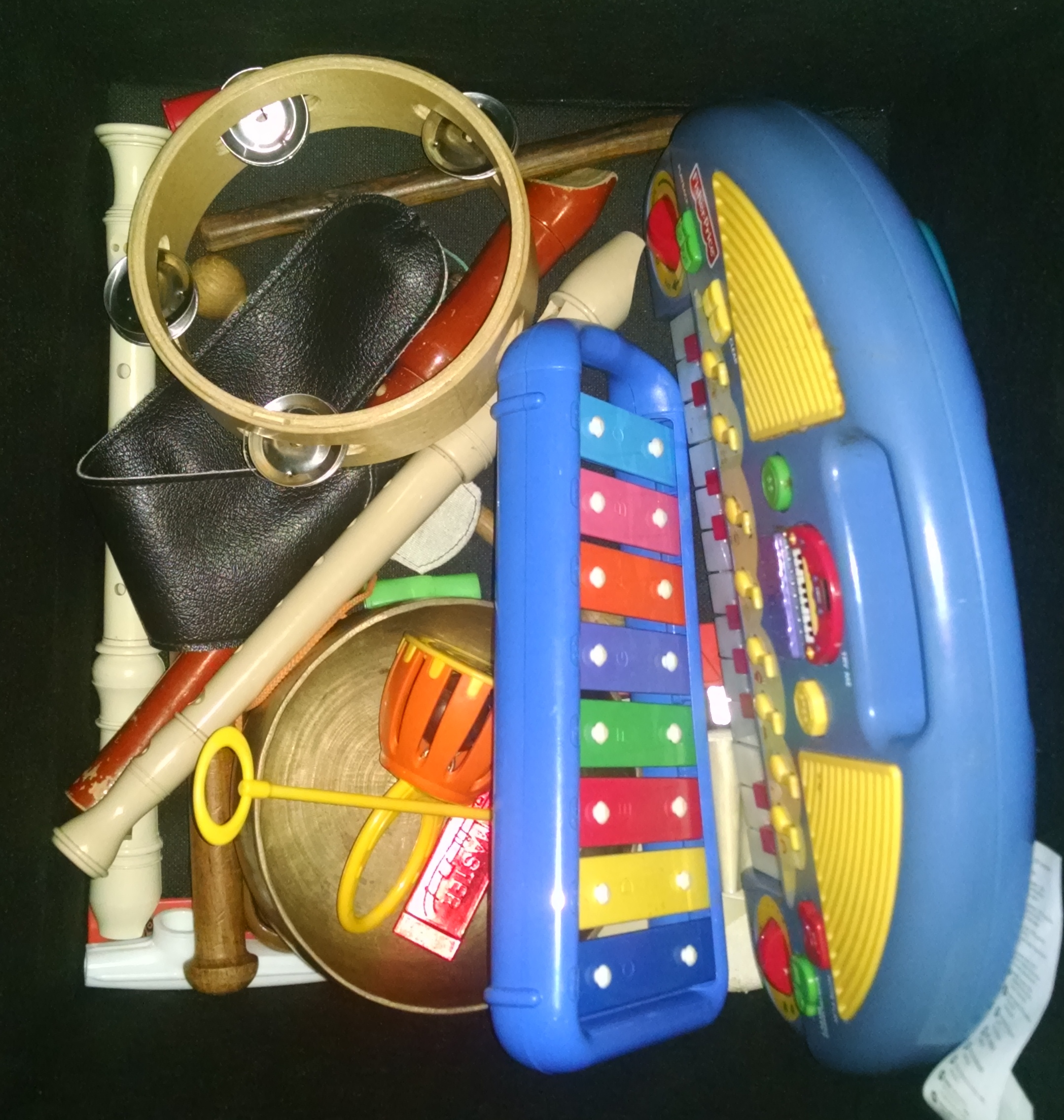
We have a box of miscellaneous musical instruments he can pull out anytime he wants. A few were purchased for him, but most are just items that have entered our lives over the years, like the plastic Yamaha recorder I had as a child, and the plastic Yamaha recorder I had to buy for my daughter’s class when I couldn’t find my old one… We also have a very old electric piano that’s in his room and he spends part of many “nap times” exploring the piano.

We listen to a lot of music together (one older sibling loves Broadway show tunes, one loves vintage jazz, Abuela loves classical and Spanish music) and sing songs A LOT, and enjoy circle-time songs at BC classes and library story times and hymns at church.

Fun with Flora and Fauna (Naturalistic Intelligence)

As you can guess if you’ve read other posts on my blog, we spend a lot of time outdoors. Camping, hikes, zoo trips, farmer’s markets, walks to the library and the pool. The only “tools” we use outdoors are a bucket and a shovel. (But, when we forget them, a stick and a rock can fill in as digging tools, and an empty Starbucks cup from the car makes a fine bucket.) Some day we’ll find our binoculars again, and pick up a new magnifying glass.

Expanding Horizons (Magic / Imagination / Religion / Cultures)

We have a big box of miscellaneous dress up – old Halloween costumes from his siblings, sunglasses, silly hats, etc. In all of our books and the videos we watch together, we aim for showing lots of diverse cultures and experiences, and we go to a church that talks a lot about diverse beliefs and appreciation of the sacred in all forms.

All the Pretty Colors (Artistic Skills and Appreciation)

This is the one area we have an abundance of STUFF.

One cabinet in the kitchen is over-flowing with art supplies: Model Magic clay, no-spill watercolors, pom poms, pipe cleaners, paint, paper, glitter glue, stickers, markers, crayons, beads, scissors, and so on. When he and I are in a relaxed, mellow mood, we pull these out and get to work.

I try not to do much art when I’m in a cranky mood, or when I won’t have time to deal with any mess that arises. I have to confess that I can have a hard time when he’s being really messy or “wasting” art supplies, or “messing up” art supplies – like when he dips the red-paint-covered paintbrush into the yellow paint. Because I know that about myself, I make sure that he has plenty of opportunity to do art in spaces that are designed for kids’ art and where it’s OK to make a mess. So, this year, he’s enrolled in Creative Development Lab, which is all about exploring and experimenting with art.

Child-Directed Play

In addition to buying stuff for your kid to play with, also make sure they have some time to play with you that is child-directed – where they get to decide what they want to play. Learn more about child-directed play.

If you have an older child, check out my Gift Guide to STEM Toys for Ages 3 – 6.

(Note: this post includes Amazon affiliate links. If you click through and purchase anything, I get a small referral fee. I spend any income from that on doing outreach to encourage more parents and educators to come check out what I offer here on this blog.)