Tag Archives: toddler

Helping Your Child Adapt to a New Baby

medium_2681695116Preparing for the New Baby

Follow your child’s lead. When they want to talk about the baby, take advantage of that, but as soon as their attention shifts elsewhere, let it go. Don’t force the topic.

Read books about what to expect. Look here for my Recommended Kids’ Books about Pregnancy, Birth, and Babies.

Watch a video about a new baby coming to a family. This was made by Penny Simkin, who had taught sibling preparation classes for 30+ years when she made it. Includes details about the birth process at an age-appropriate level. Available to stream (rent or buy) at https://www.pennysimkin.com/project/theres-a-baby-a-childrens-film/.

Take a sibling preparation class. Check with your local hospitals that offer childbirth preparation classes. They may offer sibling classes.

Tell stories to your older child about when they were a baby. Look at their baby pictures together.

Provide dolls and doll accessories for your toddler to “practice” baby care behaviors they’ll soon see.

If there are any behaviors or routines that just won’t work after baby comes, try to change them at least 3 – 4 months before the birth, so your child has a chance to adapt, without feeling like it’s “the baby’s fault” things had to change.

If one parent provides almost all the care for your child, try to increase the amount of time they receive care from other providers so they know they have other adults to rely on.

In the early weeks with the new baby

Try not to change day-to-day routines. Your child will need consistency and reliability.

The safety of the baby is top priority, so set clear limits to protect the baby.

Have some time of each day where the older child knows they are your top priority. Let them choose the activity for their “special time.”

Let your older child continue to be a “baby” when he needs to be. Don’t expect instant maturity and independence.

  • Regression is common – listen to your older child’s feelings and validate that it’s hard for everyone to adjust to the new baby.

Make sure your older child has some space and things that belong only to them.

Expect to have good days and bad days. Don’t worry that it will “never get better.”

Don’t blame things on the baby: Instead of saying “I can’t play with you because of the baby”, try saying “I really want to play with you – in just a few minutes baby will be done nursing, and you and I will have play time. Or, you can bring your toys here right now.”

Have ‘special times’ with your older child: a quick trip to the park, a bedtime story, an outing.

Give the older child special responsibilities. Making the older child a “helper” in the care of the new baby will help the child feel involved instead of neglected. However, it is important to remember that the new baby is not your older child’s responsibility.

Encourage and reinforce the positive behaviors you want to see in your older child.

Sometimes, parents feel guilty that they can no longer give the older child the same attention that they used to. It may help to remind yourself that although this doesn’t seem fair to your older child, they are also benefitting from the experience of having a younger sibling.

As your children get older

Look here for lots more tips on sibling relationships.

Resources

photo credit: K. W. Sanders via photopin cc

Cheap Dates with Toddlers: Garage Sales

medium_7714209874(1)

Any Friday or Saturday, drive around a residential neighborhood, and you’ll see the signs.

In winter, after my kids finish their scheduled activity, whether it’s dance class or coop preschool, I usually just want to go home when we’re done, back to a warm dry house. But in the spring time when the weather is beautiful, sometimes I just want to be out for a little while longer. Garage sales offer an easy opportunity.

I will pick a sign to follow, and see where we end up. We then walk around and look at things. Sometimes you have a total dud of a garage sale, when there’s nothing that appeals to anyone in the family. But, much more often, you’ll find something that you child thinks is a treasure. Once my daughter found a great tie-dyed jumper for $1.00 – it was a little big on her then, but it ended up becoming her favorite sun-dress not just that summer but for two or three summers to come. My son found a Japanese tea set he fell in love with. We found some great stuffed animals, some DVD’s, some books, a bike…

Now, I’m not a big fan of a lot of clutter in my life, so I’m always very clear that each child can pick out a MAXIMUM of one item. And sometimes we don’t find anything to bring home. Our approach was always that it’s more about the process than the product. It’s just interesting to see what things people are casting out of their lives. As my kids got older, it was interesting to pontificate on the family’s story. We would guess how old their kids were now based on what types of kid stuff they decided they’d outgrown. We found it sad when there was an older woman selling lots of men’s clothes and items, and wondered if her husband had recently passed. Sometimes we walked away wondering: why would anyone ever buy those items in the first place???

A garage sale is usually a quick outing – 15 minute or so, but often just a fun moment of serendipity in a day.

photo credit: Nomadic Lass via photopin cc

Four Parenting Styles

Developmental theorists categorize parenting styles as authoritarian, authoritative, permissive and uninvolved. Let’s look at those categories and the possible benefits and downsides of each approach. We’ll start with this illustration to summarize the idea, then walk through the details.

GRID

Two Gradients of Parenting Style

Responsiveness. The horizontal line addresses how much attention a parent pays to the child’s needs, demands, and unique temperament. Highly responsive parents attempt to foster individuality and independence by being attentive, supportive, and responsive to the child’s needs and the demands of the moment. A non-responsive parent applies the same rules / expectations to all children and all situations.

High Expectations (aka Demandingness), is how high the parent’s expectation is for obedience and “fitting in” to the family rules or to social norms. Demanding parents set clear goals and expectations, confront a child who disobeys, and disciplines when limits are crossed.

Four Parenting Styles

Note, for each I list potential benefits – how things can work out if this style of parenting is done well, and potential pitfalls – if you’re aware of them, you can work to avoid them.

Authoritarian (aka “The Boss”)

The parent is in control, the goals are obedience and reaching high expectations. Parents provide structured environments, set strict rules, and don’t explain rules beyond “I know what’s best for you.” Children may face consequences if they don’t meet standards, and may or may not be rewarded when they do. Children are scolded for showing negative emotions. Parents may not show overt affection. Potential Benefits: Children may perform well in school and not get in much trouble, and may excel at skills that require focus and discipline to learn. Potential Downsides: Some children may rebel and have poor relationships with parents. Some children may experience low self-esteem or an inability to make their own decisions.

Authoritative / Democratic / Balanced (aka “The Friendly Boss”)

The focus in on teaching decision-making, the goal is finding a balance between personal happiness and accomplishment. Democratic parents provide clear, reasonable expectations, explain why they expect children to behave that way, and monitor behavior in a warm and loving manner. Mistakes are used as a chance to teach important lessons rather than as an opportunity for punishment. Parents give limited choices based on developmental ability, balancing freedom with responsibility. Potential Benefits: Children are self-regulated, self-determined, cooperative, and socially responsible. Potential downsides: This style is harder work for the parents than the other styles.

Permissive (aka “The Friend”)

The focus is on meeting the child’s desires in the moment, the long-term goal is a happy life rather than specific accomplishments. Permissive parents have an indulgent laissez-faire attitude. They make few rules and routines, and may not consistently enforce the rules and routines they do establish. They want children to feel free, and have as many choices as possible. They may not have specific expectations for appropriate behavior, and accept their child in a warm and loving way, no matter how the child behaves. Potential Benefits: kids may have high self-esteem, good social skills, low depression, and be creative. Potential Downsides: Might perform poorly in school/work due to challenges with following rules, may alienate people by over-stepping boundaries.

Uninvolved 

Uninvolved parents may not give any guidance, punishment, or rewards. They may simply be detached, and un-interested in their children and their activities. Most provide the basic needs of life, but shrug off responsibility for their child’s activities and concerns. In extreme cases, this might include rejection and/or neglect. Children tend to be rebellious, irresponsible, perform poorly at school, and show signs of emotional distress.

Inconsistent Parenting (aka Wishy-Washy)

We’re all guilty of this at times… Some days you’re tired so you’re overly permissive and let your child do anything they want; then you over-correct and are overly authoritarian and set strict punishments. This is confusing and stressful for children. Children want to do well, and when the rules change it makes it hard for them to know how to do so. When setting family rules and expectations, be realistic with yourself about what you can consistently enforce.

choices grid

Parenting Style – Approach to Choices

Your parenting style may effect how many choices you let your child make. The authoritarian parent makes the choices for the child, dictating what should be done and what the consequences will be if it’s not done. An authoritative / democratic parent offers limited choices and teaches the child about the consequences of each choice. The permissive parents offers a wide range of acceptable options. The uninvolved parent leaves it to the child to figure out their own way in the world. Learn more here and in my post on how to effectively offer choices.

Learn More about Parenting Styles

Cheap Dates with Toddlers: Nature “Shopping” and scavenger hunts

leaves

Are the long months of winter/spring/rainy season getting to you and your kids? Are your kids starting to make you crazy? Here’s a quote I love:

“If your kids are bouncing off the walls, remove the walls.”

Even if it’s pouring rain, you can still go out in nature. That’s what rain coats and boots are for! On especially rainy days, I like going for hikes in the woods, where the trees help to shelter you from the worst of the rain.

Try Nature “shopping”

Take your kids out in the woods, and let them make collections. They can gather rocks, or seashells, or autumn leaves, or pinecones. Whatever they choose. As you explore, let them gather as many as they want (you may even choose to bring along a bucket or bag for them to collect into.) Near the end of your hike, pick a sheltered spot to examine the collection. Talk about colors, sizes, shapes, textures. Compare and contrast them. Sort them into categories. (Not only is all this fun for kids, you’re also teaching some foundational skills for science learning here… did you know that many Nobel winning scientists talk about the time they spent exploring nature as a child as one of their fundamental learning experiences?)

When you’re done examining them all, tell your child they may choose one special item to take home, but that you will leave all the other items out in nature. Remind them that these things serve a homes for animals and are also there for other children to see and discover. [Note: it helps to tell your child at the beginning of the process that they will need to leave most of these items in the park at the end of your time there.]

Collecting photos

You could also tell your child that you want to collect photos to make a nature book with. Tell them that on your walk, they should point out to you anything they think is special, and you will take a picture of it. Later on, it’s easy to do some quick cut and pasting into a word document or whatever to make up a page with a collection of photos that you can print and post at home. (If your child wants to take the pictures, check out these tips.)

Note: if your child wants to collect bugs, this may be a way to satisfy them without letting them pick up and carry the bugs home!

Scavenger Hunts

For ages 3 and up, you can prepare a list of things you would expect to be able to see or hear or do on your outing. Bring stickers along and as you’re out on an adventure, any time you find one of the items on the list, your child can put a sticker on it. Then when the scavenger hunt is complete, you can have a snack together as a reward. Ideas for scavenger hunts (some borrowed from Teacher Ann at Tiny Treks… )

  • Things to listen for: crows, woodpeckers, running water, wind in the leaves, people’s voices in the distance
  • Things to look for: pinecones, mushrooms, ferns, moss, spider web, bugs
  • Things to do: balance on a log, jump off a log, splash in a puddle, throw a rock in a stream, build a ‘log house’ with sticks, make a circle of rocks

If you’re in the Pacific Northwest, I have a series of handouts about plants you’ll find in our woods, and a scavenger hunt where kids search for salal, Oregon grape and more. Find them all here.

I find that being inside with my toddler and trying to encourage him to use his inside voice and inside manners all the time can be exhausting. Letting him run outside and be as loud as he wants is such a relief. Both of us feel much better after our time outside.

There’s also lots of other great benefits to outdoor time.

Screen Time: Making it Work for your Family

medium_4488299882

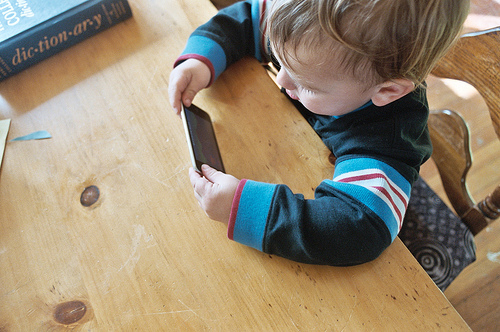
Screen time no longer means just TV in the living room. We now have DVD players, computers and video games at home, and tablets and smart phones we carry all day everywhere we go. And kids get lots of screen time.

Most parents have heard expert advice that warns of risks of screen use. But we also find there are benefits to using them, so we use them – maybe with a twinge of guilt each time…

So, rather than taking a “just say no” approach, many parents are trying to find a way to make screen time work well for their family. Here’s a wide variety of suggestions from parents and experts:

  • Plan what your child views; preview what they use: Choose developmentally appropriate programs and tools that teach skills you want your child to learn and demonstrate values that align with your family’s values.
    • For babies and toddlers especially, choose slow-paced shows and games, with calm backgrounds and without loud, jarring sounds and actions. Choose shows where the characters do everyday things that children do, like go to the park, take a bath, or spend time with friends at preschool. These shows may seem boring or goofy to you, but they engage young children without overwhelming them.
      • Shows that focus on fantasy / unrealistic experiences (a trip to the moon or a superhero battle) do not engage the brain as well as those that involve everyday experiences familiar to your child.
      • Fast-paced TV grabs the attention of the sensory / motor parts of the brain, but doesn’t engage the pre-frontal lobes which relate to attention, and decision-making. In an experiment, children were assigned to a 9 minute activity: drawing, watching a slow-paced educational TV show, or watching a fast-paced entertainment show. Afterwards, children were given four tests that looked at executive function. Kids who had been drawing performed the best on these tasks, those who watched educational TV performed less well; those who watched fast-paced TV performed poorly on all four tasks. (Source: The Immediate Impact of Different Types of Television on Young Children’s Executive Function – Lillard and Peterson – http://pediatrics.aappublications.org/content/early/2011/09/08/peds.2010-1919.full.pdf.)
      • Children this age also respond well to shows where the television characters occasionally speak directly to the child, or ask the child to participate in some way – “can you help me find Blue’s paw print?”
    • Pay attention to the way social / emotional issues are presented in the stories. Research found that some shows that aim to teach good behavior instead model negative interaction. They may spend the first 20 minutes setting up the conflict by showing kids behaving badly, then resolve it in the last ten minutes by kids behaving well (apologizing, confessing to a lie, etc.) Young children remember the emotionally-charged content at the beginning of the show more than they remember the pleasant resolution at the end. They may then practice bad behavior for the next few days…
    • Pay attention to what academic skills and life skills are being taught and whether they are taught effectively.  “Educational programming” ranges a great deal in how educational it really is. Use independent reviews and ratings such as Common Sense media to learn more before letting your child use a product.
    • Choose the right tools: infants may respond best to touchscreen devices that let them learn hands-on. School age children may learn hand-eye coordination and decision making through video games, and can learn important school/work skills by using a computer. Tweens can practice communication skills with a cell phone. Facebook and other social networking are appropriate for teens, with guidance.
    • It’s important to know what sites our children are using online, and what they’re doing there. Limit access to the Internet, use systems to block inappropriate content, know how to check the browser history (but don’t tell your child how to clear it!). Consider limiting internet use to public spaces of house, where parents can see / listen in.
      • You may need to learn new tech skills to keep up with your child’s abilities.
    • Use technology to your benefit: use DVR, on-demand or streaming TV to choose the best programming (rather than just watching what’s on at the moment), to skip over commercials, mute parts you don’t want your child to hear, or pause things to discuss.
      • Watch out for apps with in-game purchasing! Some devices have systems which can block your child from spending money at least. But these games tend to cause addictive behavior and can lead to children who are very upset when you won’t let them purchase the next level.
  • Watch/ Play with your child and Discuss
    • Although 40% of parents say they always watch TV with their child, many others report that they do not, because the whole reason they’re letting their child use media is so they can get other things done while the child watches! (AAP) But, when possible, watch with your child, play games with your child, or watch while they use an app.
    • Co-watching enables us to maximize the educational benefit of the media. Examples:
      • Point out and name things they see on the screen
      • Answer questions as they come up – children often don’t understand everything they see on the screen
      • Quiz them about what they saw: “What’s the closest planet to the sun?”
      • Practice skills they used with the media – if they were practicing tracing letters on a touchscreen, give them fingerpaints or a pencil and let them practice more
      • Act out a show together, or use puppets to re-tell the story you just viewed, or make up new stories with the same characters
      • Talk about real-life tie-ins to media: “in the show, they went to the grocery store and bought apples – would you like to go to the store with me now?”
    • Co-watching give you opportunities to share your values with them.
      • Talk about programs. Ask them what it was about, what characters they liked or disliked, how it made them feel, what choices the characters made, what they would have done in the same situation.
    • Co-watching or playing games together helps us to connect with our kids. It’s another way to have fun playing together with something that captures their interest.
  • Don’t feel like media is an essential tool in the education of your child.
    • The best preparation for school and life involves you spending time with them, reading, talking, exploring things hands-on, and exposing them to diverse experiences.
    • Children who live in households with heavy media use are read to less, and read less. Make a conscious commitment to read to your children more often. Even after they can read themselves, you can continue to read to them – choosing books that are a little above their reading level – or you can read a book together.
    • When you are using media, tie it into real life. For example, if they see a TV show about an animal, go to the zoo to see that animal in person, paint a mask of the animal at home, go on the internet to learn more, and then pretend to be that animal.
  • Eliminate background TV – or be conscious about your use. In addition to the times that children are actively using media (cited above), they are also exposed to background television – when the TV is on but no one is really watching it, or when a parent is watching TV while the child is theoretically engaged in other activities. Children between 8 months and 8 years are exposed to an average of 232 minutes a day of background TV. (http://pediatrics.aappublications.org/content/130/5/839.full) This media distracts the parent’s attention and significantly reduces how much time the parent spends talking to the child (and since a child’s vocabulary growth depends on interaction, this can cause language delays). It also distracts the child: 1 – 3 year old children have shorter attention spans when the TV is on, moving from one task to another quickly.
  • Avoid couch potato behavior:
    • Don’t eat in front of the TV. This unconscious eating may well lead to obesity increases seen in those with heavy media use.
    • Do activities that you see on the screen: dance to the music, jump on the floor like the monkeys jumping on the bed, and so on.
    • Do other physical activities while watching TV. Exercise? Stretch? Fold laundry?
  • Keep screens out of the bedroom.
    • Internet access in the bedroom increases the chances of children accessing inappropriate content of all sorts.
    • The presence of a TV in a child’s bedroom has been linked to obesity, poor performance in school, difficulty with sleep, and substance use.
    • 30% of parents report using TV to help their child fall asleep, but TV actually increases resistance to bedtime, causes anxiety, delays sleep, and shortens sleep duration. (AAP)
  • Set limits: Some experts recommend against having an outright ban on screen use – saying it can become the forbidden fruit your child craves – but it is fair to set limits. Some examples:
    • Establish routines – when in the day are screens an option and when are they not? If your child knows they can never use a screen in the morning before school, then they know not to bother asking in the morning. But, if one day you change that rule…
    • Teach that some times and places are OK for mobile device use, and others are not.
      • Note: your children pay very close attention to what you do! If you tell them that they’re not allowed to use screens during dinner, but then you check your email or take a phone call during a meal, they won’t take your limit seriously.
    • Teach your children to ask you whether it’s OK to turn on media.
    • Privilege? Some parents find it works well to have media be a privilege that a child has to earn. For example, if they read for 30 minutes, they earn 10 minutes of screen time. Other parents are against this, fearing that then we’re setting up a value judgment that says reading is the boring thing you have to do so you can do the fun thing.
    • Place limits on screen time. AAP recommends <1 – 2 hours daily for kids 2 – 8, less than that for kids under 2
      • Count total screen time: TV + DVD + video games + computer time + mobile device. Make sure that tablet time is replacing TV or other screen time, not displacing physical play, reading or other essential activities.
      • Consider a screen curfew for the whole family – a time at night when the screens go off. We know that screen use (especially blue light from screens) too close to bedtime can disrupt sleep (see above).
  • Encourage balanced activities
    • Environment: Set up you house so that the screens are off in a corner, or in rarely used rooms, versus lots of other options in plain view, easily accessible and ready to use. Have available: board games, art supplies, books, sports equipment, etc. Spend time outdoors with no screens in sight!
    • Activities: Build into your routine plenty of other activities: sports and exercise, creative projects, household chores, social time with friends, and so on. Spend more time in unstructured play, which helps children learn to problem-solve and think creatively.
    • Model good behavior. Turn off your screens or set them aside for a portion of each day. Model a balanced life of social time, physical activity, time outdoors, reading, etc.
    • Ask yourself: “if I didn’t have my [device] with me right now, how would my behavior be different?” If your answer is that you’d be talking to your child, or singing to avoid boredom, or coming up with other ways to distract them in a meeting (like say, reading to them) then you may want to consider setting aside the device for now…
    • Have unplugged time. One author advocates setting aside “one hour per day, one day per week, and one week per year” when the whole family sets aside their screens.

Reviews of kid’s media and other tips at: www.commonsensemedia.org

Design Tips: If you (or someone you know) designs apps for kids, check out Sesame Street’s great tips on how to build the best kids apps possible.

photo credit: cafemama via photopin cc