Tag Archives: toddler

The Wind Tube

We’ve built a fun science exploration tool, which we use in our Family Inventors’ Lab class.

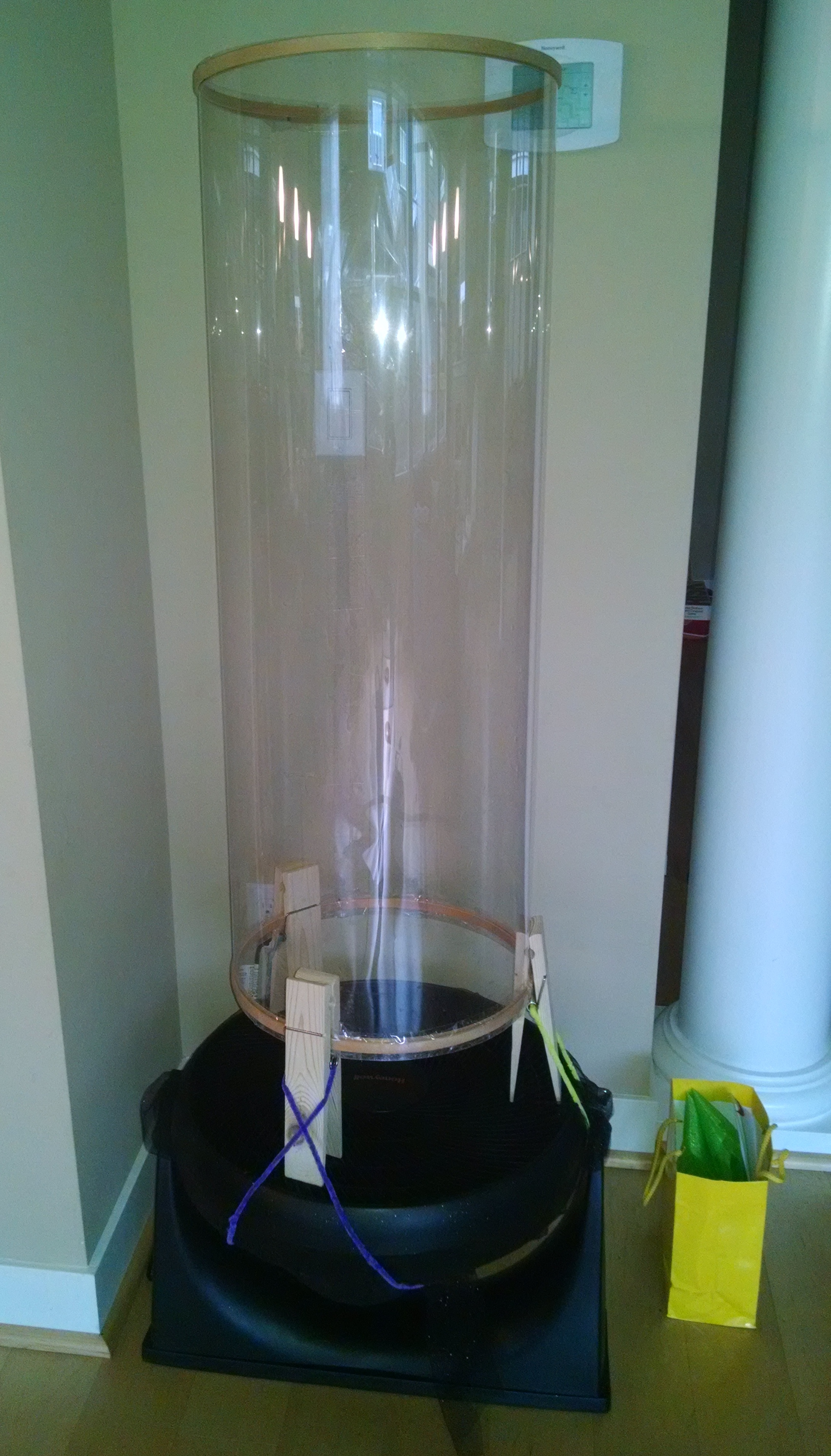
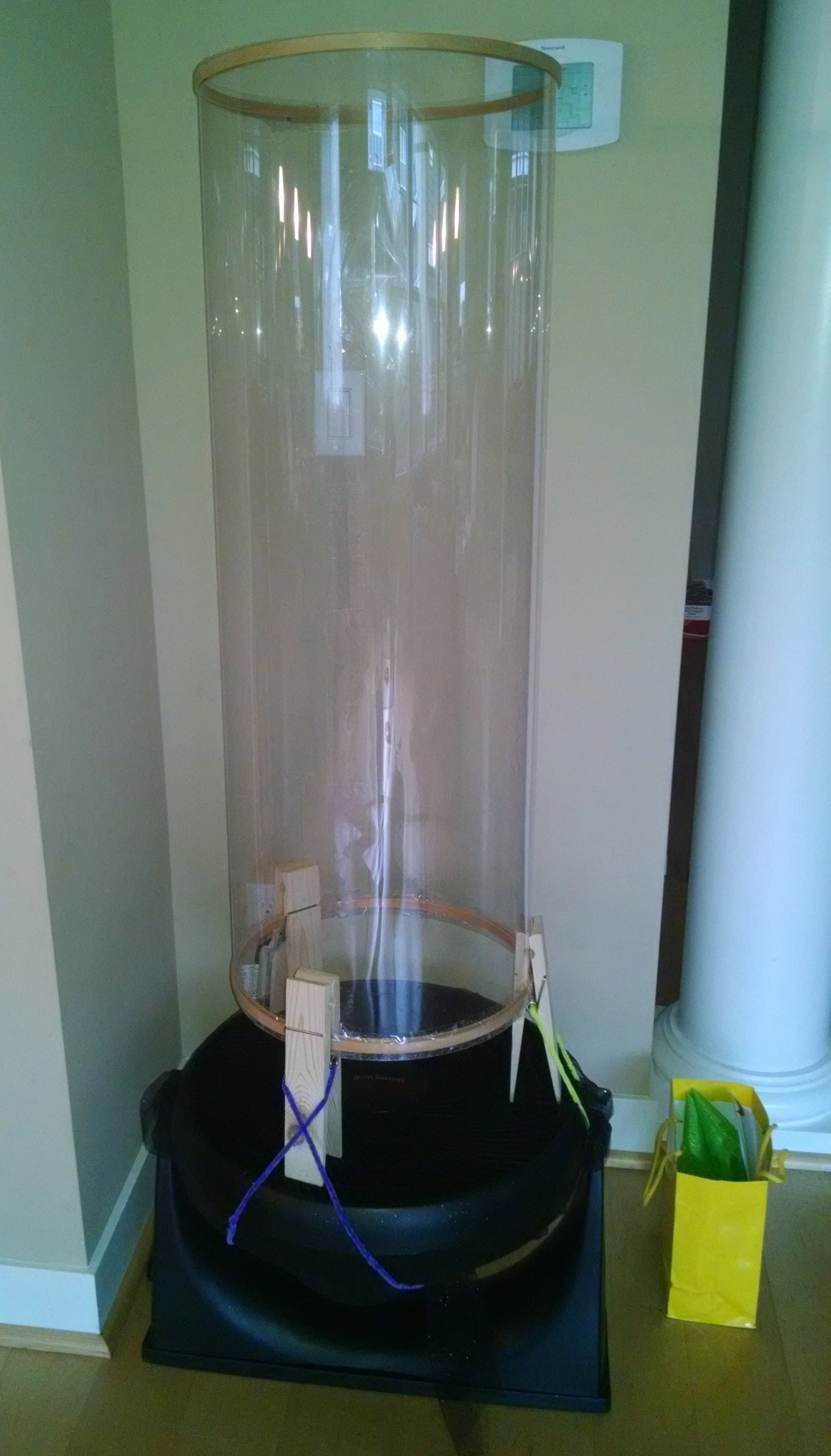
The Exploratorium shared a project idea for building a Wind Tube. (Also check out the Kodo wind tunnel.) It’s basically a clear tube mounted over a fan. Kids can place items into the tube and see what happens. Heavy items just sit there. Lightweight items shoot out the top of the tube. Other items may float, spin, or rattle back and forth. The video at the the top of this post shows some of our initial experiments. (If you want to learn how to make a DIY wind tube, check out my next post.)

Dave Stroud says this about how kids (and adults!) play with a wind tube.

The Wind Tubes intrinsically encourage a particular type of play that helps guests experience the way science works. The intent is for guests to internalize a science based mindset – do something, measure the outcome, make changes, do something, measure the outcome, compare the outcomes, make changes, do something, measure the outcome, compare the outcomes – repeat this process until you run out of time. The user experiences the phenomena by exploring it, rather than being shown an outcome and having it explained. (Source)

I have definitely seen this in action. Toddlers and preschoolers love to launch the same items over and over. Four to five year olds start experimenting more, looking around the room and deciding what to try next! As they experiment, I hear them talking: “I wonder what this will do?” “What can I try next?” “What do you think will happen this time?” “That didn’t work, I wonder if I could combine it with this?” It’s “tinkering” at its finest! Older kids, teens, and adults enjoy engineering items to achieve different goals – lifting up heavy materials, designing a neutral buoyancy item that will float in the tube forever, or creating items that spin on their way up.

As Stroud says, this activity results in:

• Making guests [child] less reliant on “authority” to answer questions
• A higher level of engagement and deeper investigation
• Guests defining their own success and making their own meaning (user defined outcomes)
• Generating a particular category of questions such as: How can I get it to…? What if I…? Instead of: Why does it…? What makes it…?

Here are some of the experiments my family developed just in a few hours of play when we first built our tube:

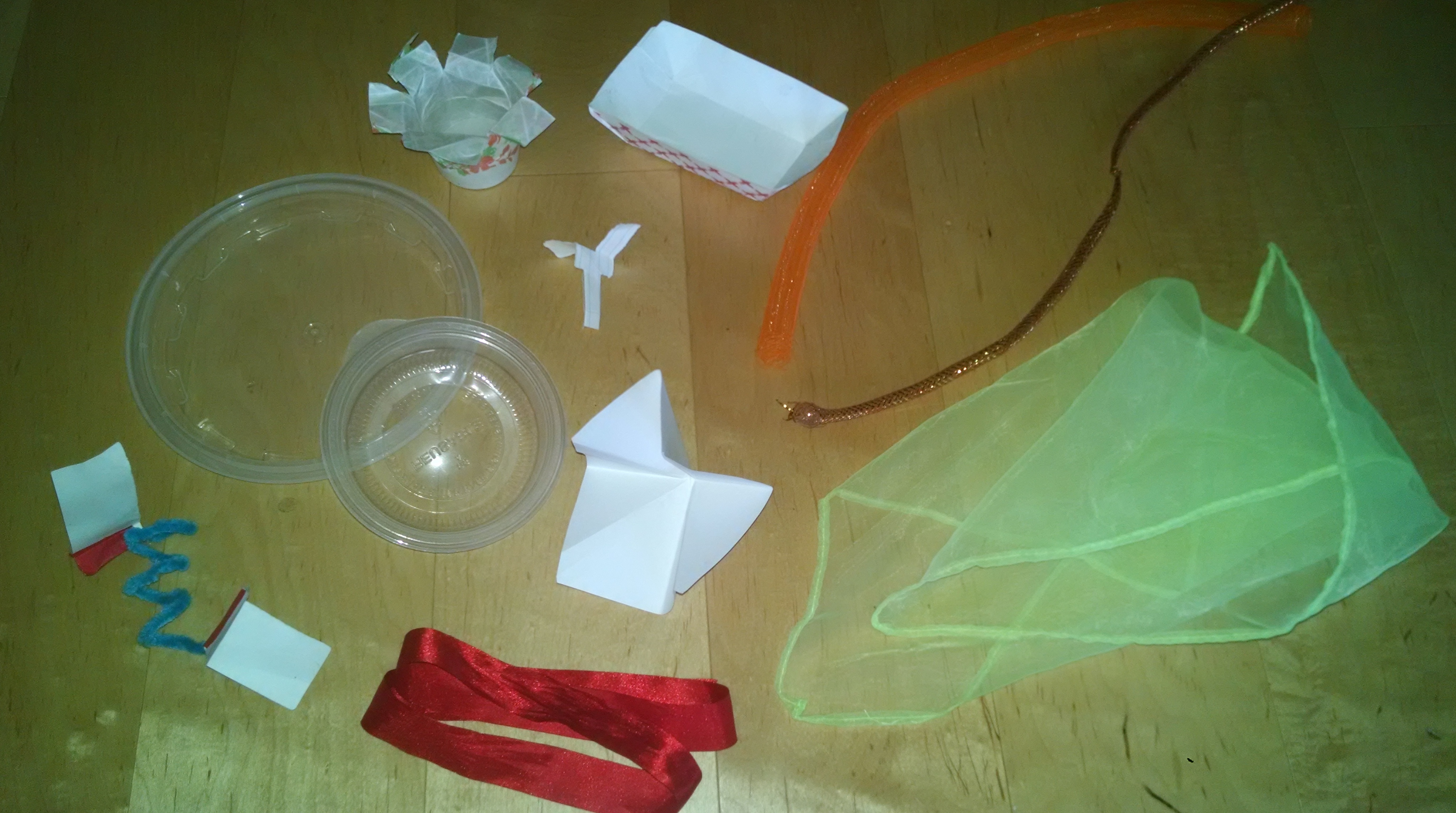
Scarves. An easy peasy thing is scarves – they catch the wind so nicely, then gently flutter to the ground.

The Frisbee. (really a plastic lid)  It gets caught in the air currents and will float forever. My son learned that if you put your arm over the fan to block some of the air flow, the Frisbee will sink down the tube.

Cardboard boat. This cardboard snack tray will float easily on its own. The small plastic monster will not – it’s too heavy and not aerodynamic. But, put the monster in the boat and it floats!

Parachutes. This plastic pterodactyl won’t fly even though it has wings. But, if you build it a parachute out of a plastic bag and a pipe cleaner, it soars. Note: you can also make parachutes with coffee filters or use these parachute party favors. (Amazon affiliate link)

Pipe cleaner spinner. My personal favorite is this twirled-up pipe cleaner that spins and spins as it floats in the air.

Tops. And speaking of spinning, watch these plastic tops. They don’t float, but they definitely respond to the wind!

Other materials to try: scarves, balloons, rubber gloves blown up and tied, dixie cups with coffee filter parachutes, whiffle balls, strawberry baskets, etc. I also really like these three projects… these pictures were from the wind tube activity at the Orlando Science museum.

flyers

Here is a printable template for the helicopter shown above.

Here are ideas from the Cincinnati Museum of Natural History:

As kids play, they learn hands-on about aerodynamics, wind currents, how lightweight things fly better than heavy things, but even heavy things can fly if they have a parachute or an “air ship” that can catch the wind currents. Having the ability to play hands-on with this will allow them to internalize the learning much more than when they cover all this stuff in high school physics class someday!

Challenges for Kids:

For older kids, you could make a poster to accompany this activity with challenges like these from MOTAT:

  • Can you build something that will leave the tunnel in a particular direction?
  • Can you build something that will hover above the wind tunnel?
  • Can you make something that spins clockwise as it rises in the tunnel?

Learn more:

If you want to read more about “transactivity” and what makes this such a cool learning activity, check out Stroud’s post: http://www.exhibitfiles.org/vertical_wind_tubes. This is a great “case study” post, which shares observations on how people play with the tubes.

Here are links to some other people’s experiments with and thoughts about Wind Tubes

Fun with Toddlers: Pet Theme

This month’s theme was Pets, especially dogs and cats. Here are some fun pet-related things to do with your toddler:

Outings to Go On: Visit a pet store. Look at the fish, or the rodents, or the birds or reptiles. The pet store is just as educational as the zoo, and it’s free! It’s a great chance to talk to your child about animals, and to practice observation skills: “Can you find a yellow fish?” “Which is the biggest bird?” “These are all reptiles. What makes them different from the rodents we just looked at?” If you don’t have a pet at home, don’t feel like you have to buy anything. Most pet stores are used to parents coming in and hanging out with their children for a while. If you want, you could buy a bag of pet food to donate to the store’s pet food drive. (Look for a donation bin at the front of the store.)

Toys to make for your child

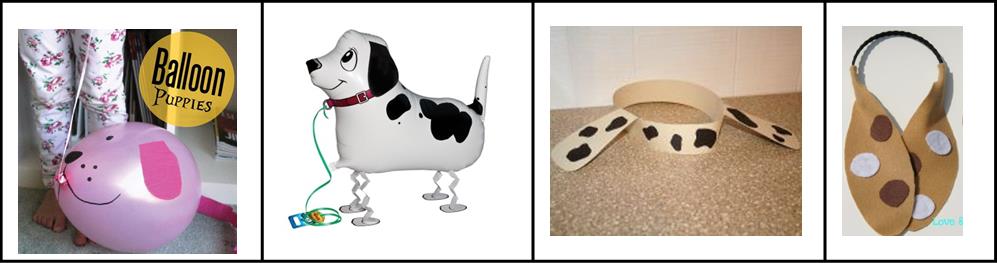
Balloon Puppies. Take a balloon. Blow it up. Draw animal features on, add a string and you have an instant pet for your child to take on a walk! If you want to be fancy, you could use a helium balloon and fasten on “legs” made of accordion-folder paper – the home made version of the toy pictured.

petsDoggy ears (or kitty ears). Make a circle of paper that fits around your child’s head and add ears, or turn a child’s headband into the base for ears.

Imagination Games to Play

The Dog House. Take a big cardboard box. Cut an arched doorway in it. Decorate it like a dog house. Add things to represent dog food dishes, dog bones, dog toys and more. Add stuffed puppies if you have them, and then let the play begin.

Pet Store. Set up a pet store with stuffed animals, and accessories for animals (food bowls, collars, treats, toys, and so on, and go shopping.

Songs to Sing / Rhymes to Say

Where has my little dog gone?
Oh where, oh where has my little dog gone?
Oh where, oh where can he be?
With his ears cut short and his tail cut long,
Oh where, oh where can he be?

How Much is that Doggie in the Window
How much is that doggie in the window? The one with the waggly tail?
How much is that doggie in the window? I do hope that doggie’s for sale.
[Search on YouTube for many videos of this song!]

I have a cat
I have a cat (stroke your fist); My cat is fat (arms form a stomach)
I have a cat (stroking); My cat wears a hat (hands on head)
I have a cat (stroking); My cat caught a bat (clap hands together above head)
I have a cat (stroking) Purrrrrr, Meowwww

Circle Time Ideas

Poor Kitty. There is a game that elementary school aged children love called “Poor Kitty”. One person pretends to be the kitty and goes around a circle, trying to make the other kids laugh (by purring rubbing against them, licking them…). The others are supposed to keep a straight face and just pet the “cat” and say “poor kitty” without laughing. You can adapt this for a one-on-one game with toddlers or preschoolers. (Though they probably won’t get the whole “you’re not supposed to laugh” idea.)

Puppy puppet. Bring a puppy puppet and some dog treats (or dog toys.) Give a treat to each child. Bring the puppy around the circle and have each child give the dog a treat. Have fun with pretending to be a happy puppy.

Purple cat, what do you see. Make a felt board collection of pets – brown dog, black cat, yellow bird, gold fish, etc. Give one animal to each child. Do the rhyme, similar in style to Eric Carle’s Brown Bear. Go around the circle to each child in turn, having them place their animal on the felt board. So, if you started with brown dog, and the first child has a black cat, you’d say “Brown Dog, Brown Dog, what do you see? I see a black cat looking at me.”

Books to Read

Roly-Poly Puppies by Elaine Moore. A counting book with a nice rhyming structure.

Pete the Cat by James Dean. There are lots of fun Pete books, but the best is I Love My White Shoes. (Check out our Pinterest page for lots of activities to go with Pete books!)

Aggie and Ben by Lori Ries. Ben’s dad takes him to the pet store to pick out a pet.

More ideas (and source citations) at: www.pinterest.com/bcparented

For my full collection of theme-based “Fun with Toddlers”, click on “Fun with Toddlers series” in the right hand side bar. Or if you would like them in printable handout form to share with students, click here.

Motivation, Punishment and Reward

starsOur kids are always learning from us. They learn by observing as we role model a variety of skills, they learn by interacting with us as we play, and they learn when we actively “teach” them. There are many things we teach casually, and aren’t too worried about the exact timeline when our child picks up the idea. Things like covering your mouth when you sneeze, saying please, or putting their dish in the sink. There are other things though that we may have a sense are REALLY IMPORTANT, or that we believe MUST BE DONE BY A CERTAIN AGE and those are the things we tend to stress about our child learning. Potty training and reading both fit in this category for many parents. What happens when there is something we really want our kids to learn?

The first thing I’d ask you to consider: Is this skill developmentally appropriate? Can we typically expect a child of this age to learn this thing? Once you’ve learned it is appropriate, then you can consider teaching it.

Motivation

There will be many times in your child’s life where you want them to do something they don’t want to do, or there’s a skill you want them to learn because it will be valuable in the long run, but they aren’t particularly interested in learning at this moment in time. How can you help them find their own internal motivation? Potty training is one of our first chances to explore this challenge, so we’ll use it as our example.

First, consider your motivations. Why do you want your child to learn this new skill? Here are some common reasons and some examples from the potty training process.

  • Outside demands: Is it pressure from a pre-school or daycare that requires it by a certain age?
  • Peer pressure: Is it because other families are doing it, and you’re feeling peer pressure to keep up? The media and social media can also create this pressure of what our child “should” do.
  • What you do or don’t want to do yourself: Are you just tired of changing diapers? Or tired of paying for diapers? Or washing them?
  • What you want for your child: You want to encourage your child toward independence in all areas?

The clearer your motivation, and the stronger your motivation, the more time and energy you’re likely to be willing to commit to the process. Some parents actually find that they’re not actually motivated to teach a skill. For example, the diaper routine might be working for their family’s schedule and commitments. This is fine for a while, but at some point (maybe three years old for potty training?) it’s time to help your child move forward.

Then ask yourself: What are your child’s motivations? Try to view things from your child’s perspective and understand why they might not be as interested in learning a new skill as you are in teaching it.

In our potty training example: Why might a child prefer to continue to use diapers? Some ideas: they’re used to eliminating in their diaper – it’s comfortable and familiar. They may be in a state of regressing a bit, and not feeling bold enough to be ‘a big kid’. They may not like interrupting play time with trips to the potty. They might be frightened of the potty. They might be rebellious toddlers, defying their parents ‘just because.’ They might have a desire to be completely in control of their bodies. They might also have been constipated at one point, and found that it hurt to have a bowel movement, and be afraid of repeating that experience.

Then ask: What might motivate your child to use the potty? Some options are punishment or rewards…

Punishment?

It’s best not to use punishment. Punishment can definitely work in the short term, in that a child who is punished for doing something (e.g. eliminating in a diaper) may well try hard to avoid that punishment in the future (e.g. by using the potty). But it could also shame them and damage their self-esteem. And it also means that they’re doing something only to avoid punishment – not for any positive reason.

On the other hand, logical consequences are appropriate, as long as they are done without shaming. For example, having them help with clean-up after an potty-training accident allows them to see the consequences. Or taking back the big kid underwear, saying ‘it looks like you’re not ready for this yet… let’s go back to diapers for a while’, helps them to see what the goal is and what the reward is of accomplishing it.

Rewards

Many people use a sticker chart, or other reward system when they want to shape behavior. The general idea is: talk with your child about what you want them to do, tell them that when they do it they’ll get a reward. Then involve them in setting up the system: pick out the reward, or make the chart, etc. For rewards, it’s best to choose something cheap and easy to obtain, like a sticker. (Not candy.) For a toddler, the reward needs to be immediate for them to understand “when I do this action, I get this reward.” Older kids can work toward a bigger reward over time – “if I do all my chores this week, we’ll watch a movie together on Friday night.”

Make sure they are clear about what the behavior is you are working on, and be consistent about the response. For example: “if you sit on the potty, you get a sticker whether or not you pee there” may be a good first level. Later on, when they’ve mastered that step, you ask more of them: they need to actually pee or poop to get the sticker. You may choose to also have a cumulative goal to work toward, like “once you’ve pooped in the potty 10 times, you will have filled the chart, then you get a new toy.” It’s important to think of these rewards as short-term reinforcement, not an on-going system! Over time you will phase out stickers completely. Rewards can be a very effective tool for toddlers. However, you don’t want to over-use rewards! And you want to make sure the focus is on accomplishing the goal for its own sake, not on just doing something so they get a reward.

Expectations

If you regularly say “If you do this [bad thing], then I will punish you by [negative consequence]”, your child might come to feel that you expect him to do bad things and you look forward to punishing him. Instead, try “When you do this good thing then you get this [positive consequence].” Make sure your tone of voice implies that you have confidence that they will do the good thing because that’s what you expect of them.

Praise

When your child accomplishes something for the first time, definitely praise them. If it’s a HUGE accomplishment, make the praise really big. But honestly, if it’s small accomplishment, the praise can be just a quiet observation that they accomplished it. As they start repeating a skill again and again, on the way to mastery, we can fade out our praise. It feels silly and a little embarrassing to get praised for something you’ve mastered (as you know if your child has told you something like “You peed in the potty! Good job mama!”) Praise them for what they have done, and the work it took to do it.

Read more about praise here.

The Downsides to Rewards & Praise

Critics of rewards say they are a short-term solution to gain compliance with parental requests, not a long-term path to instilling the behaviors, qualities, and values you want your child to attain. And, research has found that kids who are raised on a series of rewards can become more self-centered, materialistic, reward junkies looking for their next fix from parents who can become exhausted by coming up with new rewards.

Research has also shown praise can backfire. If we continually praise our child for being “smart”, “beautiful” or “strong”, then they may be afraid to take risks – not wanting to do anything that they might not succeed at… fearing that then we will realize they’re not so smart or strong or beautiful after all – and thus not lovable. Also, when a child is vigorously praised for every little thing she does, she may not know whether praise is genuine.

Experts recommend that when you want your child to learn a new skill, think about what it is you are really trying to teach and stay focused on that. Work with your child to find their motivation for learning this new skill. As they make attempts along the way, give specific praise for their efforts and their commitment, and specific recommendations for how they might improve. The emphasis is more on the process than the product, more on the work they do than on the “talent” they have. When they accomplish a goal that they set, then it is totally appropriate to celebrate that with something (Stickers? M&M’s? A special toy?) as long as the emphasis is on the value of the accomplishment itself, not on having done whatever they needed to do just to earn the reward.

Sources on Internal Motivation, Rewards and Praise

photo credit: Pewari via photopin cc

My Child Won’t Poop in the Potty!

NoPottyDuring the potty training process, about 20% of children go through a phase of refusing to use the potty at all, or refusing to poop in the potty. For some the phase lasts a month or so. For others it can be a year. This is called “Toilet Refusal for Stool Only.” One scenario is a child that asks for a diaper at nap time or bed time, goes in their room and poops in the diaper, and then asks to be changed. Clearly, they have bowel control, and are making a very conscious choice about when and where to poop. It’s just not the choice you wish they were making.

An important note here: I’m not talking about “stool holding” here. That’s a child who refuses to poop at all, anytime, anywhere. That’s a different issue and it’s a medical issue that can cause constipation and bowel impaction and requires different treatment (see here).

I’m talking about kids who have regular, normal poop once or twice a day, just not in the potty. And I’m especially talking about a child who you know is developmentally capable of pooping in the potty because they’ve done it in the past… they’re just not doing it anymore.

So why does a child do this?

There are lots of proposed reasons. Most won’t make sense to you as an adult, but they may be what your child is feeling.

  • Fear of Pain: They may believe pooping in the potty will hurt. This sometimes follows an episode of constipation, when it did hurt. It’s hard for them to understand that the pain won’t always happen when they poop on the potty.
  • Fear of Falling In. Fear of being Flushed down the Toilet. Using a small, non-flushing potty rather than sitting on the big toilet may help with this one.
  • Fear of Losing a Part of Themselves: Some boys fear that if the poop falls out of them and into the potty, then maybe their penis could too. I also know of a girl who was terribly frightened the one time she saw the poop coming out while she was on the potty and then getting flushed down – she feared that part of her was gone forever.
  • Hate the sound of flushing. Some children are very frightened of a loud flush. Sometimes it helps if they are in charge of flushing so they know when it’s coming. Sometimes it’s better to let them leave the room / the stall before you flush. On auto-flush toilets in public bathrooms, you can cover the sensor with your hand or a post-it note until they’re done.
  • Desire for privacy. If you’re always with them in the bathroom, and they always poop when they’re alone, try just giving them a little privacy on the potty! (On the other hand, some kids want company in the bathroom and if you’ve been trying to send them in on their own to give them privacy, maybe they’d rather have you there.)
  • Sensory issues. They’re used to the poop staying next to them as it fills the diaper. Feeling cold air on their bottom and feeling the poop fall away from them may be uncomfortable to them. An intermediate step may be to have them sit on the potty with their diaper on until they can poop there, and then remove the diaper.
  • Shame. They’ve been taught that poop is disgusting and are ashamed of it. In one study, they encouraged parents to never use negative terms for feces, and – before they start potty training – to praise children for pooping successfully in their diaper. Some of these childre still went through a period of refusing to poop in the potty, but it was a shorter-term problem than it was for the control group in the study.
  • Power struggle. Many children go through periods of rebellion, and if they learn that this potty refusal really pushes your buttons, they may keep doing it to get a reaction.
  • Autism, developmental delay, or physical challenges can lead to this issue.
  • Emotional trauma or sexual abuse.
  • Temperament or Personal Preference. Some kids just like to use their diaper and see no reason to change.

Which one applies to your child? You may be able to guess, or if your child is old enough to talk about it, then ask them in a really non-judgmental open-ended way. “I notice that you always poop in your diaper and you won’t try pooping in the potty. Why is that – tell me more.” They may be able to tell you.

How NOT to respond…

Don’t punish. Don’t scold, shame, or publicly humiliate them.

Don’t show a lot of emotion about it. Be very matter-of-fact. “It looks like you pooped in your diaper again. Remember, I’d like you to use the potty. Let’s go get you changed.” Be bland and boring during the diaper change.

How do you get a child to poop in the potty?

It’s hard to make someone poop on command! And no, threats don’t work either, because when we’re scared, our sphincter muscles tighten up and it gets harder to poop.

What can you do? Here are some suggestions – don’t feel like you have to try them all. Some will feel right for you and your family’s situation. Others won’t.

  • Ask them why they don’t want to poop in potty. Address their fears. If they have any of the fears listed above, talk it over with them. Don’t expect to be able to just say “that’s a silly irrational fear” and have it go away. Take it seriously, validate it, ask them to help you figure out a plan for preventing that thing from happening.
  • Give them some motivation. Consider a reward system. Stickers? Big kid underwear? A cool toy they only have access to on days when they poop in the potty?
  • Withhold diapers. “Oops, we ran out of diapers. I guess you’ll have to use the potty.”
  • Or combine those two: say something like “This Sunday is our Happy No More Diapers Day. From then on, I want you to always poop in the potty. And hey, check out this cool doll house I got you. As long as you remember to poop in the potty, you can have it. If there’s a day when you ask for your diaper back, that’s fine. I’ll just put the dollhouse away for a while.”
  • Give up for a while. Give control back to them. Say “When you’re ready, you’ll poop in the potty. Until then, I will change your diaper when you poop.” And then just go on with your life without fretting about the potty. Once a week, check in with them to see if they’re interested in giving it a try. If they say no, say “OK, I’ll ask again in a week.” Try to just relax and let the worry go in between those checks. In one study where parents “gave up” on potty training, then 24 out of 27 kids started using the toilet spontaneously within three months.

Constipation

Your child may have some short-term issues with constipation. You should expect to see at least one stool a day, about the size of a small banana, and fairly soft. If your child is only passing small hard stools that hurt to poop, that’s constipation. Make sure they drink plenty of water, eat plenty of high fiber foods, and get lots of physical activity to help making bowel movements regular and easy to pass. If constipation persists or recurs often, check in with your child’s doctor.

Sources:

How to Deal with Your Child’s Stool Toileting Refusal; Toilet Training Problems; Toilet Training and Toileting Refusal – a Prospective Study; Toilet Training Resistance.

photo credit: Darren W via photopin

Fun with Toddlers: Winter Theme

Bring the snow inside!Sensory Activities to Do:

Snow in the Shower. When it snows, parents will often excitedly bundle up their toddler, and take them out to play. Then the child just sits and shivers and looks sadly up at the parent. It’s not as fun as you expected it might be.

Instead, try bringing the snow inside! Make sure your bathroom is nice and warm, then bring a big bucket of snow and dump it on the floor of your shower or bathtub and put your child next to it with shovels and toys. (He can even be fully clothed to stay warm.) As the snow melts, it disappears down the drain, so no clean-up required! When your child is done playing, run a warm bath or shower to warm him back up.

Ice Play

  • Hockey rink: freeze a cake pan of water. Make mini “hockey sticks” and use a checker as the puck. Hit the puck back and forth to score.
  • Excavation: Use a loaf pan or large bowls to make blocks of ice. Freeze items inside (e.g. plastic penguins or Legos). Set it out on a tray to catch the water as it melts. Give your child a toy hammer and other tools to excavate the toys.
  • Melting experiments: Give your child ice, water with pipettes or eye droppers, salt to sprinkle. Let them explore how to get the ice to melt. Add food coloring or liquid watercolors to make it prettier.

Dry Ice Experiments: Check out my post for lots of ideas. Note – this requires close supervision!!

Games to Play:

Indoor Snowball Fight. Make or buy big white pompoms, or soft white balls. Or just wad up a bunch of paper into balls. Or ball up pairs of socks. Fill a basket with them. Then spontaneously start snowball battles anytime you want to! Not only is this tons of fun, I like playing games where I throw (soft) things at my kids. It helps them be a little bolder about ball games later in life – a little more willing to “head” the ball in a soccer game. This also allows them to get out their throwing energy indoors without much risk of damaging anything.

Crafts to Do:

http://www.howwelearnathome.com/2013/01/build-shape-snowman.html

howwelearnathome.cm

Mittens: Cut out 10 paper mittens. Have your child decorate them. (Or for younger kids, have them scribble / finger paint all over a piece of paper, THEN cut out mitten shapes.) Then do the 10 little mittens rhyme together.

Tracks in the Snow. Take some colored construction paper. (Green, brown, or whatever you have.) Squirt white paint onto it. Use a paintbrush to spread it around, smoothing it. Then walk some toy animals or dolls across it. Point out their tracks. Drag a stick across it. Drag across a fork or a comb. Notice the paths they make in the paint. Then spread the paint back out again smoothing it over, and make some more tracks.

Tracks in the Snow, take 2. Make white play-dough. Play with toy animals and dolls in it, and point out the tracks they make. (Source, with pictures.)

Shape snowmen. Check out original idea here.

Snowy Day. Make a drawing (or find a picture) of an outdoor scene with trees and more. Put out white paint and show your child how to put one finger in, then dot it on the paper to make a snowflake. They make more and more snowflake dots till the landscape is covered in snow.

Rhymes to Say

Up the Mountain rhyme
Sit child on your lap
Up the mountain (run your fingers up one of their arms)
Down the other side (then run fingers down their other arm)
Brr it’s cold out… (hug them tight)
Let’s climb inside! (tickle their neck as you reach your fingers under their collar)

Five little snowmen
Five little snowmen standing in a row (hold up 5 fingers)
Each with a hat (pat head) and a big red bow (pull at neck like a bow tie)
Along came the sun (arms form big circle over head)
and it shone all day (lean sideways)
And one of those snowmen melted away! (put down one finger)
Continue until there are no snowmen left.

Disappearing Snowman
(make a paper snowman; cut as you tell story, making snowman smaller)
On Monday, I made a snowman. Just like that.
On Tuesday, the wind blew some snow away. Just like that.
On Wednesday, it rained on my snowman. Just like that.
On Thursday, the hot sun started to melt it. Just like that.
On Friday, it melted into a puddle. Just like that.
On Saturday, it snowed again. Just like that.
On Sunday, I made another snowman. Just like that.

Three little snowmen.   (mime 3 fingers perched on sled made by other hand)
3 little snowmen riding on a sled.  One fell off and bumped his head. Mama called…

Songs to Sing

For the first two songs, make your child a paper snowflake and have them put it on their head, their knee, etc.

Little Snowflake Swirling Round (tune: London Bridges)
Little snowflake twirling round
Twirling round, twirling round
Little snowflake twirling round
Lands on my head!
Repeat with different body parts.

It is Snowing (Tune: Frere Jacques)
It is snowing, it is snowing,
All around, all around.
See the pretty snowflakes, See the pretty snowflakes,
Touch the ground. Touch the ground.

Snow is Falling (tune: Skip to My Lou)
Snow is falling, what do I do? Snow is falling, what do I do?
Snow is falling, what do I do? What do I do, my darling
I’ll build a snowman bigger than you! …That’s what I’ll do, my darling!
I’ll ride my sled fast, how about you?… That’s what I’ll do, my darling!

Sing the My Mittens song in those inevitable moments when you’re searching for your child’s missing mittens.

Books to Read:
Amy Loves the Snow by Hoban. Sweet simple story for little ones.

The Snowman Storybook or The Snowman by Raymond Briggs. These are the same story, but the Snowman is wordless – you tell the story in your own words. Beautiful illustrations. Story of a snowman who comes to life. Note: This book has a sad ending. (I think that’s OK – helps to build emotional literacy. But some parents prefer to avoid.)

Red Sled or Red Hat by Judge or The Mitten by Jan Brett. All three are stories of woodland creatures getting into mischief with children’s belongings. On the long side for toddlers, so save for when they’re feeling calm and patient.

The Snowy Day by Ezra Keats. A little boy in the city enjoys a snowy day. This book, published in 1963, was noteworthy for being one of the first picture books to feature an African-American child. Note: this combines really nicely with the “tracks in the snow” activity above, where you can show how the doll tracks or the track from the stick is like what was shown in the book.

Other books toddlers love: Books that sing – Itsy bitsy snowman, I’m a Little Snowman. Counting Books – Millions of Snowflakes. A Winter Walk in the City. Other: Dr. Seuss’ Winter Things. Biscuit’s Snowy Day. Colors in the Cold. Snow Kisses. Let it Snow;

More ideas (and source citations) at: http://www.pinterest.com/bcparented

For my full collection of theme-based “Fun with Toddlers”, click on “Fun with Toddlers series” in the right hand side bar. These are great for parents or for teachers and librarians doing story-time for toddlers or preschoolers. If you would like theme information in printable handout form to share with students, click here.