Tag Archives: preschool

My Child Won’t Poop in the Potty!

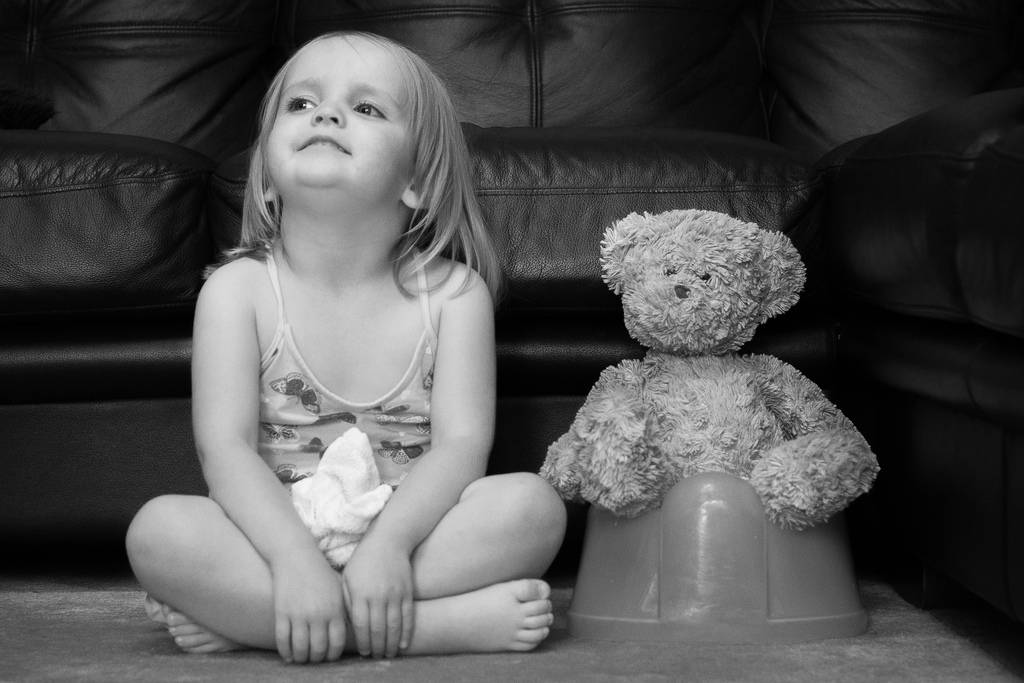
NoPottyDuring the potty training process, about 20% of children go through a phase of refusing to use the potty at all, or refusing to poop in the potty. For some the phase lasts a month or so. For others it can be a year. This is called “Toilet Refusal for Stool Only.” One scenario is a child that asks for a diaper at nap time or bed time, goes in their room and poops in the diaper, and then asks to be changed. Clearly, they have bowel control, and are making a very conscious choice about when and where to poop. It’s just not the choice you wish they were making.

An important note here: I’m not talking about “stool holding” here. That’s a child who refuses to poop at all, anytime, anywhere. That’s a different issue and it’s a medical issue that can cause constipation and bowel impaction and requires different treatment (see here).

I’m talking about kids who have regular, normal poop once or twice a day, just not in the potty. And I’m especially talking about a child who you know is developmentally capable of pooping in the potty because they’ve done it in the past… they’re just not doing it anymore.

So why does a child do this?

There are lots of proposed reasons. Most won’t make sense to you as an adult, but they may be what your child is feeling.

  • Fear of Pain: They may believe pooping in the potty will hurt. This sometimes follows an episode of constipation, when it did hurt. It’s hard for them to understand that the pain won’t always happen when they poop on the potty.
  • Fear of Falling In. Fear of being Flushed down the Toilet. Using a small, non-flushing potty rather than sitting on the big toilet may help with this one.
  • Fear of Losing a Part of Themselves: Some boys fear that if the poop falls out of them and into the potty, then maybe their penis could too. I also know of a girl who was terribly frightened the one time she saw the poop coming out while she was on the potty and then getting flushed down – she feared that part of her was gone forever.
  • Hate the sound of flushing. Some children are very frightened of a loud flush. Sometimes it helps if they are in charge of flushing so they know when it’s coming. Sometimes it’s better to let them leave the room / the stall before you flush. On auto-flush toilets in public bathrooms, you can cover the sensor with your hand or a post-it note until they’re done.
  • Desire for privacy. If you’re always with them in the bathroom, and they always poop when they’re alone, try just giving them a little privacy on the potty! (On the other hand, some kids want company in the bathroom and if you’ve been trying to send them in on their own to give them privacy, maybe they’d rather have you there.)
  • Sensory issues. They’re used to the poop staying next to them as it fills the diaper. Feeling cold air on their bottom and feeling the poop fall away from them may be uncomfortable to them. An intermediate step may be to have them sit on the potty with their diaper on until they can poop there, and then remove the diaper.
  • Shame. They’ve been taught that poop is disgusting and are ashamed of it. In one study, they encouraged parents to never use negative terms for feces, and – before they start potty training – to praise children for pooping successfully in their diaper. Some of these childre still went through a period of refusing to poop in the potty, but it was a shorter-term problem than it was for the control group in the study.
  • Power struggle. Many children go through periods of rebellion, and if they learn that this potty refusal really pushes your buttons, they may keep doing it to get a reaction.
  • Autism, developmental delay, or physical challenges can lead to this issue.
  • Emotional trauma or sexual abuse.
  • Temperament or Personal Preference. Some kids just like to use their diaper and see no reason to change.

Which one applies to your child? You may be able to guess, or if your child is old enough to talk about it, then ask them in a really non-judgmental open-ended way. “I notice that you always poop in your diaper and you won’t try pooping in the potty. Why is that – tell me more.” They may be able to tell you.

How NOT to respond…

Don’t punish. Don’t scold, shame, or publicly humiliate them.

Don’t show a lot of emotion about it. Be very matter-of-fact. “It looks like you pooped in your diaper again. Remember, I’d like you to use the potty. Let’s go get you changed.” Be bland and boring during the diaper change.

How do you get a child to poop in the potty?

It’s hard to make someone poop on command! And no, threats don’t work either, because when we’re scared, our sphincter muscles tighten up and it gets harder to poop.

What can you do? Here are some suggestions – don’t feel like you have to try them all. Some will feel right for you and your family’s situation. Others won’t.

  • Ask them why they don’t want to poop in potty. Address their fears. If they have any of the fears listed above, talk it over with them. Don’t expect to be able to just say “that’s a silly irrational fear” and have it go away. Take it seriously, validate it, ask them to help you figure out a plan for preventing that thing from happening.
  • Give them some motivation. Consider a reward system. Stickers? Big kid underwear? A cool toy they only have access to on days when they poop in the potty?
  • Withhold diapers. “Oops, we ran out of diapers. I guess you’ll have to use the potty.”
  • Or combine those two: say something like “This Sunday is our Happy No More Diapers Day. From then on, I want you to always poop in the potty. And hey, check out this cool doll house I got you. As long as you remember to poop in the potty, you can have it. If there’s a day when you ask for your diaper back, that’s fine. I’ll just put the dollhouse away for a while.”
  • Give up for a while. Give control back to them. Say “When you’re ready, you’ll poop in the potty. Until then, I will change your diaper when you poop.” And then just go on with your life without fretting about the potty. Once a week, check in with them to see if they’re interested in giving it a try. If they say no, say “OK, I’ll ask again in a week.” Try to just relax and let the worry go in between those checks. In one study where parents “gave up” on potty training, then 24 out of 27 kids started using the toilet spontaneously within three months.

Constipation

Your child may have some short-term issues with constipation. You should expect to see at least one stool a day, about the size of a small banana, and fairly soft. If your child is only passing small hard stools that hurt to poop, that’s constipation. Make sure they drink plenty of water, eat plenty of high fiber foods, and get lots of physical activity to help making bowel movements regular and easy to pass. If constipation persists or recurs often, check in with your child’s doctor.

Sources:

How to Deal with Your Child’s Stool Toileting Refusal; Toilet Training Problems; Toilet Training and Toileting Refusal – a Prospective Study; Toilet Training Resistance.
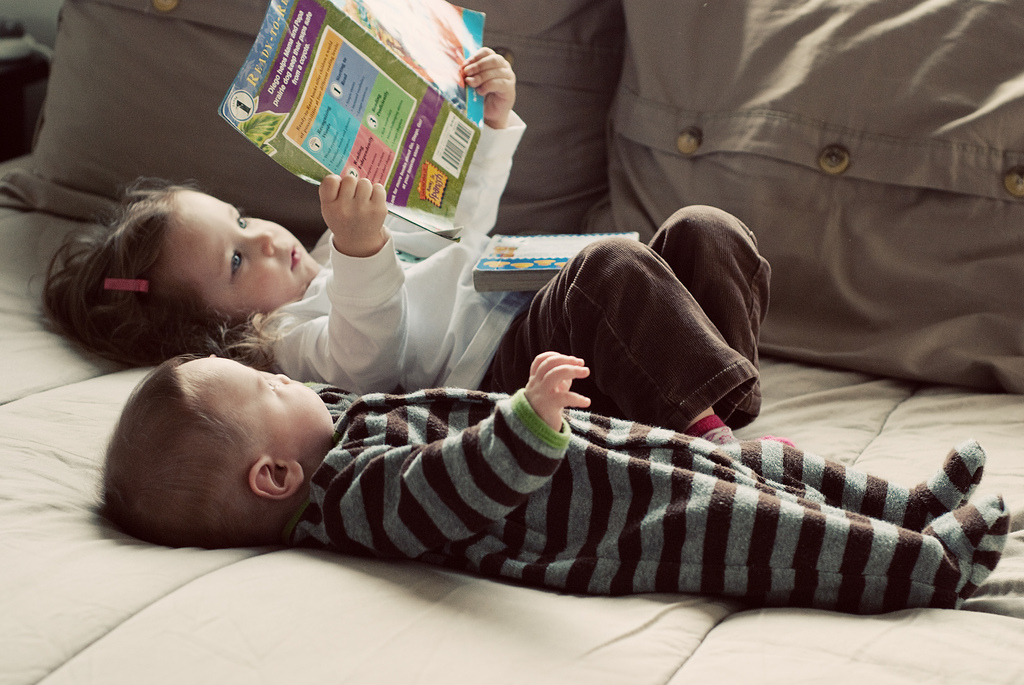
photo credit: Darren W via photopin

When should kids learn to read?

readThe Alliance for Childhood and Defending the Early Years just released a report called Reading Instruction in Kindergarten – Little to Gain, Much to Lose, discussed in a Washington Post article titled “Requiring kindergartners to read — as Common Core does — may harm some.” This post looks at what we know about children and early literacy learning.

When I was a child in the 60’s, I came into kindergarten knowing how to read – I could easily read any picture book. I was the only real reader in the class – but I came from a big family of early readers. By the end of the year, my classmates were all expected to have their alphabets down, and more kids were reading. By the end of first grade, most kids were reading. Those who weren’t got a little extra help in second grade and were caught up by the end of the year. That may reflect the normal range in developmental capabilities.

But today’s kindergartners are being taught to Common Core standards. In kindergarten, there are over 90 standards kids are expected to meet, including:

  • Recognize and name all upper- and lowercase letters of the alphabet.
  • Associate the long and short sounds with common spellings (graphemes) for the five major vowels.
  • Use the most frequently occurring inflections and affixes (e.g., -ed, -s, re-, un-, pre-, -ful, -less) as a clue to the meaning of an unknown word.
  • [And, by the end of the year:] Read emergent-reader texts with purpose and understanding.

Is this do-able for some kids? Absolutely. My kids all read before kindergarten. My youngest just turned 4 and has already mastered the standards I just listed. (And believe me, it’s not because we drilled him with flashcards or worked with worksheets for hours… we’re much too lazy as parents to do that! We just did simple things to create a good environment for literacy learning, and he took it from there.)

But NOT ALL KIDS are ready to read at this young age!

Kids develop in predictable patterns, but not at exactly the same rate. And they’re stronger in some areas at any given time than in others. For example, although my kids were early readers, they also each had areas they were “behind on” for their age, which were the challenges they needed to work on in kindergarten.

Dr. Arnold Gesell found that all children go on the same path of development; however, some go faster, some go slower, and all have spurts and set-backs
along the way. The obvious example is the age that children learn to walk. Some children learn to walk as early as nine months, some as late as 15 months. But that is all normal and we all agree that the early walker is not a better walker than the later walker. … Some children learn to read at age three or four years, others not until seven years or later. That range is quite normal. The most compelling part of the reading research is that by the end of third grade, early readers have no advantage over later readers. Some later readers even go on to become the top in their class. Reading early is not an indicator of higher intelligence. In fact, children at the top of their class in kindergarten only have a 40 percent chance of being at the top of their class at the end of third grade.

When we focus on academically based standards, it’s hard for kids who aren’t developmentally ready for that, but it’s also hard for kids like mine who needed skills that weren’t necessarily on the list of things a teacher is now “supposed” to teach. “In a survey… of early childhood teachers… 85% of the public school teachers reported that they are required to teach activities that are not developmentally appropriate for their students.”

And when teachers are asked to teach non-developmentally appropriate content, they have to do it in non-developmentally appropriate ways.

We hear increasing reports of kindergartens that use worksheets and drills, rely on lengthy whole-group lessons, and require teachers to frequently pull children out of the classroom to administer assessments. A parent recently wrote: “My 5-year-old son started Common Core Kindergarten this year in California. Even though it’s only been two months he is already far behind. … [W]e are required to do … [worksheets] four nights a week. It’s the same boring thing over and over again… I know he’s not stupid but I’m being told in not so clear terms that he is. It’s very disheartening.”

Drills and worksheets are not the way kids learn.

Well, in the short-term, they can be. Direct instruction CAN help children memorize specific facts and learn specific skills, but it doesn’t foster the curiosity and creativity that can be beneficial for learning in the long run. (Learn more in this article on “Why Preschool Shouldn’t Be Like School.”) And, the “boring” work can drain the passion for learning from our kids, which I believe is key for long-term academic success. And, for kids who aren’t developmentally ready for the work, it can make them feel stupid. I know of boys who weren’t ready to read at age 6 and 7. They learned at that age that they were “stupid” in school subjects and continue as young adults to think of themselves that way.

The report states: “We could find no research cited by the developers of the CCSS [Common Core] to support this reading standard for kindergarten… of the people on the committees that wrote and reviewed the CCSS, not one of those individuals was a
K-3rd grade teacher or an early childhood professional.”

What does the research show?

 There is no solid evidence showing long-term gains for children who are taught to read in kindergarten. In fact, by fourth grade and beyond, these children read at the same level as those who were taught to read in the first grade.

So, what is developmentally appropriate for preschool and kindergarten? Play-based learning.

Children learn best when they are engaged in activities geared to their developmental levels, prior experiences and current needs. As they construct their ideas through
play and hands-on activities that make sense to them, children’s knowledge builds in a gradual progression that is solid and unshakable. They build a foundation of meaning that provides the basis for understanding concepts in language, literacy, math, science and the arts. In active learning, their capacities for language development, social and emotional awareness, problem solving, self-regulation, creativity, and original thinking develop, transforming them into effective learners.

Being able to read well will also depend on the strength of a child’s oral language development. Active, play-based experiences in the early years foster strong oral language in children. As children engage in active learning experiences and play, they are talking and listening all the time. They attach words to their actions, talk with
peers and teachers, learn new vocabulary and use more complex grammar. As they build, make paintings, and engage in imaginative play, they deepen their understanding of word meanings. As they listen to and create stories, hear rich language texts, sing songs, poems and chants, their foundation for reading grows strong.

What’s the evidence that play-based preschool and kindergarten works in the long-run?

In one study, in the third grade there was little difference between students who had been in play-based preschools versus academic achievement programs. By 6th grade, the kids from the academic preschools earned lower grades than those who were in play-based preschools. A German study in the 70’s compared kids from play-based vs. academic preschools. In fourth grade, those from play-based programs excelled “on all 17 measures, including being more advanced in reading and mathematics and being better adjusted socially and emotionally in school.” So, they’re not only successful academically, but also socially. In an American study from the 60’s, children from impoverished households were assigned to either play-based preschools or to a scripted, direct-instruction approach. There were similar short-term gains for all children in the first year. But at age 23, there were significant differences. 47% of the kids from the direct instruction classroom needed special education for social difficulties versus 6% of the play-based alumni.

When looking for preschool or kindergarten for your child, you can look for play-based options. If they are in a kindergarten that follows Common Core standards, you can look for ways to balance that out at home with lots of child-directed free play. You can create a literacy-rich home environment without pushing reading. If your child is ready to read young, they will do so. If they’re not ready, they won’t feel stressed or stupid.

If you are the parent of a toddler, don’t feel any pressure to teach your child to read. But, you can create an environment full of literacy materials that show reading is exciting and fun.Read my ideas on this or follow this lead:

[In play-based settings] Teachers employ many strategies to expose children to rich oral language and print —without bombarding or overwhelming the child. These may include telling stories, reading picture books and big books, singing songs and reciting poems, reading from posted charts (using pointers to read along), drawing and writing with invented and conventional spellings, taking dictation from children, and helping children write their own stories. In organic and meaningful ways, teachers often use print — labeling block structures, cubbies, and interest areas, writing recipes, transcribing the children’s stories, and making charts for attendance or classroom jobs.

photo credit: ThomasLife via photopin cc

Preschool Choice Time

choiceThe holidays are over. You’re ready to sit back and relax.

Then suddenly you start seeing ads for preschool fairs, and lectures on choosing a preschool, your parent educator tells you the discussion topic is preschool, and other parents ask you if you’ve decided what you’re doing next year, and tell you that you need to think about it NOW before all the best places fill up.

It can be very stressful.

If your child will be 3 or older on September 1, then it could be a good year for you to start preschool. (But you don’t necessarily have to.) And January and February are prime time for preschool open houses, and for enrollment to begin, so now is a good time to think about it. (Though if you don’t think about it till August, you’ll still have good options.)

If your child is younger than 3 this September, you don’t have to make any decisions yet about their future preschool. But now is a good time to check out some of those preschool fairs, just to get some sense of what options are available in your area.

Check out these posts:

First decide: Is preschool necessary? Is it something you want for your child?

If you decide you’re looking, the first thing to think about is logistics: What do you need in a preschool in terms of location, schedule, cost, and so on.

Then, research your options.

Then visit, or attend an open house, and ask these questions to learn more.

photo credit: JoshSchulz via photopin cc

Fun with Toddlers: Winter Theme

Bring the snow inside!Sensory Activities to Do:

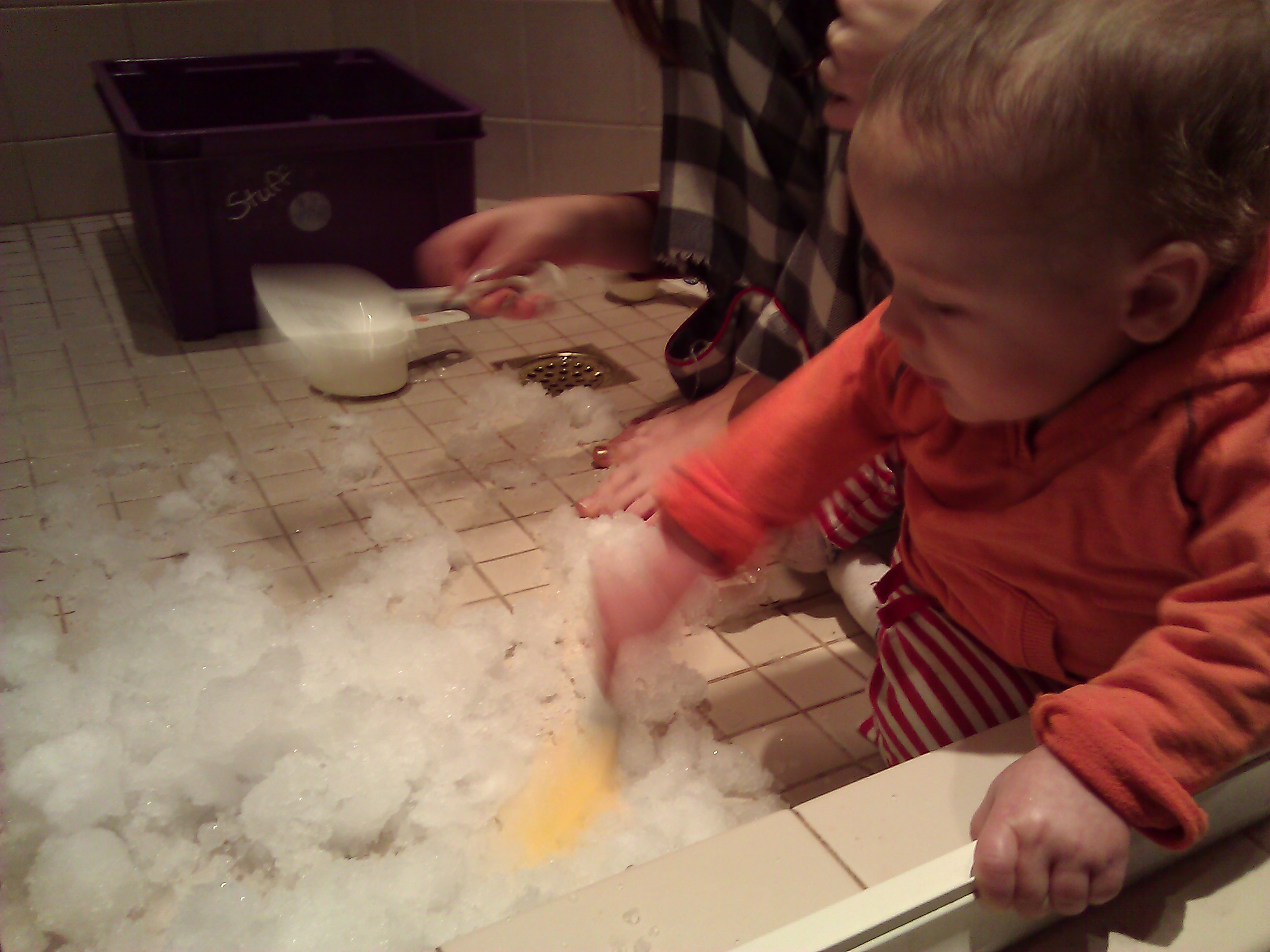
Snow in the Shower. When it snows, parents will often excitedly bundle up their toddler, and take them out to play. Then the child just sits and shivers and looks sadly up at the parent. It’s not as fun as you expected it might be.

Instead, try bringing the snow inside! Make sure your bathroom is nice and warm, then bring a big bucket of snow and dump it on the floor of your shower or bathtub and put your child next to it with shovels and toys. (He can even be fully clothed to stay warm.) As the snow melts, it disappears down the drain, so no clean-up required! When your child is done playing, run a warm bath or shower to warm him back up.

Ice Play

  • Hockey rink: freeze a cake pan of water. Make mini “hockey sticks” and use a checker as the puck. Hit the puck back and forth to score.
  • Excavation: Use a loaf pan or large bowls to make blocks of ice. Freeze items inside (e.g. plastic penguins or Legos). Set it out on a tray to catch the water as it melts. Give your child a toy hammer and other tools to excavate the toys.
  • Melting experiments: Give your child ice, water with pipettes or eye droppers, salt to sprinkle. Let them explore how to get the ice to melt. Add food coloring or liquid watercolors to make it prettier.

Dry Ice Experiments: Check out my post for lots of ideas. Note – this requires close supervision!!

Games to Play:

Indoor Snowball Fight. Make or buy big white pompoms, or soft white balls. Or just wad up a bunch of paper into balls. Or ball up pairs of socks. Fill a basket with them. Then spontaneously start snowball battles anytime you want to! Not only is this tons of fun, I like playing games where I throw (soft) things at my kids. It helps them be a little bolder about ball games later in life – a little more willing to “head” the ball in a soccer game. This also allows them to get out their throwing energy indoors without much risk of damaging anything.

Crafts to Do:

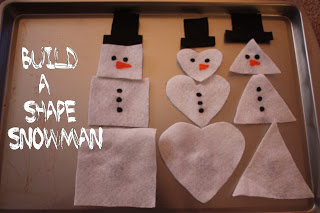
http://www.howwelearnathome.com/2013/01/build-shape-snowman.html

howwelearnathome.cm

Mittens: Cut out 10 paper mittens. Have your child decorate them. (Or for younger kids, have them scribble / finger paint all over a piece of paper, THEN cut out mitten shapes.) Then do the 10 little mittens rhyme together.

Tracks in the Snow. Take some colored construction paper. (Green, brown, or whatever you have.) Squirt white paint onto it. Use a paintbrush to spread it around, smoothing it. Then walk some toy animals or dolls across it. Point out their tracks. Drag a stick across it. Drag across a fork or a comb. Notice the paths they make in the paint. Then spread the paint back out again smoothing it over, and make some more tracks.

Tracks in the Snow, take 2. Make white play-dough. Play with toy animals and dolls in it, and point out the tracks they make. (Source, with pictures.)

Shape snowmen. Check out original idea here.

Snowy Day. Make a drawing (or find a picture) of an outdoor scene with trees and more. Put out white paint and show your child how to put one finger in, then dot it on the paper to make a snowflake. They make more and more snowflake dots till the landscape is covered in snow.

Rhymes to Say

Up the Mountain rhyme
Sit child on your lap
Up the mountain (run your fingers up one of their arms)
Down the other side (then run fingers down their other arm)
Brr it’s cold out… (hug them tight)
Let’s climb inside! (tickle their neck as you reach your fingers under their collar)

Five little snowmen
Five little snowmen standing in a row (hold up 5 fingers)
Each with a hat (pat head) and a big red bow (pull at neck like a bow tie)
Along came the sun (arms form big circle over head)
and it shone all day (lean sideways)
And one of those snowmen melted away! (put down one finger)
Continue until there are no snowmen left.

Disappearing Snowman
(make a paper snowman; cut as you tell story, making snowman smaller)
On Monday, I made a snowman. Just like that.
On Tuesday, the wind blew some snow away. Just like that.
On Wednesday, it rained on my snowman. Just like that.
On Thursday, the hot sun started to melt it. Just like that.
On Friday, it melted into a puddle. Just like that.
On Saturday, it snowed again. Just like that.
On Sunday, I made another snowman. Just like that.

Three little snowmen.   (mime 3 fingers perched on sled made by other hand)
3 little snowmen riding on a sled.  One fell off and bumped his head. Mama called…

Songs to Sing

For the first two songs, make your child a paper snowflake and have them put it on their head, their knee, etc.

Little Snowflake Swirling Round (tune: London Bridges)
Little snowflake twirling round
Twirling round, twirling round
Little snowflake twirling round
Lands on my head!
Repeat with different body parts.

It is Snowing (Tune: Frere Jacques)
It is snowing, it is snowing,
All around, all around.
See the pretty snowflakes, See the pretty snowflakes,
Touch the ground. Touch the ground.

Snow is Falling (tune: Skip to My Lou)
Snow is falling, what do I do? Snow is falling, what do I do?
Snow is falling, what do I do? What do I do, my darling
I’ll build a snowman bigger than you! …That’s what I’ll do, my darling!
I’ll ride my sled fast, how about you?… That’s what I’ll do, my darling!

Sing the My Mittens song in those inevitable moments when you’re searching for your child’s missing mittens.

Books to Read:
Amy Loves the Snow by Hoban. Sweet simple story for little ones.

The Snowman Storybook or The Snowman by Raymond Briggs. These are the same story, but the Snowman is wordless – you tell the story in your own words. Beautiful illustrations. Story of a snowman who comes to life. Note: This book has a sad ending. (I think that’s OK – helps to build emotional literacy. But some parents prefer to avoid.)

Red Sled or Red Hat by Judge or The Mitten by Jan Brett. All three are stories of woodland creatures getting into mischief with children’s belongings. On the long side for toddlers, so save for when they’re feeling calm and patient.

The Snowy Day by Ezra Keats. A little boy in the city enjoys a snowy day. This book, published in 1963, was noteworthy for being one of the first picture books to feature an African-American child. Note: this combines really nicely with the “tracks in the snow” activity above, where you can show how the doll tracks or the track from the stick is like what was shown in the book.

Other books toddlers love: Books that sing – Itsy bitsy snowman, I’m a Little Snowman. Counting Books – Millions of Snowflakes. A Winter Walk in the City. Other: Dr. Seuss’ Winter Things. Biscuit’s Snowy Day. Colors in the Cold. Snow Kisses. Let it Snow;

More ideas (and source citations) at: http://www.pinterest.com/bcparented

For my full collection of theme-based “Fun with Toddlers”, click on “Fun with Toddlers series” in the right hand side bar. These are great for parents or for teachers and librarians doing story-time for toddlers or preschoolers. If you would like theme information in printable handout form to share with students, click here.

Kids Love to Build

sand

A few years ago, I went to one of the best birthday parties I’ve been to over my 20+ years of parenting. It was a construction site themed birthday party for a four year old boy.
When they arrived, the kids got construction helmets with their names on them (so helpful for me, as I only knew a third of the kids at the party) and construction apron / tool belts from Home Depot. (Note: you can also get 6 Construction Worker Vest with 6 Helmets pretty cheap on Amazon.)

The party was held in a community room with an easy clean floor. There were 4 stations:

  • The quarry – a kiddie pool filled with sand, construction trucks and little shovels; surrounded by some big storage tubs and stacked up sandbags to climb on (and a construction broom to sweep all the sand back to the quarry).
  • House painting – big cardboard boxes, paint, paintbrushes and rollers. Put a BIG plastic tarp and drop cloths under it for easy clean-up. (An alternative would be to draw houses on big paper to hang on the walls, and let kids paint that.)
  • Architects’ office – tables with architectural blueprints spread out and markers for drawing anything you want. (We later ate snack at those tables.)
  • And the best part: the construction site – 6 foam insulation panels, miscellaneous foam blocks from packaging, golf tees, and toy hammers (including a couple squeaky hammers).
    The kids assembled a building out of them. For an hour and a half straight (!) these kids focused on this building. They were working intently, hammering non-stop, negotiating design issues with each other, re-building when there were accidental dis-assemblies of the building, problem-solving when they discovered they’d forgotten to put a door between the rooms (they solved this by putting a foam “step” on each side of the wall so they could easily step over it.) They were totally engaged in the project and the imaginary play that accompanied it. This was all self-guided by the kids. Parents rarely stepped in to offer any guidance – almost no dispute resolution was needed – the kids worked it out. And note: some of these kids knew each other in advance, but many were strangers to each other. It was the work that brought them together.

house1house2

Since this party, I have replicated this house building project several times in my Inventors’ Class. You can read more about it and see more pictures at this post about our class session called If I Built a House. That post also has lots of other ideas that could be adapted for a birthday party or preschool class themed around construction, Bob the Builder, etc. We draw blueprints, excavate in the dirt, build plumbing in the water table, connect electrical circuits, and lots more.

Get Kids Building

People will often say that children this age (4 – 8) have short attention spans and are hard to entertain / control / keep focused on a task. But if you find engaging, hands-on projects and let the children guide their own creation, it’s amazing just how hard kids will work on a project and how much satisfaction they’ll get out of it.

Kids love to build. They love to be competent at a skill. They learn by using tools and by the trial and error that goes with the building process. They can work together collaboratively. We just need to come up with good projects to help them do so. And there are long-term benefits to building. (Check out:The Importance of Learning to Make Things: http://harvestamericacues.com/2014/03/10/the-importance-of-learning-to-make-things/)

Some more ideas for building projects:

  • Give a child scraps of wood, sand paper, glue. Hammer and nails if you’re feeling bold. Encourage them to build a boat, or a castle, or whatever inspires them.
  • Cardboard forts. Ask your friends for their giant cardboard boxes (the week around Christmas is a great time to post this request on your Facebook page!). Give your kids packing tape, and markers, fabric for curtains and flags and so on. Help them cut doors and windows as needed.
  • Building tunnels. Tape flaps on cardboard boxes open or cut flaps off so that boxes form a tunnel – string several together to be an animal den or a prison escape route or whatever pretend play the kids want to do. (There’s an amazing scene of this in the Ant Man and the Wasp movie!)
  • Marble runs / ball runs. Use cardboard tubes, or foam insulation cut in half, or PVC pipes and a lot of tape to build mazes to run marbles or balls through. (Learn more.)
  • Water walls: Use PVC pipes and PVC connectors on suction cups or water bottles and tape, and create great “mazes” to pour water through. Good for outdoors or the shower wall. (Here’s the one we built.)
  • “Paint” your house with water. In the summer, put out paint rollers, paint brushes, and paint trays of water. Let kids paint the house, the patio, the car…
  • Sanding wood. If you’re working on a project with wood, even small children can help with the sanding. Show them how to sand with the grain, how to touch the wood to see if it’s getting smoother, etc.
  • Using screws. Your child can use a screwdriver and screws – it may be easier to screw them into a bar of soap first, before trying wood.
  • Screwing in bolts. We have a fun toy drill driver with plastic bolts and wrench, but you could also use real bolts and a real wrench.
  • Construction snacks: Use materials like graham crackers or marshmallows or gingerbread. Mortar them together with cream cheese, frosting, or peanut butter. Let kids create buildings with them. Decorate with candy or dried fruit or cereal.
  • More ideas for songs, books, and more related to construction: http://www.everythingpreschool.com/themes/construction/
  • And more great ideas: http://notjustcute.com/2011/03/11/lets-build-activities-for-a-preschool-tools-and-construction-theme/

In our STEM enrichment class, we do lots of building activities. Go here to learn more: http://inventorsoftomorrow.com/category/math-engineering/