Tag Archives: Infant

Passive Toys = Active Kids

passiveThought for the day, from a workshop based on the principles of RIE (Resources for Infant Educarers.): the more active the toy, the more passive the child.

An active toy that does something entertains – all a child needs to do is press a button and sit back and watch passively. A passive toy that doesn’t do anything engages – a child needs to be active to enjoy it.

Or as Magda Gerber says about her recommended play objects – all passive toys: What do [they] have in common? None do anything. They will only respond when the infant activates them. In other words our active infant manipulates passive objects. In contrast, entertaining kinds of toys, such as mobiles or later on, windup toys, cause a passive infant to watch an active toy. This trains the child to expect to be amused and entertained, and sets the scene for later TV watching.

Active Toys

Active toys also include: LeapPads, stuffed animals or dolls where when you squeeze their hands they sing a song… most things with batteries.

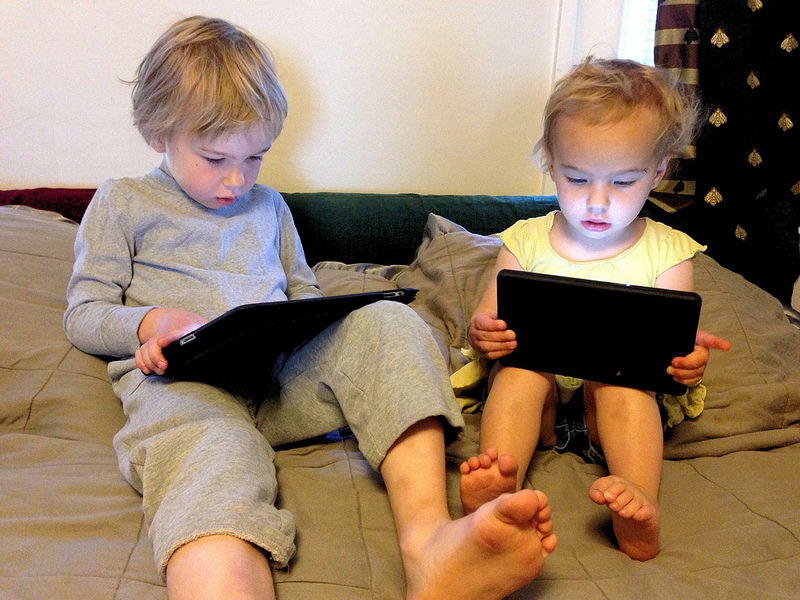
The ultimate in active toys is a touch screen device – I-Phone, tablet, etc. I’ve written before on the benefits and downsides of screen time, but the truly amazing things about these devices is their pacifying effect. My son can do an amazing transformation from Squirmy Whiny Disturbing-the-whole-restaurant Boy to Silent Child in less time than it would take to duck into a phone booth – all I need to do is hand him my Kindle or phone. And in moments he’s thoroughly entertained by a video or app. (Here’s thoughts on how to choose well-designed age appropriate materials.)

But, I think the corollary to the statement of “the more active the toy the more passive the child” should be something like: “the more effectively a toy pacifies the child, the more actively they will protest when you try to take it away.” Silent Child turns into Wild Screaming Misery Lad when I then try to take the Kindle away, or when, god forbid, the battery dies in a public place.

I do still use active toys (including the Kindle) at times, but I also try to balance them with a lot of “passive” toys – a lot of open-ended toys that encourage exploration and engagement. And I try to give him time – plenty of uninterrupted time – to explore them.

Some fabulous open-ended materials for toddlers and preschoolers:

Magda Gerber recommends (in The Best Toys for Babies Don’t Do Anything): balls, scarves, plastic bottle, containers (cups, bowls, baskets in many sizes and shapes). Or check out Geek Dad’s list: sticks, boxes, string, cardboard tubes, and dirt. And, of course, my favorite open-ended toy: nature.

Read more about open-ended toys: Here are a couple posts from Mamas in the Making, which are about toys for the 3 – 6 month old crowd, but most of their thoughts apply through the toddler years: Our Thoughts on Open-Ended Toys and Age Appropriate Toys. Check out this video, or many of the videos on Janet Lansbury’s YouTube channel for examples of babies at play with simple open-ended items.

Have enough toys… but not too many…

It’s easy to get excited about open-ended toys. Don’t go overboard though, filling the house or classroom with stuff…

Both at home and at work, I want to be sure there aren’t too many options for kids to explore. It’s great for kids to have some choices, but too many choices are stressful and overwhelming. When faced with too many choices, instead of engaging with one, kids may run from one to the next, never settling. Or, as someone said at my in-service yesterday: “If your child spends their playtime dumping all the toys out of the bucket, that means there’s too many toys in the bucket. Put at least half of them away for now, and the child will play more with what’s left.” Often, less is more. When we give kids the chance to really engage and explore open-ended toys, it’s amazing what they can come up with.

active

Just for fun: Check out this blog post on Being the Cool Kids on the Block, which talks about saying yes to your kids’ play ideas (within reasonable limits) and open-ended materials.
photo credit: ianus via photopin cc
photo credit: peterme via photopin

Building the Young Brain

I recently attended a presentation by Dr. Sarah Roseberry Lytle, Director of Outreach for I-LABS, the Institute for Learning and Brain Sciences at University of Washington. They conduct research into brain development during the first five years of life. She presented about the Importance of Everyday Experiences to Building the Young Brain.

I’ll share with you my [incomplete] notes from the presentation.

Why early learning is important: She had a great graphic about brain development (similar to this one from http://doctorcare4u.com/images/brain-skull.jpg) that showed that at birth, the baby’s brain is just 25% of the size of the adult brain, but by 5 years old, it’s 92% of the size. That’s a huge amount of development in baby’s first 2000 days.


So, what can we as parents due to aid in that brain development? Expose our child to a variety of in-person life experiences.

Research has show that fewer life experiences lead to less brain development: children raised in households with lower socio-economic status and less opportunity have less specialized brain function at the age of 5.

On the question of nature vs. nurture, or whether a child’s learning is a result of biological potential or of life experience, she offered the analogy of a cookie recipe: biology is the ingredients and experience is the recipe. If I want to make pancakes, I use flour, sugar, salt, baking powder, eggs, and oil or butter. If I wanted to make cookies, I might use those exact same ingredients, but in different proportions, and with different methods, and come up with a very different result. So, your child comes with certain innate factors, but there’s a lot we can do with the experiences to affect the results.

What types of interaction best aid in a child’s learning? Here’s some of the things research tells us.

  • Children learn best “in the moment” – you can’t necessarily plan ahead what they will learn when, but you can seize the moments of everyday learning opportunities (i.e. there’s no point in talking to a toddler about the rain when it’s sunny out, but when you’re out in the rain, talk about “we’re getting wet… there is water falling from the sky right now. That’s called rain.”
  • Children learn better from live interaction than from the TV. (Here’s an article talking about how DVD’s do not appear to be effective at teaching language. However, interestingly, interactive discussions with a live human being via Skype do appear to aid in language learning – responsiveness and turn taking seem key.)
  • Children learn better from their mothers than they do from unfamiliar research assistants. Or, taken more broadly, children learn best from people they have personal relationships with.
  • Children learn language better when parents use ‘infant-directed speech’ (a.k.a. Parentese) – the sing-songy, highly animated, lots of facial expressions style speaking adults use when interacting with small children.
  • Children learn better when a researcher first established eye contact with the child and then looked at the object – the child would follow their gaze. This was more effective than the researcher just looking at something and talking abut it without first inviting the child along through eye contact. So, engage with eye contact and then teach. [Note. I have also read elsewhere that children learn language better when following child’s lead. In other words, if your child is looking at the light on the ceiling, you don’t say: “look at that teddy bear over there on the floor. The teddy bear is brown.” None of that would feel relevant to the child. If instead, you follow his gaze and say “You’re looking at the light. The light is bright,” that will be relevant, and worth remembering.]

Language Learning

Babies have “sensitive periods” when they are most open to learning certain skills. In language learning, we see that at age 6 months, babies are ‘universalists’ – they are capable of hearing any sound the human voice can make. But, by 11 months, they have become ‘specialists’ in their native language. (For example, in the Japanese language, there’s not an important distinction between the sound ra and la. A 6 month old Japanese baby can differentiate between those sounds just as well as an American baby. But, by 11 months, the Japanese baby has learned that the difference between those sounds doesn’t matter in their native language, and they no longer ‘hear’ it.) If a baby is raised bilingual – with significant adults speaking two different languages around him, he will remain a ‘universalist’ for longer – at 11 months he can still recognize all human sounds, by 14 months he is a ‘specialist’ in both of his languages, but has lost the ability to hear sounds differences that are not important to either language.

Cognitive Control / Self regulation

A key ingredient to a child’s success in school is self regulating: being able to change modes. For example, if you’re outside running and playing at recess, can you calm yourself down when you return to the classroom?

Simon Says game is a great way to practice this. When you say “simon says touch your elbow” that’s easy for a child to follow. But when you say “touch your elbow” without first saying Simon says, then the child has to work hard to not follow the directions they’ve just heard.

At the toddler level one way to practice this “activate and inhibit skill” is sorting. When you ask them to sort all the trucks into one pile and all the cars into another, they don’t care what color the vehicles are. But when you then ask them to put all the green vehicles into one pile and all the red vehicles into another pile, they have to actively ignore what type of vehicle it is so they can focus on the important attribute of color.

Dr. Lytle shared brief information about a few other studies with us, including one about a researcher who had put signs in a grocery store suggesting things parents could talk to their kids about while shopping, and yielded a big increase in the amount of talking and interacting by parents.

Her summary point was that the little everyday things that parents do with their kids matter. Diverse life experiences, with the companionship of an engaged caring adult, helps our babies to learn and grow.