Category Archives: Parenting

Link

I will be talking about positive discipline in my class this week. Many people mistakenly believe that positive parenting means permissive parenting – always saying yes, and never saying no. I absolutely believe in setting clear limits with children.

Positive Parenting Blog has a great post on how positive parenting is not authoritarian but neither is it permissive. Check it out: www.positive-parents.org/2011/06/positive-parenting-is-not-permissive.html

If you have a hard time saying no, check out: Saying No to Your Child and No Means No.

Why “More Good Days”

Why More Good Days? Because it’s a theme that weaves throughout my teaching in various ways:

  • When working with pregnant people and discussing nutrition, exercise, and so on, I say “I’m going to tell you all the ideas I know of for increasing your chances of a healthy pregnancy and birth, but I’m not telling you that you have to do every one of these things every day! I’m giving ideas, and you’ll do as many of them as you can make work in your life. And some days you’ll eat perfectly, and other days you’ll grab beef jerky and raisins at the convenience store because that’s the only way you can get “lunch” that day. It’s OK. Babies are resilient – they won’t suffer for a few bad days here and there. We just shoot for more good days than bad… the more healthy choices the better.”
  • When teaching breastfeeding, if people raise concerns about not “succeeding” at breastfeeding, I say “I’m going to give you all the ideas I can to help increase your chance of reaching your goals, and I’m going to give you lots of resources for where you can go for help, and you’re going to do the best you can. Hopefully you reach or exceed your goals for how long you nurse baby. But sometimes life happens, and breastfeeding doesn’t turn out as someone had hoped. I want you to remember that even a few days of breastmilk has health benefits for baby, and the more days of breastfeeding they get, the better for them and for you. So focus on those good days and how much good you did for baby on those days.”
  • When teaching parents caring for children of any age, I say “You’re not going to be a perfect parents. None of us are. There will be days (or at least moments each day) when you feel like a fabulous parent – like you’re really succeeding at this whole parenting gig! And there will be days when you’re a crappy parent. Days when you find yourself saying or doing something that you never thought you’d say or do. Days when you just really feel like you screwed up. When you have those days – or those moments each and every day – keep moving on. Seek out advice and new ideas on how to do better, seek out support for yourself on this path, and learn about what resources there are for you and your child. You’ll continue trying to do the best you can every day, and you hope that in the long run, when you look back, you’ll say that there have been more good days than bad.”
  • When working with parents of teenagers who have been battling their kids, I say “how do you hold limits firmly yet compassionately? Yesterday, you tell me you were yelling at your kid… can you go back to them and say “I’m sorry I yelled – that was not appropriate. However, your behavior was a problem and you do need to do better. How can we work together to improve things?”

So, really “more good days” is about finding a balance. Doing the best you can. Finding more information, support and resources to help you do better. And forgiving yourself for the bad days.

I also think that part of what determines whether something is a ‘good day’ or a ‘bad day’ is our attitude. Some days feel like there’s problem after problem, and every little thing pushes us closer to the edge, and we find ourselves saying “what a crappy day! Why does this keep happening? I hate my life!!” Other days, everything feels easy and fine, and all those little annoyances slide right off.

Here is a blog entry from the day in 2013 when I named this blog:

Yesterday morning with my three year old, I was relaxed and mellow and all was fine with the world, and then… he pooped in the bathtub. But, it was OK. I cleaned him up, I cleaned up the bathtub, and then he pooped in the potty, which is always worthy of celebration. It was all fine – it was a good day.
But then yesterday afternoon, it was so hot in the house that he couldn’t go down for his nap in his room upstairs. So, he’s “napping” on the couch. But he’s not. And I’m trying to work. But I’m not. And he’s making a mess with all his toys, and I’m asking him to clean it up. And he’s not. And I should be calm and reasonable in asking him to clean it up and go back to his couch. But I’m not. And now, it is a terrible, horrible, no-good, very bad day.
And really, the difference between morning and afternoon was all about my attitude. But even knowing that, it’s hard to shift out of it in the moment.
But, we did shift out of it – we had a fabulous evening in the splash park and watching outdoor Shakespeare with the whole family.
And it was so joyful for me to watch my three year old in the water, trying out all his new skills from swimming class and laughing and playing with all the other toddlers. And it was so joyful for me to watch my 20 year old – my theater major son – enjoying the show – laughing at some beautiful moments of physical comedy.
In the end, it was a very good day.

Every day, parents have experiences like these. The good moments, the bad moments. Parenting can definitely be “all joy, and no fun.” In the hard moments, we wonder why we put ourselves through it. And then in the joyful moments, we realize that there’s really nothing better than watching a child learn and grow.
And every day, I work to find the same balance I encourage in my students. Doing the best I can. Finding more information, support and resources to help me do better. Forgiving myself for the bad days. And hoping that in the long run, there are more good days than bad.

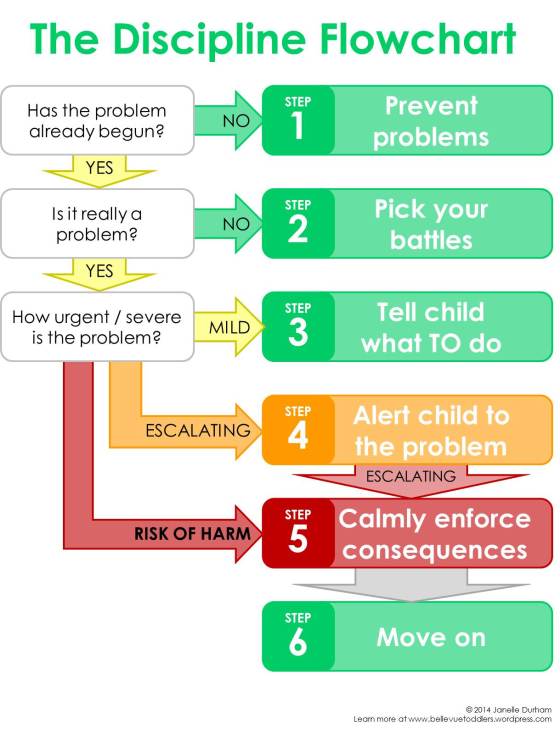
The Discipline Flow Chart – 6 Easy (or not always-so-easy) Steps of Discipline

DisciplineFlow

When many people hear the word Discipline, they think of punishment – the consequences for bad behavior. Discipline is so much more: it’s Prevention of problems – setting up an environment where your child can be successful. It’s Picking Your Battles – deciding which lessons are the most important to teach. It’s Teaching your child about the right way to behave (not assuming they were born knowing.) It’s Setting Limits – letting your child know when there is a problem and giving them the opportunity to correct it. Then, as step 5, not step 1, come Consequences. After consequences, we Move On – making clear to the child that their behavior was not OK with us, but they are! Let’s look at the 6 steps in more detail.

Step 1 – Prevent Problems

There are lots of things we can do to set the stage for good behavior. It’s easier for your child to behave when they are well-rested and well-fed. It’s easier for your child to behave when you have predictable routines for your day and they know what’s expected of them. We can plan our activities so that each day the child has plenty of kid-friendly times and places where we can say yes to them – yes, it’s OK to run here, yes, it’s OK to be loud here, yes, you can touch and play with all the things here. Having this time will make the “No” times easier.

Effective discipline is grounded in relationship. If your child trusts you, and trusts that you love them, discipline will be easier.

A key step of prevention is to teach your child what to expect, and what is expected of them. It will take them a while to learn what is appropriate behavior for church, stores, the doctor’s office and so on. On your way to an activity, talk about what you will be doing, and how you would like them to behave.

Step 2 – Pick your Battles

When some questionable behavior begins, think before you intervene.

If something is clearly bad behavior, we move on quickly to the other steps… especially if there’s imminent danger of harm to a person or a possession – then we’d jump straight to step 5 – consequences. Or if your child is having a full-out tantrum, you may need to just remove them from the situation and explain later.

But sometimes the ‘misbehavior’ that we notice and react to is really not that big of deal. Sometimes the behavior is just annoying to us but not really bad. (If this is the case, can you just ignore it?) Or sometimes, our kids just surprise us by doing something we didn’t expect them to do and we react negatively before we really think about it. And then next thing we know, we’re caught in a battle of wills about something, and we realize part way through that it’s a battle not worth fighting, but we don’t want to back down because then our child learns that they can out-argue us.

When you encounter one of those moments of “I can’t believe she just did that!”, stop and think before reacting. Share your thought process with your child….  “hmm… I need to think about whether it’s OK to do that.” Once you’ve decided, explain your decision to them so you both know the rules for the future.

[Note: when I say things like “explain”, remember that you always have to act in a developmentally-appropriate way with your child. So, explaining to a toddler may be “no, no, too hot” and an explanation to a 5 year old will be a lot more specific.]

Step 3 – Tell Your Child what TO do

[If the situation is escalating quickly, we might need to jump to step 4 or step 5. But ideally, we can spend a while on step 3… ]

We need to ask for the behavior we want to see. Toddlers don’t understand the word “don’t” very well, so if you say “don’t bite”, they hear the verb, and continue to bite. Also, even if they grasp what they shouldn’t do, they may not be able to think of any alternatives for what they should do instead. Tell them what they should do.

Connect to Correct: Don’t call out suggestions from across the room. Go close to your child, establish eye contact, and then give suggestions. Engage them in the new activity before moving away.

Model: Act the way you would like your child to act. Point our other kids who are behaving well. Children are great at copying what they see. “Let’s touch the doggy gently. See, this is gentle.” “Watch how I walk carefully down the stairs, and I get to jump off just the very last stair.”

Re-direct: Tell them what other action they could do with that object. So instead of “don’t pour the rice on the floor”, say “keep the rice in the bowl.” Instead of “Don’t drop that!!” say “Hold it very carefully” and say “when you’re ready to set it down, I’ll take it from you.”

Substitute: Tell them what other object they can do that action with. “I can see you’re in the mood for throwing. Let’s go find a ball.” “I can see you want to bang on things. Where’s your drum?” Sometimes it’s delayed substitution: “I know you want to jump and run today. Later, we’ll go to the playground and you can do that all you want. For now, I need you to sit quietly.”

Offer Choices: “You have 3 cars. Bobby wants to play with one. Which one do you want to give him?”

Note: don’t offer choices to a child who is very upset. It will only make it harder for her to calm herself down. A tantrum-ing child needs to be given clear direction about what to do.

Explain the Reasons: “I want you to stop banging on that, because it might break. That would make us sad.” “I need you to be safe. When you go head first down a slide, it can hurt you. Go feet first.”

Step 4 – Alert Child to the Problem, set Limits

If re-directing has not been working, and misbehavior continues, we need to take action. [If there is imminent risk of harm, jump to step 5.]

Get serious. By this, I mean: change your tone of voice to calm but stern, change your body language. Let them know you mean business. Tell your child that his behavior is not OK. (He might not know. Or he may know and is testing the rule – and you.)

Remind your child what the expectations are and encourage her to behave better. Let her know what the consequences will be if the misbehavior continues.

Try for logical consequences, where ‘the punishment fits the crime.’ The most common consequences fall into two categories: remove the child from the situation until they can behave well, or remove options from the child (i.e. take away toys, buckle them into the high chair, stop them from using the slide.) Make sure the consequence is in proportion to the issue. Some examples: “when you throw your Duplos, I need to put them away for the day” or “when you don’t stop when I say red light, I need to carry you to keep you safe” or “I need you to help put away toys. If I put them away all by myself, I will put them up high on a shelf out of reach.”

Don’t set any consequences you’re not willing to enforce!

Step 5 – Calmly Enforce Consequences

If the misbehavior continues, you must impose the consequence. Although it’s hard to “punish” a child, it actually builds more trust if you do what you said you would do than if you “let it slide.”

Your role is to be the authority who helps your child stay safe and grow into the best adult they can be. Although you can be loving and friendly to your child at all times, you can’t always be their friend. Sometimes you’ll be the “bad guy” who blocks them from doing what they want.

No need to discuss this or re-hash it or re-negotiate it. Just do it.

Step 6 – Moving On

Once the consequence is complete (your child has calmed down enough to return to the situation or the time limit on taking the toys away has run out) then you move on.

Remind your child you still love himhis behavior was the issue. Make plans together for how to prevent or manage this sort of situation in the future.

Over time, we want our children to learn self-discipline, so as they get older, we need to “fade” back a little with our guidance. We ask them to tell us what the appropriate behavior is for a situation, we wait a little longer to correct, we let them experience some of the problems we’ve warned them about (instead of always protecting them from consequences), and take more responsibility for behaving properly.

——————————————-

Would you like a cheat sheet version of this article to print and post on your fridge? Download PDF: Discipline Flow Chart

If you found this helpful, click on links on the right to “follow this blog” or “like me on Facebook” to stay up-to-date on posts.

If you want to learn more parenting skills, and get expert advice customized to your family, look for parent education classes in your community! I teach for Bellevue College – on the Eastside of Seattle. (For other classes in Puget Sound, look here.)

Sample Tip from the CDC: Using Consequences

On the new CDC website on Essentials for Parenting Toddlers and Preschoolers, they offer these 5 steps for using consequences as a discipline tool.

1: Identify the behavior. Be specific about what is wrong. So, instead of “be gentle”, say “you are being too rough with those toys when you crash them together like that.”

2. Give a warning. Let them know the behavior needs to change, and if it doesn’t, there will be a consequence. (Make sure you pick a consequence you’re willing to enforce!) If-then statements work well: “If you keep crashing your toys, then I will put them away for a while.”

3. Give a consequence. If they behave well, give a positive consequence, like praising them or playing with them. If they continue to misbehave, follow through on the negative consequence that you set.

4. Tell them why. Explain the action, but keep it brief – now’s not the time for a lot of talk. “You were rough with your toys, and I’m afraid they will break, so I need to take them away from you for the next five minutes.”

5. Go back to positive communication. After the consequence is complete, let go of what happened, and return to positive communication and positive expectations for your child. “The five minutes are up, and I can see that you are being gentle with your other toys, so I will give those toys back to you. You are welcome to play with them gently.”

Want more info on discipline? Check out my tips here.

Link


The Centers for Disease Control has launched a new service called Essentials for Parenting Toddlers and Preschoolers. The major topics covered are: communicating with your child, creating structure and rules, giving directions, using discipline and consequences, and using time out. It includes tips on each topic, advice from experts, and videos that show real-life scenarios of how tips can be put into practice. all are clear, simple, and easy to implement.

You may find you don’t agree with all their recommendations. If so, just take what works for you as a parent, and ignore the rest. Or you may find that you need to adapt their ideas for what works for you and for your child. Whether or not a discipline technique is effective depends on

1) whether the parent can use it confidently and consistently

2) whether it is a good match for the child’s temperament

For example, I did not find timeout effective with my older daughter. Trying to put her into time-out would escalate a minor discipline issue into a huge power struggle. A logical consequence like taking a toy away from her for a while worked much better. For my son, although I don’t put him in a chair by himself for timeout as shown on the CDC website, I do definitely remove him from situations when he is behaving inappropriately. Spending a few minutes in my arms, or sitting quietly away from the situation helps him calm himself down and return to good behavior.

Find the CDC site at www.cdc.gov/parents/essentials/index.html