Category Archives: Fun Activities

Winter Fun with Little Ones

wp_001014

During cold and rainy winters, it can be easy to feel the cabin fever of being “trapped” at home with your toddler or preschool age child. I’ve written lots of posts over the past few years on “Cheap Dates with Toddlers” – easy, fun, and cheap activities. Here’s the best ideas for winter fun:

  • Go to the playground in the winter – just bundle up and bring a towel to dry everything off! (For reviews of several Kirkland area parks, click here.)
  • Try an indoor playground – lots of large motor play with new friends, out of the rain.
  • Hike in the woods and have a nature scavenger hunt to see what you can find.
  • Take a ride on a bus or train – or on a ferry – just for the fun of the journey. (Just because you don’t think riding on a bus is exciting doesn’t mean it’s not for your child!)
  • Find a construction site and watch the work.
  • Attend library story time – they’re free, happen at several locations each week, and are great for encouraging a love of reading.
  • Go to the store – a hardware store, a grocery store, whatever – focus on sharing the experience with your child instead of on what you need to buy.
  • Wander around a rock yard looking at big rocks, and collecting a few small pebbles to bring home.
  • Go to a pet store (or as we like to call them “small animal zoos with free admission).”
  • Watch the fish at the Seattle aquarium, or even just in the small aquarium at your local Chinese restaurant.
  • Go to a dog walk, watching very happy pups is a great mood lifter.
  • Check out a sushi restaurant with a conveyor belt – just watching the food go around is great entertainment!
  • If you can find your plastic Easter eggs, you can pull them out for a fun hunt any day.
  • For lots more ideas, for songs, books, games, and crafts you can do at home, check out my “Fun with Toddlers” series, which are all focused around a theme such as ducks, farm, winter, zoo, or moon and stars.
  • Also, check out Inventors of Tomorrow, which is my blog focused on hands-on STEM activities for teaching kids about science.

If you’d like someone else to do all the planning for enriching varied activities for your child (from music to art to big motor play), check out classes sponsored by the parent education programs at our local community colleges. Great play-based learning for kids from birth to age 7, and parent education and support for you!

If you still need more ideas, then we have a fabulous resource here in Seattle. Check out parentmap.com for a never-ending supply of ideas for things to do with kids in the Puget Sound area.

Teaching Kids about Northwest Native Plants

nw-plants

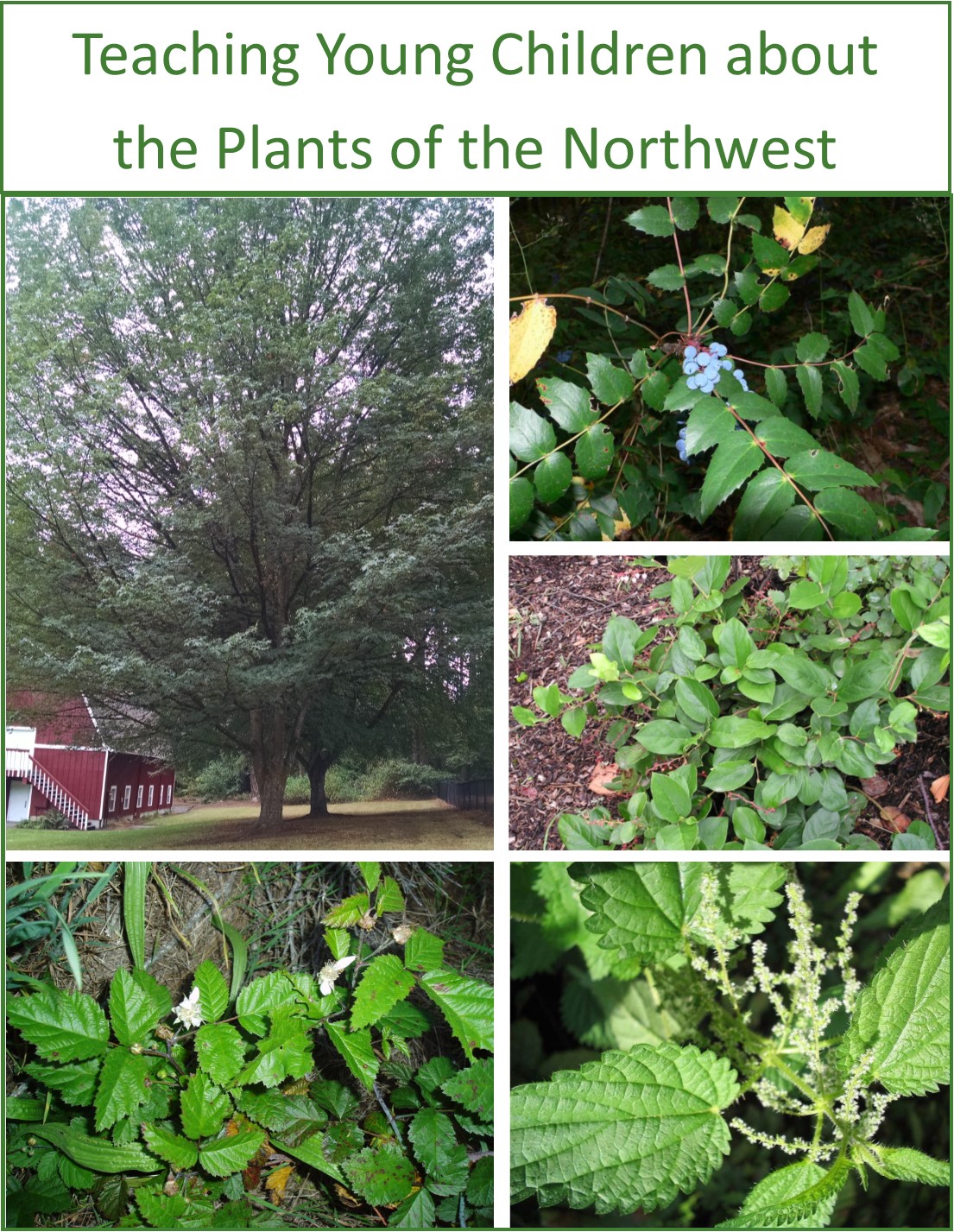
Once a month, our Family Inventors’ Lab meets at Robinswood Park in Bellevue. We go out for a hike in the woods, and we learn about native plants, cycles of nature, insects, habitats and more.

There are plenty of benefits to spending time outdoors, including less vitamin D deficiency, better vision, higher activity. Getting to know local plants helps your child feel more at home in their world, helps them gain a sense of competency (there’s something really fun about being able to identify all the plants they see), teaches vocabulary and science, and teaches observation skills – discerning the difference between a trailing blackberry and a Himalayan blackberry teaches your child how to observe small details, a skill which is helpful in almost all their pursuits!

I found a great song about Pac NW plants, and I added to it to make a really memorable way for introducing preschoolers to 8 common plants – find it and related materials here.

We have a “plant of the month” curriculum and on this page, I’ll share the materials I’ve developed, so you can use them with your family. All of the plants can be found in most of the wooded areas and parks trails in the King County area.

This free printable Plant Guide combines all the plants listed into one guide. Although it refers to Robinswood Park, you’ll see most of these plants on almost any hiking trail in King County.

  • Big Leaf Maple. (PDF)  This is the second most common tree in the Pacific NW, so it’s a great ones for kids to learn because then they can find it everywhere they go. Help them count the points on the leaves – there’s always 5. (A vine maple has many more points.) It’s great to introduce kids to a big leaf in the spring, so they can watch “their” tree go through the changes from buds in the spring, to green leaves, to fall color, to winter. Also help them find helicopter seeds to drop and let spin to the ground.
  • Blackberries. (PDF)  Get to know all your blackberry types: if it trails along the ground, and has clusters of 3 leaves, it’s Trailing Blackberry, which are native to the Northwest. If there’s a big thicket of blackberries with clusters of 5 leaves, it’s the Himalayan blackberry, an invasive species. (If you have some invading your yard, look here for tips on removal.) The Evergreen Blackberry, another non-native, looks very different from the others – its alternate name “Cut-leaf blackberry” describes its unique leaves. All these plants produce plenty of tasty edible berries from July to September.
    • This handout also includes information on Stinging Nettles, so you know to watch out for them in woods. We’re blessed in this area to have few truly dangerous plants or animals in our woods, but stinging nettles can be an annoyance.
  • Douglas Fir. (PDF) Very common throughout the Pacific Northwest. Tall trees with bare trunks for much of the height of the tree, branches full of needles up higher on the tree. Rough bark.
  • Holly. (PDF) Holly can be found in all 50 states, and is common in Christmas decorations and art, so its distinctive spiny leaves and red berries (visible in winter) are recognizable to most people. Its berries are NOT edible! They can make pets and children quite sick.
  • Indian plum. (PDF) A Northwest native flowering shrub. One of the first plants to leaf out and bloom each spring. Also called osoberry for its edible (but not tasty) berries, or skunk bush for the smell of the male flowers (you have to put your nose right up to them to smell them.
  • Ivy. (PDF) English Ivy is not native – it’s an invasive noxious weed – if you have any on your property, its best to replace it with native plants. If it’s climbing your trees, be sure to remove it. Children can easily identify ivy, and you can show them how it spreads across the ground until it finds anything vertical, then it climbs as high as it can.
  • Oregon Grape. (PDF)  Oregon grape is a native plant. Adults sometimes mistake it for holly, but your child should be able to easily learn to tell them apart. The fruit is edible, but far too tart for most people’s taste – some use it in jelly.
  • Salal. (PDF)  Salal is another native plant, with glossy green leaves, which is very common throughout our woods, and in landscaping everywhere. It also produces an edible berry that some people dry to use in cakes, or use in jelly.
  • Vinca. (PDF) A non-native evergreen. The glossy green leaves and purple flowers that bloom for much of the year make this a lovely, low maintenance ground cover.
  • Western Red Cedar. (PDF) Easily distinguished from the common Douglas fir. Branches start much lower to the ground, flat sail-like needles form spray-like branches. Very small cones. Stringy bark that can be pulled off in long strips.

If you’re working with a young child (3 or 4 years old), you want to focus on only one plant at a time. I’ve created postcards which show pictures of just one plant per card. Hand a card to your child to carry as  you hike through the woods, and encourage them to tell you every time they find a plant that matches that card.

Once your child is familiar with many of these plants, try challenging them with a Scavenger Hunt (PDF) – This includes pictures of 14 plants to find in the woods. (For younger kids, you could also use the postcards as a scavenger hunt challenge.)

For older kids (age 6 and up), here’s a dichotomous key they can use to try to figure out what kind of plant they see. You could also use this key as a basis for a 20 questions style game on a hike. (Learn more about 20 questions and what the game teaches here.)

If you want to check out the woods at Robinswood Park, it’s an easy park to start on with young hikers. There’s over a mile of trails, so enough to explore for a little one, but you’re never far from the parking lot. Here’s a trail map, with one of our favorite trails through the woods marked out on it.

Check out this post for links to lots of other great parks on the Eastside of Seattle. And here’s a guide to recognizing the bird calls you may hear.

Enjoy your hikes!

Why We Walk to School

zozowalk-to-school-posterWe live in a safe, clean, suburban neighborhood, three-quarter’s of a mile from the school where my son attends kindergarten. We walk him to and from school almost every day. I wouldn’t think this would surprise anyone. Yet, I’ve had neighbors stop to offer me rides home, then be surprised when I say we choose to walk. I’ve had people assume we must not own a car, or are not able to drive. But no, we choose to walk.

And in the summer, we walk to swim lessons, the park, the library, and out to lunch.

Here’s why we walk [Note: I’ve also made a handout with summaries of this information, called “The Benefits of Walking Your Child to School.”]

For my son:

  • Walking to school can help my son do better in school.
    • Exercise: Kids who exercise pay better attention in school, are less moody, and have better impulse control. (Source, another source, another and another, and a final one for good measure)
    • Time in nature: Spending time outside and connecting to the natural world improves academic performance, ability to concentrate in the classroom, and improves self control. (Source, source, and more info on the benefits of nature.)
    • My son is a very active, squirrelly kid who struggles with impulse control, so I really think that our daily walk is an essential part of his success at school.
  • On our walk, there’s plenty of learning opportunities that don’t happen at school:
    • Nature: Nature provides an always-changing experience on our walks…. and we have time to stop and observe, ask questions, and learn. Yesterday, we looked at these pinecone-like seed pods (I don’t know the name of the plant), which over the past few weeks have been falling to the ground, and then slowly, gradually opening up to reveal bright red berries – we talked about how those berries probably appeal to birds who eat them, fly away, and poop them out, propagating that species of plant. Today, we found a bird leg… just the leg, which led to a conversation about what might have eaten the rest of the bird.
    • Science and Engineering: A few months ago, we got to watch the progress of digging a trench and installing drains and irrigation. Recently, we’ve seen them cut down a large tree (and we got to see the rotted out core, which showed why they’d cut it), then break up the stump, and haul it away. A new development of town homes has provided an on-going experience of the construction industry.
    • Traffic rules and navigation: We get lots of practice at looking both ways before you cross the street – and knowing what you’re looking for and making judgments about whether it’s safe to cross. He’s learned the names of all the streets, and learned about addresses, alternate routes, bus stops, parking rules, turn signals, and more.
  • Teaching a lifelong habit of walking instead of driving: Amongst children 5 – 15, 15% of their total trips are walking. As they get older, it’s 7 – 9%. Source  The more we turn to driving as our default mode, the more our children will do the same. We choose, instead, to role model deciding to walk whenever possible.
  • Social / Independence Benefits: For now, we get a chance to interact some with the (few) other families that walk back and forth to school along our route. Some of the older kids in the neighborhood have a “walking bus” where a group of them walk home together. This gives them a chance to connect with and socialize with these other kids, and also helps them build skills at independently navigating their world.
  • Exercise: He also gets all the health benefits of walking, as described below, plus a reduced risk of obesity.

For both of us:

  • Walking home from school together is a great chance to re-connect and catch up on all the news of the day. If we drive home, it’s about four minutes, and my mind is mostly focused on driving. Walking is more relaxed, slower paced, and doesn’t take much of my attention, so we can be much more tuned in to each other.
  • We also have a good relationship with his teacher, partially because we see her briefly every day at drop-off time and at pick-up. It often gives us the chance for that ten second check in on his day.

For me:

  • Free Exercise. When he started school this fall, and I suddenly had lots of kid-free time on my schedule, I thought of joining a gym. But, based on my past experience, I’m lousy at going to the gym, and I mostly waste the money I’m paying for a membership. Walking is free, with no expensive equipment or specialty clothing required. The only time I ever managed to go to the gym was when I had a scheduled obligation – a class I was signed up to take, or a friend I was meeting. The walk to school means a scheduled obligation twice every weekday – I gotta get the kid to school, and I gotta pick him up.
  • Regular exercise. Plenty or research shows that more short bouts of exercise is better for our heart and our metabolism than a few long bouts. Walking him to school, dropping him off and coming home is 1.5 miles, and about 35 minutes of exercise to start my day. Then, after a day of sedentary work at my computer, I have another 35 minutes. In an average week, I walk at least 12 miles – about four-and-a-half hours of exercise.
  • Healthy Exercise:
    • Healthy for my heart: Walking improves my blood pressure and my cholesterol (Source), and reduces my risk of coronary heart disease and stroke by 34-35% (Source).  It also reduces risk of diabetes. (Source)
      • “Protection [from cardiovascular events] was evident even at distances of just 5½ miles per week and at a pace as casual as about 2 miles per hour.” (Source)
    • Healthy for my brain:
      • “Nine years later, the walkers underwent brain scans, which revealed that those who had walked more had greater brain volume than those who walked less. Four years after that… 116 people showed signs of memory loss or dementia. Those who had walked the most … about 7 miles each week — were half as likely to have cognitive problems as those who walked the least.” (Source)
    • Healthy for my bones and joints:
      • “In just one mile, a typical runner’s legs will have to absorb more than 100 tons of impact force. …walkers have a much lower (1% to 5%) risk of exercise-related injuries than runners (20% to 70%).” (Source)
      • “Healthy postmenopausal women who walk approximately 1 mile each day have higher whole-body bone density than women who walk shorter distances. Walking is also effective in slowing the rate of bone loss from the legs.” (Source)
      • Note: Adding 60 seconds of high impact exercise (running, jumping jacks, jogging up stairs, or sudden backwards steps) to a walk will further strengthen your bones. (Source)
    • Reduces risk of breast and colon cancer (source). I have a family history of both.
  • Efficient use of time: For picking him up at 3:30 in the afternoon, it honestly takes the same amount of time to walk as to drive. Driving there takes about 4 minutes. But… if I want to find a space in the parking lot, I have to leave the house at 3:10. Then I sit in the parking lot for 15 minutes, then pick him up, then drive home… 35 – 40 minutes round trip, just like walking. If I’m too late for a parking space, I have to get in the giant line of cars to pick up. Again, about 35 – 40 minutes round trip. And here, my time is doing double-duty for exercise and kid pick-up.
    • “Because walking is less intensive than running, you have to walk for longer periods, get out more often, or both to match the benefits of running. As a rough guide, the current American Heart Association/American College of Sports Medicine standards call for able-bodied adults to do moderate-intensity exercise (such as brisk walking) for at least 30 minutes on five days each week or intense aerobic exercise (such as running) for at least 20 minutes three days each week. That makes running seem much more time-efficient — but if you factor in the extra warm-ups, cool-downs, and changes of clothing and shoes that runners need, the time differences narrow considerably. Add the time it takes to rehab from running injuries, and walking looks pretty good.”  (Source)
  • Time to listen to podcasts! When I’m walking alone, I get a chance to listen to some of my favorites /Filmcast, NPR Politics, Pop Culture Happy Hour, Vinyl Café, the Moth.
  • Walking also improves your mood, and reduces depression. (Source, Source)

For my marriage: My husband and I are often able to walk together in the morning. This gives us connection time with our son on the way to school, and with each other on the way home. Sometimes we use that connection to catch up on family business, sometimes to have deep conversations about how we’re doing emotionally or relationship wise, sometimes it’s catching up on politics and world news, and sometimes it’s picking each other’s brain for help solving a problem one of us is working on. Just having that slow-paced, in synch time together is a lovely way to start the day.

For the environment and my community:

  • 28% of all car trips in America are less than one mile. (Source) When people travel a distance of 1 – 3 miles, 90% use a car. (Source)  Many of these short trips are about driving kids to school or activities. And that’s hard on the environment.
    • “Emissions from cars are greatest when an engine is cold. The first few minutes when you start up and then drive your car produces the highest emissions because the emissions control equipment has not yet reached its optimal operating temperature. On a cold day a petrol car may take up to 10km [6.2 miles] to warm up and operate at maximum efficiency. One of the best ways individuals can contribute to reducing air pollution is to leave the car at home for short trips and walk instead.”  (source)
    • “Transportation accounts for 26% of greenhouse gas emissions, and passenger cars are responsible for the majority, more than 60%, of those emissions.” (Source)
    • “If a family walks to school twice a week rather than driving, they can reduce their carbon emissions by 131 pounds each year… If half of the students at an average-sized elementary school choose to walk… [saves] 36 tons of greenhouse gas emissions a year…. equal to the carbon removing abilities of 1,000 trees.” (Source)
  • When we walk, we do little things to help the community: pick up litter when we see it (impressively rare on our stretch of road), move away leaves that are clogging the storm drains, fix the lost cat sign that’s falling off the pole, pick up a trash bin that was knocked over in the wind. They’re little things that take a few seconds when you’re just walking by, but would never happen if everyone drove by.

Barriers to walking to school (Source) – and how to overcome them

About 55% of children travel to school in a private car. (Source) Some of these children may live far enough away that they have the option to take a bus but are choosing to drive. But many of them are children who live within what is considered “walking distance” from a school. What stops the families from walking?

Barrier Percentage of parents
Distance to school: 61.5
Traffic-related danger: 30.4
Weather: 18.6
Crime danger: 11.7
Opposing school policy: 6.0
Other reasons (not identified): 15.0

(Centers for Disease Control and Prevention [CDC], 2005)

Distance to School

In 1969, 48% of elementary school students walked or biked to school. In 2009, it was just 13%. Yes, some of that is because fewer kids live less than a mile from their school (31% now vs. 41% in 1969). But, even amongst those who live less than a mile away, only 35% usually walk or bike now vs. 89% in 1969. (Source)

What if you don’t live in walking distance from your school? Consider parking half a mile away (or a few blocks away) and walking in! Many schools (at least in the Seattle suburbs) have walking paths through nearby neighborhoods that keep you off busy streets. (And then you won’t have to deal with the crowds in the school parking lot / the long line up of cars.)

Traffic Danger

First, it’s worth noting that a big part of the traffic load is people driving their kids to school…. “Parents driving their students to school comprise 10 to 14 percent of morning rush hour traffic (McDonald, Brown, Marchetti, & Pedroso, 2011).” If more people were walking their kids to school, there would be less traffic – especially in school zones.

Second, driving is not necessarily safer than walking. Motor vehicle accidents are one of the leading causes of death.

As more and more people drive, and fewer and fewer people walk, city budgets focus more on roads than on sidewalks and pedestrian safety. Be an advocate in your community for making your neighborhood pedestrian friendly!

We used to live in Bellevue, the city right next door to Kirkland. Hardly anyone walks in most parts of Bellevue. Lots of people walk in our part of Kirkland. That means that drivers in Kirkland remember to watch out for pedestrians vs. people in Bellevue don’t bother. The more people who walk, the safer it is to walk.

You can also increase safety while walking by choosing high visibility clothing for your child – like a red coat with reflective stripes instead of a black coat.

Weather. I’ll confess – Of the few times we’ve driven to or from school this year, half were for weather. I don’t mind walking in drizzle to mild rain. (I live in the Seattle area – that’s our normal everyday weather.) But this year, we’ve had some times (weird for Seattle) of POURING DOWN RAIN. One happened when we were walking back from school… by the time we got home, we had to hang the coats to dry, change our pants, shoes, and socks. I was glad that hasn’t happened on my son’s way TO school, where he wouldn’t have spare clothes to change in to. So, there are days when the weather seems too bad to walk.

But, most days, it’s just a matter of choosing appropriate clothing and footwear for the weather. My son attended outdoor preschool for two years, where he would be outside for 2.5 to 3 hours straight, so we’re used to dressing appropriately. And yes, it’s possible even if you live in a colder climate than Seattle. There’s plenty of outdoor preschools in Scandinavian countries with much colder winters. Getting good outdoor clothes can be pricey, but just think how much money you save on gas, wear and tear on your vehicle, and on a gym membership by walking!

Crime Danger: Clearly, there are neighborhoods where it is risky to walk through. (Unfortunately, those are often also the same neighborhoods where parents have no other option than having their child to walk to school.)

For the majority of American neighborhoods, the risk of crime is not that high, especially in the hours when you would walk a child to and from school. Although many people believe that the world is a “more dangerous place than it used to be”, statistics actually show that the rate of child abduction by strangers has stayed stable over the past 20+ years.

One way to increase safety is to travel in a group. Some neighborhoods organize a walking train, where there’s an adult “engine” leading the way, and an adult “caboose” at the end, making sure all the kids in the middle stay safe.

School Policies: Some schools place limits on children walking to school, or on children arriving at school unaccompanied. If this is true of your school, talk to the administration to learn more, learn what the options are, and advocate for any change you believe would be beneficial to the families at your school.

Physical condition: Although this wasn’t in the top 5 issues in the survey, I imagine this is a barrier for many. My husband’s foot was injured for the past few weeks by too many dance performances in a short period, so he had to take a few weeks off from our walk. But, if you have physical limitations, walking may actually be one of your best ways to get active. I have one leg and use crutches to walk, and walking on the sidewalk works great for me, but treadmills, ellipticals, and lots of other specialized exercise equipment is completely unusable for me. For my parents, who are 80-something, walking and going up and down stairs are the main exercises they are still able to do. If your physical condition prohibits long walks, can you fit in a few short walks outdoors each week with your child?

Schedule: Sometimes a parent’s work schedule means that walking is not feasible. For example, a few mornings each month, I need to be at work across town 20 minutes after I drop off my child at school. I have to drive on those days, because I don’t have time to walk back home and pick up my car, and then drive. If this is your situation, ask your manager whether there’s any possibility of making a slight adjustment to your work schedule, or consider talking to neighbors about a walk-pool / walking bus, where you take turns being the grown-up walking the kids to or from school.

What do YOU do? What could you do?

I’d like to hear from others… do you walk your child to school and other activities? If so, why – what are your favorite benefits? If not, why not – what are your barriers?
Play-Dough Recipe

playdough

Our students are often surprised to discover we make all our own play-dough. I tell them: you should make all your own play-dough!! It’s cheaper, it’s a much nicer texture to work with, and shapes much better than commercial PlayDoh. It also doesn’t dry out as quickly. Plus, I hate the smell of commercial PlayDoh… when you make your own, you can leave it unscented – my preference – or you can add scents with a few drops of essential oils or some spices. And making a batch takes only 15 minutes from start to finishing clean-up… or a little longer if your little one “helps.”

There’s LOTS of recipes out there. Here’s the one that works well for me:

Recipe 1

Boil 2 cups water (you’ll use just 1.5 cups to start with, but may add more later)

Mix together: 2 cups flour*, 1 cup salt, 2 tbsp. cream of tartar, 4 tbsp vegetable oil (note, 4 tbsp. is the same as 1/4 cup)

Mix in separate container: 1.5 cups of the boiling water plus food coloring – make the color STRONG! (If you use Betty Crocker Gel you’ll need 1/3 – 1/2 a tube in a batch)

Mix the colored water in with the other ingredients. Stir well. (If it’s still really sticky, you can stir in more flour now.) 

When it gets too hard to stir in the bowl, it’s time to knead. I knead in the bowl, but it’s likely easier to: spread a thin layer of flour on a counter or cutting board. When it’s cool enough to touch, place the dough on that and knead it. What you’re trying to do is create  good, consistent dough that’s just the right texture for kids to play with. If it’s sticking to your hands, add a little flour. If it’s too dry and crumbly, add a little hot water. (It’s a little different each time – if the weather is really humid, or really dry, that affects the dough.) Knead till it’s just right. Usually takes a few minutes. Then it’s ready for play!

When not in use, store in a ziplock or a closed plastic container. It keeps for weeks or months, depending on how frequently it’s used.

*Note: the recipe calls for 2 cups of flour but you mix in more later, so make sure you have a little extra available before you start!

Recipe 2 – A recipe my co-teacher Cym likes has slightly different proportions / ingredients, but the process is the same.

3 cups flour, 1 cup salt, 2 tbsp. corn starch, 4 tbsp. cream of tartar, 1/4 cup vegetable oil, 2 cups boiling water, food color.

Cloud Dough

While I’m sharing recipes, another Cym recipe that we use a lot is her cocoa cloud dough. Mix together 1.5 cups flour, 1/2 cup cocoa powder, and 1/4 – 1/2 cup of any edible oil (canola oil, safflower… whatever you’ve got.) For a big batch, 6  cups flour, 2 cups cocoa, 1 – 2 cups oil. How much oil you use depends on the texture you want. We use this in the sensory bin to simulate dirt so we want it pretty crumbly (it looks like dirt, but it won’t hurt any little ones who decide to eat it! and it smells good. See pictures on my other blog, Inventors of Tomorrow, here and here.) If you want to shape it more, use more oil.

Learn more about cloud dough at Babble Dabble Do.

Using Play-Dough

You can play with play-dough directly on most tables, but if you’re worried about your table, you can put out a plastic tray, place-mat or table cloth to play on.

In class, each week, we put out new tools with the play-dough. Using a variety of tools teaches small motor skills, strengthens hand muscles (helpful for learning to write), and teaches life skills. Here’s just some to try: rolling pin, cookie cutters, garlic press, a plastic knife, kid scissors, spatula, pizza cutter, pastry cutter, melon baller, wooden hammer, napkin rings (can cut circles of play-dough), a cup or container they can press down on dough to flatten a circle of dough, rubber stamps to press impressions in the dough. You can also mix other toys in with the dough – like plastic animals to leave footprints in the dough, toy trucks to leave tire tracks, shapes from a shape sorter tray, etc.

Problem Solving at the Adventure Playground

Update 2026; In a separate post, I told all about the Adventure Playground on Mercer Island, which sadly no longer exists. In this post, I want to share a few stories from our long ago trip there to illustrate some of the learning opportunities it presents.

Responsibility for Others

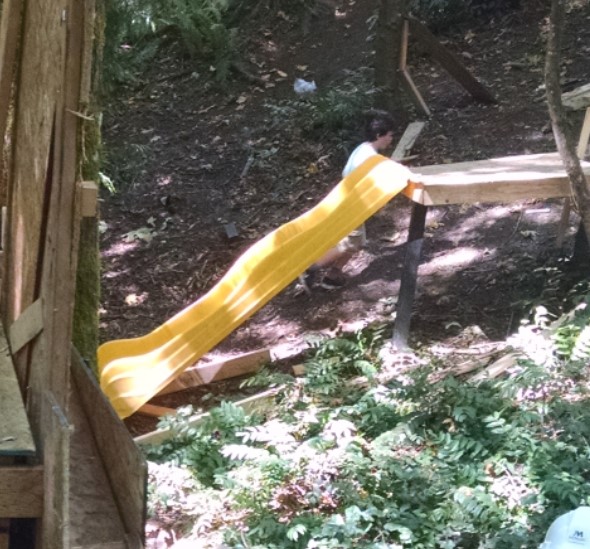
We visited with our son, who is five. He saw this slide in the distance.

slide

He immediately ran over to play on it. There was an older boy there – maybe 10 – 12. He warned my son – “be careful, it’s not stable.”

The boy had started to remove the nails that were supporting the slide, because his family wanted to move it over to a more stable platform that they were working on.

APFamilly

My son was very sad about not being able to use the slide. The older boy told him he’d fix it – he pounded back in the nails he had just pulled so my son could use the slide. I told my son I wasn’t sure it was safe, because the bottom of the slide was propped precariously on a couple boards, with some loose boards just beyond the slide. I asked him to slow himself down on the first time down the slide, and once we knew it was reasonably stable, we cleared away the loose wood, and let him take 3 full speed slides, then we moved on so they boy could return to his work of re-locating the slide.

I thought this was a great example of a tween who was paying attention to and looking out for younger children. He knew that with the joy of risky play that the playground offers, we also have responsibility to keep others safe. And he knew that in a communal space, sometimes you change or pause your plan to make sure other kids are having fun too.

Risk Assessment

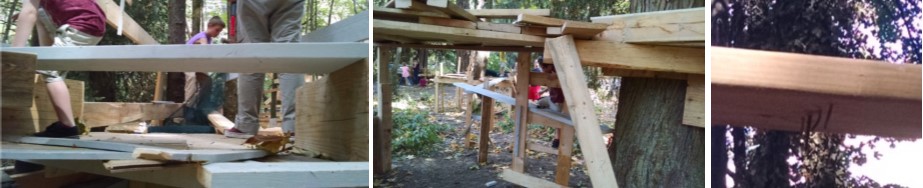
At a typical playground with mass produced equipment, it’s all been carefully designed and tested to be as safe as possible. That’s not the case at the adventure playground! This stuff was all knocked together by kids! It was a good opportunity for my 5 year old to learn how to watch out for hidden dangers: he learned to test for wobbly boards before going onto a platform, to be careful to stay in the center of high platforms without railings, and to look for protruding nails before going under something (note the third picture below, which has a random cluster of nails poking down in the middle of a board, for no real reason… this is at about head height for an adult.)

dicey

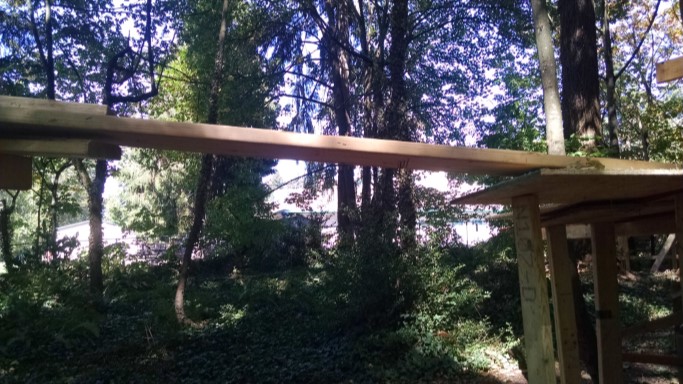
My son found one “balance beam” catwalk he really wanted to cross. It was about 6 – 8 inches wide, which would normally be easy for him. But it was also 5 feet up in the air. He was wise enough to realize this was not a good thing for him to attempt.

no rail

Problem-Solving / Engineering

My son wanted to make the “bridge” wider so it was safer to cross. But, we looked at the support platforms at each end, and there was just no way to make it work.

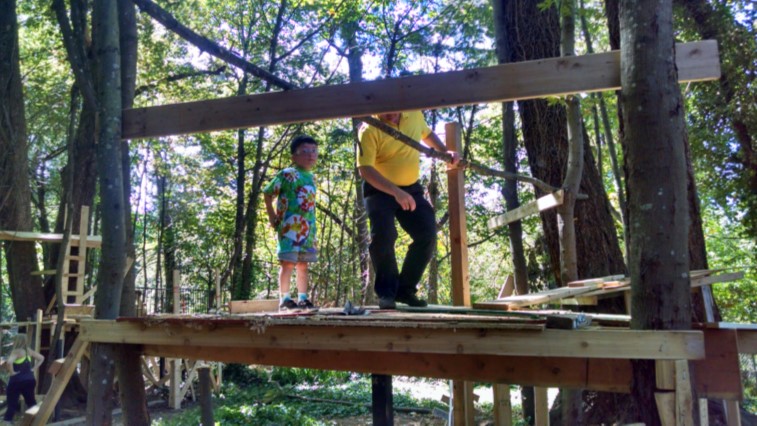
I suggested a hand rail, which he could use to stabilize himself, and he liked that idea. But this was a long span (8 feet?). We searched around and realized it was longer than any of the planks that were available. We thought about a rope handrail, but didn’t think it would provide enough stability. Then we looked around on the ground and found a really long branch. Perfect!

My husband, my son and I worked together to lift the branch up high. We were able to brace it in multiple places on tree branches. Then we scavenged for some ropes to tie it in place.

installing

Then, my husband tested it, then made some minor adjustments, and then my son got his chance to cross the bridge – it’s a success!

railingtest

This was a fabulous example of the engineering process in action: find a problem, brainstorm solutions, test available materials, build a prototype, test it, refine it – the problem is solved! My son learned a lot in the process, and was very satisfied with the results. The idea that he could help build something big and real that other kids could use was very empowering to him.

Taking Ideas and Improving Them

We walked around and played on other people’s structures for a while, and my son found this swing:

floppy swing

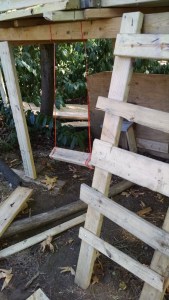
He is a huge swing fan, so couldn’t wait to try it. But it was a big disappointment. Instead of hanging flat, it tended to tilt up to 45 degrees forward and basically dump you off of it. It also didn’t have much of a swing radius.

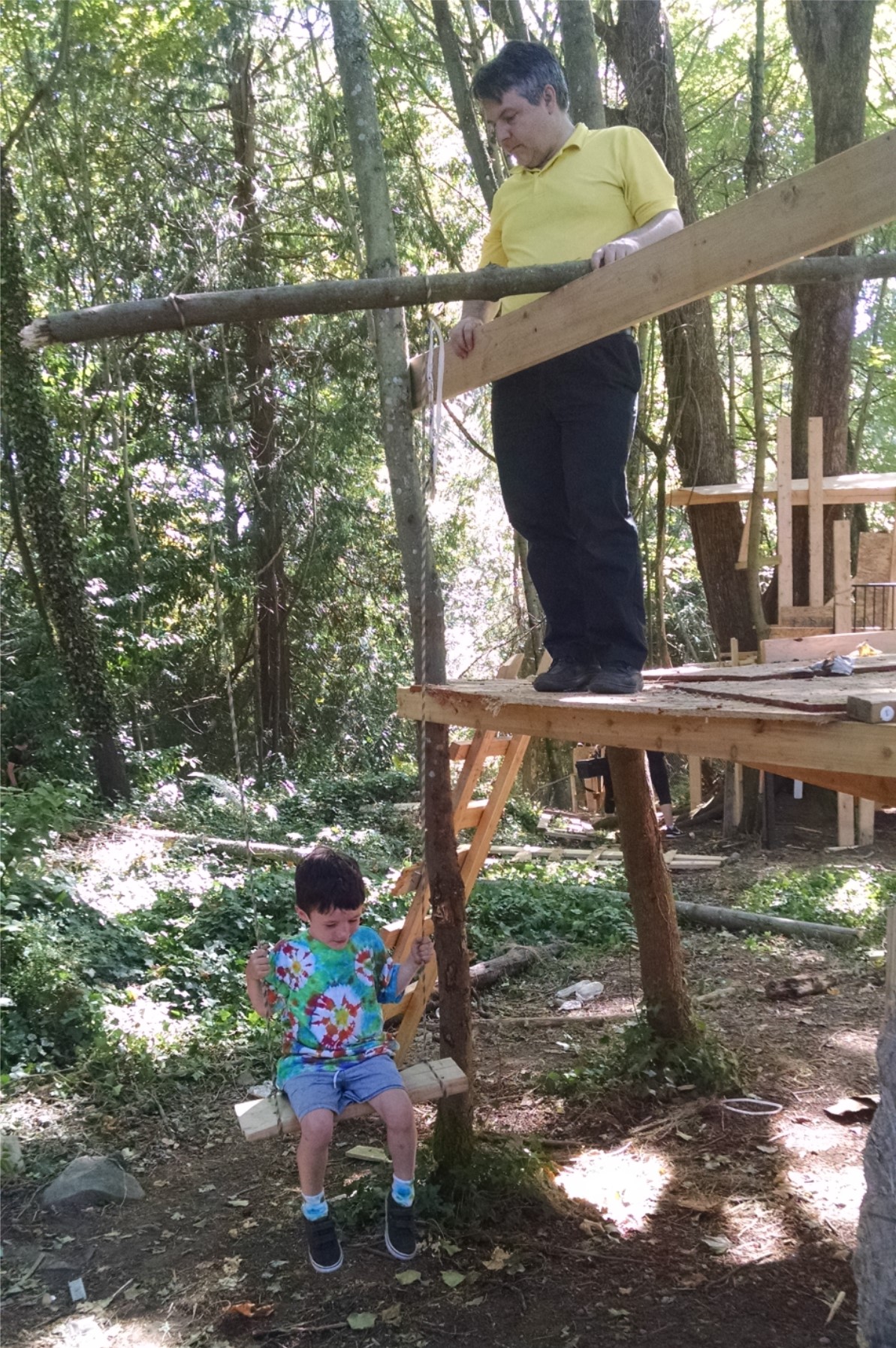
We decided to build our own swing. We went back to the platform where we’d added the handrail. The handrail branch was so long that about 3 – 4 feet of it hung off over the end of the platform, at the perfect location and height for a swing support!

But, we’d installed it with the skinny end of the branch at that end. So, we uninstalled our handrail, flipped it over (tricky to do with a branch that must have been 15 feet long or more) and re-installed it with the fat end hanging over the end.

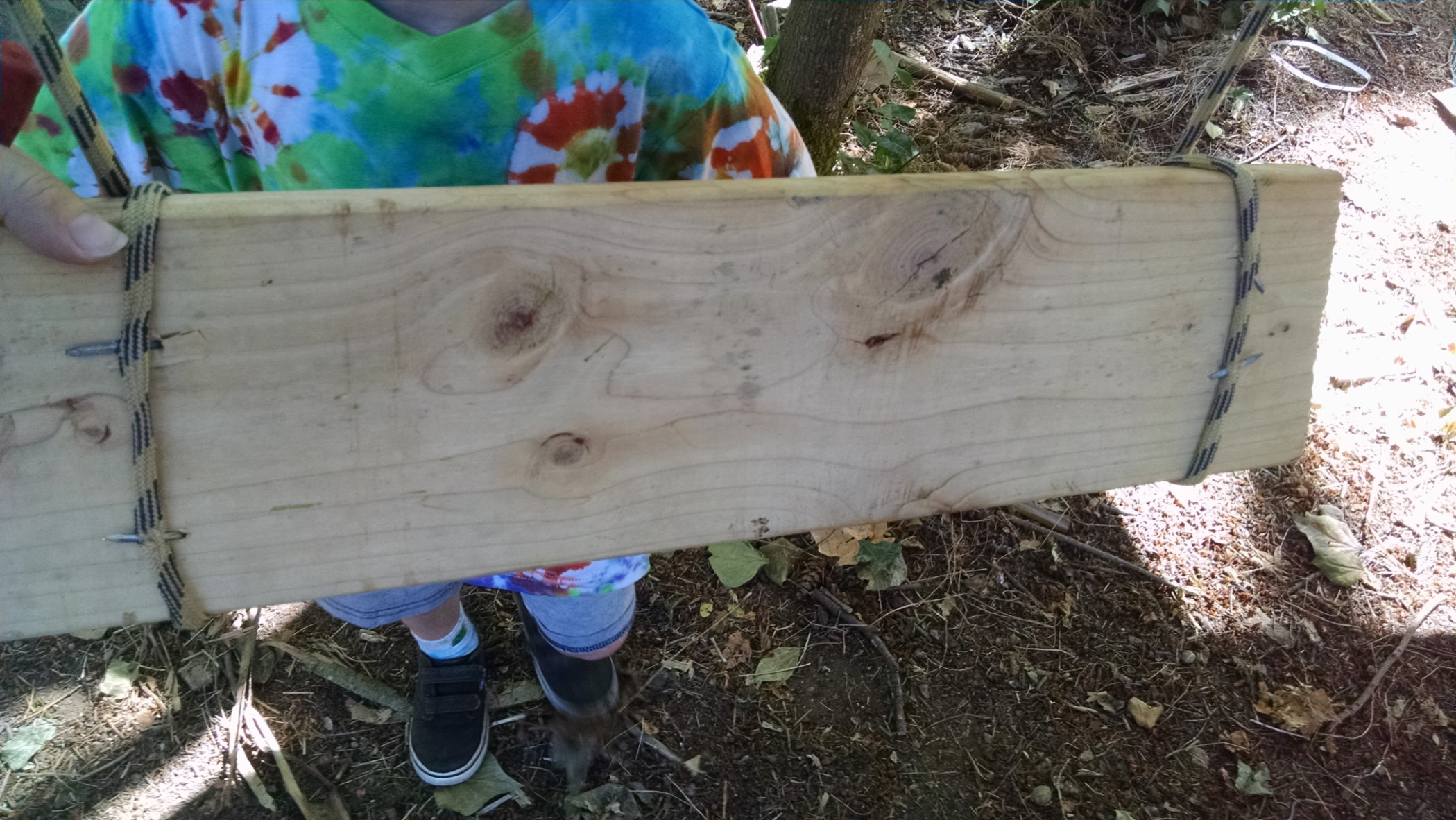
We found rope and a board for the seat, and started to build a swing. The board had four nails pounded through it, near each of the four corners – I started to take them out, but then realized that we could use them to stabilize the swing. So, as I tied the rope around the board, I poked the nails through it, then pounded them down to hold them in place.

board nails

Stringing the swing up was a little tricky, because we didn’t have any scissors, knife, or anything to cut the rope with, so it had to be one continuous loop. Once it was installed, again, my husband tested first, figuring if the swing could hold his weight, it was safe for kids. The branch support wobbled back and forth a bit as he swung, so we found some straps to tie it down better, then my son got to test it. Another building success!

swing installation
swing test


Because my son is such a huge fan of swings, he was so excited that we had built a swing together! He shouted to the kids who were working nearby to look at it. He ran over to some other kids to invite them to come try it out. But they were busy working and didn’t come, so he came back and tested it more. A grandma who was supervising those kids came over and checked it out and shared my son’s excitement with his creation.

Competence and Empowerment

We saw similar excitement throughout the adventure playground, and lots of kids who were glowing with the empowered satisfaction of having BUILT SOMETHING.

names

Modern American kids don’t get a lot of experience with making real things, although they may do virtual building in Minecraft for hours.

These kids all built real structures that they could climb on and play on, and they felt competent, powerful, creative, bold. That sense of accomplishment is the best thing about the adventure playground, I think. And it’s something they carry out of the playground to increase their confidence at taking on other tasks.