Category Archives: For Professionals

Ages & Stages Questionnaire

How ASQ works

The Ages & Stages Questionnaire, or ASQ, is simply one of the best tools available for developmental screenings of children from birth to age 5. It has been in development for about 40 years and tested by tens of thousands of participants.

You can purchase questionnaires, or it is now available as a free* online screening tool at https://osp.uoregon.edu/home/checkDevelopment.  A parent may complete it by themselves, or it can be done with a professional. (Parent educator, social worker, child care worker, physician…)

Completing the questionnaire

First, you choose the correct questionnaire for the child’s age: they’re in two month increments for the first two years (2 months, 4 months…. 24 months), then every 3 months (27, 30, 33, 36), then every 6 months (42, 48, 54, 60).

The parent fills out the questionnaire. It asks six questions in each of five realms of child development: communication (what child understands and what they can say), gross motor (running, climbing, throwing), fine motor (hand and finger coordination), problem solving, personal-social (self-help skills and interactions with others).

The form asks simple questions, like “If you point to a picture of a ball (kitty, cup, hat, etc.) and ask your child, ‘What is this?’ does your child correctly name at least one picture?” The parent answers the questions yes, sometimes, or not yet. They are encouraged to try things out with their child as they go through the questionnaire, so they can see what their child’s abilities are for sure.

There is an additional optional questionnaire called ASQ:SE which assesses social-emotional development, such as autonomy, compliance (ability to follow directions), adaptive functioning (sleeping, eating, toileting), self-regulation, emotional affect, interaction (ability or willingness to respond to others), social communication.

Results (and how they’re calculated)

With the online questionnaire, the parent receives a report which lists which categories their child is “on schedule” with, where they should “monitor” and if there are any categories where the child is “not on schedule.”

To give professionals a little more insight into the calculations that lead to these categorizations: The results are scored 10 points for every yes, 5 for sometimes, 0 for not yet, so a maximum of 60 points per category. On the written test, you would then tally it on a table similar to this:

tally

If the child scored as we would expect for a child of this age (on the example above, this would be a score of 40 or higher on problem-solving, shown in the white/un-shaded area of that row), then the child’s development appears to be on schedule. If they scored close to the cut-off (in the gray area, shown as 35 or 40 points on the personal-social row), that would be something to monitor. If they score below the cut-off (a unique number for each category of each questionnaire), then further assessment by a professional is recommended.

This is a screening tool, not a diagnostic tool. If all looks well for the child (all scores are in the white area or the online tool says “on schedule”) then we can be assured that they are likely well on track. If they’re in the gray area / “monitor”, then we ask more questions to figure out why. If there’s a good explanation, then the score probably is not a cause for worry, but you could recommend adding activities to build the child’s skills in those areas and re-screening in a few months. If they’re in the black area / “not on schedule” consider referrals to more resources. The Oregon website offers this helpful ASQ Review Guide to help you determine next steps.

These videos for providers offer more information about how to use the ASQ with parents.

Follow-Up

It’s most effective when this tool is used as the beginning of a conversation with parents. After completing the tool, what do they see as their child’s strengths? Do they have any concerns about their child’s development? Did the screening reduce those concerns (they discovered the child is actually on track) or increase them (child is shown as monitor or not on schedule)? What are some next steps they can do to help their child’s development?

On my post for parents about how to complete the ASQ, you can see how I talk with parents about interpreting their results – whether to worry, how to seek help, etc.

If they completed the online questionnaire, their emailed test results will include links to age appropriate learning activities and play activities.

* The screening is free for parents. Since I know the ASQ is a product that is sold, and is fairly pricey, I wanted to be sure I wasn’t violating copyright by promoting use of the online tool. The website is for the Oregon Screening project, so  I have looked for legal terms on the site to see whether they limit its use to Oregon residents or in any other way, and all I have found is “This site is open to all parents of children ages 1 month up to 72 months.”

The screening is also available free at Easter Seals: www.easterseals.com/mtffc/asq/. I prefer the Oregon screening project, because Easter Seals asks for all of the family’s contact information and will add them to their mailing list.

Fun with Toddlers: Sensory Play

img_20140522_095756848.jpg

A sensory bin is a simple toddler play activity: take a plastic tub, fill it with rice (or another filler), add scoops and containers to pour into (or other tools) and a few of your child’s small toys, and let your child play. The benefits for your child are: learning to use tools, using fine motor skills, and sensory exploration. The benefits for you are that your child will play independently for quite some time while you get other things done! (Expect some clean-up time when you’re done!)

Learn all about sensory play in: The Ultimate Guide to Sensory Play.

Teaching Math Skills

See the source image

Let’s talk about math…

When we talk about which skills kids need to succeed in school or in the work world, reading and math are always at the top of the list of “most important things to know about.”

If you ask parents what they do to teach their kids to read, they will say: we do bedtime stories every night, we go to the library, we practice reading signs, menus, and labels – they have a whole list of ideas. If you ask them what they do to teach their child math, many parents draw a blank or they protest that they don’t know how to teach math, and they’re counting on preschool and school to do that.

Can we instead think about easy ways to incorporate math into everyday interactions and play just as easily as we do reading? I(‘m not talking math drills and flash cards and pushing academics here! I’m talking about playing with numbers like we “play” with words and stories.)

Here are some opportunities and resources (click on the links to learn more):

Hands-On Activities to Teach Core Math Skills

  • Counting / Number Sense
    • You can count almost anything – how many blocks in your tower, how many goldfish crackers on your plate, how many books do we get at the library
    • You can ask: who has more? Divide objects into two piles – which is bigger?
    • Set the table – each person gets one plate, one spoon, five berries, etc.
    • Count money – it’s trickier to get the different values of different coins.
  • Representation – recognizing that the numeral 5 and the letter f-i-v-e can be used as symbols to represent how many physical objects you have
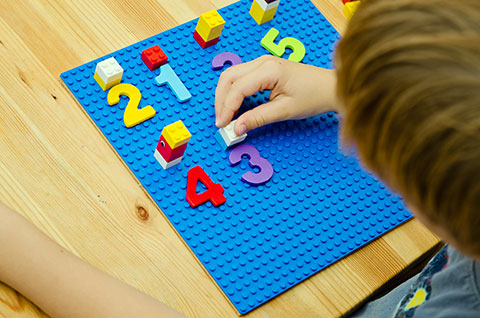
    • Play with magnetic numbers, assemble puzzles with pieces shaped like numbers, make numbers with play-dough, draw numbers in the sand
    • Do connect the dot puzzles, do physical games where they have to jump from the paper numbered one to two to three
    • Make number cards with the numeral and word written on them. When you count physical objects, have them find the card the shows the total.
  • Shapes and Spatial Relationships
    • Play with shape sorters, puzzles, nesting cups, blocks, building toys. Make crafts.
    • Talk about (and play games with) positional words: under, next to, between…
  • Measurement
    • Cook together, using a recipe.
    • Compare things: line up in order by size.
    • Measure with standard units (8 inches) and non-standard (12 paper clips long)
  • Patterns
    • Help them notice sequence: first we do X, then Y. After ____, we always _____.
    • Sort laundry and pair the socks. Separate M&M’s by color, then make a pattern.
    • Build patterns: red bead, yellow bead, red…  Clap rhythm patterns.

For lots more hands-on ideas, just search pinterest for preschool math activities! Or go to https://childcare.extension.org/young-childrens-developing-math-skills/

Sing Counting Songs and Read Counting Books

  • Math Songs. Counting songs like 5 Little Monkeys jumping on a bed, or 10 Little Indians, or 5 Little Ducks are all great teaching tools, especially if you have props. A bath-time game with 5 rubber ducks can teach one-to-one correspondence plus the concept of zero (no little ducks came back…) You can find a huge collection of math songs for all ages at www.songsforteaching.com/numberscounting.htm

Turn (almost) any conversation into a math conversation: Check out the blog http://talkingmathwithkids.com/ It has examples of math concepts into conversations with kids in an engaging way. More ideas: https://bstockus.wordpress.com/talking-math-with-kids/ and http://prek-math-te.stanford.edu/overview/math-thinking-conversations.

Bedtime Math: Every night, before or after the bedtime story, add in a math story problem.

You could make up your own. They could be based on your day (“Today at dinner, there were 8 slices of pizza. You ate two, and I ate three. How many did Dad eat?”). They could be based on the book you just read. (“The Cat in the Hat is holding a book, an umbrella and a fish bowl. How many things is that?” “How many pieces of fruit did the Very Hungry Caterpillar eat?”

Or, you can download the Bedtime Math app (it’s free!) or buy a Bedtime Math book if you prefer a screen free option. They offer a new kid-friendly story problem every day, with questions appropriate for three different levels of math skills, for kids age 3 – 9.

Sports are a fabulous way to practice math skills. For younger kids, keep the score simple – one basket equals one point. For older kids, make the scoring more challenging: “if you can sink the sock in the laundry basket from here, it’s 1 point, but if you can do it from this line, it’s 3 points.” When watching sports in person or on TV, have your child keep a written score tally.

Restaurant Games: When waiting for your food, try these games. Hide 2 – 5 sugar packets behind your menu. Lift the menu to briefly show them the items, put it back down, and ask how many they saw. Tap on the table 1 – 6 times, and have them set out that many packets. “There are four blackberry jams, two strawberries, and a marmalade – how many total?”

Board games are my favorite math skill builder. They’re so much fun that kids don’t notice their learning math. Research shows that the more board games that a kid played and the more different settings he played games in, the better his performance in four math tasks.

Let them see you using math. Point out to your child when you use math – to calculate a tip, compare the cost of two items, figure out how long it will take to drive somewhere, or to help them decide what to buy with their allowance. (For a discussion of financial literacy for kids and how to handle allowance: https://gooddayswithkids.com/2016/02/09/financial-literacy/)

What Not to Do:

  • Don’t feel like you need to get flash cards, math apps and workbooks and drill basic math facts over and over. Let math be fun at home, not a terrible bore.
  • Don’t try to push kids along faster – push them deeper – rather than moving on to the next step on the math skills checklist as fast as you can, make sure you’ve really explored each step in depth first. For example, some parents want to toddler to count to 20, so they push them fast. It takes a long time for a toddler to really truly understand the difference between one and more than one. And then to understand the difference between one and two, and more than two. Let them stay there till they really get it, and then they’ll be able to master more complicated ideas in the future. But rush this one, and everything is confusing from there on out!

My other blog, Inventors Of Tomorrow, is about teaching STEM skills to kids. I have more details there. Start with the post on developmental stages of math learning.

Making Music: How it Benefits Early Learning

When parents attend our parent-child classes with their children, they may think of the songs we sing at circle time as one of the fun and enjoyable parts of class, but they may not realize just how much important learning is going on. When children actively participate in making music (whether that’s a baby bouncing to rhythm, a toddler shaking their bells, a preschooler singing along, or an elementary age child playing an instrument), here’s how they benefit:

Music Skills: Of course, they begin learning musical skills, such as rhythm, varying tempo and pitch, and how to echo back what they hear. They learn to use their singing voice and play instruments.

Auditory Processing: They learn how to listen. Children who have music lessons respond to sounds more quickly, distinguish between sounds, and pay attention to sounds, all of which aids in learning.

Language: When listening to and singing songs, there’s lots of language learning. They learn to hear the rhythm of language, the break between syllables and words, hear and predict rhymes, work on pronunciation, and get exposed to a wide ranging vocabulary – from the water spout the spider climbs up to the pockets full of posey and the fleece on Mary’s lamb. Singing the alphabet song and singing about 5 little ducks who went out one day teach letter and number sequences.

Vestibular Development: With babies and toddlers, when we hold them in our arms while we dance, or hold them in our laps for lap songs, like the Grand Old Duke of York, all that bouncing up and down, swaying side to side, and even flipping upside down helps to develop their vestibular system – the system that helps them to balance and know their position.

Large Motor: When kids dance, clap, swing their arms, roll arms to Wheels on the Bus, shake the shaker or bang the drum, they’re learning large motor movements – new ways of using their bodies.

Small motor: As children learn to use more sophisticated instruments, starting with triangles and rhythm sticks, moving up to keyboards, and then stringed instruments or wind instruments, they develop precise fine motor skills. They can then apply these in lots of other areas of life.

Steady Beat: By the age of 3 or 4, children should know how to keep a beat, but most do not. Steady beat helps with a huge array of physical tasks which are easier and/or more effective with rhythm: walking, dancing, dribbling a ball, rowing a boat, typing on a keyboard, cutting vegetables, jumping rope, cutting with scissors and much more. Also, research shows kids with the ability to keep a steady beat pay attention for longer periods and do better in school.

Keeping Time / Math: Music enhances brain development in areas tied to counting, organization, time, and division of larger notes into smaller notes (i.e. fractions).

Impulse Control: When we take our shakers and we “shake and we shake and we shake and we stop”, kids are learning impulse control and following directions. How do we stop doing something when told to stop, and how do we wait till we’re told it’s time to start again? These are key skills for success at school and life.

Predicting what comes next / pattern recognition: When you sing the same song to your child over and over, they learn to expect what is coming next… “After mom says ‘with a one step, and a two step’ she’s gong to tickle me!” This helps them learn to understand cause / effect, and routines.

Emotional Intelligence: In Brain Rules for Babies, John Medina describes how when a child learns to recognize different musical tones, they also learn to recognize different emotional tones, and can tell more about how others feel. Young babies who were exposed to music classes had improved communication: more likely to point to objects, wave goodbye, smile, and show less distress.

Attachment: Music can foster emotional attachment. Even when babies are still in the womb, music can be a way to make a connection – they will respond to your voice. After birth, your family’s songs start becoming familiar and recognizable, and a part of their safe and secure environment.

Tradition: Music is a unique and powerful way for children to connect to their roots. An African-American spiritual, a Yiddish or Irish lullaby, a Mexican folk song… all introduce a child to the family’s heritage in a way that goes beyond words or pictures.

Routines / Transitions: Familiar songs create a sense of comfort for a child. No matter where you are, you always have access to this same familiar tune. Many parents and teachers learn the value of songs for reinforcing routines (“this is the song we always sing at bedtime”) and signaling that it’s time to transition from one activity to the next (the cleanup song!).

Memory: Research has shown that children who’ve taken music lessons have a better ability to repeat back and to remember what they hear or read. Teaching information in a song form also makes it easier for kids to remember – make up a little song to help them memorize your phone number!

Practice group skills: Sitting at circle time, listening to the teacher, participating when asked, figuring out when they’re supposed to just sit quietly (and learning how to just sit quietly!), starting an activity when all the other children do and stopping when they do are all important steps in school readiness.

IQ and academic success: Research has shown that children who participate in music lessons have higher IQ’s, do better in school, and score better on standardized tests. The more years of music lessons they take, the better they do.

Fun: One of the biggest reasons we have music in our classes is because it is fun! Making music with others gives us all joy. The smiles and giggles in music time delight parents, children, and teachers.

Resources I’ve compiled

Other Resources

  • King County library – videos of librarians singing 100’s of classic children’s rhymes. http://kcls.org/content
  • Jbrary – a YouTube channel featuring children’s librarians singing songs, lap songs, and finger rhymes from library story times: www.youtube.com/user/Jbrary/videos.
  • Nancy Stewart – lyrics and .mp3 audio recordings of lots of traditional songs, including “songs every child should know” http://singwithourkids.com/song-library.htm. Recommended books which include songs, or have rhythmic text that can be sung, to reinforce early literacy skills: http://singwithourkids.com/bookshelf.htm.
  • Let’s Play Music – Over 150 songs, each with lyrics, sheet music, a video of the tune played on a xylophone and motions to go along with the song. www.letsplaykidsmusic.com
  • YouTube has a huge collection of animated videos featuring traditional and new children’s songs, in a wide range of languages. Quality ranges tremendously, and many are inappropriate for children; however, there are some great ones if you search and preview and make your own playlists.

If you would like a printable version of this information to hand out, here’s the Music Benefits PDF.

Earthquake Preparedness

rabbits-in-a-hole-earthquake-drill-for-preschool

When looking at websites about earthquake preparedness, I found multiple references to a “Rabbits in the Hole” story to use with preschoolers for earthquake drills. I couldn’t find an official version of the story, so I wrote a little book of my own, aimed at the preschool or kindergarten age child.* It tells the story of a bunny school where the teacher tells the bunnies how to stay safe if the ground shakes. It is intended to teach essential skills in a simple, manageable way, without creating fear.

You can download and print a copy of the story for schools or childcare settings here: rabbits-in-a-hole-earthquake-drill. Here is a version for parents to read at home: rabbits-in-the-hole-for-parents

For adult reference, here are current recommendations (source) on what to do indoors:

  • DROP down onto your hands and knees (before the earthquakes knocks you down). This position protects you from falling but allows you to still move if necessary.
  • COVER your head and neck (and entire body if possible) under a sturdy table or desk.
    • If there is no shelter nearby, crawl away from windows and things that could fall on you, covering your head and neck with your arms and hands.
  • HOLD ON to your shelter (or continue covering your head and neck) until the shaking stops. Be prepared to move with your shelter if the shaking shifts it around.

What to do outdoors: Move no more than a few steps, away from trees, buildings and power lines. Then drop and cover.

If you are driving: pull over, stay in your car with your seat-belt buckled (and your child buckled in their car seat) until the shaking stops.

What NOT to do:

  • Do NOT stand in doorways. In modern buildings, the doorways are no stronger than other parts of the house. You are safer under a table.
  • Do NOT try to run outside or run around inside the building. Although it is safer to be near an interior wall, away from windows, it’s not a big enough benefit to risk running to another room during an earthquake. It’s better to drop, crawl a few feet to the safest space, cover, and hold.
  • If in bed, stay there – put a pillow over your head for protection.

* Note: This book is for children age 2 – 6. If you have a baby or young toddler, we can’t rely on them to follow instructions. In the case of an earthquake, it’s the adults’ job to keep them safe. Pick up the child in your arms, tight against your chest as  you drop and find cover for both of you. If possible, cover the child’s body with your own. (source)

There’s a lot more information on earthquakes at the Earthquake Country website.

You may also be interested in my posts on: