Category Archives: Child Development

Toddlers love repetition

P1040090

All young children love repeating the same thing over and over. It gives them a great sense of mastery over their world when they know what to expect and they know what is expected of them. This is true of ALL children. But especially of my little boy.

With his big sisters, I was all about variety in their activities, and diverse experiences, and exposing them to as many things as possible. Sure, we had some books we read again and again, and some favorite places we visited often, but I definitely actively sought out new adventures for them, both for their sake, and – frankly – because I was young and impatient and easily bored of the ‘same old thing.’

But my boy demands routine. He insists on the familiar. He revels in repetition.

He dives deep into things with a devoted passion. When he had just turned two, he fell in love with Cat in the Hat, and we spent 3 months reading it over and over.We all had it memorized, and we were all grateful that there are so many of us in his daily life that can read to him. (Between me, my husband, the grandparents, and the sisters, he has 6 dedicated readers to go to. So each of us only had to read the book about 100 times, rather than the 600 repetitions I would have had to read without my village of support.)

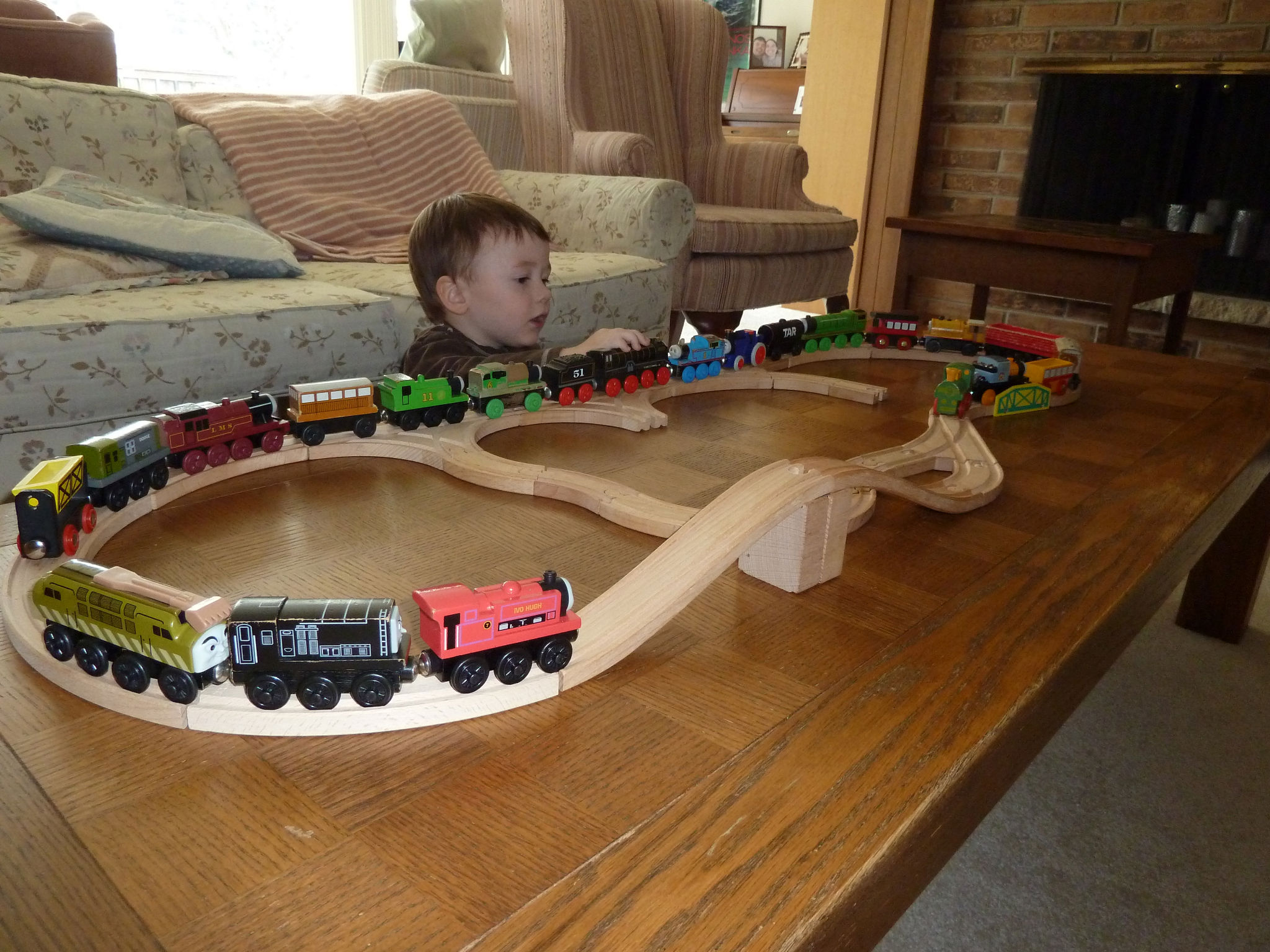
After that, it was about 6 months of trains. The Thomas the Tank Engine videos, train books, toy trains and tracks, the trips on real steam engines, the sitting by tracks and watching trains pass by. Now, it’s not that trains were the ONLY thing we played with. On a regular basis, I “made him” do other things, and there were plenty of trips to the playground and the library and concerts and books about other topics… But definitely trains dominated. Again, it helped that his abuelo (grandpa) loves trains and was quite happy to play along.

Then it was 5 or so months of the alphabet. Listening to YouTube ABC songs in the car everywhere we drove, playing all the ABC apps that exist for the Kindle Fire, putting together letter puzzles, singing the ABCs, playing the “I’m thinking of an animal that starts with the letter R” game.

Now we’re five months into the planets. The books, the videos, the planetarium visits…  I’ve got the three year old who is sliding down the slide shouting “Mercury, Venus, Earth, Mars…” and telling the other kids “the sun is the center of our solar system. The planets orbit around it. It takes one year for the Earth to orbit the sun” and so on. And everywhere we go he finds sets of nine objects to line up to be the planets. Whether it’s balls, rocks, sea shells, sugar packets at a restaurant… the smallest items are Mercury and Pluto, the biggest is Jupiter, etc.

Sometimes this repetition / focus drives his sister crazy. She’s 17 and thinks the world is more interesting with variety.

It doesn’t really drive me crazy though.

Most of the time.

Partially because I’m older and more patient. Partially because of all the other adults (and adult-like older siblings) who help support his passions – if it was only me doing all this with him, I’d have worn out by now. Partially because I can see how much he learns by doing it. We know from neuroscience that children learn / build connections in their brain through repetition, especially in a setting where they feel happy and safe. My boy learned to read before he was 3. He can memorize books, songs, and videos… the other day he was quoting a Bill Nye the Science guy video word for word… He’s also on track for learning all the things he should be learning at 3 – how to hold a marker (and draw planets), how to sort things by categories (rocky planets, gas giants, dwarf planets), how to make things of clay (yep, planets), how to carry a tune (yes, singing songs about planets) – and lots more skills we expect at this age. We’ve also talked about things I didn’t expect to cover at this age – like states of matter.

And really, the biggest reason I’m willing to repeat things over and over is simply that it makes him happy. The joy and satisfaction he finds in a deep mastery of a topic is pretty hard to resist.

Child Development and Early Literacy

[This is my second post on early literacy. Look here for tips on how to get your child excited about reading, and here for how to read to your child, and here for other games and activities that build literacy skills]

Developmental Stages of Literacy

12 – 18 months: can hold or carry books, look at board books independently, points to pictures in the book, may gaze at one book for a long time, or may switch between books quickly

18 – 24 months: may carry a favorite book around; will hold books and pretend to read; may want you to read the same book over and over. When you read favorite books, your child may say some of the words and phrases with you

2 – 3 years: can learn to turn pages in a regular book, names objects in pictures, may recite parts of books from memory, starts to relate what they’re reading about in books to their life experiences

3 – 4 years: understand that words on a page have meaning, begin to recognize letters, might recognize some words, enjoy longer stories, can guess what might happen next, like to discuss stories, can easily turn pages

What kind of books do kids love?

Young Toddlers (12 – 24 months): choose sturdy board books with only a few words on each page. Look for simple rhymes and predictable text (e.g. a repeating phrase that appears throughout). Look for simple pictures that match the text. They like books about things they see and do in their day-to-day lives, like eating lunch or going to the park, more than fantasy or books about exotic experiences.

Toddlers (2 – 3 years): Choose books that tell simple stories. Pay attention to what your child is passionate about – animals, trains, dinosaurs – they’ll love books about that. Look for non-fiction on topics like shapes, numbers, letters. Choose books with rhythm, rhyme, and repetition. Lift the flaps. (These are my favorite books for toddlers.)

Preschoolers (3 – 5 years): Children are able to enjoy longer stories, and stories about things outside their daily experience. You can choose non-fiction books about simple ideas like telling time, counting, opposites, and also about anything they’re excited about – planets, sports, kittens…

Aim for a mix of familiar books and fresh ones – kids love to hear the same book over and over – the familiar is comforting and repetition helps them learn. New books introduce new ideas and new things to fall in love with. At any reading session, offer multiple books and let them choose.

Source for developmentally specific recommendations:

Getting Ready to Read is a short booklet on helping your child become a confident reader. (It also includes lots of great tips for language development and development in general.) www.zerotothree.org/child-development/early-language-literacy/cradlingliteracy_ready2read_8-14-09.pdf

These Pathways for Literacy gives very specific guidelines for each developmental stage.

Sources for book recommendations for each age group:

Lists of recommended books are available on websites for many library systems or in person at the library. Check out some here: www.kcls.org/kids/whattoread/booklists/ and here www.bklynpubliclibrary.org/first-5-years/read/toddlers/books

I often look at these lists for ideas, then go to Amazon to read reviews of the book to learn more. (Then back to my library website to put the book on hold. We read 15 new books a week – we couldn’t afford this habit if we bought all those books!)

Another great collection of resources and recommendations is: http://www.readingrockets.org/audience/parents

Here is a printable handout on Literacy for age 2 – 6  and one on Pre-literacy for toddlers. Find more handouts on my Resources for Parent Educators page.

Language development in Toddlers

Developmental Milestones

Individual children vary, based on gender, temperament, and caregivers’ language use, but here are some typical average milestones for language development:

  • At one year old, your child might understand 50 words and say a few.
  • Around 20 – 24 months, he may understand 150 – 200 words, and speak 50 – 150. Somewhere in the period, he’ll have a huge growth spurt in language knowledge, called ‘fast mapping’ where he may learn up to 8 words a day!
  • By 24 months, she speaks 250 words. She can answer some questions, ask questions, name many familiar objects in the house, and can ask for what she wants.
  • By 30 months, he understands 500 words. Speaks 250-500, saying them more clearly so others can understand. Uses 2 word sentences. Can begin to talk about how he feels.
  • By 3 years, she speaks in full sentences. Begins to figure out grammatical rules.
  • By kindergarten, children may know 10,000 words.

Help them learn

How to talk: When speaking directly to a baby or very young toddler we use “parentese”, also known as “baby talk”. We establish eye contact, slow our speech down, simplify language, and vary our tone a lot, in a bright, happy, sing-songy voice. This makes language very interesting to the child, engaging, and emotionally satisfying.

As the child gets older, we still use aspects of this, but we shift gradually over time to a more mature way of speaking, with full sentences and more complex vocabulary.

What to talk about:

  • Describe events and actions – what the child is doing and how they are doing it. This teaches verbs and adverbs: “you are running fast”, “you’re touching that kitty very gently.”
  • Describe objects in the room and things they’re interacting with. This teaches nouns and adjectives: “that’s a big ball”, “that’s a red car”. Ask “can you point to the picture of a goat?”
  • Use lots of details, but keep sentences short and simple. Repetition reinforces new words.
  • Ask questions, then pause and wait for child to respond verbally or non-verbally. “Do you want more peas?” Repeat (or verbalize) their response: “Yes, I see you reaching for more peas.”

Research has shown that children learn language best when the parents tune into what the child is interested in the moment and talk about that. Or as Bronson and Merryman say “the central role of the parent is not to push massive amounts of language into the child’s ears. Rather, the central role of the parent is to notice what’s coming from the child and respond accordingly.”

Some parents just throw language at kids: “Look, over there is a window. Outside, I see blue sky, and trees, and birds. Next to the window, there’s a bookshelf. There are red books and green books…” The more effective parent notices that their child is reaching for a crumb on the floor and talks about that. When a dog barks and the child looks up, the parent says “Did you hear the dog bark? I did too.” Timing is essential – make sure you’re talking about the thing they are currently focusing on, not on what held their attention 30 seconds ago.

Listening and responding

As our children begin to communicate, they need us to show that we are listening and responding.

  • Let your child tell you stories, and respond as they do
  • Pay attention as your child speaks
  • Repeat your child’s words. Add to what she has said. If she says “doll”, you say “you have a doll.” If she points and says “horse”, you say “horse, yes, that’s a white horse.”
  • DON’T correct your child. This can cause the child to feel self-conscious and worried about using language. Instead, use repetition of their words, where you use the correct form of the word… If your child says “we runned to the playground” you can say “Yes, we ran very fast.” Or if she says “I love p’sketti”, you say “I love spaghetti too!”

Who talks to your child?

Research has shown that if only one person says a new word to a child, even if they say it many times, the child might not learn the word. If multiple people say the new word to the child, even just once each, the child learns the new word. So, try to expose your child to multiple speakers.

Vary your words, but not too much

When you say “You have a toy. Can you give me the toy? Thank you for giving it to me.” you have just illustrated verbs (have, give, and giving), pronouns (you and me) and that you can use the indefinite article “it” to refer to a toy. That’s a lot of language learning, but it works because it’s a natural, easy follow-able flow of thoughts. Variety in speech is great, but be careful not to go too far.

If you say “Are you thirsty? Does Bobby want milk? Or can I get my little guy a glass of water?” those sentences may have nothing in common with each other from a toddler’s perspective. Try “Do you want a drink? I can get you a drink of milk or water. Milk? OK, here is your milk to drink.”

Games and activities to build language skills

  • Say nursery rhymes together, make up new verses. As your child gets old enough, have him make up rhymes of his own.
  • Sing songs. This is a great way to build vocabulary through repetition.
  • Play games with physical responses: “Can you touch your elbow?” “Put your hand on your tummy.” “The easter egg is hiding under the table – can you find it?”
  • Ask questions that have “right answers” they can memorize and repeat for a sense of mastery. The classic game is “What does a dog say? What does a cat say?”
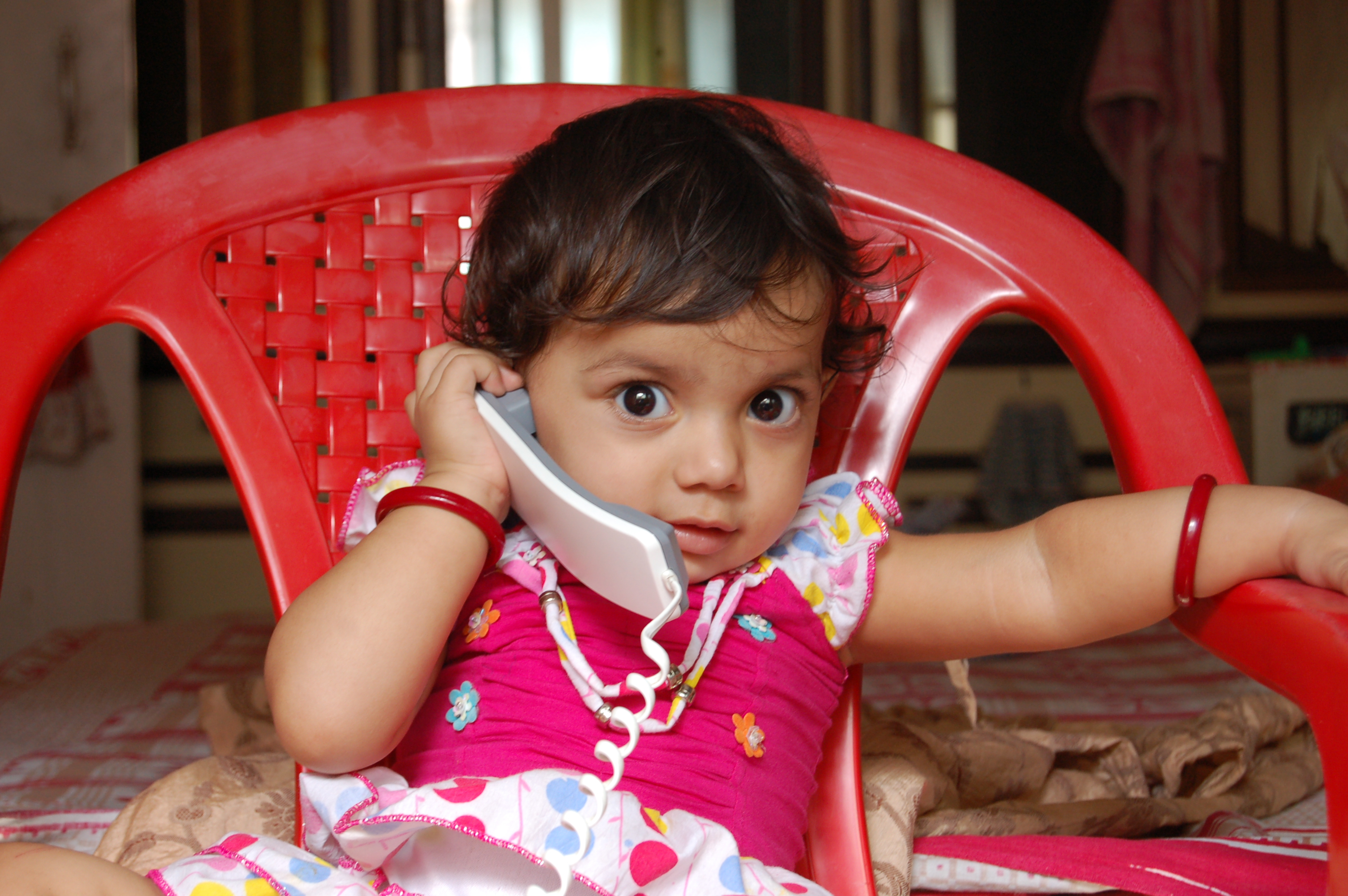
  • Play telephone – pretend to talk to each other on the phone, taking turns in conversation.
  • Pretend that a toy or stuffed animal is talking to your child. Encourage him to respond.
  • Ask your child to tell you stories about her day, or re-tell the storyline of her favorite book.
  • Emotion coaching includes labeling emotions. As a child gains words to describe his feelings, the feelings can seem more manageable.

Curious about raising bilingual children? Check out yesterday’s post.

Resources:

Read about Responsive Language with your child to boost their language learning.

Language for Learning: a video for child care providers, showing how simple it is to encourage language learning www.youtube.com/watch?v=7DPhIQh91Mw&list=WLsMLXfBPSxoG3J_FkZGqnxVV2P34cr_S_

Talking Toddlers: 7 tips to help develop language skills (or read Nurture Shock by the same authors, Bronson and Merryman) http://abcnews.go.com/GMA/Parenting/tips-toddlers-develop-language-skills/

Getting Ready to Read is a short booklet that says about helping your child become a confident reader, but it’s really bigger than that – full of ideas to support language development from birth to 5. www.zerotothree.org/child-development/early-language-literacy/cradlingliteracy_ready2read_8-14-09.pdf

Screen Time for Parents and Kids – How Much is Happening?

For decades now, doctors, teachers, and developmental psychologists have been warning about the perils of TV viewing for children. Parents often feel guilty about letting their kids watch, but nevertheless continue to do so.

58% of kids under 8 watch TV at least once a day. 14% of children 6 – 23 months old watch two or more hours of media a day. A third (36%) of all kids have a TV in their bedroom. Over the past few decades, we have added many more screens into the mix. Children 8 and under now average 2 hours a day actively using a screen: 50% of that time is watching TV, 19% watching DVD’s, 13% using mobile devices (tablets or smart phones), 10% on computers, and 9% on video game players. Children 8 – 18 average 6. 5 hours of screen time a day (more time than they spend in school) and much of that is media multi-tasking – texting while watching TV, listening to an IPod while working on a computer, etc. The biggest change in recent years has been mobile devices. In 2011, half of children had access to one. By 2013, three quarters did. 72% of children under 8 have used a mobile device for playing games, watching videos, or using apps. 17% use them on a daily basis. Even amongst children under 2, 38% have used a mobile device.

So, screen time is no longer just time spent in front of a TV in the family living room. Instead, screens are with us 24 hours a day, everywhere we go: in the car, at the playground, in restaurants, doctor’s offices, etc. And we use them in all those places! Not only do parents use mobile devices to distract kids (16% of parents use screens for their child when they need to go to a meeting or take a class, and 44% use device-distraction when they’re running errands) but parents also use them to distract themselves while hanging out with kids (32% use them while their child plays in the playground.)

Given that screens are such a huge part of modern life, it doesn’t make sense for educators to preach a “just say no” attitude toward screen use for children. Instead, we need to think about using screens consciously, aware of the benefits and risks, and keeping in mind our long-term goals for our kids.

Major sources

Common Sense Media, Children’s Media Use in America, 2013. www.commonsensemedia.org/research/zero-to-eight-childrens-media-use-in-america-2013

Children, Adolescents and the Media – AAP policy statement: http://pediatrics.aappublications.org/content/132/5/958.full.pdf

Media Use by Children Younger than 2 years old – AAP policy statement. http://pediatrics.aappublications.org/content/128/5/1040.full.pdf

Child Development Milestones

It is helpful for parents to have a good working knowledge of typical development (see the resources post for great information) so they know if their child is on track, and children may also benefit from occasional screenings to make sure children are progressing well. (You can complete the ASQ developmental screening online anytime.)

Let’s look at five key areas of development.

Gross Motor (aka Large Motor)

These skills include activities like running, jumping, throwing, kicking, climbing, swimming, and dancing.

To build these skills, ensure that your child has plenty of time and opportunity to move: playgrounds, indoor gyms, hikes in the woods where they can balance on logs, going up and down stairs, tumbling on a mat. Try for a mixture of free play time where they explore movement on their own, and playing together. Kids love wrestling with parents, dancing, chasing around the house together, kicking a ball together. You can teach the basic skills of any sport – just don’t expect them to follow rules yet!

Fine Motor

Fine motor skills are anything that uses the fingers. They allow a child to pick up and manipulate small objects. These skills help them to feed themselves, dress themselves, hold a pencil, and other essential skills for independence.

You can help build these skills with activities like: coloring / drawing / painting, threading beads onto a pipe cleaner, threading pipe cleaners through the holes on a colander, putting dried beans inside a bottle, taking lids on and off containers, feeding them small and slippery finger foods (like diced peaches), letting them feed themselves with a fork or a spoon, and stacking blocks.

If your child tends to still mouth small objects, that doesn’t mean you shouldn’t let them use small items ever…  but you should supervise them when they play, and put small items away when you’re done.

Social-Emotional Development

These skills can be seen when your child copies your actions, notices the emotions of other people, shows empathy for others, or plays games where they are pretending to be/do something.

These skills are primarily built in interaction with others. However, children can also learn a lot about social interaction and emotions by reading books or watching TV. When you read to your child, talk about the emotions the characters may be feeling. Talk about the ways they are interacting with each other – are they being nice? Mean? How does their behavior make the other characters feel?

Language & Communication

Communication is not just saying words out loud. Especially for a young toddler, we want to know: do they seem to understand the words that are said to them (e.g. Can they follow simple directions – like ‘close the door’? If asked to point at a picture of a cat, can they do so? Do they point/gesture to indicate what they want? Do they follow your gestures? Can they name a few familiar objects?)

The best way to build language skills is to follow your child’s lead… rather than throwing language at them about what you see around you, first watch them. What are they looking at? What has their attention at the moment? Talk to them about that, giving them words to describe what they see.

Cognitive Development: Problem-Solving

This is about using tools, and solving challenges. For example, a child who sees a toy you put on the counter out of reach, then gets a stool and pushes it over to the counter and climbs up on the stool to get the toy is a great problem-solver! (And a frustrating child to parent!)

To build problem-solving skills, give them challenges: puzzles, shape sorters, tasks that require multiple steps (first you take the lid off the box, then you put the toy in, then you put the lid back on the box), sorting objects by color or size or other characteristics, and putting toys away in their proper places. Allow your child to become frustrated without always “rescuing” them from that frustration. Notice their triggers, and signs that frustration is building, and move in for a little extra support, but don’t just take over and do the task for them – they can learn through those challenges. You can sit with your child and provide emotional support for their feelings of frustration while still encouraging them to keep trying to solve the puzzle. You may suggest things they could try, but don’t do it for them.

Asynchronous Development

Children develop skills on a fairly predictable timeline, but they can have uneven development – for example, a 24 month old may have the motor skills we expect of a 30 month old, and the communication skills typical of an 18 month old… if you look at that same child 6 months later, they may have surged in their communication skills. Temperament and interest levels have big effects on which skills they focus most on, but parents can also ensure they have opportunities and encouragement to develop in all these areas.

It can be helpful to watch other children at the playground in your child’s classes to get a sense of typical development, but try not to compare your child too much to other children. They all develop in their own way at their own pace.

I still remember something that happened when my now 30-year-old was a toddler. I was very proud that they were stringing together simple 2 word phrases – ‘throw ball’, ‘more crackers’, and ‘doggy book’. Then I talked with a friend who had a child the same age… she said her child had said the day before ‘Hey Grandma, Grandpa, come downstairs, breakfast ready.’ I was devastated, feeling like there was something wrong with my child. But then later in that conversation, I shared how my child had played at the park that week, climbing up the ladder on the slide, sliding down, then climbing up the slide itself and sliding back down. The other mom sheepishly admitted that her child could barely climb on and off the couch!

That’s when it became clear that at that moment in time, my child was working on physical skills and hers was working on verbal skills. Developmental theorists will tell you it all evens out in time, and I can also tell you the same from my experience. Those two children are now graduates of Oberlin College and Reed College, and both very bright independent adults with solid skills in all developmental areas. It all works out in the end…