Why do a developmental screening?
Developmental screenings are a helpful tool for making sure your child is on track with their development. They are a “snapshot” of how your child is doing at this moment. They’re helpful even if you’re pretty sure your child is on track, because they help you get ideas of where to focus your attention in the short-term to make sure they’re well rounded. They’re especially helpful if you have any concerns about your child’s development – a screening tool can either reassure you that they actually are on track, or can verify that they have some challenges that you should seek support for early on.
Developmental delays, learning disorders, and behavioral and social-emotional problems are estimated to affect 1 in every 6 children. Only 20% to 30% of these children are identified as needing help before school begins.(Source)
The ASQ
There are several great screening tools and resources for understanding child development. Today, I’ll walk you through the ASQ – the Ages & Stages Questionnaire, a free online tool, using a method that’s been proven through research with tens of thousands of parents. (Learn more about the ASQ.)
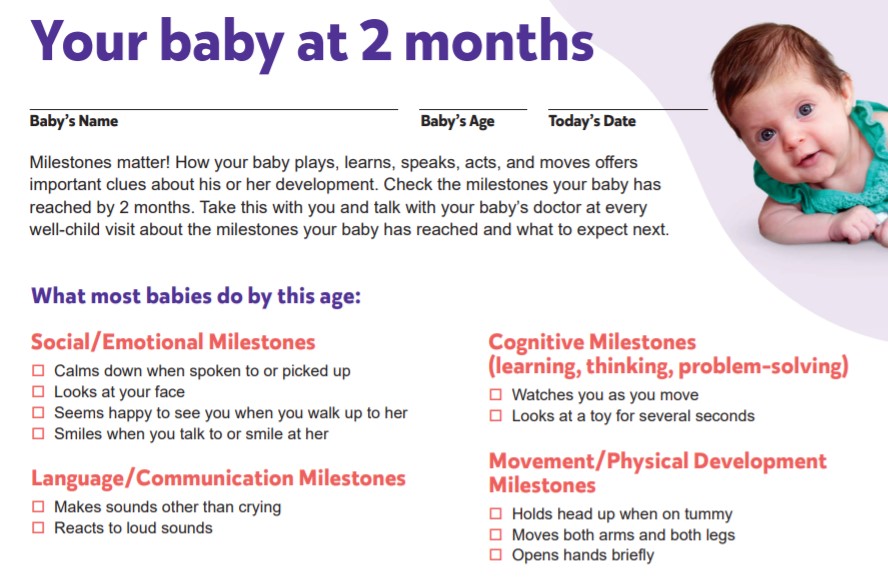
It looks at how your child is doing in five areas: communication, large motor, fine motor, social-emotional, and problem-solving. Learn more about these developmental milestones.
Doing the questionnaire likely takes 15 – 20 minutes. It’s easier to do on a laptop or desktop than on a mobile device. It’s best to do it when your child is around so you can check their skills if there is any answer you’re not sure about. And it’s best if they’re rested, fed, and relaxed so they can show you their best skills. That said, it can also be helpful if another adult is around to help you with distracting the child while you’re filling out questions and can help you figure out answers to questions you’re not sure about.
Note: Some parents choose to download the questionnaire and print it to fill in off and on over the next week, then return to the website to enter their results online so that it will do the scoring for them.
Completing the Online ASQ
Go to https://osp.uoregon.edu/home/checkDevelopment. Click on “Let’s Get Started”
On next page click continue – on next page click to agree to terms and continue, then enter date of birth. Then you’ll get a screen saying something like “For ages 25 months through 28 months – 27 month ASQ” – this is making sure you’re using the right checklist for your child’s current age.
Continue to online questionnaire. (Or download it to fill out by hand and then return to the website later.)
There will be a page where they ask about demographics – ethnicity, education and so on – they ask this because the people who are offering this survey are doing research on who uses the tool, and this is helpful to their research process. They do not do anything with this data which would violate your privacy, and you won’t get any emails from them except the results of this screening.
The next screen will be instructions – they’ll tell you that you need to try every activity with your child before marking an answer – that would be ideal, but you don’t have to… if you know your child can do something easily, it’s OK to just mark it yes. On things you’re not sure about, do have your child try it.
On the questionnaire, you’ll be asked 30 questions – 6 questions per category in 5 areas of child development. You’ll mark “yes” if this is something your child is definitely capable of and has done successfully multiple times. If they have done it a few times or they can sometimes do it but not always, mark “sometimes”. If they’ve never done it, mark “not yet”. The way the survey is designed, we might expect a not yet or a couple sometimes in any given category, so don’t worry if you’re seeing some.
Mark answers as accurately as you can – this screening is not about “making your child look good” – it’s about getting an accurate assessment of where they’re at.
Then there will be a few general questions, like does your child hear well, do they have vision problems. It’s OK to fill those out or to skip them.
Then it will say something like: “For ages 21 through 26 months (24 month ASQ:SE). The ASQ:SE-2 asks simple questions about your child’s behaviors. Before continuing, please read instructions…”
This second questionnaire, the ASQ-SE, is optional. I would say: if you feel like your child has more behavioral challenges than the average child, or more big meltdowns / tantrums, or doesn’t connect to you and others like you see other children do, or there are other things that make you worry that your child may not respond like other kids do, then do this questionnaire. If not, you can choose to skip it. This questionnaire takes 5 – 10 minutes.
Enter your email address to receive results by email. (If you’d prefer not to give your email, then click to skip this step, and it will take you on to a page where you can “download your ASQ Results letter”)
Understanding Your ASQ Results
Your results will look something like this:
Results for your child BXD born on November 23, 2016
Your child’s development appears to be on schedule at this time. |
| On schedule |
Communication, Gross Motor, Fine Motor, Problem Solving, Personal-Social |
| Monitor |
None |
| Not on schedule |
None |
or
| Results for your child BXD born on November 23, 2016. |
| ASQSE |
Social-emotional development is in a monitor area at this time. |
| Overall Section |
You noted a concern in this section. See below for follow-up ideas. |
Note: if you had a paper version of the questionnaire, results look like this:

The white zone is “on schedule”, the gray zone is “monitor” and the black zone is “not on schedule.”
If your child shows as being “on schedule” that’s good news. This test rarely has any “false positives.” If a developmental screening shows that a child is on track developmentally, we can be pretty reassured that all is well. You can just keep doing what you’re doing with them. Or, if there’s one developmental area where you had more “sometimes” or “not yets” then you may choose to do more activities in that area to ensure they stay well-rounded. For example, if you didn’t mark “yes” on all the large motor questions, then spend a little more time at the playground, pool, or gymnastics or dance classes so they can run, jump, kick, throw…
If your child has some things marked as “monitor” – I think of those as “grey areas”. This test can have “false negatives” where the test shows a possible problem, and it turns out that all is well.
If I see “monitor” in one area, that makes me go “hmmmm…. I wonder why.” Here are the questions I ask myself
- Can they do similar things? The first thing I do is look back at the questions in that section and how you answered them. (The questionnaire with your answers marked will be attached to your email, or you can find it by clicking on “download your completed ASQ”.) Sometimes there were just super specific questions, for example, there’s a fine motor question of “does your child flip switches on and off” or “can your child string beads on a string” and you said no just because they happen to have not ever done this… but think, are you confident that they have enough fine motor skills that they could do something like that? If so, then there’s no reason to worry about it.
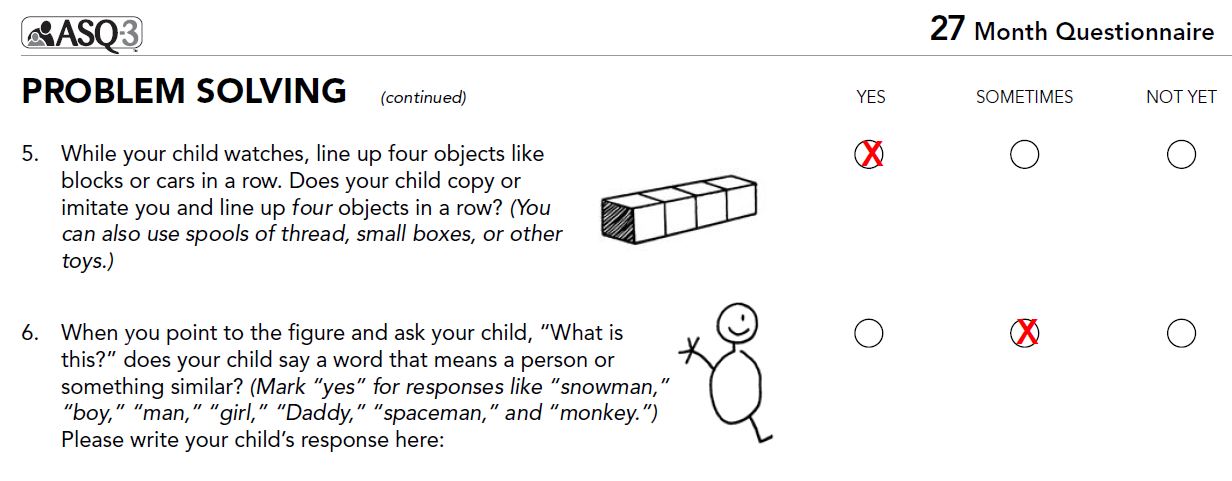
- Is there something about that question that doesn’t apply to their experience? All standardized questionnaires have some biases or assumptions. For example, there are questions about climbing stairs, and there are children who grow up in a town with no stairs. There are questions about forks and some families tend to only eat finger foods or they use chopsticks so may not use forks at home. When the mother of one of my students was doing this questionnaire, and she showed her daughter the incomplete stick figure drawing in the illustration at the top of this post, her daughter said it showed a teacher. This may not make sense to you, but if you’d met me, it would make sense! (I have one leg and this child knew me well as her first teacher.) If the question doesn’t directly apply to your child, again ask yourself “do they know similar things?”
- Is there a reason they might be behind in this particular area of development at this particular time? For example, if you are a bilingual or trilingual household, your child might test as “behind” in language in ONE of those languages. But if you think they have solid language skills in BOTH languages, I wouldn’t worry. If you tend to solve problems for your child whenever they get frustrated, they might be “behind” in a problem solving skill, like getting themselves dressed. Or sometimes kids are behind in large motor skills in the winter time just because we haven’t been playing outside where there’s room to run.
- Is there a reason why they might be behind overall right now? If you’ve had any big stressors in your family recently like a move, a new baby, a death in the family, a divorce – these are all things that might have distracted your child’s learning temporarily.
If you find answers to these questions that satisfy you, it’s likely that all is well and there’s no reason to worry. It wouldn’t hurt to put some extra effort into building your child’s skills over the next two months, and then do another screening just to be sure.
If you’ve taken all of these questions into consideration, and your child still seems to be missing some skills, then definitely work on building those skills (see below) and do another screening in a few months, or seek more information now.
If your child is marked as “not on schedule” in one or more areas, you definitely want to explore it more. Ask yourself the questions above to get a clear understanding of the results, then consult with your child’s doctor, teacher, or another professional to learn more. It is possible that when you investigate more, it will turn out all is well, or there is only a very temporary delay. But it’s important to check to be sure, because if a child does have any developmental challenges, the sooner they get extra support, the better.
Resources if you’re concerned about your child’s development:
Resources to build all kids’ skills
Whether your child is on schedule, not on schedule, or in that gray area of “monitor” they will benefit from diverse learning experiences. I have lots of articles on Play and Fun Activities on this blog. Or check out:
Note: Easter Seals also offers the ASQ online for free: www.easterseals.com/mtffc/asq/. Theirs works just fine as an alternate, I just prefer the uoregon site listed above because Easter Seals asks for more of your private information (name, address, phone number) and will add you to their mailings.


 More Good Days with Kids