Author Archives: Janelle Durham

Unknown's avatar

About Janelle Durham

I am a parent educator and social worker, and teach music and science to children age 1 - 8.

Boys in Dance Class

billyellrevI am working on a post about “how to make sure your classes are gender inclusive.” But first, I thought I’d share my story of why this topic is on my mind right now…

My 4-year-old son has recently started taking a ballet and tap dance class. Note: this is not advertised in any way as a girls’ dance class… in theory, it is open to all. Realistically, I knew Ben was likely to be the only boy. But even knowing that, it’s surprising to me just how girl-centric the class is.

On the first day, the teacher said “we have 10 girls enrolled in this class, so if you would like to move your daughter to a smaller class, you could do the 5:00 class”. Really, the class has 9 girls and one boy. The name Ben on the roster should have been a clue. And referring to our “daughters” when my son was sitting on my lap seemed odd.

Then she said “OK girls, come on over to dance.” And out run the girls in pink leotards and tiaras, and Ben in his blue shorts and Lego Star Wars t-shirt. (The class does not require any particular clothing. The other parents all chose leotards. I chose his favorite regular clothes.)

The teacher put on princess music (it’s all princess music… Little Mermaid, Frozen, etc.) and handed them all pink scarves, and they began to dance around the room. The walls  of the room are decorated with paintings and photos of girls in tutus. Not a single male dancer in sight.

And it’s not just this dance class. My older children took dance for years, and I know it’s pretty systemic. I’ve seen lots of pink leotards and paintings of ballerinas over the year. You can’t even buy boy’s dance shoes in my son’s size – manufacturers don’t make them – so he’s wearing pink ballet shoes and the least girly tap shoes I could order. In all the dance classes my daughters ever took, there was never more than one boy in their class. In recitals, boys are rare, and you can tell the instructor struggled to figure out what a boy costume should look like.

boyAnd it’s not just dance. With my older kids, it was rare to see boys in any of their  gymnastics classes. I’m told it’s the same in the equestrian world. And in all the theater activities my kids have done, the ratio is usually, at best, one-third boys and two-thirds girls. In pretty much any audition they’ve attended, my girls knew that every boy who auditioned would get a part. Some girls would get a girl part, some girls would get a boy part, and some girls would not get cast.

And, if boys do stick with dance as they get older, or do gymnastics or theater, what does our culture assume about their “manliness”, gender identity, and/or sexual orientation? If they’re straight, cisgender boys, then people talk about how “lovely” it is that they’ve stuck with their interest despite stereotypes. But all these attitudes show: They’re not generally viewed as “regular boys.”

The gender divide goes the other way in other extra-curricular activities. The STEM themed preschool-age class I teach tends to be two-thirds boys and one-third girls. I know from experience that the wilderness survival courses, aikido classes, computer programming classes, video gaming sessions and role-playing games (Dungeons & Dragons) that my daughters participated in had way more boys than girls.

And those girls are labeled tomboys, or, as they get older, butch. Or “a girl who excels in science.” The adults around them may be proud of how they are overcoming gender stereotypes. But again, they’re not viewed as “regular girls.”

Why is the gender divide still so clear in what activities are considered “boy things” and what are considered “girl things”?

I think if you asked most of the parents I encounter at these classes about their views on gender issues, they would talk a lot about the importance of equal access to all activities for all genders. I think they would all vehemently defend a boy’s right to take dance classes or a girl’s right to program computers. Many would share dismay over the fact that toy stores and clothing stores are so gendered.

Yet, when these same parents choose classes and camps to enroll their kids into, they perpetuate the gender roles.

Now, I know that the average boy may have different skills and interests than the average girl. The research shows it, as does anecdotal evidence. However, the researcthh shows that those differences are small, and that there is just as much difference between individual boys (the athlete, the brain, the criminal) as there is between an individual boy and an individual girl (the athlete and the princess).
Yes, boys are statistically more likely to like toy trains and cars than girls are. But that doesn’t mean there aren’t plenty of girls who would like trains, and plenty of boys who don’t really care. In choosing toys, I like to offer a variety of options without assuming what the child will like based on their gender. And when choosing activities for young children, I try a wide variety of activities, regardless of whether they are viewed as “boy things” or “girl things.” As  kids get older, they partially follow their inherent interests, but they will also be more likely to pursue activities where they feel like they “belong” and they “fit in.” Those male gymnasts, male ballet dancers, female programmers, and female wilderness guides all deserve some kudos for sticking with a passion even when the culture didn’t welcome them.

We can make it easier on the next generation. Parents can do their part by encouraging their children to try a wide variety of activities, and by not expressing surprise when a child of the “unexpected” gender is enrolled in those activities. Teachers and program administrators can also do a lot to make their classes gender inclusive.

We should all also remain aware that gender is not as clear-cut and binary as we were raised to believe. Any child in a class may not identify as the gender they were assigned at birth. Some transgender people don’t recognize this until adulthood. But some very young children have already figured out that they don’t fit the typical definition of “boy” or “girl.” It’s even harder for them to go into environments where assumptions are made about who belongs there, and who can participate based on gender labels. By making our cultural assumptions about gender more fluid, we make it easier for these children to find their place in the world. (More on gender identity: https://gooddayswithkids.com/2018/05/02/gender-identity/)

Just for the fun of it, I’ll conclude this post with a pointer to a playlist I’ve made on YouTube called Boys Can Dance, which features dances from Billy Elliot, West Side Story, Singing in the Rain, and lots more. https://www.youtube.com/watch?v=iOuZuAGvMRg&list=PLsMLXfBPSxoEF6nPQj13QjvAX-I53Ob2R  Or, if you’d like a little more modern / urban / less Broadway, check out the League of Extraordinary Dancers: https://www.youtube.com/watch?v=qVZyfsaKPS4&list=PLTXGCzZ9AAzPhEM_y-vudz1GbwsMhVL_0

Growing Up Wild Activity Book

See the source image

Project Wild offers a great resource for educators and parents with children aged 3 – 7. The Growing Up Wild book (order it here) covers 27 themes, including “Oh Deer (a habitat theme)”, “The Deep Blue Sea”, “Who Lives in a Tree”, and “Wildlife is Everywhere.” Each theme includes: several ideas for group activities, and for self-guided exploration stations, recommended books (fiction and non-fiction), songs and movement activities, outdoor exploration ideas, math activities, art projects, snack ideas, links to videos (listed here) and “take home” sheets with ideas for parents to try at home. (See sample theme here.)  Each theme also includes a list of numerical codes for which Head Start Domains and which NAEYC Accreditation Criteria are met by the activities, and warm up and wrap up activities to assess children’s prior knowledge and learning outcomes. (Learn more about the contents of the book here.)

I attended a training where we had the opportunity to try out several of these activities. Some samples:

  • Looking at Leaves. The instructor had collected 25 leaves, and given us each one. She asked us to look at our leaves and memorize them. You could ask children to think about how to describe their leaf: shape, color, texture, and so on. Then we put them all in a pile and mixed them up, then had to find our own. Simple, free, and great for teaching attention to detail, visual discrimination, and short-term memory. Easy to customize to age group, or to start a year with leaves that are very easy to tell apart, and over the course of time, have collections with more subtle differences. After the leaf match, you could take them outdoors to find the plant their leaf came from. You could also do leaf rubbings or leaf prints, then add the leaves to a collage.
  • Spider Web Wonders. Draw a spider, discussing its anatomy (head, abdomen, 8 eyes, 8 legs that attach to the “head”). Children create spiders with a variety of craft or snack materials. The math game is “how many legs”. The teacher holds up a sign saying 0, and asking what creatures have zero legs. After children guesses, turn over the card to show a picture of the answers. (Snake, worm, etc.) Then do 1, 2, 4, 6, 8, 14, 30+. A take home at Halloween time could be to check out Halloween decorations, and see how many of them get the spider anatomy wrong.
  • Hiding in Plain Sight. Gather a collection of toy animals (stuffed or plastic). Begin with a matched pair, and hide one in plain sight before the children arrive. Then show them the matching animal animal and see if they can spot the hidden one in the room. Talk about how it was hiding  in plain sight – for example, placed in front of a similar colored item it could blend into, or placed somewhere that’s visually very busy so it could “hide” in the clutter. Explain the basics of camouflage. Next, the teacher or some children “hide” more animals, either in the classroom or outdoors. BUT… they should be told to hide them in plain sight. Then take the other children out to search. Then, build camouflage collages: cut out photos of animals, have the child paste one onto paper, then surround it with tissue paper squares in the colors that would camouflage it. Play “freeze birds”, explaining that even when animals are camouflaged, they give themselves away if they move. The “hawk” closes his eyes while the “bluebirds” play. When you call out freeze, they freeze, and the hawk opens his eyes. If he sees anyone move, they become the hawk.

That’s just a small sampling of ideas. For educators this book could provide a full ready-made nature curriculum for  your class, or could provide lots of ideas you might sample as you build your own curriculum. For parents, there’s plenty of fun and easy ideas in here – you can try out any that seem fun to you.

To learn more about nature play, click on these links “Recommended Daily Allowance of Outdoor Time“, Benefits of Outdoor Play, and Overcoming the Barriers to Outside Play.

Brain Map

BrainMap

I have created a poster / handout on brain development and how parents can help their children learn. Great for educators to handout or post, but also helpful for parents to print a copy to post on the fridge as a reminder of ways to help all of your child’s brain capacity develop. The ages shown are “sensitive periods” when that part of the brain is most actively developing or reaching maturity, and when parents might most want to focus on those skills.

On the back is the handout for my “Hands On is Brains On” presentation.

If you don’t have access to a printer that can do 11×17 (most printers can’t), the “brain map” will reduce well to print on an 8.5×11 sheet.


Hands On is Brains On

I recently did a presentation at Kidsquest Children’s Museum in Bellevue, WA on how kids learn, titled Hands On is Brains On.

It combines information on the basics of brain development, ideas about the important of offering a balance of learning opportunities, the benefits of free play, and the parent/teacher’s role in play-based learning.

You can check out the powerpoint handout here, or, if you’re a parent educator, you can download a powerpoint presentation that you could edit and use in your own classroom.

Car Seats – Don’t Hurry to the Next Stage

Motor vehicle accidents are the second leading cause of child death in the United States. Proper use of the proper car seat can hugely reduce the risks. There are four stages of car safety restraints. To maximize safety, keep your child in each level of seat as long as possible, until they reach the maximum height and weight for that seat. Each stage provides less protection. Don’t move your child to the next stage until you have to. This is NOT one of the places where we want to rush our kids along to the next developmental milestone!

Note: To choose the right level seat for your child, it is more important to consider their height and weight than their age. (So, if your child is small for their age, they may be in a seat longer than age recommendations say.)

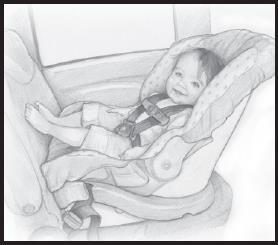
Rear-Facing. (Birth to age 2 or beyond)rear-facing car seat
Infant Seat. Weight from 4 pounds to 22 – 35 pounds and height up to 29 – 32 inches, depending on the seat. Convertible Seat. Weight from 5 or 20 pounds minimum to 45 pounds maximum rear-facing, maximum height 40 inches.

The American Academy of Pediatrics says “All infants and toddlers should ride in a rear-facing car safety seat (CSS) until they are 2 years of age or until they reach the highest weight or height allowed by the manufacturer of their CSS.” Riding rear-facing helps to protect a child’s fragile neck and spinal cord, and reduces the risk of severe injury by 75%.

Many parents notice that as their toddler grows, there is less room for their legs, and they have to bend their legs or sit cross-legged in order to fit. They wonder if they should turn the child forward. As a car seat technician told me: “yes, there’s a minor risk of broken legs in an accident. But, broken legs are much easier to heal from then a broken neck, which is more likely if they’re forward facing.”

forward-facing car seatForward-Facing Car Seat with a 5-point Harness. (Age 2 to 7)
Should never be used for a child less than 20 pounds or less than one year old.
Maximum weight 35 – 70 pounds. Max height up to 50 inches.

These seats are equipped with a 5 point harness. In a crash, that harness keeps the child in the seat and helps distribute the force of the crash to the strongest parts of the child’s body. Use for as long as possible, as they provide more support and protection than a booster seat. Your child is ready for a booster when he reaches the top weight and height allowed for his car seat (shoulders are above the top harness slots and his ears have reached the top of the seat.)

You may find as your child gets older that they are riding in other people’s cars more often (for field trips, playdates, and so on). Make sure the person who is transporting your child knows how to install the seat or booster properly.  Some parents choose to use an easy-to-install booster for these occasional trips once their child hits the minimum size, while continuing to use a forward-facing car seat with a 5-point harness in their own car for the majority of car rides.

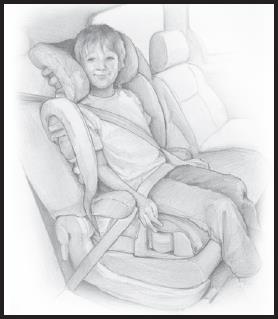
boostBooster Seat. (Age 4 – 8 or beyond)
Up to 100 – 120 pounds. Maximum heights from 34 – 63”.

Washington requires that children use a safety seat until they’re at least 8 years old or taller than 4’9” (57”) whichever comes first. (Note: Less than 5% of kids are taller than 4’9” at 8 years old. 25% don’t reach 4’9” until they are almost 12 years old.)

Boosters properly position the adult lap and shoulder belt for a child, so it provides proper restraint in case of an accident.

Your car must have a lap and shoulder belt to use a booster. If your car only has lap belts, you can use a forward-facing car seat with a harness or see if shoulder belts can be installed in your car. There are backless booster seats, which are generally less expensive and easier to carry. There are high-back boosters, which should be used in cars without head rests or with low seat backs.

Seat Belt. (Age 8 or older)
If your child is 8 – 12 years old or at least 4 feet 9 inches tall, AND you can answer yes to these questions, then they’re ready to move out of a booster seat.

  • When the child is sitting all the way back against the vehicle seat, do the child’s knees Seat beltbend comfortably at the edge of the vehicle seat?
  • Does the lap belt stay on the top of the child’s thighs, not on their belly?
  • Is the shoulder belt centered on the child’s chest and shoulder (and not on the neck or throat)?

Can the child stay seated this way for the whole trip? Without putting the shoulder part of their seat belt under their arm or behind their back?

Front Seat. By Washington law, all children should ride in the back seat until age 13.
(Exceptions for: pickup trucks or sports cars with no back seat, or if the back seat is filled with younger children)

Air bags are very dangerous to children riding in rear-facing car seats. If your vehicle has a front passenger air bag, infants in rear-facing seats must ride in the back. If a young child must ride in the front seat of the car, check your vehicle owner’s manual to learn how to turn off the air bag.

Choosing a Car Seat: Choose a car seat that is easy for you to use, so that you will use it right every time. NHTSA offers ease of use ratings for all the car seats on the market: http://www.nhtsa.gov/nhtsa_eou/

If your child is likely to be tall or heavy for their age, choose a seat with higher maximum weight and height to allow your child to use that car seat as long as possible.

Install the Car Seat Properly. For a car seat to work correctly, it must be installed correctly. Check the web resources below for information on car seat installation, and read your car seat manual and your vehicle manual for tips. Once you’ve installed a seat, you can have it checked for free. See www.800bucklup.org/carseat/inspections.asp for a list of inspectors.

Clothing. If a child is dressed in bulky clothing, the car seat may not properly restrain them in case of a crash. In the winter time, buckle your child into the seat without a coat on, and then place the coat or a blanket over the harness for warmth.

Other Objects. In case of an accident, loose objects in the car can fly around and strike passengers, and if your child is holding a hard object, it could hit them, causing injury. Keep this in mind as you do your best to keep your car tidy and consider what your child has access to in the car.

Be a Good Role Model. Always buckle up yourself. Always encourage all the other adults in the car to buckle up. Practice safe driving practices with minimal distractions. Your children will be driving themselves in just a few years, and they will have learned a lot about driving by watching you from the back seat. Make sure you are showing the behavior you want them to learn.

I think of motor vehicle safety as what I call a “red light” issue. When I teach safety skills to children, or talk to parents about safety skills, I think about “green light” situations with no risk of harm, “yellow lights” where we just let them know to be careful, “orange lights” where we only allow them to do something with very close adult supervision, and “red lights” which are absolute rules, set by the parents, and followed all the time in order to keep the child safe. Riding in the proper seat, properly buckled is mandatory. (To learn more about my thoughts on teaching safety skills, click here. And to learn about letting a child take reasonable risks as a learning experience, click here.)

More info: www.800bucklup.org; www.safercar.gov/parents; www.healthychildren.org

In this post, I reference Washington State laws. To learn the laws in your state, visit: http://www.ghsa.org/html/stateinfo/laws/childsafety_laws.html

For a printable handout of this information, click here.

Illustrations from healthychildren.org