Author Archives: Janelle Durham

Unknown's avatar

About Janelle Durham

I am a parent educator and social worker, and teach music and science to children age 1 - 8.

47 Things You Should Never Say to Your Kids (or Their Heads Will Explode)


explode

There’s an article by Parents Magazine  that I often see shared on the internet. It’s titled “10 Things You Should Never Say to Your Kids.” When I see that headline, I think of things like “You’re worthless.” “I hate you.” “I wish you’d never been born.” Those probably should fall in the category of things never to say to your kids. Or to anyone else’s kids, for that matter.

But what are the horrible, soul-wounding phrases that Parents magazine cautions against? “Great job.” “Practice makes perfect.” “Let me help.” “Be careful.” “You’re OK.”

Huh??

Now, when you read their article, it’s actually got lots of good content, with some helpful tips. It’s well worth a read. I agree with them all and I’m not concerned about the topic so much as the tone that is presented by the headline.

A better title would be “Translating Common Parenting Sayings into More Positive Statements Which Will Help Them Develop Into the Emotionally and Physically Healthy, Upstanding Citizens You Hope They Will Become.”

But, Parenting magazine knows the rules of modern media. When you want people to read a title on Facebook and click through to read the article, it helps to include a number in the title (“5 reasons chocolate is healthier than kale”) and it helps if they can convince readers that if they don’t read the article something terrible will happen to them or their children. (“Follow our screen time tips or your child will be brain damaged for life.”) Companies who advertise on a magazine’s website appreciate those “clickable” titles, because it means more people look at the article, and thus at their ads.

And it’s not just Parenting magazine – many other media outlets have used this same headline with success. Here’s just the first page of search results for “things never to say to your kids”

But, when parents read these headlines, how does it make us feel? It raises anxiety. It creates stress around the sense of “I have to do everything right as a parent, or my child will end up screwed up.” It makes us feel guilty about all the times we’ve “done it wrong.”

For example, check out this anxiety and guilt  inducing intro from Parent Society:

If you’re a halfway decent parent, you do your best to not swear at your children or call them names. But other phrases that roll off the tongue can be every bit as dangerous — especially since you might not even realize you’re saying them. Take a look at six phrases you need to cut out of your conversations…

Then to read through  those six dangerous phrases, you have to click through seven pages that are so loaded with ads, it’s hard to actually find the content…

So, let’s first reality check these messages:

  1. It’s pretty guaranteed… At some point, all parents say mean things to their kids. We do. I do – just yesterday I said some things I’m sure are on lists of “things never to say to your kids.” We have bad days, and we get angry, because we’re human. (Check out my series on parental anger – how to manage it and how to heal from it.)
  2. Luckily, kids are remarkably resilient. (To learn more about resiliency and how to help your kids build it, read this article by Jan Faull on the PEPS website.) If you have a positive, loving relationship with your child overall, a few harmful words will not damage that permanently.
  3. Almost all the things on all these lists of “things never to say” aren’t really that dreadful. I promise you that if you say good job to your child, they won’t be permanently damaged!!  However, there are many more things you might say instead, or in addition to, good job. Having an awareness of alternatives just helps broaden your list of options for how to connect with and guide your child.

So, I read through all those articles on things never to say. And I’ve gathered them all [well, almost all] into the left hand column of this table. But I am NOT saying “Never say these things.” Frankly, for most of these phrases, it would be totally fine if you say them from time to time. But, they don’t want to be the only message your child hears from you.

The middle column is just to help raise awareness of how these phrases could have a negative impact if over-used over time. The right hand column suggests other options you can try out, and gives resources for where you can learn more.

Phrase that “parenting experts” caution parents against using Negative / non-helpful ways the phrase could be heard by a child if this is all you ever said to them Alternative things to say or do (on good days when you have the time and energy) that may be more helpful
Good Job / Great Job / Good girl


That’s a beautiful picture
You did that just right
What a perfect building you built!


You’re the best _____ in the whole wide world

Empty praise – if it was something that was really easy for them to do, it’s weird to say good job.

Judgement – implies that there’s one right way to do things.

They’re reached their limit – you don’t think they can do any better.


They’ll someday realize you’re lying or exaggerating and lose faith in your judgment. Or they’ll feel pressure to really become the best.

Only praise things that took effort.


Focus on the process and HOW they did it and what they learned rather than on the product.
Give specific detailed feedback about what’s good, and what could be even better.
Read about questions to ask to extend their learning.

Read more about effective praise.

I’m proud of you

I love it when you….

It would make me happy / mad if you…

I’m ashamed when you….

I’ll never forgive you

Conditional love. Also implies that your emotional well-being as an adult is dependent on your child’s behavior of the moment. Let your children know that you will always love them, no matter what. (This doesn’t mean that their behavior is always OK – it’s not, and you do need to set limits. And it doesn’t mean you don’t have high expectations for them – you do want them to work hard and be good people. But your happiness is not dependent on that.)
Practice makes perfect Well, practice makes much better. But, it doesn’t make perfect because nothing is perfect. And aiming for perfect implies that mistakes are evil. “Practice and you will improve.”
“Making mistakes helps us get better.”
“If you aren’t making any mistakes, this is too easy for you and maybe you’re ready for more challenge.”
Read more about “Willingness to Fail is the Inventor’s Key to Success.”
You’re so [shy, smart, clumsy, pretty]

You’re the [strong, fast, silly, wild] one

You always…

You’ll never… [lose, win, do anything wrong / right]

You’re worthless / a loser

Girls don’t do that / Boys don’t like..

This is all labelling. Labelling your child limits them.

If you label them based on a problem behavior, It becomes a self-fulfilling prophecy and they continue to be that way.

If you label them by a “talent” they have, then that creates a lot of pressure on them to retain that talent. They worry about losing your love / their identity if they don’t succeed in that area.

You do want to understand your child’s temperament, gender influences, and learning style and help support them in using their strengths to build confidence and work around the things that come harder to them. But don’t “label” kids or think they’ll never change.

Praise effort, not talent. Let them know that everyone can get better at anything if they work at it. Learn more about the growth-based mindset.

You’re just like [someone I don’t like]
Why can’t you be more like….Stop acting like a baby.
You’re so [bad adjective]
Big boys don’t…
Good girls don’t….
The first labels them (see above). The second means they’re always being held to someone else’s standard.
These statements are intended to shame a child. “A child’s self-identity is shaped around the things they hear about themselves.”
Let your child become the very best them they can become without worrying whether they are just like someone else.

If you disapprove of a child’s behavior, tell them how to change the behavior. Try not to attack their identity or their sense of being worthy of your love.

What’s wrong with you? Implies that the problem is with them, instead of with the situation. “What’s wrong?”
“What happened that upset you?”
Let me help you

Just let me do it for you

You’re doing it wrong, let me do it

You’re too slow, I’ll do it

Implies that they’re not competent.

If you rescue your child from every challenge, how will they ever learn to do anything on their own?

Allow them to be frustrated. When we’re struggling with something, we’re on the verge of learning something new. (If they’re miserable, that’s a different story….)
Ask guiding questions – “what happens if…”
Make gentle suggestions “Try…”
If you’re really in a hurry say “I need to help you so we can get to preschool on time. Tomorrow you can try again when we have more time.”
You’re OK (after child is hurt and is crying)

Don’t cry

What a dumb thing to get upset about

Don’t worry, it will be fine

There’s no reason to be scared, just do it

Dismisses their feelings as unimportant.


Tells them not to trust their intuition and just do things even if they seem risky. (This could get them into all sorts of trouble as teenagers.)

Validate emotions and pain first, then reassure. Once you’ve said “I hear that you’re scared / hurt / worried” then you can address logical reasons why you believe that it will be OK in the end. More on emotion coaching.
Don’t talk to strangers. This blanket message can make your child fearful of everyone and also limit their ability to learn the social skills they’ll need as adults who very frequently have to talk to strangers! Model appropriate ways to interact with appropriate strangers.
Talk to them about how to tell the difference.
Read more about how to help your kid judge whether to talk to strangers.
Be careful. If over-used, can create a fearful child who thinks the world is a dangerous place. Also: Teacher Tom says: “An adult who commands, “Don’t slide down that banister!” might be keeping a child safe in that moment, but is… robbing him of a chance to think for himself, which makes him that much less safe in the future when no one is there to tell him what to do.” Demonstrate / model how to be safe.
Encourage them to look before leaping.
Encourage them to tune into how they feel about something – if they’re nervous, there may be a good reason.
When the risk is just a mild bump or bruise, let them test things. Someday they’ll get that bruise, and they’ll learn something important.
Read more about teaching safety skills.
I’ll never let anything bad happen to you

Don’t worry – you’ll always be safe

I promise – I’ll never die. I’ll always be here

Don’t make promises that you can’t keep. You can tell that you’ll try to do all these things. “I’ll do my best to keep you safe. I’ll try to always be there for you, for as long as I live. Sometimes bad things will happen and I’ll try to help give you tools for coping with that.”
You’re in the way.

I can’t get anything done with you around.

Hurry up. You’re making us late.

Shut up.

I have better things to do than…

Would you just leave me alone for 5 minutes?

We all know that children are terribly inconvenient room-mates who just make everything harder. But, we don’t need to tell them that every day!

These sorts of statements create stress and anxiety and make the child wonder if he is loved.

Give positive, concrete suggestions for other positive, concrete things they could be doing in the moment.

When you really need a break or need help, admit it and ask for it. That’s part of modelling self care. “Mama is really sick today. I need your help. Can you sit and play quietly for just a few minutes?”

If …. then…..  If you don’t do [this bad thing], then you’ll get [this punishment]. “I’m expecting bad behavior and am looking forward to punishing you.” When … then….  “When you do [good thing that I’m expecting you to do], then we’ll get to do [this fun thing] together.” Learn more about punishment and reward.
Wait till your father gets home… Makes someone else into a bad guy.

Implies that you don’t have enough power to enforce consequences.

Consequences should be immediate, logical, and enforced by the parent who encountered the misbehavior.
I told you so

That’s what you get for not listening

Yes, you probably told them not to do something, and yes, it’s frustrating when they do it anyway. But rubbing it in serves no purpose. “Well, that’s not what you were hoping would happen is it? What could you do differently in the future so you don’t have this problem again?”
Because I said so Implies that you make arbitrary judgments on a whim and they have no control over that. “I’m your parent, and it’s my job to keep you safe and help you grow up to be a good person and keep things running well around the house. Sometimes I have to enforce rules you don’t like. It feels unfair to you, but I will continue to do what I think is best.”

Here is a PDF of this table on Words Matter.
Routines and Rituals

When working with parents of toddlers and preschoolers, I talk a lot about the benefits of daily routines. Today I want to look at the difference between the routines of everyday life and the rituals of the year.

Routines Rituals
When: Daily or Weekly. Everyday life. When: Holidays, Seasons, Life Events
What: Predictable, reliable, easy to learn and to do What: Special, memorable. Specific to family / culture
How they make kids feel: Safe, competent How they make kids feel: Special, loved
Examples:
·       How they wake up in the morning
·       How you say goodbye when you go to work or they go to school
·       How you reunite and share your day
·       Mealtimes – Do you eat together?
·       Bedtime Routine
Examples:
·       Birthdays
·       Holidays: Memorial Day, Fourth of July, Thanksgiving, religious and cultural holidays
·       Life events: first day of school, graduation, tooth fairy, etc.
Hint from an experienced parent: Keep it short and simple! Hint from an experienced parent: Make it special, but not too elaborate or expensive. It needs to be easy to repeat if you want it to be a tradition.
How you know a routine is working for your family: It makes everyone’s life calmer and more enjoyable. You can enjoy it too! How you know a ritual is working for your family: It feels special, and meaningful and fun to you to. If you’re overwhelmed with stress trying to do something, think about how to simplify it to focus on what’s important to you.

When your child is young, it’s a great time to think about what you want your family rituals to be around holidays and special occasions. If there are traditions from your family of origin or group of friends that work for you, definitely keep doing them. But, if there are traditions that just exhaust or frustrate you, then having a new child in your life is a great excuse to get out of those activities!

Think about what rituals you would enjoy. What would feed special to you? What would be fun for you? What lessons do you want your child to learn about your family values from the way you celebrate holidays? When your child is one year old, test some out. When they’re two years old, repeat the ones that you liked, but drop the rest, and try something new. When they’re three or four years old, experiment some more. By the time they’re five years old, they’ll start noticing and remembering traditions, so it’s nice if you’ve found some good “keepers” by then.

When you do these rituals, reinforce their power by reminding your child that they are traditions: “Every year, you get to open one present on Christmas Eve” or “remember, last year when you were four, you found four balloons in the house – how many do you think you’ll find this year?” Tell them why you do those traditions: “I give you a book every year for your birthday because my dad gave me a book for my birthday every year” or “We always volunteer on Martin Luther King Jr. day because it’s important to work to make the world a better place.”

It’s OK if your traditions are different from their friend’s family! When your child says “How come my friend does this and we don’t” you can explain your family culture and how you make the choices that are right for you.

Learn more about daily routines here and specifically about sleep-related routines here.

Read more about birthday rituals here and more about using rituals to connect your child to his/her culture and heritage here.

Inventors of Tomorrow: Class Structure

process

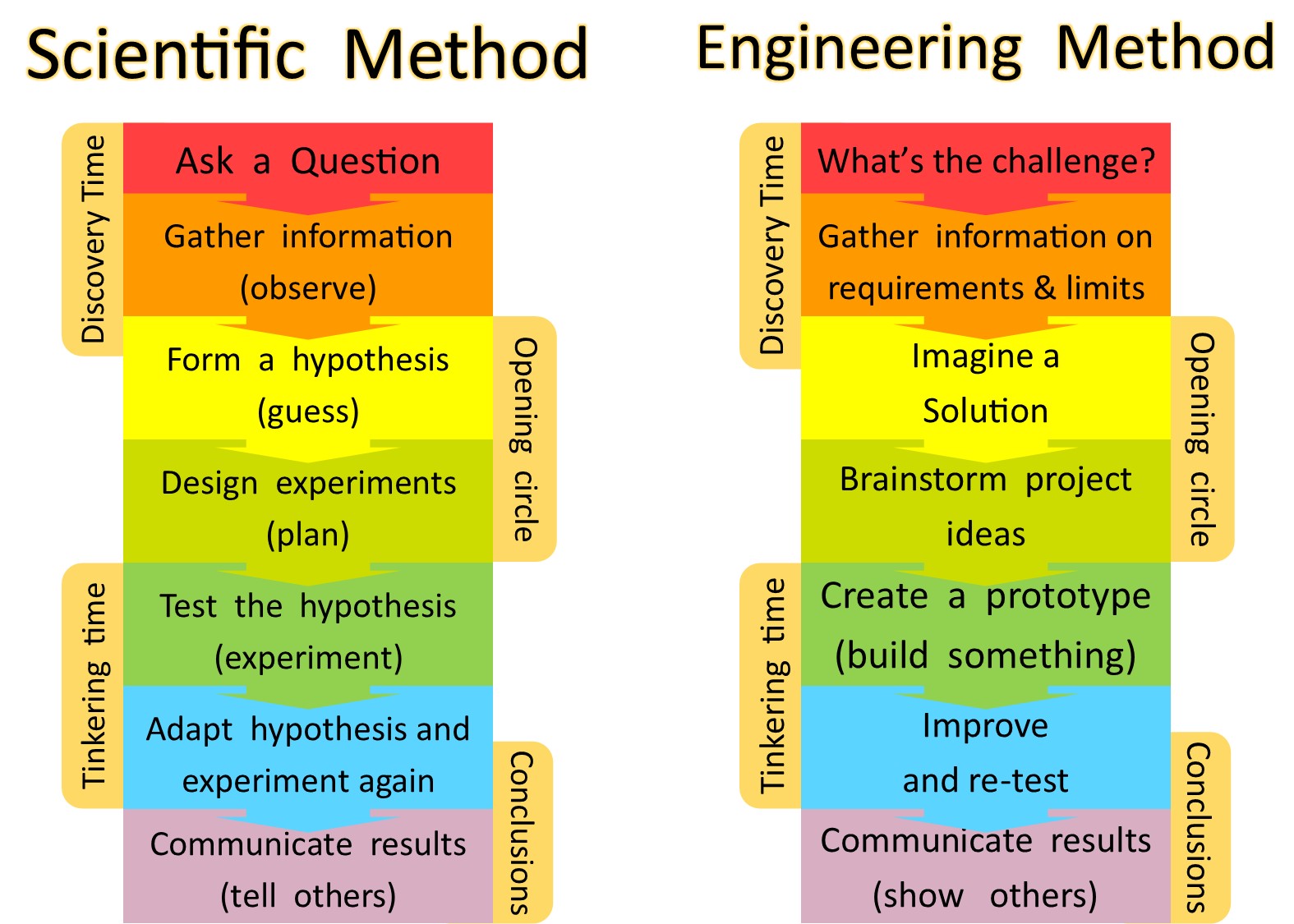
I teach a Family Inventor’s Lab, a STEAM enrichment class for ages 2.5 – 7. However, this class structure could work for any play-based preschool / early elementary classroom.

We have designed the flow of the class so we begin with letting the children explore and discover on their own, making their own connections, and discovering their own questions before we give them any answers. After that, we talk about some big ideas, then send them to play with those ideas some more, then re-gather to share their conclusions. The maps above show the relation of this class structure to the scientific method and to an engineering process. Let’s look in more detail about how this works.

Set-Up: Before class, the teachers have set up a variety of hands-on activities related to the theme. They always include: building projects, toys for free exploration, art projects, some big motor activity, a sensory table and/or a water table, and books on the concept.

Discovery Time: The first twenty minutes is “discovery time.” We let the kids explore freely, trying things out hands-on, noticing patterns, and making their own connections and interpretations before we present the concepts of the day. Some children come in with a lot of prior knowledge on the day’s topic (like our resident paleontology fans on dinosaur day!) and quickly build on that knowledge. Others come in with virtually previous exposure to a concept, and are really creating connections from scratch. They are “gathering information.”

Opening Circle: We then have an opening circle with all the kids combined (up to 24 kids, ages 2.5 to 7). We ask them to share what they’ve seen and done. We ask them what they think the theme is and how the activities connect to it. After we’ve first grounded in what they’ve discovered, we introduce the key concepts of the day, and talk about the other activities we’re doing. Sometimes we’ll give them a challenge to work on during tinkering time.

Tinkering Time: They return to the activities with fresh information and interpretation, and have 30 more minutes to explore more, tinker more, and test out ideas.

Teachers encourage kids to test ideas, then adapt them a little, then test them again, to learn more about the topic. We also ask questions which extend learning.

Outside Time: We have fifteen minutes on the playground. We often have more ideas related to the theme that they can explore outside. But this is also a little time to just run off some steam, so they come back in better able to relax and attend to opening circle. (Learn about the mood and concentration benefits of outside time here.)

Conclusions Circle: In closing circle, we talk again about: what did you observe, what did you build, what did you test, what did you learn? We do more activities related to the theme, often including a book on the topic to wrap up the day’s concept.

A few days after class, parents receive an email, which often has follow-up activities they can do at home, or pointers to this blog to learn about activity ideas we had but weren’t able to fit into class time or logistics.

We find that beginning with hands-on discovery raises the children’s engagement. Kids are naturally curious, but this format specifically harnesses that curiosity as a learning tool. They arrive to the opening circle open and ready to learn more. If we started by “teaching” them, they wouldn’t learn as much.

Check out this great article: What’s Going On Inside the Brain of a Curious Child. (It’s from KQED’s Mindshift series which is full of fascinating stuff about how we learn!)

Discipline is grounded in Relationship

scribble

Last night, in a class discussion about discipline, we were sharing examples of discipline challenges. One mom said sometimes when she puts out paper and markers, she tells her child he needs to keep the markers on the paper, and not draw off the edges of the paper onto the table. Yet, he often draws off the edges, looking up at her to see her reaction.

There are several possible responses to this situation: You could change the environment to make it easier for him to succeed: place a big piece of newspaper under the art paper so if he draws off the edges it doesn’t matter. You could create a game that makes it easier to succeed by telling him what to do: “I drew a big turtle here. Can you color in the turtle’s shell? This is a re-direction: telling him a different activity to focus on with the same objects. And you can “catch him being good” by noticing what a good job he does of staying on the paper most of the time. You could use substitution – giving him different materials to do the same action with. “I see you really love doing big giant scribbles. We can’t do that on the table. Let’s get some chalk and go draw on the sidewalk.” (Or water to paint the fence with, or a giant piece of paper on the floor.) You could model by sitting next to him and drawing yourself. You could think about whether he’s developmentally ready for the task: maybe he’s just not old enough to keep the marker on the paper reliably. If you think it’s purposeful misbehavior (not just that he’s young and goes off the paper by accident) you could set limits and consequences: “It’s not OK to draw on the table. If you do it again, I will need to take away the markers and paper.”

So, which one of these possible actions do you do? What will work best in the short-term and the long-term to move your child toward behaving like you want him to? (This being the goal of discipline.)

The answer: it depends.

Temperament: I often say that the type of parenting your child needs depends on their temperament. For example, for most children, it works well to put on your voice of authority in discipline situations and speak sternly to them so they know you’re serious. But, there are a few children who are easily distressed by a stern voice or strong words (possibly those whose love language is words of affirmation). They will feel ashamed or anxious if you use this tone. They may instead need you to be gentle and say quietly “I love you and I’m concerned about you. How can we help you do better?”

Motivation: I also think that what form of discipline works depends on your motivation and your child’s motivation. For example, if you really want your child to love doing art, you might think about ways to do art that don’t make messes that trouble you, so you might take your child and the chalk and go outside. But, if your motivation was to get your child to sit still for just a minute while you cook, then you may try something other than an art project. If your child loves doing art, then the consequence of “I will take away the markers” would be a big motivator to try to do things differently. But if they’re not that motivated to do art, then they’ll probably just continue drawing on the table so you will take the markers away and maybe give them something they think is more interesting to do.

For more thoughts on motivation, read this post on Motivation, Punishment and Reward.

Relationship: But today, as I thought about temperament and I thought about motivation, I realized that really the key to deciding which discipline tool will work for you and your child in the moment is Relationship.

  • Relationship helps you understand their temperament and know how you need to adapt your message so they hear and respond to it.
  • Relationship helps you understand their motivations. If you know someone well, then you will know whether it would be more effective to say “if you can do this [good behavior], then you can have this [thing you want]” or “if you continue to do that [bad behavior], I’m going to have to enforce this consequence you don’t want.”
  • If you have a loving and trusting relationship, they will believe you when you say things like “I love you. But that behavior was not OK, so I needed it to stop. I know you can do better in the future.” If you have to enforce consequences, they’ll know that they weren’t done out of anger or lack of love for them, but were instead done to help motivate them toward better behavior.
  • If you have a positive relationship and positive expectations for your child, they will want to live up to those expectations and be worthy of your respect.

Effective discipline needs to be based in a consistent, reliable, respectful relationship.

There are some “discipline tools” which don’t honor this. For example, any discipline that involves shaming your child doesn’t come from a positive relationship place. “You are so bad. You know not to do that but you keep on doing it because you’re a bad kid.” Shame might re-direct their behavior in the short run, but it doesn’t lead to them feeling good about themselves or about you. Another example is physical punishment, such as spanking. Physical punishment done in anger is very frightening to a child and very damaging to a relationship. But even well-reasoned, “logical” punishment is not the best discipline tool. It does work to change behavior in the short-term. But, it doesn’t motivate the child to do better in the future, especially when the punishing parent is out of sight. So, in our example from above: if every time a child drew on the table, you slapped their hands, they would probably stop drawing on the table. But, they would have less trust in you, and consider art and drawing to be stressful and unpleasant activities.

Instead, it is best if discipline comes from a place of: “I love you and I want to help you grow up to be a good person. I know that you’re still figuring out what that means, and testing your limits, so you’re going to do bad things sometimes. That’s normal… but it’s not OK. When you do bad things, I will stop you, and I will tell you how to do better in the future. Because I know that you can be a good person.”

Because relationship is so key to discipline, remember this: No matter which discipline tool you use to respond to a situation, the very first thing you need to do is connect to your child: get down to their level, look in their eyes, or touch them gently. Make sure you have their attention. Then you can re-direct, or substitute, or set limits, or whatever. And they will hear you, and remember that your request comes from the relationship: you love them and you want them to be safe and successful. To remember this step, use the mantra: Connect to Correct.


photo credit: Sam’s first mastrpiece (recto) via photopin (license)

Discipline Tools Posters

When discussing Discipline, I use a tool I developed called the Discipline Flow Chart. It covers 6 steps:

  1. Prevent Behavior Problems
  2. When a problem begins, decide whether intervention is needed. (Pick your battles.)
  3. Instead of telling your child “Don’t Do X” or “Stop Y”, tell them what TO DO. A young child is often not able to think of alternatives, so tell them a positive action to take, and that’s often all you need do.
  4. If the problem is escalating, or is already at the point where more direct intervention is needed, let your child know a) what the problem is, and b) what the consequences will be if the problem continues.
  5. If the problem is at the point where immediate intervention is needed (especially if there’s imminent risk of harm to someone or something), then immediately enforce consequences: either remove the child from the situation, or remove the problematic item from the child.
  6. Move on. Let your child know that you still love them, but that their behavior was not OK, and you won’t let them do it now or in the future. Give a hug, and let it go.

Students asked for a poster to summarize this, so here’s the Discipline Flow Chart Mini Poster. I also have posters I hang in class, and students asked for a mini version of the discipline tools posters