Author Archives: Janelle Durham

Unknown's avatar

About Janelle Durham

I am a parent educator and social worker, and teach music and science to children age 1 - 8.

Do the ASQ Screening for Your Child

stick

Why do a developmental screening?

Developmental screenings are a helpful tool for making sure your child is on track with their development. They are a “snapshot” of how your child is doing at this moment. They’re helpful even if you’re pretty sure your child is on track, because they help you get ideas of where to focus your attention in the short-term to make sure they’re well rounded. They’re especially helpful if you have any concerns about your child’s development – a screening tool can either reassure you that they actually are on track, or can verify that they have some challenges that you should seek support for early on.

Developmental delays, learning disorders, and behavioral and social-emotional problems are estimated to affect 1 in every 6 children. Only 20% to 30% of these children are identified as needing help before school begins.(Source)

The ASQ

There are several great screening tools and resources for understanding child development. Today, I’ll walk you through the ASQ – the Ages & Stages Questionnaire, a free online tool, using a method that’s been proven through research with tens of thousands of parents. (Learn more about the ASQ.)

It looks at how your child is doing in five areas: communication, large motor, fine motor, social-emotional, and problem-solving. Learn more about these developmental milestones.

Doing the questionnaire likely takes 15 – 20 minutes. It’s easier to do on a laptop or desktop than on a mobile device. It’s best to do it when your child is around so you can check their skills if there is any answer you’re not sure about. And it’s best if they’re rested, fed, and relaxed so they can show you their best skills. That said, it can also be helpful if another adult is around to help you with distracting the child while you’re filling out questions and can help you figure out answers to questions you’re not sure about.

Note: Some parents choose to download the questionnaire and print it to fill in off and on over the next week, then return to the website to enter their results online so that it will do the scoring for them.

Completing the Online ASQ

Go to https://osp.uoregon.edu/home/checkDevelopment. Click on “Let’s Get Started”

On next page click continue – on next page click to agree to terms and continue, then enter date of birth. Then you’ll get a screen saying something like “For ages 25 months through 28 months – 27 month ASQ” – this is making sure you’re using the right checklist for your child’s current age.

Continue to online questionnaire. (Or download it to fill out by hand and then return to the website later.)

There will be a page where they ask about demographics – ethnicity, education and so on – they ask this because the people who are offering this survey are doing research on who uses the tool, and this is helpful to their research process. They do not do anything with this data which would violate your privacy, and you won’t get any emails from them except the results of this screening.

The next screen will be instructions – they’ll tell you that you need to try every activity with your child before marking an answer – that would be ideal, but you don’t have to… if you know your child can do something easily, it’s OK to just mark it yes. On things you’re not sure about, do have your child try it.

On the questionnaire, you’ll be asked 30 questions – 6 questions per category in 5 areas of child development. You’ll mark “yes” if this is something your child is definitely capable of and has done successfully multiple times. If they have done it a few times or they can sometimes do it but not always, mark “sometimes”. If they’ve never done it, mark “not yet”. The way the survey is designed, we might expect a not yet or a couple sometimes in any given category, so don’t worry if you’re seeing some.

Mark answers as accurately as you can – this screening is not about “making your child look good” – it’s about getting an accurate assessment of where they’re at.

Then there will be a few general questions, like does your child hear well, do they have vision problems. It’s OK to fill those out or to skip them.

Then it will say something like: “For ages 21 through 26 months (24 month ASQ:SE). The ASQ:SE-2 asks simple questions about your child’s behaviors. Before continuing, please read instructions…”

This second questionnaire, the ASQ-SE, is optional. I would say: if you feel like your child has more behavioral challenges than the average child, or more big meltdowns / tantrums, or doesn’t connect to you and others like you see other children do, or there are other things that make you worry that your child may not respond like other kids do, then do this questionnaire. If not, you can choose to skip it. This questionnaire takes 5 – 10 minutes.

Enter your email address to receive results by email. (If you’d prefer not to give your email, then click to skip this step, and it will take you on to a page where you can “download your ASQ Results letter”)

Understanding Your ASQ Results

Your results will look something like this:

Results for your child BXD born on November 23, 2016
Your child’s development appears to be on schedule at this time.
On schedule Communication, Gross Motor, Fine Motor, Problem Solving, Personal-Social
Monitor None
Not on schedule None

or

Results for your child BXD born on November 23, 2016.
ASQSE Social-emotional development is in a monitor area at this time.
Overall Section You noted a concern in this section. See below for follow-up ideas.

Note: if you had a paper version of the questionnaire, results look like this:

tally

The white zone is “on schedule”, the gray zone is “monitor” and the black zone is “not on schedule.”

If your child shows as being “on schedule” that’s good news. This test rarely has any “false positives.” If a developmental screening shows that a child is on track developmentally, we can be pretty reassured that all is well. You can just keep doing what you’re doing with them. Or, if there’s one developmental area where you had more “sometimes” or “not yets” then you may choose to do more activities in that area to ensure they stay well-rounded. For example, if you didn’t mark “yes” on all the large motor questions, then spend a little more time at the playground, pool, or gymnastics or dance classes so they can run, jump, kick, throw…

If your child has some things marked as “monitor” – I think of those as “grey areas”. This test can have “false negatives” where the test shows a possible problem, and it turns out that all is well.

If I see “monitor” in one area, that makes me go “hmmmm…. I wonder why.” Here are the questions I ask myself

  • Can they do similar things? The first thing I do is look back at the questions in that section and how you answered them. (The questionnaire with your answers marked will be attached to your email, or you can find it by clicking on “download your completed ASQ”.) Sometimes there were just super specific questions, for example, there’s a fine motor question of “does your child flip switches on and off” or “can your child string beads on a string” and you said no just because they happen to have not ever done this… but think, are you confident that they have enough fine motor skills that they could do something like that? If so, then there’s no reason to worry about it.
  • Is there something about that question that doesn’t apply to their experience? All standardized questionnaires have some biases or assumptions. For example, there are questions about climbing stairs, and there are children who grow up in a town with no stairs. There are questions about forks and some families tend to only eat finger foods or they use chopsticks so may not use forks at home. When the mother of one of my students was doing this questionnaire, and she showed her daughter the incomplete stick figure drawing in the illustration at the top of this post, her daughter said it showed a teacher. This may not make sense to you, but if you’d met me, it would make sense! (I have one leg and this child knew me well as her first teacher.) If the question doesn’t directly apply to your child, again ask yourself “do they know similar things?”
  • Is there a reason they might be behind in this particular area of development at this particular time? For example, if you are a bilingual or trilingual household, your child might test as “behind” in language in ONE of those languages. But if you think they have solid language skills in BOTH languages, I wouldn’t worry. If you tend to solve problems for your child whenever they get frustrated, they might be “behind” in a problem solving skill, like getting themselves dressed. Or sometimes kids are behind in large motor skills in the winter time just because we haven’t been playing outside where there’s room to run.
  • Is there a reason why they might be behind overall right now? If you’ve had any big stressors in your family recently like a move, a new baby, a death in the family, a divorce – these are all things that might have distracted your child’s learning temporarily.

If you find answers to these questions that satisfy you, it’s likely that all is well and there’s no reason to worry. It wouldn’t hurt to put some extra effort into building your child’s skills over the next two months, and then do another screening just to be sure.

If you’ve taken all of these questions into consideration, and your child still seems to be missing some skills, then definitely work on building those skills (see below) and do another screening in a few months, or seek more information now.

If your child is marked as “not on schedule” in one or more areas, you definitely want to explore it more. Ask yourself the questions above to get a clear understanding of the results, then consult with your child’s doctor, teacher, or another professional to learn more. It is possible that when you investigate more, it will turn out all is well, or there is only a very temporary delay. But it’s important to check to be sure, because if a child does have any developmental challenges, the sooner they get extra support, the better.

Resources if you’re concerned about your child’s development:

Resources to build all kids’ skills

Whether your child is on schedule, not on schedule, or in that gray area of “monitor” they will benefit from diverse learning experiences. I have lots of articles on Play and Fun Activities on this blog. Or check out:

Note: Easter Seals also offers the ASQ online for free: www.easterseals.com/mtffc/asq/. Theirs works just fine as an alternate, I just prefer the uoregon site listed above because Easter Seals asks for more of your private information (name, address, phone number) and will add you to their mailings.

Ages & Stages Questionnaire

How ASQ works

The Ages & Stages Questionnaire, or ASQ, is simply one of the best tools available for developmental screenings of children from birth to age 5. It has been in development for about 40 years and tested by tens of thousands of participants.

You can purchase questionnaires, or it is now available as a free* online screening tool at https://osp.uoregon.edu/home/checkDevelopment.  A parent may complete it by themselves, or it can be done with a professional. (Parent educator, social worker, child care worker, physician…)

Completing the questionnaire

First, you choose the correct questionnaire for the child’s age: they’re in two month increments for the first two years (2 months, 4 months…. 24 months), then every 3 months (27, 30, 33, 36), then every 6 months (42, 48, 54, 60).

The parent fills out the questionnaire. It asks six questions in each of five realms of child development: communication (what child understands and what they can say), gross motor (running, climbing, throwing), fine motor (hand and finger coordination), problem solving, personal-social (self-help skills and interactions with others).

The form asks simple questions, like “If you point to a picture of a ball (kitty, cup, hat, etc.) and ask your child, ‘What is this?’ does your child correctly name at least one picture?” The parent answers the questions yes, sometimes, or not yet. They are encouraged to try things out with their child as they go through the questionnaire, so they can see what their child’s abilities are for sure.

There is an additional optional questionnaire called ASQ:SE which assesses social-emotional development, such as autonomy, compliance (ability to follow directions), adaptive functioning (sleeping, eating, toileting), self-regulation, emotional affect, interaction (ability or willingness to respond to others), social communication.

Results (and how they’re calculated)

With the online questionnaire, the parent receives a report which lists which categories their child is “on schedule” with, where they should “monitor” and if there are any categories where the child is “not on schedule.”

To give professionals a little more insight into the calculations that lead to these categorizations: The results are scored 10 points for every yes, 5 for sometimes, 0 for not yet, so a maximum of 60 points per category. On the written test, you would then tally it on a table similar to this:

tally

If the child scored as we would expect for a child of this age (on the example above, this would be a score of 40 or higher on problem-solving, shown in the white/un-shaded area of that row), then the child’s development appears to be on schedule. If they scored close to the cut-off (in the gray area, shown as 35 or 40 points on the personal-social row), that would be something to monitor. If they score below the cut-off (a unique number for each category of each questionnaire), then further assessment by a professional is recommended.

This is a screening tool, not a diagnostic tool. If all looks well for the child (all scores are in the white area or the online tool says “on schedule”) then we can be assured that they are likely well on track. If they’re in the gray area / “monitor”, then we ask more questions to figure out why. If there’s a good explanation, then the score probably is not a cause for worry, but you could recommend adding activities to build the child’s skills in those areas and re-screening in a few months. If they’re in the black area / “not on schedule” consider referrals to more resources. The Oregon website offers this helpful ASQ Review Guide to help you determine next steps.

These videos for providers offer more information about how to use the ASQ with parents.

Follow-Up

It’s most effective when this tool is used as the beginning of a conversation with parents. After completing the tool, what do they see as their child’s strengths? Do they have any concerns about their child’s development? Did the screening reduce those concerns (they discovered the child is actually on track) or increase them (child is shown as monitor or not on schedule)? What are some next steps they can do to help their child’s development?

On my post for parents about how to complete the ASQ, you can see how I talk with parents about interpreting their results – whether to worry, how to seek help, etc.

If they completed the online questionnaire, their emailed test results will include links to age appropriate learning activities and play activities.

* The screening is free for parents. Since I know the ASQ is a product that is sold, and is fairly pricey, I wanted to be sure I wasn’t violating copyright by promoting use of the online tool. The website is for the Oregon Screening project, so  I have looked for legal terms on the site to see whether they limit its use to Oregon residents or in any other way, and all I have found is “This site is open to all parents of children ages 1 month up to 72 months.”

The screening is also available free at Easter Seals: www.easterseals.com/mtffc/asq/. I prefer the Oregon screening project, because Easter Seals asks for all of the family’s contact information and will add them to their mailing list.

Kids Do Well If They Can

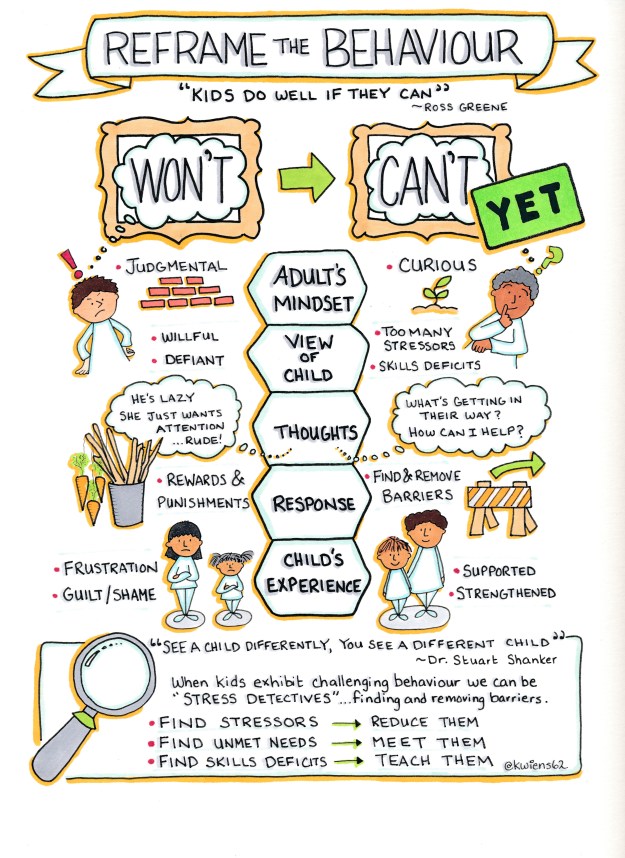
To resolve problem behavior in children, first attempt to figure out why the behavior is happening. A key question to ask yourself is: are they capable of behaving better? Dr. Ross Greene argues that “if your child could do well, he would do well… If your child had the skills to exhibit adaptive behavior, he wouldn’t be exhibiting challenging behavior.”

Let’s contrast this “kids do well if they can” idea with another common philosophy, which Greene calls “kids do well if they wanna.”

Kids Do Well if They Wanna

If a child is not doing well, this model assumes that it’s because they don’t want to do well. So, that implies that the parent/teacher’s primary job is to make him want to do well. Typically that would lead to rewarding the behaviors you like, or punishing the behaviors you don’t like. If you’re right and he IS capable of doing it, then this may work. If he’s not capable of doing well, all the rewards and punishment won’t change that. The problem behavior might not improve or might even get worse.

Under this model, you first ramp up the punishment, and if it still doesn’t work, you may decide his behavior is fully intentional… maybe he’s trying to manipulate you or get attention or test limits or maybe he’s just lazy and unmotivated. If you start assuming this kid is a bad kid who intentionally misbehaves, his behavior will not improve.

Kids Do Well If They Can

What happens if we instead assume that kids want to do well, but sometimes they aren’t yet able to? Here, the parent/teacher’s primary job is to figure out what’s getting in his way and how to help him get past it.

Instead of jumping ahead to fix the behavior, first figure out what the core issue is. What’s hard for them? Think about the environments / situations where the challenging behavior appears. What are the stressors in that environment and how could you reduce them? What skills are they lacking that would help them to be successful there? How can you teach those crucial skills? What unmet needs in the child might be causing this behavior? Can you address those?

Here’s a nice infographic (source: https://self-reg.ca/infographics/ ) that summarizes these models.

reframe-behaviour-growth-mindset-edition

Learn a lot more about this idea, and about Greene’s model at https://www.livesinthebalance.org/walking-tour-parents which includes several helpful videos of Dr. Greene sharing his ideas.

What’s the Best Summer Camp?

20180803_222448381_ios

Each year around this time, parents start asking me about summer camp. They want to know which are the best ones. Just like with choosing preschool, I can’t give you a simple answer. Because what’s “best” depends on what your needs or goals are.

So, I recommend that before you look at camps, you first answer these questions for yourself. [Note: at the bottom of this post, I recommend camps my family has enjoyed on Seattle’s Eastside, so local folks may want to check those out!]

Needs

What are your basic logistical needs?

  • Scope: Do you need full-time care all summer while you work? Or full-time care for a few weeks so you can focus on adult projects? Or part-time enrichment camps that leave the afternoons for free play? (I know families that when they visit the grandparents, they enroll the children in a part-time day camp, which may be more fun than hanging out at the grandparents’ house all day, and allows the adults some time to do adult activities.)
  • Schedule: What time would it work for you to drop off? What time can you pick up?
  • Location: I’ve often enrolled my kids in camps that are quite a ways from home. (Like wilderness camps and farm camps that were both about 40 minutes from our suburban house.) It works for me, because I just bring my laptop and while they’re at camp, I sit at nearby parks or coffee shops and get my work done. But you may prefer to stick closer to home or your workplace.
  • Cost: Costs range a lot! And it’s hard to compare costs between camps, as some camps are 5 hours long, some 6, some 7…  For example, even within the one Parks department, for a 7 year old, the hourly cost could be anywhere between: $9 per hour for theater or ballet camp to $11.50 for Lego/STEM to $22 per hour for pottery camp (high materials cost, I’m assuming.) If you need full-time care, the hourly cost matters. If you’re just looking for an activity focus for a week, and don’t necessarily need 6 – 8 hours of child care, maybe the total cost is more important. The Lego camp is $400 a week (9 – 4 each day), and the pottery camp is $242 a week (10 am – 12:30 pm).
  • Age requirements. There are plenty of camps for age 6 – 12. It’s harder to find camps for little ones, and if you do, they tend to be EITHER full-time child care OR very short – a few hours at a time.

Goals

The next question is what are your goals for having a child attend summer camp?

  • Is it just about child care while working? You may choose to have them attend the same camp every week all summer because having that routine is easiest for you.
  • Is it about summer fun? You may choose camps that emphasize being outdoors and playing, or you may send your kid to the same camps their buddies are going to so they have built-in friends.
  • If you want to expose your child to lots of different activities to broaden their life experience, you may dabble through a: farm camp, wilderness camp, theatre camp, art camp, science camp, and multi-sports camp all in one summer.
  • Is there something you want your child to learn that you’re not able to teach? (Bike camp for me!)
  • Do you want a church-based camp, or a scouting camp?
  • Or do you want a family camp that you can ALL attend together?

Each family may have unique goals for each child.

Limitations: You should also keep in mind if your child has limits to what they can do. My youngest is autistic. He’s also very bright, so he can do so well at a camp that the staff  never realizes his challenges. But he has limits… and when he passes those limits, he has giant meltdowns. So, he does best when I enroll him in half day camps, not full day, and when he is one of the oldest kids in the program rather than one of the youngest so the social/emotional expectations are set at a lower developmental level. Know your child, and choose camps that set them up for success. (Note: there are camps that offer a few sessions each summer that are sensory friendly and have higher staffing levels, and there are also specialty camps that are solely for kids on the spectrum and that really focus on social/emotional skills – those can be a good match for some families’ needs.)

Research your options

Check out your parks department, and those in neighboring cities. Check the Boys & Girls Club, Campfire, Boy Scouts and Girl Scouts. They tend to offer LOTS of different camps, in lots of interest areas and locations and may be fairly affordable options.

Your city may have a summer camp fair (in the Seattle area, ParentMap has offered camp fairs in February and March where you can discover lots of options for summer camps). 6 Crickets is a camp directory. Check ads in local parenting magazines – but  there are lots more great programs that can’t afford to advertise, so also get word-of-mouth recommendations. Ask your friends, family, parents of your kids’ friends, and parents at the playground about what camps they have loved (or not).

Once you’ve collected names of interesting options, you can do your research online to learn more. Look at their websites and Facebook pages, and also search to see what else other people say about them online. (Always remember with online reviews, the people most likely to submit a review are the ones who are mad about a bad experience – anger motivates action. They’ll mark one star. The second most likely are the ones who had unusually amazing experiences they want to share in five star reviews. But there may be 100’s of other people who had perfectly fine experiences who don’t get around to posting their 4 to 5 star reviews.)

Questions to Ask

Things to look for when you’re researching your options:

  • What is the typical schedule for the day?
  • How much is structured activity and how much is free play?
  • What activities does your child participate in?
  • How many children attend? What is their adult to child staff ratio?
  • What experience / training do those adults have? (Note: the vast majority of staff at ALL summer camps are college students, age 17 – 22, with one or two years of summer camp experience.)
  • What backup staff is available in case unexpected challenges arise at a camp site? You may not be able to find this info online, but it’s helpful if they do have this. (I had one camp we went to the first week of their season and it was the first year they’d used that site and the young, inexperienced staff faced some unexpected challenges without experienced folks on-site to back them up… the senior staff got there, but it took them a while – I’m now inclined to choose long-established camps for the beginning of the summer, and save those “start-up” experiences for later in the summer when they’ve worked out the bugs.)
  • Do they have an indoor option in case of weather problems (too wet, or too hot)? I don’t find this a necessity but some parents really don’t want their children out on a really wet or really hot day.

After you go through this process, you’ll have a lot better idea of what you’re looking for in a good summer camp. And one of the nice things about summer camps is that they’re only one week long. It’s a lot less pressure than choosing a school for a full school year. I figure it’s easy to just try it out for a week, and if it’s great, we return every year, if it’s not, it’s a learning experience we move on from.

Camps We Have Liked

Sometimes when I offer parents ‘more questions to ask’ instead of answers to their questions, that can be frustrating. So, here are some recommendations of the “best” summer camps my kids have attended over the years. (All on the Eastside of Seattle metro / King County)

These are  my personal experiences as a parent, not representative of the views of my employers (Bellevue College and Parent Trust for Washington Children.)

My logistical needs for location, cost and schedule were always fairly flexible, so I was able to prioritize my goals of broad learning experiences for my kids. I put them in part-time summer camps most weeks of each summer, because I find I’m the best parent to my kids when I have a few hours to myself each day to work on my projects – that energizes me to come back for a great afternoon with them – going on hikes, swimming, picnics, and more.

Here are camps that my younger child has attended recently and enjoyed (most are camps my older kids also went to years ago.)

  • Studio East. Theatre camps for ages 4 – 19, held at multiple locations in Kirkland. Kids spend a really fun week learning dance, music, lines, and more, and put on a show at the end of the week. Theatre education is also great for social skills, emotional intelligence and teamwork. They really encourage creativity and include kids’ ideas in the experience.
  • Pacific Science Center camps. We’ve tried lots of science camps. PacSci’s are the best, I think, for science learning. They offer lots of themes, in multiple locations throughout King County. Staff is well-trained, and curriculum well-developed. PreK through grade 8. What I don’t love – they’re pretty indoors and pretty structured for a summer camp experience. And most of their camps are full day (9-4). [My child is autistic, and that long of a camp was simply more than he could handle when he was 5 – 8 years old. So, he tended to make it through Monday to Wednesday of a PacSci camp, start melting down on Thursday and on Friday they ask me to take him home partway through the day. I love that they’re starting to note “sensory-friendly” camps on their schedule that are a better match for kids with autism or sensory issues. I wish they’d realize that a shorter schedule would also help.]
  • Wilderness Awareness. Day camps for ages 4 – 13, overnights for 11 – 18. Day camps in Kenmore, Issaquah, Seattle, and Carnation. Nature games, story-telling, songs, hikes in the woods, animal tracking, and more.
  • Pedalheads. Because of my disability, I’m not able to teach my son to ride a bike, so I love having a bike camp option. They offer everything from 60 minute long camps for 2 – 3 year old beginning riders to full day camps for older kids with strong skills. I know many parents who had a 5 or 6 year old who started the week not knowing how to ride, and was riding independently by the end of the week. My son went for one week at age 5 and ended that week still on training wheels. He went for a week at age 6, he could just barely ride without training wheels. But he still had a great time both weeks. Pedalheads also offers a Heroheads sports camp he has taken twice and greatly enjoyed. (The photo at the top was taken there.)
  • Skyhawks offers many sports camps at many sites. Many are focused on a single sport, but I really like their multi-sports camp. Although we’re a physically active family, we don’t really play team sports, so I like that my son gets to spend a couple weeks each summer being trained in baseball, basketball, and soccer skills so that if a buddy on a playground asks him to play he at least has a clue.
  • Family Camp. With my older kids, we thought about attending a family camp, like the YMCA camps at Camp Orkila and Colman, or Cascades Camp, or North Cascades Institute. But, we never did. Then, four years ago, we started attending Eliot, a week-long family camp for Unitarian Universalists. Partway through that first week, I looked at my partner and said “I guess we know what we’ll be doing for one week every July from now on.” It is a joy to spend a week at camp, singing, tie-dyeing, dancing, listening to Harry Potter under a tree, swimming in the lagoon, and re-connecting with people we see every year at camp, who range in age from birth to 90-something. We love family camp!
  • Some cooperative preschools offer a few summer camps each summer for ages 3 – 5. These can be especially helpful for young ones who are just about to start drop-off preschool or kindergarten to get them used to being without you at class. (I teach a summer STEM camp at Bellevue College for 3 – 6 year olds.)

My older kids did some fabulous camps that I haven’t revisited with my youngest, so I don’t have current info on them. But when my kids attended these camps (between about 1998 and 2013), they were fabulous:

  • Wolf Camp – a wilderness skills camp. Day camp for ages 7 – 13 in Issaquah or Puyallup. Overnight camps for age 9 – 17 around Washington State.
  • Shoo Fly Farm – a day camp which captures everything you would imagine summer childhood on a farm to include – take care of and play with farm animals, making butter and jam, tie-dyeing, and swinging on a tire swing. Registration tends to fill by the end of January.
  • DigiPen Academy – their Project Fun camps for k-12 teach programming skills for video game development. My oldest child did them as a teenager. (He’s now a paraeducator. My middle child who did fashion design camps is now a software developer… it’s interesting how our kids turn out!) They are very pricey.
  • Stone Soup Theatre Camp in Seattle, for ages 5 – 15.

Flexible Options:

  • Arena Sports – these win for the most flexible camp option! 5 locations. Half day OR full day, with extended care options, for ages 3 – 12. They play soccer and active games, they play on the bounce house. As a friend once described an activity: “it sweats ’em up good.” We would attend these on weeks when we had plans on some days but had other days free, and I wanted to have my child to have a chance to burn off some energy while I caught up on projects.
  • Steve & Kate’s Camp – It was held on the campus of Bellevue’s The Little School for many years – they’re now at International Friends School. The advantage is their flexibility. It’s a huge age range from pre-K to 7th grade. You don’t need to sign up in advance – once you’ve registered for the year, you just show up there in the morning, whenever you want to for as many days as you want to. And when kids are there, they have virtually complete freedom to choose from many different activities (film-making, bread-making, games, robotics, sewing). It’s a “free range” approach. Works great for many kids – I have a friend who says it’s an incredible opportunity for his daughter to learn skills and use her creativity! But for my kid, he basically sat in the “lounge” reading books all day. It was fine for days I needed child care, but it’s lot more expensive than Arena Sports.

We’ve also done various one-shot camps that were great but we never happened to return to. Like one year I visited friends in Portland for a week while my kids attended Do Jump circus camp. There were summers where my child’s interests of the moment led to Fashion Design or Nature Illustration camp. We  attended several camps sponsored by the zoo and our local parks departments. So, the ones listed here are just a sampling of what our family has done, but there are SO MANY MORE great options out there.

What have I missed? What other camps in King County have you had a good experience with? Add a comment below. (If possible, include with  your recommendation: what ages it’s for, where it’s located, and what you loved about it.)

And if you’d rather just spend time hanging out at parks with your kid, read my posts about local parks, or if you have a toddler too young for camp and need ideas for activities, check out cheap dates with toddlers.

And, a product recommendation to make every day of summer camp easier for you: I LOVE the Solar Buddies sunscreen applicator! (Amazon affiliate link.) You fill it with your favorite sunscreen and then just roll it on. So much faster for me, so many fewer complaints from my son, and I don’t end up going to work with hands all gunked up with sunscreen.

Teaching Language is Not Just About Saying More Words

The Oto Monitor

There is a new product called Oto – “the First Monitor for Your Baby’s Healthy Brain Development”. (Learn about it at https://www.oyalabs.com/)

They’re  electronic monitors you place around your home. The website says they use AI and Natural Language Processing to tally how many words a child hears, how many engaged, back-and-forth exchanges you have with your child, and the quality of your language including the ratio of positive to negative words.

If this were an academic study that I’d been asked to participate in with my child, I would absolutely say yes, because it would be fascinating to participate and see the research results!

But I’m a little troubled by the marketing of the device. It says “These indicators are proven to be critical for their IQ and emotional development.” The implication is that this device is essential for helping you ensure your child reaches their full potential. They also say “The number of words you speak to your child daily is a core metric – the more language, the better child’s outcomes.”

I worry that the parents who purchase this device would then become anxious, feel guilty when they weren’t talking, and become overly focused on talking and talking and talking to their child. This onslaught of words would be exhausting for me to produce as a parent and exhausting for a child to hear and may totally miss the point of how children most effectively learn language.

Bronson and Merryman (source) say “For years, the advice has been that the way to kick-start a child’s language learning was to simply expose kids to massive amounts of language. However, as we explain in our book NurtureShock, the newest science has concluded that the central role of the parent is not to push massive amounts of language into the child’s ears. Rather, the central role of the parent is to notice what’s coming from the child and respond accordingly.”
Let’s look more at what we know about language learning.

Can there be too little language in a child’s world?

capture

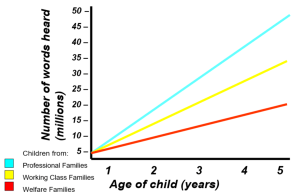
There are definitely “linguistically poor” households, and this can absolutely lead to significant “vocabulary gaps.” In general, children from households with lower income and lower family education know fewer words. (source of chart above) Some examples from research:

  • A child in a low income home will hear an average of 616 words in an hour, a child in an average professional home will hear 2153. (source)
  • In one year, children from poor families hear 250,000 utterances at home, while children from wealthy families hear 4,000,000.  (source)
  • By age four, middle and upper class children hear 15 million more words than in working-class families, and 30 million more than in families on welfare. (source)
  • By second grade, a middle income child will know ~6020 words. A low income child will know ~4168. (source)
  • By 18 months, toddlers from disadvantaged families are already several months behind more advantaged children in language proficiency. (source)
  • 5-year-old children of lower SES score two years behind on language tests. (source)
  • When 18 month olds were shown two objects, then one was named aloud, higher SES toddlers could identify the right object in 750 milliseconds, lower SES toddlers were 200 milliseconds slower to respond. That slower mental processing speed means they have a harder time keeping up with teacher’s words. (source)

Not only are there fewer words spoken in a lower income household, the discussions that do happen are likely to be focused on daily life, such as what to eat, work schedule, and other practical topics. They are less likely to have wide-ranging discussions around the dinner table on a variety of topics. The parents may also work multiple jobs, which means less opportunity for reading bedtime stories. This may lead to the same words being used a lot, and fewer novel words that broaden the child’s vocabulary.

Also, in single parent households or homes where one partner is away at work, it may be more likely that the television is on in the background much of the time, which leads to less engagement and conversation between parent and child. (Source)

A child who understands fewer words and has slower processing speed  when they begin school will not just start behind – they’ll stay behind. As the teacher talks and some kids understand all the words and all the concepts, and some kids can’t even understand the words used, they get lost before reaching the concepts. (source for graph below)

capture 2

So yes, if there are too few words being used in a child’s environment, that child can be word poor. And yes, that will create academic challenges. But, that doesn’t necessarily mean the answer is to just talk a lot more…

What Is Responsive Language?

Imagine two scenes.

  • A toddler is sitting and poking at her cheerios and poking at her spoon so it rattles on the table. The parent, wanting to be sure the child is receiving mental stimulation, talks about their day: “As soon as you’re done with your breakfast, we’re going to put your new red shoes on and we’re going to go for a walk, and maybe we’ll see some butterflies again. Remember, the last time we went to the bakery to buy bread and we saw two blue butterflies?” The child keeps poking at her food as the parent talks. “I’m going to get a book now – we can read it together.”
  • As the toddler pokes, she looks up at the parent for their reaction. The parent sits with the child and says “you’re poking your cheerios with your finger. You pushed them all into a big pile on that side of your dish.” As the parent speaks, they point at the big pile. The child pushes a few more cheerios into the pile. “Now there are five more cheerios in the pile.” Then the child pats the spoon. “You’re using your hand to pat the spoon. The spoon makes a fun noise, doesn’t it?” The parent pats the spoon and says “It’s going rattle, rattle.” The toddler rattles the spoon some more, parent says “rattle, rattle” again. Then the child holds up the spoon to show it to the parent. “You picked up the spoon – can you use it to pick up some cheerios?”

In the first example, the parent’s voice is mostly background noise for the child whose attention is focused on the cereal and the spoon. There is also the chance of “criss-cross labeling” where if every time the child touches the spoon, the parent happens to talk about butterflies, the child could get confused about whether the thing they’re touching is called butterfly.

In the second example, the parent closely observed the child’s actions and where the child’s attention was focused, then talked about that. This gives the child the words for what they are experiencing in the moment with all their senses. This builds a much stronger connection between the words and their meaning. When you talk about a spoon later, the child can remember this moment and remember what the spoon felt like in their hand and the noise it made on the table.

To some parents, it may seem like talking about cheerios and a spoon is boring. They may feel like they need to jazz up the child’s learning with talking about bigger ideas. But slowing down to your toddler’s pace and tuning in to what they are in the process of exploring offers a meaningful connection for their learning.

There are three characteristics of responsive language: it’s prompt (happens within seconds of the child’s behavior, it’s contingent (related to the behavior) and it’s appropriate (parent responds in a positive and meaningful way). (source)

So, if a child showed a parent a ball, the parent would quickly respond, “Oh, you have a  ball in your hand!” If the child said “ba”, the parent would say “Ball. Yes, it’s a green ball.”

Does responsive language increase learning?

  • One study showed that when parents were more responsive, their children would reach all these milestones sooner: imitating parent’s words, first words, speaking 50 words, combining words to make a “sentence” and talking about the past.
  • A parenting style that includes parental warmth, high expectations and clear routines is associated not just with language ability but also better memory and higher achievement. When parents use a lot of negative strategies, their children have more limited language skills. (Source)
  • Children who hear more child-directed speech – not just overheard speech – process language faster and learn words more quickly. (source)

Here is a summary of other research:

In the second year, when infants begin to understand and produce words and simple phrases, responsiveness predicts the sizes of infants’ vocabularies… the diversity of infants’ communications… and the timing of language milestones… Infants of high-responsive mothers (90th percentile) … achieved language milestones such as first words, vocabulary spurt, and combinatorial speech, 4 to 6 months earlier than infants of low-responsive mothers… Toddlers of low-responsive fathers were 5 times more likely to display cognitive delays than were toddlers of high-responsive fathers… fathers’ responsiveness to their 2- and 3-year-olds predicted toddlers’ cognitive and language abilities within and across time… (source – includes citations for all studies)

How can you use responsive language?

Dr. Dana Suskind, author of Thirty Million Words recommends three steps for parents and caregivers to expand a child’s vocabulary:

  1. Tune In by paying attention to what your child is focused on
  2. Talk More with your child using lots of descriptive words
  3. Take Turns with your child by engaging in his or her conversation. (source)

Additional recommendations:

  • The Hanen Centre says that step 1 is OWL: “Observe Wait Listen. The parent needs to give the child the opportunity to take that first turn, so that the parent has something to respond to.”  (Learn more about OWL – Observe, Wait, Listen.)
  • Their next step is follow the child’s lead: imitate what the child says, interpret (what the child would say if they had the words), comment (giving the child words to describe what they are doing) or join in child-directed play. (Learn more.)
  • Use parentese – that sing song higher voice parents use to talk to babies.
  • Use motion – point to things as you talk about them, touch them, shake them. All this helps the child focus their attention while you label the objects.
  • Talk about what they want to talk about (what they are doing or are paying attention to in the moment). Don’t change topics quickly.
  • Don’t interrupt their attempts to communicate with you. Wait for them to get their thought out. Look at their face to show you are listening.
  • Children also benefit from hearing lots of different people speak – at different pitches, tempos, and with different accents and facial expressions. So take them out in the world, so they have an opportunity to interact with diverse people.
  • Reading to your child is also a huge influence on language learning. Learn about how to read to a child and lots of other literacy topics.

Don’t feel like you have to talk all the time

For brain development in general, children need three things: novelty (new experiences), repetition (the chance to explore something over and over to learn about it in depth from all angles), and down time (restful periods without lots of input when they can process all that they’ve seen and heard). This is true of language too.

Children need new words, they need to hear the same ones over and over in different contexts, and they also need quiet time for their inner thoughts to unfold. It is fine to have long periods of silence at home too. Even if you choose to have an Oto monitor listening in.

Learn more about responsive language: