Tag Archives: toddlers

Music Books for Kids

Check out my recent post on sound books for the big picture on interactive books where kids press a button to play a sound. This post focuses on some great music-themed sound books. (Pressing a button starts a song, pressing it again stops the song.)

At the bottom of the post, I have a video, where you can hear a sample of what each of these books sounds like.
Disclaimer: Pirouette Kids sent me two of their books to review. This post includes my unbiased review of those books, and info on books from other publishers for comparison.

Pirouette Kids

Their focus in on “music beyond nursery rhymes”. They have four books at this time, the two I review below, plus World Music and Classical Music.

Some overall impressions: I like the size of the books – easy to pack, easy for small hands to hold. The pages are sturdy. The buttons to activate the music can be a little tricky for a child to spot for the first time, and activating them requires pressing precisely on them (a fine motor skill builder) but they work reliably. The speaker is on the back – so, if it’s laying flat on a surface, it is much quieter than if held upright. (That can be an advantage if you’re holding the book as you can adjust the volume a bit. If the child is using it lying flat on carpet, it’s pretty quiet.)

The books can be purchased on Pirouette’s website for $18.99 each.

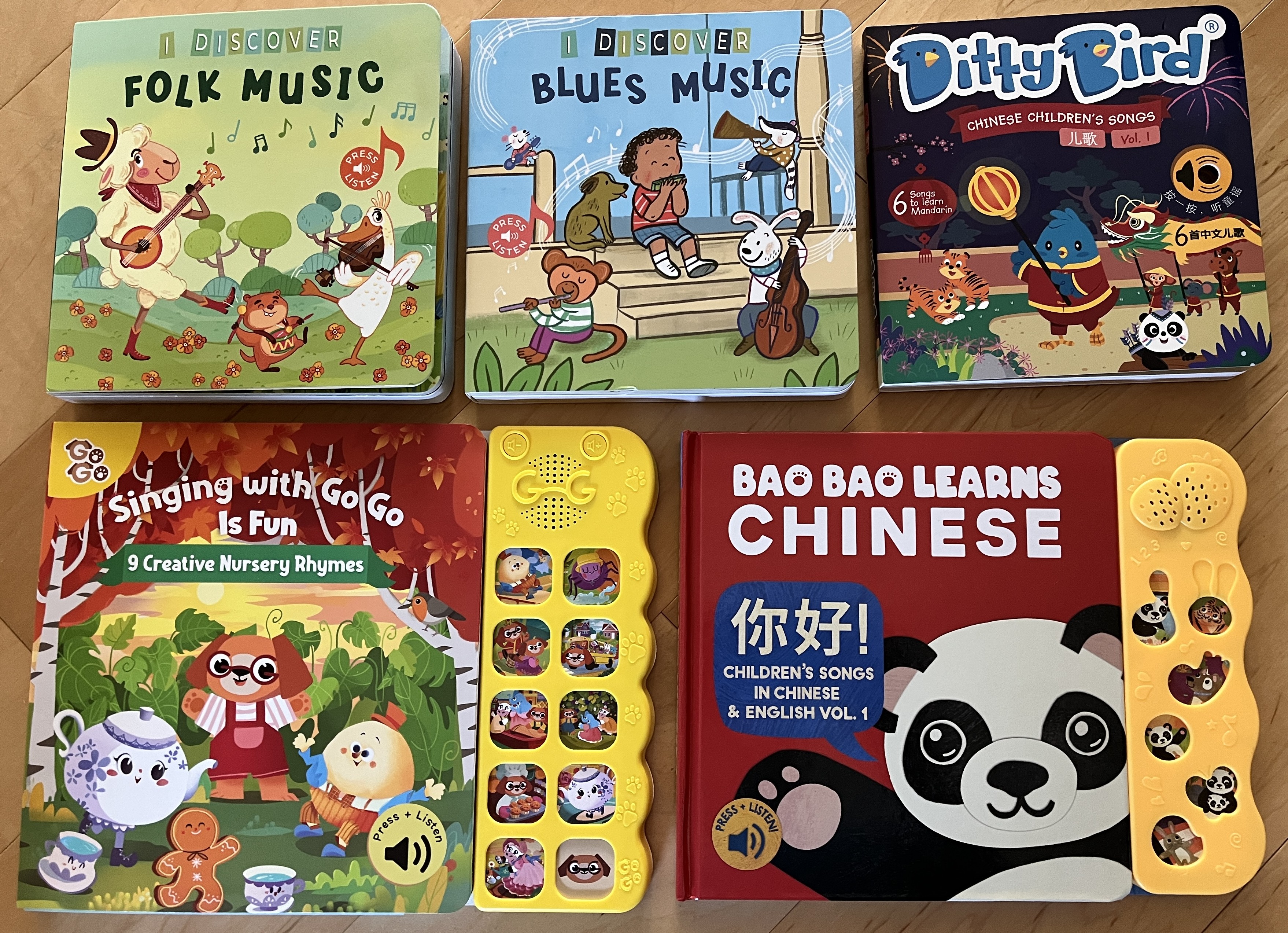
Pirouette’s I Discover Folk Music

This board book has snippets of 6 folk music tunes (Oh Susanna, This Land, Little Liza Jane, Sarasponda, Home on the Range, This Little Light). Each page has the lyrics for 3 or 4 lines of the song, and a button that plays a 15 second clip. They are all performed by the same musician – Daria, who is pleasant to listen to and not cutesy / chirpy as many performers are when doing children’s songs. The illustrations by Margarita Fomenko, which feature animals doing human things, are pretty cute.
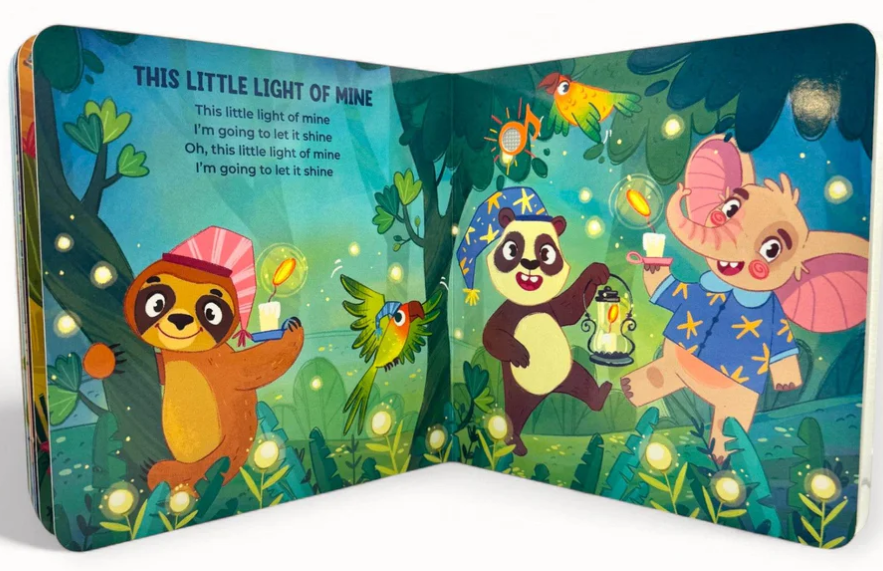
I like the choice of songs – it expands outside the typical kid songs repertoire but still all quite accessible. The 15 seconds is really short. It works OK on some songs, like Little Liza Jane feels complete on its own, but many feel like a song is just getting started then gets cut off abruptly. (They do have full versions of each song available on Spotify and there’s a QR code on the back of the book that takes you there.) For me as an adult who knows these songs well, they leave me feeling a little incomplete, and I wish they could wrap up a full verse or chorus. But that likely won’t trouble a child who is new to these songs.

Overall, it’s a cute book with nice tunes you might not find elsewhere, and I would recommend it.

Pirouette’s I Discover Blues Music

This book has snippets of 6 blues songs – recordings by original artists. There are 3 vocal tracks: Goodnight Irene by Jerry Lee Lewis and his band (1958), Careless Love by Big Joe Turner (1958), See See Rider by Louis Armstrong and Velma Middleton, and 3 instrumental: John Henry Blues by Erskine Hawkins and his Orchestra (1950), Old Stack O’Lee Blues by Sydney Bechet and Nicholas Blue Five (1949), Jumping at the Woodside by Buddy Tate and his Celebrity Orchestra. I love that they included the “real” versions of these songs, and chose songs that children are unlikely to be exposed to elsewhere (a few of these are even new to me, and I thought I had listened to a lot of old blues!) I love the John Henry Blues especially.

Illustrations by Sakshi Mangal are cute, and show animals doing human things. Since many of the songs are instrumental, instead of having lyrics on the page, they have information about the tune, and questions to ask a child. Here are two examples.
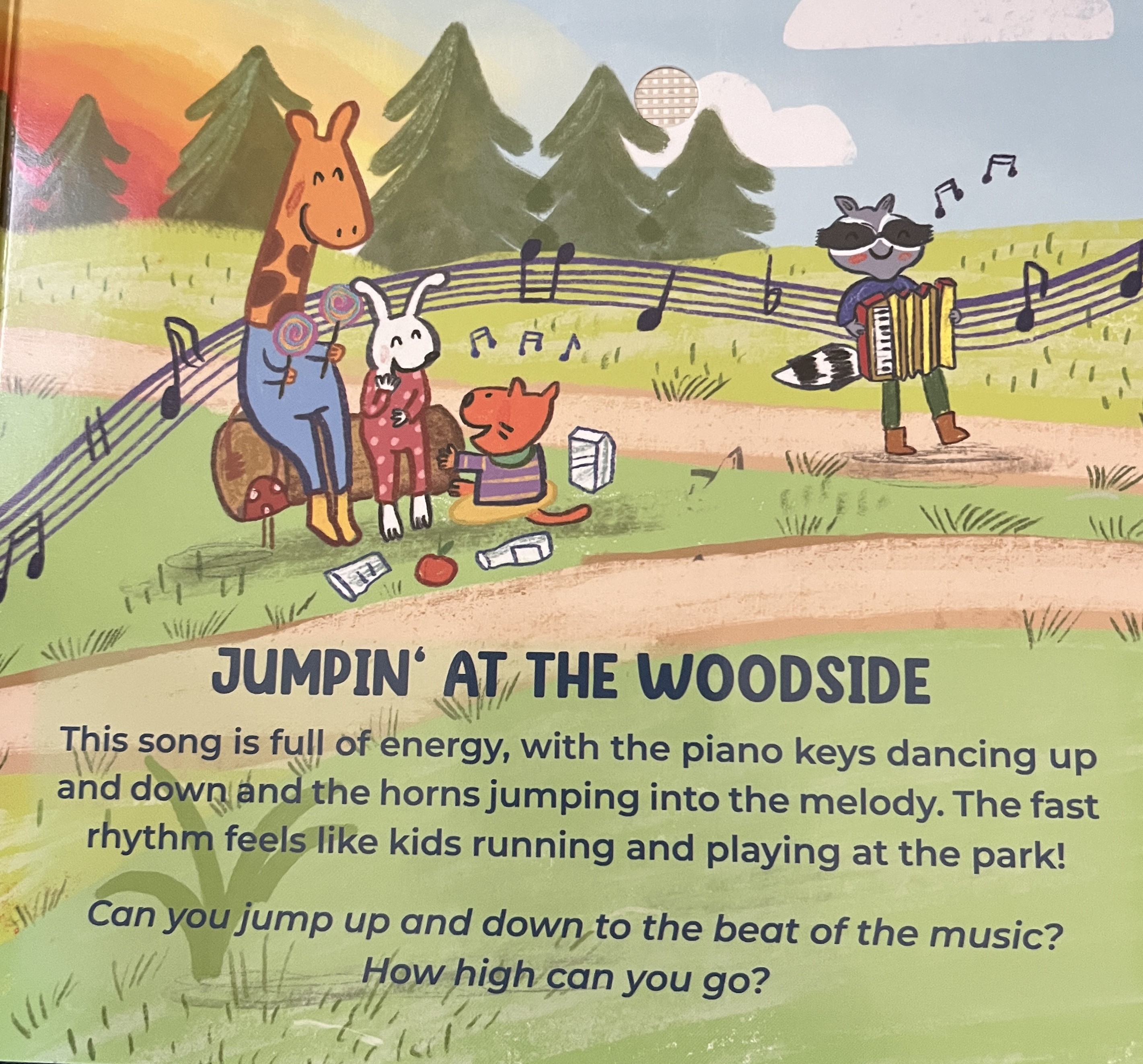
and
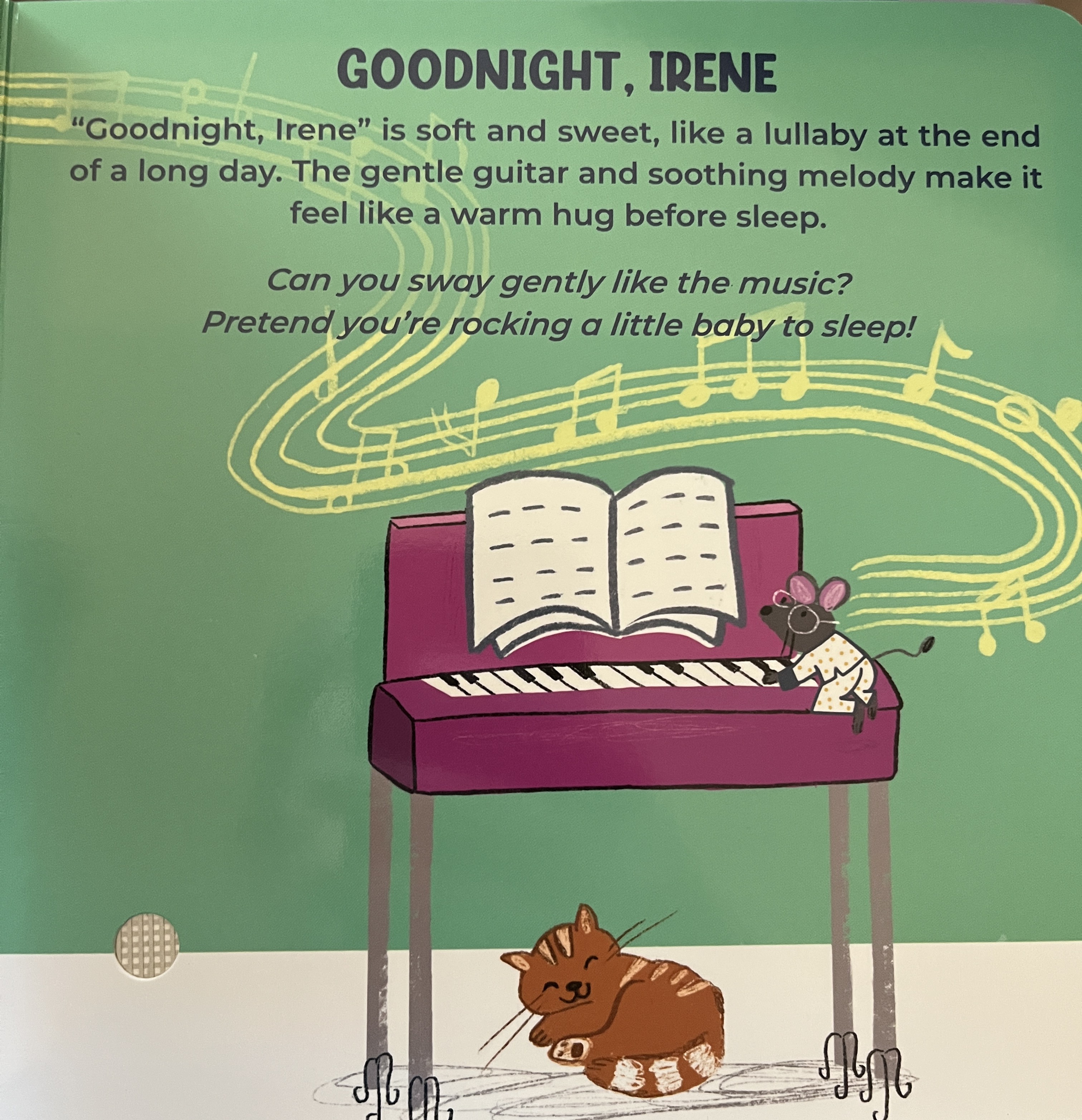
On Pirouette’s website, they have links to where you can find full versions on Spotify. (Though there’s not a QR code on the book to point you to this page.) A caution though: these are blues songs, so some of the lyrics in the full vocal performance aren’t kid friendly, for example, See See Rider says “I’m gonna buy me a pistol, Just as long as I am tall… Kill my man.” But you can also find instrumental only versions of the tunes. For Good Night Irene, there are kid friendly versions of the lyrics.

These song clips are again only 15 second snippets, but it doesn’t bother me on these like it did on the folk music one… since I know they’re long songs it makes sense that it’s only a sample vs with the folk songs, sometimes I felt like if they’d just had one more line of the chorus it would have felt more complete.

I definitely appreciate the way this book helps to stretch our repertoire of “fun music for kids to listen to.” I recommend it.

Ditty Bird’s Chinese Children’s Songs

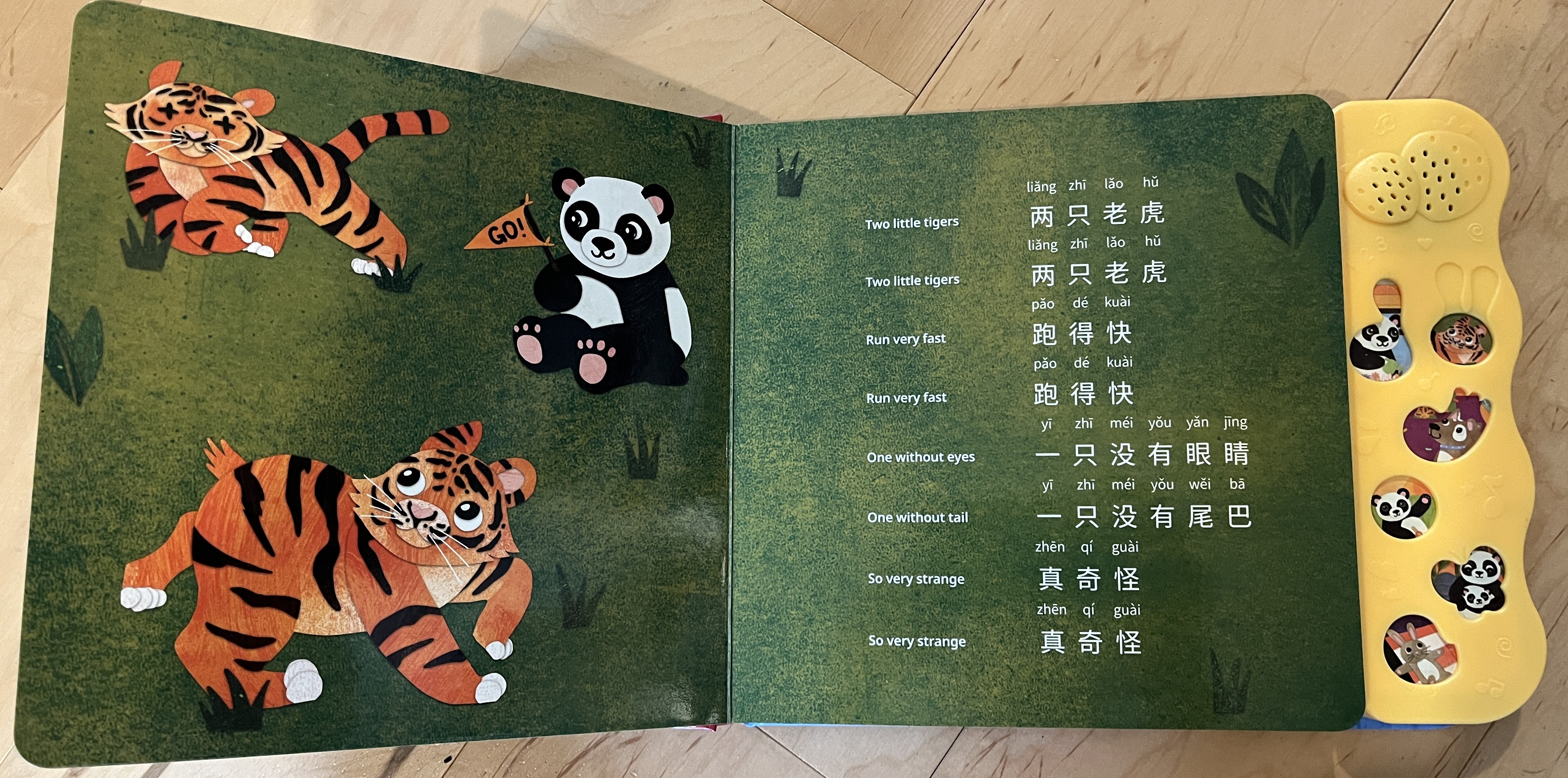
Ditty Bird has LOTS of books. Sounds, Songs, Bilingual… the one I reviewed was Chinese Childen’s Songs Volume 1 It includes 6 songs: Two Tigers, Where’s Spring, Little Donkey, Picking Radish, Good Little Rabbit, Where’s My Friend. I love that these are traditional Chinese songs. I do not speak Mandarin but the reviews say the pronunciation is good and that traditional Chinese instruments are used. The recordings are pleasant to listen to. They are as long as they need to be for the complete song, so 12 – 25 seconds.

They include the lyrics, in pinyin and traditional characters, and an English translation. (Unfortunately the English words don’t seem to scan to the tune.) I wish the lyrics were printed in a larger font for all of us who are over 40 to read! The illustrations are cute, showing animals in Chinese settings, wearing both traditional and modern clothing.
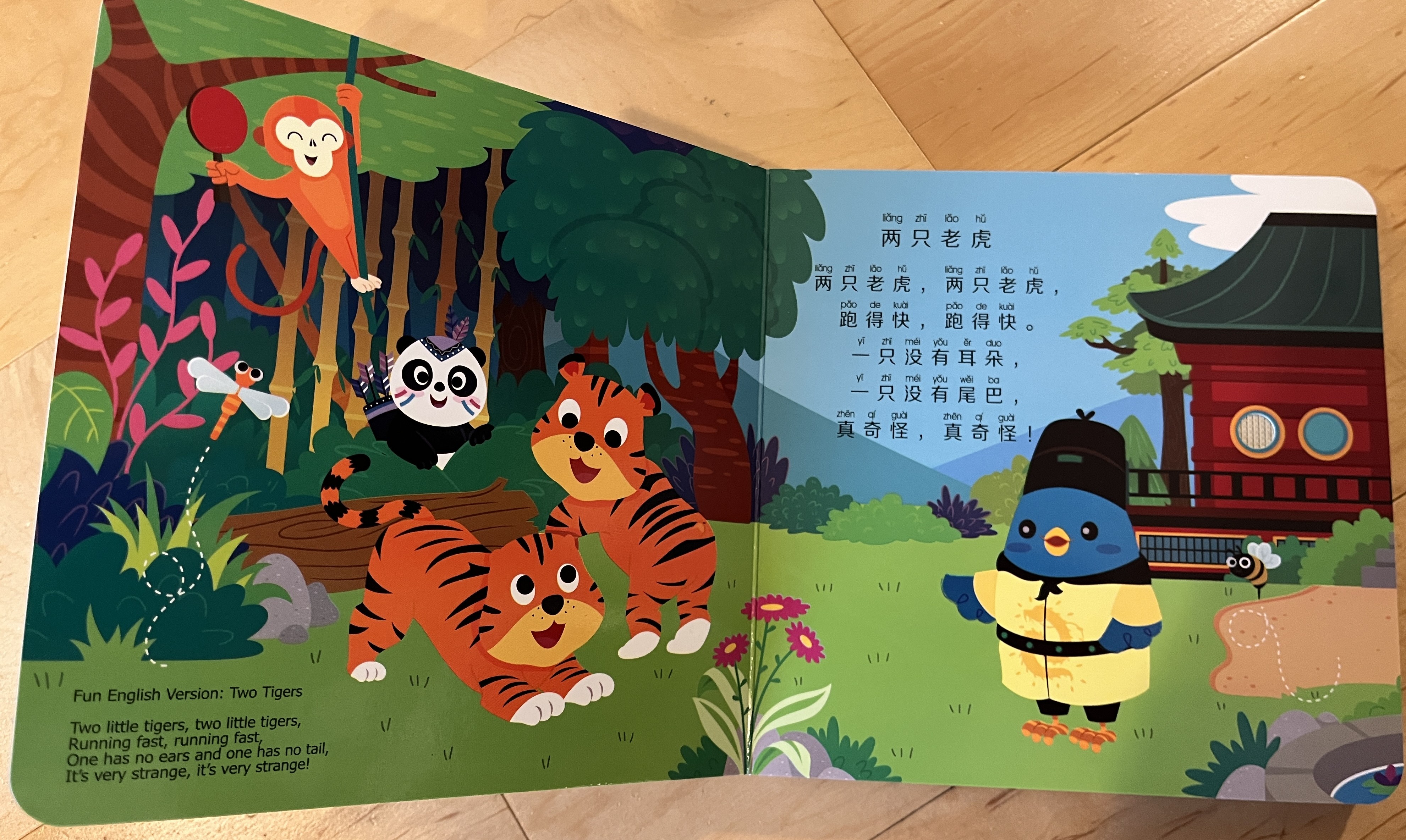
Like the Pirouette books, this is a nice small, sturdy board book, with the speaker on the back. The music buttons seem to be the same technology – so they work well, though do require a child to put their finger in a specific place. It is $19.99 on Amazon. (affiliate link). Reviews on Amazon say that durability can be an issue, with some reviewers reporting the buttons stopped working.

I purchased this book because I mean to learn some children’s songs in Mandarin, and although there are many YouTube videos and other resources online, I have not been remembering to use them. Having a physical book on the table reminds me to listen.

I recommend this book too.

Bao Bao Learns Chinese

This company has 3 Chinese books, plus similar books in: Tagalog, French, Spanish, Korean and English. I reviewed their Chinese Volume 1 which includes 6 songs – some traditional Chinese – Two Tigers, FInd a Friend, and Mama is the Best in the World, and some traditional English – Itsy Bitsy Spider, Row Your Boat, and Twinkle Twinkle. It includes lyrics in English, pinyin, and Mandarin. (In a larger font than Ditty Bird.) The Mandarin words do line up with the English tunes. But I can’t make the English words scan well to the tunes for the Chinese songs.
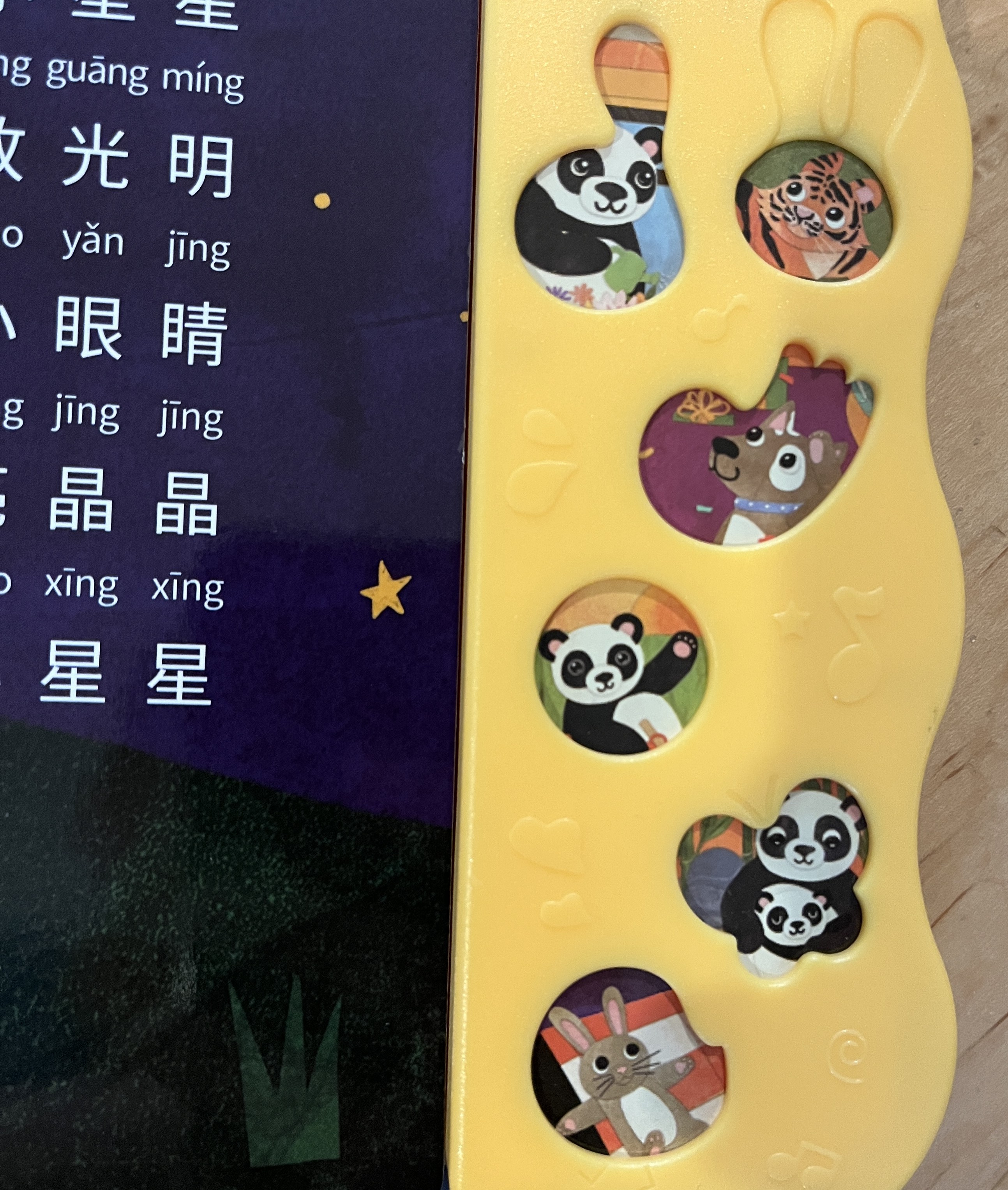
This is a bigger book – a little harder for little hands to hold. The soundbox is to the side of the pages. It does have two volume settings to choose from. Since the buttons are off to the side, a child has to figure out which one to press to get the song that matches that page – the image on the button is just some small portion of the image that’s on the page, so I’m not sure it’s obvious to kids which image goes with which page. (And the soundbox has random shaped openings for the buttons that don’t really line up with the illustrations.)
Songs repeat twice so recordings range from around 30 seconds to 85 seconds. The repetition helps with learning. They’re nice recordings and very pleasant to listen to. They offer super helpful resources on their webpage, like information on how to pronounce Mandarin words, and videos where they talk you through the lyrics of each song, clearly enunciated so you can get the pronunciation right. (I wish they had a QR code on the back that would take me right to that page.) $28.99 on Amazon.

For learning Mandarin songs, if I had to choose just one of Bao Bao or Ditty Bird, I would choose Bao Bao, but am happy to have both.

Singing with Go Go is Fun

There are LOTS of Go-Go books. Including English, Spanish, Mandarin and a Christian themed line. They are $29.99 each. I have the “9 Creative Nursery Rhymes” volume. (I’d swear that what I put in my Amazon cart was one of the Go Go Mandarin books, but this is what Amazon says I ordered and what they sent….) It has 9 songs – Humpty Dumpty, Itsy Bitsy Spider, Jack and Jill, Wheels on the Bus, London Bridge, Mulberry Bush, Muffin Man, I’m a Little Teapot, and Mary Quite Contrary. Many of the songs are pretty traditional, but on Itsy Bitsy and Jack and Jill, they added a little riff at the end, and the Wheels on the Bus became “the Go Go Bus goes round and round.”
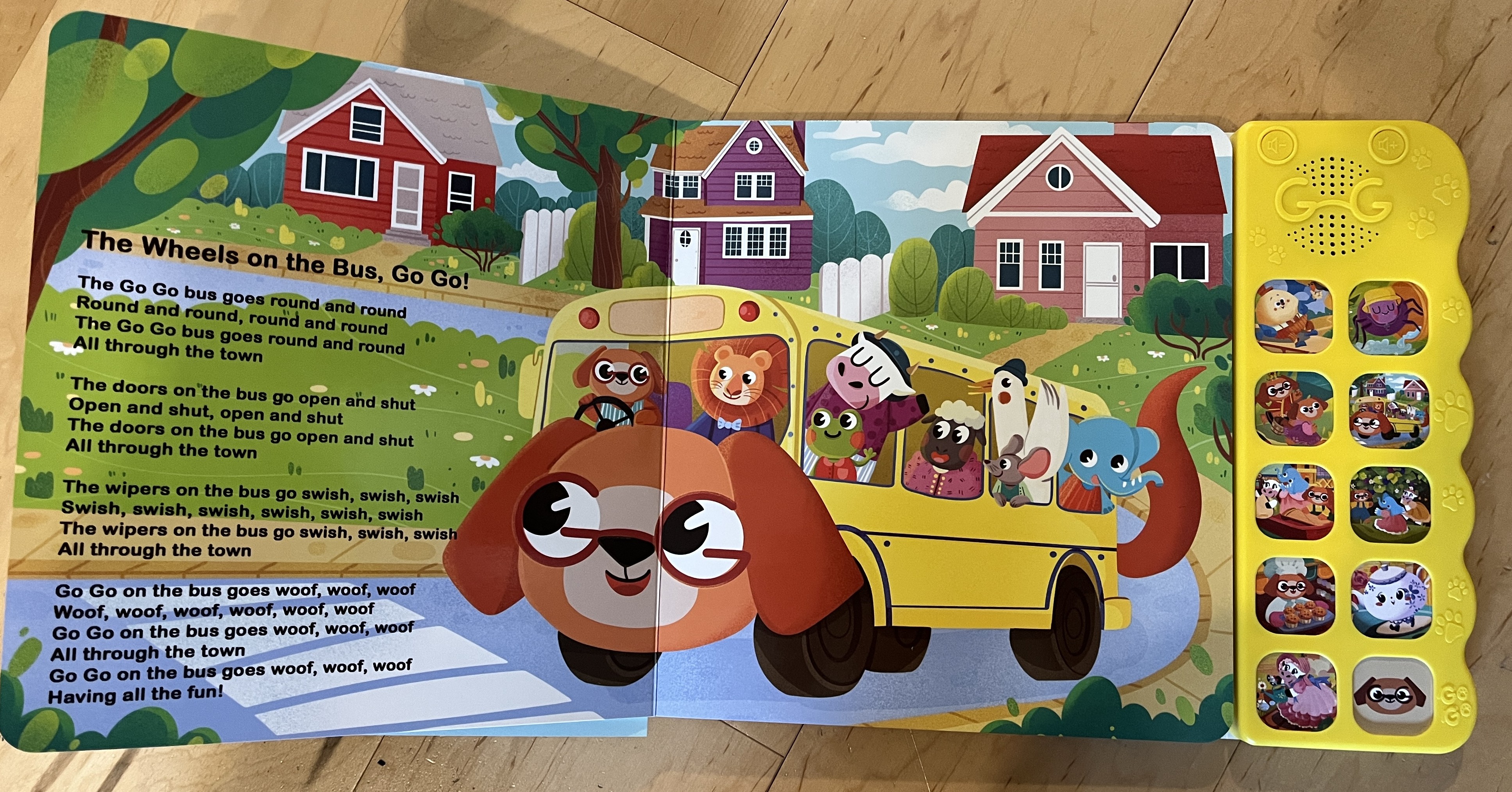
This is another large board book, with the controls on buttons off to the right side. There are two volume settings, controlled on that side panel. The child needs to figure out which of the 9 buttons matches the song for the page they’re on (the 10th button is just announcing the name of the book). Songs are up to 60 or so seconds.

Personally, I don’t like the style of these recordings. They’re like Barney the Dinosaur vibe – just a little too enthusiastic / peppy with kiddie pronunciation. I’m not a fan.

Hear samples from every book:
Top Ten Takeaways

I was just writing an end of year email to a parenting class, and wrote down my top ten takeaways from our whole year of learning together. They are also a fair summary of the information you’ll find on this blog:

  1. Every child is a unique individual and needs a unique parenting approach. What’s right for someone else may not be right for your situation. Trust your instincts and reach out for support when needed from people who understand kids like yours.
  2. Children behave better when they know what to expect and what’s expected of them. If a child is not behaving well, ask yourself: What support do they need, what systems would make it easier for them to be successful, what skills do they still need to learn?
  3. All feelings are OK, but not all behaviors are OK. Validate your child’s emotions and offer support, while still setting appropriate limits. Teach appropriate ways to express big feelings, and model self-calming skills.
  4. With food: parents decide when and where it’s offered and what is offered. Children decide whether to eat and how much to eat. With all choices: Parents decide what options are on the table, children choose amongst those appropriate options.
  5. Kids need time to run, to be loud, to be silly, to explore their world. Make sure there are a lot of “yes” times and places in their day. Taking small and manageable risks builds skills and independence, even if it means an occasional bump or bruise.
  6. We learn from mistakes. Embrace them! Teach your child the Power of Yet: “you can’t do it yet, but someday, if you keep trying, you’ll be so good at it!”
  7. Children learn best when they feel safe and happy, so play-based learning is powerful. Brains develop through novelty – being exposed to new experiences – and repetition – having the chance to do something again and again till they master it. Explore art, the outdoors, large motor play, building things, doing crafts, and more.
  8. Music and stories build language skills, vocabulary, memory, emotional intelligence, and knowledge of diverse life experiences. And they bring joy!
  9. There is no one right way to parent. If you, your child, and other family members are happy, healthy, and succeeding at your goals, then all is well. If you’re unhappy or not feeling successful, seek out new ideas and seek out support. (Parenting classes, counseling, support groups or just connecting with other parents!)
  10. You will have good days and bad days as a parent. When you have a bad day and are not the parent you want to be, acknowledge that, forgive yourself and commit to doing better in the future. When you are having more good days than bad, celebrate that! You’re doing a great job.

Here’s a PDF of those takeaways.

Responsive Feeding

Since it was first published in 1983, Ellyn Satter‘s Child of Mine (affiliate link) has been considered the leading book involving nutrition and feeding infants and children. Her “division of responsibility” concept can be summarized as: You are responsible for what, when, and where. What food you’ll offer, and when and where your child is allowed to eat. Your child is responsible for how much and whether to eat. A short way to say this is “parent provides, child decides.”

Recent trends in the field add the idea of “responsive feeding” especially with infants and toddlers who are not yet communicating clearly. (This handout from the AAP is a great overview.)

What is Responsive Feeding

Responsive feeding emphasizes the interactive nature of feeding. Parents set guidelines (decide what, when and where food is offered), then there is a respectful give-and-take, or serve-and-return, where 1) the child signals that they are hungry with movement, facial expressions or sounds, 2) the caregiver provides food and engages with the child to create a warm and caring environment which encourages eating, 3) the caregiver watches for signs that the child is full and helps wrap up mealtime.

Responding to your child’s cues communicates love and fosters a close relationship. You’re also preserving their inborn appetite regulation by providing food when they signal they are hungry and not pushing them to eat more when they signal they are full. This can lay a foundation for a lifelong habit of following cues and eating only when hungry rather than eating for emotional reasons, eating because they’re bored, or eating to be in the “clean plate club.” This may reduce obesity in their future.

Recognizing Hunger and Full Cues

Responsive feeding for an infant requires knowing how to recognize hunger cues (such as rooting, tongue thrusts, and sucking) and full cues (letting go, falling asleep, long pauses in sucking pattern.) I have a video you can watch to learn about Newborn Cues. For an older baby, eating solid foods, hunger cues may include leaning toward food, opening their mouth, focusing on and following food with their eyes. Full cues might include: spitting out food, pushing it away, closing their mouth when you offer food or turning their head away, being distracted, playing with the food.

When your child is around 9 months old, you can teach sign language basics like the signs for “milk”, “more” and “all done.” Toddlers can then communicate with those signs, and, of course, older children will learn to use words to tell you when they’re hungry and when they’re full. Especially if these are concepts you’ve been talking about and cues you’ve been responding to since birth. (Note: older children do sometimes mistakenly say they’re hungry when really they are bored or anxious or have some other needs.)

A few other tips for supporting responsive eating:

  • the feeding environment should be pleasant with few distractions (e.g. no TV)
  • the child is seated comfortably, facing others for interaction
  • foods are healthy, tasty, developmentally appropriate and offered on a predictable schedule when the child is likely to be healthy
  • don’t force a child to finish the food on their plate – forcing children to eat usually leads to eating less
  • don’t use food as a reward or a punishment – food is a basic need and shouldn’t be mixed up with discipline.
  • make mealtime a joyful bonding experience
  • try to serve as a positive role model for healthy eating

Learn more:

Photo by Phong Duong on Unsplash

Parachute Play with Children

Parachute from Lakeshore Learning

Parachutes can be a fun accessory for indoor story-times or outdoor play, for groups of children from birth to adolescence.

Benefits of parachute play:

  • Collaborative and non-competitive – children work together, need to spread out around the chute and all participate for it to work
  • Helps to develop rhythm
  • Builds shoulder, arm and hand muscle strength
  • Good for practicing listening to instructions – if they didn’t understand it when you say to lift it up, but then their hand is lifted up into the air along with the parachute, that helps them learn the meaning of the instruction
  • It’s a great way to gain children’s attention when it’s wandering, or to settle down chaotic energy in a group time
  • It’s fun!

Choosing Equipment

If you don’t already own one, buy a parachute. (That’s an Amazon affiliate link to a product that looks good quality and comes in a variety of sizes.) Parachutes are fairly inexpensive, and fold up pretty small so they don’t require a lot of storage space.

The size you need depends on two things – how big is your room and how many people will participate?

Parachutes are described in diameter – so 12′ means 12′ from one side to the other. You need space all around it for the people to move, so it’s best to have a 20×20 space at least for that 12′ parachute.

Parachutes typically have one handle per foot of diameter. So, a 12′ parachute could work for 6 people if they all held onto two handles, or for 12 people if each holds one handle – you can squeeze in more than that, but it gets tight.

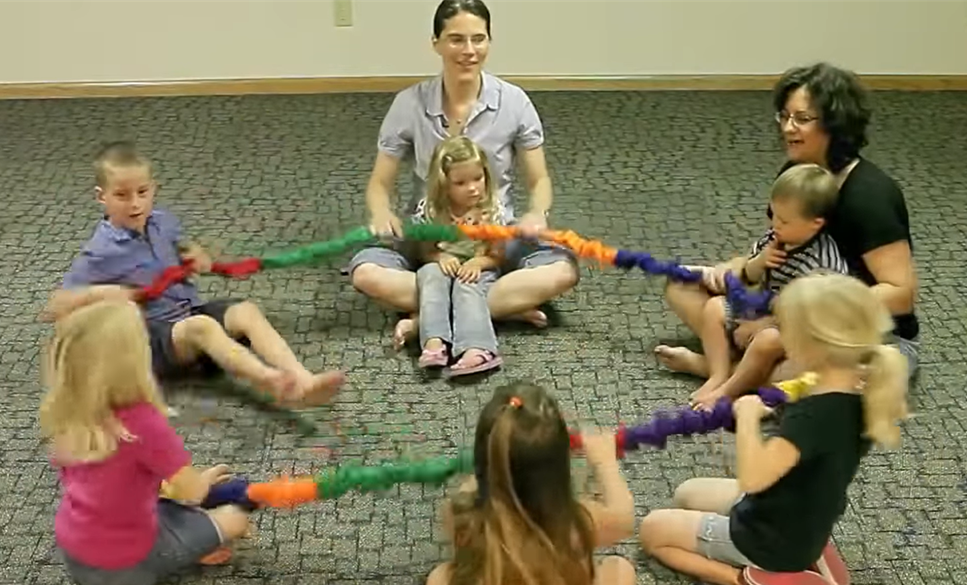
A parachute alternative – in some of our classrooms, we have a red elastic band that is probably about 12′ in diameter. Many things you can do with a parachute you can do with this elastic band, and in some ways it is easier to start with because they practice all holding something in a circle without having all that fabric to get tangled up in. I have not found one of these for purchase, but it seems similar to this stretchy band. Learn about stretchy band play.

image from https://www.singplaycreate.com/2016/01/stretching-learning-with-stretchy-bands.html

Ages

In my activity descriptions below, I’ll code what age groups they work best for:

  • B = Babies. The parents hold the parachute and do the actions while the babies observe
  • P/C = Parent/Child. For toddlers and preschool age. Parents all hold the parachute and do the actions. The children may hold on, they may go under the parachute, they may wander off…
  • P = Preschool. A group of 3 – 5 year old children and 1 or 2 adults can do this without needing more adults to help.
  • O = Older Kids. Kids 5 and up can do this.
  • All = OK for any of these contexts

Up and Down

You can simply stand in a circle, say “up” and everyone lifts the parachute up high and “down” while everyone lowers it. Kids can be holding on the edge raising and lowering, or they can be standing under it or lying down under it. So easy, and it manages to feel intriguing yet soothing at the same time. ALL

You can also put on calming music and raise and lower in rhythm with the music for a calming moment in the midst of a story time. B, P/C

Sing this song to the tune If You’re Happy and You Know It. “When the parachute goes up (raising it up), shout hurray. Hurray! (as you lower it down). When the parachute goes up, shout hurray. When the parachute is high and floats up in the sky. When the parachute goes up, shout hurray.” Repeat with “dance a dance” or “stomp your feet” and so on. P/C, P

Toast in the Toaster chant – shake side to side, then “pop” it up at the end
I’m toast in the toaster / I’m getting very hot / Tick tock, Tick tock / Up I pop!

You can also do lap songs with up/down motions like “Grand Old Duke of York” or “Let’s Go Riding in an Elevator” except instead of lifting a child up in your lap, you’re raising the parachute.

Side to Side

You can stand in place and swish the parachute from side to side. Here’s a chant to go with that motion: “I am a washing machine. Washing clothes till they are clean. I am a washing machine. Swish swish swish swish swish.” P

Making Waves / Shaking

You can shake a parachute slow and gentle, or fast and rough.

With slow waves, sing “My Bonnie Lies Over the Ocean.” B, P/C, P

With shakes, you can use some songs you use with shakers: “Oh you shake and you shake and you shake and you stop… (3x) Shake it up high, shake it down low, shake it on your tummy, and way down to your toes.” P/C, P

There’s a video here of a nice shaking song: https://nancykopman.com/parachute-songs-and-games-for-young-children/

Walking Songs

Merry Go Round. The children hold onto the parachute with one hand and walk around the circle clockwise. Play any music – as long as music is playing, they walk, If the music stops, they stop. Turn to face the other direction (e.g. counterclockwise) and wait for the music to begin, then walk more. P

Ring around the Rosie. P/C, P
Walk around as you sing: Ring around the rosie, pocket full of posy, ashes, ashes
Kneel Down: All fall down!
Shake gently, close to the ground: cows are in the meadow, eating buttercups.
Then shaking fast: Thunder, Lightning, stand We all Stand Up!

Roly Poly (a chant) P/C, P
Roly Poly, Roly Poly, Up, Up, Up lift the parachute up
Roly Poly, Roly Poly, Down, Down, Down parachute down
Roly Poly, Roly Poly, In, In, In, walk toward the center of the circle
Roly Poly, Roly Poly, out, out, out
…. fast… slow… shake it

Zoom. (tune) P/C, P
Zoom Zoom Zoom. We’re going to the moon. walking around
Zoom Zoom Zoom. We’re going to the moon. stop walking at the end of this line
In 5…. 4…. 3… 2… 1 lower the parachute gradually to the ground
Blast off!!! quickly raise your arms and let go to launch the chute up in the air

Pop Goes the Weasel P/C, P
All around the cobblers bench (walk around a circle),
the monkey chased the weasel (rattle parachute).
The monkey thought it was all in fun (lower the parachute to the ground).
Pop goes the weasel (pop it up)

Wheels on the bus. Go round and round… wipers go swish… babies go up and down…

Children on Top of the Parachute B, P/C, O

For 3 – 6 month old babies, you can lay the babies on the parachute, and the adults hold on to the parachute and walk in circles, and give the babies a ride. You have to be slow and gentle so they don’t roll on top of each other!

For older toddlers, who are able to sit well and stay where you tell them to stay, you can have them sit up on the parachute and take them for a ride.

This activity does NOT work well with the “wobblers” in between those ages – the children who can sit but not very well and would tip over, or the children who will try to crawl away, and knock over the other children.

Many of the songs above and below here combine well with taking the children for a ride, as does “Here we go round the mulberry bush” or “we’re going to the zoo”.

Children Under the Parachute B, P/C

Babies can lay on the ground as the parents hold the parachute above them. Toddlers or preschoolers can sit or walk under the parachute as the parents hold it.

Colors Over You. (tune)
Red and Yellow, Green and Blue, these are the colors over you. Red like the apple, green like the tree, yellow like the sun and blue like the sea. Red and yellow, green and blue, these are the colors over you.

Peekaboo. hold the parachute low, just above the children Someone is hiding, hiding, hiding, someone is hiding, Who could it be? lift it up high Peekaboo!

Come Under My Umbrella (tune of The More We Get Together)
Come under my umbrella, umbrella, umbrella. lift it up high so it “balloons” up a bit
Come under my umbrella, it’s starting to storm. again
There’s thunder and lightning and wind and rain. shake it hard and fast
Come under my umbrella it’s starting to storm. lift it high

Sitting Down with the Parachute P

The children sit on the floor in a circle, holding on to the parachute.

10 Little Bubbles (tune: 10 little indians)
shake the chute as you do the counting part – pat the parachute with your hands for the “pop the bubble’ part
1 little, 2 little, 3 little bubbles. 4 little, 5 little, 6 little bubbles.
7 little, 8 little, 9 little bubbles. 10 little bubbles go pop, pop, pop!
Pop pop pop pop those bubbles. (x3) Popping all the day.

Row Your Boat – divide the children in half – those on the left half and those on the right half. (It helps if there’s a teacher on each side! They “row” the parachute – holding on and leaning back, then forward. So, as left leans back, right leans forward, and so on. Sing row your boat.

Props on Top – P/C, P, O

For parent/child classes, it’s easier for toddlers to see what’s on top of the parachute if the parents are sitting down and the parachute is down low. Preschoolers or older children could do it sitting or standing.

Popcorn – put several balls on the parachute and do this chant:
Popcorn, popcorn in a pan (hands go gently side to side),
shake it up, shake it up, (shake it fast side to side)
bam bam bam! (three quick “pops” of the chute – will send balls flying off the chute.)

Autumn Leaves. Put lots of silk leaves on the parachute. Sing this song to the tune of London Bridge is Falling Down
Autumn Leaves are Falling Down, Falling Down, Falling Down… All Around the Town. up and down gently, so the leaves lift off the chute just a little
The wind will blow them round and round… swish the chute
Then you shout “oh no, it’s a storm” and you all shake like crazy till all the leaves fly off.
Now it’s time to pick them up…. gather up the leaves

Five Little Monkeys Jumping on a Bed. (use monkey puppets)

Games – O. (maybe P)

Ball through the Hole: Only works for parachutes with a hole in the center!
Place a ball on the parachute. Try NOT to let it fall through the hole in the center! For children 4+, divide the kids into teams (e.g. everyone who is holding onto a blue or green section of the parachute is one team and the other team is everyone holding onto red or yellow). Put two balls on the parachute – team 1 is trying to get their ball in the hole before team 2 can get their ball in.

Knock the Ball Off: If your parachute has a mesh circle in the center instead of an opening, you can adapt this game and have them try to keep their ball on the parachute while they knock off their opponents ball.

Swap Places. Everyone is raising and lowering the parachute. Then you say “stop” and everyone freezes with the parachute held way up high. You announce who needs to trade places. They swap quickly, then you continue going up and down. “Up and down, up and down. Up and stop! Bobby and Sally swap!”

Parachute Cave – lift up on 1, 2, 3 – when you get to 3, everyone (still holding on!) steps 3 steps forward under the parachute, then sits down with the parachute under their bottoms. You’re all in a parachute cave together!

Pass the ball – put a beach ball on the chute. Person A lowers the parachute till the ball comes to them – they raise one hand to roll the ball to the person next to them. That person then raises the chute to pass the ball to the next person. Keep going, trying to make it all the way around the circle.

Cat and Mouse – Children sit on the floor holding the parachute. One child is the cat – they sit on top of the chute and close their eyes while everyone counts to 10. The “mouse” child crawls under the parachute. Then the kids all shake the parachute to hide the mouse. The cat opens his eyes and crawls around trying to find the mouse.

Sources: https://childcarelounge.com/pages/benefits-of-parachute-play; https://www.earlyyearscareers.com/eyc/learning-and-development/top-5-parachute-games-children-early-years/; http://brampton.momstown.ca/baby/parachute-songs-kids; https://earlyimpactlearning.com/14-parachute-songs-for-preschoolers-games-lyrics-tips/; https://klmpeace.wordpress.com/2013/03/20/parachute-play-with-babies-and-toddlers/

More Resources

Also check out my posts on

Keys to Brain Development

Infographic with Keys to Brain Development

In the first five years of life, a child’s brain grows from 25% the size of an adult’s brain at birth to 92% of adult size. All that growth comes from making connections – connections built through hands-on, multi-sensory experiences of their world. There are several ways parents and teachers can support children’s growth and development. This 90 second video gives a quick summary, and there’s more details below.

Novelty – New Experiences

The parent / teacher can provide a diverse array of new experiences. These don’t have to be fancy, expensive, or complicated. These are just the everyday experiences of life. Simple activities like going for a walk, looking at the clouds, stomping in puddles, touching a slug, coming home and making hot chocolate together, snuggling up on the couch with a good book, playing with blocks, then drawing pictures. Any new experience builds connections in a child’s brain.

And if you don’t have the energy to think of something new to do, try putting together two familiar things in a new way, and see what your child does differently. For example, take the rubber duckies from the bathtub and put them with the Duplos, or take the colander from the kitchen to the bathtub. Your child will be delighted by the new possibilities. Learn more about “invitations to play.”

I have a whole collection of easy free activities with toddlers to get you inspired. Everything from “nature shopping” to “counting cars”, from “construction theater” to year-round egg hunts.

We want to encourage children’s growth in all diverse knowledge and skills. I find it helpful to think about categories of development – have we done anything today to build large motor skills? What about fine motor skills? I also find the theory of multiple intelligences to be a helpful guide to inspiring new ideas – have we tried out any music today? And spatial challenges? Here’s a handout I wrote on choosing toys and activities that build multiple intelligences.

I do encourage you to offer your child lots of learning opportunities, but please don’t feel like you have to be doing a non-stop song and dance, tossing new things into the ring continuously. That would be exhausting for you! And it could teach your child that the only way to be happy is to be continually entertained with new things. They would also be missing out on the full depth of possible learning if you did this and ignored the next two keys to brain development: repetition and down time.

Repetition – Doing it Again and Again Builds Mastery

Doing something for the first time makes a connection. Doing it again strengthens that connection. Doing it again in a different setting strengthens that connection and also makes connections to this new setting. Combining that activity with another deepens understanding. Think of a child learning to walk – they fall again and again until the a-ha moment happens. But then they still stumble and wobble along for a while. But the more they walk, and the more different surfaces they walk on, the better they get at it. Or think of anyone learning an instrument – we don’t become expert by going to a class once a week. To become a skilled musician requires playing those same scales again and again, and playing a variety of tunes till you reach mastery.

Don’t rush them. If they’re just barely starting to understand something and you push them onward, they’ll have a shaky foundation for future learning. For example, if you have a child who has just barely learned to count to three, don’t feel like you have to rush them on to 4, 5, 6… 10… 100. Let them stay at three for a while – really exploring three, getting to the point where they can tell at a glance if they have three objects or more than that or less than that. If you can do this, your child will have such a solid understanding of the fundamentals of math that everything later on will make more sense.

When my oldest kids were little, I over-did the novelty. I felt like I continuously had to provide new experiences. My oldest child resisted transitions so much, and looking back, I think a big part of it was that he was always feeling forced to move on before he was ready. By the time my third child came along, I had learned a lot about the importance of repetition for brain development, so I was willing to let him do things again and again. It’s a good thing, because that little boy has deep passions and wants to immerse himself in the same things for weeks or months on end.

But with him, I saw clear evidence of everything the research says about repetition and also about following a child’s interests. When he was wild about dinosaurs, we could teach everything else he needed to learn in that context – we could teaching counting, and colors, and music and art, all focused on dinosaurs. When he had the chance to do something again and again, he developed so much self-esteem in seeing himself as a competent learner. Whenever he was feeling anxious about anything else, returning to this familiar territory helped get him grounded and feeling capable, then he could take on new challenges.

There is a concept called Schemas of Play, which addresses how children tend to be working on a few key ideas at any given time. They might be exploring: Trajectory – kicking and throwing balls, or Transportation – carrying things everywhere, or Connecting – assembling puzzles. They may repeat the same activity over and over, but know that they are learning important concepts by doing that. Check out some ways to support your child’s schemas of play.

Down Time to Process it All

Children need rest. It is during sleep that we build myelin sheaths that insulate our nerve pathways, helping us access information more quickly and efficiently apply that knowledge to new situations. (Nutrition is also important. To build myelin, they also need a diet with plenty of healthy fats, like fish oils, nuts, avocados, olive oil, and whole milk. Learn more about nutrition for growing brains.)

Children need down time – time to putter around the house “doing nothing.” Time to play aimlessly. Time to “waste time.” When they don’t appear to be doing anything, it may be because they are processing all the new learning they’ve been experiencing, and they need time to take it all in and incorporate it.

Don’t feel like you have to constantly entertain your child. When they are “bored” is when they may come up with some of their most creative ideas. They might make connections between things on their own. I remember once my daughter, who was 5 at the time, was complaining about how bored she was. I told her “I need to finish this work… figure out what to do for 15 minutes, OK?” My work took longer than expected, and when I went to find her 45 minutes later, she had all the toy horses arrayed on the table, and proceeded to tell me all their names, ranks and how they were related: “Princess Snowy is getting married to Duke Blaze – he is from a different kingdom where his sister… ” She’d created this whole complex imaginary play world, which she would never have done if I was hovering over her guiding her play.

I think it can feel tricky to find the right balance between feeling like we should introduce novelty and guide learning and knowing when to step back and let them explore on their own. It could be something as simple as having a bedtime story routine – each night, we read two stories – one for novelty, one for repetition, and then I let my child look at books on her own for a few minutes before turning off the light. (Here’s more about choosing books for your child.)

Read this article on How Much is Enough, How Much is Too Much which looks at questions like how many toys to buy, how many activities to schedule, and how screen time fits in.

Check out my past writing on brain development, which includes more about the science of brain development.