Tag Archives: toddler

Family Meal Time – making it pleasant for everyone

family eating a meal

Meal time is about more than putting food into our bodies. The family meal also offers:

  • Together Time: a chance to talk and connect as a family
  • Social Skills Practice: a place to learn polite manners and the art of conversation
  • Routine and Rituals: grounding in a reassuringly predictable experience
  • Healthy Habits: modelling, practicing and discussing healthy eating

Unfortunately, children don’t come into the world prepared to be pleasant dinner companions. Proper mealtime behavior is a learned skill. There are many steps you can take to start the path to making meals enjoyable and pleasant for everyone. I offer some tips here which most experts recommend, but there is no one right way to parent, so you should do things that work best for your family.

Whose Job Is It?

I find this message from Ellyn Satter about the division of responsibilities is simple but really powerful:

You are responsible for what, when, and where. Your child is responsible for how much and whether.

Your role is to offer healthy food and be a good role model for healthy eating. But, your child will choose whether to eat something and how much to eat. Don’t turn meals into a power struggle. Help them to be a joyful time.

What to Eat

Put out a variety of healthy foods. Let your child serve himself, choosing how much to put on his plate (encourage him to start with small servings – reassuring him he can always have more). Be a good role model in your own food choices and portion sizes.

Involve your child in choosing and preparing the food. They are often more willing to eat a variety of foods if they were involved in making it.

Help your child recognize when she is full – this will decrease the chance of later obesity. Don’t praise children for a clean plate. Reward them with attention, kind words and fun activities, not food.

Don’t restrict certain foods – they may become the “forbidden fruit” and children will overeat them when they can. Offer small amounts of dessert items with the rest of the food – don’t set it aside as the “special” part of the meal.

When to Eat

Newborns have tiny tummies and digest breastmilk or formula quickly so need to be fed often. So parents get used to lots and lots of “meals” every day. As children get older, they no longer have that need, but I feel like many parents continue to use snacking as an anytime activity / distraction for their toddlers and preschoolers. It is better for older children to have a routine such as three meals a day with an afternoon snack and a bedtime snack, and avoid continuous grazing.

Allow plenty of time at the table. At least 20 minutes for a meal. When your child is full, he can leave the table, but let him know that when he leaves the table that means he’s done for that meal – he can’t come and grab bites then run off to play.

Where to Eat

Eat at the dining table or in the kitchen. Not in the play room, or in front of the TV, or in a bedroom. This helps keep the rest of the house cleaner, but also helps us remember to be conscious of what we’re eating and not just eat because we’re bored. (Most experts would say don’t eat in the car, but I have to confess that as a parent, I’m often running late to things so we eat in the car on the way there… I won’t say it’s perfect, but it’s apparently part of our reality.)

More Tips

Ask your child to help prepare for the meal, perhaps by carrying things to the table, setting the table, turning off the TV, or calling other family members in. Clean up together. Involve them in clearing the table, and wiping the table. Don’t present these things as chores that they get punished if they don’t do (if you don’t ____, then ____). Instead present them as just part of the work of the family and let them know that when we get our family work done, we get to have fun together. (“When we’ve cleaned up dinner, then we get to play.”)

A two year old can learn to use a spoon and a fork, drink from a regular cup, and feed herself a wide variety of finger foods. Allow for some mess – children are learning how to eat neatly. Help her use a napkin to wipe her face if needed, but don’t feel like you have to hover over her and clean up after bite. You may need to set limits on mess-making. If she starts throwing food or intentionally dropping it, end the meal. Take her away from the table and clean up the food. (Don’t worry if she didn’t eat “enough”. She won’t starve between now and the next meal, and we want her to get the message not to make a mess.)

During the meal, engage in conversation. Many families have a ritual question, such as “highs and lows” or “what is one thing you learned today” or “what is one thing you were grateful for today.”

Family meals matter: research shows kids who regularly eat with their families do better in school, have better self esteem, make healthier food choices, and are less likely to abuse drugs and alcohol.

More on manners: www.parenting.com/article/ask-dr-sears-table-manners-for-toddlers; https://www.babycenter.com/toddler/development/teaching-table-manners-to-your-toddler_1429019 

Learn more about nutrition recommendations for toddlers. This post from Mott’s Childrens’ Hospital is on picky eaters, but offers lots of great all-purpose mealtime tips, and here’s my post on picky eaters. Also, check out Ellyn Satter’s website.

Nutrition for Toddlers and Preschoolers

photo of child eating wheat bread

When it comes to nutrition and toddlers, the most important thing to remember is: Your job is to decide what food to offer, when to offer, and where the child may eat. Your child’s job is to decide what to eat and how much.

What to Offer

Offer a variety of healthy choices – 2 to 3 items at each meal. Children often prefer foods they can feed to themselves. Many children prefer food as separate items – if the family is eating spaghetti, your child may want plain noodles, sauce on the side, and a meatball on the side. Offer food in unbreakable dishes with utensils the child can hold. Give milk or juice with meals, and offer water between meals.

To encourage your child to try new foods:

Offer a new food with familiar, well-loved foods. Try the food yourself, describing its texture, taste, and smell. Give a small portion to begin with (3 peas, 2 beans) so there’s less waste. Children may need to be offered a new food 10 – 15 times before they’ll try it, and the first few “tries” may be a lick, or a small taste, or holding it in their mouth then spitting it out. Over time, they will eat more of it. Involving your child in choosing and preparing a new food may get them more excited about eating it.

Be a good role model: eat healthy, try a variety of foods yourself, talk about healthy eating. Exercise, and have fun being active together.

When to Offer Food

Most young children eat three meals a day, plus two or three snacks. This helps them keep a stable blood sugar level (and thus a stable mood and energy level) throughout the day. Try not to let your child graze all day long. It is better to eat full meals and let the body rest/digest between meals. If your child whines about this, remind yourself that they won’t starve if they have to wait!

Also, don’t use food as a distraction every time you’re in the car, at the library, and so on. Try to develop other ideas for keeping them busy.

Where Your Child May Eat

Most experts recommend feeding your child only at the dining table or in the kitchen, rather than eating all around the house. They also recommend sitting and talking with your child, both for safety’s sake and as a great opportunity for building communication skills, and strengthening your relationship. Turn off TV’s and other screens and focus on time together.

What Your Child Chooses To Eat

Your child may be eating less than she did just a few months ago. It is normal for a toddler’s appetite to decrease, as their rate of growth slows after age one. You will notice that some days your child barely touches his food, and other days he seems to eat non-stop. This is fine. Look at how much food and how much variety they take in over the course of a week, not just one day.

Don’t force your child to eat. Toddlers are trying to assert their independence, and it is easy for food to become a power struggle.

Supplements: consult with your child’s doctor. If a child has a well-rounded diet, none may be needed. In Seattle’s non-sunny climate, a common recommendation is 400 IU / day of vitamin D. Omega 3 fatty acids are recommended by many naturopaths. If your family is vegetarian, or vegan, pay special attention to vitamins B12, D, riboflavin, calcium, and protein.

Reducing Risk of Choking:

Children should always sit when eating. There should be an adult nearby. Avoid foods that are hard to chew (steak, jerky, stringy celery), small and round (hard candy, popcorn; grapes – cut these in half; carrot slices, hot dogs, chunks of cheese– cut these into thin sticks); spoonfuls of peanut butter (OK to spread thin on things). All parents and child care providers should learn choking rescue, just in case: www.youtube.com/watch?v=kOWwyJEFiPo

How Much Should a Toddler Eat

Here’s a chart that lists recommended daily servings for toddlers of each food group (with definitions of appropriate serving size), total calories needed, and other key info about healthy eating.

Infant and Toddler Forum has a really helpful site showing what a toddler size portion of food looks like, whether that’s 4 French fries, or one-quarter of an apple, or 4 ounces of yogurt.

The Hass Avocado board has a number of helpful tips on teaching nutrition to kids, and hands-on activities to reinforce healthy habits.

Read more about making mealtimes pleasant.

Read about tips for picky eaters and for super picky eaters.

Bellevue College Parent Education Programs

I have some spaces available in my class, from now through early June. We are a first year toddler program for children born between September 2011 and August 2012. We meet just north of downtown Bellevue on Thursdays from 9:30 – 11:30. There are also spaces available in some other classes in the program: To sign up, go to: www.bellevuecollege.edu/parented/2013-2014-class-schedule/

We are also now registering for the 2014 – 2015 school year. (We have lots of open houses next week if you’d like a chance to check things out.) All of our programs share key components:

  • play-based learning for the kids based on brain research that shows children learn best through hands-on play in environments where they are relaxed and happy and encouraged to explore
  • circle times led by our fabulous children’s teachers, filled with developmentally appropriate songs, rhymes, stories, and active games
  • parent involvement – at every level from infant classes to cooperative preschools to enrichment programs for 5 – 7 year olds, parents are involved, active participants in the classroom
  • parent education – our college faculty present lectures and facilitate discussion on topics from emotional development to discipline to early learning and nutrition – all the topics parents care most about

In other news from our program: this weekend is our Healthy Kids, Healthy Family Fair, with exhibitors, free consultations with parent educators, mini seminars, and lots of great hands-on activities for your children! It is open to anyone. Learn more here: http://bcparents.org/Healthy_Kids_Event.html

Learn more about the parent education programs and cooperative preschools at Bellevue College and other community colleges by clicking here.

Discipline

DisciplineFlowLooking for tips on discipline? Read on to learn about: having developmentally appropriate expectations, helping kids understand what is expected of them, modelling and rewarding desired behaviors, setting limits, and enforcing consequences.

What is discipline?

Discipline does not mean punishment after misbehavior has happened.

Discipline means guidance. It means setting clear expectations for how we would like our children to behave, not assuming they know how. It means modeling for our children the kinds of behavior we would like them to display. It means setting clear limits about things they cannot do. And, it means that when they misbehave, we let them know that the behavior was not OK, but we do still love them, and we tell them how to be better in the future. This style of discipline not only guides behavior, it also builds trust and respect between parent and child.

The first step in discipline is to consider how old your child is…

Make sure your expectations are developmentally appropriate

From birth to three, your child is going through massive developmental changes, with more brain growth than ever again. They learn through hands-on exploration of the world, which means they get into everything, and have no sense yet of what is safe and what’s not. Your role is to protect them as needed, but also allow them to explore and learn within limits. They learn through repetition, which means they need to do something over and over to learn it, and that includes misbehaving over and over and experiencing consequences over and over before they really remember the rule. Your role is respond consistently each and every time to misbehavior to help reinforce their learning.

Discipline will be more effective (and you’ll be less frustrated) if you keep your child’s developmental capabilities in mind at all times. Do encourage them to stretch themselves and work on impulse control, but don’t expect more than they are capable of. Learn about developmental capabilities by reading books, looking online, taking classes, and by watching other kids. (Though it’s also important to remember that individual temperaments have a big effect on what kids are capable of, no matter their age.) For example, typically toddlers are not yet capable of sharing, have a hard time waiting and controlling their impulses, will bite and hit at times, and can’t always “use their words.” We ask them to do better, but we shouldn’t be surprised when that’s too much for them.

Learn more: www.askdrsears.com/topics/parenting/discipline-behavior/9-development-reasons-why-toddlers-can-be-difficult-discipline and Discipline that works: Ages & Stages Approach: http://umaine.edu/publications/4140e/

Explain what to expect, and what is expected of them

Remember how little your children know about the world. They don’t know that you’re supposed to be quiet in some places and that it’s OK to be loud in other places until you teach them that. They don’t know that they need to stay at the table at the restaurant until you teach them that (and remind them again and again). The more you can tell them ahead of time what to expect and what is expected, the better. When they are young, keep it very simple: “this is a quiet place”, “you need to sit with me here”. As they get older, you can have codes. Like in our family “theater rules” means a place where you sit in a seat, and are quiet, unless everyone else is clapping or singing.

To learn more about ways to guide your child in what TO DO, rather than focusing on what NOT to do, see my post on “Saying Yes.”

Model desired behavior and praise them when they manage it

Act the way you would like your child to act. Also, point our other kids who are behaving well. Children are great at copying what they see.When you make mistakes, say so, and apologize for it. “I tell you not to use bad words, and I just used a bad word. I need to work harder on using nice words.”

“Catch” them being good – praise them for the positive behavior they demonstrate. Some people recommend you shoot for a ratio of 4 – 5 times where you tell them they’re doing something right for every 1 time you tell them they’re doing something wrong.

Setting Limits and Consequences

When misbehavior begins, let them know that what they’re doing is not OK. (They might not know. Or they might, and are testing to be sure they understand.) Use a firm voice and a serious expression to convey this. It is confusing to toddlers if we use our regular sweet smile and playful voice when we’re telling them what not to do. Also, the louder your child gets, the calmer you need to be.

Remind them what the expectations are and encourage them to behave better. If they don’t, let them know what the consequences will be if misbehavior continues. Try for logical consequences, where the ‘punishment fits the crime.’ For example: “when you throw your Duplos, I need to put them away” or “when you don’t stop when I say red light, I need to carry you to keep you safe” or “I need you to help put away toys. If I put them away all by myself, I will put them up high on a shelf out of reach” or “when you dump your food on the floor, it tells me you’re done, and I’ll put it away.”

Consistently Follow through on Consequences

If the misbehavior continues, you must impose the consequence.  Although it’s hard to “punish” a child, it actually builds more trust if you do what you said you would do than if you “let it slide.”

Punish the behavior, not the child. Let them know you still love them, but the behavior was not OK. Use a calm and firm voice and expression, not an angry tone.

No need to discuss this or re-hash it or re-negotiate it. Just be clear and move on.

Handling Quickly Escalating Situations (including hitting and biting)

When anyone (or anything) is in imminent danger of harm, we need to act more quickly. There may not be time to suggest better behavior nor time to tell them what the consequences will be. You may just need to act quickly and explain later.

Also, if your child is in a full meltdown tantrum or very wild and out of control, you won’t be able to reason with them. They’re not understanding language at that point. You may just need to remove them from the situation, go somewhere quiet till they calm down, and then explain things.

How does your child respond to your no’s? How do you respond to that?

When you set a limit, does your child beg, whine, and plead? Or throw loud dramatic tantrums? Or try to make you feel like a bad parent, shouting “you don’t love me!”? If so, do you give in? If you do, you teach your child that whining, tantrums, and guilt trips are effective tools and they will use them again. And the toddler tantrums that seemed overwhelming at the time won’t compare to the battle your teenager will be able to put on after years of learning how effective tantrums are against you.

Try to stick to your no, no matter what. If you change your mind for some reason, be very clear about why “I’m not saying yes to this because you begged for it. I’m saying yes because I talked it over with your dad, and now that we’ve had more time to think about it, it seems fair to do. In return, here’s what we expect from you….”

Remember that giving in can make things easier in the moment, but it doesn’t accomplish your long-term goals, and can reinforce behaviors you dislike. Sticking to your consequences can be really hard sometimes. One year we had to bar our daughter from participating in a school play – something the whole family was looking forward to – due to one really bad week of homework issues. My husband and I were a strong united front in her presence, and did our own grieving behind the scenes.

Discipline Tactics that are Less Effective

Avoid empty threats: Saying “I’ll just leave you here in the store” or “I’ll throw away all your toys” can be very frightening to a child and scare them out of proportion with the offense. Then someday they figure out you don’t mean it, and then it’s pointless. Either way, it’s not effective at helping the child behave well.

What about spanking? It works in the short term to discourage a particular misbehavior. But it’s not beneficial in the long-term. Murray Straus, after 4 decades of research, says “Research shows spanking corrects misbehavior. But … spanking does not work better than other modes of correction… Moreover… the gains from spanking come at a big cost. These include weakening the tie between children and parents and increasing the probability that the child will hit other children and their parents, and as adults, hit a… partner. Spanking also…lowers the probability of a child doing well in school.”  www.sciencedaily.com/releases/2013/12/131211103958.htm
It also harms brain development: www.cnn.com/2014/07/23/health/effects-spanking-brain

What about time-outs?

  • Time outs work very well for some families. It depends on the temperament of the child and of the parent. Successful time-outs are not a punishment. They are a chance for a child to go somewhere quiet and calm down. They come back out when they’re ready to get along again. A typical rule of thumb is for a maximum time-out of one minute per year old. So a 5 year old would have at most 5 minutes.
  • If your child views a time out as a rejection, it might make her very sad. That child might need a “time-in” where the two of you sit quietly together until she calms down.
  • Some children view timeouts as a call to battle, and they only escalate the situation.
  • Some parents take time-outs themselves, saying “I need to go to my room for just a minute to calm down, then I’ll come back and we’ll talk about this.”

Think before reacting – Pick your Battles

As much as possible, think ahead of time about what the limits are. But sometimes you find yourself in a situation where you need to set a limit in the moment… take a little while to think it through before acting. For example, my first daughter wanted to wear her dress-up clothes to the grocery store. I said no, which turned into a battle of wills. Halfway through, I realized I really didn’t care. But at that point, I couldn’t just back down – I had to stick to the rule I had set. So, what I should have done is when she asked for something I didn’t expect, I should have said “Hmm… I need to think about that for a minute and decide if that seems OK with me.”

Some parents have tried a system where they have in their minds three categories of behavior. Green light options: things that are always OK, that they can always say yes to. Red light options are never OK, and they can never say yes to them, no matter how much the child asks or how embarrassing the public tantrum may be. (Safety issues are a good example.) And there’s a whole lot of yellow lights: things that are sometimes OK, and sometimes not. Then when their child asks them “Can I wear my swimsuit today” they might say “hmm… that’s a yellow light thing. Let’s think it through: if it’s warm out and we’re playing outside, that’s OK. But it’s not OK if it’s cold out or we’re going somewhere like church. So, today, since it’s so cold out, I have to say no.”

Think before reacting – See things from your child’s perspective

Children love to explore but sometimes that means they make a big mess. Before getting upset, try to see things from your child’s perspective to see the joy they may have found in making that mess. And try to see that they might not have realized that the mess would be a problem. Say “It looks like you had a lot of fun playing and exploring here! But, next time you want to play with that, we need to figure out how to do it without making a big mess. Can you help me clean up now?”

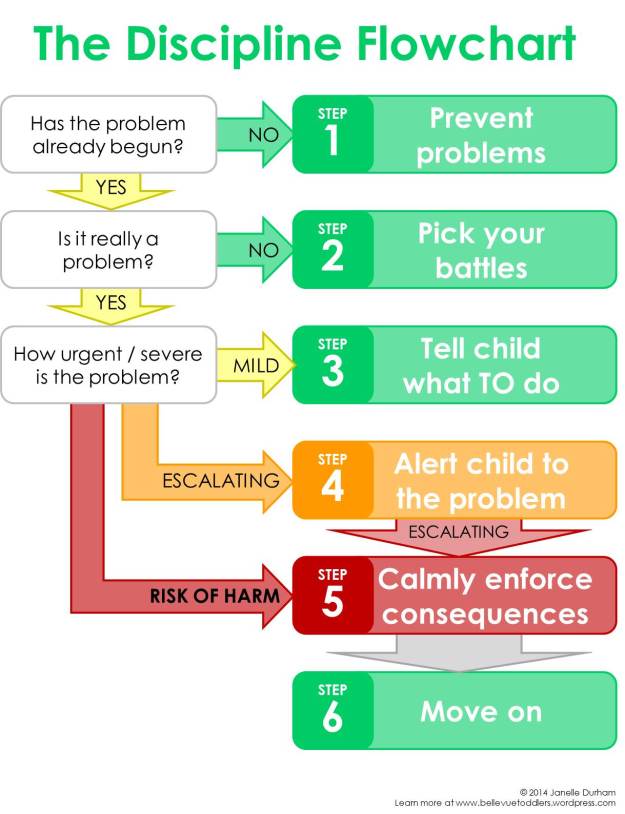
Steps in the Discipline Process

Check out this flowchart for steps which help your child to behave well.

Helpful resources

Webinar on Discipline: www.youtube.com/watch?v=sX0MQ5ZXVio&list=WLsMLXfBPSxoG3J_FkZGqnxVV2P34cr_S_

Overview Handout: www.parentingcounts.org/professionals/parenting-handouts/information-for-parents-discipline.pdf

8 tools for babies/toddlers. www.askdrsears.com/topics/parenting/discipline-behavior/8-tools-toddler-discipline

Tantrums: https://bellevuetoddlers.wordpress.com/2013/11/14/toddler-tantrums-and-emotional-meltdowns/

If you have a hard time saying no, check out:
www.empoweringparents.com/saying-no-to-your-child-how-to-be-a-more-assertive-parent.php?&key=Effective-Parenting
www.empoweringparents.com/No-Means-No-How-to-Teach-Your-Child-that-You-Mean-Business.php#ixzz2rlUqTBC9

Self Discipline and Impulse Control

temptationOur goal for discipline, in the long-run, is to make ourselves obsolete. Our children need to learn to discipline themselves… We don’t want a child who only behaves well because we praise him for it. Or one who only avoids misbehavior if she thinks she might get caught and punished. Or one who has no real sense of what is good and what is bad unless we’re standing there interpreting the situation.

We want to raise adults who are capable of controlling their impulsive behavior, capable of working hard for a delayed reward (or even no reward other than their satisfaction with a job well done), and who have such a strong internal sense of right and wrong that it guides their every action, and who do what’s right simply because they can’t imagine behaving differently.

Impulse Control and Simple Ways to Teach It

To succeed in school and life, kids need to be capable of: sitting still when they want to move, being quiet when they feel like talking, not letting other kid’s misbehavior lead them astray, and so on.

Lots of childhood games and parenting methods are all about teaching this. Try these:

  • Sing the “Clean Up Song”. Stopping playing and cleaning up takes a lot of self-control.
  • Sing songs like “You shake and you shake and you stop.” Play stop-moving-while-playing games like “Red Light, Green Light” or “Musical Chairs” or “Freeze Tag”.
  • “Simon Says.” It’s hard to hold still when someone says “touch your nose” and touches theirs!
  • Play imagination games like “pretend you’re a castle guard – how long can you stand still?”
  • Use “Emotion Coaching” to help acknowledge that although it’s always OK to have feelings, it’s not always OK to act on them. Help them learn ways to manage their feelings.

Delayed Gratification and Simple Ways to Teach It

Some day your child will be an adult who needs to do her job every day, even when she doesn’t feel like it, so that at the end of the month she gets a paycheck and can pay her bills and then purchase some treat she wants. How will she do that well? If you start teaching delayed gratification now.

  • Make them wait. When they ask for something, don’t get it immediately. Acknowledge the request, and tell them when you will do it. “When I’m done washing this dish, I’ll get the toy.”
  • Encourage children to take turns, wait in line, and share. Toddlers struggle with these things, but we start laying the foundation early so they get it as they get older.
  • Let them get bored. Don’t feel like you have to entertain your child continuously. Sometimes their greatest learning happens when they have to get creative to ward off boredom.
  • Teaching manners also helps. When they drop something on the floor, and scream for it, say “Ask me nicely, and I will pick that up for you.” And then mosey your way over to do that.
  • Offer rewards they need to work for. “If you put away your toys, I’ll read 2 books at naptime.”
  • Be a consistent and reliable parent. If your child can trust that you fulfill your promises, they will be much more willing to wait. Check out this post on the “marshmallow experiment” to learn more.

Right vs. Wrong and How We Teach It

As our children go out in the world, they will continuously encounter new situations, with new ethical dilemmas. We won’t be there to interpret all of these situations for them, so we want them to have their own sense of right and wrong. How do we teach that?

  • We continuously model how we would like them to act. (When we do things we don’t want them to do – yell, swear, etc. – we may apologize for our bad behavior. Don’t just hope they don’t notice, because they do. I      won’t tell you what swear words my 3 year old knows!)
  • We talk about our values. When we read books, or watch TV, or see people out in public, we make observations about the behavior we like. (It’s tempting to criticize bad behavior, but it is more effective to tell      them what TO DO, rather than what not to do.)
  • We praise them when they “do the right thing”, especially in situations where that’s hard. (Like sharing a favorite toy, or apologizing for upsetting someone.)

To Get Involved or Not

One question parents often face is how much to intervene. If children are battling over toys, or pushing to see who gets the next turn on the slide, or threatening to hit, when do we step in? The answer varies a lot by culture. Christine Gross-Loh, in Parenting without Borders, tells about her experience watching kids on the playground in Japan. What she was used to, from American playgrounds, was that parents would quickly step in and referee conflicts between children. In Japan, parents did not intervene. They let the children work it out. They viewed playground battles, the crying that results, and making up as normal and natural ways for children to learn how to get along with others. What impact does that have as children get older? One researcher looked at Japanese and American 10 year olds. When asked why they should not hit others of be mean to them, American children said it was because you don’t want to get in trouble with a teacher or parent. Japanese children said you shouldn’t hurt others because it’s wrong and would hurt their feelings.

Wait for It – The Developmental Timeline of Self-Regulation

This self-discipline is a long time in coming. Our toddlers have a very hard time controlling their impulses, and rely on us almost completely for guidance. Pre-schoolers are better at self-control. And elementary aged kids are even better.

But, to be honest, we need to expect even our 17 and 18 year olds to still have regular lapses in judgment and moments of rash action. That’s because the part of their brain that is responsible for planning, impulse control, and making complex judgments (the prefrontal cortex) is still developing. They often make decisions in the moment based on their limbic system (the part of the brain which processes emotion). Anger, fear, excitement, peer pressure and sexual attraction can inspire adolescents (especially boys) to do things faster than the prefrontal cortex can slam on the brakes.

When they make their inevitable poor decisions, you’ll be glad you’ve got 17 or 18 years’ worth of practice at positive discipline and that you have already built a strong relationship based on trust and respect, but in which you’re still the “boss” of them.

Scaffolding

We can’t expect our toddlers to have self-discipline. We hope our teenagers will. How do they get there? Through “scaffolding” – a process where in their early years we intervene a lot and give lots of clear explicit guidance, but the older they get, the more we hang back, the more we wait for them to find their own solutions, the more we help them reflect on their responses and what they could have done differently. As we fade back, they take on more responsibility for their actions, and live more with the consequences that result.

Learn More:

Self-Regulation: www.parentingcounts.org/professionals/parenting-handouts/information-for-parents-self-regulation.pdf

Video that does a nice overview of benefits of self-control, and gives parents tips for how to help their child learn: www.king5.com/news/learning-for-life/Parent-to-Parent–196937571.html

Photo credit: http://www.freeimages.com/photo/734909


Here is a printable handout on Self discipline. Find more handouts on my Resources for Parent Educators page.