Tag Archives: toddler

Benefits and Risks of Screen Time for kids and parents

Benefits of Screen Time for Kids

We often hear about the downsides of TV watching for kids – aggressive behavior after watching superhero shows, short attention spans after watching fast-paced action shows, etc. Are there any benefits of screen time – time spent watching TV, playing video games, or using mobile devices?

For young children (8 and under), the majority of the time they are spending with screens is spent with “educational content.” Ever since the early days of Sesame Street in the late 60’s, there has been a huge growth in educational media: television, computer games, and now apps. High quality educational media can have benefits for children age 2 to 8:

  • High quality TV can lead to improved social skills, language skills, and school readiness. (AAP)
  • Educational media can expose children to the broader world far beyond their community: they can learn about exotic animals, historical events, a wide range of musical and artistic styles, diverse cultures and lifestyles, and scientific concepts like interplanetary space.
  • Story-telling, whether in books or video, allows children to experience social interaction and emotional challenges vicariously. Watching characters interact positively can teach manners and social graces. Watching a character deal with grief can help a child learn to manage it.
  • Media can teach concrete skills, if the skill is demonstrated slowly and repeatedly. In one research study, children were shown a 20 second long video of an adult playing with a toy by taking it apart. 90% of 24 month olds, and 65% of 14 month olds were able to copy those actions. www.parentingcounts.org/information/documents/copycats-100-710-200907.pdf
  • Media can also teach basic academic skills like ABC’s and counting, and help children memorize basic facts, like the order of the planets or the order of the colors in the rainbow. The kinds of skills that can be learned by drilling with flash cards can typically be learned in a more engaging way with media.

It’s important to note that these benefits are from high quality, developmentally appropriate programming. Not all media is created equal! Don’t choose games, videos or apps based on the company’s marketing. Instead look for independent reviews and ratings of a product’s learning value. One good source is Common Sense Media (see resource list.)

Also, the majority of the research has been done on children age 2 to 8, focusing on television viewing. There is very little research showing benefits of media for children under age 2.

There is also very little research on the modern experience of highly interactive touch-screen apps, though some theorize that these will be more effective “educators” than a passive screen experience.

It’s also important to note that there is very little information that children can only learn from the screen. Parents who believe that educational media is very important for healthy development are likely to use media twice as much as other parents. But the AAP reminds us that “Unstructured playtime is more valuable for the developing brain than any electronic media exposure. If a parent is not able to actively play with a child, that child should have solo playtime with an adult nearby… solo play allows a child to think creatively, problem-solve, and accomplish tasks.”

Benefits of Screen Time for Parents

Experts frown upon parents using media as “a babysitter”, but we need to be honest that media is very good at this job! Parents often need a way to keep kids busy and out of trouble while they make dinner, take a shower, do household chores, or work from home. Screens are one of the quickest ways to distract a kid. (Single parent families report more media use in their households, probably because they don’t have a second parent available to entertain the kids while they get jobs done.)

(FYI, you can learn more here about how much screen time kids are getting.)

Parents also use screen time as “company” for themselves. Spending all day at home with a small child can be very isolating, and having the TV on in the background or checking Facebook can reduce the parent’s loneliness. Listening to a podcast or reading an e-book can provide some much needed mental stimulation in the midst of a day filled with finger painting and Dr. Seuss.

Mobile devices have added a new benefit. Parents have learned that they are remarkably effective at keeping a child quiet in environments such as doctor’s offices, restaurants, and churches. (Of course, parents have also learned that trying to take away a mobile device in one of those areas, or having the battery die on a mobile device, can lead to a huge eruption of noise and disruption!)

Problems with Screen Time

Again, the majority of the research is on kids 2 to 8 years old, and on television viewing, but much of it may also apply to younger children and/or other media.

Television has been linked to obesity, sleep issues, aggressive behaviors, and ADHD. Early TV viewing is correlated with (i.e. doesn’t necessarily cause, but is related to) deficits in executive functioning – attention, memory, problem solving, impulse control, self-regulation and delayed gratification. Children younger than 2 who watch more television show delays in learning language.

Research may not show this specifically, but anecdotally, teachers report that children who use media often become passive, lose creativity, and forget how to entertain themselves without a screen.

Amongst 8 to 18 year olds surveyed, heavy users of media and moderate users when compared to light users (less than 3 hours a day) were: less likely to get good grades, more likely to say they have a lot of friends, less likely to get along well with parents, less likely to be happy at school, are more often bored, more often sad or unhappy, and report that they get into trouble a lot.

Media can be addictive. The more toddlers watch, the more they want to watch, and the more upset they are when it is taken away. Many parents report that it is much more challenging to transition a child from a media device to another activity than it is to move from one unplugged activity to another. Parents can also be addicted: one survey showed 53% of adults feel upset when denied internet access, 40% feel lonely when unable to go online (www.dailymail.co.uk/sciencetech/article-2017543/Britons-deprived-internet-feel-upset-lonely.html#ixzz1T7IEFW00 )

It may not be that media itself is harmful – some of the issues may be what kids miss out on when they spend time on screens. One study showed that for young kids, every hour of TV time meant 50 minutes less per day of interaction with parents and siblings and ten minutes less of play. (cited in AAP report) We know hands-on play, human connection, eye contact, and interactive conversation are essential for learning many skills. When children are on screens, they simply get less of that.

When parents are also engaged in their own screen use, this further limits interaction. There are plenty of articles and opinion pieces bemoaning the sight of parents looking away from their child’s eyes and into their IPads. There are also plenty of blog posts from parents defending their right to take a sanity break now and then, and defending their need to distract their child while they tend to the business of the day. Both sides have good points – and both sides may be more strident than they need be. As with many things in the life of a parent, we need to find our own way, thinking intentionally about our priorities, and striking a balance that works for our family. See here for tips from parents and experts.
Screen Time for Parents and Kids – How Much is Happening?

For decades now, doctors, teachers, and developmental psychologists have been warning about the perils of TV viewing for children. Parents often feel guilty about letting their kids watch, but nevertheless continue to do so.

58% of kids under 8 watch TV at least once a day. 14% of children 6 – 23 months old watch two or more hours of media a day. A third (36%) of all kids have a TV in their bedroom. Over the past few decades, we have added many more screens into the mix. Children 8 and under now average 2 hours a day actively using a screen: 50% of that time is watching TV, 19% watching DVD’s, 13% using mobile devices (tablets or smart phones), 10% on computers, and 9% on video game players. Children 8 – 18 average 6. 5 hours of screen time a day (more time than they spend in school) and much of that is media multi-tasking – texting while watching TV, listening to an IPod while working on a computer, etc. The biggest change in recent years has been mobile devices. In 2011, half of children had access to one. By 2013, three quarters did. 72% of children under 8 have used a mobile device for playing games, watching videos, or using apps. 17% use them on a daily basis. Even amongst children under 2, 38% have used a mobile device.

So, screen time is no longer just time spent in front of a TV in the family living room. Instead, screens are with us 24 hours a day, everywhere we go: in the car, at the playground, in restaurants, doctor’s offices, etc. And we use them in all those places! Not only do parents use mobile devices to distract kids (16% of parents use screens for their child when they need to go to a meeting or take a class, and 44% use device-distraction when they’re running errands) but parents also use them to distract themselves while hanging out with kids (32% use them while their child plays in the playground.)

Given that screens are such a huge part of modern life, it doesn’t make sense for educators to preach a “just say no” attitude toward screen use for children. Instead, we need to think about using screens consciously, aware of the benefits and risks, and keeping in mind our long-term goals for our kids.

Major sources

Common Sense Media, Children’s Media Use in America, 2013. www.commonsensemedia.org/research/zero-to-eight-childrens-media-use-in-america-2013

Children, Adolescents and the Media – AAP policy statement: http://pediatrics.aappublications.org/content/132/5/958.full.pdf

Media Use by Children Younger than 2 years old – AAP policy statement. http://pediatrics.aappublications.org/content/128/5/1040.full.pdf

Child Development Milestones

It is helpful for parents to have a good working knowledge of typical development (see the resources post for great information) so they know if their child is on track, and children may also benefit from occasional screenings to make sure children are progressing well. (You can complete the ASQ developmental screening online anytime.)

Let’s look at five key areas of development.

Gross Motor (aka Large Motor)

These skills include activities like running, jumping, throwing, kicking, climbing, swimming, and dancing.

To build these skills, ensure that your child has plenty of time and opportunity to move: playgrounds, indoor gyms, hikes in the woods where they can balance on logs, going up and down stairs, tumbling on a mat. Try for a mixture of free play time where they explore movement on their own, and playing together. Kids love wrestling with parents, dancing, chasing around the house together, kicking a ball together. You can teach the basic skills of any sport – just don’t expect them to follow rules yet!

Fine Motor

Fine motor skills are anything that uses the fingers. They allow a child to pick up and manipulate small objects. These skills help them to feed themselves, dress themselves, hold a pencil, and other essential skills for independence.

You can help build these skills with activities like: coloring / drawing / painting, threading beads onto a pipe cleaner, threading pipe cleaners through the holes on a colander, putting dried beans inside a bottle, taking lids on and off containers, feeding them small and slippery finger foods (like diced peaches), letting them feed themselves with a fork or a spoon, and stacking blocks.

If your child tends to still mouth small objects, that doesn’t mean you shouldn’t let them use small items ever…  but you should supervise them when they play, and put small items away when you’re done.

Social-Emotional Development

These skills can be seen when your child copies your actions, notices the emotions of other people, shows empathy for others, or plays games where they are pretending to be/do something.

These skills are primarily built in interaction with others. However, children can also learn a lot about social interaction and emotions by reading books or watching TV. When you read to your child, talk about the emotions the characters may be feeling. Talk about the ways they are interacting with each other – are they being nice? Mean? How does their behavior make the other characters feel?

Language & Communication

Communication is not just saying words out loud. Especially for a young toddler, we want to know: do they seem to understand the words that are said to them (e.g. Can they follow simple directions – like ‘close the door’? If asked to point at a picture of a cat, can they do so? Do they point/gesture to indicate what they want? Do they follow your gestures? Can they name a few familiar objects?)

The best way to build language skills is to follow your child’s lead… rather than throwing language at them about what you see around you, first watch them. What are they looking at? What has their attention at the moment? Talk to them about that, giving them words to describe what they see.

Cognitive Development: Problem-Solving

This is about using tools, and solving challenges. For example, a child who sees a toy you put on the counter out of reach, then gets a stool and pushes it over to the counter and climbs up on the stool to get the toy is a great problem-solver! (And a frustrating child to parent!)

To build problem-solving skills, give them challenges: puzzles, shape sorters, tasks that require multiple steps (first you take the lid off the box, then you put the toy in, then you put the lid back on the box), sorting objects by color or size or other characteristics, and putting toys away in their proper places. Allow your child to become frustrated without always “rescuing” them from that frustration. Notice their triggers, and signs that frustration is building, and move in for a little extra support, but don’t just take over and do the task for them – they can learn through those challenges. You can sit with your child and provide emotional support for their feelings of frustration while still encouraging them to keep trying to solve the puzzle. You may suggest things they could try, but don’t do it for them.

Asynchronous Development

Children develop skills on a fairly predictable timeline, but they can have uneven development – for example, a 24 month old may have the motor skills we expect of a 30 month old, and the communication skills typical of an 18 month old… if you look at that same child 6 months later, they may have surged in their communication skills. Temperament and interest levels have big effects on which skills they focus most on, but parents can also ensure they have opportunities and encouragement to develop in all these areas.

It can be helpful to watch other children at the playground in your child’s classes to get a sense of typical development, but try not to compare your child too much to other children. They all develop in their own way at their own pace.

I still remember something that happened when my now 30-year-old was a toddler. I was very proud that they were stringing together simple 2 word phrases – ‘throw ball’, ‘more crackers’, and ‘doggy book’. Then I talked with a friend who had a child the same age… she said her child had said the day before ‘Hey Grandma, Grandpa, come downstairs, breakfast ready.’ I was devastated, feeling like there was something wrong with my child. But then later in that conversation, I shared how my child had played at the park that week, climbing up the ladder on the slide, sliding down, then climbing up the slide itself and sliding back down. The other mom sheepishly admitted that her child could barely climb on and off the couch!

That’s when it became clear that at that moment in time, my child was working on physical skills and hers was working on verbal skills. Developmental theorists will tell you it all evens out in time, and I can also tell you the same from my experience. Those two children are now graduates of Oberlin College and Reed College, and both very bright independent adults with solid skills in all developmental areas. It all works out in the end…

Cheap Dates with Toddlers: Buses and Trains

wp_001450

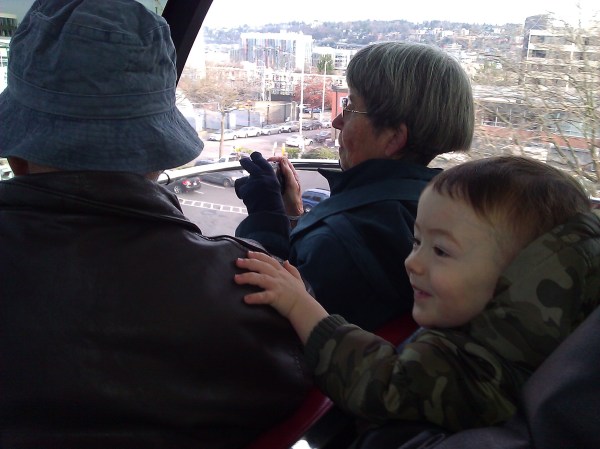
If you use these all the time, they’re probably not that exciting for you or your child. However, if you don’t regularly use these, you can convince your child that a ride on public transit is almost as special as Disneyland!

Plan a short simple outing at non-peak travel times, and get a transfer when you board – you’ll be able to ride back out for the single fare.

You can choose to take transit to a special destination. (Even something as simple as a shopping center with an ice cream shop.) Or you can just go on a ride, focusing on enjoying the journey, not a destination.

Things to Do on the Trip:

  • Gaze out the window and talk about what you see.
  • Play I-Spy.
  • Do a scavenger hunt or travel bingo, looking for things like stop signs, blinking lights, and so on.
  • for older children who know their alphabet: first find an A (on a sign, license plate, etc.) then a B and so on. See if you can complete the alphabet.
  • Many transit stations feature public art – check it out!
  • This post covers the new light rail on Seattle’s Eastside and fun kid attractions along the way.

Here are lots of train related adventures in the Seattle area. #5 is the monorail, #6 is the Seattle streetcar, 7 is light rail, 8 is the Sounder.

Cheap Dates with Toddlers: Farm Parks

Spring is coming, and the baby animals are appearing at local farms.

A few years ago, I took this picture of a 2 week old calf  at Farrell-McWhirter. He was shorter than my 3 year old! (Sorry that it’s not a great picture… my son was really ready to go have snack, so we only got a really quick look at the calf… but wow he was cute!)

calf

At any time of year, toddlers love outings to meet farm animals. Lots of children’s books, games, and videos feature farm animals, so kids tend to be familiar with them, and get very excited when they can recognize and name the “real thing.” Seeing and hearing (and smelling) the animals in person make the idea much more real. At farm parks, you can check out chickens, sheep, bunnies, cows, pigs, and goats. Some times you’ll get an opportunity to see fresh eggs in the coop, or see a cow or goat being milked.  This is a great outing for a child who has just learned to answer all those vital questions like “What does a cow say?”

For my readers in the Seattle area… here are some free outings:

Farrell McWhirter Park in Redmond. When last I visited (it’s been a while), they had a small pot-bellied pig and a really big pig, bunnies, chickens, 2 goats, a calf and horses. Animals are on view 9 am to 4 pm.  It is not a petting zoon – you  can’t pet or feed the animals – just see them. They do offer farm classes and pony rides. You can register for programs here. Farrell McWhirter is also home to Nature Vision preschool. There are great hiking trails, streams, swings, and tire swings too.

Kelsey Creek Farm Park in Bellevue. They’ve got sheep, pigs, cows, goats, ponies, bunnies, and chickens. (Learn about their animals.) Again, they’re on view, but this is not a petting zoo and you can’t feed them. It’s free to visit – animals are on view every day from 9 am to 3 pm. They also offer horseback riding and farm classes, including a great program for toddlers called Little Farmers. They also have a nice playground and walking trails. Learn about farm tours and farm classes.

Sammamish Animal Sanctuary. They have alpaca, goats, mini horses, mini donkeys, llama, cows, pigs, sheep, chicken, ducks, bunnies and guinea pigs. For a small donation, you can purchase treats to feed the animals, or you can bring your own spinach or carrots. You do have to make reservations. It is free, but they encourage donations to support their work.

Farms with a Fee:

Red Barn Farm in Redmond. They do farm visits on Wednesdays – you need to reserve. Feed the animals and walk around the farm! Price is $25 per car up to 4 guests. Additional guests beyond 4 are $10 each children under 2 free. They have cats, chickens, dogs, donkeys, ducks, goats, pigs and rabbits. (See pictures.)

Fancy Farm in Fall City. By appointment only. (Check their Facebook page for availability.) $10 per person, or $20 for family for a one hour visit. They have emu, goats, pigs, horses, chickens and ducks. Pony ride for an additional fee. I believe they let you hold / pet the animals.

Remlinger Farms Fun Park in Carnation. Opens for the season on Mother’s Day. They haven’t announced 2023 fees yet – a few years ago, they were ~$20 per person (babies under 1 are free). They have horses, pigs, sheep, alpaca, goats,  rabbits and donkeys. They have pony rides for an additional fee. They also have some amusement park style rides, and a train ride. Plus a hay maze and a hay barn to play in.

Woodland Park Zoo in Seattle. Adults $27.00. Kids are $16.50. Under two years is free. By the south entrance, there’s the Family Farm area, which includes a petting zoo where kids can meet goats up close. There’s pigs, goats, sheep, cows, bunnies, chickens, and a donkey. Plus, of course, lots of more exotic animals.

When visiting  farm parks: remember bring a change of clothes and shoes for your child! They can get pretty muddy in any of these places. Please teach your children to be calm around animals and gentle. If you’re at a petting zoo, always remember that these are animals – if you stand behind a horse and spook it, you may get kicked. If you annoy a goat, you may get bit. If you stay calm and quiet around petting zoo animals, you’ll do fine.

Updated March 2023.