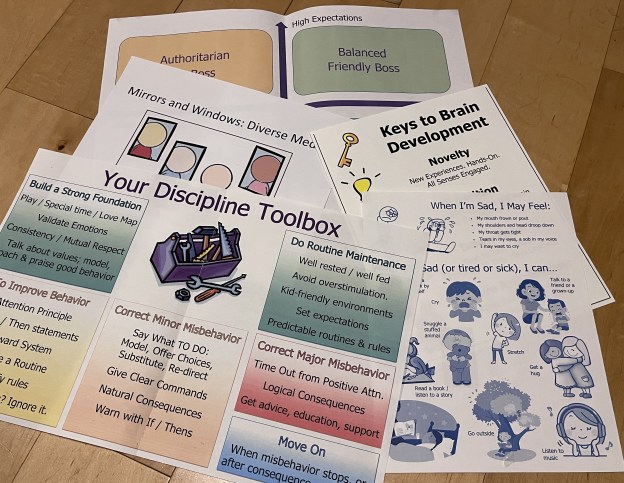
I have been teaching parent education for about 30 years now, with the past 13 years spent teaching parent-child classes for Bellevue College. In that time, I’ve created over 150 handouts on a wide array of topics related to parenting children from age 1 to 9. I just went through the whole collection and updated them all.
The PDF’s are all available for free at https://gooddayswithkids.com/for-professionals/for-educators/ You can print them, send them in emails, share links to them, or take excerpts from them. If you know any professional who works with parents – parent educators, teachers, counselors and therapists, health care professionals or whoever, let them know these resources are there.
While you may be familiar with the five senses (hearing, sight, taste, smell, touch), there are more than that, including: vestibular (am I balanced), proprioceptive (where is my body in relation to the things around me, and interoception.
Interoception is your perception of your own internal states: are you hot or cold? are you hungry or thirsty? do you need to pee? poop? move your body to a more comfortable position? are you sick? is your heart racing?
Developing Interoception
When a baby is born, they display the most basic of “feelings”. They are content, or they are distressed. That distress is often caused by an internal experience, such as hunger, fatigue, or pain. But they do not yet have the life experience to interpret what those sensations mean, and what would fix them.
That’s where parents and caregivers come in. We do our best job of guessing what they might need and meeting that need. If we guess right more often than not, they soon learn that when they feel this particular set of internal cues and then they eat, they feel better. Eventually they learn to label it as hunger, and someday they learn that they can eat before the hunger pangs hit to ward off that feeling.
Learning to tune into and trust our internal cues helps us to take care of our bodies. For example, stopping eating when you’re full honors those cues, and can be helpful for developing healthy eating habits. Being told “you have to finish all the food on your plate” teaches you to ignore those cues and keep on eating.
Interoception and Emotions/Behavior
As we get older, noticing and interpreting internal cues is so helpful for taking good care of our bodies, but having interoceptive intelligence also helps us with emotional and behavioral regulation.
We’ve all experienced being “hangry.” When you’re hungry, the smallest irritation sets off a disproportionate wave of anger. We know that when a child is tired, they get cranky or sad. Letting a child move and change positions during group time can help them be comfortable and help them pay attention. When a child just can’t sit still in a class, it is often worth asking whether they need to pee.
If your child is having lots of tantrums, it’s easy to interpret those as behavioral choices. But it’s worth asking yourself – is it possible that instead they are sensory meltdowns? When a sensory meltdown happens, the best way to calm it is with co-regulation. You as the caregiver stay as calm as you can, speaking quietly, holding them gently until they get back to calm. The bridge from them needing your help to calm themselves to being able to calm themselves down to them being able to notice internal distress and dispel a meltdown before it happens is interoception.
How can we help build a child’s interoception?
For babies: notice their cues, do the best you can to interpret them and respond to them promptly. This helps your baby learn how their body signals tell them what they need and how those needs can be met.
If we ignore bodily issues, we teach them to ignore them. If we change a wet or dirty diaper promptly it helps them realize that when they pee or poop something happens – that will help with potty training later. But if you often delay diaper changes, they learn to just ignore the situation, and are hard to talk into potty training later.
For toddlers and children, start to interpret their experience. “I notice you’re wiggling a lot, I wonder if you need to pee.” “You’re all sweaty now – I bet you’re hot. Do you think taking your coat off would help?” As with teaching emotional literacy, rather than telling them how they feel, phrase it with curiosity and questions that encourage them to tune in to those inner signals for themselves. “Hmmm… it’s been a long time since we ate, I wonder if you are feeling hungry yet?”
You can also share your own experience: “whoo – I’m really cranky right now… you know what I think is going on? I think I’m hungry and I notice that I get really cranky when I’m hungry.”
Don’t dismiss their experiences. If they hurt themselves, instead of saying “you’re fine”, say “it seems like that really hurts, huh? I’m pretty sure it will feel better soon, but what would help you now?”
When they’re younger, we might teach common experiences, like “if your stomach growls, it means you’re hungry.” As they get older, we can talk about how everyone has unique body experiences: “if you’re feeling worried, where do you feel it in your body? When you feel that way, what could you do to feel better.”
Understanding their own internal needs helps them to meet those needs, and helps reduce the chance that those needs will distract them from learning and from behaving well.
Learn More about Interoception and Sensory Regulation
(Side note: Enteroception with an e is a subset of interoception, and refers specifically to the senses of your gastrointestinal system – hunger, fullness, and urge to have a bowel movement.)
This post is the text of a handout I created for orientation at my co-operative preschool (I’ve added links for learning more), so it talks about how we do things in our classroom, but all of these 12 principles apply to parents and teachers in all settings.
Respect! Let’s commit to a fundamental belief that everyone here (kids and parents) is doing the best they can given their developmental level, skills and knowledge, and challenges in their past and current environment. And… we all have bad days. When you have a bad moment, call yourself on it, apologize as needed, forgive yourself and commit to doing better. When someone else is having a bad moment, don’t judge.
Kids do well if they can. If someone (kid or adult) is “mis-behaving”, ask yourself: What skills do they lack? What support do they need? What stressors are making it hard to do well right now? When those things are noticed and addressed, behavior improves.
Everyone does better when they know what to expect and what’s expected of them. Consistent routines, clearly explained expectations (not “unwritten rules” they need to guess), well thought-out limits and follow-through on promises (both promised rewards and promised consequences) create an environment where a child can do well.
All feelings are OK. (Not all behaviors are.) We all have lots of big feelings. We’re all learning how to manage them appropriately. When a child is calm, we can teach appropriate ways to express feelings. When someone has big feelings, it helps to validate that. If their feelings led to bad behavior, also address that: “Wow, you were mad she took your toy. I understand. But you hit her, and that was not OK.”
When someone flips their lid, co-regulate before anything else. When we are calm and feel safe, we have access to our whole fully developed brain. So a young child can speak in sentences, follow the rules, make fairly good choices. But, when we are really scared, or sad, or mad, or just overwhelmed by too much stimulus or too many demands, we “flip our lids.” We can’t speak, we can’t be reasoned with… If you have a child who is in full meltdown, it’s not the time to teach or to explain or to ask them to make better choices. Instead, co-regulate. Get yourself calm, get down to their level, speak in a quiet voice. Set clear limits and tell them what needs to happen next.
Every kid is unique and has different needs and capabilities. We are a multi-age class, so our kids are at different developmental stages. Development is asynchronous, so you might have a child with high skills in one area and low in another. Also, we all have different interests, different temperaments, different sensory and support needs, different degrees of flexibility before we hit a breaking point. If you find yourself worrying that your child is “behind” other children, or find yourself judging other children for areas they’re struggling in, remember this range. Judge each child’s progress based solely on – is this child progressing well from where they used to be
These kids are little. They’re still learning. These kids are practicing everything. Practicing kindness, practicing sitting still and listening, practicing good choices, how to do things without making a mess. They’re going to make a lot of mistakes along the way or have days they’re not doing well. We’ll just keep working on it. Instead of telling them “don’t do that”, tell them what TO DO. Instead of assuming they know how to behave well, tell them what would be a positive action to do in that moment.
Growth Mindset/ Power of Yet. “You can’t do it yet, but you’ll get there.” At times, a child can almost do something – they’re working on a puzzle, and they know how it’s supposed to work, but just can’t do it. That is super frustrating!! Don’t feel like you have to rescue them – sit by their side for support and encourage them to keep trying – suggest things to try but don’t jump in and solve it. When they make mistakes, say “hmm, we learned something that doesn’t work. What else could we try.” But… also notice when something is just too hard (or at least too hard in this moment). Teach that it’s OK to say “I can’t do this yet. I can set it aside and try again some other time.”
Process over Product. With crafts, we might have a sample of what a final product could look like. But the process is always more important. We honor a child’s right to make their own choices about what to do. (As long as they’re following the “make don’t break” rule.) What they learn in the process of doing something is more important than the product. So, while you are welcome to help them to do it themselves, please don’t just jump in and do it for them so it will “turn out nicer.” That’s not the point!
We are child-led, play-based. We set up a variety of great learning opportunities, but it’s up to the child to decide what they want to try, and how long to do it. If they start a project and don’t want to finish, that’s OK. If they only try two activities in a day, they didn’t “miss out” on everything else. They focused on what mattered to them.
Freedom Within Limits. Everyone Gets to Feel Safe. Everyone Gets to Play. We try to give children lots of choices. They’ll make some good choices and some bad. We want to let that happen so they learn from their mistakes. But, for the sake of safety (physical and emotional) and fairness, parents and teachers must set appropriate limits. We decide what options are on the table, and they decide from amongst those good options. If they do something unsafe or unfair, we set limits. For example, rough and tumble play is tons of fun, but only if everyone has consented and everyone stays safe.
Four Keys to Brain Development: Novelty, Repetition, Downtime, and Safety. Every time we experience something for the first time, we make new connections in our brain. Novelty is so exciting! Every time we see something familiar or repeat something we’re good at, we build competence and confidence. Repetition and routine is soothing! None of us can be learning and doing all the time. We all need breaks to rest and integrate new learning. Finding a balance of novelty, repetition and downtime and ensuring a child always feels safe and loved is the best way to support learning.
Handout
Here’s the handout version of this post – feel free to share anywhere.
At my toddler class and preschool, I have children who speak lots of different languages at home: including Spanish, Russian, Mandarin, Vietnamese, Hindi and diverse Indian dialects. I speak a little Spanish, French and German – enough that I can count to ten, and name some colors and some farm animals. That means that I can sometimes talk with children in their home language. I’m now trying to take on some Mandarin, and feel like I’m way out of my league. But here’s where I’m starting.
First, this helpful video which explains the whole idea of tones and reading pinyin – the romanized version of writing Mandarin that includes pronunciation cues:
This was an a-ha moment for me. Last year, I had a student in class that I asked his mother how his name was pronounced. She said it, I echoed back what I thought I heard, she said no, and said it again – after several attempts I couldn’t get it right and couldn’t hear what I was doing wrong – I worked with my teacher who speaks Mandarin, and she couldn’t explain what I was doing wrong. (There’s research that shows that young babies can hear any tone human mouths can make, but by the time they are toddlers, they have learned to ignore tonal differences that don’t matter in their language – for example, the difference between L and R sounds in English matters, but it doesn’t matter in Japanese.) Because I was raised in an English speaking home, these different vowel tones are just not something my brain easily hears, so I will have to actively teach it to notice these differences. This video helped with that.
I know that music helps us to learn, so, to embark on Mandarin, I’m starting with children’s songs.
Where is My Friend
Lyrics:
yī èr sān sì wǔ liù qī wǒ de pénɡ you zài nǎ lǐ zài zhè lǐ zài zhè lǐ wǒ de pénɡ you zài zhè lǐ
1, 2, 3, 4, 5, 6, 7 / Where is my friend? / Over here, over here / My friend is over here
The song starts with counting to 7, so it’s a great early one to learn. I also like the video from our local library.
This video includes really clear pronunciation on the song, then teaches each of the words. (You’ll also see how she uses the fingers one one hand to count to 10 in the Chinese way rather than the method I’m familiar with which requires both hands.)
Liǎng zhī lǎo hǔ, Liǎng zhī lǎo hǔ, Pǎo de kuài, Pǎo de kuài, Yī zhǐ méi yǒu yǎnjīng, (or: Yī zhī méiyǒu ěrduo) Yī zhī méi yǒu wěibā, Zhēn qí guài, Zhēn qí guài.
Two little tigers, two little tigers / Running fast, running fast / One without eyes (or one has no ears) / One has no tail / it’s very strange, it’s very strange
This uses the same tune as Frere Jacques.
There are additional recordings at Bao Bao, and lots more. Here is a pronunciation guide from Bao Bao Learns Chinese.
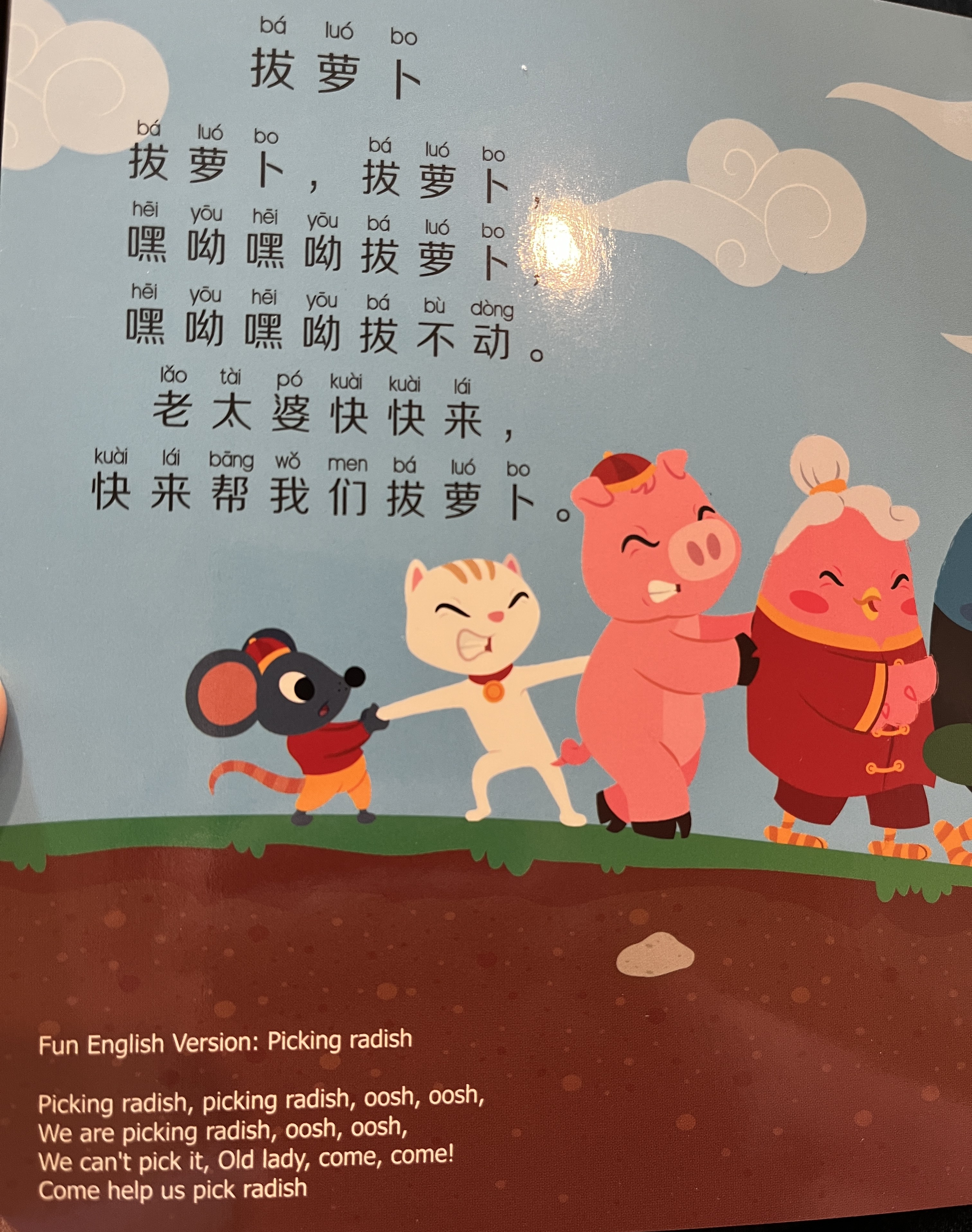
bá luó bo, bá luó bo; hāi yāo hāi yāo bá luó bo; hāi yāo hāi yāo bá bū dòng; lǎo tài pó, kuài kuài lái; kuài lǎi bāng wǒ men bá luó bo
Pull the radish, pull the radish / hey-o, hey-o, pull the radish. / hey-o, hey-o, we can’t pull / Old lady come, quickly come / Come help us pull up the radish now
This video translates the title as picking carrots, but everything else I’ve seen says radish… In repeat verses, instead of calling the old lady, you could call for little girl, little kitten, little mouse, etc.
Or here is another version – I like this song, because I really like the sound of the hāi yāo hāi yāo bá luó bo refrain. The song appears in Ditty Bird Chinese songs volume 1 sound book.
Row Your Boat – Huá xiăo chuán
I decided to try a Mandarin version of a traditional English children’s song.
Huà huà huà xiǎo chuán shùn zhe xiǎo hé liú Kuài lè ba (4X) Rén shēng shì gè mèng
Today I was listening to a webinar with Ming Fung from Agents of Speech. The topic was “Decoding the Real Signs of Speech Delays” and he was primarily talking about parent coaching for language delays.
But one of his messages gave me one of those a-ha moments you get when someone says something that should be obvious, but says it more clearly than you’ve thought of it before.
When you’re trying to teach your child any new skill and it’s just not working, you should ask yourself “is it that it’s too hard? Or that they don’t want to do it?”
If it’s too hard, that may mean you’re trying to move too far too fast, and simplifying things into next achievable step might be more successful. It is better to have small successes than fail at a big reach. Ross Greene says that often when we’re thinking “they don’t wanna do it”, it’s really that “they can’t do it… yet.” And that they need more skills, new resources, or more structural supports to be successful.
If they don’t want to do it, he says “make sure they’re fairly compensated.” If it’s just slightly hard or slightly annoying or whatever, it may need just a little motivation. If it’s a big stretch, it may need a big motivation. If your child has special interests, you could find a way to teach that skill within that interest. (When my youngest child was resisting learning to write and draw, we would ask him to write requests for treats, like “kiss” for a Hershey’s kiss or “Cheez-Its”, and he would draw if we would draw Star Wars characters that he could copy.) Or, if they have a big passion, you can use that as a motivator. (My oldest was very slow to potty train, and saying “here’s the dollhouse you want – it’s a big kid toy. As long as you can keep your underwear dry, you can play with it, but if you need to go back to pull-ups, that’s OK – we’ll put the dollhouse away for a little while till you’re ready to be a big kid.”) Don’t force the learning, but show them there is a value in learning this new skill.
Now, you don’t want to overdo rewards. There are downsides to rewards. But sometimes it is a way to move your child forward toward something you want them to learn.


 More Good Days with Kids