This post is focused on elementary age children and questions to reflect on how parenting is different at this age. But first, let’s look at a theoretical approach to the different stages of parenting.
Stages of Parenting
Researcher Ellen Galinsky interviewed 228 parents (of 396 children) with diverse parenting experiences. She found common threads showing six distinct stages of parenting.
Stage One: Image-Making
Before the first baby is born, parents begin to create pictures in their minds of what parenting will be like and what kind of parent they hope to be. They began to adapt their home and their lifestyle to accommodate the child. They observe other parents and reflect on how they were parented to help create their self-image as a parent.
Stage Two: Nurturing
From birth through the first two years. Focused on physical care, soothing, snuggling, and playing. The main goal is to develop a relationship with their child. As the attachmentgrows, parents evaluate their priorities for how much time to spend with the baby versus other aspects of life, including other relationships, and how much of their identity is being a parent.
Stage Three: Authority
From about age 2 to age 5. Parents are more certain of their own identity as parents and of their relationship to their child. They begin to define the family’s rules, decide how strictly to enforce rules and what to do when rules are broken. The main task is deciding how much authority to exert over the child’s behavior versus how much freedom to allow.
Stage Four: Interpretive
The elementary school years. Parents evaluate their own strengths and challenges, and also evaluate their child in comparison to others and to their expectations. The main task is interpreting the child’s experiences as they are increasingly exposed to a world outside their family. Parents answer questions, and determine what behaviors and values to teach. They decide how and where the child spends time and with whom. They decide how involved to be, and when to make the decisions versus when to let a child make choices independently.
Stage Five: Interdependent
In the adolescent years, parents redefine their authority and renegotiate the relationship with their child, who is increasingly making decisions independently, out of the parent’s view. Parents need to trust that they have instilled good values in the child. They don’t allow their adolescent to have complete autonomy, but do allow for more discussion about rules.
Stage Six: Departure
As the child reaches adulthood, parents prepare for the departure, re-evaluate their parenting accomplishments and failures, and re-define their parenting identity and relationships. Parenting becomes less central to their identity and their daily lives.
Parenting in the Interpretive Stage
School and peer relationships assume the central role in the child’s life, and start pulling attention and energy away from the family unit. Parents have much less time with their children than before so need to be more focused on their goals for that time.
Here are decisions parents are making during their child’s elementary school years, as they realize the increasing separation between their identity and the child’s identity.
What kind of life do I want to provide? (And what can I afford to provide?) What do I say yes to in terms of new clothes or toys, and activities to do. What do I say no to? How do I manage the inevitable times when my child says “that’s not fair! All the other parents let their kids _____.”
How should I interpret the world for my child? For example, if they ask questions about race, death, sex, religion, and so on. How do I share my beliefs and values with them to give them an internal compass? (There are resources on how to talk about difficult topics at https://gooddayswithkids.com/better-you-than-youtube/)
How do I want my child to behave? (And have good behavior internalized as self discipline?)
What do I want them to be capable of and responsible for? (e.g. chores, practicing and playing an instrument or a sport) What new privileges / responsibilities will I introduce (for example: allowance, a phone, going places independently.)
How involved do I want to be involved in their life, at home and away from home?
When should I step in to help, and when should I back off and let them make decisions and try things independently?
How do I ensure they have the skills and knowledge to self-manage healthy habits like good nutrition, personal hygiene, and good sleep?
How involved do I want to be with the other significant people in their lives. (Friends, parents of friends, teachers, counselors, sports coaches…)
How do I support them when they’re navigating the emotional ups and downs of peer relationships? How do you monitor friendships while not overly interfering?
How do I hope to define our changing relationship? For example: how much do we hug, hold and cuddle as they get older? How involved are we in bedtime and morning routines? What do we do together for fun and connection?
When they are adults, how do I want them to look back on this time? How am I hoping they’ll remember what kind of parent I was?
Note: I have a more general post on talking to children about the concept of death that I would recommend for most readers. This particular post is much more specific than that – it is focused on how to talk to a very young child (age 2 to 5) about the impending / expected death of a parent (or a grandparent.other adult who is very involved in the child’s day to day life.) It may be relevant as someone is nearing end of life or has been placed in hospice care.
First, I want to acknowledge that this is a very heartbreaking thing to have to talk about. For you, as the adult who is in the midst of this difficult situation and will have these sad conversations with the child – this is hard emotional work, and I encourage you to seek out support for yourself as well and to do the self-care that nourishes you through these hard times.
But, although it is challenging, I think it is important to have these conversations. To be honest with children about the realities of the upcoming loss. Trying to shield the child from anticipatory grief will only make it harder for them when the loss happens and the full grief becomes a part of their life. Talking about it now allows them to begin to process it, and allows you to create meaningful and loving moments with them as you begin with saying goodbyes.
Let’s look at what a child this age is capable of understanding, and some key ideas to talk with them about.
Explaining Death to a Young Child
Before talking about the upcoming loss of a child’s loved one, it’s best to start by making sure they have an understanding of what death is.
Explain what death is in very concrete ways – this is not the time for flowery metaphors like “go to a better place.” Instead, share these ideas:
Death is the cessation of life functions. Use simple terms and examples from their life experience. “Do you remember when your pea plant died, and it stopped growing and started to shrivel up?” “Do you remember when we saw that dead squirrel in the park? They looked like they were sleeping, but their heart had stopped, and their brain didn’t work anymore.”
Death is permanent. Once something has died, it will not come back to life. If someone we love dies, we won’t see them again.
Everything that is alive will someday die. Some things / beings live a very long time, and others live for a short time. Sometimes death happens suddenly, sometimes someone is sick for a long time before dying.
Death is caused by physical reasons. Describe in a simple, non-graphic way what can cause a death.
Even though someone may not be alive any more, we can always hold them in our memories.
For a preschooler, age 2.5 – 5: Even if you clearly explain what death is, they may not be able to grasp what you mean. Permanence is hard to understand. They may believe death is temporary and reversible, and may ask things like “but when will they come back?”
Teachable Moments
I often recommend that parents wait for teachable moments to talk about death. For example, if a child sees a dead bug on the window sill, or an animal that was hit by a car, or they hear that a friend’s pet died. Those are times a parent can introduce the topic. Or any time a child asks about death, calm, matter-of-fact answers are helpful. You can take advantage of these same moments. But, if you, or a close family member, is facing the end of life soon, you may feel the matter is too urgent to wait for teachable moments to appear, and may intentionally bring it up through conversations, or pretend play / storytelling, or through media.
There are many shows and movies where a character dies that you could use to introduce the subject. Two that I know of that are focused on helping a child understand death are the Mr. Roger’s goldfish episode and the Daniel Tiger episode.
If you have some time (days or weeks) to prepare, you could gradually sneak little conversations about death in and around all the normal toddler and preschool daily activities – don’t force it and don’t talk about only this… trust that you can gradually bring these conversations in.
If we use vague euphemisms, it’s confusing. Saying “mommy is sick” or “grandma went to sleep” or “daddy is going to go away soon” can cause a child to worry that the next time anyone gets sick in any way, or goes to sleep, they too will die, or any time any one leaves the room or the house, they might not come back. (This video talks more about how it’s helpful to use the word death instead of euphemisms.)
So, be clear about what disease is happening (e.g. cancer), what you might guess the timeline will be and what to expect. (As much as you can guess.) You don’t want to overwhelm them with details, but do give an honest overview.
An extremely important thing to address is who will care for them. Reassure them that they will be OK, and all their needs will still be tended to.
Having this conversation will be hard for you. You may cry. It’s OK. You can be honest with your child about how you are feeling. (Do be sure to get lots of support elsewhere so your child does not feel like they have to help you feel better.) But it’s OK for them to see your feelings.
How They May React
When you tell them, they might be very upset. Or they may have very little reaction. It may just be too hard for them to really grasp the meaning of the situation.
Even if your child won’t talk about it, they may play this out – you might see pretend play scenarios involving hospitalization, death, and dinosaur attacks and more. This is a normal part of them making sense of it all.
They may have times they worry a lot about it, there will be many more times where they seem to have no awareness of it and are just focused on being happy toddlers / preschoolers. This video is very helpful for understanding how this is developmentally normal.
Even if they aren’t voicing any concerns related to the illness, they may show some of these behaviors: regression (e.g. needing diapers again after having been potty trained, or thumb sucking after they had stopped), clinging, sleep disturbances, separation anxiety, or fear of the dark. You might see anger and temper tantrums. It is fine to give them extra support and be a little more relaxed about “the rules” but don’t go too far into total permissiveness. Having the old familiar routines and rules is actually reassuring to children and helps give them security that although there will be some huge changes, other things will stay the same.
There are a lot of things in any child’s life that are out of their control, and especially for your child in this moment. Giving them choices anywhere you can (like what clothes to wear or what to eat for breakfast) can help them to feel more powerful.
It might also be helpful to give them “jobs” they can do to help out, even if it’s as simple as bringing a cup of water or snack to the ill person, or helping to fluff their pillow. Feeling like they can make a difference for the person they love is empowering to a small child.
When to Have the Conversation
With an older child, like an elementary age or middle school child, a parent would be able to plan this out – plan a quiet time for a long uninterrupted conversation in a private place for a single focused conversation. The reality of small children and attention spans and how much they can take in at a time means that you just have to be on the lookout for an opening… when you have a moment where things are quiet and neither they or you are tired, stressed or hungry, there may be a chance to start the conversation. While you have their interest and engagement, keep going. But watch their cues. When they wander away, or disengage, or start pushing the conversation away, let it go. You can talk some more some other day.
Don’t put off the conversation waiting for the perfect moment to get it right. There is no perfect moment. The important part is to start the conversation, don’t avoid it.
And know that this is not a one and done conversation. Your child may continue to bring it up off and on, and ask questions, and ask to be told again something you think you’ve told them several times. This is part of the process of them taking in and understanding the information.
Answering their Questions / Concerns
Some common questions come up for kids. Listen for them, or even if they don’t voice these questions, you may want to talk about these issues proactively.
“Is it my fault?” Kids are naturally very self-centered. They may wonder/worry that they caused the illness because they were mad, or bad, or whatever. They need to be reassured that it’s not their fault.
“Are you leaving because you don’t love me?” Reassure them this is not the case!
“Will _____ die too?” If one loved one is dying, they might worry that others will too. I don’t ever promise that won’t happen, because none of us can promise that. But I do tell them I think it is HIGHLY unlikely.
“Will I die too?” I think it’s only fair to say “yes, you will die someday but I think it won’t be for a very long time.” If they ask “Can I die too to be with you?” let them know that as much as you love them, you want them to live a long and beautiful life.
“What happens after you die?” You can share your beliefs with them about this. Other important people in their lives might share different beliefs. That’s OK. I say it as “No one knows for sure, but here is what I believe.” Whatever you share, it is helpful to be clear that a dead person’s body will not come back to life and someone who has passed will not be visible / tangible to them in the same way as before death.
“Will it hurt?” Be honest about whether the dying process may or may not hurt and how health care will support that. But say that death itself does not hurt, and after death, there is no pain.
“Can we fix it?” Tell them that you really wish you could, but some things can’t be fixed. Reassure them that you are doing all you can to help these be as easy as it can be on everyone, and that even though it is still very hard, in the long run, you know they will have a happy life.
Books to Read
These are some books that could be effective for the person whose passing is nearing to read to the child. (You could even make a video of them with the child in their lap reading it aloud to them.)
With each, I include a link to the book description* and also a link to a video of a read aloud so you can see if the book feels like the right fit for your situation.
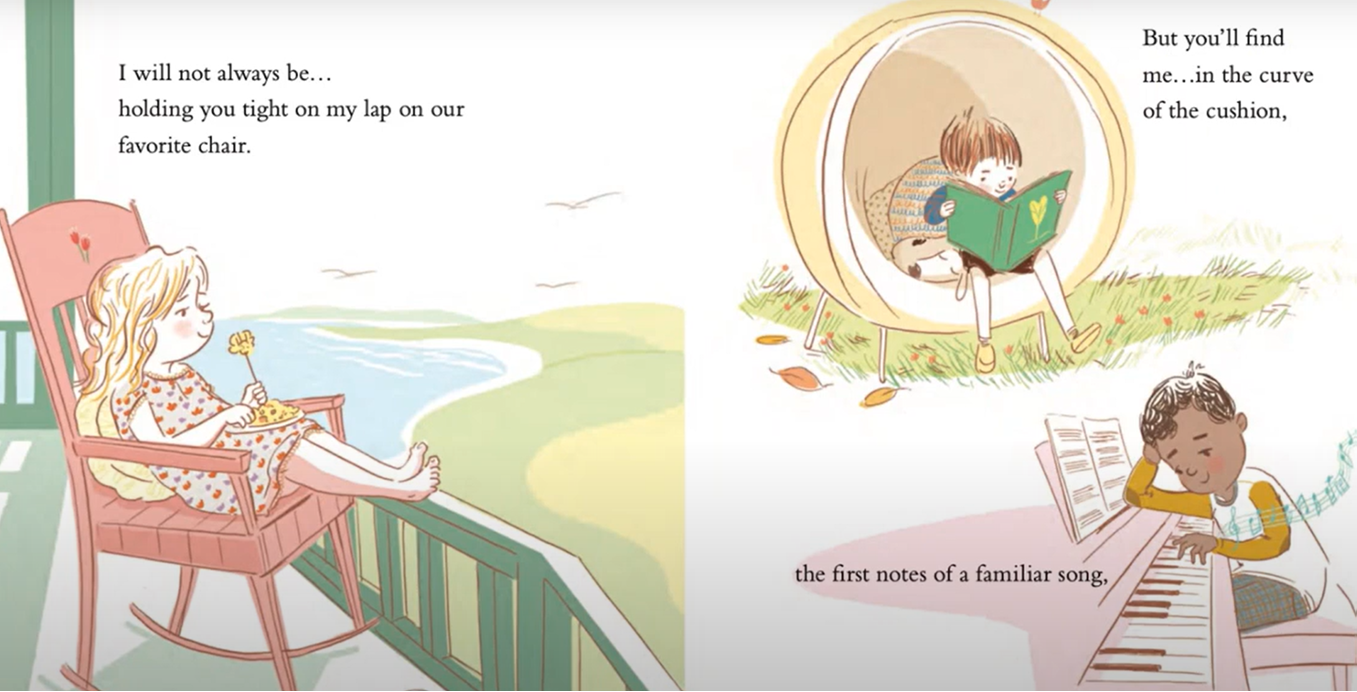
You’ll Find Me by Amanda Rawson Hill. (Video) This is beautiful. “I will not always be greeting the morning with you, but you’ll find me… in the way the sun spills through your window whispering wake up sleepyhead… I will not always be holding you tight in my lap, but you’ll find me… in the first notes of a familiar song…” The image at the top of this post is from this book.
You’ll Always Have My Love by Jennifer Chobar. (Video) Although I don’t think the rhymes are the best children’s writing, I do think there are beautiful messages in this book! I think it would be a very sweet thing for the person at life’s end to read to the child, if their belief system includes the idea that they’ll be watching over the child after they die.
When Mama Goes to Heaven by Jayna Russell. (Video) Talks about how the person they have lost can still be “found” in all the beauties of the world.
The Goodbye Book by Todd Parr. (Video) Could be read after someone’s passing, but I also think it could be read beforehand, as a chance to preview what the feelings might be like and how to hold them gently.
Creating Memories
By being honest with a child about what’s coming, you create the opportunity to create special rituals and preserve memories. Make lots of videos, take lots of pictures, write letters to be given to them on each birthday, plan a memorial service together, whatever feels meaningful to you.
You can also do more things with all the other adults who will help to support the child after the death, strengthening all those relationships, and showing them that those adults have your trust.
Still Living Your Life
Sometimes when death is coming, families let that overwhelm everything. Every day becomes about that.
It’s OK to still do all the “normal” things that “normal” families do with small kids. And let your kid be a kid! Go to the playground, watch Bluey together, dance together, see friends for playdates, go to preschool or story time, and so on. And it’s OK to have bad days when you’re cranky at your kid, like all parents have days they’re cranky at their kids!
Nearing the end
As the health situation worsens, and the end comes closer, be honest with the child about what is happening and what to expect. Keep reminding the child that they are loved and that they will be well cared for, and although many things will change, that will remain the same.
It might be tempting to keep the child away from a loved one who is becoming quite sick and frail. But it is hard for the child if someone “disappears” from their life before they are truly gone, so follow the child’s lead. If they want to be with the person, let them be! If they are ready for a break, give them a break. Allowing them to have choices in the moment is helpful. There’s no easy path, but again, letting them have some choice and control can help.
Books that can be read to the child after the loss: Missing Mummy by Rebecca Cobb. (Video), Lost in the Clouds by Tom Timm Disbury. (Video), The Memory Box by Joanna Rowland (Video). Something Very Sad Happened by Zucker (Video.) The first two are about the loss of a mother. The third isn’t specific. The last is about the loss of a grandmother. But I believe the reader could adapt these to the child’s situation.
One important thing is that people continue to talk about the person who has died. Sometimes they avoid this because they fear it will make the child sad. It actually tends to be healing and calming to children to continue to hear about this person who was so important to them.
Note about links for book titles: these are Amazon affiliate links, so I would get a small referral fee if you clicked through and then purchased, but I also encourage you to get the book from your favorite independent bookseller.
More Resources:
There are lots more helpful resources on these sites:
Note: my other more general post on Talking to Children about Death covers some of this same info, but also has other tips and resources you may find helpful.
This year has been an especially tense year related to politics in the United States. “Every year the American Psychological Association takes a look at the leading causes of stress in the U.S…. This year… all the usual suspects like money, health and family are still wearing people down, but one issue is dominating – politics… the future of the nation… 80% of Republicans rated it a top stressor, so did 79% of Democrats and 73% of Independents.” (NPR)
When parents are stressed, we tend to be less patient, get annoyed more quickly – sometimes over-reacting to small things. Our children feel that stress and may wonder if they are doing something wrong that is the reason their parents are unhappy, or may worry that bad things will happen to their family.
If you’re feeling stressed about the election, admit it to your child – let them know that they are right about what they are noticing about your feelings. But also reassure them that they have done nothing wrong and you are not upset at them. Also, reassure them that things will be OK in the end – I know that you yourself may not be feeling confident right now that things will be OK in the long run, but this is a time to dig down for whatever optimism you have, or faith or resilience, in order to reassure your child.
I have an approach for talking to kids about anything that scares them or scares you or raises your anxiety levels high – it’s especially relevant to things we may feel we have little control over (like national elections!).
Be thoughtful about how much exposure they have to the issue that is concerning
If they bring it up, or ask a question, don’t avoid it, just answer it briefly with a simple reassuring explanation.
Talk about how likely (or unlikely) the thing you’re worrying about is to happen.
Tell them what will be done to prevent bad outcomes as fall-out from that.
Reassure them that even if bad things happens, people are tough and resilient, and pull together and make it through.
So, to apply that approach to the election:
Be thoughtful about media exposure:
While you might be tempted to doom-scroll media and social media binge for all the most recent updates, try to save that for times your child is not observing you. If you are checking on things, just remind your child that their world is OK, you just have some worries about things in the outside world but that they are still safe and loved.
In 2016, when my child was almost 6, I did something that I wouldn’t recommend you repeat – I came home from work at 8:30 pm on election night and was upset and turned on the TV to watch – he heard it, got out of bed, and came to watch with me. We were all up VERY late that night, upset over election results. (And I imagine that other parents may have had a similar experience on election night 2020 for opposite political reasons.) A better choice would have been for me to turn it off, get him settled for bed, and then do what I needed to do to process the results. And I could have reassured him from a belief that I DO hold, even though it was hard to hold in that moment: as MLK said “Let us realize the arc of the moral universe is long, but it bends toward justice.”
Responding to their questions
Even young children will hear about the election – I remember when George W Bush was up for election (and with the whole Bush v. Gore hanging chads saga) my older kids who were early elementary at the time had lots of questions. Answer questions as simply as possible, then ask them if they have more questions before continuing to info dump your own anxiety on them.
For younger children, say under 8 years old, I would focus as much as I could on optimistic perspectives, reassuring them that they’ll be OK, and focusing on the things in our personal life that we do have control on and not as much about the broader world that we have less control over.
How Likely / Reducing Harm
RIght now, I have a 13 year old who follows me around asking me “the polls are so close, who’s going to win?” I tell him that millions of people around the world want to know that, and nobody has a good answer to that. Then he asks me again, “yeah, I know, but what do you think is going to happen?” I acknowledge that he’s feeling anxious and that it’s hard to sit in uncertainty.
He wants to know what will happen after the election – he has a lot of worries about what things will be like if one candidate wins.
Because my child is a teenager, I talk more openly about what challenges we would likely face over the next four years, and also talk about what people and organizations who are politically aligned with us will be doing to help mitigate the harms. And about the idea of checks and balances – while not perfect by any means, different governmental systems can reduce the most extreme policies.
Resilience
I also talk about how I’m coping with my own worries about that by thinking about all the positive reasons that I think that even if things are hard for a while (especially for certain marginalized groups), over the next many years things will get better. I talk about the ways that our society has progressed over my lifetime and his grandparents’ lifetime – progress is not fast or easy, but it does bend toward justice. We also talk about what we can do as individuals to help with that progress.
Self Care
If you need support processing your worries about this election, reach out to friends and family. Or, if there is political strife within your friends and family, search online for things like Facebook groups or Reddit forums where you can find people who share your views to help you not feel so alone. (Note: if a forum is soothing to you, stay in – if it just escalates your emotions even further, move on from it.) Do the usual self care things – sleep, get outdoors for a walk, eat well. We’ll get through this.
Pretend play, also called dramatic play, imaginary play, or dress-up is a huge part of the preschool years. Let’s talk about: the benefits of pretend play, how children’s play skills develop, and ways that parents and teachers can support imaginary play (and what to do if you don’t enjoy it at first.)
Benefits of Pretend Play
Here are just some of the learning benefits that stem from pretend play:
Social-Emotional Intelligence – By role playing different emotional experiences, children can learn empathy; and can learn how to process and express emotions when they’re not in the midst of managing real feelings.
Exploring Social Roles – Pretend play gives children a chance to learn about different roles that people play, what tools they use and what the rules are for each setting (a teacher at pretend school acts differently and uses different tools than a waitress at a pretend restaurant). This helps them make sense of their world as they play out things they don’t totally understand yet.
Experimenting with their identity – They get to try on different personalities and different styles of interaction.
Abstract Thinking – understanding that this piece of bark that represented an ice cream cone earlier is now representing a piece of pizza for the next “customer” supports symbolic thinking (pre-literacy, pre-numeracy).
Communication and Negotiation. Discussing with a playmate what scenario they want to play out, who plays each role, and taking turns when they both want to be the doctor, helps them practice social skills.
Planning: short and long-term goals. If they want to play restaurant, first they have to gather the toy food, and the play money and set up the table, then decide who plays which role, then begin play – there’s a lot to think through.
Vocabulary: To play out a scenario takes a lot of new words!
Here are some examples of what children can do at each age.
1 to 2 years old. They need concrete props to organize play around. They can imitate things they have seen done in real life: pretend to talk on a toy phone, stir an empty pot with a spoon, pretend to eat toy food, tuck a doll in bed.
2 to 3 years old. Can substitute items – they can pretend a stick is a magic wand, or a pinecone is a cookie. Can play out a couple steps – car drives down road, goes to car wash. They can do pretend play if an adult or older child is supporting the play (by coaching them or asking questions or mimicking behaviors), but they’re not really able to get it with peers.
3 or 4 years old. They can do pretend play with others their age, following a pretty standard “script” where they know what it means to “play house” or “play pet store.”
4 to 5 years old. They play more creatively. “In [mature] pretend play, children act out sophisticated narratives. Children use a combination of objects, actions, and language together in narrative sequences and use language outside of their daily vocabulary as they meaningfully act out different perspectives and roles” (Early Childhood Learning Knowledge Center, 2006, p.2).
Supporting Pretend Play
“The adult should facilitate play, but not dominate play. Support the play, encourage the play. If children get stuck, you want to help them get unstuck and take the next step, but you don’t want to direct it.” (Source) Here are some ways to support it:
Read books and watch movies with that setting so they have a “script” for how to act in a pretend play scenario. (For example, before we do astronaut pretend play in my class, I encourage parents to watch shows about astronauts or read books to give context to the child. Before we did a pretend doctor’s office, we might learn about doctor’s visits.
Narrate steps to act out – “now it’s time to get on the airplane, put your bag here, let’s put on our seatbelts.”
Suggest next step: Can you make me some toast – will you put butter on it?
Pretend to eat. This is always engaging! Note, kids under two have a hard time not really mouthing the pretend food – pelase teach them how to pretend to eat at home, that will help reduce germ transmission at preschool!
Follow your child’s lead – don’t feel like it’s up to you to be witty and create amazing new scenarios – you’re not the director.
Have your own props, such as a doll to feed – model new ideas for them to imitate.
Slow down – take time and let your child process things
No multi-tasking – be present. No matter how tempting it is to scroll through social media, try to give the game your full attention.
Repetition is good – I know it can be exhausting to play the same thing again and again, but children learn through repetition.
If you’re getting bored, think about how to stretch their pretend play. Maybe try reading some new books or watching some new shows to inspure new scenarios? Or use cardboard boxes and items from the recycling bin to make props for a new scenario.
Props
Here are ideas for materials to enhance pretend play. Again, with 1 – 2 year olds, they need the props – older kids can create anything with imagination.
Toddlers have a hard time putting on complicated clothes, so for young children, choose hats, big shoes, capes – be careful about items that go around the neck if they are also playing on large motor equipment.
Three year olds respond best to clothing for characters they see in the real world: police, fire fighters, doctors, baristas
Four year olds love fantasy costumes: princess, fairy, superhero
Spaces – play tent, tunnel, big cardboard box, tent
Themes for Pretend Play: restaurant, school, library, post office, camping, zoo, doctor’s office, airplane, road trip, pirates. Don’t expect a 2 or 3 year old to be able to play something they’ve never experienced – e.g. old time farm life – play real world experience. 4 and ups more adventurous – show them a pirate movie then create a pirate ship on the couch.
What if you don’t like pretend play?
If you don’t enjoy pretend play with your child, you’re not alone!
Here are some tips:
Don’t feel like you have to entertain your child at all times… it’s healthy for them to learn to entertain themselves.
If you want to do things with your child, but just don’t enjoy pretend play, you can cook together, or do art, or play board games, or sports. Doing something you enjoy is better than gritting your teeth through things you don’t enjoy. And you can “outsource” the pretend play to a friend, family member, babysitter or drama teacher who does enjoy it.
Set a timer or something and explain you can play cars for this amount of time then you need to move on to something else.
Find pretend play that does work for you – I don’t love playing house or playing with dolls, but I enjoy putting on puppet shows where I tell a story with “ideas from the audience”
Build things together – asking questions about “what else would we have in our dollhouse” stretches the same abstract thinking muscles for your child.
Watch Bluey to See Pretend Play in Action
The show Bluey on Disney Plus does a fabulous job of illustrating how parents (and other grown-ups) can do pretend play with kids. Here are just a few sample ideas for pretend play scenarios from Bluey. They are cataloged (and there are links to episodes) at: Bluey’s official website, Fatherly, Dad Fixes Everything, and Bluey Wiki.
Taxi or Bus – where will you drive them to? Which passenger will get in next?
Hotel – they’re the desk clerks who check you in and show you to your room.
Restaurant – you’re the customer, they’re the wait staff. What will you order? What will they bring?
Neighbors – stand on both sides of a fence and have a conversation.
The Queen and the Butler. One person sits on the throne and gives orders.
Born Yesterday. Pretend to know nothing, and respond accordingly when they ask you questions or tell you what to do
Open a Zoo: design exhibits with the stuffed animals, make signs, and maps.
Backpack – they fill a backpack with goofy items, and you do travel themed pretend play, when you ask for a ticket, they may give you a plunger.
Kids pretend to be food. You pretend to prepare them .
When children are about to start preschool, parents may worry about how their child will adapt. Here are steps you can take to ease the transition.
Prepare Yourself
If you are anxious, your child will pick up on that, and they’ll be anxious too. So, before you start talking to them about preschool, do whatever you need to do to build your own confidence about it. Get support from others if needed. If your child does notice your anxiety, calmly say “I’m feeling worried now just because this is something new – here’s what I’m doing to remind myself it will be OK.”
Planning for Success
If you’re still trying to choose a preschool, think about what kinds of settings and routines work best for your child, and if possible, choose a program that matches their needs and interests. For example, while some children are ready for full day preschool five days a week, that can be overwhelming for some children. If your child gets overstimulated quickly with social activities, consider starting small with a program that meets only a few hours a week, and gradually build up to more, or consider a cooperative preschool where they can stay with their child in the new setting to help make the transition easier.
Teach Skills
In the weeks or months before starting preschool, here are some skills to work on with your child:
Teach self-help skills. It’s hard on a child if they have to wait for a teacher to help them put on their coat for outside time or wait for help getting their lunch containers open.
Help them learn how to put on their shoes, put on and take off their coat and put things in a backpack.
Help them learn how to open their string cheese or yogurt containers by themselves.
Teach toileting, handwashing skills, and also practice how to use hand sanitizer.
Make sure they know to cover their cough by coughing (or sneezing) into their elbow, and they know how to blow their nose and throw the tissue away.
Teach social skills: how to make friends, how to invite someone to play with you, how to ask to play with a toy someone else is using, taking turns, and so on. Set up playdates to practice skills.
Create routines. What routines can you establish at home to make it easier to get moving in the morning? If you’ll need to be up earlier than you’re used to, can you adjust bedtime? Learn about school routines and use similar practices at home. (e.g. wash hands before snack time.) If your child will use new tools – like a lunchbox or water bottle – get them early and practice.
Read Books / Watch Shows
One of the best ways to introduce the idea of preschool (before even talking to your child about the fact that they will be going to one) is to watch shows or read books about preschool and about starting school. (Here are my recommended picture books about preschool.) Choose ones with a positive approach. (If your child is NOT feeling anxious, don’t choose books that talk about how worried a child might be… that can actually introduce anxiety!)
Preparing them for Preschool
Talk about what to expect at their school. Visit the school if possible. Or look at pictures or a video tour, visit the outside of the building and walk around. Show your child pictures of the teacher. Get some materials like they’ll have in the classroom and practice using them at home.
Teach and practice how to interact with a teacher. Explain that the teacher is there to help them and take care of them. Explain that the teacher is in charge. Teach how to get a teacher’s attention (raise your hand, touch their arm) and how to ask for help. Teach that sometimes they have to wait for a grown-up to be available to help. Play listening games (Simon Says, Red Light Green Light, or Copy this Rhythm).
Pretend play. Pretend to be going to school – who will play the parent? The child? The teacher? Play at things like: waiting in line (with stuffed animals), doing circle time, taking turns, raising hands, asking the teacher for help, saying goodbye at drop-off time.
Set clear expectations about your role at preschool. If you will be dropping them off and leaving, talk about how the drop-off will go, what you will do while they’re at school, and when you will pick them up. Create rituals for drop-off and pick-up time. Reassure them that although this may be a new experience, and they may feel a little worried, you are confident that they will be OK.
When Classes Begin
Don’t make too big a deal of the first day. That anticipation and excitement can turn into anxiety. (No big photo sessions!)
Don’t introduce all new clothes and shoes and backpack on the first day. Let them wear familiar and comfortable items. Pack their favorite foods and pack the exact same lunch for the first several days so they know exactly what to expect. Ask your school’s policy about “transitional objects” – having a toy from home might help them adjust to all the new things around them.
Allow extra time to get there – you want time to relax beforehand and remind your child what to expect. (Note: this is especially true if you have a child you think of as shy – I call them “slow to warm up.” These children do best when they can arrive a little early, before most of the other children, and settle in. They don’t do well running in frantic and late to a full and busy classroom.)
Build a relationship with the teacher(s), other kids, and other parents. When your child sees that you feel comfortable interacting with them all, they will feel comfortable too.
When it’s time to leave, keep your goodbyes brief and radiate confidence that they will be OK. DO say goodbye – don’t try to sneak out when they’re not looking. Tell them what they will be doing while you’re gone, and when you’ll return. (Be sure to honor that promise.)
Make your goodbye ritual simple and sweet. Make sure your child is either settled into an activity or knows that to do next, or hand them off to an adult for care so that when you walk out the door, your child has something else they’re focused on other than the sight of you leaving them behind.
Lots of children have moments of separation anxiety at first, and may be sad or crying when it’s time for you to go. Resist the rescue. Be caring and validate their feelings but stick to the plan and leave. Trust the teachers to be the professionals they are and manage common challenges of separation anxiety. Typically a child who cries at drop off will cry only briefly and soon calm down.
After class, give your child a chance to debrief and talk about how the day went.
Handling the Challenges
Even if you “do everything right”, your child may have bad days, with separation anxiety, biting or hitting, not sitting still for story time or other challenging behaviors. That’s developmentally normal!
Some things that help: if your child is having big feelings, acknowledge them, don’t just try to distract them away. Regression is normal – for example, a child who was potty trained may have accidents. Don’t punish or shame, just acknowledge the issue and say “let’s try to do better tomorrow.” If your child is really clingy, maybe they just need more snuggling for a while – soothe and reassure them.
Children who know they are loved try hard to be good. If they’re misbehaving, ask yourself – is there a skill or support they’re lacking? If so, help them build it. Ask yourself: could they have an underlying need that is driving the misbehavior? If so, meeting that need may resolve the issue. Be patient and remember that any challenges are just a phase. Just keep doing your best every day and encourage them to do their best, and you’ll make your way through to the other side of this big life step.
Note: if you’re in the Seattle area and looking for a great part-time preschool option, check out the co-op preschools offered by our local colleges’ parent education programs. I teach at Eastgate Co-op in Bellevue.


 More Good Days with Kids