Tag Archives: nature

Time to go wading!

image

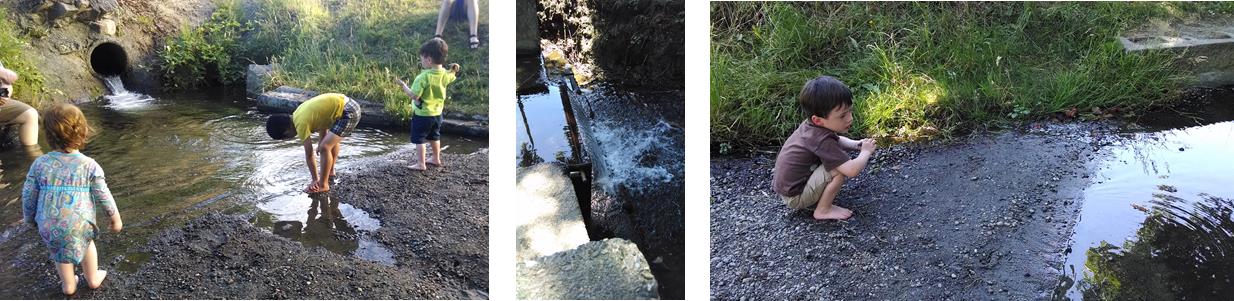
What could be better on a hot day than wading in a cool creek?
It’s cool, the sound of the water is relaxing, it’s building big motor skills (staying balanced on uneven ground), small motor skills (picking up pebbles to throw), caution and limits (don’t go to the deep area), entomology (water bugs!), mud-ology  (check out this great post on the benefits of mud play http://rightfromthestart.wordpress.com/2012/08/30/build-a-mud-kitchen-why-playing-with-mud-is-good-for-children/) fluid dynamics (water moves much faster over the waterfall than on the flat), mama’s limits (you can’t play near the waterfall!)
Lots of great stuff!
Do be aware of safety. Watch for broken glass in the water if you’re wading barefoot. It’s great if you know drowning rescue and CPR just in case. And it’s best to go with friends to help keep an eye out for everyone. Shower or bathe when you get home to wash off any buggies…

Wading at Everest park in Kirkland, WA

Wading at Everest park in Kirkland, WA

These pictures were taken at Everest park in Kirkland, WA. Plan to park in the lot north of the ball-fields. The creek is between parking and fields / playground. I was surprised to find we were the only ones in the creek on this hot hot day, but this park is never crowded… It is one of those almost- undiscovered gems.  http://parksofkirkland.com/everest-park/

Note: You do need to closely supervise here… the middle picture above shows the waterfall at the edge of this little pond area.


Cheap Dates with Toddlers: Nature’s Playgrounds

stumps

Peter Kirk Park, Kirkland, WA. Click to enlarge photos

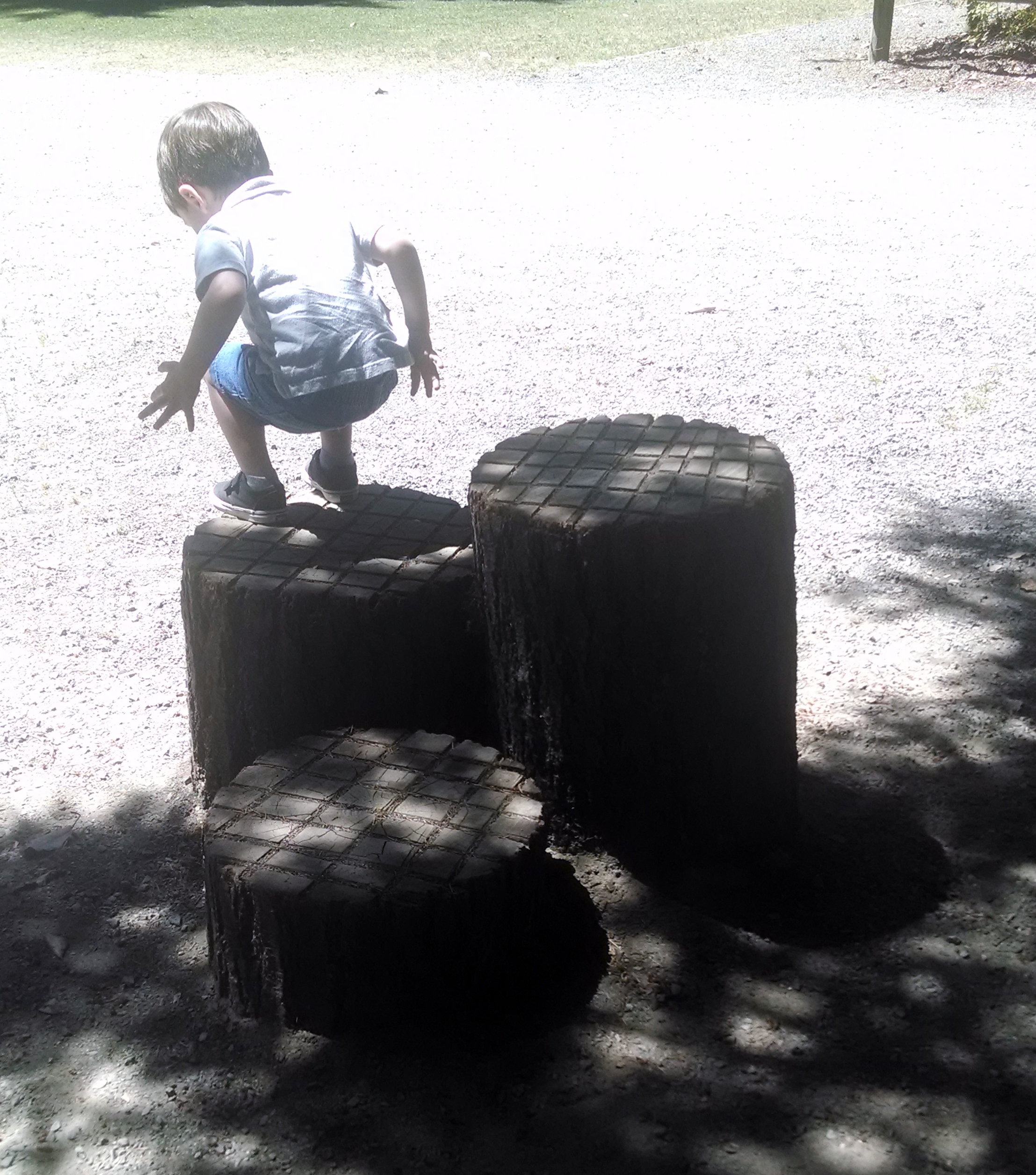
Sometimes, parks have to take out trees – they’re old, they’re damaged by insects or lightning or whatever. That’s always sad. But, when you’re really lucky, the park does this! At Peter Kirk Park in downtown Kirkland, when they took out a tree (or cluster of trees?) recently, they left the stumps behind, in a perfect toddler and kid playground adventure!

My three year old loves playing on these, but so do kids of all ages. Unlike modern playgrounds, they’re not standardized sizes and shapes, with the exact measured distance between objects and a scientifically designed surface beneath. They’re just four stumps, of different heights that you can climb up, perch on, jump off. Fabulous!

If you live in the area, come check them out (but be sure to park on the street or at the library – the shopping center says they’ll tow park users). If you’re not local look for similar lucky finds in your neighborhood!

We also found a great set of stumps at Bridle Trails Park in Bellevue, next to the arena.

Bridle Trails State Park, Bellevue, WA

Bridle Trails State Park, Bellevue, WA

To learn more about kids and nature, just click on ‘nature activities’ in the right hand side bar.


Cheap Dates: Explore New Parks

St. Edward's State Park - Kenmore, WA. Click on photo to enlarge

St. Edward’s State Park – Kenmore, WA. Click on photo to enlarge

Summer is a great time to try something you haven’t tried before! Is there a park near you that you’ve heard people talk about, but never actually gone to? Have you ever driven down a road that has a sign saying that there’s a park that-a-way, but never followed the arrow to check it out? Have you looked on a map, and said “there’s a park in that neighborhood? I never knew!” Now is your chance to check them out!

To find out more about your local parks, search online on the websites for your city, your county, your state, and national parks websites. (Or look on an old-fashioned paper map!) Most will have directories of camps, with listings of what amenities are available at each park. You can also check Yelp and other online review sites for reviews of local options.

There are also lots more playgrounds that aren’t listed on maps and directories: playgrounds at your public elementary school, playgrounds in new neighborhood developments (some of those may be officially limited to neighbor kids only, but really, who’s going to check?)

For my readers in the Seattle area, here are some of our new discoveries:

St. Edward’s State Park

For YEARS, I have heard about the playground here. (See pictures above and this article) It was built in 2003, just when my older kids were growing out of playground age. It was a community project – kids from 7 elementary schools and some scout troops dreamed up ideas, and adults worked together to design it and make it happen. They built it with all volunteer hours and donated funds from individuals and companies. I’ve heard for years about how great it was, and we finally went.

My son LOVED it. He ran through every square inch of the playground, played on the slides, explored the sandbox, played on the marimba, and so on. Very big, diverse, interesting playground, well worth going back to.

Only strike? It’s big, and there’s lots of places in it where it’s hard to see your child. If you had multiple children, there’s no one place you could sit and keep an eye on them everywhere. So, this is definitely a play-with-your-kid or follow-your-kid playground, not an “I’ll just sit here and read Facebook while you play” playground.

There are also hiking trails and waterfront here… we’ll have to check those out the next time we go.

St. Edward’s is a state park. It’s $10 to park your car there, unless you have a Discovery Pass ($35 per year – we use it here, at Bridle Trails State Park, Lake Sammamish State park, so get our money’s worth from that, but the other day I looked up Washington State parks in King County and it turns out there’s LOTS of them. They’re next on our list to check out!)

O.O. Denny Park, Kirkland. Photo: http://www.lakewaparks.com/2011/06/o-o-denny-park/

O.O. Denny Park, Kirkland. Photo: http://www.lakewaparks.com/2011/06/o-o-denny-park/

O.O. Denny Park

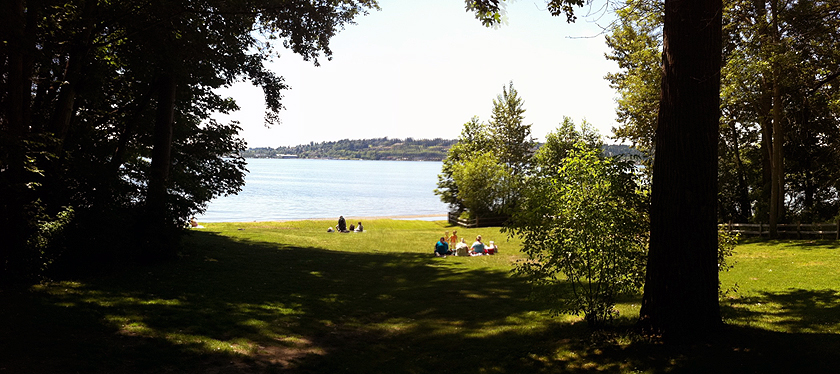
On our way out of St. Edward’s park, I noticed again the signs I have noticed for years for “O.O. Denny Park.” We decided that the next time we wanted to go to a park to check it out. When we returned, we went on the hiking trails which was a nice and slightly challenging hike – the three year old wasn’t with us, but I think he would have struggled a bit with a couple of the hills. After the hike, we walked along the water. This is a Kirkland area beach park with shade by the water (!) that isn’t crowded! It’s nice to know there’s this option for the hot sunny days when you know Juanita Beach and Marina Park will be mobbed. There is a playground as well.

Note: O.O. Denny Park was willed to the City of Seattle in the early 1900’s. It appears to now be operated by City of Kirkland and/or the Finn Hill Neighborhood Alliance.

Big Finn Hill Park, Kirkland / Juanita. source: http://finnhillalliance.org/2013/10/a-walk-in-the-park/

Big Finn Hill Park, Kirkland / Juanita. source: http://finnhillalliance.org/2013/10/a-walk-in-the-park/

Big Finn Hill Park

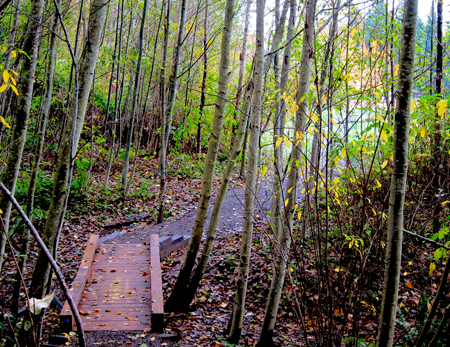
Then on the way home from Denny, we saw the signs for Big Finn Hill (a King County park), which again, we’ve seen the signs for years and never gone. So, this was next on our list. We planned a hike in the woods on a hot day. We didn’t realize there was a playground till we got there, but of course our son had to try it out before (and after) the hike. We followed the trail maps and it was a great opportunity to practice Left and Right skills with our son, asking him “we need to turn left, which way is left” Nice trail, very manageable for a 3 year old. Nice range of plant life, lots of animal dens, and one baby bunny spotted.
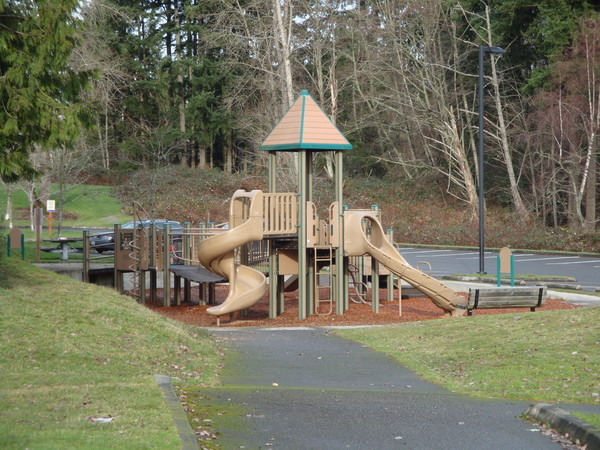
Big Finn Hill playground Kirkland / Juanita

Big Finn Hill playground Kirkland / Juanita

Toddlers and preschool age kids are happy to return to the same park over and over again, but for me as an adult, it’s nice to discover something new…   So, check out some new parks in your neighborhood!

Here’s links to posts I’ve written about other local parks: farm parks – Farrell McWhirter in Redmond and Kelsey Creek in Bellevue, dog parks at Marymoor, Robinswood and KDOG; turtle watching at Juanita Bay Park, stumps to climb on at Peter Kirk and Bridle Trails, Woodland Park in Seattle, and wading at Everest Park in Kirkland.

To get more ideas for “cheap dates with toddlers” (most have specific details for Seattle area folks, but hopefully there’s useful ideas there for non-locals too) just click on “toddler dates” in the right hand sidebar of the page.

Getting Outside: Overcoming the Barriers to Outdoor Play

Spending time outside is great for kids’ physical health, mental health, and cognitive development. (Read about those benefits here). Plus, outdoor play is FUN!!

But although most parents say they would like their kids to have more outdoor time, they also see lots of barriers that prevent them from making it happen. How do we overcome those barriers and go play outside? Look below for tips on coping with: lack of access to nature, safety issues, lack of time, the inconvenience of muddy clothes, dressing for the weather, lack of interest in the outdoors (for child or parent!) and lack of playmates outside.

Perceived barrier: Lack of access to nature

(it’s too expensive, too far away, I lack the skills)

In several surveys, modern parents and children often say that there is no nature where they live. They say that outdoor recreation is too expensive, or that outdoor opportunities are too far away, or that they lack the knowledge and skills to participate in outdoor recreation. When asked to describe outdoor recreation, they often talk about things like national parks, ski areas, theme parks, water skiing, kayaking, and mountaineering. If you had asked a parent in the 1950’s where their kids play outside, they would have said: the backyard, the garden, the park, or the school yard. If you’d asked what activities their kids did outside, the first things that would come to mind would be: climb trees, dig in the dirt, and throw rocks.

Outdoor time doesn’t just mean a week-long camping trip in Yellowstone. It could mean just a little time outside every day on that little strip of grass at the corner of the apartment parking lot. It could be walking to school and noticing the plants, rocks and bugs in the neighbors’ yards. It could mean finding a little “patch of nature” that you can visit once a week. Maybe that’s a city park, but maybe it’s an empty lot in a residential neighborhood. (when my girls were little, we visited an empty lot two blocks from the Microsoft corporate campus, we saw coyotes, rabbits and snakes, and picked all the blackberries we could eat.) By looking further afield, you may find hiking trails, lakes, streams, arboretums, botanical gardens, farms, nature preserves, beaches, sandboxes, and other places to dig in the dirt. And for most of them, you can bring a picnic lunch and stay all day without spending any money.

For ideas for outdoor activities in an urban area, search online. Here’s a couple blog posts to get you started: http://projectwildthing.com/posts/view/296 and http://projectwildthing.com/posts/view/304.

If you feel like you lack the knowledge or skills for outdoor adventures, start small and simple with visits to the local park. When you’re ready, you can take on new challenges on your own. Or visit local outdoor supply stores to see if they offer classes, or check with your local parks department for classes and for group outings with an experienced guide.

You can also check out websites for lots of tips on outdoor activities with kids and how to make them successful. Try http://www.rei.com/learn/expert-advice/family.html

Perceived barrier: Safety (traffic, stranger danger, etc.)

Parents often say “it’s just not as safe for kids to play outdoors as it used to be.” But statistics actually show that the rate of abduction by strangers has stayed steady for many years, and the risk of car-pedestrian accidents has decreased significantly.

  • Traffic: Choose outdoor play areas and neighborhoods with minimal traffic risks. Teach your child pedestrian safety rules (crossing at crosswalks, looking both ways, not running out into the street after a ball, and so on). Don’t allow children to play in the street. Yes, many of us played in the street when we were young, but drivers expected that then and watched out for it… they don’t now.
  • Note: “children at play” signs are not shown to be helpful at reducing risk – they don’t have much impact on driver behavior, but they do lead parents and children to have a false sense of confidence – which then leads them to behavior that puts them at risk
  • If you have specific concerns about traffic in your neighborhood, try contacting your city to see if there’s anything they can do. (here’s an example from my hometown.)
  • Some basics: it’s OK to talk to strangers when mom or dad are right there with you, but your parents aren’t there, don’t talk to the stranger. If an adult says they need help (with directions, with finding a lost puppy, etc.) then go to a trusted adult and let them know. Be sure your children know their full names, parents’ phone numbers, and where the trusted adults are near their home.
  • Enlist your neighbors. Get to know your neighbors, and make sure your kids get to know them too. Tell them you’ll help look out for their kids. Encourage them to help keep an eye on your kids.
  • Child’s Age: some parents worry about taking babies outside – “they might get dirty”, “they might eat dirt.” Read this article on benefits of outdoor play for babies: www.janetlansbury.com/2014/06/your-babys-call-of-the-wild-guest-post-by-angela-hanscom/
  • Risk of injury in outdoor settings: Unlike a modern playground, a natural setting has not been intentionally designed to meet rigorous safety standards. There may be sharp edges and hard surfaces and thorns and stinging insects. Whenever you’re out in nature with your child, be aware of potential hazards, show them to your child, and educate her about how to be safe if she encounters those things on solo adventures. There’s no need to frighten, but it is a good idea to teach caution and a healthy respect for nature.
  • Although there are potential risks outdoors, parents should remember that developing the habit of staying indoors all the time also carries risks: increasing the long-term chances of obesity, heart disease, diabetes, etc.

Perceived barrier: No time in the schedule

  • Homework: Some parents say “my kid has so much homework to do, it takes him forever, and we don’t have time left to go outside.” If that child was allowed to run and play outdoors for a half hour after school, research indicates that would help him concentrate better when he did settle down to homework, thus perhaps reducing homework time.
  • Extracurriculars: Children certainly benefit from organized activities that teach specific skills (e.g. piano lessons, baseball team) but there are unique benefits to unstructured play time, especially if that takes place outdoors. Finding a balance in the week’s schedule that allows for some unstructured time is the best option for maximizing a child’s learning potential.
  • Can your time do double-duty? Instead of driving to a store across town, could you walk outdoors to a store nearby? Instead of sitting in the car with one child while you’re waiting to pick up the other one from school, can you go for a short walk or play outside? If you work out in a gym, could you take your exercise outside and do it while your child plays?
  • Consider looking for a nature-based preschool or “forest kindergarten” to do double duty between school and outdoor play. Don’t worry that your child will miss out on academic skills if they don’t spend their preschool hours sitting at desks with pencil and paper. Outdoor time is great for brain development and they will be very ready for school when it comes around.

Perceived barrier: Outdoor play is inconvenient

  • Dirty clothes and dirty kids: Outdoor play is definitely messy. Parents may need to increase their tolerance for mess. It also helps to plan ahead: carry a full extra set of clothes, including socks and shoes, in the car at all times. Some parents carry a washcloth and some water in case you need to scrub the child down before putting on the clean clothes. It also helps to have a towel to cover up the car seat if needed (or I also use the towel to dry off wet swings and slides on winter playgrounds.)
  • Parents’ responsibilities: Parents say it’s hard to get things done (like cooking dinner) if the child is playing outside and needs to be supervised.
    • Can the child play outside without supervision? (with clear boundaries and safety proofing set up in advance, of course)
    • Can you team up with another parent and take turns supervising?
    • Can you take any of your work outside? You may not be able to do laundry outside, but with modern technology, you may be able to make phone calls, read and respond to email, catch up on Facebook, or read materials for work while your child plays outdoors. (Note: make sure you don’t spend all your time wired to the screen – parents benefit from outdoor play too!)
    • Note: If you find your kids are often being wild indoors when you’re trying to work, try taking a break to go outside and play. When you return inside, they may settle down.

Perceived barrier: Kids say outside is uncomfortable

  • Too hot: Plan your outings for early in the morning, or late in the evening. Consider lightweight sun-protective clothing, and a lightweight hat with a brim.
  • Too cold / too wet: Teachers at outdoor preschools and forest kindergartens (go to YouTube to learn more about these!) often say “there’s no such thing as bad weather, just bad clothing choices.” It’s well worth investing in a good pair of waterproof boots (I love my son’s Bogs rain boots and snow boots– they cost more than I usually spend on kids’ clothes (I get all their clothes at consignment shops), but they are easy for him to walk in, unlike most boots that flop around on kids’ feet, and they’re so waterproof he can wade in streams without his socks getting wet) and rain gear. We liked our Oakiwear rain pants and rain jacket. A friend swears by the Muddy Buddy Overalls.  Here are some more tips for how to dress for the outdoors in winter: www.raisingwildones.com/2014/01/how-to-dress-kids-for-winter-outdoor-play.html and how to dress for rain: www.modernparentsmessykids.com/2012/10/outdoor-preschool-how-to-dress-for-hours-of-rain-cold.html
  • Some young children do not like getting their hands dirty. Offer them shovels and tools to use, or you might even offer lightweight gloves if needed.
  • Good shoes are important: flexible soles are nice for dexterity, but they need to be thick enough that the child can’t feel rocks and sticks through them. Avoid open sandals and clogs that let in (and then trap) sand, pebbles, and bark. (I like water shoes for summer days at the lake or beach, as they can wear them in and out of the water and protect their feet.)

Perceived barrier: Kids aren’t interested

  • Kids would rather stay inside and watch TV / play video games / use the computer.
    • Don’t assume this to be true. When surveyed, many kids say they prefer outdoor time.
    • This is less likely to be true for kids who have spent a lot of time outside since they were small. It’s more likely to be true for kids who haven’t had any significant positive experiences outside. Getting those kids out to have those experiences may help.
    • Sometimes transitions are the hard part – you may have to force the issue of turning off the screen and getting outside, but after a while outside they usually settle in.
  • “There’s nothing to do!” If you have been taking your child outside to play since he was young, you’re less likely to hear that complaint. But if you have a child who is used to the high intensity stimulation of video games and amusement parks, it can be hard to slow down to enjoy the quieter pleasures of the outdoors. Having ideas for what to do outdoors may help.
  • Try to allow your child some freedom outside. Kids who are given a little extra independence are more interested in going out to play.

Perceived barrier: There’s no one to play with

It’s often disappointing to kids if they go outside to play and discover they’re the only ones there. Here are some strategies:

  • Find families who are focused on spending time outdoors: Check out your local parks department, campgrounds, and outdoor supply stores for classes, camps, and guided hikes. When you attend, make an active effort to network with other parents and set up future activities together. You can also search online (Meetup.com, Facebook) for “children and nature” groups, or look for local outdoors clubs, or search for a Nature Club (or learn how to start your own) at www.childrenandnature.org/movement/naturalfamilies/clubs/
    • If your child takes outdoor sports classes near your home, try to connect with some of those families who live nearby. It could be they’d also enjoy unstructured playtime outdoors too.
  • Encourage your existing circle of friends to play outdoors: When it’s your turn to host a playdate, make it an outdoor one. When friends are planning a gathering, encourage them to consider an outdoor site. Even if you’ve invited a child over to play on a rainy day where most of your time will be inside, be sure to spend a little time outdoors. Having some fun, unique outdoor play options can sweeten the deal.
  • Connect with the neighbor kids and parents.
    • Let them know that you would love a neighborhood where kids play outside together. Talk about how to make that happen. Offer to supervise other children.
    • Don’t worry if the kids are a wide range of ages. One of the benefits of unstructured outdoor play is that it works really well for multi-aged groups.
    • Try setting an “outdoor hour” at least once a week (hopefully more) when everyone tries to get their kids out together and where kids can rotate between multiple yards.
    • Set one day a week as “walk to school” day. Or organize walk-pools where parents take turns escorting kids on a walk to school instead of all the parents driving alone.

Perceived barrier: “I’m just not an outdoors person…”

Some parents feel like they should get their kids outside more, because they have heard about the benefits of outdoor time. But they find themselves dreading outdoor time because they have not enjoyed it in the past. It’s OK to start small, and with simple things that seem manageable to you. Yes, some parents take their kids wilderness camping or mountain biking or white water rafting. Maybe you just take your child to the playground often, or walk at botanical gardens, or go to the zoo, or just notice nature around you as you shop downtown. Yes, some families spend hours outside every day and go on week-long campouts every summer. You may manage one hour a week of intentional outdoor time. Do what you can. You may find that as you start small and have experiences you enjoy you may become more of an outdoors person and look forward to these times.

What will you do?

Some experts recommend that parents commit to a “green hour” – one hour a day that their kids spend outside. Does that seem do-able to you? Could you make that a goal to shoot for, even if you know there’s lots of days you won’t make it? On the days you do, congratulate yourself!

By spending time with our kids outdoors, we can develop life-long habits of getting outside and being active. This will mean our kids experience less stress, high blood pressure, obesity, diabetes, ADHD and sensory issues, and depression. And they’ll probably do better in school. It’s well worth the effort!

Why you should let your child play in the mud: Benefits of Outdoor Play

Not spending time outdoors – the modern epidemic of Nature Deficit Disorder – carries risks for our children. They include: vitamin D deficiency and nearsightedness. May include: obesity (and related diseases), asthma, allergies, ADHD, and depression.

There are so many benefits to spending outdoors in nature! Most parents have seen those benefits in action – times outdoors where their child seemed calmer, more settled, and happier than they usually seem indoors. There’s plenty of research to back up our observations.

Cognitive Benefits of Outdoor Play:

  • Exploring and Investigating: There are always new things to find outside (if you slow down and look closely.) This helps keep the spark of curiosity burning in a child, and creates a passion for learning more that can carry over into school work as well.
  • Creativity and Imagination: “Studies in several nations show children’s games are more creative in green places than in concrete playgrounds. Natural spaces encourage fantasy and role-play, reasoning and observation.” (Guardian)
  • Symbolic play: If you hand a child a manufactured toy (like the current top seller at Toys R Us for Pre-schoolers: the Peppa Pig Playhouse), it is usually obvious to the child at first glance what the object is supposed to be and how they are supposed to play with it. If you take that child outdoors, he may soon start looking for the perfect stick – then the stick becomes: a sword, or a magic wand, or a walking staff, or a fishing pole, or whatever he needs it to be in the moment. (The Stick made Wired magazine’s list of 5 best toys of all time, and sticks are in the Toy Hall of Fame.)
  • Building: Children love to build sand castles on the beach, build dams in a stream, build fairy houses in the woods, weave daisy chains, build houses of driftwood, dig holes and more. Manipulating these loose parts builds large and small motor skills, balancing all those uneven items teaches some of the basic laws of physics in a hands-on way. They also develop persistence, remaining dedicated to a task as they fail again and again, and then get it right, only to have the waves sweep away their hard work so they need to start again.
  • Self-direction: The outdoors don’t come with instructions. There’s not a right and wrong way to play outdoors, and parents tend not to have any agenda for what “must be done”, so children are free to create their own ways to play. They continue a game for as long as it pleases them, then evolve a new game when they’re ready.
  • Control and mastery: This ability to move independently, explore, and create gives kids a huge sense of empowerment and competence, which will serve them well in other challenges.

Mood and Concentration Benefits of Outdoor Time:

Most people find spending time outdoors relaxes and calms them. To understand these benefits, it helps to understand a little about how the nervous system works. The sympathetic nervous system is triggered in response to stressors and allows us to focus on what actions we need to take right now. (A full scale response would be if someone senses a predator, and they get the adrenaline rush which guides them to choose between fight and flight and freeze.) This targeted focus on tasks is very helpful in most jobs in the modern world, but always operating in this mode also is stressful in the long run. The parasympathetic nervous system is about conserving energy while the body is at rest, so the body (and mind?) can heal itself. Rather than “fight or flight”, this is called “rest and digest” or “feed and breed.”

Cities and built environments are full of intense stimuli that capture attention dramatically – honking horns, flashing lights, traffic to navigate. These trigger the sympathetic nervous system. Outdoor environments are filled with interesting stimuli – there’s plenty to look at and explore, but it’s much less dramatic – someone walking outside can relax and gaze around them without needing tight focus on anything. This triggers the parasympathetic system. One study showed that after spending 14 minutes seated in nature, and 16 minutes walking in nature, participants had lower cortisol levels, lower pulse rates, lower blood pressure, greater parasympathetic nerve activity, and lower sympathetic nerve activity than they did after spending 30 minutes in a city environment.

Spending time outside is restorative – studies show that being outdoors, exercising outdoors, and viewing nature all increase participant’s sense of vitality (physical and mental energy). And when people (adults or children) return indoors, they are better able to focus on tasks that require directed attention. Research shows:

  • Children’s classroom behavior is better if they have recess.
  • Children with ADHD concentrate better after spending just 20 minutes in nature.
  • Schools with environmental education programs score higher on standardized tests in math, reading, writing and listening.

Another benefit that parents often appreciate about outdoor time is that it allows kids to “burn off some energy.” When kids are indoors, we’re often saying “quiet voice” and “don’t make a mess” and “don’t throw that” and “would you just calm down a little!!” Outdoors they can be loud, they can be big, they have freedom, and can push boundaries and take risks. This helps them settle down, and regulate their mood and emotions better when they return inside.

Physical Benefits of Outdoor Play:

  • More ways of moving. In a dance class, gymnastics class, or soccer class, children are using specific muscle groups to accomplish specific tasks. There is certainly benefit to doing that. But there’s also benefit to moving freely during play in the outdoors and discovering all the ways their bodies can move, as they scramble under low branches, climb rocks, step carefully over brambles…
  • More ability to customize experience to ability  They can choose how high up the tree to climb, choose fatter or skinnier logs to balance on, choose the steeper or less steep parts of the hill.
  • More variability in surfaces requires kids to adapt their movement. In most playgrounds, the movements are standardized. For example, on a playground ladder, all the rungs are the same size and the same distance apart, but on a tree there’s a variety of sizes of branches and a range in the distance between them.
  • Challenges grow with a child: Modern playgrounds are much safer for younger children than older playgrounds, but modern playground design often means kids over age 8 find them limiting and boring. Nature always offers new challenges.

One occupational therapist argues that children would be better served by sessions in the woods than in O.T. clinics filled with specially designed tools. She describes the outdoors as the ultimate sensory experience. “In the clinic, we often have children go barefoot on plastic balance beams, which have been engineered to be “sensory” with little plastic bumps. If we take children outside, we could let them go barefoot on fallen trees… experiencing different textures… [and] sensations of moist versus dry, crunchy versus soft, noisy versus quiet, and changes in temperature”

Health Benefits of Outdoor Time:

  • More exercise: children who play outside are more physically active than those who play inside. Kids who make up their own play activities are more active than those who are told what to do by adults. (i.e. their free play may be better exercise than their sports classes)
  • Lower obesity rates
  • Better vision: For every hour per week a child spends outdoors while growing up, chance of myopia drops 2%
  • Even just seeing nature benefits our health: studies of hospital patients have shown decreased need for pain medications and shorter post-operative stays for those who can see nature.
  • Living near natural settings leads to: lower stress levels, lower rates of many diseases, less asthma, reduction in circulatory disease, and lower childhood obesity rates.
  • Playing in the sun provides essential Vitamin D, which protect children from future bone problems, heart disease, diabetes and other health issues

Social Benefits of Outdoor Time:

  • Social interaction: Parents tend to sit back and observe more outdoors rather than get as involved as they do in indoor settings. That allows children to explore social dynamics. Many parents observe that their children seem to make friendships quickly in outdoor settings.
  • Multi-age: Outdoor settings that encourage free play (like playgrounds) often attract a wide range of ages, unlike structured recreational activities that are usually limited to kids within a one-year age span. This encourages multi-age interaction.
  • Different basis for popularity: “The social standing of children [outdoors] depends less on physical dominance, more on inventiveness and language skills.” (Guardian)
  • Concern for the Environment: You can only care about what you know about. Kyle MacDonald of Bay Area Wilderness Training says “Connecting kids to the out of doors in a way that makes them realize, ‘this is fun, this is a place I want to be’ — that’s going to create a generation of environmental stewards.”
  • In coronavirus times, it’s easier to be socially distanced outdoors, and there’s much less risk of viral transmission than in an indoor setting, which may allow us to socialize more with others.

Given all these benefits, why do modern children spend so little time outside? Parents and kids describe all sorts of barriers to outside time. Here are tips for overcoming the barriers and getting outside to play.

If you’re in the Bellevue / Kirkland / Redmond area of Washington State, be sure to check out my post on lots of great lesser-known parks on the Eastside. If you’re in the Pacific Northwest, you might like my Guide to Northwest Native Plants.