Tag Archives: Kirkland

Cheap Dates: Explore New Parks

St. Edward's State Park - Kenmore, WA. Click on photo to enlarge

St. Edward’s State Park – Kenmore, WA. Click on photo to enlarge

Summer is a great time to try something you haven’t tried before! Is there a park near you that you’ve heard people talk about, but never actually gone to? Have you ever driven down a road that has a sign saying that there’s a park that-a-way, but never followed the arrow to check it out? Have you looked on a map, and said “there’s a park in that neighborhood? I never knew!” Now is your chance to check them out!

To find out more about your local parks, search online on the websites for your city, your county, your state, and national parks websites. (Or look on an old-fashioned paper map!) Most will have directories of camps, with listings of what amenities are available at each park. You can also check Yelp and other online review sites for reviews of local options.

There are also lots more playgrounds that aren’t listed on maps and directories: playgrounds at your public elementary school, playgrounds in new neighborhood developments (some of those may be officially limited to neighbor kids only, but really, who’s going to check?)

For my readers in the Seattle area, here are some of our new discoveries:

St. Edward’s State Park

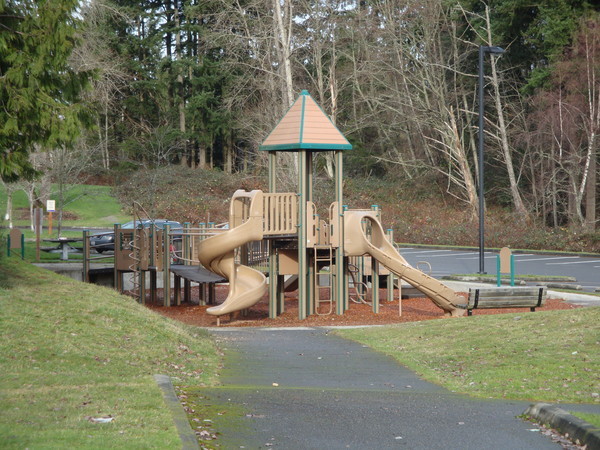
For YEARS, I have heard about the playground here. (See pictures above and this article) It was built in 2003, just when my older kids were growing out of playground age. It was a community project – kids from 7 elementary schools and some scout troops dreamed up ideas, and adults worked together to design it and make it happen. They built it with all volunteer hours and donated funds from individuals and companies. I’ve heard for years about how great it was, and we finally went.

My son LOVED it. He ran through every square inch of the playground, played on the slides, explored the sandbox, played on the marimba, and so on. Very big, diverse, interesting playground, well worth going back to.

Only strike? It’s big, and there’s lots of places in it where it’s hard to see your child. If you had multiple children, there’s no one place you could sit and keep an eye on them everywhere. So, this is definitely a play-with-your-kid or follow-your-kid playground, not an “I’ll just sit here and read Facebook while you play” playground.

There are also hiking trails and waterfront here… we’ll have to check those out the next time we go.

St. Edward’s is a state park. It’s $10 to park your car there, unless you have a Discovery Pass ($35 per year – we use it here, at Bridle Trails State Park, Lake Sammamish State park, so get our money’s worth from that, but the other day I looked up Washington State parks in King County and it turns out there’s LOTS of them. They’re next on our list to check out!)

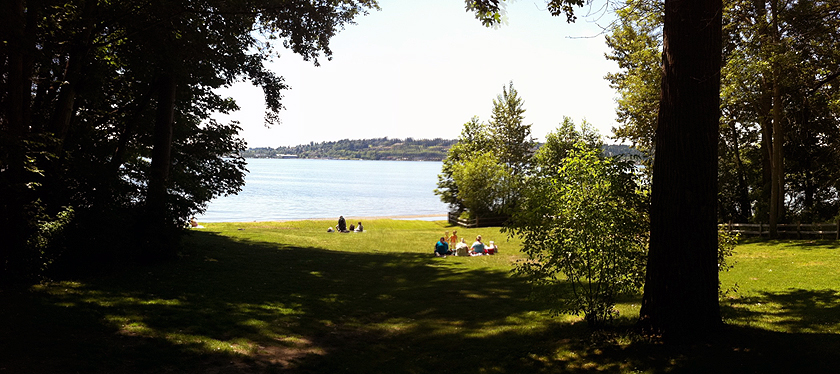
O.O. Denny Park, Kirkland. Photo: http://www.lakewaparks.com/2011/06/o-o-denny-park/

O.O. Denny Park, Kirkland. Photo: http://www.lakewaparks.com/2011/06/o-o-denny-park/

O.O. Denny Park

On our way out of St. Edward’s park, I noticed again the signs I have noticed for years for “O.O. Denny Park.” We decided that the next time we wanted to go to a park to check it out. When we returned, we went on the hiking trails which was a nice and slightly challenging hike – the three year old wasn’t with us, but I think he would have struggled a bit with a couple of the hills. After the hike, we walked along the water. This is a Kirkland area beach park with shade by the water (!) that isn’t crowded! It’s nice to know there’s this option for the hot sunny days when you know Juanita Beach and Marina Park will be mobbed. There is a playground as well.

Note: O.O. Denny Park was willed to the City of Seattle in the early 1900’s. It appears to now be operated by City of Kirkland and/or the Finn Hill Neighborhood Alliance.

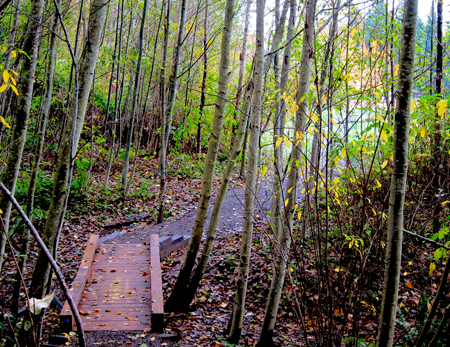
Big Finn Hill Park, Kirkland / Juanita. source: http://finnhillalliance.org/2013/10/a-walk-in-the-park/

Big Finn Hill Park, Kirkland / Juanita. source: http://finnhillalliance.org/2013/10/a-walk-in-the-park/

Big Finn Hill Park

Then on the way home from Denny, we saw the signs for Big Finn Hill (a King County park), which again, we’ve seen the signs for years and never gone. So, this was next on our list. We planned a hike in the woods on a hot day. We didn’t realize there was a playground till we got there, but of course our son had to try it out before (and after) the hike. We followed the trail maps and it was a great opportunity to practice Left and Right skills with our son, asking him “we need to turn left, which way is left” Nice trail, very manageable for a 3 year old. Nice range of plant life, lots of animal dens, and one baby bunny spotted.

Big Finn Hill playground Kirkland / Juanita

Big Finn Hill playground Kirkland / Juanita

Toddlers and preschool age kids are happy to return to the same park over and over again, but for me as an adult, it’s nice to discover something new…   So, check out some new parks in your neighborhood!

Here’s links to posts I’ve written about other local parks: farm parks – Farrell McWhirter in Redmond and Kelsey Creek in Bellevue, dog parks at Marymoor, Robinswood and KDOG; turtle watching at Juanita Bay Park, stumps to climb on at Peter Kirk and Bridle Trails, Woodland Park in Seattle, and wading at Everest Park in Kirkland.

To get more ideas for “cheap dates with toddlers” (most have specific details for Seattle area folks, but hopefully there’s useful ideas there for non-locals too) just click on “toddler dates” in the right hand sidebar of the page.

Cheap Dates: Swimming!

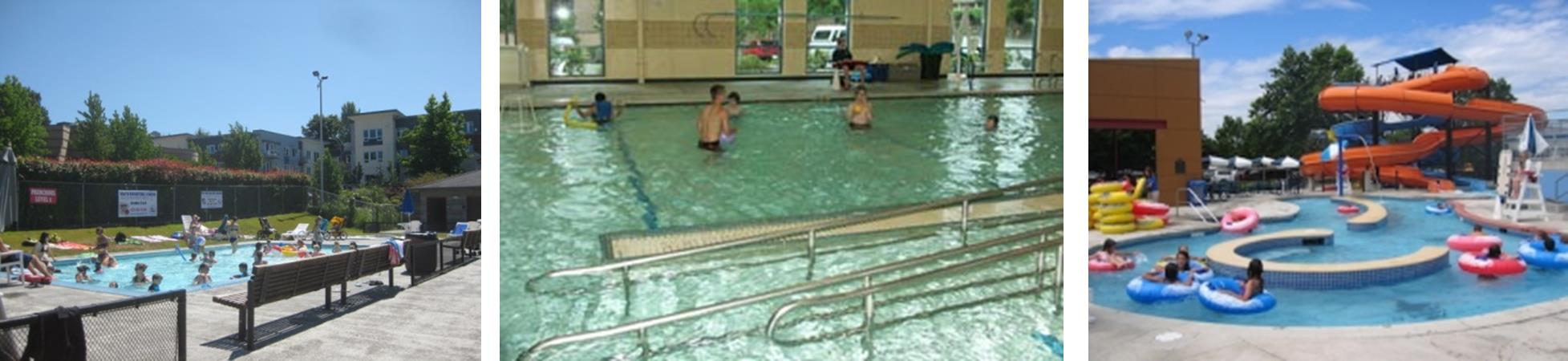
Peter Kirk, Bellevue, Renton pools

Peter Kirk, Bellevue, Renton pools

Although baby swim lessons are really fun, you don’t need them to have fun with your baby in the water. (You just need to keep a tight hold on baby all the time, or even if they’re sitting in a shallow pool, you should be in arms reach at all times.)

Here are some great games to play in the water with your child and some recommended local pools (for my readers who live on the Eastside of Seattle).

Some games to play in the water:

Motor boat: In a shallow pool, you can have your child sit on the bottom of the pool and kick their legs up and down. In a deeper pool, you can hold your child, or have them put their back to the wall and hang on with their hands, then kick their legs. As they kick, chant:”Motor boat, motor boat, go so slow. Motor boat, motor boat, go so fast. Motor boat, motor boat, run out of gas.”

Bubble, bubble, pop. Sing “All the fish are swimming in the water” (click here for video and lyrics)  When you’re singing about fish swimming, move your child around in the water, when you sing about ducks paddling, paddle your hands, then frogs jump and children splash. When you get to the part about “bubble, bubble splash”, raise your child in the air as you sing bubble… then splash down on the word splash.

Trot, Trot: Sing Trot Trot to Boston, bouncing your child on the trotting part, and lifting up and splashing down on “watch out baby or you might fall IN.”

Practice blowing bubbles in the water. Bring something that floats (rubber duck, ball, etc.), throw it, chase it, catch it floating in the water and throw it again. Bring a plastic cup or watering can in the pool with you, scoop and pour.

Why swim?

Well, first and foremost, water safety is an essential skill to teach your child! We can’t count on swim lessons to “drown proof” a child, but certainly the more familiar they are with water, the better!

Second, research shows the following benefits for swimming for kids: swimmers outperform non-swimmers in balance, movement, grasping skills, higher IQ’s, strengthened all their muscles, were more self-confident, etc.

Finally, its fun. Most kids love playing in the water! It’s also fun and engaging for the parent – at a playground I may sit on the sidelines and check out Facebook on my phone, but at the pool, I have to be fully aware of and involved with my child – it’s good for me to give him my full focus. And, my kids always sleep better at naptimes and at night on days when they were in the pool.

Some great local pools:

North Shore Lagoon at Anderson School / McMenamin’s in Bothell. Our favorite! Salt water pool, so no chlorine irritation for eyes. The tiki-themed decor makes it feel like you’re on vacation. There is not a toddler wading pool there. Bothell residents are free. Non-residents: under 3 is free, children $6, adults $7.50. Open year-round.

Peter Kirk Pool – in downtown Kirkland. Outdoor pool, open only in the summertime. Check their schedule here. They’ve got a big pool, of course, but I love them for the wading pool – it’s shallow enough for my short 3 year old to walk in, but nice and big so plenty of kids can play. $6 per person.

Henry Moses Aquatic Center in Renton.  It’s a little more Theme Park like, with big slides and a lazy river. They say it has a toddler play area. Costs: free for under 1 year old, $8 for ages 1 – 4. Ages 5+ $16.

ParentMap lists more local pools.

Do you have a favorite local pool? Or favorite game to play in the pool with little ones?

[Note: this post is part of a series called “Cheap Dates with Toddlers” about fun, cheap activities that kids age one to five (and their parents) can enjoy. Many include recommendations that are specific to Seattle/the Eastside, but hopefully most of the core ideas apply to all parents everywhere….]

Cheap Dates with Toddlers – Wildlife Viewing

20210508_202842862_iOS

Spring is a great time to explore wetlands parks* and see what kind of wildlife you can spot. Ducklings are a pretty likely bet at most wetlands! Often wetlands parks have boardwalks, where you’ll have to hike out a ways to see the wildlife.

Hikes are great activities with toddlers, because they burn off energy but in a lot lower-key, non-overstimulating way compared to a trip to a playground at a McDonalds or the mall! (Now, I’m not knocking McDonald’s playgrounds here – they’re absolutely a place we head on a cold, rainy day when we’ve got to get out a little energy before story time at the library.)

You can sing songs or do nursery rhymes as you walk. You can talk about the things around you – the plants, the people, the animals…

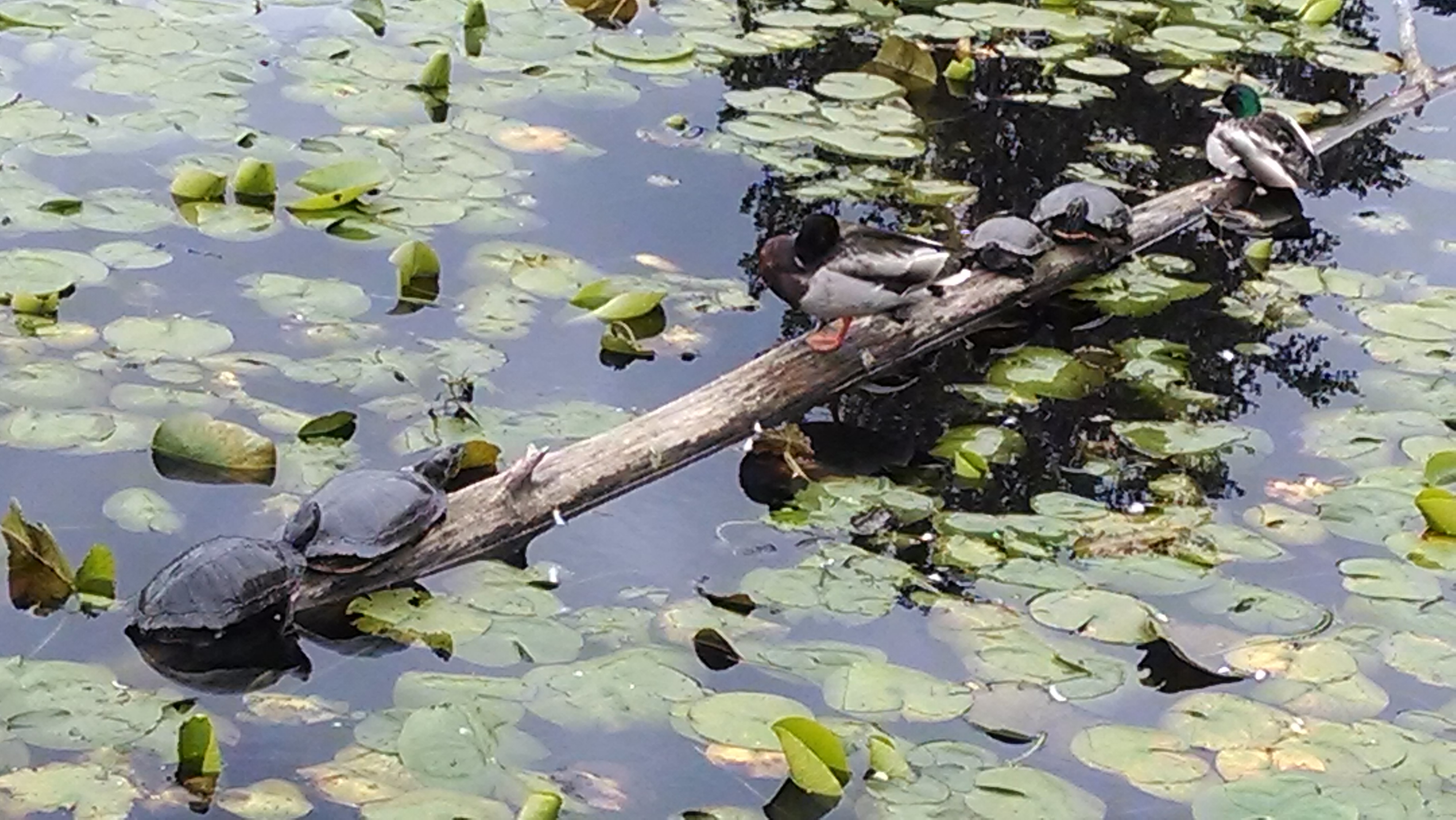
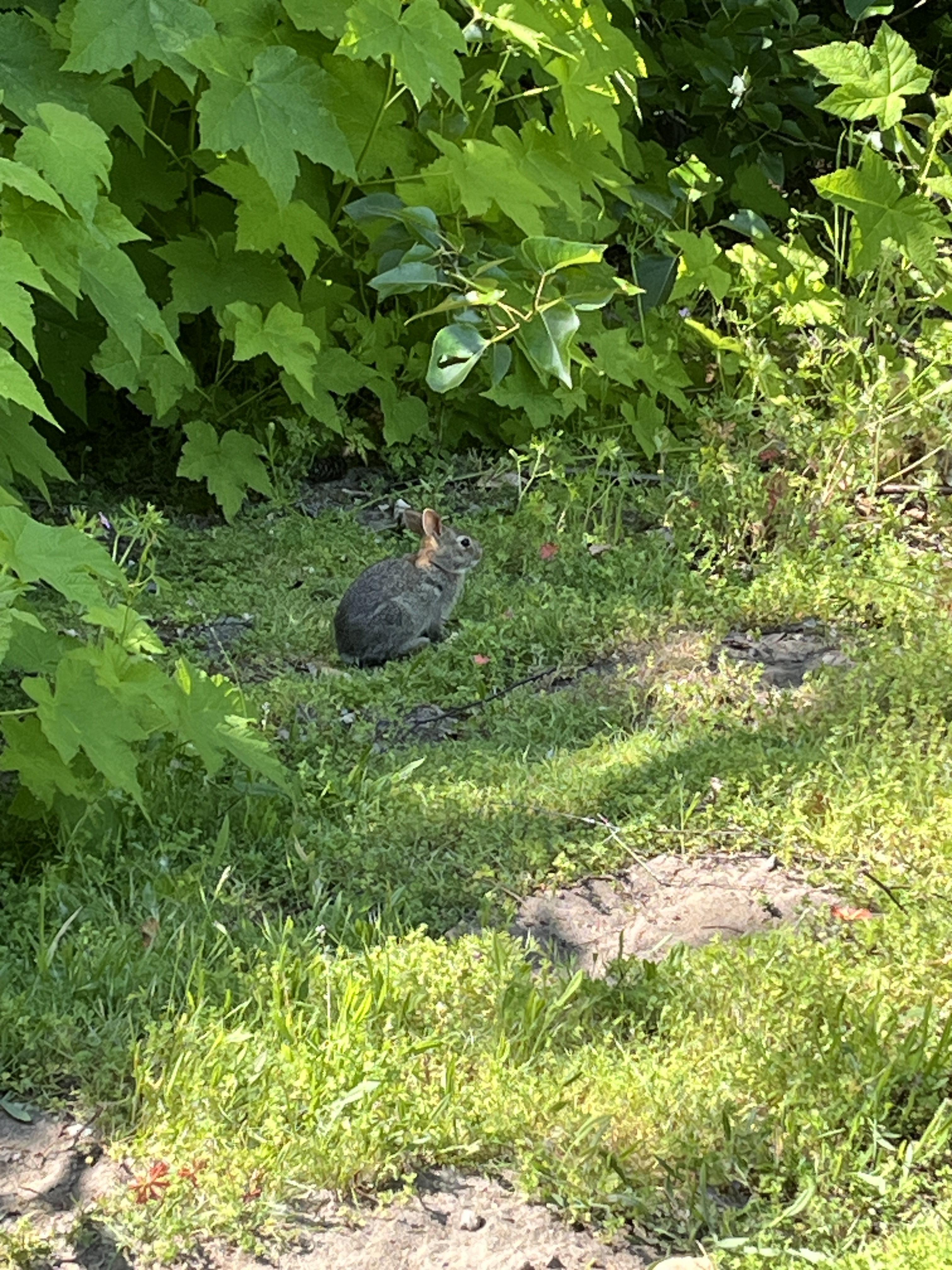
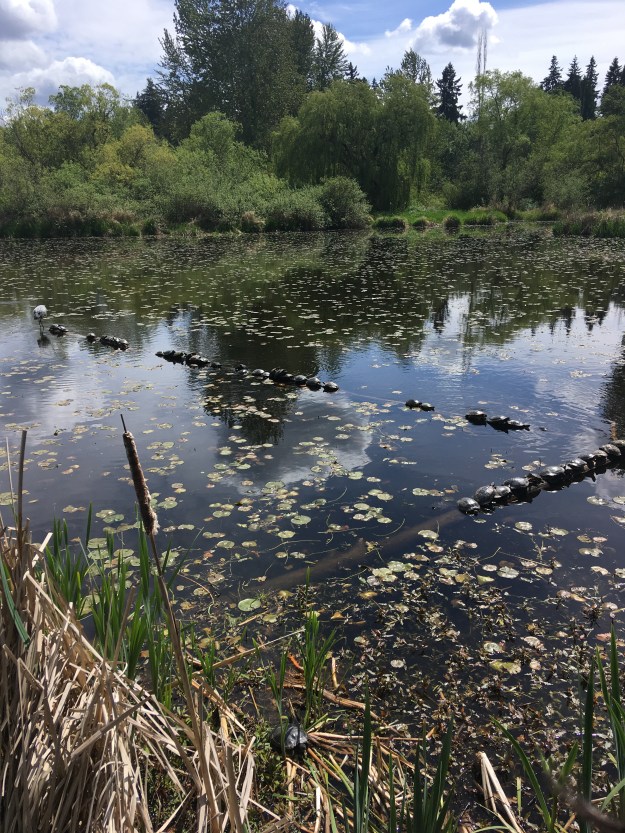
Today, we went to Juanita Bay Park in Kirkland, WA. It looks small from the road, but then you get in and it’s a huge park with lots of trails and board walks. We saw a mama duck with 7 ducklings, lots of other ducks, red-wing blackbirds, and lots of turtles sunning themselves on logs. We spotted a baby bunny off the side of the path. And we checked out some ant hills on our way back to the parking lot.

One of the challenges of nature hikes is that sometimes the thing you want to see is a long ways away, or camouflaged. I think this offers great practice for toddlers in observation skills. When they look out at this sea of lily pads, can they spot the mama duck? How about the babies? It’s also good for listening to directional information: like when I was pointing out a squirrel, and said “look way over there, in the tree with the white blossoms on it. Do you see the tree? There are two branches on the right side – the squirrel is on the top branch”, there’s a lot of vocabulary and concepts that go into understanding those directions.

For more ideas for nature activities with your child, click here.

20210508_202819448_iOS

* If you’re thinking there are no wetlands near you, I’ll tell you that today I looked at a map on a sign at the park, and it showed wetlands in every single state – I grew up in Wyoming, and the map showed wetlands in the northeast quadrant – now I’m curious where they are!

Great Classes for Kids AND Parents: Parent Education Programs and Cooperative Preschools

Classrooms in the Bellevue College Program

Classrooms in the Bellevue College Program – click for larger view

Are you a parent of a baby, toddler, or preschool age child? Are you looking for:

  • A place where your child can explore toys, do art, hear stories, sing songs, and make friends?
  • A fun activity to do with your child where s/he learns new skills and you get new ideas?
  • Opportunities to meet other families and build community?
  • Expert advice and research-based information about parenting and child development?
  • Support from professionals and other parents for the challenges of life with a little one?

You can find all these great opportunities in one place!

In the Seattle area**, our community colleges sponsor parent education programs, including parent-tot programs and cooperative preschools, which are a fabulous resource for families. For children, classes offer hands-on learning, discovery and play. For adults, they offer on-going education on all topics related to parenting, and connections to other parents.

What is the children’s experience like?

The programs are play-based, because research shows children learn best through hands-on exploration in places where they feel safe and free to explore. Each classroom has several stations around the room, with developmentally appropriate activities to help kids build the skills they need. Children are encouraged to move around and explore at their own pace. In parent-child programs (aka “mommy and me classes”) for babies and toddlers, parents play along with their children. In coop preschools, working parents are assigned to a station:

  • Art activities: play-dough to roll, easels to paint at, markers for learning to write
  • Sensory activities: tubs of water or rice or beans to scoop, pour, stir, and run fingers through
  • Large motor: mats for tumbling, tunnels to crawl through, climbers and slides, balls to throw
  • Small motor: blocks to stack, puzzles to assemble, shape sorters to solve, beads to thread
  • Imaginary play: dress up zone for trying on new roles, dolls to care for, kitchen for “cooking”
  • Science experiences: seeds to plant, tadpoles to watch, items from nature to explore
  • Snack time: a place to practice social skills and table manners and to discover new foods

stations

Classes also include “circle time” or “music class” where the teacher leads the class in singing songs, dancing, playing musical instruments, and reading stories. This is a chance for children to practice sitting still, listening to a teacher, and participating in a group activity, all essential skills for kindergarten readiness. Academic skill-building (reading, writing, pre-math skills) is integrated into all types of activities.

What makes these children’s programs different from other programs?

Diverse Experiences in One Familiar Setting: Most children’s programs focus on one domain of learning: dance class, art class, story time, music class, or tumbling. These programs do it all. And they do it in a known space where the child feels safe and comfortable. Some of the same toys activities reappear from week to week to provide reassurance and routine, and some new toys and activities rotate in to encourage children to explore and try new things.

Long-Term Relationships: Lots of programs run in short sessions of 4 – 6 classes. Parent ed programs run for the full school year. Seeing the same children week after week allows kids to build friendships.

Close parental involvement: Parents are always welcome in the classroom.

What are they like from the parent perspective: how do they work?

Each program works a bit differently, so check to be sure of the details, but here is the general idea:

Parent-infant Classes and Parent-Toddler Classes: Meet weekly for two hours. Every other week, the parents attend a one hour parent education session. In infant classes (for babies birth to one year old), the baby remains with the parent for parent ed. In toddler classes (for one-year-old and two-year-old toddlers), children are encouraged to play in one room with the children’s teachers and other parents while their parent attends parent ed.

Staffing and Parents’ Role: Each class is staffed by a parent educator and one or two children’s teachers. Parents provide snacks for the class on a rotating basis. Each family may bring snacks 1 – 3 times a year. Parents may also be asked to help tidy up the toys at the end of the class.

Cooperative Preschools:Three-year-olds may attend 2 or 3 days a week, four-year-olds attend 3 or 4 days a week. Typically, the parent stays with the child and works in the classroom one day per week, and the other days are “drop-off” preschool for that family. Classes may be 2 – 3 hours long.

Staffing: There is a preschool teacher, trained in early childhood education, who is responsible for planning and coordinating the children’s activities, and leading group times. A parent educator observes / consults during some class sessions, and offers a monthly parent education session plus one-on-one expert parenting advice.

Parents contribute by working in the classroom once a week. They also help with the running of the school by: providing snacks, fundraising support, helping with end-of-year cleanings, serving on the board (chair, treasurer, secretary, etc.), or as class photographer, play-dough maker, etc.

Length of program:Most classes (parent-child and coops) meet for the full school year – September through May. [Note: sometimes families need to leave during the year, so if you’re looking for a class in the winter or spring, check with programs to see if they have openings – they’ll often have a few.] Some have summer programs.

What do Programs Cost?

For some programs, you pay by the month, some by the quarter, some by the year. If you look at the cost for a quarter (11 weeks) or year (33 weeks), it may look like a lot compared to other children’s activities in the community. So, to compare apples to apples, it’s best to look at it as cost-per-hour. Infant and toddler groups at our local community colleges range from $7.00 – 11.00 per hour. For comparison’s sake, here’s what a sample of other programs cost on an hourly basis:

  • Big motor activities: Gymboree $30, Gymnastics East $20, Northwest Aerials $13
  • Parent education and support: Mommy Matters $22 plus child care costs. Baby Peppers $9
  • Art programs: Kidsquest $17 per hour. Kirkland Parks $13. Kirkland Arts Center $10.
  • Music programs: Kindermusik $22, Kirkland Parks $11. Bellevue Parks $21 for residents.

Cooperative preschools in these programs range from $7 – 9.50 an hour. For comparison sake:

  • Bellevue public schools, $10 per hour. Bellevue Christian School $10. Bellevue Boys & Girls Club $11. Bellevue Montessori $16. Jewish Day School $18. Villa Academy $18. Seattle Waldorf $22. Cedar Crest $24.
  • Note: most preschools have an adult/child ratio ranging from 1:6 – 1:9. At a coop, the ratio may be 1:3 or 1:4.

All the parent education programs and cooperative preschools offer scholarships to lower income families which can further reduce the cost.

What makes these programs different from other programs?

College credit and student privileges: Parent education programs are college classes, and parents receive college credit for attending. They can also receive student ID cards, which depending on the school may give access to discounts and services such as fitness center or gym access.

Parent Education: Experienced professional educators offer information that is current and research-based but also relevant to the day-to-day reality of parenting little ones. Topics are tailored to the age and needs of the families, but may include: daily routines, discipline, child development, early learning, nutrition, potty training, emotional intelligence, and self-care for parents.

Individualized Advice: Parent educators and children’s teachers have the opportunity to get to know each child as an individual, and also get to know parents well. This allows them to answer questions in a highly personalized way. They can also refer on for additional services when needed.

Parent Involvement: Participating in your child’s classroom from day one encourages you to think of yourself as an active participant in your child’s learning and an advocate for them in future classrooms. You’ll know the other children and can help your child learn about them. You’ll know what happened in class, so you can later reinforce the learning. Seeing classroom activities may give you new ideas for what you can do at home to enhance your child’s development. Having the opportunity to observe other children each week helps give you a deeper understanding of child development, and seeing parents respond to their children shows you options for parenting style.

Peer Support and Long-Term Relationships: Parents meet with other parents over the course of many months, which allows for long-term connections. Working together on projects strengthens those bonds, as does the peer support gained when parents discuss and share the joys and challenges of caring for kids.

Programs offer classes for families with children from birth through age 5, so instead of having to search for new classes every month or every year, you always know where you can find a fun and educational class for you and your child.

Learn More about Programs Near You and Register Now!

Note: Classes for 2014 – 15 start in September but it is best to register in spring or summer, because they do fill up!

Program Name / Website Locations * Ages Served / Programs
Bellevue Collegewww.bellevuecollege.edu/parented/ Bellevue, Carnation, Issaquah, Mercer Island, Renton, Sammamish, Snoqualmie Birth to 7: Parent-Child (day & evening), Coop, Dad & Me, Science Enrichment
Edmonds Community Collegewww.edcc.edu/pared/ Edmonds, Lake Stevens, Marysville, Mill Creek, Snohomish 7 months to 5: Parent-Child, Coop Preschool, Daddy & Me
Green River CC. Limited info available online: www.greenriver.edu/academics/areas-of-study/details/parent-child-education.htm. Auburn area, birth to age 5.
Lake WA Institute of Technologywww.lwtech.edu/parented Bothell, Kirkland, Redmond, Woodinville 5 months to 5 yrs: Parent-Child and Coop Preschool
North Seattle Community Collegehttp://coops.northseattle.edu/ Several sites in Seattle, north of ship canal to NE 145th. Vashon. Birth to 5: Parent-Child (day and evening), Coop Preschool
Seattle Central Community Collegewww.parentchildcenterseattle.org/ Capitol Hill, Mt. Baker, Madison Pk, Rainier Val, Queen Anne Birth to 5 yrs: Parent-Child and Coop Preschool
Shoreline Community Collegewww.shoreline.edu/parenting-education/ Shoreline, Bothell, Inglemoor (Kirkland), Woodinville Birth to 5 yrs: Parent-Child and Coop Preschool
South Seattle Community College https://sites.google.com/a/southseattle.edu/homelife/ SCCC campus, Admiral, Alki, Arbor Heights, Lincoln Park Birth to 5 yrs: Parent-Child and Coop Preschool

*Not all ages served at all sites. For example, most programs only have infant classes at one site.

** I don’t know whether community colleges in other cities have similar programs. They might!

Would you like to print this information for your reference or to share with a friend? Get the PDF here.

If you want more information right now about parenting, look in the “categories” section on the right hand column and click through to any topic that interests you (for example, you can read my posts about choosing a preschool or find lyrics to songs your child will love.) To receive updates as I publish new articles, go to the right hand column and click on “like me on Facebook” or “follow this blog.”