Tag Archives: discipline

Sample Tip from the CDC: Using Consequences

On the new CDC website on Essentials for Parenting Toddlers and Preschoolers, they offer these 5 steps for using consequences as a discipline tool.

1: Identify the behavior. Be specific about what is wrong. So, instead of “be gentle”, say “you are being too rough with those toys when you crash them together like that.”

2. Give a warning. Let them know the behavior needs to change, and if it doesn’t, there will be a consequence. (Make sure you pick a consequence you’re willing to enforce!) If-then statements work well: “If you keep crashing your toys, then I will put them away for a while.”

3. Give a consequence. If they behave well, give a positive consequence, like praising them or playing with them. If they continue to misbehave, follow through on the negative consequence that you set.

4. Tell them why. Explain the action, but keep it brief – now’s not the time for a lot of talk. “You were rough with your toys, and I’m afraid they will break, so I need to take them away from you for the next five minutes.”

5. Go back to positive communication. After the consequence is complete, let go of what happened, and return to positive communication and positive expectations for your child. “The five minutes are up, and I can see that you are being gentle with your other toys, so I will give those toys back to you. You are welcome to play with them gently.”

Want more info on discipline? Check out my tips here.

Link


The Centers for Disease Control has launched a new service called Essentials for Parenting Toddlers and Preschoolers. The major topics covered are: communicating with your child, creating structure and rules, giving directions, using discipline and consequences, and using time out. It includes tips on each topic, advice from experts, and videos that show real-life scenarios of how tips can be put into practice. all are clear, simple, and easy to implement.

You may find you don’t agree with all their recommendations. If so, just take what works for you as a parent, and ignore the rest. Or you may find that you need to adapt their ideas for what works for you and for your child. Whether or not a discipline technique is effective depends on

1) whether the parent can use it confidently and consistently

2) whether it is a good match for the child’s temperament

For example, I did not find timeout effective with my older daughter. Trying to put her into time-out would escalate a minor discipline issue into a huge power struggle. A logical consequence like taking a toy away from her for a while worked much better. For my son, although I don’t put him in a chair by himself for timeout as shown on the CDC website, I do definitely remove him from situations when he is behaving inappropriately. Spending a few minutes in my arms, or sitting quietly away from the situation helps him calm himself down and return to good behavior.

Find the CDC site at www.cdc.gov/parents/essentials/index.html

Four Parenting Styles

Developmental theorists categorize parenting styles as authoritarian, authoritative, permissive and uninvolved. Let’s look at those categories and the possible benefits and downsides of each approach. We’ll start with this illustration to summarize the idea, then walk through the details.

GRID

Two Gradients of Parenting Style

Responsiveness. The horizontal line addresses how much attention a parent pays to the child’s needs, demands, and unique temperament. Highly responsive parents attempt to foster individuality and independence by being attentive, supportive, and responsive to the child’s needs and the demands of the moment. A non-responsive parent applies the same rules / expectations to all children and all situations.

High Expectations (aka Demandingness), is how high the parent’s expectation is for obedience and “fitting in” to the family rules or to social norms. Demanding parents set clear goals and expectations, confront a child who disobeys, and disciplines when limits are crossed.

Four Parenting Styles

Note, for each I list potential benefits – how things can work out if this style of parenting is done well, and potential pitfalls – if you’re aware of them, you can work to avoid them.

Authoritarian (aka “The Boss”)

The parent is in control, the goals are obedience and reaching high expectations. Parents provide structured environments, set strict rules, and don’t explain rules beyond “I know what’s best for you.” Children may face consequences if they don’t meet standards, and may or may not be rewarded when they do. Children are scolded for showing negative emotions. Parents may not show overt affection. Potential Benefits: Children may perform well in school and not get in much trouble, and may excel at skills that require focus and discipline to learn. Potential Downsides: Some children may rebel and have poor relationships with parents. Some children may experience low self-esteem or an inability to make their own decisions.

Authoritative / Democratic / Balanced (aka “The Friendly Boss”)

The focus in on teaching decision-making, the goal is finding a balance between personal happiness and accomplishment. Democratic parents provide clear, reasonable expectations, explain why they expect children to behave that way, and monitor behavior in a warm and loving manner. Mistakes are used as a chance to teach important lessons rather than as an opportunity for punishment. Parents give limited choices based on developmental ability, balancing freedom with responsibility. Potential Benefits: Children are self-regulated, self-determined, cooperative, and socially responsible. Potential downsides: This style is harder work for the parents than the other styles.

Permissive (aka “The Friend”)

The focus is on meeting the child’s desires in the moment, the long-term goal is a happy life rather than specific accomplishments. Permissive parents have an indulgent laissez-faire attitude. They make few rules and routines, and may not consistently enforce the rules and routines they do establish. They want children to feel free, and have as many choices as possible. They may not have specific expectations for appropriate behavior, and accept their child in a warm and loving way, no matter how the child behaves. Potential Benefits: kids may have high self-esteem, good social skills, low depression, and be creative. Potential Downsides: Might perform poorly in school/work due to challenges with following rules, may alienate people by over-stepping boundaries.

Uninvolved 

Uninvolved parents may not give any guidance, punishment, or rewards. They may simply be detached, and un-interested in their children and their activities. Most provide the basic needs of life, but shrug off responsibility for their child’s activities and concerns. In extreme cases, this might include rejection and/or neglect. Children tend to be rebellious, irresponsible, perform poorly at school, and show signs of emotional distress.

Inconsistent Parenting (aka Wishy-Washy)

We’re all guilty of this at times… Some days you’re tired so you’re overly permissive and let your child do anything they want; then you over-correct and are overly authoritarian and set strict punishments. This is confusing and stressful for children. Children want to do well, and when the rules change it makes it hard for them to know how to do so. When setting family rules and expectations, be realistic with yourself about what you can consistently enforce.

choices grid

Parenting Style – Approach to Choices

Your parenting style may effect how many choices you let your child make. The authoritarian parent makes the choices for the child, dictating what should be done and what the consequences will be if it’s not done. An authoritative / democratic parent offers limited choices and teaches the child about the consequences of each choice. The permissive parents offers a wide range of acceptable options. The uninvolved parent leaves it to the child to figure out their own way in the world. Learn more here and in my post on how to effectively offer choices.

Learn More about Parenting Styles

Discipline

DisciplineFlowLooking for tips on discipline? Read on to learn about: having developmentally appropriate expectations, helping kids understand what is expected of them, modelling and rewarding desired behaviors, setting limits, and enforcing consequences.

What is discipline?

Discipline does not mean punishment after misbehavior has happened.

Discipline means guidance. It means setting clear expectations for how we would like our children to behave, not assuming they know how. It means modeling for our children the kinds of behavior we would like them to display. It means setting clear limits about things they cannot do. And, it means that when they misbehave, we let them know that the behavior was not OK, but we do still love them, and we tell them how to be better in the future. This style of discipline not only guides behavior, it also builds trust and respect between parent and child.

The first step in discipline is to consider how old your child is…

Make sure your expectations are developmentally appropriate

From birth to three, your child is going through massive developmental changes, with more brain growth than ever again. They learn through hands-on exploration of the world, which means they get into everything, and have no sense yet of what is safe and what’s not. Your role is to protect them as needed, but also allow them to explore and learn within limits. They learn through repetition, which means they need to do something over and over to learn it, and that includes misbehaving over and over and experiencing consequences over and over before they really remember the rule. Your role is respond consistently each and every time to misbehavior to help reinforce their learning.

Discipline will be more effective (and you’ll be less frustrated) if you keep your child’s developmental capabilities in mind at all times. Do encourage them to stretch themselves and work on impulse control, but don’t expect more than they are capable of. Learn about developmental capabilities by reading books, looking online, taking classes, and by watching other kids. (Though it’s also important to remember that individual temperaments have a big effect on what kids are capable of, no matter their age.) For example, typically toddlers are not yet capable of sharing, have a hard time waiting and controlling their impulses, will bite and hit at times, and can’t always “use their words.” We ask them to do better, but we shouldn’t be surprised when that’s too much for them.

Learn more: www.askdrsears.com/topics/parenting/discipline-behavior/9-development-reasons-why-toddlers-can-be-difficult-discipline and Discipline that works: Ages & Stages Approach: http://umaine.edu/publications/4140e/

Explain what to expect, and what is expected of them

Remember how little your children know about the world. They don’t know that you’re supposed to be quiet in some places and that it’s OK to be loud in other places until you teach them that. They don’t know that they need to stay at the table at the restaurant until you teach them that (and remind them again and again). The more you can tell them ahead of time what to expect and what is expected, the better. When they are young, keep it very simple: “this is a quiet place”, “you need to sit with me here”. As they get older, you can have codes. Like in our family “theater rules” means a place where you sit in a seat, and are quiet, unless everyone else is clapping or singing.

To learn more about ways to guide your child in what TO DO, rather than focusing on what NOT to do, see my post on “Saying Yes.”

Model desired behavior and praise them when they manage it

Act the way you would like your child to act. Also, point our other kids who are behaving well. Children are great at copying what they see.When you make mistakes, say so, and apologize for it. “I tell you not to use bad words, and I just used a bad word. I need to work harder on using nice words.”

“Catch” them being good – praise them for the positive behavior they demonstrate. Some people recommend you shoot for a ratio of 4 – 5 times where you tell them they’re doing something right for every 1 time you tell them they’re doing something wrong.

Setting Limits and Consequences

When misbehavior begins, let them know that what they’re doing is not OK. (They might not know. Or they might, and are testing to be sure they understand.) Use a firm voice and a serious expression to convey this. It is confusing to toddlers if we use our regular sweet smile and playful voice when we’re telling them what not to do. Also, the louder your child gets, the calmer you need to be.

Remind them what the expectations are and encourage them to behave better. If they don’t, let them know what the consequences will be if misbehavior continues. Try for logical consequences, where the ‘punishment fits the crime.’ For example: “when you throw your Duplos, I need to put them away” or “when you don’t stop when I say red light, I need to carry you to keep you safe” or “I need you to help put away toys. If I put them away all by myself, I will put them up high on a shelf out of reach” or “when you dump your food on the floor, it tells me you’re done, and I’ll put it away.”

Consistently Follow through on Consequences

If the misbehavior continues, you must impose the consequence.  Although it’s hard to “punish” a child, it actually builds more trust if you do what you said you would do than if you “let it slide.”

Punish the behavior, not the child. Let them know you still love them, but the behavior was not OK. Use a calm and firm voice and expression, not an angry tone.

No need to discuss this or re-hash it or re-negotiate it. Just be clear and move on.

Handling Quickly Escalating Situations (including hitting and biting)

When anyone (or anything) is in imminent danger of harm, we need to act more quickly. There may not be time to suggest better behavior nor time to tell them what the consequences will be. You may just need to act quickly and explain later.

Also, if your child is in a full meltdown tantrum or very wild and out of control, you won’t be able to reason with them. They’re not understanding language at that point. You may just need to remove them from the situation, go somewhere quiet till they calm down, and then explain things.

How does your child respond to your no’s? How do you respond to that?

When you set a limit, does your child beg, whine, and plead? Or throw loud dramatic tantrums? Or try to make you feel like a bad parent, shouting “you don’t love me!”? If so, do you give in? If you do, you teach your child that whining, tantrums, and guilt trips are effective tools and they will use them again. And the toddler tantrums that seemed overwhelming at the time won’t compare to the battle your teenager will be able to put on after years of learning how effective tantrums are against you.

Try to stick to your no, no matter what. If you change your mind for some reason, be very clear about why “I’m not saying yes to this because you begged for it. I’m saying yes because I talked it over with your dad, and now that we’ve had more time to think about it, it seems fair to do. In return, here’s what we expect from you….”

Remember that giving in can make things easier in the moment, but it doesn’t accomplish your long-term goals, and can reinforce behaviors you dislike. Sticking to your consequences can be really hard sometimes. One year we had to bar our daughter from participating in a school play – something the whole family was looking forward to – due to one really bad week of homework issues. My husband and I were a strong united front in her presence, and did our own grieving behind the scenes.

Discipline Tactics that are Less Effective

Avoid empty threats: Saying “I’ll just leave you here in the store” or “I’ll throw away all your toys” can be very frightening to a child and scare them out of proportion with the offense. Then someday they figure out you don’t mean it, and then it’s pointless. Either way, it’s not effective at helping the child behave well.

What about spanking? It works in the short term to discourage a particular misbehavior. But it’s not beneficial in the long-term. Murray Straus, after 4 decades of research, says “Research shows spanking corrects misbehavior. But … spanking does not work better than other modes of correction… Moreover… the gains from spanking come at a big cost. These include weakening the tie between children and parents and increasing the probability that the child will hit other children and their parents, and as adults, hit a… partner. Spanking also…lowers the probability of a child doing well in school.”  www.sciencedaily.com/releases/2013/12/131211103958.htm
It also harms brain development: www.cnn.com/2014/07/23/health/effects-spanking-brain

What about time-outs?

  • Time outs work very well for some families. It depends on the temperament of the child and of the parent. Successful time-outs are not a punishment. They are a chance for a child to go somewhere quiet and calm down. They come back out when they’re ready to get along again. A typical rule of thumb is for a maximum time-out of one minute per year old. So a 5 year old would have at most 5 minutes.
  • If your child views a time out as a rejection, it might make her very sad. That child might need a “time-in” where the two of you sit quietly together until she calms down.
  • Some children view timeouts as a call to battle, and they only escalate the situation.
  • Some parents take time-outs themselves, saying “I need to go to my room for just a minute to calm down, then I’ll come back and we’ll talk about this.”

Think before reacting – Pick your Battles

As much as possible, think ahead of time about what the limits are. But sometimes you find yourself in a situation where you need to set a limit in the moment… take a little while to think it through before acting. For example, my first daughter wanted to wear her dress-up clothes to the grocery store. I said no, which turned into a battle of wills. Halfway through, I realized I really didn’t care. But at that point, I couldn’t just back down – I had to stick to the rule I had set. So, what I should have done is when she asked for something I didn’t expect, I should have said “Hmm… I need to think about that for a minute and decide if that seems OK with me.”

Some parents have tried a system where they have in their minds three categories of behavior. Green light options: things that are always OK, that they can always say yes to. Red light options are never OK, and they can never say yes to them, no matter how much the child asks or how embarrassing the public tantrum may be. (Safety issues are a good example.) And there’s a whole lot of yellow lights: things that are sometimes OK, and sometimes not. Then when their child asks them “Can I wear my swimsuit today” they might say “hmm… that’s a yellow light thing. Let’s think it through: if it’s warm out and we’re playing outside, that’s OK. But it’s not OK if it’s cold out or we’re going somewhere like church. So, today, since it’s so cold out, I have to say no.”

Think before reacting – See things from your child’s perspective

Children love to explore but sometimes that means they make a big mess. Before getting upset, try to see things from your child’s perspective to see the joy they may have found in making that mess. And try to see that they might not have realized that the mess would be a problem. Say “It looks like you had a lot of fun playing and exploring here! But, next time you want to play with that, we need to figure out how to do it without making a big mess. Can you help me clean up now?”

Steps in the Discipline Process

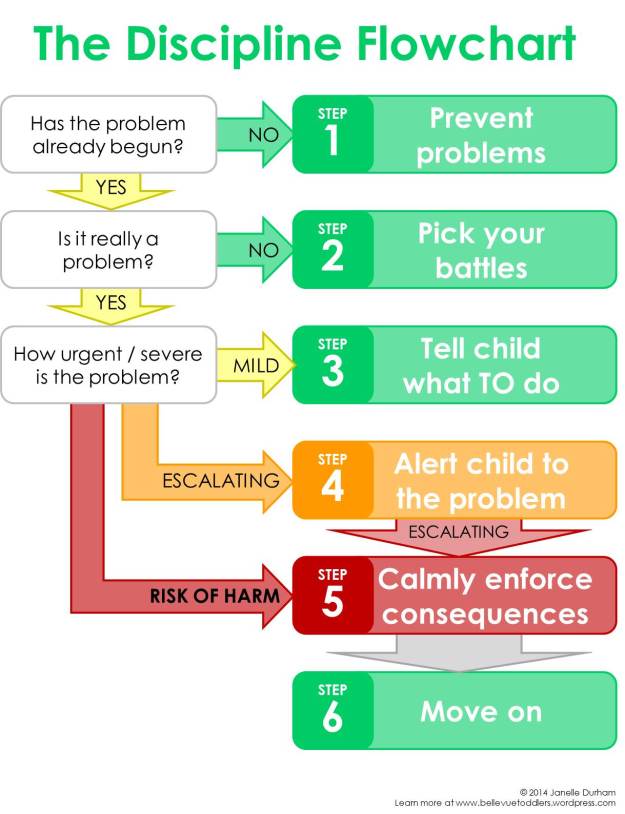
Check out this flowchart for steps which help your child to behave well.

Helpful resources

Webinar on Discipline: www.youtube.com/watch?v=sX0MQ5ZXVio&list=WLsMLXfBPSxoG3J_FkZGqnxVV2P34cr_S_

Overview Handout: www.parentingcounts.org/professionals/parenting-handouts/information-for-parents-discipline.pdf

8 tools for babies/toddlers. www.askdrsears.com/topics/parenting/discipline-behavior/8-tools-toddler-discipline

Tantrums: https://bellevuetoddlers.wordpress.com/2013/11/14/toddler-tantrums-and-emotional-meltdowns/

If you have a hard time saying no, check out:
www.empoweringparents.com/saying-no-to-your-child-how-to-be-a-more-assertive-parent.php?&key=Effective-Parenting
www.empoweringparents.com/No-Means-No-How-to-Teach-Your-Child-that-You-Mean-Business.php#ixzz2rlUqTBC9

Self Discipline and Impulse Control

temptationOur goal for discipline, in the long-run, is to make ourselves obsolete. Our children need to learn to discipline themselves… We don’t want a child who only behaves well because we praise him for it. Or one who only avoids misbehavior if she thinks she might get caught and punished. Or one who has no real sense of what is good and what is bad unless we’re standing there interpreting the situation.

We want to raise adults who are capable of controlling their impulsive behavior, capable of working hard for a delayed reward (or even no reward other than their satisfaction with a job well done), and who have such a strong internal sense of right and wrong that it guides their every action, and who do what’s right simply because they can’t imagine behaving differently.

Impulse Control and Simple Ways to Teach It

To succeed in school and life, kids need to be capable of: sitting still when they want to move, being quiet when they feel like talking, not letting other kid’s misbehavior lead them astray, and so on.

Lots of childhood games and parenting methods are all about teaching this. Try these:

  • Sing the “Clean Up Song”. Stopping playing and cleaning up takes a lot of self-control.
  • Sing songs like “You shake and you shake and you stop.” Play stop-moving-while-playing games like “Red Light, Green Light” or “Musical Chairs” or “Freeze Tag”.
  • “Simon Says.” It’s hard to hold still when someone says “touch your nose” and touches theirs!
  • Play imagination games like “pretend you’re a castle guard – how long can you stand still?”
  • Use “Emotion Coaching” to help acknowledge that although it’s always OK to have feelings, it’s not always OK to act on them. Help them learn ways to manage their feelings.

Delayed Gratification and Simple Ways to Teach It

Some day your child will be an adult who needs to do her job every day, even when she doesn’t feel like it, so that at the end of the month she gets a paycheck and can pay her bills and then purchase some treat she wants. How will she do that well? If you start teaching delayed gratification now.

  • Make them wait. When they ask for something, don’t get it immediately. Acknowledge the request, and tell them when you will do it. “When I’m done washing this dish, I’ll get the toy.”
  • Encourage children to take turns, wait in line, and share. Toddlers struggle with these things, but we start laying the foundation early so they get it as they get older.
  • Let them get bored. Don’t feel like you have to entertain your child continuously. Sometimes their greatest learning happens when they have to get creative to ward off boredom.
  • Teaching manners also helps. When they drop something on the floor, and scream for it, say “Ask me nicely, and I will pick that up for you.” And then mosey your way over to do that.
  • Offer rewards they need to work for. “If you put away your toys, I’ll read 2 books at naptime.”
  • Be a consistent and reliable parent. If your child can trust that you fulfill your promises, they will be much more willing to wait. Check out this post on the “marshmallow experiment” to learn more.

Right vs. Wrong and How We Teach It

As our children go out in the world, they will continuously encounter new situations, with new ethical dilemmas. We won’t be there to interpret all of these situations for them, so we want them to have their own sense of right and wrong. How do we teach that?

  • We continuously model how we would like them to act. (When we do things we don’t want them to do – yell, swear, etc. – we may apologize for our bad behavior. Don’t just hope they don’t notice, because they do. I      won’t tell you what swear words my 3 year old knows!)
  • We talk about our values. When we read books, or watch TV, or see people out in public, we make observations about the behavior we like. (It’s tempting to criticize bad behavior, but it is more effective to tell      them what TO DO, rather than what not to do.)
  • We praise them when they “do the right thing”, especially in situations where that’s hard. (Like sharing a favorite toy, or apologizing for upsetting someone.)

To Get Involved or Not

One question parents often face is how much to intervene. If children are battling over toys, or pushing to see who gets the next turn on the slide, or threatening to hit, when do we step in? The answer varies a lot by culture. Christine Gross-Loh, in Parenting without Borders, tells about her experience watching kids on the playground in Japan. What she was used to, from American playgrounds, was that parents would quickly step in and referee conflicts between children. In Japan, parents did not intervene. They let the children work it out. They viewed playground battles, the crying that results, and making up as normal and natural ways for children to learn how to get along with others. What impact does that have as children get older? One researcher looked at Japanese and American 10 year olds. When asked why they should not hit others of be mean to them, American children said it was because you don’t want to get in trouble with a teacher or parent. Japanese children said you shouldn’t hurt others because it’s wrong and would hurt their feelings.

Wait for It – The Developmental Timeline of Self-Regulation

This self-discipline is a long time in coming. Our toddlers have a very hard time controlling their impulses, and rely on us almost completely for guidance. Pre-schoolers are better at self-control. And elementary aged kids are even better.

But, to be honest, we need to expect even our 17 and 18 year olds to still have regular lapses in judgment and moments of rash action. That’s because the part of their brain that is responsible for planning, impulse control, and making complex judgments (the prefrontal cortex) is still developing. They often make decisions in the moment based on their limbic system (the part of the brain which processes emotion). Anger, fear, excitement, peer pressure and sexual attraction can inspire adolescents (especially boys) to do things faster than the prefrontal cortex can slam on the brakes.

When they make their inevitable poor decisions, you’ll be glad you’ve got 17 or 18 years’ worth of practice at positive discipline and that you have already built a strong relationship based on trust and respect, but in which you’re still the “boss” of them.

Scaffolding

We can’t expect our toddlers to have self-discipline. We hope our teenagers will. How do they get there? Through “scaffolding” – a process where in their early years we intervene a lot and give lots of clear explicit guidance, but the older they get, the more we hang back, the more we wait for them to find their own solutions, the more we help them reflect on their responses and what they could have done differently. As we fade back, they take on more responsibility for their actions, and live more with the consequences that result.

Learn More:

Self-Regulation: www.parentingcounts.org/professionals/parenting-handouts/information-for-parents-self-regulation.pdf

Video that does a nice overview of benefits of self-control, and gives parents tips for how to help their child learn: www.king5.com/news/learning-for-life/Parent-to-Parent–196937571.html

Photo credit: http://www.freeimages.com/photo/734909


Here is a printable handout on Self discipline. Find more handouts on my Resources for Parent Educators page.