I have been teaching parent education for about 30 years now, with the past 13 years spent teaching parent-child classes for Bellevue College. In that time, I’ve created over 150 handouts on a wide array of topics related to parenting children from age 1 to 9. I just went through the whole collection and updated them all.
The PDF’s are all available for free at https://gooddayswithkids.com/for-professionals/for-educators/ You can print them, send them in emails, share links to them, or take excerpts from them. If you know any professional who works with parents – parent educators, teachers, counselors and therapists, health care professionals or whoever, let them know these resources are there.
While you may be familiar with the five senses (hearing, sight, taste, smell, touch), there are more than that, including: vestibular (am I balanced), proprioceptive (where is my body in relation to the things around me, and interoception.
Interoception is your perception of your own internal states: are you hot or cold? are you hungry or thirsty? do you need to pee? poop? move your body to a more comfortable position? are you sick? is your heart racing?
Developing Interoception
When a baby is born, they display the most basic of “feelings”. They are content, or they are distressed. That distress is often caused by an internal experience, such as hunger, fatigue, or pain. But they do not yet have the life experience to interpret what those sensations mean, and what would fix them.
That’s where parents and caregivers come in. We do our best job of guessing what they might need and meeting that need. If we guess right more often than not, they soon learn that when they feel this particular set of internal cues and then they eat, they feel better. Eventually they learn to label it as hunger, and someday they learn that they can eat before the hunger pangs hit to ward off that feeling.
Learning to tune into and trust our internal cues helps us to take care of our bodies. For example, stopping eating when you’re full honors those cues, and can be helpful for developing healthy eating habits. Being told “you have to finish all the food on your plate” teaches you to ignore those cues and keep on eating.
Interoception and Emotions/Behavior
As we get older, noticing and interpreting internal cues is so helpful for taking good care of our bodies, but having interoceptive intelligence also helps us with emotional and behavioral regulation.
We’ve all experienced being “hangry.” When you’re hungry, the smallest irritation sets off a disproportionate wave of anger. We know that when a child is tired, they get cranky or sad. Letting a child move and change positions during group time can help them be comfortable and help them pay attention. When a child just can’t sit still in a class, it is often worth asking whether they need to pee.
If your child is having lots of tantrums, it’s easy to interpret those as behavioral choices. But it’s worth asking yourself – is it possible that instead they are sensory meltdowns? When a sensory meltdown happens, the best way to calm it is with co-regulation. You as the caregiver stay as calm as you can, speaking quietly, holding them gently until they get back to calm. The bridge from them needing your help to calm themselves to being able to calm themselves down to them being able to notice internal distress and dispel a meltdown before it happens is interoception.
How can we help build a child’s interoception?
For babies: notice their cues, do the best you can to interpret them and respond to them promptly. This helps your baby learn how their body signals tell them what they need and how those needs can be met.
If we ignore bodily issues, we teach them to ignore them. If we change a wet or dirty diaper promptly it helps them realize that when they pee or poop something happens – that will help with potty training later. But if you often delay diaper changes, they learn to just ignore the situation, and are hard to talk into potty training later.
For toddlers and children, start to interpret their experience. “I notice you’re wiggling a lot, I wonder if you need to pee.” “You’re all sweaty now – I bet you’re hot. Do you think taking your coat off would help?” As with teaching emotional literacy, rather than telling them how they feel, phrase it with curiosity and questions that encourage them to tune in to those inner signals for themselves. “Hmmm… it’s been a long time since we ate, I wonder if you are feeling hungry yet?”
You can also share your own experience: “whoo – I’m really cranky right now… you know what I think is going on? I think I’m hungry and I notice that I get really cranky when I’m hungry.”
Don’t dismiss their experiences. If they hurt themselves, instead of saying “you’re fine”, say “it seems like that really hurts, huh? I’m pretty sure it will feel better soon, but what would help you now?”
When they’re younger, we might teach common experiences, like “if your stomach growls, it means you’re hungry.” As they get older, we can talk about how everyone has unique body experiences: “if you’re feeling worried, where do you feel it in your body? When you feel that way, what could you do to feel better.”
Understanding their own internal needs helps them to meet those needs, and helps reduce the chance that those needs will distract them from learning and from behaving well.
Learn More about Interoception and Sensory Regulation
(Side note: Enteroception with an e is a subset of interoception, and refers specifically to the senses of your gastrointestinal system – hunger, fullness, and urge to have a bowel movement.)
This post is the text of a handout I created for orientation at my co-operative preschool (I’ve added links for learning more), so it talks about how we do things in our classroom, but all of these 12 principles apply to parents and teachers in all settings.
Respect! Let’s commit to a fundamental belief that everyone here (kids and parents) is doing the best they can given their developmental level, skills and knowledge, and challenges in their past and current environment. And… we all have bad days. When you have a bad moment, call yourself on it, apologize as needed, forgive yourself and commit to doing better. When someone else is having a bad moment, don’t judge.
Kids do well if they can. If someone (kid or adult) is “mis-behaving”, ask yourself: What skills do they lack? What support do they need? What stressors are making it hard to do well right now? When those things are noticed and addressed, behavior improves.
Everyone does better when they know what to expect and what’s expected of them. Consistent routines, clearly explained expectations (not “unwritten rules” they need to guess), well thought-out limits and follow-through on promises (both promised rewards and promised consequences) create an environment where a child can do well.
All feelings are OK. (Not all behaviors are.) We all have lots of big feelings. We’re all learning how to manage them appropriately. When a child is calm, we can teach appropriate ways to express feelings. When someone has big feelings, it helps to validate that. If their feelings led to bad behavior, also address that: “Wow, you were mad she took your toy. I understand. But you hit her, and that was not OK.”
When someone flips their lid, co-regulate before anything else. When we are calm and feel safe, we have access to our whole fully developed brain. So a young child can speak in sentences, follow the rules, make fairly good choices. But, when we are really scared, or sad, or mad, or just overwhelmed by too much stimulus or too many demands, we “flip our lids.” We can’t speak, we can’t be reasoned with… If you have a child who is in full meltdown, it’s not the time to teach or to explain or to ask them to make better choices. Instead, co-regulate. Get yourself calm, get down to their level, speak in a quiet voice. Set clear limits and tell them what needs to happen next.
Every kid is unique and has different needs and capabilities. We are a multi-age class, so our kids are at different developmental stages. Development is asynchronous, so you might have a child with high skills in one area and low in another. Also, we all have different interests, different temperaments, different sensory and support needs, different degrees of flexibility before we hit a breaking point. If you find yourself worrying that your child is “behind” other children, or find yourself judging other children for areas they’re struggling in, remember this range. Judge each child’s progress based solely on – is this child progressing well from where they used to be
These kids are little. They’re still learning. These kids are practicing everything. Practicing kindness, practicing sitting still and listening, practicing good choices, how to do things without making a mess. They’re going to make a lot of mistakes along the way or have days they’re not doing well. We’ll just keep working on it. Instead of telling them “don’t do that”, tell them what TO DO. Instead of assuming they know how to behave well, tell them what would be a positive action to do in that moment.
Growth Mindset/ Power of Yet. “You can’t do it yet, but you’ll get there.” At times, a child can almost do something – they’re working on a puzzle, and they know how it’s supposed to work, but just can’t do it. That is super frustrating!! Don’t feel like you have to rescue them – sit by their side for support and encourage them to keep trying – suggest things to try but don’t jump in and solve it. When they make mistakes, say “hmm, we learned something that doesn’t work. What else could we try.” But… also notice when something is just too hard (or at least too hard in this moment). Teach that it’s OK to say “I can’t do this yet. I can set it aside and try again some other time.”
Process over Product. With crafts, we might have a sample of what a final product could look like. But the process is always more important. We honor a child’s right to make their own choices about what to do. (As long as they’re following the “make don’t break” rule.) What they learn in the process of doing something is more important than the product. So, while you are welcome to help them to do it themselves, please don’t just jump in and do it for them so it will “turn out nicer.” That’s not the point!
We are child-led, play-based. We set up a variety of great learning opportunities, but it’s up to the child to decide what they want to try, and how long to do it. If they start a project and don’t want to finish, that’s OK. If they only try two activities in a day, they didn’t “miss out” on everything else. They focused on what mattered to them.
Freedom Within Limits. Everyone Gets to Feel Safe. Everyone Gets to Play. We try to give children lots of choices. They’ll make some good choices and some bad. We want to let that happen so they learn from their mistakes. But, for the sake of safety (physical and emotional) and fairness, parents and teachers must set appropriate limits. We decide what options are on the table, and they decide from amongst those good options. If they do something unsafe or unfair, we set limits. For example, rough and tumble play is tons of fun, but only if everyone has consented and everyone stays safe.
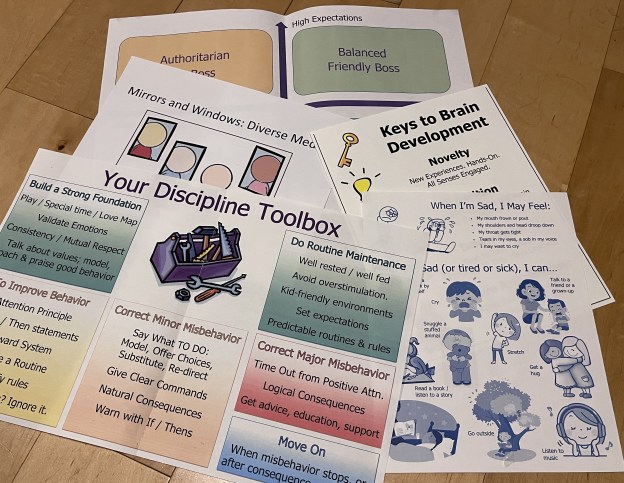
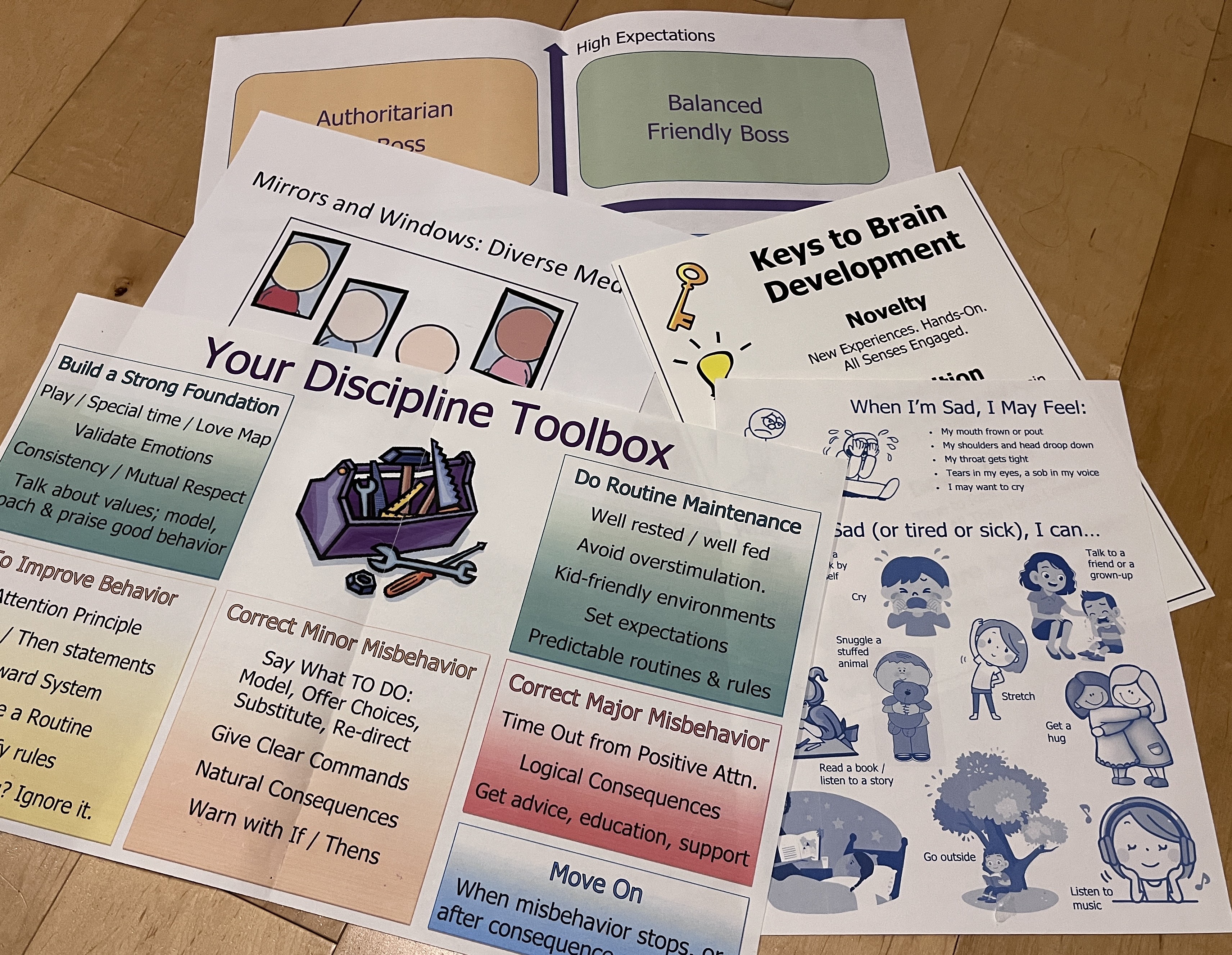
Four Keys to Brain Development: Novelty, Repetition, Downtime, and Safety. Every time we experience something for the first time, we make new connections in our brain. Novelty is so exciting! Every time we see something familiar or repeat something we’re good at, we build competence and confidence. Repetition and routine is soothing! None of us can be learning and doing all the time. We all need breaks to rest and integrate new learning. Finding a balance of novelty, repetition and downtime and ensuring a child always feels safe and loved is the best way to support learning.
Handout
Here’s the handout version of this post – feel free to share anywhere.
Today I was listening to a webinar with Ming Fung from Agents of Speech. The topic was “Decoding the Real Signs of Speech Delays” and he was primarily talking about parent coaching for language delays.
But one of his messages gave me one of those a-ha moments you get when someone says something that should be obvious, but says it more clearly than you’ve thought of it before.
When you’re trying to teach your child any new skill and it’s just not working, you should ask yourself “is it that it’s too hard? Or that they don’t want to do it?”
If it’s too hard, that may mean you’re trying to move too far too fast, and simplifying things into next achievable step might be more successful. It is better to have small successes than fail at a big reach. Ross Greene says that often when we’re thinking “they don’t wanna do it”, it’s really that “they can’t do it… yet.” And that they need more skills, new resources, or more structural supports to be successful.
If they don’t want to do it, he says “make sure they’re fairly compensated.” If it’s just slightly hard or slightly annoying or whatever, it may need just a little motivation. If it’s a big stretch, it may need a big motivation. If your child has special interests, you could find a way to teach that skill within that interest. (When my youngest child was resisting learning to write and draw, we would ask him to write requests for treats, like “kiss” for a Hershey’s kiss or “Cheez-Its”, and he would draw if we would draw Star Wars characters that he could copy.) Or, if they have a big passion, you can use that as a motivator. (My oldest was very slow to potty train, and saying “here’s the dollhouse you want – it’s a big kid toy. As long as you can keep your underwear dry, you can play with it, but if you need to go back to pull-ups, that’s OK – we’ll put the dollhouse away for a little while till you’re ready to be a big kid.”) Don’t force the learning, but show them there is a value in learning this new skill.
Now, you don’t want to overdo rewards. There are downsides to rewards. But sometimes it is a way to move your child forward toward something you want them to learn.
Part of supporting our child’s brain development is helping them experience the world with all their senses (all 8!). As they use their senses, talking about what they are experiencing helps to reinforce the learning. Here are ideas for strengthening each sense.
Vision
One of the best things you can do for your child’s vision is to take them outside. Inside, you may only look at things that are a few feet away. Outdoors, we can look close at an ant, then at a tree, a cloud, then back down to a flower. If you stand in front of a baby as you push them on a swing, they gaze at you as you get further away, then come closer and closer. These shifts in focus build their eye muscles and reduce the chance they’ll need glasses later in life. (Genetics also plays a part.) Different types of light – rosy skies at dawn, bright light of mid-day, twilight and looking at stars at night also help with eye and vision development.
Help your child learn to track motion. For a baby, hold a toy in front of them. As they look at the toy, move it to the left then the right, then up, then down so they follow it to the edge of their peripheral vision. For older children, rolling or throwing balls helps them track motion.
Hearing
Give them lots of different things to listen to. Take music classes or get musical instruments or discover instruments around you (drum on a pot with a spoon, tap on a glass with a fork, shake a box of mac and cheese.) Sing a lot! Read to them. When they notice any sounds in the environment, talk about them – “I heard that too. That was a firetruck.” (Responsive language – noticing what your child is paying attention to and talking about it – is the best way to build your child’s language skills.) Watch for background noise. If your TV is constantly on or there is always background music playing, it can be hard for a child to focus on and learn from any one sound.
Taste
Breastmilk (human milk) changes flavor based on what the lactating parent eats, so exposes even young babies to a variety of tastes. As food is introduced, expose your child to a wide variety of tastes. There are five flavors: sweet, salty, sour, bitter and umami, and there is the sensation of spicy hot. Children tend to greatly prefer sweet and usually aren’t fans of sour and bitter. But encourage them to sample a wide variety of flavors, and give them the words to describe those flavors and what they like about them and don’t like. (Learn about picky eaters.)
Smell
Let them experience a variety of smells. Go for walks in the woods, go to a flower garden or an herb garden. Have them in the kitchen as you cook (let them smell the spices and herbs when you open the containers) and when you gather to eat, talk about how the food smells. “When I peel the orange, you can smell it, can’t you?” Try scented playdough, scented markers and stickers. Add scents to the bath water. (More scent activities.)
Note: In our culture, we have lots of artificial scents –soaps, detergents, perfumes, air fresheners and more. Many people have chemical sensitivity and get head-achey or dizzy from all this. Consider unscented cleaning products, choose air fresheners that neutralize or eliminate odors – not just cover them up, use a Hepa filter, open windows for fresh air often.
Touch
Let them experience a wide range of sensations: playing in dirt, sand, grass, mud. Petting animals and touching different fabrics or sandpaper or bubble wrap. You can rub their back, hold their hand, give hugs, tickle, give high-fives. Let them experience being hot or being cold. Explore things hands on and talk about what they are feeling. When you get them dressed, talk about how their socks are tight and stretchy, their shirt is loose and soft. Make sensory bins for them to play in.
Some children are resistant to messy play or touching different textures. You can role model – show them how you touch those things. Give them tools to use with the item – a child who won’t just put their hands in the mud might use a shovel to scoop it or a stick to stir it and then if their hands happen to get muddy, they then play in it. Or show them how it’s OK to be messy when we’re doing messy play and we can always wash our hand when we’re done.
Vestibular system
This helps us to stay balanced, and tells us if we are moving slowly or quickly through space. This helps us stand, walk and sit up without falling over. Carry your baby in lots of positions. As they get older, encourage your child to crawl, walk, climb, run, ride, roll, jump and dance. Swing on a swing, spin on a merry-go-round. Put them on your lap and sing bounce songs. (More about the vestibular system.)
Proprioception
This is how we know where our body parts are located in space without having to look at them. Also helps us figure out how much force to use – whether picking up a fragile glass or banging on a drum. Play blindfolded games, or play games in the dark. Do lots of movement games where they stretch out, or clap, or shake their shaker soft or loud, or wrestle and rough house so they learn how much is fun and what could accidentally hurt someone. Let your child move heavy things, or carry heavy things, and handle soft or fragile things. (Learn more about proprioception and self regulation and more about proprioception – this article is specifically about supporting neurodivergent kids, but all kids benefit from proprioceptive learning.)
Interoception
Senses of our internal bodily systems –being hungry or full, itches, the need to urinate and “butterflies in our stomach” when we’re nervous are not explained by the five senses and instead indicate other ways in which we perceive information.
You can build your child’s interoceptive intelligence with these 5 steps: helping them notice, naming sensations, linking emotion to sensation, understand what happens when we ignore the sensation, and managing the situation. (“You’re wiggling your bottom. That tells me you need to pee. You’re also seeming really anxious – that happens to me when I need to pee. I’m worried that if you don’t go to the potty soon you could wet your pants. Why don’t you take a break and go to the bathroom?”)
Responding to your baby’s cues that they are full or hungry, helping them to burp when they are gassy, changing their diaper when it is wet or dirty, and noticing and talking about these sensations help them learn to listen to and respect their body’s cues. As your child gets older, we continue to talk about these things as this knowledge helps your child be more independent and helps them stay healthy. (Read my full article on interoception. Then learn more about interoception.)
Sensory Cup
Some children are sensory seeking and can take in all the sensory input they can get. Others are easily overwhelmed. Some children might love touch, vestibular and proprioception activities, but find different tastes or too much noise overwhelming. Be sensitive to your child’s needs. Watch for disengagement cues (glazed eyes, turning away, pushing things away, muscle tension) that tell you their sensory cup is overflowing and they need a break. If you ignore those cues and keep piling on stimulus, you may face a sensory meltdown. (A “tantrum” they can’t control.)
image credits: swing Photo by Avin CP on Unsplash; high chair Photo by Vanessa Loring; dog Photo by bin Ziegler





 More Good Days with Kids