Category Archives: Your Family

Talking to Toddlers and Preschoolers about Race

As parents, part of our role is to teach children about the world. One of the things that we can do to support our child’s learning is to play sorting games with our kids: the ability to sort things is essential to lots of future learning, so we are justifiably proud when our young child can sort all the red toys into one pile and all the blues into another pile, or when they can find all the cows in a group of barn toys, or put a group of objects in order from largest to smallest. We are excited that they have learned to distinguish similarities and differences between things.

And yet, there’s a whole category of similarities and differences we’re kind of hoping they won’t notice. Most of us have a story of walking through the mall and hearing a child loudly blurt out “that man is really fat” or “hey, that lady only has one leg” or “look how dark that guy’s skin is.” And then the parent desperately shushes the child, hoping that no one has heard. They just drag them quickly down the hallway and into a store to distract them from the subject… and never come back to it.

Or, the more enlightened parents may try to speak to the child about it, but do it in an odd “code” which tries to validate the personhood of the person they’re talking about (which is good) but without really acknowledging the difference that the child noticed (which is confusing for the child). As Bronson and Merryman say in Nurture Shock, “every parent [in a study] was a welcoming multi-culturalist, embracing diversity. But… hardly any of these white parents had ever talked to their children directly about race. They might have asserted vague principles in the home – like “everybody’s equal” or “God made all of us”… but they had almost never called attention to racial differences. They wanted their children to grow up color-blind.”

But our children are not color blind! Research tells us that, and so does our experience. I clearly remember a moment with my oldest when she was less than six months old… maybe even as young as 3 months. She was fussing in an Indian restaurant, and the owner picked her up to dance her around the room a little and show her the artworks on the wall. She never looked at the artwork. She gazed at his face. We are a very pale skinned family. He was very dark-skinned and the contrast between his skin and his white teeth and eyes fascinated her and all she did was stare at her face, obviously creating in her brain a whole new category of what people can look like.

Our kids notice differences. They ask ’embarrassing’ questions. They point to people on the bus. They blurt out their observations in malls. (They learn to stop doing that by age 5 or so.)  And the parents shush them. The parents’ shushing sends the message of “Don’t talk about that! That’s a bad thing!” A young child is not sophisticated enough to get the message that the parents intend – something about not hurting the feelings of the person called out. When they do this, the message the child gets is that the difference they noticed (whether obesity, handicap, race, or whatever) is bad and shameful and not to be mentioned in polite company.

When parents don’t talk about race and other differences openly, our children are left to draw their own conclusions. So, amongst the parents who never talked about race, what impressions were their kids left with? “14% said outright, ‘no, my parents don’t like black people’ and 38% … answered ‘I don’t know [how my parents feel about black people.]'”

Bronson and Merryman tell the story of one of their own children. He was raised in a diverse neighborhood and school with parents who tried hard never to highlight the differences between people because they wanted a non-racist “color-blind” child. At almost five years old, he never mentioned skin color. They thought things were going perfectly.

“Then came Martin Luther King Jr. day at school… that weekend, [the son] started pointing at everyone, proudly announcing ‘That guy comes from Africa. And she comes from Africa too!’ Clearly he’d been taught to categorize skin color and he was enchanted with his skill at doing so. ‘People with brown skin are from Africa’, he’d repeat. He had not been taught the names for races – he had not heard the term ‘black’ and he called us ‘people with pinkish-whitish skin.’ … we started to overhear one of his white friends talking about the color of their skin. They still didn’t know what to call their skin, so they used the phrase ‘skin like ours.’ And this notion of ours versus theirs started to take on a meaning of its own.” Soon, children make broad sweeping generalizations about what ‘people like me’ do, and about what ‘people like them’ do.

This view of “us” vs. “them” increases. Amongst teenagers, the more diverse the school, the more likely that all their friends are the same race as they are. “The odds of a white high-schooler in America having a best friend of another race is only 8%…. 85% of black kids’ best friends are also black.” (Bronson and Merryman)

Families of color are more likely to talk to their kids about race than white parents. They tend to do it in two very different contexts: one is ethnic pride, the other is preparing the child for future discrimination. In the case of preparation-for-bias, it appears that a little education helps the kids be resilient when they are faced with discrimination. However if the parents over-focused on discrimination, then the child was likely to blame his/her failures on other people – who they saw as biased against them. Ethnic pride coaching helps the child’s self-confidence and helps them be more engaged in school.

Although white kids are not usually coached in ethnic pride, Bronson and Merryman say “white children naturally decipher that they belong to the race that has more power, wealth and control in society.”

So, how do we talk with young children about race?

Think about the way we talk about gender as a model. We have no concerns at all with calling some kids boys and some girls, or asking how many girls were in their class, or telling them to hand something to ‘that man.’ It’s OK to also use language to label the racial differences that children notice and give them the vocabulary to talk about that. We tell kids ‘women can be doctors and men can be doctors.’ We can say just as nonchalantly ‘your doctor is Asian-American and your dentist is Black.’

We can choose to live in places or go to school in places with ethnically diverse populations, and encourage our children to make a variety of friends. We want to help our children see all that they have in common with diverse friends: “all three of you love dinosaurs” or “you both really like to play in the playground.” But we can also acknowledge and talk about the differences: “you live just with me, your friend lives with her parents and her grandparents from India” or “you have dark curly hair and you’ve noticed your friend’s hair is blond and soft” or “that woman wears a head scarf because that is what women of her religion wear.” We don’t want to say “all people are the same under the skin”, because that misses the beauty of our society’s diversity and also does not help your child understand their world.

We can read books, and watch movies, and look at artwork that represent a global array of people. When reading, watching movies, or people watching, talk about differences easily and openly. Note different skin colors, ages, gender expressions, weight, ability, clothing / hairstyles, and family compositions. Use descriptive words / labels they can use, like Asian, gay, deaf. We will, of course, help them understand as they grow older that no one can be defined by any one label. But, as they start to sort things out, talking about differences builds vocabulary and context for understanding the broader world.

As children get older, our discussions get more nuanced. With a toddler, we just teach vocabulary and we celebrate that everyone is different and we all have things in common too.

With our preschoolers: It’s not ideal to say “we’re all equal”, because sadly that’s not true in our society. We can say “we all have equal rights” and “we all deserve to be treated equally regardless of our race and religion.” We can teach our young children about respect for others and about justice and equality.

When these children reach elementary school, they will begin to notice inequities. They may talk about how someone has a bigger house with more toys, or they may notice that children eat subsidized breakfast at school, or they may notice that children get picked on for the color of their skin. Then we can begin discussions about racism and inequality. We’ve already given them the vocabulary to describe difference. We’ve given them the value of equal rights. Now, and as they get older, we can talk about our roles in moving our society toward that ideal of equal rights for all.

Resources to Learn More

You might also like my post on Children’s Books as Mirrors and Windows, which includes links to LOTS of great children’s books you can use to lead into conversations about diversity, race, culture, gender, family compositions, disability, and more.
Pie of Life: Is your life in balance?

pieThis week’s theme at my class has been Work-Life balance and Self Care. As parents of young children, we juggle a lot of responsibilities: caring for children, keeping up on housework, finances, relationship with our partner, and so on.

If you’re a stay-at-home parent, it’s also easy to feel overwhelmed by the never-ending drudgery of child care tasks (time to change another diaper… wash another bottle…), to long for adult conversation, to feel like your brain is turning to mush, and to feel like your personal identity is getting lost in your role of mom.

If you work outside the home, you’re also juggling all your work commitments and responsibilities to your co-workers. It’s easy to feel like you’re not managing it all – you may feel like you’re doing a crappy job at work or at home as a parent or both.

Is balance possible for parents of young children?

Some would say yes. I do know plenty of parents who are feeling pretty balanced. Actually, I’m feeling pretty balanced most of the time.

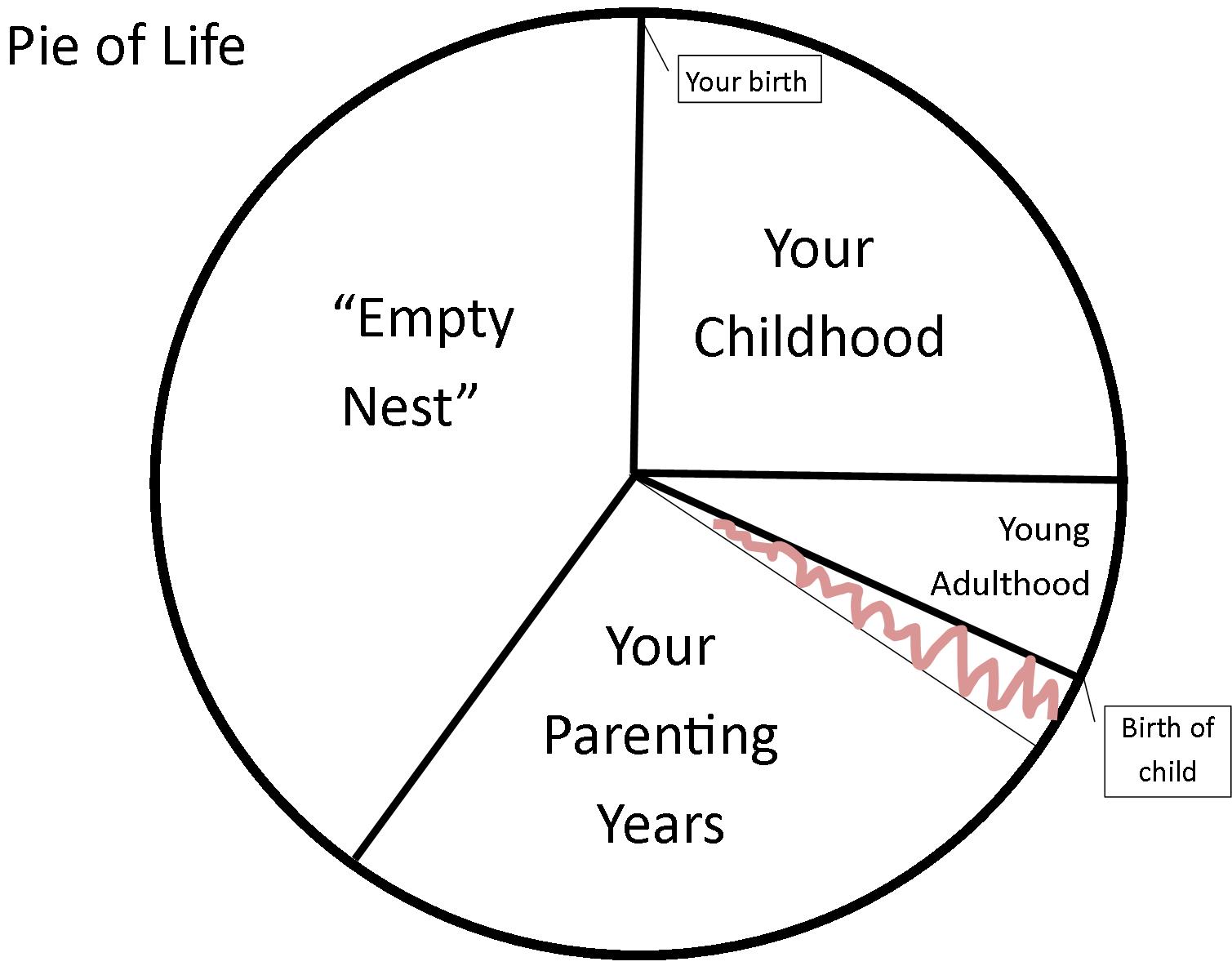
But many parents find it impossible to feel like they’re meeting all their responsibilities and getting what they want. Some of those parents feel like maybe that’s OK. That this is a short period in their life, and it’s hard, but in the long run of their life, it will all balance out. At the top of this post is a picture of the “Pie of Life.” This is taken from an idea by Ann Keppler, one of my co-authors on Pregnancy, Childbirth, and the Newborn. Imagine this pie represents your life – 80 or so years of life. It’s divided into your childhood, your time before children, your time with children in the home, and your empty nest years. See the little tiny slice that’s shaded pink? That’s your child’s life birth to age 3.

This time of life that seems all-consuming and overwhelming is just so short in the big picture of life. I’m not going to be Pollyanna on you and say “Savor these years – they’re so short, and before you know it you’ll miss them…” That’s probably true. But I also know that sometimes in the moment, it’s just HARD to parent a little one. I totally get that. But maybe it still helps to get this perspective sometimes, or to remember phrases like “This too shall pass.”

But in the moment, how do you make it feel better and more manageable now?

How do we start to find more balance?

First, get a good sense of what your life is really like now. I recommend this pie exercise where you examine where you currently spend your time and energy, and where you would ideally spend your time and energy. Divide up the two pies into all the things you need to do for yourself and others, and all the things you want to do for yourself and others. Compare them. If your current pie is pretty close to your ideal pie, you’re in good shape! If they’re very different, then you can think about what you want to do to bring them more into alignment.

If you’re noticing that you don’t make any time at all to tend to your own needs, read about Making Time for Self-Care. If you have a hard time giving yourself “permission” for self-care, check out this article on living a balanced life. If you’re feeling guilty about work taking you away from parenting, check out this article and this one.

If there are pieces in your “ideal” pie that either don’t exist on your current pie, or are smaller than they need to be, think about how you’ll make the time and space for more of that in your life. Sometimes it’s a matter of deciding it’s important to you, committing to it, and putting it on the calendar. Schedule time to relax! If there are chores that nag at you that you never quite get done, schedule them. One of the joys of scheduling chores is that instead of fretting all week about the fact that X needs to get done, you say on all the other days “I don’t need to worry about X today, because I know it will get taken care of on Tuesday.”

Prioritizing what most nurtures you

If we have limited time for self-care, we want to spend it on the things that will help the most. It’s worth taking a few minutes to figure out what those things are!

I want you to think of the things that nourish you and make you feel that you have some control over your life, and the freedom to do things you enjoy. It may be helpful to think about it this way: are there things you miss from your life before children – things you wish you could still do, but can’t figure out how to do while caring for your child’s needs? (These might be big things, or might be little things that wouldn’t seem important to others, like “I wish I could read a Sunday paper without interruption.”)

  • Make a list of four or more things they want to do (e.g. “I want to start exercising daily, I want to go on a date, I want to get 8 hours of sleep, I want to get together with my girlfriends. I want to read for 15 minutes a day.”)
  • Now compare them to each other – if you had to choose between exercise and a date, which would you choose? Whichever one you rated higher, then compare it to the next thing on the list: if you had to choose between a date and 8 hours of sleep, which would you choose? And so on, down your list, always comparing your current top choice to the next thing on the list. When you’re done, you’ll know which thing you most want to do.

Now you just need to commit to making it happen. And, if needed, committing to asking for help to make it happen.


Your Safety Style as a Parent

safetystyleDo you imagine taking your child rock climbing, bungee jumping, and white water rafting? Do you enjoy big bold play like tossing them up in the air and spinning them round? Or do you wish you could keep your child in a soft padded room full of soft padded objects so he need never get hurt?

It is helpful for parents to reflect on their own tolerance for risk as they safety-proof their house, teach their child safety skills, and allow for some risk-taking. Where you strike the balance between protecting your child and allowing exploration is influenced by your gender and theirs, your age and experience and theirs, your temperament and theirs.

Gender: Men lean toward risk-taking, women lean toward being protective. Talk to your partner, and agree what limits you will set, so you can be consistent. Try to understand the value of each others’ views.

Boys tend to be bigger risk-takers than girls, who are a little more likely to look before leaping. If you have a risk-taking boy, you may need to focus on removing most hazards; if you have a cautious girl, you may be able to adopt a wait-and-see approach.

Age & experience: Older first-time parents tend to be more cautious than younger first-timers. Experienced parents of many children tend to be less cautious over little hazards, but stricter about the big rules. If you wonder whether you’re being over-protective, or too lax, try watching other parents (on the playground, at your child’s school, etc.). It’s a good way to “sanity check” yourself. Are you setting about the same kind of limits others are? If not, do you think they’ve got the right idea and you need to adapt? Or does it reinforce with you that what you’re doing is what really feels right to you?

For children – the older they get, the more dangerous situations they are capable of getting themselves into, but hopefully they’ve also started to learn caution and safety behaviors. They need wider boundaries, so you will need to adjust safety rules as they grow. Do you feel like you’re striking the right balance?

Temperament: Some people are inherent risk-takers, some inherently cautious or fearful. Your limits need to balance your temperament, your partner’s, and your child’s. Set limits that are within your comfort zone, and set rules you can enforce consistently even if you’re tired or stressed.

There’s no right or wrong answers here, just things to be learned from self-reflection…


photo credit: safety zone – http://www.freeimages.com/photo/1422766; Jump – *vlad* via photopin cc

Relationship Skill #5: Expressing Needs

ask

Many relationship conflicts arise because one or both of you is not getting something that you need. You can start feeling like opponents on opposite sides of an issue or like competitors for scarce resources. Here are some steps to start thinking like allies again, and being working things out.

  1. Identify what you need. Sometimes you need to figure it out yourself before you can tell your partner. Hint: if you often find yourself saying “You never do X” or “You always do Y” or “I never get to do Z,” there’s a hint in there somewhere.
  2. Communicate that need to your partner. Be clear, and specific. Use the “I” word – “I need this”, not the “You” word – “Here’s what you need to do.” Help them understand how you feel about this emotionally. “It makes me sad when…” “I feel overwhelmed when…”
  3. Ask for help meeting that need.
  4. Listen to your partner’s opinions and concerns. Avoid interrupting, criticizing, defensiveness, and contempt. (Expressed out loud or with body language.) Paraphrase – repeat back what your partner has said, and make sure you heard him/her right.
  5. Ask your partner what s/he needs and work together to get that need met.

Next time you find yourself in conflict, try these ideas. Even better, try working preventatively. When you’re not in the heat of the moment, explore one areas of conflict, and see what you learn together.

I have a one-page handout with more details on this conflict resolution skill. Also check out the Non-Violent Communication method by Rosenberg, one of the key inspirations for this technique.

To see all my posts on relationship skills, click here.

Love is in the Little Things – Every Day

docu

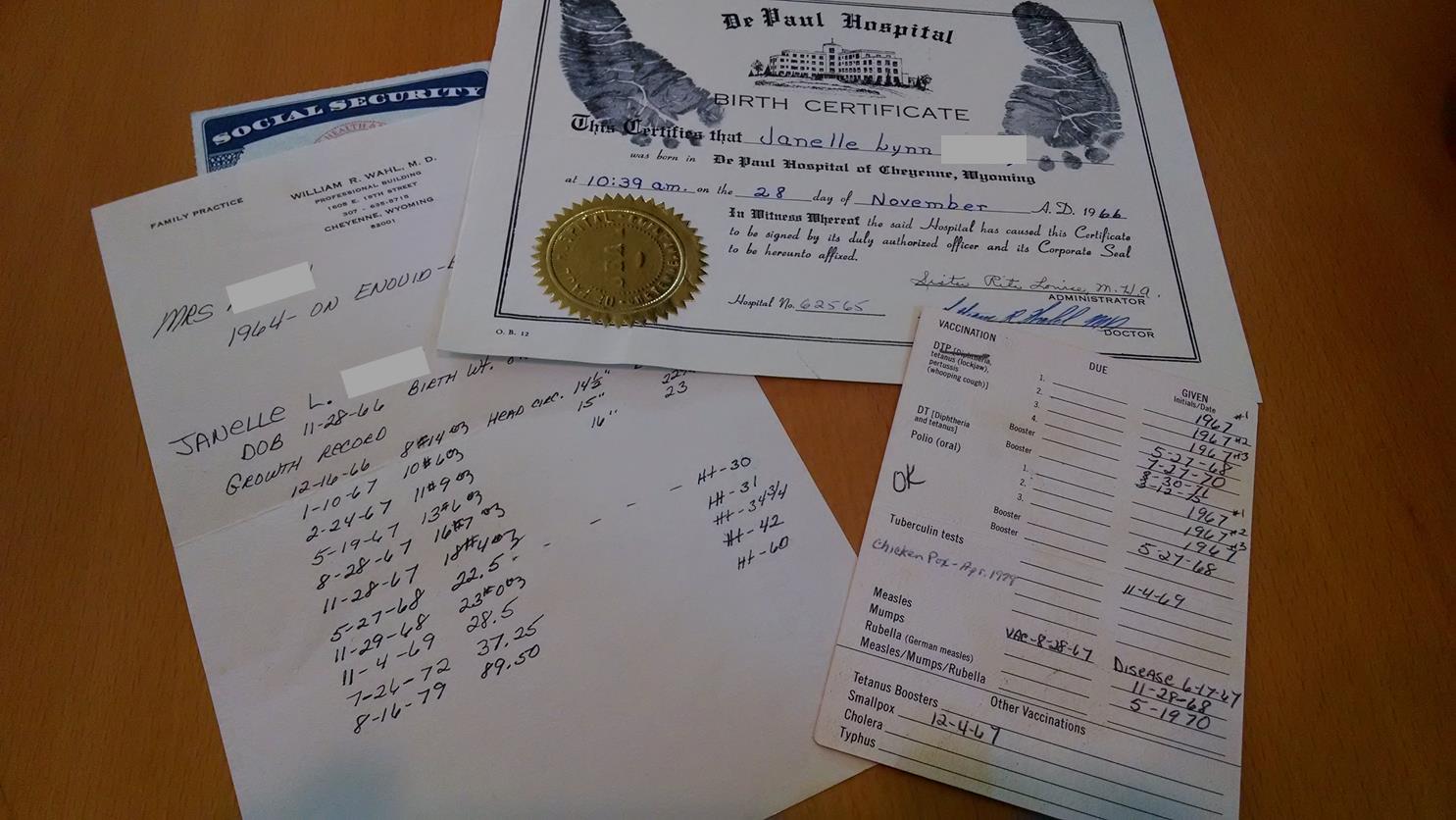
What are those pictures of? Pictures of a mother’s love and dedication.

In the technical sense, they’re

  • my birth certificate (not the official one I can order from the state, but the original one made in the hospital on the day I was born)
  • my immunization records and my growth records
  • my social security card

So yeah, just “boring documents you keep in a file”, right?

But they’re also tangible signs of all that my mother did for me. If there was an important document, she kept it carefully on file for me, and when I was an adult, gave it to me, and made sure I knew to keep it carefully on file.That birth certificate is 47 years old. On the health records, you’ll see that not only did I attend all my well child check-ups and get all my shots, if you look at the dates, you see my one year physical was scheduled exactly on my birthday. My two year old physical was the day after my second birthday – my birthday fell on Thanksgiving that year.

They’re visible reminders of how hard she tried to be sure that her children were all well cared for. My mom made our meals every day – dinner was always at 5:30. And there was always milk with dinner. Except when we had tacos – tacos were always accompanied by pop or lemonade – quite a surprise to drink that when you’re expecting milk!

She packed lunches. She made clothes. She washed clothes. She read to us and encouraged us to read. She took us to the library – a lot. She took us to church every Sunday. She served on the PTA at school. She taught me to sew, cook, clean, but never to knit. My fault – I refused to learn. She took us to 4-H and scouts meeting (and yes, she was a den leader too). She made sure we made it to school on time all the time. She took us to the doctor when we needed it.

When I was a kid, I took all that for granted. Isn’t that what all moms do?

As an adult… as a social worker… I know that no, that’s not what all moms do.

For all sorts of complicated reasons – from mental health to poverty to homelessness to substance abuse to racism to illiteracy to domestic violence to war and more, many moms are not able to do for their children what my mom did for me.

Probably most adults don’t have their original social security cards, immunization records and growth records, and their original birth certificates on file. Many adults don’t even know if they were immunized. Some adults don’t know when or where they were born. And they didn’t have three meals a day, and they didn’t get to school on time…

With that knowledge, and the knowledge that comes of raising three kids of my own, I no longer take for granted all that my mom did for me. It takes so much hard work, so much commitment, so much love to do what she did for me. With every meal she cooked, every sock she washed, every book she read. Every thing she did. Every day.

She’s 81 now. And I’m 47. And she’s still doing a pretty fabulous job being a mom to a daughter who doesn’t really remember to say thank you for that very often.