Category Archives: Parenting

Consequences

Two tools in your discipline toolbox are natural consequences, and logical consequences.

Natural Consequences

A natural consequence is what will happen if the child keeps doing what they are doing, and an adult does not intervene. Often, we rescue them by stopping a behavior just before natural consequences happen. But, sometimes we can let it play out and let a child live with the consequences of their actions.

If you’re going to let a mistake play out, it’s only fair to warn the child about the possible problem with an “If / Then”. We, as adults, might be able to foresee consequences. But a child may not realize what could happen. So warn them, and if they’re wise, they’ll stop. If not, they’ll have a natural consequence.

  • “If you pull the cat’s tail, then the cat will probably scratch you.”
  • “If you play with that toy that roughly, then it may break, and I won’t buy you a new one.”
  • “If you don’t eat any lunch, then you will be hungry during the movie.”
  • “If you don’t bring your comic book inside, then it may get ruined by rain.”
  • “If you do that, you might spill. Then you’d have to clean it up, and I won’t give you more juice.”

Natural consequences are best used when the results of the mistake will be a little painful so a lesson is learned, but not too painful. For example, if the child might break a cheap toy, you might not intervene, but if they’re about to break your laptop, you should stop them! If they might get a minor bump or a bruise, you might let that play through, but if they’re risking a broken bone, you will stop them.

When they experience a natural consequence, they are likely to be sad or mad. You can sympathize with the emotion without fixing the situation. “I know you’re sad about your toy. I’m sad that it’s broken too.”

Logical consequences

Logical consequences are actively imposed by the parent for misbehavior.

When entering a new situation, it’s the parent’s job to make sure the child knows what to expect, and what’s expected of them. We teach them how to be good. If they start a mild misbehavior, we might start correcting that by telling them what TO DO instead. But, if the misbehavior is getting worse, a consequence may be appropriate.

Generally*, you will give an “if / then” warning to let them know what’s coming so they have a chance to change behavior and avoid the consequence. Some examples, sorted into categories:

  • Removing the child from a situation where there’s an issue:
    • “If you run near the parking lot, then we’ll have to leave the playground.”
    • “If you knock the books off the library shelf, we’ll go home instead of going to story time.”
    • “If you are loud in the restaurant, then we won’t be able to stay to have dessert.”
  • Removing the problem item from them:
    • “If you don’t put away your toys, I will put them away and you won’t be able to play with them tomorrow.”
    • “If you two can’t share that toy nicely, then I will put it away for the rest of the play date.”
    • “If you knock your plate on the ground, then lunch is over and I won’t get you more food till afternoon snack time.”
  • Removing a privilege
    • “If you don’t finish your homework tonight, then no screen time tomorrow.”
    • “Since you hurt your friend, I can’t let you play tag anymore.”
    • “If you don’t put all your laundry in the basket, then no cookie at dinner.”
  • Requiring the child to do something to repair a situation.
    • “If you spill the water, you will have to clean it up.”
    • “If you break that, you’ll have to use your allowance to buy a new one.”
    • “If you don’t help put away toys now, you’ll need to help me with the laundry later.”

Make sure:

  • the consequence is developmentally appropriate
    • For a toddler, it has to be immediate and short term – if they start throwing blocks, you immediately pick them up and take them away from the blocks. Then you help them find a new activity to do. A few minutes later, they might wander back to the blocks and play with them appropriately.
    • For a preschooler, the consequence should still follow closely after the behavior but can last a little longer. If they are playing in a way that could break a toy, you take it away right away, and say “I’ll keep this safe till tomorrow, then we can try again.”
    • For an older child, the consequence can be more delayed and last longer. For a teenager, it could even be something like: “if you don’t do well on fall semester grades, then I won’t let you try out for the spring musical.”
  • the consequence is in proportion to how bad the behavior was
    • If a child spilled juice, you wouldn’t say “no drinks at the next five meals.” But you could say “no more juice today. If you are thirsty, you can have water.”
    • If a child failed to put away toys one time, you wouldn’t throw away all the toys. But the toys could “take a break” for a day or two.
  • you choose a consequence you can and will follow through on enforcing
    • Kids need to know they can trust their parents to keep their promises. That includes being consistent when applying consequences. Don’t go easy on the consequences and back down… if you do this once, they’ll try to beg you down on the next several times.
    • No empty threats. When you tell your child “if you don’t come right now, I’m leaving you here at the store and not coming back.” They know that’s not true. (And if they thought it was true, that would be very scary for them.)
  • you carry it out calmly, not with anger and shaming – consequences are not about punishing your child or making them “really regret” their choices – they’re about learning that their choices have impact and helping them learn the importance of better choices in the future.
  • as I said above*, generally you want to warn before imposing a consequence, so they have a chance to make a better choice. However, if they are hurting someone or something, there’s not a warning – it’s an immediate consequence. “You bit your friend. We are leaving the park now.” At a family meeting, when all is calmed down, you can discuss your rules with your child and establish in advance what behavior you consider unacceptable that will always warrant an immediate consequence.

For lots more on discipline, read The Discipline Toolbox, and follow the links in that post to find lots more tips.

Here is a printable handout on Consequences and Time Out. Find more handouts on my Resources for Parent Educators page.
Parenting Pyramid

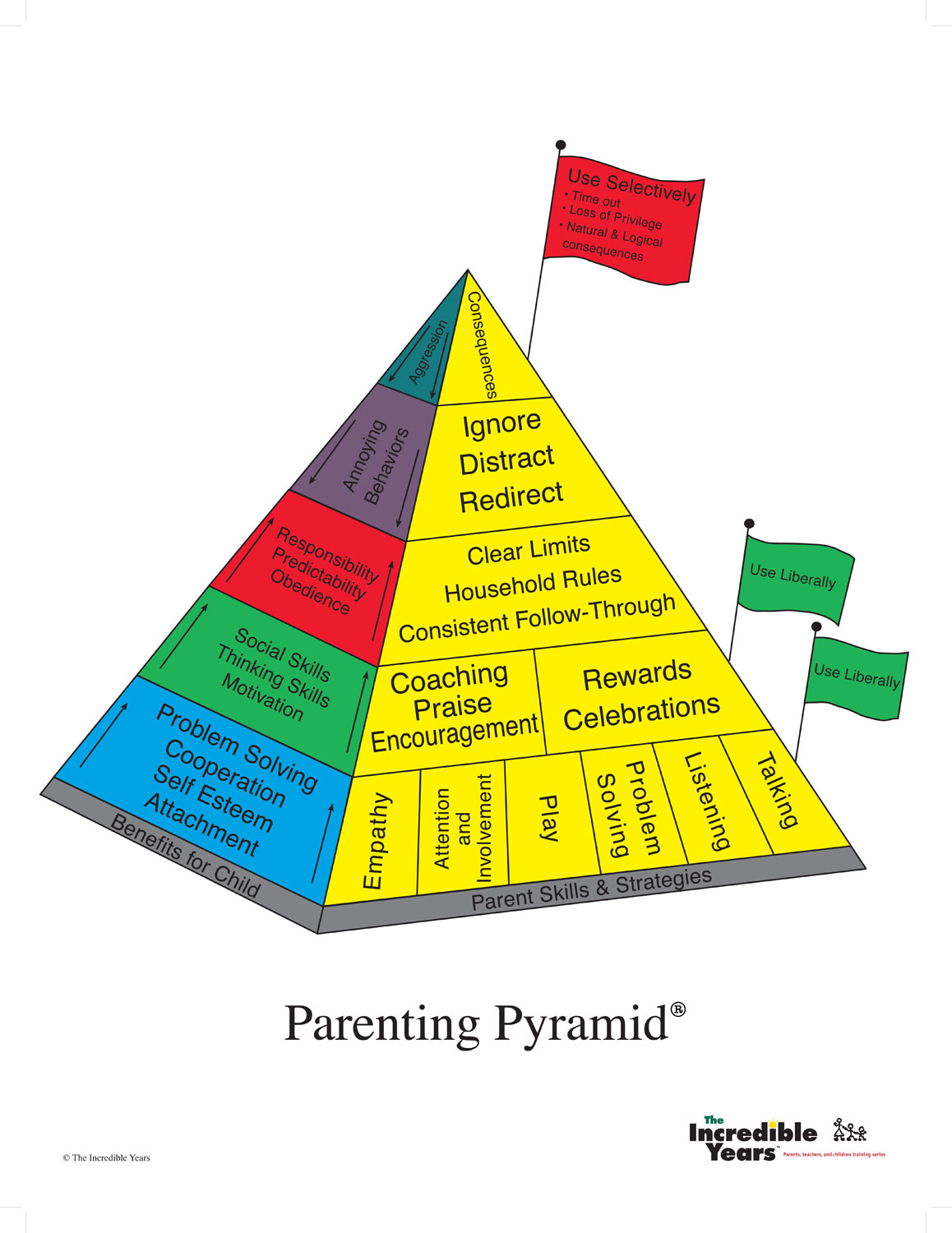
The Incredible Years Parenting program teaches a wide variety of parenting skills and strategies. One teaching tool they use is the Parenting Pyramid. I have often taught about a Discipline Flow Chart. I am thinking today about how these compare.

They begin with a foundation of positive parenting: liberal use of play, listening, talking, involvement, and empathy. Then they recommend liberal application of coaching, encouragement and praise, and use of the Attention Principle – these all help teach them what behavior you would like to see. This all relates to concepts I’ve discussed when saying all discipline is grounded in a healthy relationship and in step 1 of my flowchart – preventing problems.

My step 2 is to pick your battles. They talk about Ignoring Annoying Behavior.

My step 3 is to tell your child what TO DO. They use a lot of Coaching. They also talk about establishing routines and rewards which create an environment where it’s easy for the child to be successful, because it is clear what is expected of them.

My step 4 is to alert the child to the problem, and let them know that if the problem continues, you will need to escalate up to consequences. They teach the when / then and if / then statements.

My step 5 is consequences. They use time out and logical consequences.

My step 6 is to Move On. They also talk about the importance of this: at the end of a time out, or after the negative consequence is complete, then you return to positive attention, immediately praising any positive behavior, and moving forward with a clean slate.

My thoughts about how these compared is what led me to create my new teaching tool: the Discipline Toolbox.

When/Then and If/Then

Two useful discipline tools for parents are the “when / then” and the “if / then” statements.

When / Then

This statement basically says “when you do [this positive behavior], then you will get [this positive social reward].”

Some examples:

  • “When you’ve brushed your teeth, then we get to read a bedtime story.”
  • “When you finish cleaning up your Legos, then we get to play a game.”
  • “When you’re ready for school, then you can work on your drawing.”
  • “When you’re sitting down in your chair, then I will give you your dessert.”
  • “When you’re sitting in your car seat, then I will tell you a joke.”

The statement clearly explains to your child what you want them to do. (It also implies that you are totally expecting your child to do this positive thing, now that you’ve explained to them what’s expected.) And in return for doing it, they can expect to continue to have your loving, positive attention.

If / Then

Notice how different the tone is when you say: “If you do [this negative behavior], then you will get [this consequence.]”

  • “If you don’t brush  your teeth right now, then no bedtime story!”
  • “If you don’t put your Legos away, then you can’t play with them tomorrow.”
  • “If you’re not ready for school on time, then you can’t draw.”
  • “If you don’t sit down now, then no dessert tonight.”
  • “If you don’t sit in your car seat by yourself, I’m going to put you in there.”

These statements assume they are likely to do something wrong, and tells them that if they do, they will experience a negative consequence.

You don’t want to start here: First, assume the best of your child! Giving a “when / then” first gives them the best chance at making a positive choice and being rewarded for that.

If the when / then didn’t work, that’s when we turn to if / then.

Think about your tone when presenting these statements. These don’t need to come off as angry threats that sound like “If you don’t cut that out, you’re going to be in big trouble with me!!” They can just be matter of fact statements about the natural or logical consequences of their actions. You may even let your tone show that you’re a little disappointed that you won’t be able to do what you had hoped – that encourages them to try harder to win back that positive social reward from you.

  • “If you can’t finish getting ready for bed in the next five minutes, then we won’t be able to read a bedtime story, and that will make us both sad.”
  • “If you don’t sit in your car seat by yourself, then I will have to put you there and buckle you in. Then I can’t tell you the great joke I have saved up for today.”

Test these two tools out over the next few days, and see how it goes. Does your child respond better to one than the other? Which do you feel better about using?

Learn about lots of other tools for your Discipline Toolbox, including: the Attention Principle,  Substitution and Re-direction, and Natural Consequences.


[cartoon images from white-garden.blogspot.com, marked free to share and use]

Your Discipline Toolbox

There are lots of different techniques for guiding children toward good behavior. Learning about discipline tools is like stocking your toolbox for home maintenance. If you have a good solid foundation, and you perform routine maintenance, you may not need to pull out your toolbox very often. But we all have  little repair jobs from time to time that require a basic, all-purpose tool, and some days we have really big issues that need specialized power tools to address, and sometimes we call in a professional to help. This post will orient you to all the tools in your toolbox, and help you figure out how to use the right tool for the right job, in the right way.

[Note: This post is intended as an overview… there are lots of links to more details on each technique. If you prefer video content, I also offer a video overview of the Discipline Toolbox.]

What is Discipline?

Discipline means guidance. It means being a good example, setting clear expectations for how we want our children to behave (not assuming that they know how), and setting clear limits on things they cannot do. And, when they do misbehave, we let them know what behavior was not OK, we remind them we still love them, and will tell them how to be better in the future. This style of discipline not only guides behavior, it also builds trust and respect between parent and child.

Building a Strong Foundation

All discipline is grounded in a positive relationship. Here’s some ways to build that foundation:

  • Play together—often!
  • Have snuggle time and special time and let them know you love them.
  • Listen to them—build a “Love Map” of what’s important to them.
  • Validate their emotions—their feelings are always OK. (Some behaviors are not.)
  • Be consistent and trustworthy.
  • Ask for respect from them and treat them with respect.
  • Teach how to be good: talk about values; model, coach, and praise good behavior.

Do Routine Maintenance

  • Take care of yourself. Get the support you need in order to have enough energy to be a calm, thoughtful parent.
  • Whenever possible, ensure your child is well fed and well rested.
  • Avoid overstimulation (it leads to meltdowns).
  • Spend time each day in kid-friendly environments where it’s easy for them to succeed.
  • Set expectations: warn of transitions, and explain what the plans are.
  • Create predictable routines & clear rules so they know what’s expected of them. Set appropriate limits on behavior. (Be sure that your expectations are developmentally appropriate.)

Tools to Improve Behavior

Sometimes there are situations where your child is not necessarily mis-behaving but they could be behaving better.  Here’s how  to move things in a positive direction:

  • Use the Attention Principle: pay attention to positive behavior you want to see more of.
  • Use When / Then. “When you do [positive behavior], then you get [something positive.]”
  • Create a Reward System. (Read more about praise and reward here.)
  • Create a Routine to address any chronic challenge in daily family life.
  • Clarify rules—your child may do something that they didn’t realize was wrong. You can explain what the problem is and how to avoid it in the future.

For example, if you are often running late to school in the morning because your child is reading or playing instead of getting dressed, you could set up a routine by writing down what the steps are that they need to do, saying “when you’ve done these steps, then you can read your book”, giving positive attention when they do well and giving them a reward at the end of the week if they’re on time every day.

Tools to Correct Minor Misbehavior

(Note: If your child is hurting someone or something, skip these ideas and escalate to the next level.)

As parents, a big part of our job is to help our children learn to be good people, as this helps them succeed in school, work, and in all of life. To do that, we need to set clear limits on what’s OK and what’s not OK. (Learn here about the authoritative parenting style, which balances high expectations for our children with high responsiveness to them as individuals.)

For example, if you’re trying to get dinner ready and your toddler is banging their sippy cup to get your attention, you might just ignore that. Or you substitute by trading the cup for a drum. If their milk spills, then you can let them experience the natural consequences by having them wipe up the milk, then giving them a cup of water to replace it. Or you could say “if you keep banging your milk, then I will take it away, and you can just have water.”

To Correct Major Misbehavior

These are your power tools. You’re not going to pull them out of the toolbox every day, but they’re there when you need them.

You might use them any time your child is hurting someone or something or is at risk of being hurt. You might also use them for non-compliance – if you used the tools in the category above (telling your child what TO DO, given clear commands, etc.) and they continue to intentionally disobey, then these tools kick in.

You may notice that I haven’t talked about one discipline tool: Physical Discipline, such as spanking. Many parents have discovered that, in the short term, spanking can be an effective way to get a child to stop doing something bad. In the long term, in the context of an otherwise loving relationship, it can turn out OK. However, it’s also quite possible that in the long-term, spanking can damage the relationship, or cause fear and anxiety in the child, or teach the child that anger and violence are the ways to get things done.

Spanking doesn’t teach a child much about why the behavior is bad and how they could do better. They may learn to avoid doing it when you’re around so they won’t get hit, but there’s no reason for them to avoid it when you’re not there, so they don’t gain self discipline skills. Read more on physical punishment and spanking here.

If the power tools aren’t working, seek peer advice, parent education, or professional support as needed.

Sometimes handling our child’s misbehavior can make us really angry. Look here for tips on “What if you’re angry at your child?“.

Move On

When misbehavior stops, or after a time out or a consequence is complete, then re-engage with your child, providing positive attention and praise for good behavior.

It’s especially important to do this if you lost your cool and got angry at your child. Read more about Resolution.

Self Discipline

Our goal for discipline, in the long-run, is to make ourselves obsolete. Our children need to learn to discipline themselves. We want to raise adults who are capable of controlling their impulsive behavior, capable of working hard for a delayed reward (or even no reward other than their satisfaction with a job well done), and who have such a strong internal sense of right and wrong that it guides their every action, and who do what’s right simply because they can’t imagine behaving differently. Read more on self-discipline and how to begin to teach it.

Handout

If you’d like a free, printable handout that summarizes all this information, just click here for the Discipline Toolbox in color or Discipline Toolbox,  Black and White.

Ignoring Annoying Behavior

The second step on my discipline flow chart is to “pick your battles.” Ask yourself: Is their behavior really a big problem that needs serious consequences? Or is it just annoying? If it’s just annoying, just ignore it.

Let’s start with a few examples:

  • If you’re trying to get work done, and your child keeps coming over and whining about a snack, this is certainly annoying. But asking for food isn’t a discipline problem. You could just ignore the child until they ask politely, or you could give the child a hint: “it’s hard for me to understand you when you’re whining. If you used polite words and a nice voice,  I could hear you better.” Ignore them as long as they’re whining. As soon as you hear the polite request, respond to it.
  • If you’ve asked your child to pick up their toys, and they are doing so… but they’re stomping around and making faces while they do it, ignore the bad behavior, and turn your attention to what they’re doing well: “Thanks for getting all the Legos back in the tub.”
  • If your kids are squabbling in the backseat, instead of scolding for that behavior, just say “hey, I downloaded a great science podcast you’ll really like. When you’re ready to listen, I’ll turn it on.” Drive on, ignoring the bickering till they settle down, then turn on the podcast.

Your goal is to ignore the annoying behavior. As soon as you see positive behavior, focus on that. This ignoring method is a corollary to the attention principle. The more attention a child gets for a behavior, the more they will repeat it. So, play plenty of attention to positive behaviors. Ignore the ones you don’t want to reinforce. (Of course, if the bad behavior is significant, you’ll set limits and consequences… Ignoring is mostly for the things that are annoying little things, not the big stuff.)

All discipline is grounded in relationship.This technique does not work in a relationship where the child is often ignored or dismissed. But in a warm relationship where they regularly get attention for positive behavior, ignoring can be effective. It’s important to be clear that this ignoring is not intended as a rejection of your child, just of their current behavior, so it takes place in the context of a loving relationship.

Also, if your child is having strong feelings, don’t dismiss the emotions. Validate the emotions and turn attention toward the positive things they are doing to cope with them, but ignore annoying behaviors that result. For example, my son was begging for more screen time, and I said “I know you’re really sad about not being able to play more.” And “I see you’re looking through your books for something else to do.” But I didn’t acknowledge the repeated begging.

You can also teach your children to use their “ignoring muscles.” If their sibling or classmate is annoying them, they can ignore the other child. If they respond, the annoying behavior continues. If they don’t respond, the other child may give up.

When ignoring, you really want to be bland and poker faced and show no outward sign of noticing or caring about the bad behavior.  Don’t roll your eyes or sigh. Just think: If your daughter puts her fingers in her ears, turns her back and says “I’m ignoring you” and then turns back to make sure your son has noticed he’s being “ignored”, then he’s not really being ignored is he? He’s actually got all of her attention right now. It’s better to walk away and do something else as blandly as possible.

Test this method out, and comment to let me know what you think!

This is one of the many tools taught by the Incredible Years parenting program – check out their book for all the details!