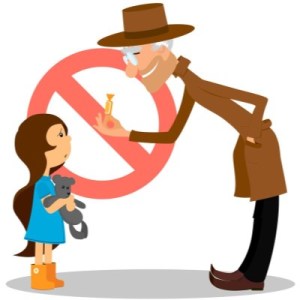
Parents worry. It’s part of being a parent. We worry about all the things that could possibly harm our children. We do all we can to protect them. Sometimes our efforts to keep them safe limit their opportunities to fully explore and experience their world.
How Parents’ Fears Impact Children:
One of the biggest fears amongst American parents is abduction. 72% of parents worry about abduction, 14% say it’s their biggest fear for their child. Parents believe that the risk is much higher than it used to be, when actually rates of child abduction have been steady for over 20 years.
Abduction is a rare risk. If you total up all the cases of ‘stereotypical kidnappings’ – where a stranger snatches a child and disappears with them – in a year it might be 105 children in the US (mostly teenage girls). We have almost 70 million children under age 18, so 105 cases means less than a 2 in 1 million chance. It is a tragedy for those families, but a rare tragedy.
Despite the unlikelihood of abduction, the fear stops parents from sending their kids outside to play. In one survey, 19% of parents never allow their child to play outside. In Great Britain, 49% said they limited their children’s outdoor play because of fears about “stranger danger”. (Source)
What do kids miss out on when we keep them inside? They miss out on a lot of what we think of when we say the words “happy childhood.” Running in the sprinklers, playing in the backyard, riding bikes around the neighborhood, climbing trees, playing tag….
Parents need to consider not just the potential risks of unsupervised time outdoors, but ALSO consider the risks of:
I encourage parents to teach safety skills to their children when they’re young, because that lays the foundation for them making smarter decisions as they grow older. When I teach a toddler how to carefully climb a small tree, I teach them how to be cautious, but I don’t convey fear, because I want them to have both the skills and the courage to climb bigger trees as they get older. In a similar way, I want to start teaching my child at a young age how to stay safe around unsafe people. But I don’t want to create a universal fear of “strangers”. I want to teach what behaviors would show us that someone was a “tricky person” and how we would avoid interactions that put us at risk.
Why Not Teach Stranger Danger?
For decades, parents and educators have taught the idea of stranger danger. There are several flaws to this message:
- It creates a culture of fear. It can be frightening to a child to be out in public when they’ve been told that all the strangers around them are people to be feared.
- Talking about “bad people” means that our children are on the lookout for people who look and act evil: the mustache-twirling, black-clad villain. Most people who perpetrate crimes against children are nice looking and quite charming.
- Talking about “odd looking” or “dangerous looking” people or “people who don’t look like us” can lead to racial profiling and prejudiced attitudes.
- Creating fear of strangers might mean that our children are afraid to seek help from adults when needed – such as a lost child who is too frightened to approach a security guard to help find their parents, or a lost child who evades rescuers because they are strangers to him.
- Crimes against children are much more likely to be committed by someone the child knows than by a stranger.
- For child sexual abuse, only 10% of perpetrators are strangers, 60% are non-family members who are known to the child and family, 30% are family members. Source. In 23% of reported cases the perpetrator was under the age of 18. (Stats for Canada here.)
- For abduction, 90% of the kidnappers are family members. Source.
- If our children have been taught that strangers are always bad, but that the people they know are always “safe”, then we have not protected them.
I don’t want my children to be frightened of all the new people they encounter. I want my children, and the children I work with, to feel safe in their world. Children are happiest and learn best when they feel safe. I tell children, through my words, my body language, and my interactions, that the vast majority of people are good people. Even a stranger who looks very different from the people I interact with every day is most likely a good person.
But, when children are around three years old is a good time to start talking about “tricky people.” They’re not a certain kind of people (like strangers, or like people whose skin is a different color from my own) but they are any person who displays certain odd behaviors. Those behaviors should raise red flags for a child, and let them know they should check in with a trusted adult for advice on how to respond.
What are Tricky People?
Here are some things to tell your child to watch out for. Tricky people may:
- ask kids for help (such as help finding a lost puppy or pretending to be hurt). If safe grown-ups really need help, they’ll ask other grown-ups. If an adult asks them for help, they should go speak to a trusted adult.
- try to arrange for alone time with a child. Let your child know that it’s best to have two adults around them, or be with other kids and an adult. They should not go somewhere alone with one adult unless a trusted adult has told them it’s OK.
- Note: parents should be wary of someone who offers “too enthusiastically” to help out by doing things like free babysitting, car rides, or trips that put the child alone and unsupervised with that person, especially if they try to make the parent feel guilty for saying no to them
- try to make one particular kid feel special, lavishing praise and gifts. Tell your child that if someone offers to give them something (candy, money, a kitten), they should not take it, they should say that they need to ask their parents if that is OK.
- ask kids to do something that breaks the family rules, or just doesn’t feel right. Teach your child the idea of thumbs up or thumbs down – does the interaction feel perfectly fine to them (thumbs up) or does it give them an uncomfortable “uh-oh” feeling (thumbs down.) Encourage them to trust their instincts.
- ask kids to keep a secret from their parents or their teacher, or threatens something like “if you tell anyone, I won’t be your friend anymore” or “if you tell, you’ll be in big trouble”. Any time this happens, a child should tell their parent or a teacher.
- touches a child a lot (tickling, wrestling, asking for hugs), especially if they get angry or unhappy if the child says no to the touch
- touches a child in a private area, asks a child to touch their private areas, asks to see a child’s private areas, asks to take pictures of private area, or shows a child their private areas. For more on how to talk to your children about this topic, see below, or read my post on Touch, Consent and Bodily Autonomy.
- tells the child “there’s an emergency. You need to come with me right now.” Note: For children over 5, it can be a good idea to establish a password (see below).
How to Help Your Child be “Street Smart”
An article for kids on Kids Health describes street smart as “knowing how to keep yourself safe from strangers when you’re alone or with other kids. Whether you’re walking to school or to the bus, hanging out on the playground, or riding your bike in your neighborhood, being street smart helps you stay safe. When you’re street smart, you know your way around, you know how handle yourself in tough situations, and you’re able to “read” people.”
Here are some things we can do to help our kids be safe:
For a child age 1 and up
- Teach them their name and their parents’ name(s)
- Under three years old, I don’t talk about “tricky people” or “bad people.” But, if I am in a situation where I feel uncomfortable, I show it with my body language, and I tell my child “I don’t like being here… I don’t feel safe right now. We’re going to leave.” Even at this age, I want to start teaching them to trust their instincts.
- Tell them they need to stay near you when you’re out in public, set boundaries – tell them where it’s OK to go and what’s not OK. If they step outside those limits, or refuse to hold your hand in a parking lot, or whatever guidelines you have set, then there should be consequences (e.g. you need to leave the park, or you need to carry them in the parking lot.)
- When going anyplace where you might become separated, put your contact info somewhere on them (e.g. on a card in their pocket, on a bracelet, etc.). Also, take a picture of them that day with your phone so if you become separated you have a photo of what they look like and they are wearing.
- Teach healthy touch: high fives and fist bumps, patting on the back, brief hugs, etc. Don’t force your child to give a hug to someone if they are not comfortable.
- Teach them names for their body parts, including private parts. It is best to use commonly used terms (e.g. penis or vagina), not family euphemisms. Feeling comfortable with these words makes it possible for a child to explain if something inappropriate happens. (Learn more.)
- You should always know the basic description of your child at all ages, so if they are missing, you can tell searchers: how tall they are, how much they weigh, piercings, tattoos, birthmarks. Take good head and shoulder pictures at least every 6 months (every 3 months for young children.)
For a child age 3 and up
Everything listed above, plus:
- Be sure they know their address, parent’s names, and parent’s phone numbers.
- Help them know what adults you trust. Tell them: “if you ever feel scared or need help, then ____ and _____ are adults you can talk to.”
- Talk to them about how to find a trustworthy stranger if they somehow become separated from you and need help. You could teach to look for a police officer, but they’re rarely around. So, I also tell my children to look for a person who is working there – I help them identify workers – they’re standing behind the check-out counter, or they’re wearing a uniform. I also tell them they could go to another parent – someone who has a child with them. From time to time, we practice this – I ask my child to look around and identify two people who they could ask for help if needed. Also, point out “safe spots” – the places they are most likely to find helpful people.
- Talk to them about “tricky people” and what behaviors are red flags. Don’t try to cover it all in one big “talk” – it should be an on-going dialogue.
- If your child is uncomfortable around someone and wants to avoid that person, don’t dismiss this. Respect your child’s instincts.
- If you go somewhere you might get separated (the zoo, an amusement park, a large event), talk to them on the way there about the importance of staying close to you the whole time. Tell them that if they look around and can’t find you, they should stop where they are and you will find them.
- By the time they are three, teach them that the parts of their body that are covered by a swimsuit are private. They should be kept covered around other people, and other people should not touch them there, except for parents or caregivers who are briefly helping to clean them, or a doctor, when the parents are in the room.
- Don’t label your child’s clothes or backpacks with their name in big, visible letters. “Tricky” adults often use a child’s name to convince the child they are safe.
As your child gets older, and more independent:
Everything listed above, plus
- They should know contact info for multiple trusted adults, and have a plan for how they could contact them. (For a younger child who doesn’t have a cell phone, they should know how to seek adult help. For older kids with phones, they need plans for what to do if their phone battery dies.)
- If going someplace you may get separated, have a plan in advance for where you would meet up again. Make sure they can describe it to you, and from time to time, ask them “do you remember where our meet-up place is? Can you point to where it is?”
- A responsible adult should always know where they are. Set boundaries on where they can go, ask that they check in with you from time to time, and require that they check in if their plans change.
- In the places they frequent, they should be able to list “safe spots” where they could go for help if they were feeling worried – for example, if someone at the park was making them uncomfortable, they could go into the nearby convenience store. They should also know to avoid unsafe spots – isolated areas with no one around.
- They should know how and in what circumstances to call 9-1-1.
- They should know never to answer the door when they are home alone.
- They should know never to approach a stranger’s car. If someone calls them over to a car, they should not go.
- When out and about, they should use the buddy system, not go places alone.
- If someone offers them money, or an easy job, they should be wary.
- Consider a family password so that if you ever could need to send an unexpected adult to pick them up in case of emergency, your child could ask that adult for the password to be sure it’s really someone you sent. You could also use that code word or another one for your child to communicate to you “I’m feeling unsafe and I need your help.”
- Tell them to trust their instincts. If they’re worried about something, they should talk to you or another trusted adult who can help them problem-solve. If they’re very frightened, they should call 9-1-1 or shout for help. Tell them it is better to seek help and find out that everything is actually OK than it is to not seek help when things really are bad.
- Give kids examples of “tricky behavior”; have them describe how they would respond.
- Don’t talk about “bad touch” because sometimes sexual touch can feel good or can “tickle.” Instead, talk about “secret touch” that the other person wants you to hide from people, or touch that makes them feel wrong after it happened. Let children know that if anyone ever touches them in an inappropriate way (or makes the child touch them), that it’s not the child’s fault and they will not be in trouble with you. Perpetrators may first involve children by showing them pornography – let your child know that if someone shows them pornography, they should let you know.
- Explain that you’re teaching safety rules because they are more mature and ready to be responsible. You want to give them more freedom, but you also need to be reassured that they know how to stay safe.
Letting Your Children Out of Your Sight
Here’s an example of how this could play out: My six year old wanted to be able to sit on the front porch and read while I was inside making dinner. We set boundaries: “you can sit on the porch swing. You may not leave the porch or step onto the driveway or the path to the sidewalk.” We reminded him of tricky people ideas: “we have lots of people walk by the house. Remember, that most people are good people. If they say wave or say hi, you can say hi back. However, if they ask you to leave the porch, they’re being tricky and you need to come inside and get us. If they step off the sidewalk onto our driveway or path, you need to come in right away. Even if it’s someone you know from church or school, I would still want you to come inside and get me.” We let him know that as long as he could follow the rules, he could have porch-sitting privileges. But if he ever violated those rules, he would lose those privileges.
Deciding to let a child play outside unsupervised, or let an older child go places without you, requires a leap of faith on your part. It can be scary to take that risk. But remember that keeping them at home and in sight at all times also creates risks – it limits their potential to be active, independent, decision-making people.
Part of parenting is teaching our kids the skills they need to know so that later on, they don’t need us so much any more. This is just one of many things that we do to prepare them to be out in the world on their own.
Handouts: If you’re a parent educator who would like to share this information with families, I’ve created a 4 page handout and 2 page handout of this information.
Related Topics: Check out my posts on Better You Than YouTube – Having the Hard Conversations, Talking to Children about Sexuality; Talking to Children about Touch, Consent and Bodily Autonomy; and Talking about Scary Topics (e.g. violence, natural disasters, accidents, etc.)
More Resources



 . They are everything I hate in a toy. They’re cheap plastic, lots of clutter, gender biased, and encourage consumerism values not in alignment with mine. The slogan for Shopkins is “once you shop you just can’t stop.” But… we have lots of Shopkins. Why? Because he fell in love with them at pretty much exactly the same time as we introduced allowance and the idea of having saving money, gift money, and spending money. (Learn more about
  More Good Days with Kids