Category Archives: Fun Activities

Cheap Dates with Toddlers: Garage Sales

medium_7714209874(1)

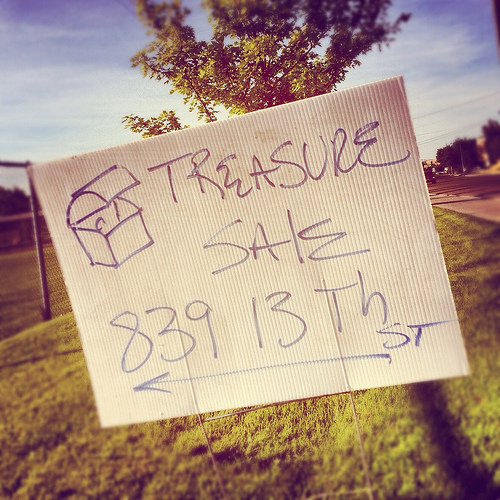
Any Friday or Saturday, drive around a residential neighborhood, and you’ll see the signs.

In winter, after my kids finish their scheduled activity, whether it’s dance class or coop preschool, I usually just want to go home when we’re done, back to a warm dry house. But in the spring time when the weather is beautiful, sometimes I just want to be out for a little while longer. Garage sales offer an easy opportunity.

I will pick a sign to follow, and see where we end up. We then walk around and look at things. Sometimes you have a total dud of a garage sale, when there’s nothing that appeals to anyone in the family. But, much more often, you’ll find something that you child thinks is a treasure. Once my daughter found a great tie-dyed jumper for $1.00 – it was a little big on her then, but it ended up becoming her favorite sun-dress not just that summer but for two or three summers to come. My son found a Japanese tea set he fell in love with. We found some great stuffed animals, some DVD’s, some books, a bike…

Now, I’m not a big fan of a lot of clutter in my life, so I’m always very clear that each child can pick out a MAXIMUM of one item. And sometimes we don’t find anything to bring home. Our approach was always that it’s more about the process than the product. It’s just interesting to see what things people are casting out of their lives. As my kids got older, it was interesting to pontificate on the family’s story. We would guess how old their kids were now based on what types of kid stuff they decided they’d outgrown. We found it sad when there was an older woman selling lots of men’s clothes and items, and wondered if her husband had recently passed. Sometimes we walked away wondering: why would anyone ever buy those items in the first place???

A garage sale is usually a quick outing – 15 minute or so, but often just a fun moment of serendipity in a day.

photo credit: Nomadic Lass via photopin cc

Cheap Dates with Toddlers: Nature “Shopping” and scavenger hunts

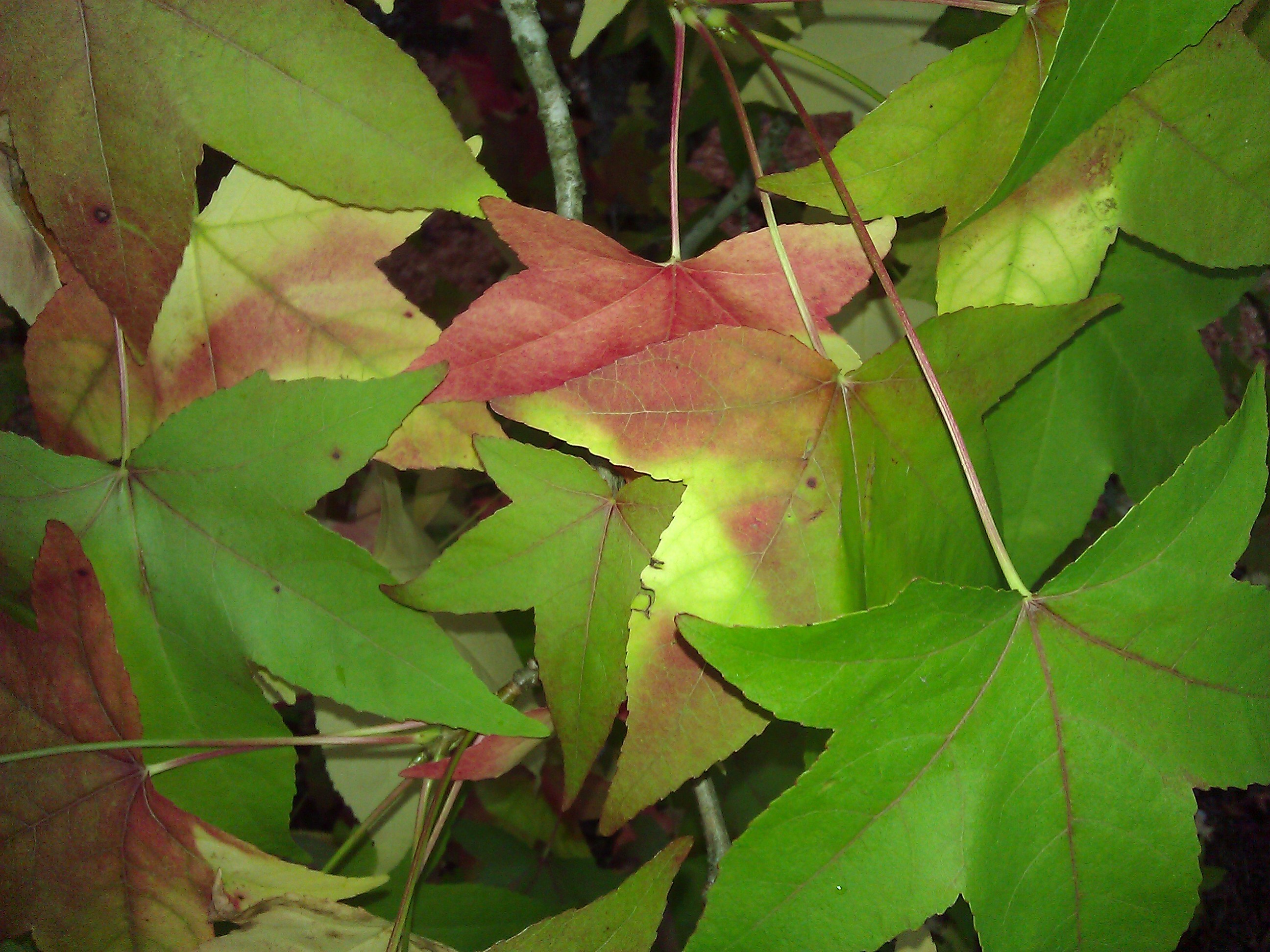
leaves

Are the long months of winter/spring/rainy season getting to you and your kids? Are your kids starting to make you crazy? Here’s a quote I love:

“If your kids are bouncing off the walls, remove the walls.”

Even if it’s pouring rain, you can still go out in nature. That’s what rain coats and boots are for! On especially rainy days, I like going for hikes in the woods, where the trees help to shelter you from the worst of the rain.

Try Nature “shopping”

Take your kids out in the woods, and let them make collections. They can gather rocks, or seashells, or autumn leaves, or pinecones. Whatever they choose. As you explore, let them gather as many as they want (you may even choose to bring along a bucket or bag for them to collect into.) Near the end of your hike, pick a sheltered spot to examine the collection. Talk about colors, sizes, shapes, textures. Compare and contrast them. Sort them into categories. (Not only is all this fun for kids, you’re also teaching some foundational skills for science learning here… did you know that many Nobel winning scientists talk about the time they spent exploring nature as a child as one of their fundamental learning experiences?)

When you’re done examining them all, tell your child they may choose one special item to take home, but that you will leave all the other items out in nature. Remind them that these things serve a homes for animals and are also there for other children to see and discover. [Note: it helps to tell your child at the beginning of the process that they will need to leave most of these items in the park at the end of your time there.]

Collecting photos

You could also tell your child that you want to collect photos to make a nature book with. Tell them that on your walk, they should point out to you anything they think is special, and you will take a picture of it. Later on, it’s easy to do some quick cut and pasting into a word document or whatever to make up a page with a collection of photos that you can print and post at home. (If your child wants to take the pictures, check out these tips.)

Note: if your child wants to collect bugs, this may be a way to satisfy them without letting them pick up and carry the bugs home!

Scavenger Hunts

For ages 3 and up, you can prepare a list of things you would expect to be able to see or hear or do on your outing. Bring stickers along and as you’re out on an adventure, any time you find one of the items on the list, your child can put a sticker on it. Then when the scavenger hunt is complete, you can have a snack together as a reward. Ideas for scavenger hunts (some borrowed from Teacher Ann at Tiny Treks… )

  • Things to listen for: crows, woodpeckers, running water, wind in the leaves, people’s voices in the distance
  • Things to look for: pinecones, mushrooms, ferns, moss, spider web, bugs
  • Things to do: balance on a log, jump off a log, splash in a puddle, throw a rock in a stream, build a ‘log house’ with sticks, make a circle of rocks

If you’re in the Pacific Northwest, I have a series of handouts about plants you’ll find in our woods, and a scavenger hunt where kids search for salal, Oregon grape and more. Find them all here.

I find that being inside with my toddler and trying to encourage him to use his inside voice and inside manners all the time can be exhausting. Letting him run outside and be as loud as he wants is such a relief. Both of us feel much better after our time outside.

There’s also lots of other great benefits to outdoor time.

Cheap Dates with Toddlers: Buses and Trains

wp_001450

If you use these all the time, they’re probably not that exciting for you or your child. However, if you don’t regularly use these, you can convince your child that a ride on public transit is almost as special as Disneyland!

Plan a short simple outing at non-peak travel times, and get a transfer when you board – you’ll be able to ride back out for the single fare.

You can choose to take transit to a special destination. (Even something as simple as a shopping center with an ice cream shop.) Or you can just go on a ride, focusing on enjoying the journey, not a destination.

Things to Do on the Trip:

  • Gaze out the window and talk about what you see.
  • Play I-Spy.
  • Do a scavenger hunt or travel bingo, looking for things like stop signs, blinking lights, and so on.
  • for older children who know their alphabet: first find an A (on a sign, license plate, etc.) then a B and so on. See if you can complete the alphabet.
  • Many transit stations feature public art – check it out!
  • This post covers the new light rail on Seattle’s Eastside and fun kid attractions along the way.

Here are lots of train related adventures in the Seattle area. #5 is the monorail, #6 is the Seattle streetcar, 7 is light rail, 8 is the Sounder.

Cheap Dates with Toddlers: Farm Parks

Spring is coming, and the baby animals are appearing at local farms.

A few years ago, I took this picture of a 2 week old calf  at Farrell-McWhirter. He was shorter than my 3 year old! (Sorry that it’s not a great picture… my son was really ready to go have snack, so we only got a really quick look at the calf… but wow he was cute!)

calf

At any time of year, toddlers love outings to meet farm animals. Lots of children’s books, games, and videos feature farm animals, so kids tend to be familiar with them, and get very excited when they can recognize and name the “real thing.” Seeing and hearing (and smelling) the animals in person make the idea much more real. At farm parks, you can check out chickens, sheep, bunnies, cows, pigs, and goats. Some times you’ll get an opportunity to see fresh eggs in the coop, or see a cow or goat being milked.  This is a great outing for a child who has just learned to answer all those vital questions like “What does a cow say?”

For my readers in the Seattle area… here are some free outings:

Farrell McWhirter Park in Redmond. When last I visited (it’s been a while), they had a small pot-bellied pig and a really big pig, bunnies, chickens, 2 goats, a calf and horses. Animals are on view 9 am to 4 pm.  It is not a petting zoon – you  can’t pet or feed the animals – just see them. They do offer farm classes and pony rides. You can register for programs here. Farrell McWhirter is also home to Nature Vision preschool. There are great hiking trails, streams, swings, and tire swings too.

Kelsey Creek Farm Park in Bellevue. They’ve got sheep, pigs, cows, goats, ponies, bunnies, and chickens. (Learn about their animals.) Again, they’re on view, but this is not a petting zoo and you can’t feed them. It’s free to visit – animals are on view every day from 9 am to 3 pm. They also offer horseback riding and farm classes, including a great program for toddlers called Little Farmers. They also have a nice playground and walking trails. Learn about farm tours and farm classes.

Sammamish Animal Sanctuary. They have alpaca, goats, mini horses, mini donkeys, llama, cows, pigs, sheep, chicken, ducks, bunnies and guinea pigs. For a small donation, you can purchase treats to feed the animals, or you can bring your own spinach or carrots. You do have to make reservations. It is free, but they encourage donations to support their work.

Farms with a Fee:

Red Barn Farm in Redmond. They do farm visits on Wednesdays – you need to reserve. Feed the animals and walk around the farm! Price is $25 per car up to 4 guests. Additional guests beyond 4 are $10 each children under 2 free. They have cats, chickens, dogs, donkeys, ducks, goats, pigs and rabbits. (See pictures.)

Fancy Farm in Fall City. By appointment only. (Check their Facebook page for availability.) $10 per person, or $20 for family for a one hour visit. They have emu, goats, pigs, horses, chickens and ducks. Pony ride for an additional fee. I believe they let you hold / pet the animals.

Remlinger Farms Fun Park in Carnation. Opens for the season on Mother’s Day. They haven’t announced 2023 fees yet – a few years ago, they were ~$20 per person (babies under 1 are free). They have horses, pigs, sheep, alpaca, goats,  rabbits and donkeys. They have pony rides for an additional fee. They also have some amusement park style rides, and a train ride. Plus a hay maze and a hay barn to play in.

Woodland Park Zoo in Seattle. Adults $27.00. Kids are $16.50. Under two years is free. By the south entrance, there’s the Family Farm area, which includes a petting zoo where kids can meet goats up close. There’s pigs, goats, sheep, cows, bunnies, chickens, and a donkey. Plus, of course, lots of more exotic animals.

When visiting  farm parks: remember bring a change of clothes and shoes for your child! They can get pretty muddy in any of these places. Please teach your children to be calm around animals and gentle. If you’re at a petting zoo, always remember that these are animals – if you stand behind a horse and spook it, you may get kicked. If you annoy a goat, you may get bit. If you stay calm and quiet around petting zoo animals, you’ll do fine.

Updated March 2023.
Easter Egg Hunts – They’re Not Just for Holidays Anymore

img_20160317_214040151

Kids love hunting for Easter eggs. Why limit the activity to just once a year?

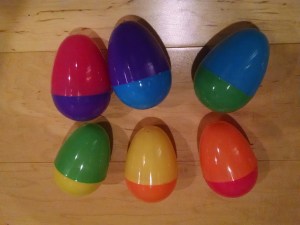
We have a ziplock bag full of 10 plastic eggs. Anytime he wants to, my son asks us to hide them all. We have him sit in a chair in one room while we go to the next room to hide them. I count as I hide each one – he knows he has to wait till I say 10, then he comes running to find them. As he puts each one back into the bag, we count it. He has a great time, and here are some of the things he is learning:

  • Delayed gratification – having to sit and wait for something fun teaches that good things come to those who wait.
  • Counting and math skills – as he finds them, we talk about “You’ve found 7 eggs. How many more do you still need to find?”
  • Observation skills – some of the eggs are very easy to find to build his confidence, some are much more difficult – challenging him to build his skills at observation, understand that things can be present but out of sight (under the towel, behind the clock, etc.)
  • Persistence – sticking to one task until it is complete.
  • Vocabulary – if he’s having a hard time finding something, we tell him to look “under” this, “behind” that, “next to” this, or “between” that. We also talk about what color each egg is, reinforcing his color vocabulary.
  • Prediction – as we hide things in the same room over and over he can guess where some likely hiding places are based on past experience. Of course, we also trick him by moving on to new locations.
  • Approximation skills – usually the last egg is somewhere really hard to find. We help him in his search by telling him when he’s getting “warmer” (closer to the egg) and “colder” (farther away). He’s had a hard time getting this concept and what it means for what direction to go, but he’s getting there.

Developmental note: My son is three years old – if I had a two year old, I might start with 5 eggs instead of 10. And “hiding” them would really mean leaving them in plain view scattered around the room. For older kids, hide more, and make them harder to find.

For more ideas for plastic eggs and other eggs, check out my eggs post on my Inventors of Tomorrow blog, which focuses on STEM activities for kids.

Check out lots of other easy, cheap, fun and education activities for toddlers: https://bellevuetoddlers.wordpress.com/category/child-development/play-and-fun-activities/