Maybe your child has tried out a sensory bin or a water table at a children’s museum, daycare, or a class, or maybe you’ve stumbled across sensory play ideas on Pinterest or Instagram or a Flisat table group on Facebook, and you want to try it out, but aren’t sure how to get started? Here’s a beginner’s guide.
Sensory play has a few basic components:
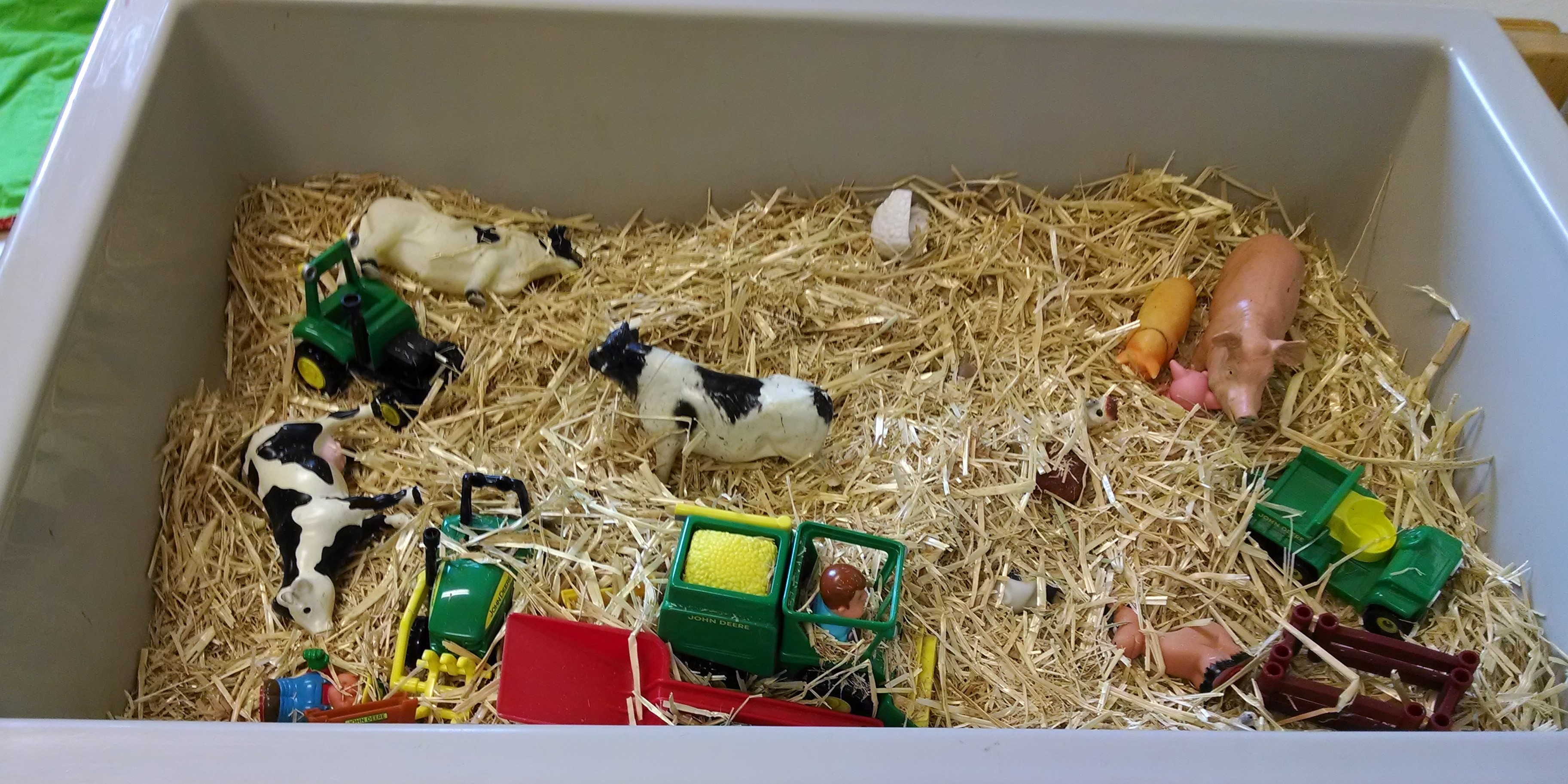
a bin – don’t feel like you have to start by buying a fancy table – it’s OK to start with water play in the sink or use a cake pan or a plastic storage tub
things to scoop and pour with – spoons and measuring cups work great, and tongs to pick up larger items
smaller containers to put in the bin – plastic cups and “tupperware” containers are good
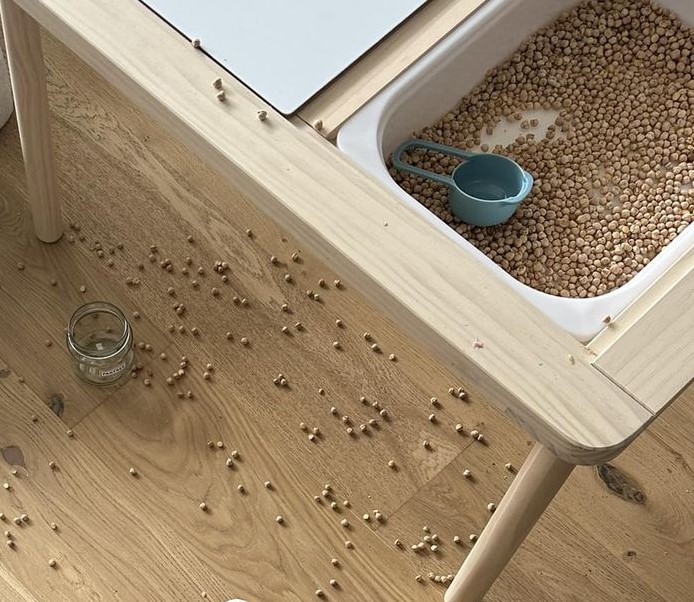
a sensory material – I would start with something that’s really easy to pick up: balls made of crumpled paper, pompoms or cotton balls, pasta (bowtie or rotini work well); rice is always a good option, but expect that it will get spilled across the floor!
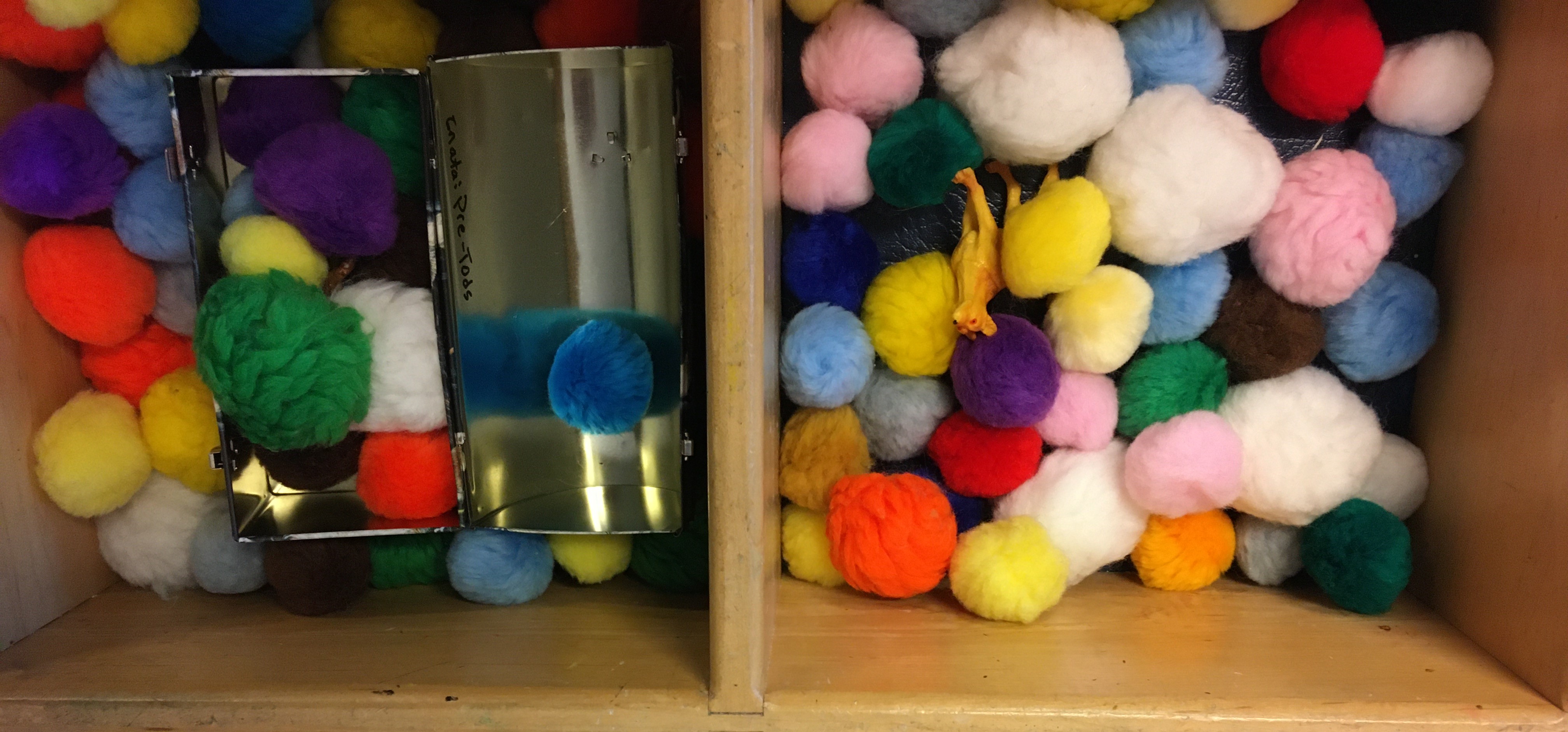
That’s all you really need to start with. Don’t feel like you have to create amazing Instagram-worthy wonders. Start simple! (For this post, I purposely picked photos of some really basic set-ups so you see how easy it is – like this one with pompoms, metal treasure box and some plastic animals.)
The first several times your child plays with it, sit alongside them, teaching them how to do sensory play – eventually this will be great independent play, but first they need you to teach them.
What do you do? It’s super simple – you scoop, you pour. You fill the container. You dump it out. You pick up a handful of rice and let it sift through your fingers. You stir. It’s OK if your child repeats the same actions hundreds of times. Sensory play is all about repetition. It can be a very soothing play activity while they’re also learning a lot about how to use their body and how to use tools to move things around. (Keys to brain development are: novelty, repetition, and down-time and sensory bins can bring all this.)
If you feel like you’re ready to liven it up a bit, the easiest way to add novelty is to take some of your children’s toys they already love and add them in so they can explore them in this new setting. (Filling a toy dump truck with rice, pouring rice over plastic animals, or hiding and finding puzzle pieces to assemble a puzzle with.)
Let them play as long as they want, and move on when they’re ready. They’ll come back to it again later. If they spilled materials on the floor, ask them to help with clean-up, even if they only clean up a few items, it’s a good practice to begin.
That’s it. That’s the basics.
Learn More
I’ve got lots more ideas on this blog which focuses on parenting skills, and my other blog Inventors of Tomorrow, which focuses on STEM learning.
This post is called Reducing Sensory Bin Mess, but it also talks a lot about how to teach your child appropriate ways to play with the bin.
Check out the Ultimate Guide to Sensory Bins to get LOTS more ideas about what sensory bins you could buy, what materials to fill them with (everything from flax seed to cloud dough), what tools to use (from water wheels to conveyor belts), and what add-ins to include (jingle bells? magnetic letters? seashells?). This post also talks about the benefits of sensory play for brain development.
Check out the Ultimate Guide to Water Tables to learn all about great options for enhancing water play. (Many of these ideas also work at bath time or in the swimming pool!)
Sensory Table Set-Ups shares lots of examples I found online and my observations about general lessons to learn from these ideas.
Looking for other simple, low cost ideas for what to do with a 1 – 4 year old child? Check out my Cheap Dates with Toddlers series.
When parents or teachers first introduce a child to sensory bin play, they usually make a big mess!
While some mess is inevitable, here are tips for reducing it.
Teach Them How Sensory Play Works
One of my core beliefs is that children want to do well. If they’re not behaving well, it’s usually because they don’t yet have the knowledge or skills they need. So, let’s teach them!
Play alongside
Over time, sensory play becomes a great independent play activity for children, where they can play with little supervision or intervention from adults for quite a while. However, first you have to teach them how to do it, and then gradually fade out your support. So, expect to be right next to them the first several sessions.
Role Model
I mostly just start playing appropriately next to them, and they quickly follow along! I narrate my play, and also narrate theirs. “Look, I’m scooping the beans – oh, you picked up the scoop – see how I use it? I can pour the beans in the bucket. Can you?”
Re-Direct
If they are doing something “wrong”, tell them the right thing to do. “Let’s keep the rice in the bin.” If they’re pouring on the floor, substitute a new target – “can you pour into this bucket?” Try to avoid saying “don’t _____”. If you say “don’t splash”, all they can think about is splashing. If you say “oh, look, when I move my hand slowly, see the ripples in the water?” they will often stop splashing.
Set Limits
Once they’ve learned how to do well in general, they may still have days when they’re having a hard time not making a mess. It’s OK to sometimes say “it looks like now is not the right time for this – let’s put it away / close it up for now, and we’ll try again tomorrow.” To be as fair as possible, I try this method: first when-then: “when you show me you can play well with this, then we can have it out more often.” Then if-then warning – “if you keep dumping things on the floor, then I’ll close the bin.” Then follow through on that consequence if needed.
Setting Up for Success
Fillers
Start with fillers that are easy to clean up. I use pompoms as the first material for my toddler class. Or paper crumpled into balls. Later, I might use pinto beans – they’re easy to sweep up. Other things are harder to clean up. For example, kinetic sand needs to be vacuumed up and can get ground into carpet, so it’s not the thing to start with.
When you start, put a small amount of sensory items in a small bin inside the large bin. If they spill outside the small bin, the large bin catches it!
Don’t use too much filler at first. Don’t feel like you have to have a 3 inch thick layer of sensory material. Start with a thin layer – they can always pile it all up in one corner if they want a deeper pile.
Remember that they will mix together any item that’s within easy reach of the bin. So, if there’s something you don’t want to be mixed in, move it elsewhere. (For example, we don’t recommend putting a bin of rice right next to the playdough table or water table.)
What Surface to Put the Table On
If possible, put sensory tables on linoleum or hardwood floors – it’s way easier to clean up than carpet!
Many parents and teachers do sensory tables outdoors where they are less concerned about mess.
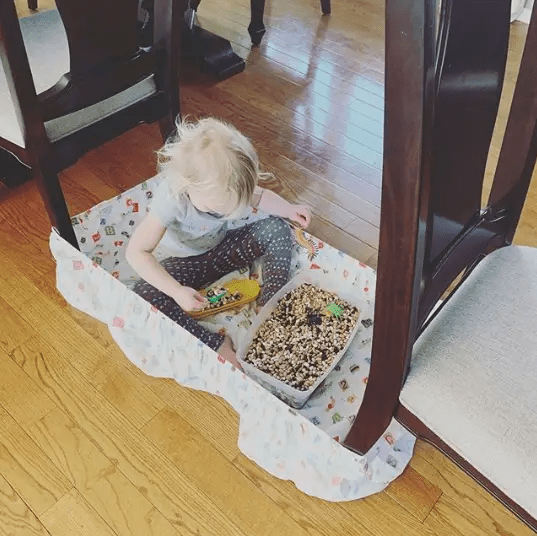
Many people recommend putting a mat under the table – like this mat where the edges can fold up to make a wall, or things like playpens and crafty pods and pop-up ball pits that help to contain the mess in one area where it doesn’t get tracked around. Some use fitted sheets – like in the image below (source) or shown here. Wrap the corners of the fitted sheet around some objects to create a little nest. Or use a table cloth or shower curtain liner. Sometimes you can salvage sensory material from any of these surfaces by lifting them up so the filler all slides to one corner and then scooping it from there.
One site recommended a “builders’ tray” that looks amazing, but the link is broken and I can’t find it anywhere… Amazon has a 20×20 play tray, or you could use an oil drip pan, maybe.
Allowing for Transport
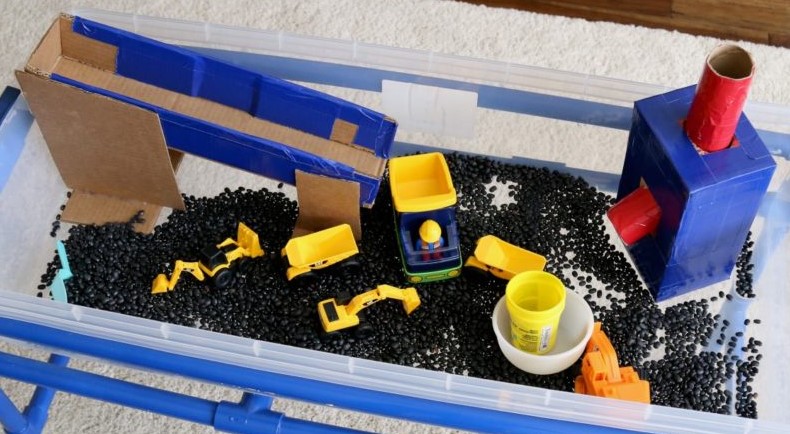
Kids LOVE to transport things. So, they often want to carry things from one place to another. Sometimes just having containers inside the bin, like having two buckets in the bin where they can move things from the bin to one bucket to the next is enough. Or setting up a cardboard box apparatus where there’s a higher spot in the sensory bin and a ramp for pouring things so they slide to the lower level, like these examples from Frugal Fun:
Or having a table right next to the sensory bin with containers on it they can move things into can work. But some kids like to have a separate bucket somewhere else they can carry things to – you can decide if that’s viable for you.
If they like the sound the beans make when they hit the floor, try putting a metal pie tin or hard plastic container upside down inside the sensory bin that they can pour onto to get the sound.
Helping with Clean Up
Ask your child to help with clean-up. You may choose to get them a mini broom and dustpan or a dust buster vacuum. (For some kids having to do clean-up is a disincentive – they don’t want to make a mess they’ll have to clean up later. Some kids like cleaning up the mess so much that they’ll make more of a mess!)
Remember, sensory play is a learning process, so they will accidentally (or intentionally) spill from time to time and there will be messes. Try to take a deep breath when it happens. If you’re having a day where you feel like the mess would be too stressful, it’s fine to close the sensory bin for the day and offer other activities.
Recently a parent asked me: “what’s the best first pet for my child?” She had grown up in a culture where most people didn’t own pets so had never had one herself. But she had found that pets are a big part of American culture. For example, a common question at school is “what kind of pet do you have?” Or teachers give assignments to describe your pet. She didn’t want her child to miss out, but didn’t know where to start.
I wrote another post on all the factors to consider when getting a first pet for your child. Some definitely take a lot more work than others! This post is just about my recommendation for a first pet – the betta fish (also known as a Siamese fighting fish.)
They are beautiful to look at. (And watching fish in an aquarium can reduce stress, blood pressure, and hyperactivity.) Betta fish will respond to you when you come to the tank, swimming up to you (unlike most other fish). Some bettas will learn tricks, like following a prop as you move it through the water. They’re also manageable for busy parents to care for, and low cost after the original investment. Betta fish are also good classroom pets for teachers to manage.
I’ll begin with a super-quick overview of how to get started. (I’ve included Amazon affiliate links, in case they’re helpful. I do get a small commission at no cost to you if you click on these and then purchase something.) Further down in the post, there are more details, and links to learn lots more. I am not an expert in this – I’m just a mom whose kids have owned betta fish and we made it work well.
Buying Supplies
Here’s what you’ll need that you can order online or get from Amazon. (Click here for the full list in one place.) It’s best if you get this all set-up and running for about week before getting your fish. (But it may be hard for children to be that patient.)
Yes, there’s a fair amount of start-up costs. That adds up to about $170. (Plus the fish will be ~$10 – 15.) But once you’ve got that, you’re almost done with costs. The food lasts for months, as does a container of water conditioner. The snail and moss balls may last as long as your fish does. (A few years.)
Choosing your Betta
Betta are beautiful, but there’s more to check for than just looks.
At the store, when you move your face or finger up toward the fish’s bowl, does it respond? Healthy betta fish will swim up to investigate when you come near. Some may flare at you aggressively. (In the picture below, you can see the flared out gills as this fighting fish tries to show you how tough he is.) Our first two betta were friendly and inquisitve when we came near. Our third was definitely a tough guy with lots of machismo.
How does the fish look? Healthy betta have bright colors and undamaged fins. Signs that a betta might not be healthy: lethargic, uneaten food in tank, dull coloring, tattered fins, white growns on body, and labored breathing.
Male betta fish have longer and fuller fins and tails.
You generally only want to buy one betta: Bettas are solitary pets – never put two males together in a tank – they will fight till one is injured or dead. Also don’t put a male and a female in the same tank – males are too aggressive. (You could keep a few female bettas together in a larger tank.)
You may see suggestions that you can keep a betta in a very small container (like a big margarita glass) with no pump. That is not a humane way to keep one and they won’t live long like that. (You could live in a closet, but it wouldn’t be a happy life, right?) A 2.5 – 5 gallon tank is best.
This is the tank I had – we bought it at Petco and it’s still in good condition after 5 years. However, the pump creates a strong current. The same company offers this betta tank that has a more betta friendly pump.
The tank must have a lid! Our first betta fish was a jumper. Once I came into my daughter’s room and found something on the floor that looked like a feather – I realized it was a dried out betta fish! I scooped it up and put it back in the tank in time, luckily.
Don’t fill the tank to the very top. Betta originally lived in puddle-like still water (streams and rice paddies), and need to be able to go to the water’s surface to gulp air. (Betta can get oxygen from the air as well as from water via their gills.) Because of this, they don’t need an aerator in the tank.
Heater
Keep the water heated to between 76F (24C) and 82F (27C). Betta are tropical fish, native to Thailand, Vietnam, Laos and Cambodia. In cooler water, they become sluggish and sickly and can’t digest food well. (If your tank doesn’t come with a heater, be sure to buy one.) Don’t put your tank right next to a furnace vent or air conditioner which could have a strong effect on the water temperature.
Filter
Filters reduce harmful bacteria while supporting healthy bacteria, and make it easier to keep the tank clean. The one that came with my tank had a very strong current, which is hard on bettas who evolved in very slow moving waters. So, I only ran it for an hour a day. If your tank didn’t come with a filter, Fish Girl recommends choosing a sponge filter. (Learn about sponge filters.)
Light
Betta like light in the daytime and dark at night. You can put them in a place where they get natural light, but not in bright direct sunshine, which can overheat their tank. They look prettier and it’s easier to see them if you have a bright aquarium light you turn on, but I found that if I left the light on for more than an hour or two a day I got a lot of algae growth I had to deal with cleaning.
Tank Set-Up Needs
Sand or gravel – you’ll need about 1.5 pounds for each gallon of water to end up with 1-2 inches of substrate.
Accessories / decor for the betta to hide in / behind: Bettas don’t like to feel exposed, so make sure you have things for them to hide in / behind. Some like to rest on things near the surface of the water, so include some of those in your decor. Choose silk plants rather than plastic, and check all accessories for sharp edges – if it would snag pantyhose, it could harm the betta’s delicate fins. File sharp edges if needed.
Water conditioner. When you set up the tank, or replenish the water, you’ll need water conditioner. It neutralizes harmful chlorine, chloramines, ammonia and heavy metals in aquarium water. The pH of the water should be between 6 and 8 and the hardness between 5 and 35 dGH. Ammonia should be 0 ppm, nitrates < 40 ppm and nitrite 0 ppm. If your tap water comes from a municipal source, you may be able to find test results online for initial set-up. You can get test strips to evaluate your water over time. Do not use distilled water. It is lacking vital minerals.
Moss balls help remove nitrogen and phosphate from the water, and reduce algae by competing with algae for nutrients. (Learn more)
A nerite snail helps to clean the tank. Watching it slowly cruise around the tank adds interest. (Our son said the fish was his pet, and the snail was the fish’s pet.) Learn more about snails. It is better to get the snail before the fish, as sometimes when you introduce a snail into a betta’s existing habitat, it views the snail as an intruder and harasses / attacks it.
Food
We used Betta Bio-Gold pellets. We fed 8 – 10 in the morning, 8 – 10 in the evening. One .7 ounce container lasted more than a year. (FWIW, one guide says to feed 2-4 pellets twice a day. We fed double that and our fish lived for over two years…)
Choose a pellet food with fish as the first ingredient, and protein >38%. Don’t use flakes – they can cause bloating. You can give frozen bloodworms or brine shrimp for treats (thaw them before feeding).
For vacations, fish can go 2 or 3 days without food. When we were gone for a week, we used Pro-Balance vacation feeders. You do need to clean the tank of the residue when you return. When we were gone two weeks, we had someone come in to put in a new feeder on day 8. Our fish didn’t do well after that two week vacation. I might try the Marina buffet blocks. Or learn more here about vacation needs.
Maintenance
For a 5 gallon tank, it’s recommended that once a week or every other week you do a 25% water change. That means removing part of the water (not all) and replacing it with new conditioned water (use water at about the same temperature as the tank). Doing a partial water change helps to reduce the ammonia in the tank, but is less of a shock to the fish than a 100% change.
Once every 3 – 6 weeks, do a full clean and 100% water change. Clean the gravel (put it in a strainer and rinse it) and the silk plants and accessories (scrub and rinse with water, no soap.) More info on cleaning the tank.
There have definitely been times that I was not an ideal pet owner, and I went a lot longer between water changes and tank cleanings than this, and the fish survived. But these are the recommendations.
Note: a fish tank is an eco-system and it can get out of balance – for example, you can have a severe overgrowth of algae where the tank is filled with green gook. The balance I describe here is what worked for us: the moss balls, the snail, only turning on the tank light for an hour or two every day. If I started to see algae growth, I used the tank light less (note, the tank was in a corner of our kitchen counter so there was plenty of sunlight and artificial light in the room, just not direct into the tank.)
Note: If you see a lot of bubbles on the surface of the water, that means your fish is happy! He’s made a bubble nest in hopes of attracting a mate.
Lifespan
Some guides say they can live up to 10 years with proper care, but most pet ownership guides say 2 – 4 years. The three bettas my family has owned each lived 2 – 3 years. I believe that when you take a living creature into your life, you are committing to care for it for its natural lifespan, so I would encourage you to only get a betta if you are open to the idea of having it for 4 years or so.
Helping Your Child Be a Successful Pet Owner
It’s great if your child can take on much of the work of pet care! It’s a great way to learn responsibility. However, you as the adult are ultimately responsible for the well-being of this living creatue you have brought into your home.
I recommend writing up a checklist to keep next to the tank. Or use a calendar. Either way they make a checkmark when they feed the fish breakfast and again when they feed it dinner. That lets you keep an eye on whether or not the fish is getting fed. Also create another system for remembering to clean the tank or rotate the water.
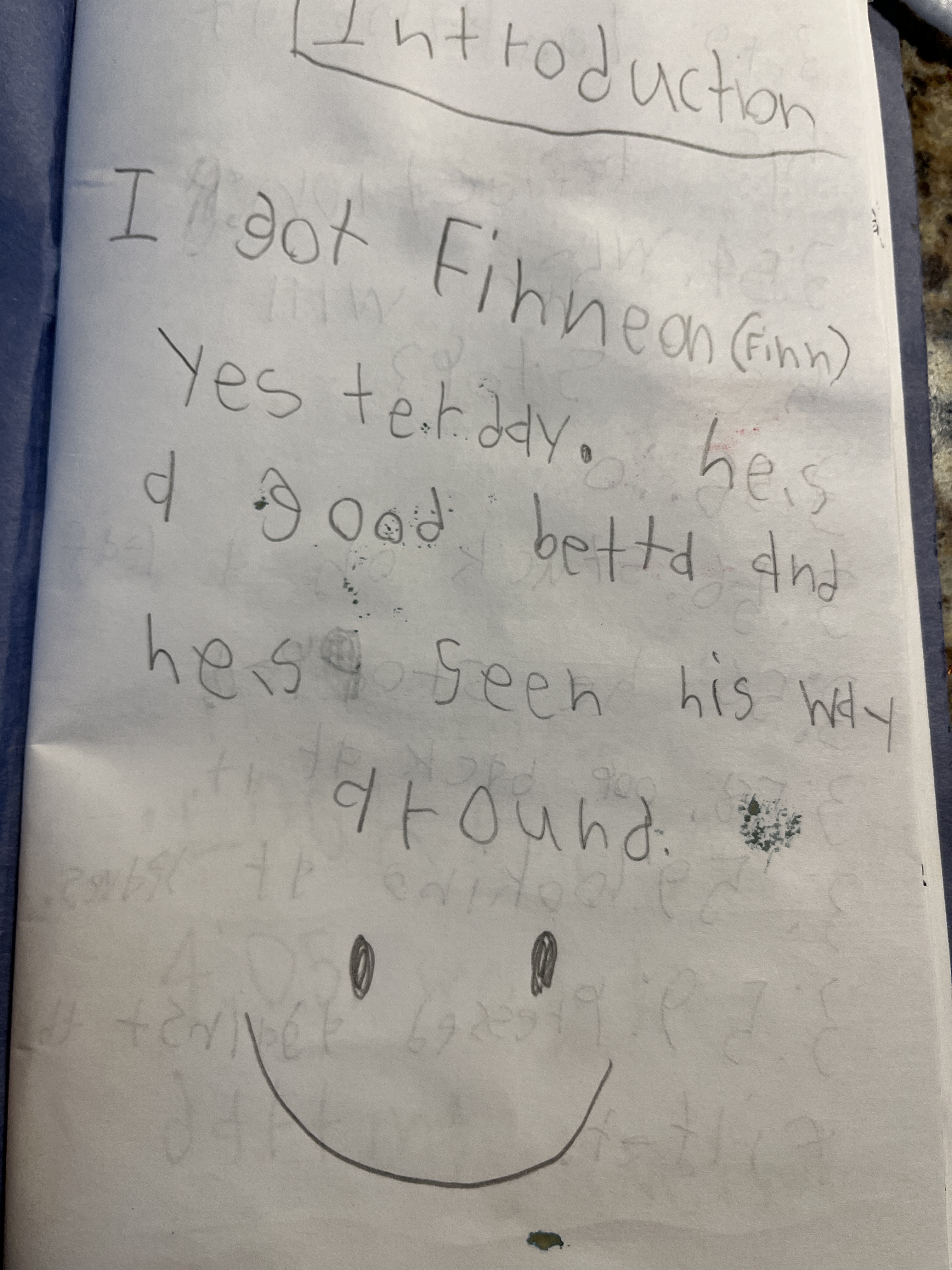
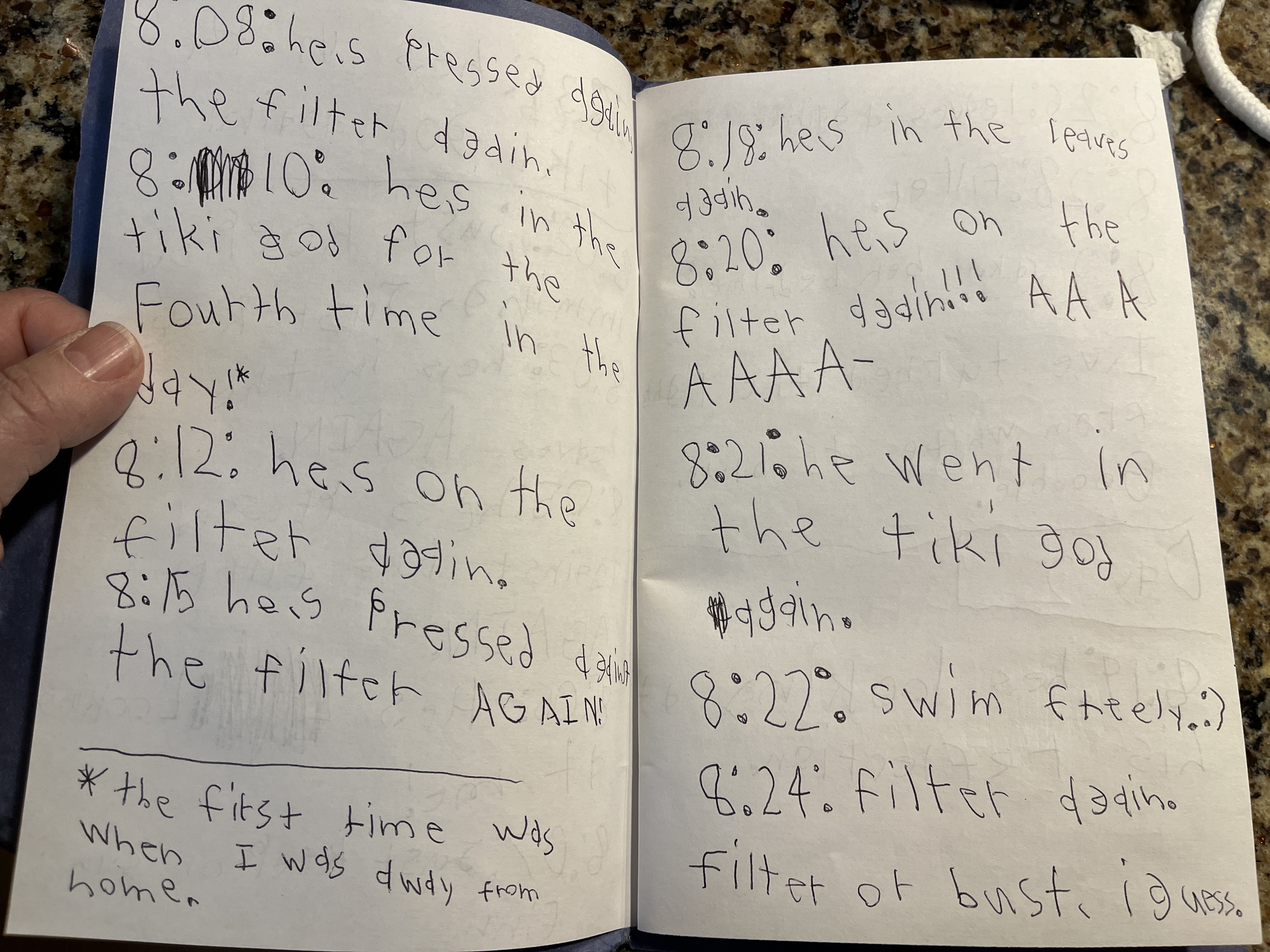
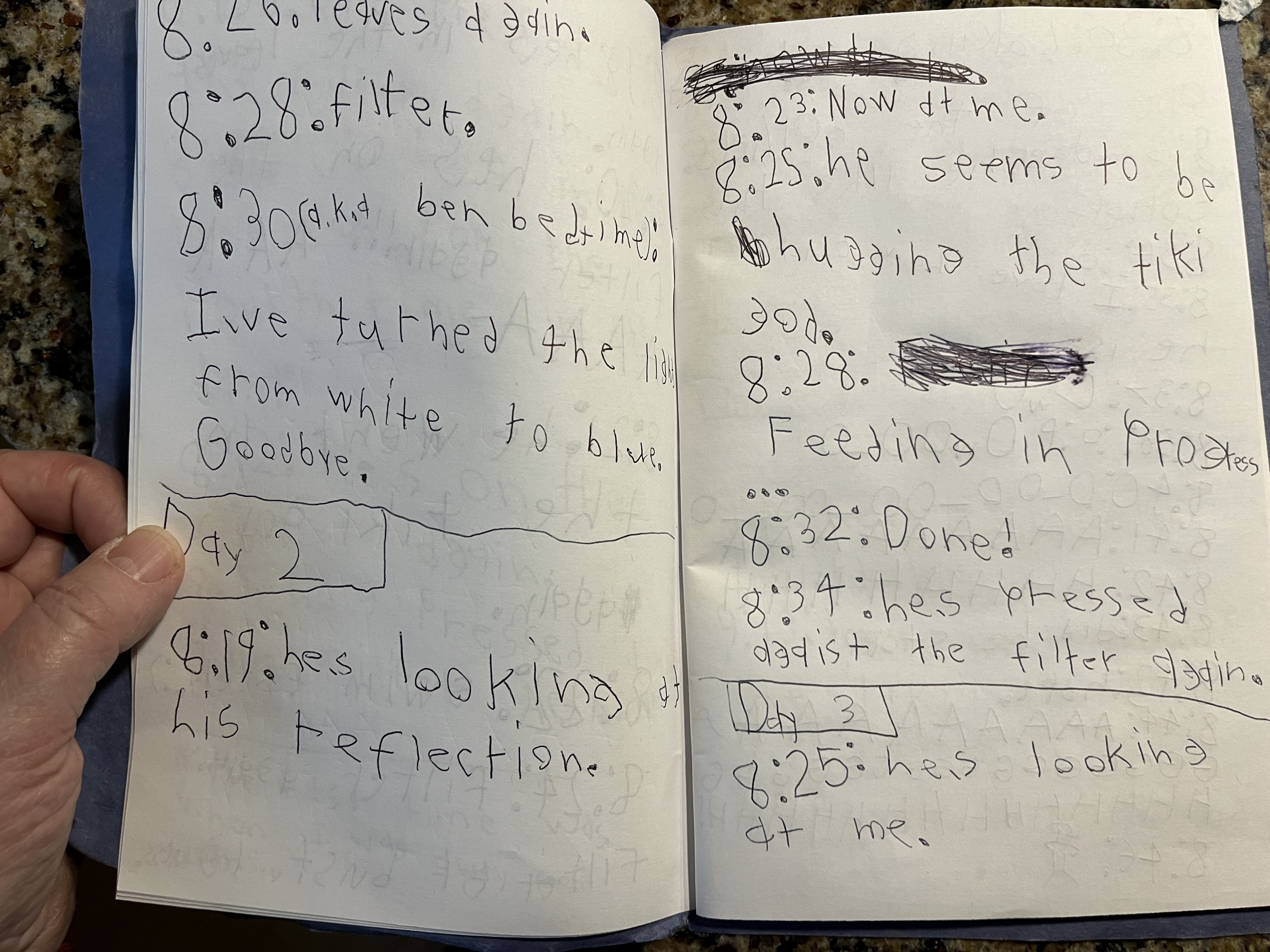
You can also encourage your child to find other ways to connect with the animal. Here are some pictures from my son’s “betta log book” and his initial experience with his first pet.
vacation issues – if you go away for a weekend or a week, what needs will the pet have?
lifespan cost and effort: how long will the pet live? how much effort / cost does it take to keep the animal fed? what health care costs might you face?
annoyance factor: does the pet create lots of noise or unpleasant odors or does it make messes that must be cleaned? Is it nocturnal? what about allergies?
reward: what joys can be found in owning this pet?
I know a lot of people start by thinking about the rewards of pet ownership – they imagine how fun it will be to play with their puppy, or snuggle their kitten, or watch the hamster roll around in its ball. Those are all joyful experiences, but owning a pet is also a lot of work and responsibility and there are plenty of non-joyful aspects.
When I was a kid, I volunteered at a local animal shelter. I saw so many good animals relinquished – some of which went on to other homes but many that were euthanized. Sometimes pets were relinquished because their owner’s life circumstances changed in unexpected ways and they weren’t able to continue to care for the animal, but more often they decided they just didn’t want to.
I believe quite strongly that when you take a pet into your life, you are committing to that animal’s health and well-being for its natural lifespan, so it’s important to think carefully before taking on that commitment.
Who Makes the Decision?
If your child is asking for a pet, remember it’s really going to be the parent who ends up being mostly responsible for the pet. Tweens and teens may be more responsible than younger children, but will still need lots of support. So, the adult has final say. If there are multiple adults in the household, they need to talk it through and be sure they are in agreement about the pet and about who will be responsible for which aspects of pet ownership.
So, if my child asks for a pet, I first need to decide whether I’m willing to consider it at all. If I am, then I make my children do all the needed research. If they want a pet, I go through the topics covered in this article with them, and I tell them they have to know the answer to those questions before I will consider the pet, and we have to have a care plan for the pet before bringing it home.
Start-Up Costs
Part of the research is learning about ALL the things you’ll need for the animal. We tend to only think of a few of the supplies at first, then they start adding up. Consider:
cost of the animal itself (note: where possible, please consider adopting a pet from an animal shelter or rescue facility rather than buying a new pet from a store or a breeder. There are many great animals who need a new home! Adoption is also often cheaper than purchasing.)
where they’ll live / sleep: an aquarium? hutch? bird cage? dog crate? pillows to sleep on? What other things are needed to make that the appropriate habitat for them: a light? a heat lamp? a pump? a heater? places to hide?
what are their toileting needs? will you need poop bags? litter box? do you need bedding (e.g. cedar shavings in a rodent cage)
what feeding supplies do you need? food dish? water bottle?
what toys and accessories will you buy to enhance the fun of pet ownership? chew toys? costumes? hamster ball?
any needed medical care: vaccinations? spay / neuter?
for dogs and cats, there might also be licensing fees, pet deposits at an apartment, and so on
Effort – Regular Care and Maintenance
What will you need to do every day to care for your pet? What else will need to happen on a regular basis (like once a week, or once a month)?
Feeding: how much time, effort and clean-up does feeding entail?
Obtaining food: how often will you need to go to the store to buy food – can you get food at any grocery store or do you have to go to a specialty pet store?
Toileting / Hygeine: letting a dog out or taking it for a walk several times a day? changing a litter box? cleaning shavings? cleaning a tank? What supplies will you need and what are the on-going costs?
Cleaning up after your pet: if you have a pet that roams the house, even if they are housebroken, there may be times you need to clean up feces or urine. They may also chew shoes, scratch up furniture and so on. Birds are known for scattering feathers, poop, seeds and more around their cages.
Dog Walkers, Day Care and Vacation
How many hours can your pet be left alone? How will that work around your daily schedule of work, school, and children’s activities? Will you need a dog walker? Doggy day care?
How many days can they be left alone? What care will they need while you’re away on a vacation? How easy will it be to find someone to provide that care? How much will it cost?
Some people take their pets along on vacations – if you plan to do so, how will that limit your options for where you can stay and what you can do on your trip?
Lifespan Cost and Effort
In choosing a pet, it’s essential to be aware of their expected lifespan, so you can decide whether you want to commit to the cost and effort for that full time period.
In addition to the effort and costs above, what are some other things to consider? If you’re getting a dog, will there need to be a lot of upfront effort in obedience training? With any pet, as they get older, health issues may cause complications (e.g. incontinent cats, arthritic dogs who can no longer climb stairs.)
Consider vet costs, and how you’ll handle them. I will be honest with you that as much as I’m committed to caring for a pet as well as I can for its lifespan, when our betta fish was ailing, I was researching what I could do – articles talked about taking him to a vet. Buying a new betta costs $15 – I don’t know what a vet visit costs, but I chose instead to provide hospice care at home – keeping him as comfortable as I could for his final days.
For my dogs, of course I took them to the vet and provided all needed basic medical care. But had they developed a complex condition that would have taken thousands of dollars to treat, I would not have done so. If I had that money to spend on pet well-being, it would make more sense to me to donate to a local animal shelter or spay-neuter program which would benefit many more animals.
Your ethical stance on this may be different than mine, but you should think about what it is before you have a pet and before you face decisions about their medical care.
Annoyance Factor
Pets can have behaviors that are normal and natural for them but can be troublesome for humans. Before purchasing / adopting a pet, do some searching online to learn more or ask people you know who own that animal.
Some examples:
dogs bark – some breeds bark a lot more than others
cats jump on kitchen counters; cats mark – spraying urine on vertical surfaces
birds chirp and squawk – often early in the morning
rodents smell bad
although geckos are silent, the crickets that they eat chirp a lot (especially the big ones)
many popular pets (e.g. hamsters, mice, hedgehogs) are nocturnal animals which means they may be asleep all the hours that your child is awake, and may be squeaking, scratching and disruptive at night
fish tanks can get very overgrown with algae if you’re not careful.
There are options for mitigating each of these annoyances, but they are part of pet ownership to consider.
Another issue: are there pet allergies in the household? Allergies to cats and rodents are pretty common, and dog allergies are not unusual (though some dogs are hypo-allergenic.) If you’re not sure if there are allergies, try spending time with an animal before committing – for example, if you’re considering a rodent, perhaps you could offer to pet-sit a rodent for someone who is going on vacation – having it in your home for a week would help you know what you’re getting into.
Reward?
What are the best parts of owning any particular type of pet? Again, search online to learn more and ask people you know who own that type of pet.
Think about what reward you most want and what pet most fulfills that. Some examples:
something pretty / interesting / relaxing to look at in exchange for a fairly low level of care? Fish. Some reptiles. Some birds.
something more active but that is mostly confined to its cage? rodents, some reptiles
a manageable way for your child to practice responsibility? Fish, reptiles, some rodents.
something to cuddle? Some cats, most dogs, some rabbits.
something to get you out in the world and engaging with others? Dogs.
If you’re considering a cat, realize that they can have very different temperaments – some are social, some shy, some playful, some grumpy, some cuddly, some avoidant.
If you’re considering a dog, please realize that different breeds have very different traits – if you want a guard dog, or a dog that plays fetch, or a dog that lies to quietly snuggle, do your research to figure out what breeds match that. Don’t just pick based on appearances.
What’s Best for Your Family?
You can evaluate all the info above and take into account your own goals, limitations, and priorities and make the best decision for your family. I can share just a few examples from my experience.
Dogs
For the first 50+ years of my life, I owned at least one dog. I don’t at the moment. Because my past three dogs have each lived 15 – 17 years. That’s a lot of joy and love, and the dogs were a huge part of our family life and memories. But that was also a lot of dog walking, paying for boarding when vacationing, scooping poop, paying vet bills, not being out of the house for more than 8 or so hours at a time, and so on. It’s more than I’m willling to take on right now.
On the other hand, I know someone who has a dog who is a sweet but needy, anxious little dog who needs a lot from her. He worships the ground she walks on and is very sad when she’s away at work or elsewhere. She likes having him to care for because having to stay calm and reassuring for the dog helps to distract her from her own worries.
Rodents (and snakes)
When I was a young kid, we got 2 pet gerbils. One was sweet and cuddly. The other was mean and bit. To my memory, they were pretty good pets overall, until my brother’s friend took the mean one out of his cage and the gerbil bit him and the kid dropped it. I think it was a few days before we were able to find the gerbil in the pantry and get it back into the cage. (This is why you should have the rule of “you can only take the animal out of the cage when there is adult supervision.”)
In college, my room-mate had a corn snake, which was an easy room-mate. Quiet, non-obtrusive, easy to watch or easy to ignore. It only needed fed once a week – it ate pinkie mice. (Brand new baby mice, so young they didn’t have fur yet.) My room-mate wanted to save herself a trip to the store, so one week she bought two pinkies. The snake ate one, and was too full to eat the other. So the mouse just lived in the snake cage for a week… and it turns out that snakes are so stupid that once a mouse has been there for a while, they stop noticing it. So, I ended up taking pity on the terrified mouse and getting it out of the snake cage and getting a mouse cage and suddenly I had a pet mouse.
I had him for about six months. He was a little loud and stinky for an ideal dorm pet, and did need weekly cage cleanings. But it was manageable.
Reptiles
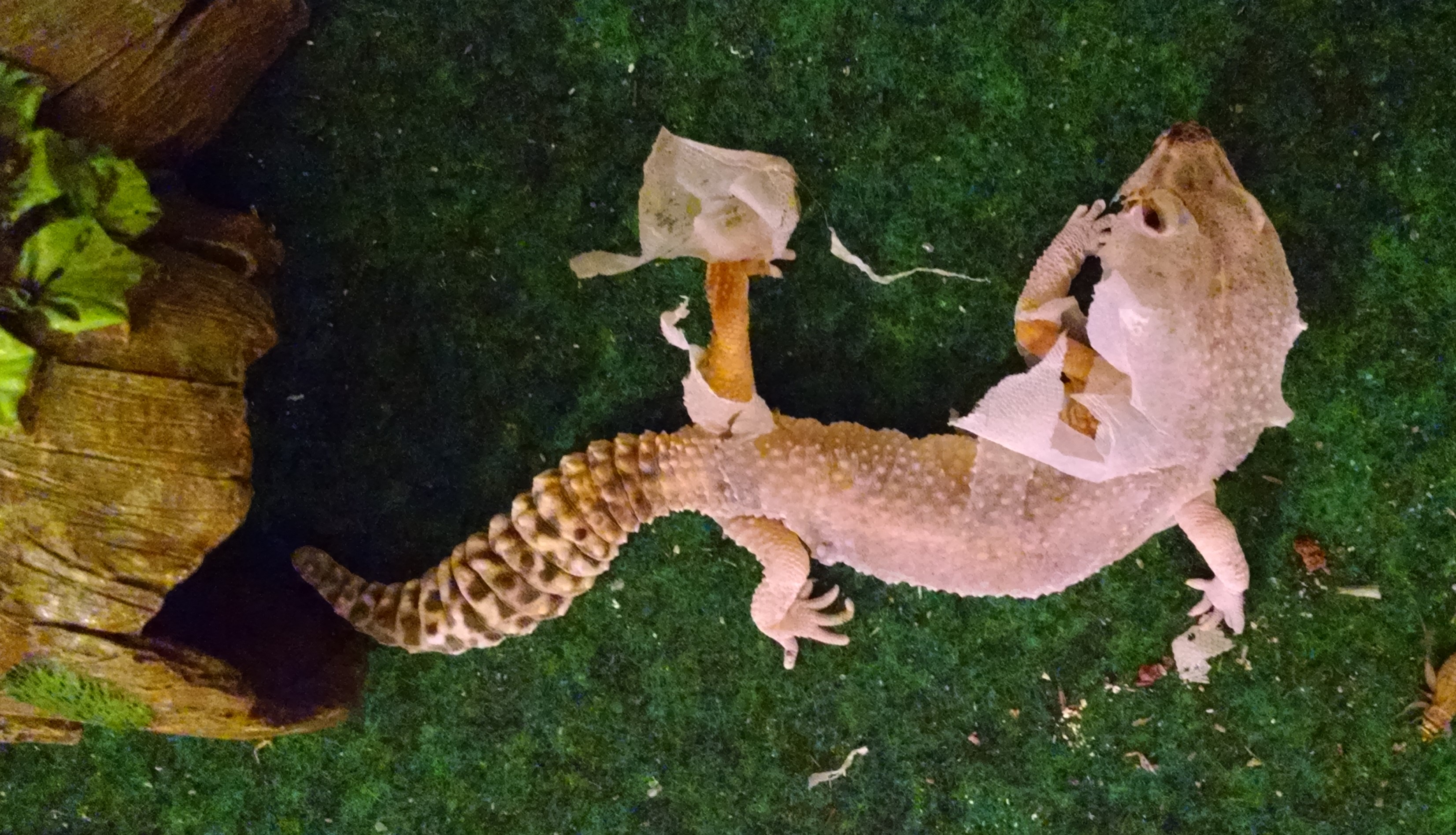
When my daughter was in middle school, she wanted a leopard gecko. (The gecko she got is shown in the picture above, where she’s shedding her outgrown skin.)
My daughter did all the research, took on all the responsibility and so on. The only thing I had to do was drive to the petstore every ten days to buy crickets. In general, the gecko was a very easy pet who provided some entertainment when you wanted it but didn’t care if were busy and paid no attention other than daily feedings.
I swear my daughter told me that the lifespan of a gecko was 3 to 7 years, and that’s what I thought I agreed to. She swears she told me 10 – 15. In the end, her gecko lived to 10. That means that when my daughter went off to college 1000 miles away, guess who took over care of the gecko? And what else did that mean? It means in the end, I drove to the petstore every 10 days for 10 years straight.
Fish
My daughter also had a betta fish for a few years. My youngest has had two betta fish – each lived for about 2.5 years. In that time, the effort was feeding it twice a day and cleaning the tank once a month. And going to the pet store for supplies a handful of times over those 5 years. For my son (who has ADHD), it was a manageable level of responsibility, and the family had the relaxing vibe of a fish and a snail hanging out in their aquarium on the counter.
What’s Best?
Were the dogs a more rewarding pet than the fish? Yes, of course, by far. But, at different times in the life of your family, you may make different tradeoffs between reward and effort. There’s no one right answer, but making an informed choice is important.
Learning More
Whatever pet you’re considering, it’s easy to do lots of online research to answer all the questions I’ve offered here. Do look at multiple sources, and be aware of their biases. (For example, a pet store that wants to sell you a pet and supplies may have a motivation to convince you that pet ownership is easy-peasy.)
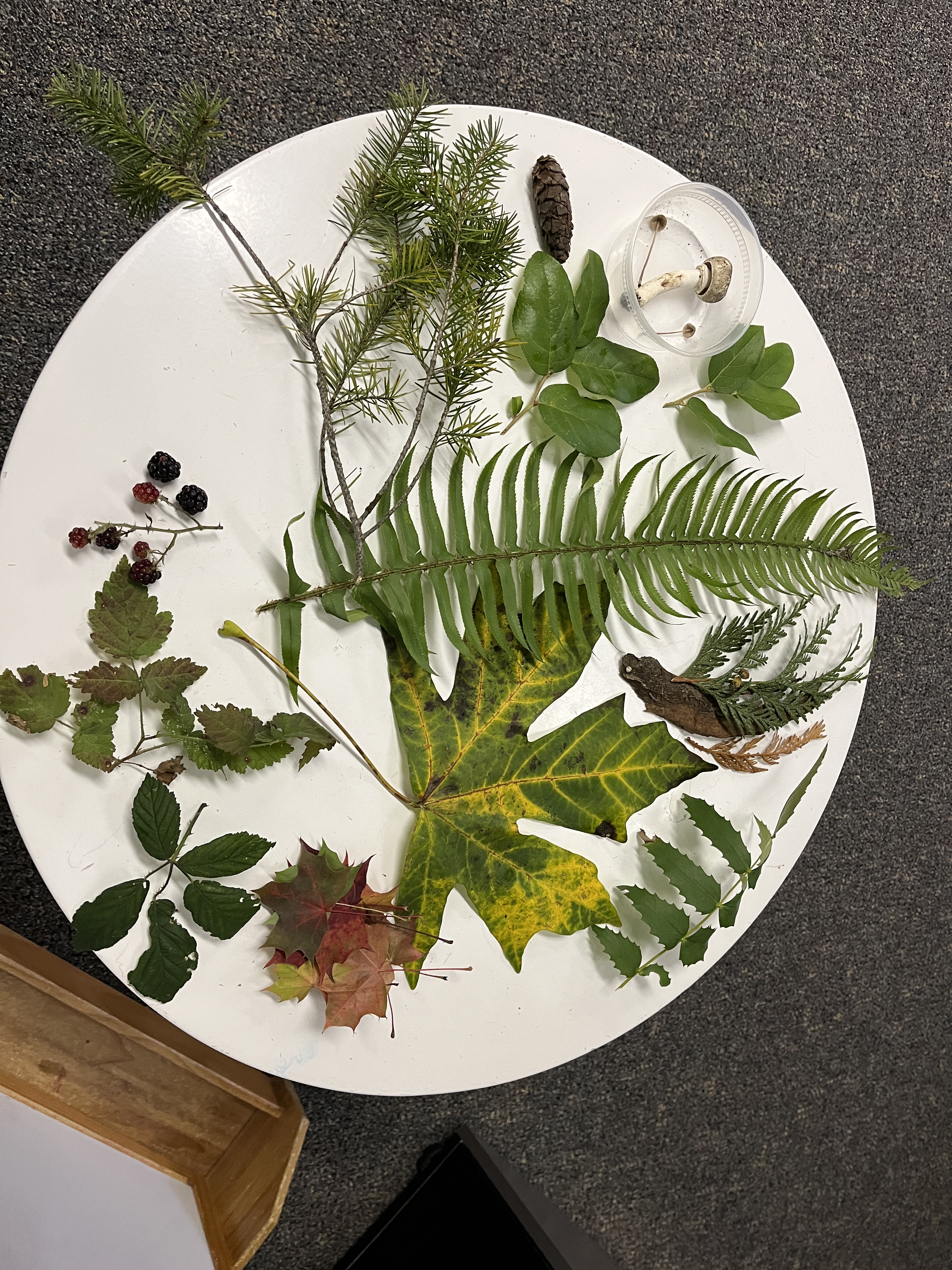
This movement song is set to the tune of Aram Sam Sam*. It’s a great way to remember some of the most common plants that we see on our preschool nature hikes in the Pacific Northwest.
Lyrics
A Douglas Fir, A Douglas Fir. A tiny little mushroom and a Douglas Fir.
Salal, and Sword Ferns. A tiny little mushroom and a Douglas Fir.
A Red Cedar, A Red Cedar. Some Oregon Grape and a Red Cedar.
Big Leaf Maple. Blackberries. Some Oregon Grape and a Red Cedar
Movements
For Douglas Fir, raise your hands high above you to help children remember that Dougs have very tall trunks and branches up high.
For “a tiny little mushroom” – if they’re standing up, they can squat down and cover their head with their hands. If they’re sitting, they use two fingers to show something that’s really tiny
Salal – touch your thumbs together and touch your index fingers together to make a salal leaf shape.
Sword Fern – pretend to wield a sword
For Red Cedar, spread your arms out to your sides, with the palms down low to show the low branches of a red cedar.
For Oregon grape, use your fingers to draw a serrated leaf shape.
Big Leaf Maple, hold one hand up with the fingers spread to indicate the 5 points on a maple leaf.
The furthest I can trace this idea back is that my local library, KCLS, published a video in 2015 that credits “Story Time Idea Machine blog (2010) by Cherie Rainwater.” I found it on Jbrary. I added salal to the song, and added the full second verse.
Alternate Verses
Verses for a visit to a tidepool:
A hermit crab, A hermit crab, [scuttle hands] a tiny little barnacle [stick hand to shoulder], anemone [wiggle fingers]. Some starfish [spread hands to make stars] and jellyfish. [pulse arms like swimming tentacles] A tiny little barnacle, anemone.
A geoduck, a geoduck, [one arm makes shell, the other makes the “foot”] some slimy green kelp [wipe kelp off arms] and a sea urchin. [spiky fingers] A moon snail [draw spiral], a happy clam. [make clam shell with hands] Some slimy green kelp and a sea urchin.
More ocean verses
An orca whale (move one arm in a leaping motion) An orca whale (other arm) Little sea scallops (both hand open and shut like shells) And an orca whale (leaping motion) Sea otter (sung while pounding fists on chest) Sea otter, little sea scallops, and an orca whale. [Jbrary credits to Anna Swanson]
Birds of the Northwest – rough draft
A bald eagle, a bald eagle. a tiny hummingbird and a bald eagle. Barn swallows, a stellar jay. A robin and a crow and a gull in the bay.
A barn swallow, a barn swallow, a great blue heron and a barn swallow. A mallard duck, a chickadee. A dark eyed junco is what I see.
Tune
* Aram Sam Sam is commonly sung in preschools and storytimes. It is said to be originally a song in Arabic from Morocco. What does it mean? Aram sam sam is just nonsense sounds. A rafiq is a friend or companion, and gulli gulli means tell me tell me.








 More Good Days with Kids