Category Archives: For Children’s Teachers

Parachute Play with Children

Parachute from Lakeshore Learning

Parachutes can be a fun accessory for indoor story-times or outdoor play, for groups of children from birth to adolescence.

Benefits of parachute play:

  • Collaborative and non-competitive – children work together, need to spread out around the chute and all participate for it to work
  • Helps to develop rhythm
  • Builds shoulder, arm and hand muscle strength
  • Good for practicing listening to instructions – if they didn’t understand it when you say to lift it up, but then their hand is lifted up into the air along with the parachute, that helps them learn the meaning of the instruction
  • It’s a great way to gain children’s attention when it’s wandering, or to settle down chaotic energy in a group time
  • It’s fun!

Choosing Equipment

If you don’t already own one, buy a parachute. (That’s an Amazon affiliate link to a product that looks good quality and comes in a variety of sizes.) Parachutes are fairly inexpensive, and fold up pretty small so they don’t require a lot of storage space.

The size you need depends on two things – how big is your room and how many people will participate?

Parachutes are described in diameter – so 12′ means 12′ from one side to the other. You need space all around it for the people to move, so it’s best to have a 20×20 space at least for that 12′ parachute.

Parachutes typically have one handle per foot of diameter. So, a 12′ parachute could work for 6 people if they all held onto two handles, or for 12 people if each holds one handle – you can squeeze in more than that, but it gets tight.

A parachute alternative – in some of our classrooms, we have a red elastic band that is probably about 12′ in diameter. Many things you can do with a parachute you can do with this elastic band, and in some ways it is easier to start with because they practice all holding something in a circle without having all that fabric to get tangled up in. I have not found one of these for purchase, but it seems similar to this stretchy band. Learn about stretchy band play.

image from https://www.singplaycreate.com/2016/01/stretching-learning-with-stretchy-bands.html

Ages

In my activity descriptions below, I’ll code what age groups they work best for:

  • B = Babies. The parents hold the parachute and do the actions while the babies observe
  • P/C = Parent/Child. For toddlers and preschool age. Parents all hold the parachute and do the actions. The children may hold on, they may go under the parachute, they may wander off…
  • P = Preschool. A group of 3 – 5 year old children and 1 or 2 adults can do this without needing more adults to help.
  • O = Older Kids. Kids 5 and up can do this.
  • All = OK for any of these contexts

Up and Down

You can simply stand in a circle, say “up” and everyone lifts the parachute up high and “down” while everyone lowers it. Kids can be holding on the edge raising and lowering, or they can be standing under it or lying down under it. So easy, and it manages to feel intriguing yet soothing at the same time. ALL

You can also put on calming music and raise and lower in rhythm with the music for a calming moment in the midst of a story time. B, P/C

Sing this song to the tune If You’re Happy and You Know It. “When the parachute goes up (raising it up), shout hurray. Hurray! (as you lower it down). When the parachute goes up, shout hurray. When the parachute is high and floats up in the sky. When the parachute goes up, shout hurray.” Repeat with “dance a dance” or “stomp your feet” and so on. P/C, P

Toast in the Toaster chant – shake side to side, then “pop” it up at the end
I’m toast in the toaster / I’m getting very hot / Tick tock, Tick tock / Up I pop!

You can also do lap songs with up/down motions like “Grand Old Duke of York” or “Let’s Go Riding in an Elevator” except instead of lifting a child up in your lap, you’re raising the parachute.

Side to Side

You can stand in place and swish the parachute from side to side. Here’s a chant to go with that motion: “I am a washing machine. Washing clothes till they are clean. I am a washing machine. Swish swish swish swish swish.” P

Making Waves / Shaking

You can shake a parachute slow and gentle, or fast and rough.

With slow waves, sing “My Bonnie Lies Over the Ocean.” B, P/C, P

With shakes, you can use some songs you use with shakers: “Oh you shake and you shake and you shake and you stop… (3x) Shake it up high, shake it down low, shake it on your tummy, and way down to your toes.” P/C, P

There’s a video here of a nice shaking song: https://nancykopman.com/parachute-songs-and-games-for-young-children/

Walking Songs

Merry Go Round. The children hold onto the parachute with one hand and walk around the circle clockwise. Play any music – as long as music is playing, they walk, If the music stops, they stop. Turn to face the other direction (e.g. counterclockwise) and wait for the music to begin, then walk more. P

Ring around the Rosie. P/C, P
Walk around as you sing: Ring around the rosie, pocket full of posy, ashes, ashes
Kneel Down: All fall down!
Shake gently, close to the ground: cows are in the meadow, eating buttercups.
Then shaking fast: Thunder, Lightning, stand We all Stand Up!

Roly Poly (a chant) P/C, P
Roly Poly, Roly Poly, Up, Up, Up lift the parachute up
Roly Poly, Roly Poly, Down, Down, Down parachute down
Roly Poly, Roly Poly, In, In, In, walk toward the center of the circle
Roly Poly, Roly Poly, out, out, out
…. fast… slow… shake it

Zoom. (tune) P/C, P
Zoom Zoom Zoom. We’re going to the moon. walking around
Zoom Zoom Zoom. We’re going to the moon. stop walking at the end of this line
In 5…. 4…. 3… 2… 1 lower the parachute gradually to the ground
Blast off!!! quickly raise your arms and let go to launch the chute up in the air

Pop Goes the Weasel P/C, P
All around the cobblers bench (walk around a circle),
the monkey chased the weasel (rattle parachute).
The monkey thought it was all in fun (lower the parachute to the ground).
Pop goes the weasel (pop it up)

Wheels on the bus. Go round and round… wipers go swish… babies go up and down…

Children on Top of the Parachute B, P/C, O

For 3 – 6 month old babies, you can lay the babies on the parachute, and the adults hold on to the parachute and walk in circles, and give the babies a ride. You have to be slow and gentle so they don’t roll on top of each other!

For older toddlers, who are able to sit well and stay where you tell them to stay, you can have them sit up on the parachute and take them for a ride.

This activity does NOT work well with the “wobblers” in between those ages – the children who can sit but not very well and would tip over, or the children who will try to crawl away, and knock over the other children.

Many of the songs above and below here combine well with taking the children for a ride, as does “Here we go round the mulberry bush” or “we’re going to the zoo”.

Children Under the Parachute B, P/C

Babies can lay on the ground as the parents hold the parachute above them. Toddlers or preschoolers can sit or walk under the parachute as the parents hold it.

Colors Over You. (tune)
Red and Yellow, Green and Blue, these are the colors over you. Red like the apple, green like the tree, yellow like the sun and blue like the sea. Red and yellow, green and blue, these are the colors over you.

Peekaboo. hold the parachute low, just above the children Someone is hiding, hiding, hiding, someone is hiding, Who could it be? lift it up high Peekaboo!

Come Under My Umbrella (tune of The More We Get Together)
Come under my umbrella, umbrella, umbrella. lift it up high so it “balloons” up a bit
Come under my umbrella, it’s starting to storm. again
There’s thunder and lightning and wind and rain. shake it hard and fast
Come under my umbrella it’s starting to storm. lift it high

Sitting Down with the Parachute P

The children sit on the floor in a circle, holding on to the parachute.

10 Little Bubbles (tune: 10 little indians)
shake the chute as you do the counting part – pat the parachute with your hands for the “pop the bubble’ part
1 little, 2 little, 3 little bubbles. 4 little, 5 little, 6 little bubbles.
7 little, 8 little, 9 little bubbles. 10 little bubbles go pop, pop, pop!
Pop pop pop pop those bubbles. (x3) Popping all the day.

Row Your Boat – divide the children in half – those on the left half and those on the right half. (It helps if there’s a teacher on each side! They “row” the parachute – holding on and leaning back, then forward. So, as left leans back, right leans forward, and so on. Sing row your boat.

Props on Top – P/C, P, O

For parent/child classes, it’s easier for toddlers to see what’s on top of the parachute if the parents are sitting down and the parachute is down low. Preschoolers or older children could do it sitting or standing.

Popcorn – put several balls on the parachute and do this chant:
Popcorn, popcorn in a pan (hands go gently side to side),
shake it up, shake it up, (shake it fast side to side)
bam bam bam! (three quick “pops” of the chute – will send balls flying off the chute.)

Autumn Leaves. Put lots of silk leaves on the parachute. Sing this song to the tune of London Bridge is Falling Down
Autumn Leaves are Falling Down, Falling Down, Falling Down… All Around the Town. up and down gently, so the leaves lift off the chute just a little
The wind will blow them round and round… swish the chute
Then you shout “oh no, it’s a storm” and you all shake like crazy till all the leaves fly off.
Now it’s time to pick them up…. gather up the leaves

Five Little Monkeys Jumping on a Bed. (use monkey puppets)

Games – O. (maybe P)

Ball through the Hole: Only works for parachutes with a hole in the center!
Place a ball on the parachute. Try NOT to let it fall through the hole in the center! For children 4+, divide the kids into teams (e.g. everyone who is holding onto a blue or green section of the parachute is one team and the other team is everyone holding onto red or yellow). Put two balls on the parachute – team 1 is trying to get their ball in the hole before team 2 can get their ball in.

Knock the Ball Off: If your parachute has a mesh circle in the center instead of an opening, you can adapt this game and have them try to keep their ball on the parachute while they knock off their opponents ball.

Swap Places. Everyone is raising and lowering the parachute. Then you say “stop” and everyone freezes with the parachute held way up high. You announce who needs to trade places. They swap quickly, then you continue going up and down. “Up and down, up and down. Up and stop! Bobby and Sally swap!”

Parachute Cave – lift up on 1, 2, 3 – when you get to 3, everyone (still holding on!) steps 3 steps forward under the parachute, then sits down with the parachute under their bottoms. You’re all in a parachute cave together!

Pass the ball – put a beach ball on the chute. Person A lowers the parachute till the ball comes to them – they raise one hand to roll the ball to the person next to them. That person then raises the chute to pass the ball to the next person. Keep going, trying to make it all the way around the circle.

Cat and Mouse – Children sit on the floor holding the parachute. One child is the cat – they sit on top of the chute and close their eyes while everyone counts to 10. The “mouse” child crawls under the parachute. Then the kids all shake the parachute to hide the mouse. The cat opens his eyes and crawls around trying to find the mouse.

Sources: https://childcarelounge.com/pages/benefits-of-parachute-play; https://www.earlyyearscareers.com/eyc/learning-and-development/top-5-parachute-games-children-early-years/; http://brampton.momstown.ca/baby/parachute-songs-kids; https://earlyimpactlearning.com/14-parachute-songs-for-preschoolers-games-lyrics-tips/; https://klmpeace.wordpress.com/2013/03/20/parachute-play-with-babies-and-toddlers/

More Resources

Also check out my posts on

Can We Do Sensory Bins In Class During COVID?

I’m about to return to in-person teaching of toddlers and preschoolers for the first time in 18 months. I have many questions about sensory bins, shared toys, and craft supplies. I don’t have a lot of answers, but here’s what I’ve found.

Official Recommendations for Child Care Settings

Safest Options: Here are some recommended Sensory Ideas from King County public health. These are from May 2020, when worries about surface transmission were high, so the fact that these were considered safe then means they would definitely fit under current recommendations.

  • Individual sensory items in containers. To clean, just wipe down the outside.
    • Double-bagged ziplocks, sealed with tape. Fill with slime, gak, water beads, hair gel, etc. Kids hold and squish around.
    • Fill rubber gloves with sand, lentils, etc. Tie off.
    • Water bottles filled with colored water, oil, sequins, shells, etc. Tape or glue lids.
  • Individual sensory bins in plastic tubs. Each child has their own bin they use each week, filled with rice, beans or other material. Swap tools each week: cups, scoops, toys that can be cleaned.
  • Play-dough in individual containers for each child. For play, put them on a tray, or tape off part of a table. Give the child tools to play with – like cookie cutters. When done, put child’s playdough back in their bag, and clean tools before another child uses them.
  • Give child their own containers of finger paint. Use plastic handled paintbrushes, and clean before another child uses them.

Guidelines specific to sensory bins and shared items in childcare settings

The current recommendations from the Washington DOH (they’re supposedly releasing new recommendations soon) and the CDC, were originally developed when there was high concern about surface transmission.

DOH says (https://www.doh.wa.gov/Portals/1/Documents/1600/coronavirus/DOH-OSPI-DYCF-SchoolsChildCareGuidance.pdf)

  • “Children should have their own set of items to limit the sharing of supplies or equipment.
  • Some items cannot be cleaned and sanitized. This includes things like playdough and some items in sensory bins or tables, stuffed animals, and dress up clothes. Remove these items from the program unless they are individually assigned and labeled.
  • If using sensory materials, use items that can be disinfected or discarded and replaced between sessions…. All sensory table activities should be supervised for toddlers and preschool children. Hands should be washed before and after sensory table use.
  • Books and other paper-based materials are not high risk for spreading the virus and do not need to be cleaned more than normal.”

CDC adds “Machine washable cloth toys should be used by one person at a time or should not be used at all. These toys should be laundered before being used by another child.” https://www.cdc.gov/coronavirus/2019-ncov/community/schools-childcare/guidance-for-childcare.html

What is known, but not yet reflected in the guidelines

Does the type of surface matter?

Viruses live a different amount of time on different surfaces. There were studies in the NEJM that looked at half-life – how long till it’s reduced in half and Lancet that looked at how long it took before the virus was undetectable. Department of Homeland Security has a page that addresses estimated surface decay. (Here’s a plain language summary of the research.)

When first “deposited” – like if an infected person without a mask just sneezed droplets on a surface – there’s more virus there. As time passes, the amount of virus drops, till there’s no longer any detectable. (Imagine a puddle on a sidewalk – at first it might be two feet across, then it gets smaller, and then the pavement is just damp, and eventually the pavement is pretty much dry… the water is undetectable.)

When the virus was intentionally deposited on surfaces, it’s virtually gone from paper in a few hours, from cardboard in 24 hours, wood and cloth in 2 days, glass in 4 days, and steel and plastic in 3 – 7 days.

So, that’s how long some small amount of virus might be capable of living (if not cleaned with soap and water, or sanitized with bleach, or disinfected.)

So… if we had someone in class with active coronavirus, and virus was deposited on a surface and we didn’t clean it, there is some small amount of virus on that surface the next day. The question is – how likely is it that someone who is masked and washing hands frequently would catch COVID from that?

What do we now know about surface transmission?

  • In April 2021, the CDC released a brief (https://www.cdc.gov/coronavirus/2019-ncov/more/science-and-research/surface-transmission.html) which stated: “… surface transmission is not the main route by which SARS-CoV-2 spreads, and the risk is considered to be low. The principal mode by which people are infected with SARS-CoV-2 is through exposure to respiratory droplets carrying infectious virus. The risk of fomite transmission can be reduced by wearing masks consistently and correctly, practicing hand hygiene, cleaning, and taking other measures to maintain healthy facilities.” “… the risk of SARS-CoV-2 infection via the fomite transmission route is low, and generally less than 1 in 10,000….” “Routine cleaning … with soap or detergent, at least once per day, can substantially reduce virus levels on surfaces. When focused on high-touch surfaces, cleaning with soap or detergent should be enough to further reduce the relatively low transmission risk from fomites in situations when there has not been a suspected or confirmed case of COVID-19 indoors.” “Disinfection is recommended in indoor community settings where there has been a suspected or confirmed case of COVID-19 within the last 24 hours.”

How much does cleaning reduce risk?

“From studies of cleaning focused on other microbes, a 90–99.9% reduction of microbe levels could be possible depending on the cleaning method and the surface being cleaned.”

So, if a different group of people is entering the classroom within 24 hours, then cleaning does get you a substantial reduction in risk.

The Context of Our Classrooms

Child care can look like lots of things – there are some 24 hour child cares that are back-up emergency care for essential workers – those might be more likely to have a higher load of any virus, and may be harder to clean between children. A full-time child care with unvaccinated workers might be more likely to have virus, and harder to clean between children.

In the context of my classes, things might look very different and might lead to different decision making. Here are the layers of protection we have in place to reduce the possible viral loads in our classrooms:

  • We require all adults to be vaccinated. (Also, on the Eastside, over 90% of adults have received at least one dose of the vaccine.) We will ask them to do temperature checks, and symptom and exposure checks before coming. This reduces the risk that families will bring the virus to class.
  • We will require adults to wear masks and recommend that children do so. We will also increase ventilation. These practices reduce droplets and the risk of airborne transmission.
  • We will practice frequent hand-washing and hand sanitizing which reduces the risks of fomites being transferred to surfaces.
  • We have much higher adult to child ratios than a typical child care (between 1:1 and 1:5) and can provide closer supervision.
  • Some of our classrooms are only used once a week by one group of families.

Questions there aren’t official answers for

  • If an item is used by one child for a brief period of time, then put away for a week before being used again (like maracas or jingle bells at group time), does it need special cleaning?
  • Given frequent hand cleaning protocols, would it be reasonable to share materials like scissors and markers between children, or is it essential to have a system like a bin of clean markers, and then a bin for dirty markers where any marker that has been used by a child is placed?
  • If children hand sanitize before and after, is a shared sensory bin reasonable? Should it be filled only with materials that can be cleaned with soap and water and sanitized with bleach solution? Could some items (like rice and lentils) maybe be disinfected after class by stirring in alcohol? If health guidelines for child cares allow for sandbox play outdoors (they do) – what about sand in an indoor sensory bin?

These are the things I’m thinking about. If you have additional insight into this, let me know in the comments!

Circle Time for Toddlers

music-play-youth-musical-instrument-children-sports-sound-music-group-human-positions-music-garden-995658

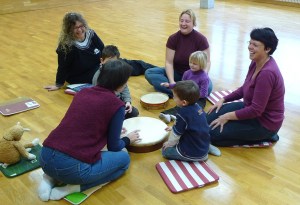
I teach a parent-child class where the toddlers are 12 – 30 months in September. Each week, we do a circle time for music and stories. I tell the parents that not only does music have many benefits for children’s learning, and not only do rhymes and songs help teach language skills, circle time is also a chance for children to begin to practice key skills for kindergarten readiness: the ability to sit still, to listen to a teacher, to notice and do what the other people around them are doing, and to stop doing something when asked. (We do the shaker song every week, “oh you shake and you shake and you shake and you stop” and I talk about how huge this is for practicing impulse control.) My secret agenda is that teaching parents things to do with their children builds connections. Plus, of course, circle time is fun!

At the beginning of the year, I make sure parents know that their children will not yet be good at sitting still and paying attention for the full circle time, but the more we practice, and the more we model that behavior for them and encourage them to try, the better they’ll get. At the beginning of the year, circle time is about 10 minutes long. By the end of the year, it’s 20 – 25 minutes.

I always go in the same order each time, just adding more pieces to each segment as we go along. That way the children learn the ritual, and are better able to participate because they can predict what will happen next.

  1. Greeting Songs – each week we do the “I roll the ball to [name] song” and one other greeting song which uses the child’s name and gives each child a moment in the spotlight.
  2. Lap Songs – when we bounce children in a rhythm, it helps to instill rhythm in them at a fundamental level. It also helps to build their vestibular system. These songs are also super fun, and get lots of giggles going.
  3. Finger Rhymes – these teach a lot of vocabulary, and also teach children to notice patterns… “after dad says ‘with a one step and a two step’, he’s going to tickle me.”
  4. “Theme Activity” – I always have some small toys, puzzle pieces, or decor items tied into the theme gathered in my red gift bag. We sing “what’s in the red bag, the red bag, the red bag…” song. The kids come running over to find out. I give each one an item to take back to their parent – they talk about it together, then we do a few rhymes or songs that are related, then they bring them back to me.
  5. Book (we start these about halfway through the year)
  6. Shakers – we do the shake and stop song, sometimes some other songs, sometimes we turn on recorded music and dance and shake to the music.
  7. Active Songs, with or without parachute. Moving around the room in rhythm to the music is great at building coordination, rhythm, and large muscle skills.

I’ve gathered the ideas for my circle time rhymes and songs from many great sources. I have lots of favorite songs (here are links to lyrics and to videos showing hand motions). I have some favorite toddler books I share.

I have a full year’s worth of circle time plans for my toddler class – it’s organized by theme, and we do each set of songs for about 4 – 6 weeks. Themes include: fall, winter, spring, farm, zoo, stars, transportation, ducks, and beach.

For my science class for 3 – 6 year olds, we do two completely different circle times each week – opening circle teaches a rhythm activity, a discussion of the day’s topic, and a non-fiction book. Closing circle teaches a song, we read a fun imaginative fiction book related to the day’s theme, and we often do a group game to reinforce the day’s learning. You can find about 35 topics worth of circle time plans at www.InventorsOfTomorrow.com.

Do you have any great tips for how to help circle time go well, any favorite songs, or favorite resources for finding more ideas?

Fun with Toddlers: Sensory Play

img_20140522_095756848.jpg

A sensory bin is a simple toddler play activity: take a plastic tub, fill it with rice (or another filler), add scoops and containers to pour into (or other tools) and a few of your child’s small toys, and let your child play. The benefits for your child are: learning to use tools, using fine motor skills, and sensory exploration. The benefits for you are that your child will play independently for quite some time while you get other things done! (Expect some clean-up time when you’re done!)

Learn all about sensory play in: The Ultimate Guide to Sensory Play.

Teaching Math Skills

See the source image

Let’s talk about math…

When we talk about which skills kids need to succeed in school or in the work world, reading and math are always at the top of the list of “most important things to know about.”

If you ask parents what they do to teach their kids to read, they will say: we do bedtime stories every night, we go to the library, we practice reading signs, menus, and labels – they have a whole list of ideas. If you ask them what they do to teach their child math, many parents draw a blank or they protest that they don’t know how to teach math, and they’re counting on preschool and school to do that.

Can we instead think about easy ways to incorporate math into everyday interactions and play just as easily as we do reading? I(‘m not talking math drills and flash cards and pushing academics here! I’m talking about playing with numbers like we “play” with words and stories.)

Here are some opportunities and resources (click on the links to learn more):

Hands-On Activities to Teach Core Math Skills

  • Counting / Number Sense
    • You can count almost anything – how many blocks in your tower, how many goldfish crackers on your plate, how many books do we get at the library
    • You can ask: who has more? Divide objects into two piles – which is bigger?
    • Set the table – each person gets one plate, one spoon, five berries, etc.
    • Count money – it’s trickier to get the different values of different coins.
  • Representation – recognizing that the numeral 5 and the letter f-i-v-e can be used as symbols to represent how many physical objects you have
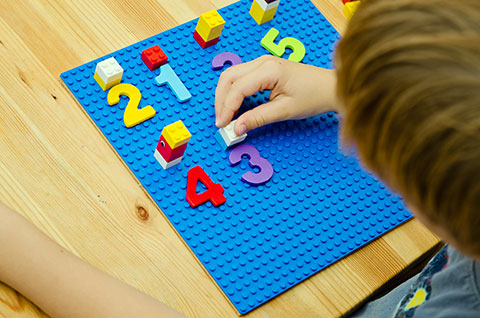
    • Play with magnetic numbers, assemble puzzles with pieces shaped like numbers, make numbers with play-dough, draw numbers in the sand
    • Do connect the dot puzzles, do physical games where they have to jump from the paper numbered one to two to three
    • Make number cards with the numeral and word written on them. When you count physical objects, have them find the card the shows the total.
  • Shapes and Spatial Relationships
    • Play with shape sorters, puzzles, nesting cups, blocks, building toys. Make crafts.
    • Talk about (and play games with) positional words: under, next to, between…
  • Measurement
    • Cook together, using a recipe.
    • Compare things: line up in order by size.
    • Measure with standard units (8 inches) and non-standard (12 paper clips long)
  • Patterns
    • Help them notice sequence: first we do X, then Y. After ____, we always _____.
    • Sort laundry and pair the socks. Separate M&M’s by color, then make a pattern.
    • Build patterns: red bead, yellow bead, red…  Clap rhythm patterns.

For lots more hands-on ideas, just search pinterest for preschool math activities! Or go to https://childcare.extension.org/young-childrens-developing-math-skills/

Sing Counting Songs and Read Counting Books

  • Math Songs. Counting songs like 5 Little Monkeys jumping on a bed, or 10 Little Indians, or 5 Little Ducks are all great teaching tools, especially if you have props. A bath-time game with 5 rubber ducks can teach one-to-one correspondence plus the concept of zero (no little ducks came back…) You can find a huge collection of math songs for all ages at www.songsforteaching.com/numberscounting.htm

Turn (almost) any conversation into a math conversation: Check out the blog http://talkingmathwithkids.com/ It has examples of math concepts into conversations with kids in an engaging way. More ideas: https://bstockus.wordpress.com/talking-math-with-kids/ and http://prek-math-te.stanford.edu/overview/math-thinking-conversations.

Bedtime Math: Every night, before or after the bedtime story, add in a math story problem.

You could make up your own. They could be based on your day (“Today at dinner, there were 8 slices of pizza. You ate two, and I ate three. How many did Dad eat?”). They could be based on the book you just read. (“The Cat in the Hat is holding a book, an umbrella and a fish bowl. How many things is that?” “How many pieces of fruit did the Very Hungry Caterpillar eat?”

Or, you can download the Bedtime Math app (it’s free!) or buy a Bedtime Math book if you prefer a screen free option. They offer a new kid-friendly story problem every day, with questions appropriate for three different levels of math skills, for kids age 3 – 9.

Sports are a fabulous way to practice math skills. For younger kids, keep the score simple – one basket equals one point. For older kids, make the scoring more challenging: “if you can sink the sock in the laundry basket from here, it’s 1 point, but if you can do it from this line, it’s 3 points.” When watching sports in person or on TV, have your child keep a written score tally.

Restaurant Games: When waiting for your food, try these games. Hide 2 – 5 sugar packets behind your menu. Lift the menu to briefly show them the items, put it back down, and ask how many they saw. Tap on the table 1 – 6 times, and have them set out that many packets. “There are four blackberry jams, two strawberries, and a marmalade – how many total?”

Board games are my favorite math skill builder. They’re so much fun that kids don’t notice their learning math. Research shows that the more board games that a kid played and the more different settings he played games in, the better his performance in four math tasks.

Let them see you using math. Point out to your child when you use math – to calculate a tip, compare the cost of two items, figure out how long it will take to drive somewhere, or to help them decide what to buy with their allowance. (For a discussion of financial literacy for kids and how to handle allowance: https://gooddayswithkids.com/2016/02/09/financial-literacy/)

What Not to Do:

  • Don’t feel like you need to get flash cards, math apps and workbooks and drill basic math facts over and over. Let math be fun at home, not a terrible bore.
  • Don’t try to push kids along faster – push them deeper – rather than moving on to the next step on the math skills checklist as fast as you can, make sure you’ve really explored each step in depth first. For example, some parents want to toddler to count to 20, so they push them fast. It takes a long time for a toddler to really truly understand the difference between one and more than one. And then to understand the difference between one and two, and more than two. Let them stay there till they really get it, and then they’ll be able to master more complicated ideas in the future. But rush this one, and everything is confusing from there on out!

My other blog, Inventors Of Tomorrow, is about teaching STEM skills to kids. I have more details there. Start with the post on developmental stages of math learning.