When children are about to start preschool, parents may worry about how their child will adapt. Here are steps you can take to ease the transition.
Prepare Yourself
If you are anxious, your child will pick up on that, and they’ll be anxious too. So, before you start talking to them about preschool, do whatever you need to do to build your own confidence about it. Get support from others if needed. If your child does notice your anxiety, calmly say “I’m feeling worried now just because this is something new – here’s what I’m doing to remind myself it will be OK.”
Planning for Success
If you’re still trying to choose a preschool, think about what kinds of settings and routines work best for your child, and if possible, choose a program that matches their needs and interests. For example, while some children are ready for full day preschool five days a week, that can be overwhelming for some children. If your child gets overstimulated quickly with social activities, consider starting small with a program that meets only a few hours a week, and gradually build up to more, or consider a cooperative preschool where they can stay with their child in the new setting to help make the transition easier.
Teach Skills
In the weeks or months before starting preschool, here are some skills to work on with your child:
Teach self-help skills. It’s hard on a child if they have to wait for a teacher to help them put on their coat for outside time or wait for help getting their lunch containers open.
Help them learn how to put on their shoes, put on and take off their coat and put things in a backpack.
Help them learn how to open their string cheese or yogurt containers by themselves.
Teach toileting, handwashing skills, and also practice how to use hand sanitizer.
Make sure they know to cover their cough by coughing (or sneezing) into their elbow, and they know how to blow their nose and throw the tissue away.
Teach social skills: how to make friends, how to invite someone to play with you, how to ask to play with a toy someone else is using, taking turns, and so on. Set up playdates to practice skills.
Create routines. What routines can you establish at home to make it easier to get moving in the morning? If you’ll need to be up earlier than you’re used to, can you adjust bedtime? Learn about school routines and use similar practices at home. (e.g. wash hands before snack time.) If your child will use new tools – like a lunchbox or water bottle – get them early and practice.
Read Books / Watch Shows
One of the best ways to introduce the idea of preschool (before even talking to your child about the fact that they will be going to one) is to watch shows or read books about preschool and about starting school. (Here are my recommended picture books about preschool.) Choose ones with a positive approach. (If your child is NOT feeling anxious, don’t choose books that talk about how worried a child might be… that can actually introduce anxiety!)
Preparing them for Preschool
Talk about what to expect at their school. Visit the school if possible. Or look at pictures or a video tour, visit the outside of the building and walk around. Show your child pictures of the teacher. Get some materials like they’ll have in the classroom and practice using them at home.
Teach and practice how to interact with a teacher. Explain that the teacher is there to help them and take care of them. Explain that the teacher is in charge. Teach how to get a teacher’s attention (raise your hand, touch their arm) and how to ask for help. Teach that sometimes they have to wait for a grown-up to be available to help. Play listening games (Simon Says, Red Light Green Light, or Copy this Rhythm).
Pretend play. Pretend to be going to school – who will play the parent? The child? The teacher? Play at things like: waiting in line (with stuffed animals), doing circle time, taking turns, raising hands, asking the teacher for help, saying goodbye at drop-off time.
Set clear expectations about your role at preschool. If you will be dropping them off and leaving, talk about how the drop-off will go, what you will do while they’re at school, and when you will pick them up. Create rituals for drop-off and pick-up time. Reassure them that although this may be a new experience, and they may feel a little worried, you are confident that they will be OK.
When Classes Begin
Don’t make too big a deal of the first day. That anticipation and excitement can turn into anxiety. (No big photo sessions!)
Don’t introduce all new clothes and shoes and backpack on the first day. Let them wear familiar and comfortable items. Pack their favorite foods and pack the exact same lunch for the first several days so they know exactly what to expect. Ask your school’s policy about “transitional objects” – having a toy from home might help them adjust to all the new things around them.
Allow extra time to get there – you want time to relax beforehand and remind your child what to expect. (Note: this is especially true if you have a child you think of as shy – I call them “slow to warm up.” These children do best when they can arrive a little early, before most of the other children, and settle in. They don’t do well running in frantic and late to a full and busy classroom.)
Build a relationship with the teacher(s), other kids, and other parents. When your child sees that you feel comfortable interacting with them all, they will feel comfortable too.
When it’s time to leave, keep your goodbyes brief and radiate confidence that they will be OK. DO say goodbye – don’t try to sneak out when they’re not looking. Tell them what they will be doing while you’re gone, and when you’ll return. (Be sure to honor that promise.)
Make your goodbye ritual simple and sweet. Make sure your child is either settled into an activity or knows that to do next, or hand them off to an adult for care so that when you walk out the door, your child has something else they’re focused on other than the sight of you leaving them behind.
Lots of children have moments of separation anxiety at first, and may be sad or crying when it’s time for you to go. Resist the rescue. Be caring and validate their feelings but stick to the plan and leave. Trust the teachers to be the professionals they are and manage common challenges of separation anxiety. Typically a child who cries at drop off will cry only briefly and soon calm down.
After class, give your child a chance to debrief and talk about how the day went.
Handling the Challenges
Even if you “do everything right”, your child may have bad days, with separation anxiety, biting or hitting, not sitting still for story time or other challenging behaviors. That’s developmentally normal!
Some things that help: if your child is having big feelings, acknowledge them, don’t just try to distract them away. Regression is normal – for example, a child who was potty trained may have accidents. Don’t punish or shame, just acknowledge the issue and say “let’s try to do better tomorrow.” If your child is really clingy, maybe they just need more snuggling for a while – soothe and reassure them.
Children who know they are loved try hard to be good. If they’re misbehaving, ask yourself – is there a skill or support they’re lacking? If so, help them build it. Ask yourself: could they have an underlying need that is driving the misbehavior? If so, meeting that need may resolve the issue. Be patient and remember that any challenges are just a phase. Just keep doing your best every day and encourage them to do their best, and you’ll make your way through to the other side of this big life step.
Note: if you’re in the Seattle area and looking for a great part-time preschool option, check out the co-op preschools offered by our local colleges’ parent education programs. I teach at Eastgate Co-op in Bellevue.
Every year students ask me: which is better – public school or private school? Or they ask – what’s the best school for my child? There are no simple answers for those questions. But let’s take a big picture look at the differences between public and private. [If you decide you’re interested in choosing a private school, be sure to check out my post on Choosing the Best School for your child.]
In this post, we’ll explore the following topics: curriculum, teachers, accreditation, class size, cost, transportation, admissions, services for gifted / special needs / ESL, diversity and outcomes.
A caveat up front: I live and teach in western Washington, and we are blessed with excellent public schools and with many great private schools too, so my comments below all assume that to be the case. I know that in many parts of the United States, the public schools are sadly not great, whether that’s due to limited funding or to political demands that have forced educators to use textbooks and curricula that do not reflect research based best practices. And in some regions there are limited private school options. So, your experience in your area may be different.
Curriculum
Public school curriculum is designed by committee – lots of committees – making lots of compromises between what’s ideal and what’s do-able within the constraints of funding, politics, staffing, and more. It will never be the perfect curriculum for all children. But it’s a pretty solid curriculum for most kids.
Private school curriculum varies widely. Some may follow a particular model, such as Waldorf or Montessori. Some may have a special focus: the environment, STEM or the arts. Some may focus on a specific population: gifted children, autistic children or bilingual. Some may be faith-based, incorporating prayer and religious teachings into the day. Some use textbooks and lesson plans developed elsewhere. Some create all their own lesson plans incorporating a wide range of books and online resources. All programs will have the basics of reading and math, but look for differences in the arts, science and world languages.
Not only does the content differ between schools, the teaching methods can range. They might use: lecture, discussion, independent work with worksheets, hands-on materials, project-based learning, and more. Most schools use a wide range of modalities, but how they divide the time up between those teaching styles varies a lot. Some private school teachers are truly excellent and use the freedom of their setting to create inspiring lessons that really engage their learners. Some are just not as great.
If you are considering a private school, it’s worth spending time perusing their website or other resources, attending open houses and asking questions to learn more about what is taught and how it is taught.
If you as a parent have very specific learning goals, and you have the time and energy to search for the perfect match, there may be a perfect private school for your child. If you just want to make sure your child gets a good solid basic education, then public school may meet your goals.
Teachers
On average, public school teachers are better paid and have better benefits, therefore, on average, public school teachers are more experienced and more highly educated. Nationwide, in public schools 11% have less than 4 years of teaching experience vs. 16% in private schools. 48% of public school teachers have master’s degrees versus 36% in private schools. (Source) More public school teachers do regular professional development. (Without regular professional development, information and skills can become dated.)
However, there are some truly excellent teachers in private schools. I know many fabulous and passionate teachers who left public school because the bureaucracy and requirements blocked them from doing what they thought was best for their students’ learning. In the private school setting they have a lot more independence and freedom to adapt their program to best meet the needs of the students in any particular class.
Public schools may have stricter requirements for teacher training and degrees than private schools do. This can ensure they meet a certain level of skill. However, private schools have more flexibility in their hiring, and may be able to do something like hire someone with 20 years of experience in a professional field who just doesn’t happen to have a degree in education or a teaching certificate but is an excellent teacher nonetheless.
If you’re considering private school, ask about the training and experience of their teachers and ask how on-going professional development is supported.
Accreditation / Standards / Assessment
Public schools have many standards that guide them (e.g. Common Core or Next Generation Science Standards) and use a lot of standardized testing to ensure that they are meeting those standards. The upside to that is there are minimum learning goals that must be met. The downside is a lot of time is spent “teaching to the test” rather than focusing on a child’s broader educational needs.
Many (not all) religious schools are part of a denomination wide or diocese wide consortium that helps to set standards. Many do an excellent job of covering all of the standard school subjects and covering religious topics. However, some focus more on religion and students might not receive an adequate basic education in topics like reading, math and science. If you’re considering parochial school, ask about this.
Many non-sectarian schools (not all) may be certified by organizations such as NAIS. The process of becoming and remaining certified is highly rigorous and requires that schools meet high standards.
Some schools are not certified by anyone. That can be just fine. All my kids have spent some years in start-up private schools that were too new to go through the certification process, and they were truly excellent schools with passionate leadership. I paid close attention to their education to make sure it met my standards. Some schools do not do any standardized testing. And that can be fine too. But I know when my older children went to a non-traditional elementary school, I would occasionally get standardized workbooks from Lakeshore Learning to doublecheck that my child had the grade level skills that they needed. They always did, but it was reassuring to me to check that.
When considering a school, ask what steps they take to ensure that the children in their program are meeting grade level standards in all the core topics so that they are adequately prepared for the next steps in their education.
Class size and ratios
In the Seattle area, our k-3 public schools have an average class size of 25. Private schools range widely, from 10 – 30 per class. (The lower cost schools or religious schools are more likely to have larger classes, the highest cost schools are more likely to have smaller classes.)
Classrooms with 12 – 18 students tended to be richer in interactions and conversations. Classrooms with 25 – 30 students might have better classroom management and children might learn more facts. (source)
In addition to class size, it’s important to look at student to teacher ratio. At private elementary schools it averages 9:1 and at public 17:1 nationwide. Some larger classes may have two teachers or a teacher and a teacher’s aide, so you may see ratios of something like 26:2. (source)
As a general rule, the smaller the class and the better the ratios, the more individualized attention each child will receive, which in general is better for their education.
If you have a shy child who is overwhelmed when there is too much going on around them, then small class size may be a priority for you. If you have an outgoing, social child they may prefer a larger class with more potential friends to socialize with.
School size
Nationwide, the average private school has 166 students and the average public school has 526. (source)
In general, the smaller the school, the more likely your child will be known as an individual. (And as a parent, when my older kids went to an elementary school with 150 kids I felt like I knew all the teachers, most of the kids and many of the parents. When my youngest went to an elementary school with 550 kids, I barely kept track of who was in his class and couldn’t have told you the names of all the teachers.)
However, smaller schools may not have all the resources of a larger school. They may be less likely to have a gym or an art room or a specialized music teacher. They may have fewer extracurricular activities. If you’re considering a small school, just be sure it has the resources that are important to you.
Cost
Public schools are free. (Paid for by local taxes which you have to pay whether or not you have children and whether or not they go to public school.) You might have to purchase some notebooks, pencils and Kleenex for the classroom. You might have a few additional charges for extracurricular activities. The PTA may ask for optional donations which help to fund special events, special equipment purchases and extracurricular activities. But basically they’re free. And if you’re lower income you could qualify for free lunches as well.
Nationwide, the average cost of private school is $11,000 a year but there’s a wide range from Catholic schools around $7000 per year to non-sectarian schools up to $25,000. (Source) Scholarships may be available.
On Seattle’s Eastside, there are Christian schools ranging from $6400 – 25,000. Catholic schools ranging from $7800 – 10,000. Non-sectarian independent schools ranging from $11,000 – 30,000. (Source) Most schools will also ask for significant additional donations, as most private schools only cover 90% of their expenses with tuition and count on donations (mostly from current families) to cover the rest of the costs.
For many people, the cost of private school is simply out of reach. Or could only be covered if the family makes substantial sacrifices elsewhere.
If you are able to afford private school, but wondering if it’s worth it, you could ask yourself: what else could I do with that money instead? Some parents choose to spend it on other enriching activities for the child or the family, such as travel, music lessons, private sports coaches, tutors and more. Some enroll their child in public school but do substantial donations to the school’s PTA that can allow that school to offer things to bring them more on par with private schools, such as art or music teachers, foreign language programs and special equipment. (source) This way the funds benefit their child and all the other children at the neighborhood school. Some parents roll those funds into paying for housing in a more expensive neighborhood than they could otherwise afford which may give them access to a better public school. I know of some families where a parent would have to work full time to afford private school and has chosen instead to enroll the child in public school and work a part time job that enables them to volunteer in the school and have more time and energy to spend with the children after school.
Facilities
Public schools are fairly homogeneous – most public elementaries have similar facilities. Amongst private schools, there is a very wide range in facilities and equipment. Some (typically the most expensive private schools) may have outstanding facilities with attractive furnishings, large gymnasiums, and maker labs full of 3-d printers and other state of the art equipment. Some (typically the least expensive private schools) may meet in older buildings with faded carpet and minimal technology. It’s easy to get caught up in appearances when you tour a school, but think hard about whether the surface glitz has a real benefit on your child’s learning and whether you want to pay for that level of facility.
Transportation / Proximity
Public schools are typically near your home. If they are not within walking distance, they provide transportation free of charge. All the students at the school live near you, so your child’s friends will all be reasonably nearby.
A private school may be near you or may be far away. You will be required to transport your child or pay extra for a school shuttle, if available. Your child’s friends may live near you or may live far away, which can make playdates and parties harder to coordinate. There is additional cost involved in transportation, and more commute time for you, so also an opportunity cost for you to consider what else you could do with that time if you weren’t having to transport them.
Admissions
Public schools have to take every child in their catchment area, even if you show up in the middle of the year, even if you have challenging special needs.
Some public school districts offer choice schools that offer special focuses, such as STEM or the arts. Admission is typically by lottery. At some you have a pretty good chance of being drawn at random. Others may have hundreds of applications for a handful of slots so your chance of getting in is quite small.
Private schools range in how selective they are. Some will admit pretty much anyone who applies. Others have long waiting lists and can be very choosey in who they admit. Some have very specific requirements, such as gifted schools that require that a child have IQ tests showing they are in the 95th or 99th percentile to be considered. There are fees for applying and for any required testing.
Note: some parents choose a private school because they will let children enroll at a younger age, and the parent is hoping to push their child ahead in school. I don’t recommend this.
When considering schools, I advise people not to fall in love with any one school or think of it as the only acceptable option, because you may not get in and you want to feel like you have other viable options. It’s important to remind yourself that your child can succeed no matter where they go to school.
Where do kids go to school
Nationwide, 50.7 million children attend public school, and 5.7 million children attend private school. Source (Of the private school children about 1.6 million of those attend Catholic school. Interestingly, 18% of those in Catholic school are not Catholic. Source)
So, about 90% public, 10% private. In the city of Seattle, 78% attend public school, 22% private. (source)
Services for Gifted / Special Needs / ESL
The public school must serve all types of children. Their mainstream classrooms are designed to meet most needs of most kids. Then they provide pull-out services and push-in services to meet special needs. For example, children may be pulled out of the class for a few hours a week for remedial math support, meeting with a speech pathologist or social skills classes for autistic kids. Or they may attend a gifted program at another facility once a week. Or instructional aides may be “pushed in” to the classroom to provide extra support during reading lessons for English language learners or to reduce behavioral disturbances. They may also have a resource room where children can go when they are not able to keep calm in the classroom. About 15% of children receive some sort of special services. The school provides for the testing to see who qualifies for gifted programs or for 504/IEP services. (Learn more about how to have a child assessed for special needs such as autism or ADHD.)
There are bilingual schools and language immersion private schools, and some parents choose these, either to connect their child to their cultural heritage, or to expose them to another culture.
There are private schools that specialize in gifted kids – prospective students must be tested to see if they qualify. Some of these programs use an accelerated curriculum where kids go through typical academics at a faster pace, doing fourth grade math in second grade, for example. Some use an enrichment program – going deeper into topics with project-based learning. (Learn more about acceleration vs. enrichment.) Some parents prefer a school that is all gifted children vs. the public school where the child spends some time in gifted programs but the majority of the time in the mainstreamed classroom. Some appreciate that in a mainstream classroom, their child gained confidence and positive teacher attention from feeling like one of the smartest kids.
There are private schools that specialize in kids with ADHD or autism. Some parents have found those to be the right fit because they feel their child is accepted for exactly who they are and gets exactly the support they need. Some say that it seems to them like institutionalizing kids with behavior challenges and they feel that their child learned worse behavior from their classmates there than they had before.
Some children with ADHD or autism can fit in anywhere and don’t need a lot of extra supports. Or, they need just a little bit of extra flexibility and individualization in the curriculum. These “quirky” kids can do very well in the right independent school. Children with more complex needs are typically served better by the public school which may have more resources to support them. (See the bottom of the post for my experiences with gifted and special needs kids.)
Diversity
In general, public schools are as diverse as the neighborhood they are located in. For the larger middle and high schools that almost always is a high level of diversity. Since elementary schools are smaller and pull from a more focused neighborhood, they may be diverse or may not. But overall, a public school is likely more diverse than a private school since private school admission typically requires a higher income and may have additional things which limit the population, such as IQ testing requirements, religious affiliation or special interests.
Some parents choose schools specifically to connect with a religious or cultural heritage and are seeking a certain degree of homogeneity. It can be comforting to feel as if you’re connected and belong amongst those who are similar to you. Some parents choose schools specifically for diversity to expose their child to a wide range of people and life experiences and also because they feel that better prepares their child for the broader world. (Learn more about the benefits of both “mirrors and windows” in your child’s education.)
If you’re considering a school and you are a person with a traditionally marginalized identity, it may be worth talking to people at the school who share that identity to see whether they feel welcomed there and feel like they belong or if they ever feel tokenized or excluded.
Equity
Some people argue that higher income parents choosing private schools supports inequality by increasing income segregation and often racial segregation within their area’s public schools. (Since private schools are more likely to be out of reach for children from lower income families of color.) John Burbank of the Economic Opportunity Institute says “I do not think that sending kids to private school is a benign act, as many Seattle parents like to believe.” (Source)
Due to this concern, some parents intentionally choose to enroll in and support their public school to increase the diversity and to advocated for increased opportunities for neighborhood kids. (Note: unfortunately, this can also lead to inequities as you can see in the fact that one Seattle area high school has fundraised $3.5 million in assets while other Seattle high schools have $0. Source)
Community / Parent Involvement
When looking at school options, it can also be well worth thinking about how involved you would like to be (and are able to be) in your child’s schooling, and what level of parent participation is welcomed or expected at that school. You may also consider how much there is a feeling of a parent community at the school.
With my three kids, there have been times where we have been at small schools (co-op preschools, a start-up elementary and a start-up middle/high school) where I have been extremely connected to the community – I knew and was friends with many parents, I volunteered in the classroom and with special events. I served on the board of directors. I spent many hours on campus. I had great insight into my kids’ education.
There have also been other times where I was the drop-off and go parent who had almost no connection to the other parents and my volunteering was one or two afternoons a year. As a busy working parent, that sometimes just feels like the easiest answer. I’m glad in some ways that right now my youngest child is at a large school and I can kind of opt out of everything without feeling terribly guilty because there are other parents picking up the slack.
However, I don’t feel nearly as connected to his education this year as I felt with his siblings in the past. And I don’t have as much peer to peer connection to parents as I did in the past and I miss that.
It is worth thinking about what you would like in a school for you as a parent and making sure that they have opportunities to meet those needs.
Outcomes
Many people think the bottom line is in the results – who does better in life – kids who went to private school or kids who went to public school.
In numerous studies, private school students have outscored public school students on standardized testing including the SAT and ACT, they have a higher rate of high school completion and college admission, and score better on other criteria as well. (One study found students who had attended a private school performed better on 14 of the 19 outcomes. Source.)
However, that may be less due to the private schools themselves, and more due to the types of families that choose and can access private schools.
“Without any control variables, Catholic school students scored better than public school students on reading and math tests. When control variables, such as initial test scores… race and ethnicity, family structure, parental marital status, parental education, income, and employment, were included in the regressions, the results differed substantially: they showed a negative effect for attending Catholic schools in math and almost no effect for reading.” (source)
“Private schools have higher scores not because they are better institutions but because their students largely come from more privileged backgrounds that offer greater educational support. After correcting for demographics… gains in student achievement at public schools are at least as great and often greater than those at private ones.” (Source)
“The apparent advantages of private school … were almost entirely due to the socioeconomic advantages that selected families into these types of schools and were not attributed to private school education itself.” Source
Higher income parents, whether they choose private school or not, are able to offer more opportunities to their children: travel, tutors, extracurriculars, test prep, music lessons, laptops and more. More highly educated parents, whether they choose private school or not, are better able to support their child’s learning and advocate with their teachers. Parents who prioritize education will typically have children who do better in an educational setting.
While you may not have full control over your income or education status, there is a lot that you as a parent can do to increase your child’s chance of school success whether they are at a private school or public school. Key things you can do are:
create a home environment that encourages learning,
communicate high, yet reasonable, expectations for their children’s achievement and future careers, and
become involved in their children’s education at school and in the community.” (source)
I will share here the stories of how we chose the elementary schools each of our kids attended and how those decisions turned out. None of these are meant to show “the right way” to do it or to be definitive examples… they’re just three examples. Your needs and experiences will vary, so feel free to skip this section…
My oldest child was bright and creative and loved stories. He was in a theater preschool which he adored. But then his teacher told me “sometimes I feel like he’s not able to follow what we’re talking about.” I was stunned by this, because I knew that he was following everything. I observed. He was a perfectionist and didn’t like being put on the spot, so when she called on him with a simple question, he froze like a deer in the headlights. I could see that in his mind he was thinking “that question is way too easy – she must be asking me something harder – what is she asking???” I realized that he wouldn’t do well in a public school class with up to 28 kids in it (the class size at that time.) He needed to be in a very small class setting with low pressure and a teacher I could work closely with. We chose a small school with small class sizes and he thrived there. He had two best friends who were also very bright and very creative and they sailed through the school together. It was an inquiry-based progressive school where the teachers were able to adapt projects to challenge these three bright children and keep them engaged and excited. My son was also “dreamy” and sometimes didn’t pay attention well. (This was later diagnosed as ADD, but since he lacked the hyperactivity part, it wasn’t obvious.) In a larger class, I think he could have spaced out for quite a while and the teacher might not have noticed because he wasn’t disruptive. In this small school, the teachers noticed and kept him on track.
My second child was also very bright. Since her brother’s private school worked so well for him, we put her there too. She did fine for a couple years, happily engaging in the play-based, inquiry based program. However, in this small school, by chance, there was no one in her age cohort that was at the same intellectual level as she was. So she didn’t really have any peers that challenged her or carried her along with them on fun projects. When she was second grade age, they put her in a class of fourth grade age kids – she was still ahead of them academically but so far behind socially that it wasn’t a good fit. Luckily by her fourth and fifth grade years, she’d found her place and they’d paired her with teachers that were able to find the right challenges with her and find ways that she could relate better to the other kids. (Much later on she was diagnosed as autistic. Autism often manifests very differently in gifted girls than the typical stereotypes of autism.) In fourth and fifth grade, they also had a flexibility with her… when this child is overwhelmed, she wants to escape away from other people. They allowed her to go outside into the woods on the school campus when she needed to and return when she was ready. I can’t imagine any public school being able to do this accommodation. In the end, the school was also a good match for her and laid a good foundation for her future.
When we decided to have a third child many years later, we planned that he would go to that same private school. Our backup plan was a local choice school which was small and had a lot of parent involvement, recreating many of the things we liked about that private school. He is super bright – taught himself to read by his third birthday. Unfortunately, he also had behavior challenges. His siblings’ school did not accept him. We lotteried for the choice school but there were only five spaces available and he was over 100th on the waiting list. So, we started at our neighborhood public school. In kindergarten we lucked out with teacher assignments and his teacher had a background in special ed. We got him assessed and he was diagnosed with autism and ADHD, and we set up a plan. Kindergarten was great for him. But his first grade teacher was not a good teacher. Not good for anyone, I thought, but especially him. So, we opted out part way through the year and joined a small start-up elementary full of quirky kids with passionate teachers who were committed to “twice exceptional” kids – kids who are gifted and have challenges. It felt like the perfect fit. He was there for the end of first grade and all of second grade. We loved it. But then just a few weeks into third grade, they asked us to leave. His behavioral issues were escalating and had become more than the small school could handle. He would have big loud meltdowns where he needed to be in a separate space with an adult to help him calm down. With only three rooms and three teachers and with the fact that they shared a building with other tenants who were distressed by my son’s screaming, it just wasn’t working. We considered a move to a private school for autistic and other special needs kids but his needs were not as high as the other children there. So, in the middle of October, we jumped back to public school. They welcomed us back in, got his IEP and 504 set up and got him settled in class. We tested him for gifted services and he qualified for those as well. He spent the rest of elementary school in the public school, with some pull-out services (gifted math, gifted reading, social skills classes) and the ability to go to the resource room with the paras when he needed help getting through a meltdown, but most of his time is spent in the regular classroom. The principal of his elementary was so supportive – when he had behavior challenges, she always approached it positively, with the ‘he’s a good kid, how do we help him get back on track’ sort of approach. Public school has ended up being a really good fit for him and his needs.
I think my lesson from my three experiences is that at every school and with all kids, there will be times when all is going well and it feels like the right fit. And honestly, you’re likely to have rough times – maybe even a whole school year that doesn’t go great. Maybe this is because your child is at a particularly rough stage in their development (a period of disequilibrium). Maybe there just happens to be a bad match between your child and the teacher that year, or there are problematic classmate pairings. But if the teachers and the administration are respectful of kids and parents and are willing to work collaboratively with parents to find the best solution, and if you as a parent are willing to advocate for your child’s best interests, you can get past those rough patches and ensure that the overall school experience is positive.
Summary
I know this was a really long post, and I know that it offers no clear answers, just more questions to ask yourself.
Public schools may be more standardized and more straightforward so you may not need to do much research. Private schools, because they vary more, require that you put more effort into understanding who they are and how they work and whether that’s a good fit. If you are choosing between private school options, ask the questions I mention above and I also encourage you to check out my other post on Choosing the Best School for your child for even more questions to ask yourself.
In the end, I think the answer is that as long as your child feels safe and supported and like they belong at the school, and as long as the school helps them to stay excited about learning, that matters more than whether the school is public or private. And whatever school you choose for them, if you support their learning and set high but fair expectations, they will succeed.
When you start looking at preschools, you discover a whole world of jargon you never knew: play-based, emergent, teacher led, benchmarks, coop, Waldorf, Reggio Emilia, and so on. It can be overwhelming. And to make it more confusing, different people use words differently.. two schools that both call themselves “child-led” or “play-based” may look very different in practice.
A couple big picture ideas:
Structured vs. Play-Based: A structured preschool might use group time, worksheets, and individual projects to teach particular skills. Students may be drilled in the basics, or asked to practice things over and over. All the children are expected to be engaged in the same activity at the same time – they are all working on a craft project together or it’s math time for everyone. (Think of your elementary school education – structured preschools are using similar methods moved down to a younger group).
Teacher-Led vs. Child-Led: A teacher-led curriculum (may also be called didactic or standards-based) means the teacher always prepares the lessons in advance (it might be their own creation or they may use a curriculum written by someone else) and sticks to it. The teacher is active, the children are passive.
A child-led curriculum (may also be called emergent or constructivist) follows the children’s interests. So, for example, the teacher may know the math concept of the week is more than/less than. But instead of teaching that in a formal scheduled way, she asks the children playing with trains whether there are more blue trains or red trains, then asks the children playing with blocks which tower has more blocks in it, and asks the child who loves dinosaurs whether they think velociraptors ate more than T-rexes or less.
Classic Montessori: The teacher sets up learning centers around the room, with “self-correcting” materials (e.g. a puzzle where the child can tell if they’ve done it right or wrong and thus can work to fix it themselves if it’s wrong.) Children work independently at their own pace, and are in a multi-age classroom.
Note: Montessori schools can range in quality and in how tightly they adhere to Montessori methods. The word Montessori is not tightly controlled, and anyone can use it, no matter what teaching methods they use. Some schools use it because it’s a known brand name that “sells” well, but the classroom experience may only have a very loose connection to Montessori practices.
Rudolf Steiner/ Waldorf – Nurturing, predictable structure and routines. Natural materials, with time outdoors, baking bread, working with wool, wood, and wax materials, no plastic. Lots of imagination and oral story-telling, but no electronic media (families are discouraged from having any screen time at home). Reading is not taught until age 7. Learn more www.youtube.com/watch?v=CoW0pCIG-FM and www.youtube.com/watch?v=tZmAX5adCl0 and www.movementforchildhood.com/uploads/2/1/6/7/21671438/heardaboutwaldorf.pdf
Note: Waldorf requires all teachers and schools to be certified, so there’s much more consistency between schools with the Waldorf name.
Reggio Emilia. Child-led investigations. Project-based: when the children come up with an idea for a project, the class focuses for a few weeks on it, finding out together what they need to know to make it happen (including pre-reading and math.) They document projects with photos and journals. www.youtube.com/watch?v=XVv5ZL9nlgs
Nature-based or “forest kindergartens“. Common in northern Europe, they are newer to the States. There are several available on the Eastside of Seattle (My son attended Tiny Treks). Children spend most, or all of their time outdoors (yes, even in the winter). Child-led, play-based, emergent curriculum where teachers respond to children’s interests, rolling in math and science where it fits logically, often doing story-time, snack, and circle outdoors. To learn more, search for “forest kindergarten” on YouTube or check out www.youtube.com/watch?v=JBoXaQKoWL0
Academic preschools. There are preschools that have an academic focus that are taught in developmentally appropriate ways. But there are also schools which drill rote facts into children. That may mean the children will in fact learn to read words younger than they might otherwise have done, but this doesn’t appear to give them a long-term advantage. An occasional worksheet is a good experience for kids as preparation for future school experiences, but a worksheet-based curriculum is not appropriate for a 3 year old. (Read more: https://gooddayswithkids.com/2016/01/07/academic-preschools/)
Cooperative preschools. Most are balanced programs with time split between play-based learning at learning centers (e.g. dress-up area, block area, art, sensory), circle time (includes story time, literacy skills, and concepts like days, seasons, colors, etc.) and outdoor or big motor play. There is a professional teacher who plans the curriculum and leads structured activities. What distinguishes co-ops is parent involvement. For a 3 year old, they might attend preschool three mornings a week. On some of those days, the parent drops off. On one morning, the parent stays and works in the classroom with the children. This means there is a very high adult to student ratio. Co-op isn’t the best answer for a parent who needs child care so they can work or do other activities. However, for parents who have the time available, many report that they enjoy the time spent in the classroom, and like knowing more about what their child does at preschool and who the other children are in the class. Parents also have the opportunity to build friendships with other parents. Note: Cooperative preschools tend to be much lower cost than other options.
When considering which method you prefer, it’s worth keeping in mind what we know about brain development (see this post): Children learn best through hands-on experiences with tangible materials, through interaction with engaged human beings, and in environments where they feel safe and happy.
If your child will be 3 this September, then January through March is a great time to look ahead and choose a preschool for next year. I have a whole collection of posts on things to think about – check out whichever ones apply to you!
If you decide you’re looking, the first thing to think about is logistics: What do you need in a preschool in terms of location, schedule, cost, and so on. What are your goals for preschool?
After you’ve done all the research with your head, narrowing it down to the list of the best three options, then listen to your heart. Which school feels best to you? Where will your child be happiest? From the science of brain development, we know that we all learn best when we feel safe and happy – our brains have a high degree of neuroplasticity and we can absorb all the teacher has to teach. In the end, it’s that happiness and preserving the love of learning that will serve our child’s educational future the best.
FYI: I teach at co-op preschools sponsored by Bellevue College, so if you live on Seattle’s Eastside, check us out! www.bellevuecollege.edu/parented.
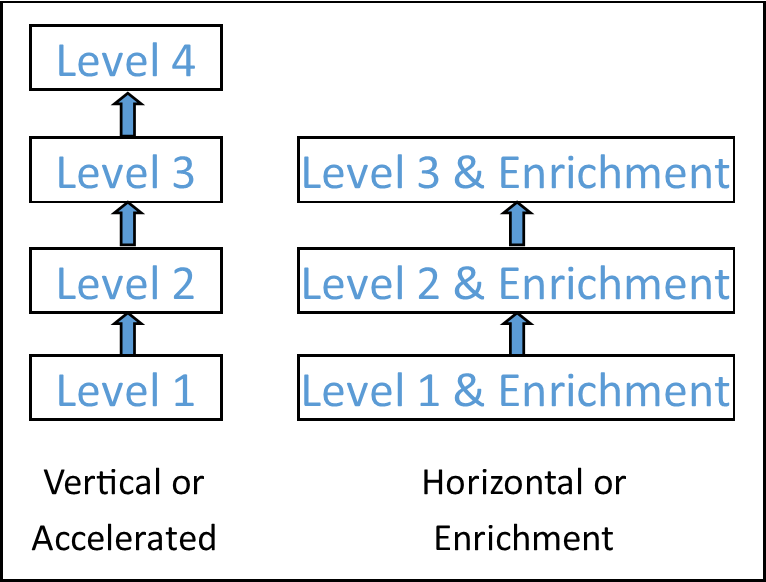
In gifted education, there are two major approaches – acceleration or enrichment. Acceleration just means moving more quickly through the stages of the same curriculum. So, if during a typical year, a typical student would do levels one through three of a subject, gifted kids would get through four levels, and end the year ahead of their age peers. Enrichment, or the horizontal approach, adds breadth and depth to each level, either through additional content or with project-based learning which enhances understanding. Children stay at the same overall level as their age peers (which can help with social interaction or ability in sports) but have learned about each topic more deeply than their non-gifted peers.
Acceleration
Acceleration can be done by skipping ahead and starting at a higher level, or “compacting” the curriculum by teaching the same content more quickly. (Gifted kids may understand something in the first pass that takes more repetition and drilling down for other kids.)
This can be very helpful for gifted kids.
When you understand the new information at first glance, and you then have to sit through the teacher explaining it and re-explaining it to other children, it can be supremely frustrating and exhausting! A lot of gifted kids actually end up dropping out of school due to this boredom / waste of time factor. So, moving faster can help to keep them more engaged. But, in the end, the kids aren’t learning anything beyond what the other kids learned. They just learned it faster. So, maybe they graduate from high school at age 16 instead of age 18. But not much else is changed. Those kids can be successful at early college or can feel social left out or not ready for early college.
Enrichment
Enrichment …. ‘refers to richer and more varied educational experiences, a curriculum that is modified to provide greater depth and breadth than is generally provided’ (Davis & Rimm, 2004, p.120). … It has often been said of the American school system that with the content standard movement we take a mile wide and an inch-deep approach. We have so many content standards to get through that we just skim the surface and have difficulty getting students to a place where they have an enduring understanding about the content. With enrichment, even though the content standards are all covered, because gifted students usually get the basic understanding fairly quickly, the teacher can go more into depth regarding the topic, digging deeper than your typical classroom. What this might look like is the teacher has a brief explanation on how vibrations cause sound and then allows the students to conduct experiments and put this idea to the test. Or a math teacher who after the class gets the gist of what she wants them to know, might do a project exploring the standard further or ask them to find a way to apply this to real life.
I will be the first to admit that acceleration is easier to accomplish. Most teachers can do it successfully, since it’s just going through standard materials more quickly. Enrichment takes more creativity, effort and skill on the part of the teacher, more advocacy by the parent, and more engagement by the child. It can fail if not done right, but if done well, can be excellent.
At a weak level, “enrichment” just equals handing kids some logic puzzles to work on, or some worksheets. These can feel like busywork and not really enhance learning all that much. If that’s all your child receives in your local school, you may need to seek out fun and challenging extra-curriculars.
Enrichment is better when a teacher is thinking really intentionally about broadening and deepening the learning. Whatever the main curriculum is for the class, the teacher finds a way to challenge the kids who are up to the challenge- perhaps by assigning hands-on projects that use the skills they’re learning, or challenging them to take a written assignment to a higher level, or encouraging them to read additional materials related to the primary topic.
The most effective enrichment is child-led… when the child has a passion and the teacher gives them the opportunity to explore it and push their learning in that area.
Since I work primarily with preschool age children, many parents ask me about early entrance to kindergarten (acceleration) but I usually recommend enrichment instead. Some examples:
choose a play-based preschool, as these allow a lot of independent exploration where a child can pursue interests and curiosity
enroll in an outdoor preschool / forest kindergarten that builds nature knowledge (and motor skills)
choose a language immersion preschool to build language skills for your child (even in a language you as the parent don’t speak)
build physical skills with swimming, outdoor play, sports activities, gymnastics and dance classes, martial arts, and more
take theater classes and go to storytimes and shows that are aimed at young children (build emotional intelligence)
take field trips, vacations to science museums, children’s museums, art museums, national parks, junior ranger programs
focus on their interests. For example, a four year old had a passion for learning about space. So, he was in a part-time preschool to build his general skills, but his parents also took him to the library for space books, watched shows and took online classes about space, and built solar system models together.
For older children here are just a few examples of how enrichment has worked well for children that I know:
A kindergartener who was a solid reader was asked by the teacher to read to the other children – it developed her mastery, and was a great model for the other kids. She also read books about their shared interests which helped her build friendships.
A first grade teacher knew her students all had different skills and challenges, so several times each year, she gave hands-on projects that she could help them adapt to best engage them and help them grow where they most needed to grow.
A second grader who was able to finish her work quickly got her teacher’s permission to always keep a book and some art supplies nearby so she had things to keep her busy and engaged while her classmates finished their work.
A school district offered a pull out gifted program where one day a week, children from several neighborhood schools were all gathered together for an enrichment program that had project-based learning – while working as teams toward a common goal, the kids deepened their knowledge of the topics they were learning in their neighborhood school.
A middle schooler found that school didn’t fully challenge him, but then he had a woodshop teacher who gave him the freedom to choose projects. During 8th grade, he built a bed, a dresser, and lots more. In the process, he built on his knowledge of math, design, planning and budgeting and more. He ended up as a pediatrician, but still does woodworking on the side.
Another middle schooler spent hours working on projects for her robotics team.
A high schooler started a small business selling their crafts on Etsy.
A high schooler enrolled in the fullest load of the most advanced classes her school offered, but was still able to complete all the work in a short amount of time. So, on the side, she volunteered for 20 hours a week in health care settings.
When I’m thinking about enrichment for kids who need an extra challenge, I have a few approaches that guide me. First, I think about hands-on options – what could they build, sew, bake, draw… that would deepen their learning? I think about following their passions – how can we take that interest and turn it into a project that will challenge them to learn and grow? I also think about all the areas of development – where do they most need to grow and about the multiple intelligences – where could they be stronger?
Acceleration just helps kids learn the same things as other kids learn – just more quickly. But enrichment can lead to really interesting experiences that make for a more interesting human being, in my opinion.

 More Good Days with Kids