Category Archives: Neurodiversity

Autism 101

For parents who are wondering why their child interacts with the world differently than some other children do, and are wondering whether it might be autism, it can be hard to understand all the different ways that autism might present. This post is intended as an overview of: the clinical definition of autism, understanding what “the spectrum” means, some of the signs and symptoms of how autism might present, information about screening and diagnosis, and resources to support parents of neurodiverse kids.

The Diagnostic Definition

When I was a kid, we tended to think of autistic people only as the people who showed significant impairment in multiple domains: non-verbal, developmentally delayed, frequently stimming (e.g. rocking, flapping their hands).

Then there were a bunch of other kids who were skilled in many areas, but had some unusual behaviors. We called them “quirky” or “odd ducks” or said they “march to the beat of their own drummer.”

Then the term Asperger’s syndrome appeared, and was often applied to kids who were gifted and “quirky.” And we would ask questions about people like “where are they on the spectrum” or “are they low functioning or high functioning?”

Now, Asperger’s is no longer a distinct diagnosis. It’s been pulled back under the umbrella of Autism Spectrum Disorder (ASD). And we’ve acknowledged that often people are “high functioning” in some areas while having a lot of challenges in other areas.

Here are the criteria for an ASD diagnosis in the DSM-V, which require showing symptoms in both of these categories:
A) Persistent deficits in social communication and social interaction (deficits in social-emotional reciprocity, in nonverbal communicative behaviors used for social interaction and in developing, maintaining, and understand relationships) and
B) Restricted, repetitive patterns of behavior, interests, or activities (as manifested by at least two of: S
tereotyped or repetitive motor movements, use of objects, or speech; Insistence on sameness, inflexible adherence to routines, or ritualized patterns of behavior; Highly restricted, fixated interests that are abnormal in intensity or focus; Hyper- or hypo-reactivity to sensory input.)

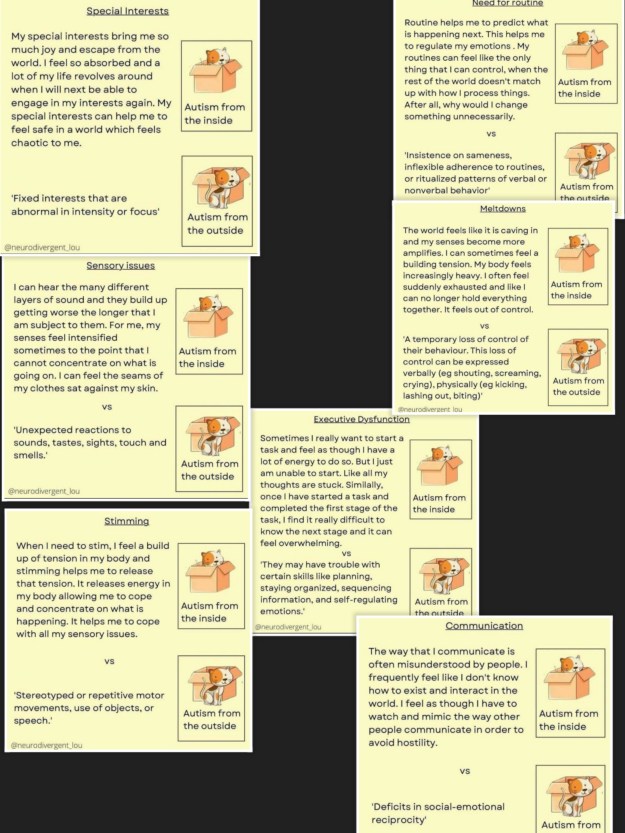
That is very deficit-based language. Here is another way to describe the criteria: A) may have challenges interpreting and following the same social rules and communication styles as their neurotypical peers or expressing / responding to emotions in the same ways that neurotypical people might and B) use repetitive movements, have strong preferences for predictable routines, and intense special interests. Reactions to sensory input and external demands may be more intense than typical.

I really like these images from @neurodivergent_lou that translate the diagnostic criteria which view autism from the outside into strength-based, empathy building views of what autism feels like from the inside perspective of an autistic person.
photocollage_2022102204220351

How Common is an Autism Diagnosis?

About 1 in 36 children is diagnosed with autism. (1 in 44 adults.) Within the diagnostic criteria, there’s a range of behaviors from subtle to extreme, and the impact on school and home ranges from minimal accommodations to major impacts.

What is a spectrum disorder?

When autism is described as a spectrum, it doesn’t mean this. (source)

continuum labeled not autistic at one end, and very autistic at the other end

Or this (source)

continuum, labelled "a little quirky" on the left, "definitely autistic" in the middle, and "tragic" on the right

Autism is a complex way of interacting with the world that can’t be described on a simple numeric scale, and can’t be simplified to either “not a problem” or “tragic”.

I’ll share a few different ways that it has been illustrated, so you can find the one the best resonates with your experience.

The autism spectrum can look something more like this:

An illustration of a circle where the "pie pieces" are labeled language, executive function, etc. and dots indicate where the person might have more strengths vs. more difficulties

(That image comes from this great comic on “Understanding the Spectrum” by Rebecca Burgess – I highly recommend reading it.)

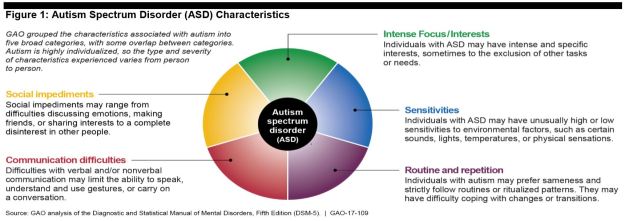
This graphic (source) breaks the spectrum into five categories, similar to Burgess, though the colors and the way they break things out are a little different:
GAO

And they explain that “the type and severity of characteristics varies from person to person” as seen in this diagram of three individuals’ ‘spectrums.’

Picture1

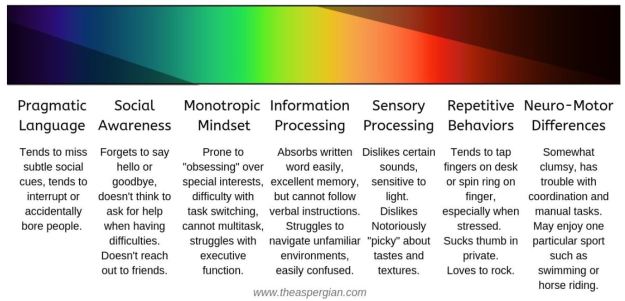
C.L. Lynch on theaspergian.com uses this illustration

spectrum

Then gives a few examples of how this would apply for an individual person.
spectrum 2

I don’t know which one of these graphics might be helpful for you, but I find it very helpful to think of these more nuanced descriptions rather than a single axis of “a little quirky” to “tragic.”

I know that if someone asks me if my youngest is “high functioning” or “low” or asks “how autistic is he”, I would find it difficult to answer those questions. It’s much easier to tell you – “here are the things he’s good at, here are some behaviors he does that might seem odd to you but don’t harm anyone or anything, and here are some challenges he has and some accommodations you could make that might help him to manage them.”

More Zones to Consider

The DSM-V criteria are two-fold: a) social-emotional differences, and b) restricted, repetitive patterns.

You’ll notice in the illustrations above that they each split the signs of autism a little differently, but here are some of the typical patterns that some autistic people might display. [Note that all autistic people are individuals, so any individual may have some of these signs and not others. As a parent, I found that if I went down any checklist of signs, I had many that I said “nope, that doesn’t describe my kid” and others where I went “ooh boy – that is exactly what I see!”]

  • Social-emotional: may have challenges reading social cues, inferring what behavior is expected in a social situation, expressing their emotions in the same way a neurotypical person might expect them to or understanding / responding to other people’s emotions. Some may avoid eye contact. May be content playing / working by themselves and not appear to need the same social connections that others might. (Or might long for social connections and be very sensitive to rejection.)
    • The Floor Time approach to child-directed play can help an autistic child connect with others in play.
  • Sensory Processing: some autistic people may be hypo-sensitive to stimuli; many may be hyper-sensitive.
    • Tactile stimulation (like tags on clothing or seams on socks or being touched) may distract and distress them. Or, they may seek tactile input, banging their heads on the wall, pressing up against others, wanting lots of hugs and loving weighted vests and blankets.
    • Some may have lots of oral sensory issues. They may be super picky eaters or may gag easily. Others seek sensation, sucking and chewing on a variety of items.
    • Many autistic people can get overwhelmed by sounds – they may be less able to filter out all the noise that neurotypical people ignore (traffic on the road, the hum of the refrigerator…) and may be happiest with wearing noise cancelling headphones in loud situations.
  • Emotional regulation challenges: may have bigger reactions to a situation than typical. This could mean being so excited they bounce up and down, gallop around or flap their hands because the joy is too great to contain. It can mean meltdowns where too much stimuli, too many demands, or big disappointments overwhelm them and they react by screaming, hitting, or other behaviors for a prolonged period of time. (Note: the Zones of Regulation tools can be very helpful for autistic kids to work on emotional regulation skills.)
  • Preference for routine / difficulty adjusting to changes and transitions. Many thrive in an environment with lots of structure, and very predictable routines. When a transition between activities is coming, they need a little more warning that it’s coming and help letting go of one thing and moving on to something new. Sometimes even with all the help you can give, an unexpected change or hard transition from a beloved activity to anything else can cause big meltdowns.
  • Specialized Interests: A common characteristic is long-lasting, all-consuming  interest in specific topics, whether that’s dinosaurs, astronomy, flags, Rubik’s cubes, or collecting memorabilia. When they start to talk about that topic to someone, it may become a prolonged monologue where they may not recognize when the other person has lost interest and is ready to move on, because they cannot imagine ever losing interest in that topic. They may also love repetition and repetitive movements.
  • Impulse control and executive function may be harder for some autistic people. Discipline techniques that work with neurotypical kids may not be as effective with autistic children. (I find the Incredible Years and Ross Greene have the most helpful approaches.)
  • Language / communication: some autistic people are less verbal or non-verbal.
  • Motor skills: some autistic people may have motor challenges, ranging from “clumsy” to limited ability to control their movements,

Not everyone who shows a few of these behaviors is autistic. And not everyone who is autistic will have all these characteristics. And any one of these characteristics can manifest in subtle, barely noticeable ways or can be blatantly obvious to the casual observer. Again, autism is a spectrum disorder that can be a bit hard to pin down.

It’s also worth noting autism can present differently in girls and be more difficult to diagnose especially for gifted girls (my daughter who is gifted didn’t get diagnosed with autism till she was 20, because she was able to figure out how to “mask“).

Awareness vs. Acceptance

In much of our culture, autism is viewed in a very negative light. You’ll hear people talking about it as a tragic diagnosis, and people seeking a “cure” for their child’s autism, and using deficit based language. Even a supposed “advocate” may do so during events like Autism Awareness Month.

The Autism Self-Advocacy Network recognizes Autism Acceptance Month, which “promotes acceptance and celebration of autistic people… making valuable contributions to our world. Autism is a natural variation of the human experience, and we can all create a world which values, includes, and celebrates all kinds of minds.”

Autistic people have unique strengths. For example, many have intense attention to detail, a high degree of persistence, and ability to analyze data. Their “obsessive” interests can lead to stunning expertise in their chosen career fields. And “Sometimes being autistic means that you get to be incredibly happy. And then you get to flap. You get to perseverate. You get to have just about the coolest obsessions.” (Source)

A Note on Co-Morbidity and Social Issues

Autism also has several co-morbidities: conditions that often occur with autism. Many of the challenges we think of as being due to autism actually come from these co-morbidities. We should think of them as separate issues and handle them separately. “Over half of autistic youth [also had] attention deficit disorder (53 percent) or anxiety (51 percent), nearly one quarter had depression, and 60 percent had at least two comorbid conditions. Other common comorbid conditions include sleep disorders, intellectual disability, seizure disorders, and gastrointestinal ailments.” (Source)

And many of the “challenges” of autism actually come from societal attitudes toward autism and demands on children to “learn how to act normal”. For example, if a child jumps up and down with excitement, is that really a problem behavior that needs to be corrected? If a teenager gets overwhelmed by noises, so chooses to wear noise-canceling headphones in many situations, is there a reason anyone else should care about this? If someone can’t stand it when the different foods on their plates touch each other, isn’t it easy to use just a little extra care when dishing them up instead of using a lot of energy telling them that “you just have to learn to cope with that”? If the neurotypical community understood more about neurodiverse people, and made simple adjustments, it would greatly reduce the “challenges of autism.”

Screening and Diagnostic Testing

If you’re wondering about your child, or a child you know, start with this list of symptoms, or red flags to watch for. https://www.cdc.gov/ncbddd/autism/signs.html

If you’re still concerned about possible signs of autism, use a screening tool:

If you’re still concerned, talk to your child’s health care provider, and/or contact your state’s public early childhood system to request a free evaluation to find out if your child qualifies for intervention services. This is sometimes called a Child Find evaluation. If your child is under three years old, look at the ECTA website. If your child is 3 years old or older, contact your local public school system. Look here for all the details about how to access testing.

In King County, Washington, where I live and teach, some resources for diagnostic testing include: Kindering (especially for kids under age 3), UW Autism Center (this is where my daughter was tested at age 20), and Seattle Children’s Autism Center. Some private practice psychologists also offer testing. For example, our son was tested by Heather Davis at Brook Powers Group, who had worked with him in their Incredible Years program.

Here is a podcast with tips for what to do when you’re waiting for an autism diagnosis or a PDF on the same topic.

Are you debating about testing?

Some parents debate about whether or not to test. Or they test and end up with a diagnosis of “we can’t say it’s autism but we can’t rule it out.” They wonder about whether to seek out special education services. For more on those topics and on what to do while waiting for a diagnosis, check out my post on “Autism? ADHD? Delayed? Or just quirky?

What was the Cause? Is there a Cure?

It can be tempting to ask “what causes autism” and for many parents, that’s a quest to understand whether they “did something wrong” that led their child to be autistic. There’s no one cause for autism. There may be genetic factors, or environmental factors, or a combination of environmental factors with genetic susceptibility. Personally, I have not found it helpful to look backwards and wonder about the cause – it’s better to focus on what we need to do to move forward into the future.

I also do not seek a “cure” for autism. (Because that implies it is a problem that needs to be fixed rather than just a different way of being in the world which benefits from accommodations.) Some parents spend a great deal of time and energy seeking a way to fix their child. There are some effective treatments which can help make things more manageable for the family, but there are also some “treatments” you’ll find on YouTube videos or random people’s blogs that can either cause harm, or simply just take more time, energy and money than they are worth.

For example, many parents have reported significant improvements in behavior problems with dietary changes. If you find diet changes that are generally considered nutritionally sound and they prove helpful for you, then hurray! But if a special diet is prohibitively expensive, or if it deviates from mainstream nutritional advice and might cause nutritional deficits, or if your kid is just a super picky eater and it’s a huge battle, it’s worth knowing that there’s not a lot of research that proves dietary changes are essential.

Resources on Autism

General Resource Guides

There are lots of resource guides from various organizations. Try these from the Seattle Children’s Autism Center, Autism Parenting Magazine, and the AAP. Plus these communication resources. Note: I have not vetted all these resources. If you discover any materials that approach autism as a terrible disease to be cured, or focus on ways to “fix” autistic kids, set those aside. I personally choose materials that talk about autism as a neurological difference that shapes who they are and how they interact with the world, and talks about ways we can increase accessibility for them. 

Autism Navigator has a free online class (approx 3 hours) on Autism in Toddlers. They have handouts you can print on everyday learning activities, how parents can support language and emotional skills, and Q&A for parents.

Discipline and Behavior Challenges

  • This article is short and helpful: 15 Behavior Strategies to Help Children with Autism.
  • There are tons of helpful resources at challengingbehavior.org: visual schedules, tip sheets on making daily routines easier, handouts on teaching emotional IQ, addressing behavior like hitting or biting.
  • If it’s available in your area, I highly recommend the Incredible Years program. (We worked with Shanna Alvarez in Seattle, who was fabulous.) While the parents meet, the kids attend “Dinosaur School” which teaches social and emotional skills. Note: my Discipline Toolbox is highly influenced by what we learned at Incredible Years.
  • Ross Greene has some really helpful tools, summarized as “Kids Want to Do Well – If they’re not doing well, ask yourself what skill or resources they are lacking.”
  • If emotional regulation is a challenge for your child, check out my post on Big Feelings and the Zones of Regulation approach.

Building Connections with Your Child

Floor Time, or Child Directed Play, is a powerful way to connect with any child, but especially children who have challenges with social-emotional connections. Click here to learn about Floor Time: child-directed play. On Autism Navigator, learn how to support social communication development, and transactional supports to promote learning.

More resources

There are helpful resources at https://brightandquirky.com which has webinars with leading experts on how to support kids who are gifted AND autistic (or have other behavioral issues).

And for your child, here’s my list of Children’s Picture Books about Autism and other “quirky kids” stories. Seeing themselves reflected in a book might be helpful for them.

If you’ve got one of those kids whose brain and body are always moving super fast, leaping from one thing to the next, make sure to check out my post on “the race car brain.” If you’ve got a shy child who observes more than they engage, check out my post on the slow to warm up child.


The Race Car Brain

There are some children whose brains and bodies always seem to be racing. The parent may feel like they start playing with blocks with the child and then the child runs off to paint and while the parent is still putting blocks away and cleaning up paint, the child has already flipped through a few pages of five different books and is climbing the bookshelf. Or while doing one activity the child is looking around the room at other activities.

Talking to them may also feel like this – they ask a question, and as you start to answer it, they ask another question, and before you can answer that one, they interrupt to tell you what they had for breakfast. Parents (or teachers) may feel like they can never quite catch up.

It’s easy to fall into patterns of continuously scolding them to “stop!” or “pay attention!” It’s easy to see them as problem kids. However, they have a lot of important strengths, like curiosity, enthusiasm and energy.

Dr. Ned Hallowell* would say to these kids: “Your brain is very powerful.  Your brain is like a Ferrari, a race car.  You have the power to win races and become a champion. However, you do have one problem.  You have bicycle brakes.  Your brakes just aren’t strong enough to control the powerful brain you’ve got.  So, you can’t slow down or stop when you need to.  Your mind goes off wherever it wants to go, instead of staying on track.  But not to worry… we can strengthen your brakes.”

Strengthening their Brakes

We can do several things to help them slow down and learn new skills like a longer attention span, persistence, and impulse control:

  • Routines: having predictable schedules, where they know what to expect and know what is expected of them. Visual schedules may help.
  • Break it down: they may have a very hard time doing a big task, but find it easier if you break it down into small specific tasks. So instead of saying “clean up this mess”, say “we have four steps – the first step is to put the Legos in the basket – when you’re done with that, let me know and I’ll tell you step two.”
  • Practice sticking with a task: try setting a timer and say “we’re going to do this activity together for at least five minutes. When we give persistence muscles a workout, they get stronger.” (Before you do this, try to get a baseline of how long they typically stick to a task. If they typically can do 3 minutes, you don’t want to set a timer for fifteen… that would be too much of a stretch.)
    • Use a timer they can read and see the progress on (for example, an hourglass where they can see that their time is halfway up, or a kitchen timer, where they can see that the dial is halfway toward zero are both easier to understand than a digital countdown timer on a phone)
  • Tell them what to focus on. Instead of just saying “focus” or “pay attention” tell them exactly what to pay attention to: “I’m going to tell you the three things we need to do today, so I want you to listen till you hear all three things.” Or “right now the priority is eating breakfast – can you focus on counting each bite you take till you get to ten?”
  • Physical supports: Some children focus better in a class when they sit on a ball where their body can wiggle or they spin a fidget spinner while their brain pays attention. My child could focus better when he wore a weighted vest because the pressure gave his brain some tactile stimulation. Some children focus better if there’s some white noise or quiet background music. (It’s over-stimulating for others who do best when they wear noise canceling headphones.) Experiment to see what helps your child.
  • De-clutter! Too much stimuli can over-activate these kids. If they’re in a room with just a few toys, they do fine. If they’re in a room full of toys and decorations, they flit from one to the next non-stop and never settle down. (Read about “How Many Toys is Enough.”)
    • These kids LOVE novelty! But instead of buying more toys, keeping a quiet home environment that helps to settle them with familiar items to explore in depth. Then once a day provide new experiences outside the home – taking classes or going on field trips (even just a trip to the store) gives their brain the novelty it craves while also giving them somewhere to settle their energy.
    • You can also add novel experiences with existing toys without having to add new – like putting the toy dinosaurs with the blocks, or using toy cars with the paint.
  • Connect to their interests. If there’s something they have to do, but it doesn’t capture their attention, find a way to make it more engaging. For example, if they need to practice writing their letters and they are dinosaur fans, you don’t have to practice writing the words a teacher assigns – they could practice writing pachycephalosaurus.
  • Some kids with race car brains also have race car bodies. Make sure they do have plenty of opportunities to move their bodies and burn off lots of energy – I think of these as brain and body breaks.
  • On the other hand, if some activities just rev your child up more, it could be that those activities are over-stimulating (for my son it was playing indoors with with lots of other kids and lots of noise.) Try “heavy work” activities like carrying things, pushing or pulling things, sit-ups or push-ups. Or spend more time outdoors. Nature can be very calming to people whose brains are always racing.

Discipline and Race Car Brains

It’s important to know that some discipline techniques that work well with other kids might not work well with these kids. Parenting advice is not one size fits all.

Check out: 8 practical tips for parents of children with challenging behaviors. For my racecar kid, I found the book Incredible Years by Stratton had the most helpful discipline tools. I wrote several posts on discipline based on these techniques. Find links to them here.

I also find neuropsychiatrist Daniel Siegel’s writing on brain development to be very helpful. He says the “downstairs brain” is responsible for survival and emotions. It’s fully developed in a toddler. The upstairs brain is responsible for advanced functions like language, decision-making, impulse control and empathy. These take years to develop. When a child is very upset, extreme emotions block their ability to use their upstairs brain. They “flip their lid” and regress back to the downstairs brain. When they’re in this state, you can’t reason with them, you can’t ask them to make choices, you can’t expect them to “use their words.” Learn more: http://msue.anr.msu.edu/news/understanding_the_upstairs_and_downstairs_brain.

So, if you have a racecar kid in the middle of a meltdown, you’re not going to be able to reason with them or have long discussions about the implications of their choices. They can’t pay attention to a deep discussion when they’re at their best, and especially not if they’ve flipped their lid. They’ll do better with clear rules, concrete statements of what behavior you want to see, and quick consequences for misbehavior. See more tips in the Discipline Toolbox.

Is it ADHD?

*Note: Hallowell, who coined this race car metaphor, specializes in ADHD, so he is using race car brain to describe the ADHD brain. I am using it more broadly.

Many toddlers or preschoolers (2 – 4 year olds) may seem like racecar kids. If you help them learn skills to slow themselves down and calm themselves, most of those kids slow down as they get older and develop better brakes and would never be considered ADHD.

However, if you’ve got a child about to start kindergarten who you have been working on brake-building skills with for a year or so and you’re still seeing this race car brain, it may be a good idea to check in with their teacher or doctor. About 9% of children do have ADHD. Learn about criteria for an ADHD diagnosis and deciding whether to have your child assessed for ADHD, and how to access testing.

The Slow to Warm Up Child

Any early childhood educator can tell you that some children leap with both feet into any new situation, trying new things, chatting easily with strangers, and rolling with any new experience that comes their way. Other children will enter the classroom slowly, hover on the edges (or behind their parents’ legs), gaze around with big eyes, duck their head when someone talks to them, and be hesitant to try new activities. These children get labeled as shy or timid or resistant, and the implication is often that there’s something wrong with the child or some problem they need to outgrow.

Let’s instead think of these kids as the slow to warm up kids. They need time to observe a situation, time to figure out how things work, space to decide whether they feel comfortable with someone, and respect for their right to move at their own speed. If they feel pressured to change, then they can turn into shy kids… shyness often is based in a fear of being judged negatively.

Instead, we can accept that this cautious approach may be a core part of their temperament, respect that introverts have many important strengths, give them plenty of time to flourish in their comfort zones, and also give them concrete tools that help them when they need to take on new experiences.

Understanding Temperament

Temperament is used to describe a child’s in-born personality. Researchers talk about 9 different temperament traits, and then how they cluster to form personality types. The slow to warm up child may be: cautious of new situations, slow to adapt to change, sensitive to things like noise and bright colors/lights, serious, and low activity level. Some also have very intense reactions to challenges.

There is no temperament type that is the best or the worst – they’re just different. Whether a child’s temperament is easy to work with or challenging often depends on “goodness of fit” with their environment and with the people in that environment. If a parent is an extroverted athletic person, and their child is as well, and they are running and shouting on the playground together, that’s a good fit. That child and parent may not fit as well at library story time. Or if that parent has another child who is slow moving, hesitant to try new things, and likes quiet places, that’s not as good of a fit.

For all children, no matter their temperament, it is helpful to them to have plenty of time in “good fit” settings – if they are in places they feel comfortable, with people they are comfortable with, and doing things they enjoy, they will really thrive. The science of brain development shows us that when children feel safe, their oxytocin flows and their brains have a high degree of neuroplasticity – they are open to learning and growing. When children are stressed and anxious, it is harder for them to learn. So prioritize finding safe spaces for them where they can relax and learn.

And… all children also need to learn how to stretch – how to push outside their comfort zone and cope with settings that aren’t as easy, and work with people who might not do things in the ways they would be most comfortable with. So, caregivers can give slow-to-warm up children challenges that help them work out their adaptability muscles. We can and should have them try things that are hard for them. But when we do that, a little extra support from their parents and teachers can help them to be successful.

Could it be more than just temperament?

Some parents with a slow to warm up kid wonder – could this be autism?

There are some common characteristics. A slow to warm up kid may not like sudden loud noises, and that can look like sensory processing issues that are common amongst autistic children. A slow to warm up kid may avoid eye contact, as does an autistic child. Autism is a spectrum disorder – some children display intense behaviors that are unmistakable. Others are more subtle and could be hard to tell apart from a slow to warm temperament.

A key question could be: once your child has warmed up and is comfortable somewhere, do they engage in play and learning in ways that are similar to most other children? If they continue to act in ways that seem different from other neurotypical children, you might choose to learn more about autism and about assessment and see if that feels like the right description for your child. Keep in mind that about 15% of children are slow to warm up and about 2% of children are autistic.

Either way, here are a bunch of ideas for how to help a slow to warm child be successful.

Set the Stage

Sometimes you’ll choose things that are way outside their comfort zone. But let’s make sure they have practice also with things that are “proximate” to their comfort zone, where there’s only so many challenges to manage once.

  • Are they more comfortable at home than elsewhere? Then host playdates on your own turf before trying the other child’s house.
  • Choose the time of day when your child is most relaxed and flexible for any new activities.
  • Pair a new activity with a familiar activity. “After we try the new music class, we’ll go to the library and pick up some books to read.” (Just be careful not to set it up as a punishment/reward that comes off as “after you do this thing you’ll probably hate, then you get to do something you like” – present them both as positive experiences.)
  • Is your child sensitive to noise and crowds? Then visit places at the least popular times so there are fewer people. (One parent’s child was invited to a Saturday party with all their classmates at a trampoline gym. They went to the gym by themselves on Tuesday morning to get familiar with it before the big party.)
  • Will your child be expected to wear unusual clothes (a gi, a leotard)? Let them wear them at home before the class.
  • Consider choosing parent-child classes or co-op preschool where you volunteer in the classroom rather than drop-off programs for a while till your child is more comfortable with new people.
  • Choose long-lasting programs. When my oldest child was little, we’d do a 4 week gymnastics class, then a 5 week art class, then we’d go to story time a couple times, then we’d try music class. He never got to settle in anywhere. With my other kids, I tended to choose things like play-based preschools that included tumbling, art, story time and music all in that one familiar setting we could attend with the same families for months.
  • Have a babysitter come to your house and watch the children while you’re still at home but busy so your child gets familiar with them and enjoys their attention before you leave them together for the first time.

Preparing – What to Expect

Slow to warm kids do better when things are predictable – they know what to expect and what is expected of them. You can help with this by:

  • Showing them pictures or videos of the activity you’ll do or the place you’re going
  • If possible, visit the location before the event you’ll be attending – you may want to try observing a class before joining the class
  • Review what the schedule will be – what activities will happen and what will be expected of them. Don’t leave out things just because they’re obvious to you… it might be obvious to you that before you go swimming you’ll go into a locker room and change into swimsuits – but if your child doesn’t expect this, it could be one more challenge for them
  • If you can meet the teacher before a class, or meet some of the other kids before an event, that can help
  • Try reading books or watching videos about similar experiences
  • Do pretend play to practice what the activity will be like

Getting Things Off to a Good Start

Make sure the first day goes as well as possible!

  • Allow plenty of time to get there so you’re relaxed, not rushed.
  • Arrive early so you and your child can be some of the first to enter the space. That will be so much better for them than arriving in a classroom that is already full of strangers.
  • Let your child come in gradually, and engage slowly when they’re ready. You may sit together on a bench at a playground for a while before they decide to play.
  • If the teacher greets your child, don’t push your child to respond. If the teacher asks a question, give your child time to respond – don’t jump in too quick to answer for them. If they are clearly not ready to respond, answer the question for them. (But don’t apologize for them! If a child always hears their parent say “sorry – he’s shy”, that creates a self-fulfilling prophecy. You can talk to the teacher at another time, out of your child’s earshot, to let them know that your child is slow to warm and give suggestions on what seems to help.)
  • Many young children do best in a new setting if the parent sits down on the floor and lets the child sit down on their lap and observe for a while. Let them decide when they’re ready to move away – don’t push them before they’re ready. Every time you push them forward one step, they’ll retreat two.
  • If your child needs to make decisions, give them time to think through their options. Let them know they can change their minds later.
  • For drop-off programs, have a goodbye ritual you do each and every time: help your child plan what they’ll do next (“go sit with your teacher so you can hear the story” or “as soon as I go, you can try out the play-dough table”), say your goodbye and walk away as if you’re totally confident that they’ll do fine without you.

Your Parenting Style

Slow to warm up kids can be frustrating for parents. It can seem like they are stubborn, and you may feel like you should be pushing them more. But try to be flexible. If you push, they may get even more resistant.

Slow to warm up kids who worry a lot can cause parents to worry a lot. If you take the sink or swim approach, they may be even more frightened of future challenges. Try to be patient. Empathize with their worries but also convey confidence that they can be OK and they can take on any challenge with the right support.

Never shame your child for their temperament or compare them unfavorably to others. (“Why can’t you be more like _____?”)

Let your child know that you love and accept them. When you ask them to try new things or face their fears, you’re not trying to change them or fix them. You just want to help them grow so they have more opportunities.

Help them Understand their Own Temperament

We want to be careful not to overly label a child and define them as only one thing. Both positive labels and negative labels can limit a child… a child who is labeled a graceful dancer may be hesitant to try sports, a child who is labeled as wild tends to stay that way.

However, thinking about categories can help people understand themselves and help them to feel seen and understood. So, as a child moves into their elementary school years, you don’t want to say “you’re so shy, it’s so hard for you to go into new settings.” But you can say “I’ve noticed that when you go somewhere new, it takes you a little while to warm up. Some things I’ve tried that seemed helpful to you were…” Or “you’ve noticed that some other kids seem to have an easy time trying new things and making new friends, and it feels harder for you. I know you just need a little more time to settle in. But I also know you get there eventually. Remember when…”

The Strengths of Slow to Warm Up Kids

Slow-to-warm kids tend to be great observers, noticing details others don’t. They tend to have good impulse control and think before they act. They may not have a lot of friends, but can be very loyal to those they do connect with. They can be very empathetic. When they are comfortable somewhere, they can be just as happy and just as adventurous as any child.

Look for Role Models

Find friends, family members or others who have that cautious personality. Ask them to talk to your child about what helps them and how they’ve learned by stepping outside of their comfort zones.

Books and Videos

I found some books about kids who are shy, or who worry or whisper. These might be nice reads for you and your child to help them feel seen and maybe inspire them to step outside their comfort zone a bit. Find the recommendations here: https://gooddayswithkids.com/2022/02/13/books-for-shy-kids/

You can also choose videos that have shyer, quieter characters like Daniel Tiger in the original Mr. Rogers, not just loud and bold characters. Help them see the strengths of all personality types.

Resources

Here are helpful resources where you can learn more about how to support a slow-to-warm child.

Parenting Advice is not one-size-fits-all

Created with GIMP

I remember very early in my parenting career (in the mid-90’s) looking at a parenting book and feeling uncomfortable about the advice I found there – perhaps it was advocating for cry it out as a response to sleep problems or perhaps it was saying to not immediately respond to your child’s cries because it might spoil them. Those types of advice did not feel right to me as a parent at a gut level. Then I found other books that did feel right – (the Baby Book, Becoming the Parent You Want to Be, and Our Babies, Ourselves) and I found parent education classes as well. Those resources offered me the opportunity to learn that there are lots of different ways to parent children and no one-right-way-that-fits-all.

All parenting book authors are sharing ideas that worked for them as parents, and worked for their children or maybe that worked for their clients. If their methods work for you and your child, that’s great. But if not, that doesn’t mean you’re a bad parent or you have bad kids, it just means you need to find different advice. And you especially need to find advice and support that is strengths-based and responsive – instead of things that say / imply “if you do it this way it will always work, and if it doesn’t work then you’re a failure”, seek out things that say “here are some ideas that work well for many families. If they don’t work for you, here are other resources you could try.”

After 27 years of parenting and 23 years as a parent educator, I believe that even more strongly. And, as the parent of children who are “thrice exceptional” – gifted and autistic and ADD/ ADHD, I especially know it’s true. Different children need different parenting styles, and neurodiverse children may need different parenting approaches than neurotypical children.

For example, let’s talk about “picky eaters.” First, I’m going to say that 30 – 50% of parents say their preschool-aged children are picky eaters! So, if you’re in the 50% that doesn’t have this experience, count yourself lucky! (And don’t pat yourself on the back too much… it might be more about the kids’ temperament than about what you did as a parent.) I work with parents to re-frame some of their assumptions about picky eaters, and see things from their child’s perspective, and I give them lots of great tips I’ve gleaned over years in this work. But then someone says “but my kid is really picky – I’ve tried all those tips, and they still won’t eat!” And I say “I know… I’m right there with you.” Because my first child was a flexible, easy kid with food. My second was picky – turns out she has lots of allergies and intolerances and she knew that some foods made her feel sick or in pain – she couldn’t articulate that as a young child – she just was “picky.” And my third child is a whole other realm of picky eater – he has a VERY limited set of food he’ll eat. He is autistic with sensory issues, and has a hard time trusting food – if he has one bad blueberry, then it takes weeks or months to coax him back into trying blueberries again. So, I have another collection of tips for those super picky eaters, and I have a lot of empathy (and no judgment!) for the parents who are managing that.

And toilet learning… well, based both on all the reading I’ve done and classes I’ve taken, plus my own experiences with my 3 kids, I’ve got one set of standard issue recommendations on potty training, and then advanced tips for children who resist toileting. 20% of children go through a phase of refusing to poop in the potty. And 10% of children (usually boys) will have challenges with bed wetting up to age 8. For the parents who are already struggling with challenges, getting well-meaning advice from others who say “it’s easy – just do this and it will work” just makes them feel worse about themselves as parents. It is so much more helpful when someone says “wow, I’m sure you’ve already tried all the usual fixes – I’m sorry they haven’t worked for you. Can I help you find other resources or do you just need someone to tell you – ‘it’s OK, you’re doing your best’?”

Sometimes these challenges and delays will work themselves out if we just wait for it. Sometimes it may be helpful to seek professional support or testing to figure out if our child has particular challenges that need extra intervention. And as you’re working on challenges, it helps to find books, websites, educators, and/or other parents who offer advice that is helpful and relevant to you and to your unique child.

Today, I was reading advice on a parenting site, and I found something that troubled me. (I am not going to share the source, because otherwise the advice on the site was excellent, and I do not wish to criticize their whole approach – only this particular content which I will be contacting them about.) Here’s what it says:

These signs – things they say show you it’s time to set a limit – almost perfectly duplicate any list you can find of common symptoms of autism.

This troubled me, so I wanted to double-check myself on this. I showed this to my 23 year old, who is autistic, and just said “I was reading this blog post on parenting advice, and wanted to know what you think of it.” She immediately said “These aren’t signs that you need to set limits… it’s like they cut and pasted in the wrong list… these are all things that are normal for an autistic kid. They aren’t signs that ‘truly difficult behavior’ is coming… unless you try to force this kid to act neurotypical, and then yeah, you’re going to see some misbehavior!”

I told her that was exactly my impression. And I worry about parents of neurodiverse kids who would see this site and think… “oh, every day my kid shows all these signs! Either I’m a bad parent who is failing to connect with them, or they’re a bad kid with too many behavior problems.”

I do agree with the overall message of the parenting site that image is taken from – the idea that connection is important for discipline. When our children feel connected to us and valued by us, they want to behave well, and are responsive to our guidance.

I think it’s so important for parents and teachers to understand that connection and disconnection can look different for different kids. For example, for some children, it is absolutely true that eye contact shows they’re feeling connected and avoiding eye contact says they know they’re in trouble. However, many (not all) autistic people are uncomfortable with eye contact, and in many cultures, direct eye contact is a sign of disrespect. Demanding eye contact could set off behavioral problems rather than serving as a path to resolve them. For some children, placing your hand on theirs and having a conversation about what is happening will calm them and resolve problems. For other children, when they’re already on the verge of a meltdown, uninvited touch might set them off, or being asked to talk it through may overwhelm them.

If you do have a neurodiverse child (autism, ADHD, ODD, etc.) or if you have any child that seems particularly challenging to manage following typical advice, you may find that some resources are much more helpful to you than others, because they are either specialized for the neurodiverse population or are at least sensitive to it. Things I find particularly helpful are the Incredible Years program and challengingbehavior.org, the work of Ross Greene (“kids do well if they can“), the Zones of Regulation, and webinars from Bright and Quirky. Also read my post on “the race car brain“.

Another issue with parenting advice is that the vast majority of it is written by white, middle class folks, raised in the United States. (And yes, that description includes me, and I know it creates unintentional biases in my work, so feel free to call me on them!) And the research it is based on was primarily done with white, middle class folks in the United States. (Read this article on why that matters – as they say “the research, and the parenting advice based on it, might not apply to everyone who receives it.”) Thus, advice might be unintentionally racist, or classist, or may simply not be relevant to your life circumstances.

Based on their cultural backgrounds, parents may have different goals for their children, in areas such as independence, individualism vs. collectivism, self-esteem, and behavior, and thus may have different approaches to achieving those goals, such as differences in warmth / affection, responsiveness, and discipline. For example, physical punishment may be more common in some cultures than others, but to understand its function in a family, it helps to understand it in a broader cultural context. While co-sleeping with an infant may be viewed as unusual to some, bed-sharing is common in many cultures around the world, and education related to safer sleep practices should inform parents of how to minimize the risks, rather than condemning the practice. The best advice is responsive to cultural and socioeconomic differences, and acknowledges challenges, and build on strengths. If you feel like what you’re hearing and reading doesn’t suit your cultural values, seek out materials from those who share your cultural background. It is easier to find diverse view in the days of the internet than it was when all publishing was managed by white, middle class folks.

When you seek out parenting advice, I do encourage parents to check out a wide variety of sources to stimulate your thinking – I get really good ideas even from reading things I fundamentally disagree with. They broaden my perspective and cause me to further examine my own parenting choices to be sure they reflect my values and goals, and are helping my child reach their potential. They help me to notice differences between my parenting style and those of others in my community which helps me better explain and interpret what my child and I might see in their classmates’ experiences. And they help me double-check myself to be sure I’m not making any big mistakes. So, do read things outside your comfort zone for the sake of mind expansion.

But, when you’re struggling with a parenting challenge, and feeling discouraged about your parenting skills or your worthiness as a parent, or when you’re feeling really frustrated at your child, seek out the parenting advice that speaks to your soul. Advice that includes methods you can see yourself doing and doing consistently. Advice that seems like it could work for your unique child with their unique personality, strengths and challenges. And seek out the people whose advice acknowledges your strengths at the same time it supports you as you work to overcome your challenges.

ChallengingBehavior.org

feeligns

National Center for Pyramid Model Innovations (NCPMI) has lots of great free research-based resources on their site at http://challengingbehavior.org – from that page, click on the link in the lower right hand corner that says “For Families: Resources” and that will take you to http://challengingbehavior.cbcs.usf.edu/Implementation/family.html

There are several sections of this page – here’s what you’ll find:

  • Making Life Easier: tip sheets on how to turn events that are often challenging for parents into something more manageable or even enjoyable. Covers: Bedtime / Naptime, Diaper Changes, Going to the Doctor / Dentist, Holidays, and Errands.
  • Visual Schedules: how to use this powerful tool for teaching routines and expected behaviors: first you do this, then we’ll do that.
  • Backpack Connection Series: a way for teachers and parents/caregivers to work together to help young children develop social emotional skills and reduce challenging behavior. Handouts on four topics:
    • Addressing Behavior – Biting, Hitting, Whining, Meltdowns
    • Teaching Emotions – Anger, Fear, Frustration, etc.
    • Routines and Schedules – and how they reduce family challenges
    • Social Skills, Sharing, Taking Turns, Appropriate ways to get attention
  • Family Articles – Making the Most of Playtime, Teaching your child about feelings (from birth to age 2), Teaching Independence with Daily Routines
  • Scripted Stories – I like Tucker Turtle Takes Time to Think. The “turtle technique” is a really helpful skill for my kid who struggles with emotional regulation.
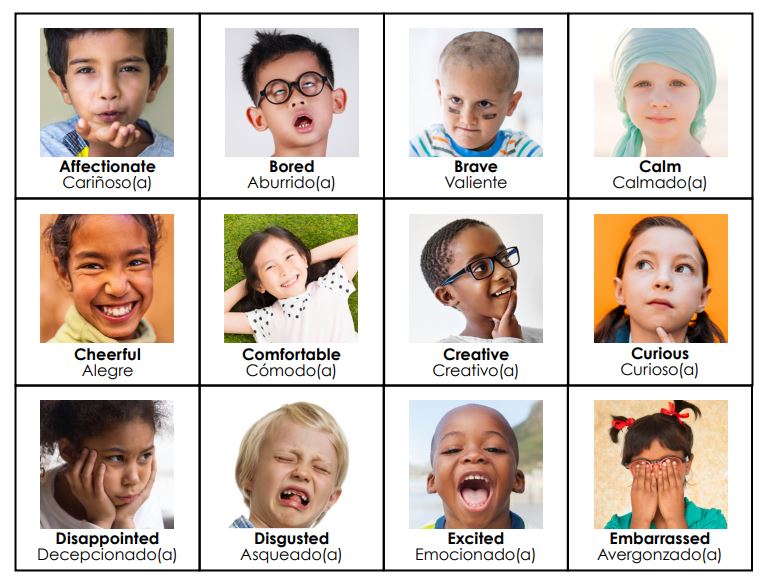
  • Teaching Social Emotional Skills – includes graphics for a feelings chart (see picture above) and problem solving steps.
  • General Resources. Includes a helpful brochure called Positive Solutions for Families: 8 Practical Tips for Parents of Young Children with Challenging Behaviors.

Elsewhere on the site is a helpful video for child care providers or parents about how to teach social skills and emotional skills in the preschool classroom. https://www.youtube.com/watch?v=jVqjF7BDsnw&feature=youtu.be