Today, I listened to a webinar called Power, Proprioception & Play presentation by Kelsie “Mick” Olds (the Occuplaytional Therapist).
They talked about proprioception and its role in emotional regulation. A key idea was that there are three different types of proprioceptive input, and knowing which one is your child’s/student’s go-to helps give important clues about what they might need to avoid and manage dysregulation. The three types are:
Exertion – using their muscles
Impact – bumping part of their body up against something
Pressure – pushing part of their body against something
For each category below, I’ll list “Problem behaviors” they might demonstrate when “throwing a tantrum” or melting down, then list positive behaviors that meet this need. The positive things are activities you could use proactively to make sure their sensory needs are met (and meltdowns are less likely) or you could use to help a dysregulated child calm down.
Impact
“Problem behaviors”: hitting, kicking, breaking things, bouncing off the walls
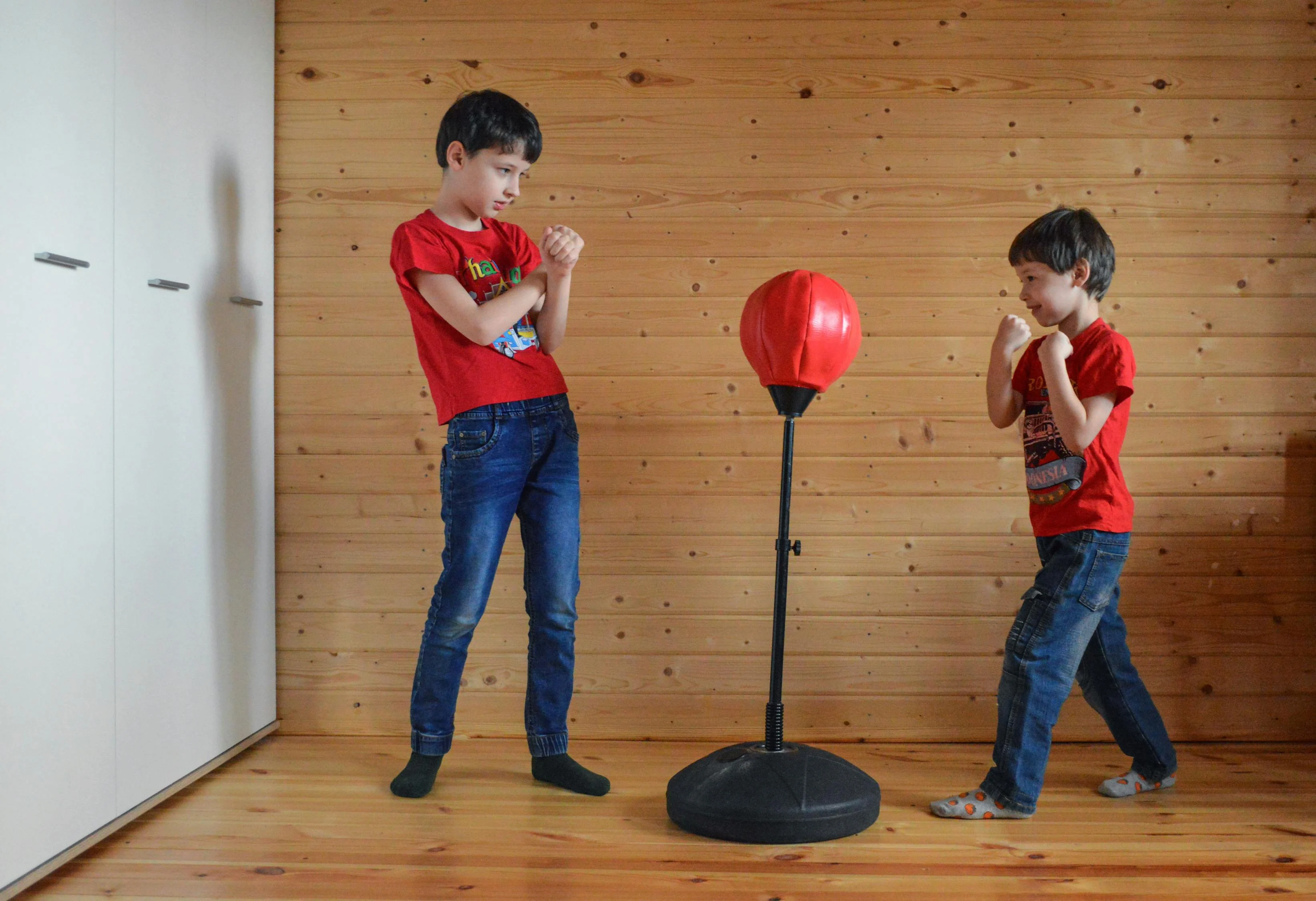
Positive actions: jumping, stomping, clapping, playing catch or tennis, tetherball, dribbling, drumming, trampoline, punching bag
Positive actions: running, dancing, pushing, lifting, “heavy work”, taking a deep breath, rolling out playdough, tearing paper, singing loudly, whisper scream
Pressure
“Problem behaviors”: clinging, climbing on other people, pushing up against others
Positive actions: hugs, leaning against someone or something, massage, weighted blankets and vests, compression clothing
For example, if whenever a child gets dysregulated, they hit or kick, that’s impact that they’re instinctively seeking. Asking them to take a deep breath (exertion) or giving them a hug (pressure) is less likely to be effective than an impact based tool like stomping their feet or banging on a drum. To avoid meltdowns, it might help if they get plenty of opportunity to bounce on a trampoline or playing catch to get the impact input that they need.
I’ve written a lot about emotional development. This post is a brief summary of concepts, with links to learn more. We’ll cover: teaching vocabulary, teaching how to recognize emotions, teaching appropriate ways to express emotions (check out my printable posters!), and thinking about how big the emotion is, – if it’s small your child may be able to manage it – for big emotions, they’ll need your support.
Teaching Vocabulary
Children learn language for abstract concepts when we talk about those things as the child is experiencing them. When they are displaying an emotion (or they notice someone else is), we label it and talk about it. Knowing that emotions exist and having words for them is the first step to coping with those emotions. (Learn more about emotional literacy.)
The core basic emotions to start with are: mad, sad, glad, and scared. (And mad is often masking sad or scared feelings.) Babies demonstrate all these by 8 months. In the toddler years, they add in pride, envy, shame, guilt, and empathy. (Learn about emotional development.)
Teach How to Recognize Emotions
The next step is to teach them to recognize their own feelings and other people’s feelings. Teach about:
body language
facial expressions
tone of voice
actions
Tip: I have posters that include descriptions of these signs.
When your child is experiencing an emotion, tell them the signs you noticed so they notice them too: “I can tell you’re getting mad, because you’re banging that puzzle piece, and your eyebrows look angry.” When someone else is experiencing an emotion, help them identify that: “when you took your friend’s toy, that made him sad – he was crying and went for a snuggle with his daddy.”
You can read books that are aimed at teaching emotional literacy (here are my recommendations for children’s books about big feelings and more ideas on teaching emotional literacy using books). Or in ANY book or show, you can pause to notice feelings… “hmm, how do you think that character is feeling right now? how can you tell? what might help them feel better?”
When doing pretend play or things like puppet shows, role play emotions, including appropriate ways to express them and how to get support for them.
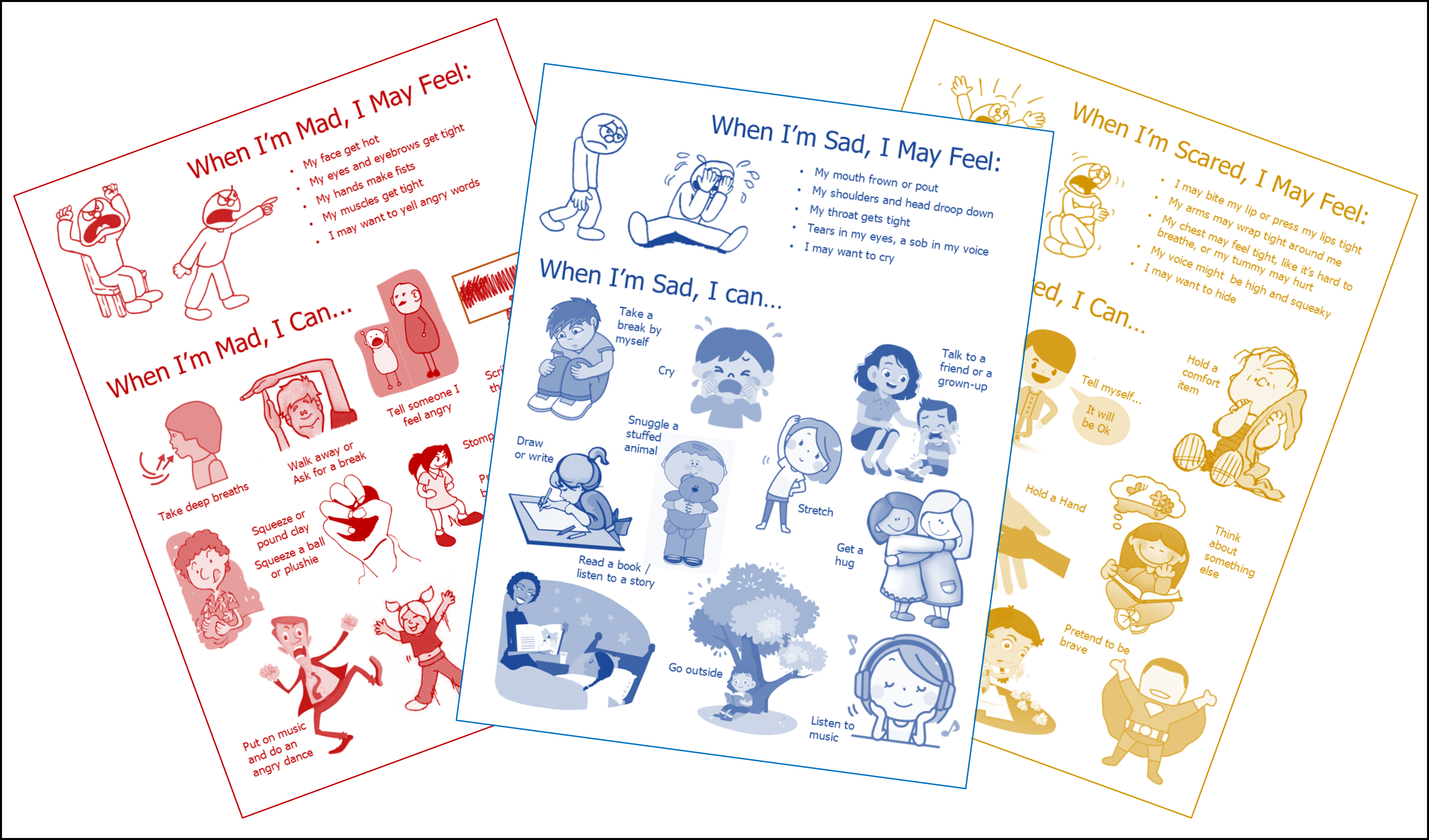
Children are going to have big feelings. They need to have a variety of tools for expressing them. Teach them good options during play time when they’re calm and suggest them when they’re having mild feelings. I have posters you can print and use.
Sometimes emotions can lead children to misbehave. Learn how to use emotion coaching to validate their feelings while still setting limits on behavior. And learn discipline tools for managing misbehavior. One key point I make is “all emotions are OK. Not all behaviors are.”
How Big is the Emotion?
It is helpful for you as the parent to understand different levels of emotion and what they mean for offering emotional support. As your child gets older (3 or older) you’ll start talking with them more about this as well.
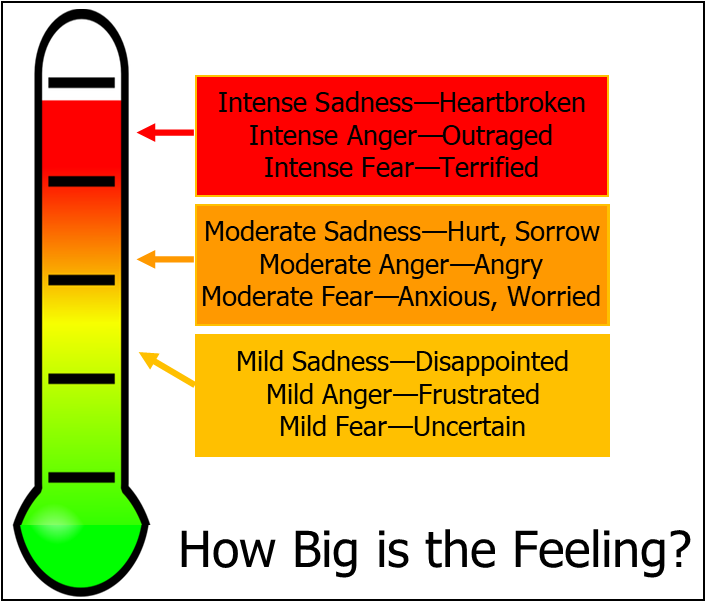
There is a big difference between a child who is annoyed and one who is outraged. A big difference between disappointed and heartbroken. The thermometer metaphor can help us visualize this.
A child who is doing fine is cool and collected – green zone. As they start to feel frustrated, disappointed or uncertain, they’re moving into the yellow zone. As the feelings escalate bigger and bigger, they move to orange and red.
When a child is in the green zone, they’re ready to learn anything. This can be a good time to teach them coping skills and how to self-calm and let them practice them.
When a child is just starting to have feelings (yellow zone), they can often calm themselves. Today, I heard a child reassuring himself as he walked down some steep stairs – “hold the railing, it will be OK if I go slow.” I’ve seen kids getting frustrated stop and take a deep breath to calm down. These are self-calming skills they learned from their parents or teachers and they’re able to access them in these moments of mild upset.
When they are getting anxious, angry or hurt, (orange zone) they may be able to calm down if you coach them on using tools that you have been practicing.
When they are outraged, heartbroken or terrified, they are in the red zone. They have flipped their lid and are in their downstairs brain. (To learn more about what that means and how to handle it, check out this post on Meltdowns, learn more about preventing meltdowns and watch the video below on the Anatomy of a Tantrum to learn when to intervene and when to wait.) In the red zone, they can’t calm themselves without help.
Learn more about identifying how big the feelings are, and about the “zones of regulation” – a tool for helping a child (age 5 or older) learn how to identify their zone and what they might need to get back to the green zone: calm, cool, and ready to learn.
Pretend play, also called dramatic play, imaginary play, or dress-up is a huge part of the preschool years. Let’s talk about: the benefits of pretend play, how children’s play skills develop, and ways that parents and teachers can support imaginary play (and what to do if you don’t enjoy it at first.)
Benefits of Pretend Play
Here are just some of the learning benefits that stem from pretend play:
Social-Emotional Intelligence – By role playing different emotional experiences, children can learn empathy; and can learn how to process and express emotions when they’re not in the midst of managing real feelings.
Exploring Social Roles – Pretend play gives children a chance to learn about different roles that people play, what tools they use and what the rules are for each setting (a teacher at pretend school acts differently and uses different tools than a waitress at a pretend restaurant). This helps them make sense of their world as they play out things they don’t totally understand yet.
Experimenting with their identity – They get to try on different personalities and different styles of interaction.
Abstract Thinking – understanding that this piece of bark that represented an ice cream cone earlier is now representing a piece of pizza for the next “customer” supports symbolic thinking (pre-literacy, pre-numeracy).
Communication and Negotiation. Discussing with a playmate what scenario they want to play out, who plays each role, and taking turns when they both want to be the doctor, helps them practice social skills.
Planning: short and long-term goals. If they want to play restaurant, first they have to gather the toy food, and the play money and set up the table, then decide who plays which role, then begin play – there’s a lot to think through.
Vocabulary: To play out a scenario takes a lot of new words!
Here are some examples of what children can do at each age.
1 to 2 years old. They need concrete props to organize play around. They can imitate things they have seen done in real life: pretend to talk on a toy phone, stir an empty pot with a spoon, pretend to eat toy food, tuck a doll in bed.
2 to 3 years old. Can substitute items – they can pretend a stick is a magic wand, or a pinecone is a cookie. Can play out a couple steps – car drives down road, goes to car wash. They can do pretend play if an adult or older child is supporting the play (by coaching them or asking questions or mimicking behaviors), but they’re not really able to get it with peers.
3 or 4 years old. They can do pretend play with others their age, following a pretty standard “script” where they know what it means to “play house” or “play pet store.”
4 to 5 years old. They play more creatively. “In [mature] pretend play, children act out sophisticated narratives. Children use a combination of objects, actions, and language together in narrative sequences and use language outside of their daily vocabulary as they meaningfully act out different perspectives and roles” (Early Childhood Learning Knowledge Center, 2006, p.2).
Supporting Pretend Play
“The adult should facilitate play, but not dominate play. Support the play, encourage the play. If children get stuck, you want to help them get unstuck and take the next step, but you don’t want to direct it.” (Source) Here are some ways to support it:
Read books and watch movies with that setting so they have a “script” for how to act in a pretend play scenario. (For example, before we do astronaut pretend play in my class, I encourage parents to watch shows about astronauts or read books to give context to the child. Before we did a pretend doctor’s office, we might learn about doctor’s visits.
Narrate steps to act out – “now it’s time to get on the airplane, put your bag here, let’s put on our seatbelts.”
Suggest next step: Can you make me some toast – will you put butter on it?
Pretend to eat. This is always engaging! Note, kids under two have a hard time not really mouthing the pretend food – pelase teach them how to pretend to eat at home, that will help reduce germ transmission at preschool!
Follow your child’s lead – don’t feel like it’s up to you to be witty and create amazing new scenarios – you’re not the director.
Have your own props, such as a doll to feed – model new ideas for them to imitate.
Slow down – take time and let your child process things
No multi-tasking – be present. No matter how tempting it is to scroll through social media, try to give the game your full attention.
Repetition is good – I know it can be exhausting to play the same thing again and again, but children learn through repetition.
If you’re getting bored, think about how to stretch their pretend play. Maybe try reading some new books or watching some new shows to inspure new scenarios? Or use cardboard boxes and items from the recycling bin to make props for a new scenario.
Props
Here are ideas for materials to enhance pretend play. Again, with 1 – 2 year olds, they need the props – older kids can create anything with imagination.
Toddlers have a hard time putting on complicated clothes, so for young children, choose hats, big shoes, capes – be careful about items that go around the neck if they are also playing on large motor equipment.
Three year olds respond best to clothing for characters they see in the real world: police, fire fighters, doctors, baristas
Four year olds love fantasy costumes: princess, fairy, superhero
Spaces – play tent, tunnel, big cardboard box, tent
Themes for Pretend Play: restaurant, school, library, post office, camping, zoo, doctor’s office, airplane, road trip, pirates. Don’t expect a 2 or 3 year old to be able to play something they’ve never experienced – e.g. old time farm life – play real world experience. 4 and ups more adventurous – show them a pirate movie then create a pirate ship on the couch.
What if you don’t like pretend play?
If you don’t enjoy pretend play with your child, you’re not alone!
Here are some tips:
Don’t feel like you have to entertain your child at all times… it’s healthy for them to learn to entertain themselves.
If you want to do things with your child, but just don’t enjoy pretend play, you can cook together, or do art, or play board games, or sports. Doing something you enjoy is better than gritting your teeth through things you don’t enjoy. And you can “outsource” the pretend play to a friend, family member, babysitter or drama teacher who does enjoy it.
Set a timer or something and explain you can play cars for this amount of time then you need to move on to something else.
Find pretend play that does work for you – I don’t love playing house or playing with dolls, but I enjoy putting on puppet shows where I tell a story with “ideas from the audience”
Build things together – asking questions about “what else would we have in our dollhouse” stretches the same abstract thinking muscles for your child.
Watch Bluey to See Pretend Play in Action
The show Bluey on Disney Plus does a fabulous job of illustrating how parents (and other grown-ups) can do pretend play with kids. Here are just a few sample ideas for pretend play scenarios from Bluey. They are cataloged (and there are links to episodes) at: Bluey’s official website, Fatherly, Dad Fixes Everything, and Bluey Wiki.
Taxi or Bus – where will you drive them to? Which passenger will get in next?
Hotel – they’re the desk clerks who check you in and show you to your room.
Restaurant – you’re the customer, they’re the wait staff. What will you order? What will they bring?
Neighbors – stand on both sides of a fence and have a conversation.
The Queen and the Butler. One person sits on the throne and gives orders.
Born Yesterday. Pretend to know nothing, and respond accordingly when they ask you questions or tell you what to do
Open a Zoo: design exhibits with the stuffed animals, make signs, and maps.
Backpack – they fill a backpack with goofy items, and you do travel themed pretend play, when you ask for a ticket, they may give you a plunger.
Kids pretend to be food. You pretend to prepare them .
Early childhood is prime time for learning social skills. Although many children will figure them out on their own, some children, especially neurodiverse kids, may need concrete instruction to build the skills and everyone can benefit from practice! Here are tips for supporting your child’s social development.
Learn what’s normal / what’s next:
If you want to evaluate whether your child is on track with social skills, check out this checklist of play skills (or this one) that children typically develop at each age – you may discover they are right where they should be developmentally. If they haven’t yet mastered some of the typical skills, checklists give you a sense of what to work on.
It’s helpful to know what we’d typically expect at each age, and what’s next in typical development, so you can foster opportunities for learning.
Infants – Babies get lots of practice with social cues and interaction from the adults who care for them. Just practice serve-and-return interactions, where your baby smiles at you and you smile back. Your baby coos and you coo back. (Learn more.) And learn about infant cues to guide your responses. If your baby has the opportunity to interact with additional adults or older children, they will likely happily engage with anyone.
Older Babies. From 6 – 12 months, your baby learns to play more interactively with you and will likely enjoy peek-a-boo, copying your actions, clapping with you, passing toys back and forth, and finding toys you have hidden. Some babies may play happily with all they encounter. However, it is important to know that many infants develop a fear of strangers at around 7 to 8 months. Here are tips on reducing separation anxiety. And more tips.)
Young Toddlers – up to 2 years. Before 18 – 24 months, children primarily engage in solitary play, where they engage with toys, but often appear uninterested or unaware of other children. They do engage with adults or older children more effectively than they do with peers. To build social skills, try Floortime play, which begins with child-led play, then “stretches” the play to be more interactive and turn-taking.
Onlookers: Around 2 years old, they begin to shift to spectator play, where they may begin observing other children more. This is a great time to take them to public parks where they can watch other children at play, up close or from afar.
Older Toddlers – 2+ years. Children begin to engage in parallel play. They will play next to each other, often mimicking what the other child is doing. They may not often engage in reciprocal back-and-forth play with a peer, but they are learning from each other.
“Stealing” toys is very common at this age. They are not intentionally trying to deprive the other child of something… it’s just that they noticed what the other child was doing and they want to do it now. One of the most effective ways to handle this issue is distraction – let the child who seems more focused on the contested toy keep it, and distract the other child with a new toy. That will work better, and is more developmentally appropriate than telling children to share.
Three Year Olds. Around age 3, children begin to do more associate play. They start to interact more with each other, trading toys, copying each other, or “inviting” the other child to participate in what they are doing. They become more interested in the other child than in the toy. They may work together on a goal – like building with blocks, but there aren’t usually “rules” to the game. They can learn social skills by playing with adults or with older children, but it’s great if they can have peer interaction at this age. It does not have to be in a large group pre-school. One-on-one or a few children at a time is fine. It may be tempting to enroll in classes as your primary place to connect with other kids, but if your main goal is social skills, it is easier for children to learn those in settings that allow lots of free play (a playground, playdates with other families, a play-based preschool, or a family size child care setting) than in a structured class (like a gymnastics or soccer class where the teacher is trying to keep them on task.)
Check out the “skills to practice at home” section below.
Four and Five Year Olds. At this age, they have moved into true cooperative play. They share toys, they share ideas, they create “rules” or agree on which role each one will play in a pretend game, and work together toward goals. They start learning more about cooperation, compromise, and fair turn-taking. Whereas at younger ages, it’s fine to have your child play with lots of different kids, this is an important age for children to have a few consistent buddies to play with repeatedly, to build friendship skills. If they are enrolled in a group setting, like preschool or extracurricular classes, look for children there that they most connect with, and try setting up playdates with that family to give them more opportunity to connect.
Skills to Practice at Home
You can boost their social skills by practicing in advance of playdates. Do lots of pretend play, puppet shows and role plays, and talk about the social and emotional experiences of characters in stories that you are reading.
When teaching about emotions, teach children to recognize how facial expressions, body language, and tone of voice all communicate emotion
Practice give-and-take conversations, where you take turns fairly, don’t interrupt each other, and ask the other person questions about what they said rather than always just telling them things. Role model social skills by how you interact with friends, family and people in the community.
If you tell a child, “you have to share that toy”, it’s easy for that to feel like “you have to give away that thing you like right now.” It can cause them to cling tighter. It works better to introduce the ideas of taking turns. Play side by side with your child, and occasionally say ‘you can have that toy for one more minute and then it’s my turn.’ If they try to take a toy from you, say ‘I’m playing with it now. You can have it in one minute. Here’s another toy you can play with now.’ Don’t expect 2 – 3 year olds to be good at taking turns! It’s a skill that needs to be learned and practiced, and they just have to reach a stage of development where they can empathize with another child’s feelings. But practicing at home gives them a chance to build trust in the idea that if they let you have your turn that you will give it back when it’s their turn.
If your child seems shy or withdrawn, learn tips to support a “slow-to-warm-up” child. Some simple ways to help them are: get together in smaller groups in quiet, not chaotic environments; arrive before the other child(ren) to get settled; sit on the ground and let your child sit on your lap till they feel ready to venture out. Don’t push.
I created three posters as visual aids parents and teachers can use for teaching young children lots of options for appropriate ways to express emotions and release big feelings before they get so big that the child melts down. Here are images, or you can download this free PDF of emotional literacy posters for kids.
Poster for children on appropriate ways to express / release anger.Poster for children on ways to handle sadness.Poster for children on ways to cope with fear.
Copyright: these are free to use anywhere, I just ask that no one else sell these for profit.
Learn more about emotional literacy, calm down skills, and the Zones of Regulation tool for noticing and managing emotions. These skills are all useful for toddlers, preschoolers and elementary age kids, age one to 8 years old.


 More Good Days with Kids