I learned about the idea of “books that sing” from Nancy Stewart (Learn more about Books that Sing.) These are books that can be sung aloud, rather than read aloud – they may be illustrated versions of traditional songs, or may be new compositions. I built a year-long preschool music curriculum that included 4 of these books each month. Here are some of the books that I found and used.
Farm Theme
Old McDonald – Cabrera and others
Old Mikamba had a farm – Isadora
Barnyard Dance – Boynton – make up your own tune to this musical rhyming book
Mary Had a Little Lamb – Hoberman or Borgert-Spaniol
Pickin Peas by Macdonald – may be too long for preschoolers
Jingle Bells. Notes on the versions – Jeffers – words don’t go quite in the order kids expect and it does include Santa and Mrs. Claus; the version illustrated by Darcy May is simple and straightforward all the words in the right order, shows bob tail and sleigh and other new vocabulary well; Kovalski – not the best writing, so I might tell a new story to the pictures; Trapani – highlights Xmas traditions around the world, so may not be suitable for a non-secular setting
Stars/Moon Theme
Twinkle – several versions! I like Cabrera, Taylor and Litwin versions better than Borgert-Spaniol
If you child will start preschool in September, now is a great time to start getting them ready. (I’ve got tips here for how to prepare for preschool.) One thing you can do is read books about what it’s like to go to preschool.
Hello Preschool by Burris. (video) This one is my favorite – a really nice intro to what to expect in preschool that also touches on what’s expected of them (like sitting still and listening during group time.)
Rosie Goes to Preschool by Katz (video) is probably my second favorite – again, just a really clear description of what to expect.
Maisy goes to Preschool by Lucy Cousins. (video preview) This is excellent. Typical cute Maisy illustrations give a really good sense of what a day of preschool is like and what fun activities will be there. If your child won’t have naptime at preschool, skip that page.
Going to School by Civardi and Cartwright. (Video) A nice intro to preschool. It’s a little wordy for a just barely 3 year old, but otherwise quite good.
Preschool Day Hooray! by Strauss and Nakata. (video preview.) A cute book with engaging drawings and rhyming text. After you read through it once, go through and talk in detail about the activities shown, and about what a day at preschool is like.
Pete the Kitty’s First Day of Preschool by Kimberly and James Dean (video) is cute, but it starts with Pete packing his paintbrush and glue sticks and taking the bus, and I don’t think these things are typical for preschool.
Preschool Here I Come by Steinberg and Joven. (Video.) There’s so much to love about this book – engaging info, good coverage of everything that happens at preschool. But, oh my goodness, too many words for most preschool age children! Each page has almost as many words as you might find in a full book for a three year old. Maybe you could buy it and read bits of it at a time? Daniel Goes to School is also too wordy for most kids this age – though some love to be read wordier books.
The Things I Love about School by Moroney. (video) This is quite nice, but better reflects kindergarten / first grade experience than preschool.
My First Day at Nursery School by Edwards and Flintoft. (video preview). What I love about this book: it does a great job of showing all the activities at preschool and the day’s routine. What makes me hesitant… it has a theme of “there’s all these great things at preschool but I don’t want them, I want my mommy!” It has a good resolution, but if your child has never had separation issues, I wouldn’t introduce the idea.
On a similar note: Bye Bye Time offers a great strategy for separating when a child is somewhat reluctant, the Kissing Hand is a great book that offers a great goodbye ritual for kids who have a hard time separating, I Love You All Day Long reminds your child that you love them even when you’re not together, and Llama Llama Misses Mama shows how someone who really misses their mama can adapt. But, for all of these, my advice is: if your child isn’t worried about you leaving them, don’t read books that suggest that they should be! Save these for when there’s an issue.
This is How We Get Ready by DK. So… this book is full of helpful tips, like “lay out your clothes the night before, try to get 10 – 13 hours of sleep, and go to bed at the same time each night.” But this is supposed to be read to a 3 year old??? I don’t think it’s a children’s book, but it does have tips that might be helpful for parents.
Note: the book titles have affiliate links – I do get a small referral fee from Amazon (at no cost to you) if you click on the link and then purchase any item. The video links are to YouTube videos that I used to preview the book – I can’t ensure that the whole video is appropriate for your child – these links are not intended as a replacement for the book but intended to encourage you to purchase the book or check it out from your library and support great book authors and illustrators.
I like mixing these in with other books you’re reading to your child so they’re just part of the rotation. But don’t force them on your child. If there’s a day they only want to read the truck books or the butterfly books, that’s totally fine. We’ll have plenty of opportunities to chat about the baby without it being something that blocks your child from what they want to read about in any given moment.
What not to read
There are a lot of books about sibling rivalry and how awful it is to live with a new baby. I would not read those before the baby is born. We don’t want to set things up with the assumption that it will be bad! If it is hard for your child once the baby is there, then definitely check out those books with them, but let’s not start there.
While it can be helpful to read books that talk about some of the challenges of life with a baby, you don’t want that to be the full focus of what you read as you prepare.
What to read:
Books about Pregnancy and Birth
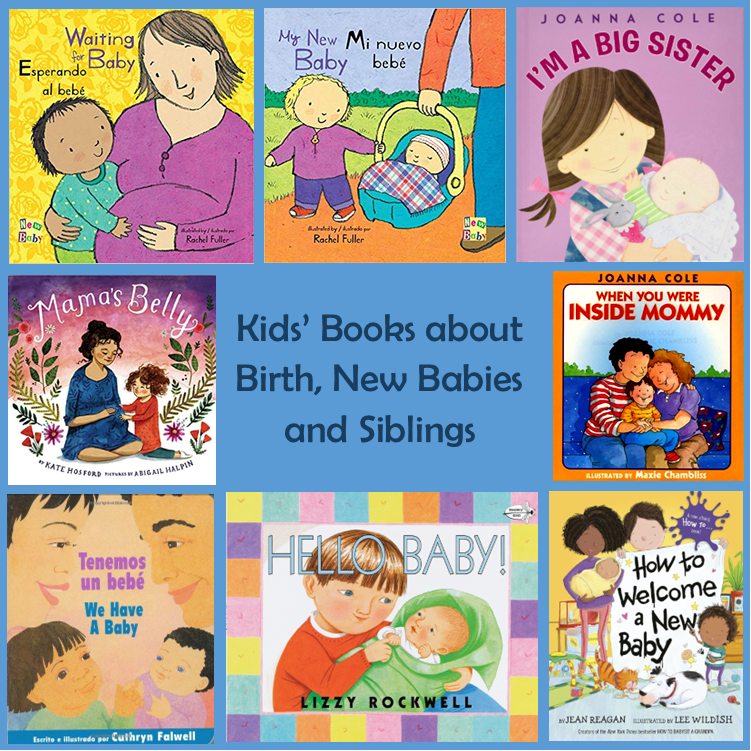
Waiting for Baby / Esperando Al Bebé by Rachel Fuller (2009). For ages 1 to 4. Tells of a sibling’s trip with mom to the doctor, helping prepare for the baby, and meeting the baby at the hospital.
Mama’s Belly by Kate Hosford (2018). For ages 3 to 5. A girl asks her mother questions about the pregnancy and what it will be like when baby arrives.
Hello Baby by Lizzy Rockwell (2000). For ages 4 to 7. Touches on all aspects of the baby-to-come, from prenatal development and doctor appointments to meeting baby at the hospital.
We’re Having a Homebirth!! by Kelly Mochel (2012). For ages 4 to 7. Simple illustrations and brief details about home birth.
When you were Inside Mommy by Joanna Cole (2001). For ages 5 – 8. Discusses fetal development, explaining the umbilical word, using the word uterus, etc.
Babies Don’t Eat Pizza by Danzig. Ages 5 -8. Covers prenatal development and how baby is born “through an opening between mom’s legs”. Compares what the baby can do to what they can do.
Books for Children about Babies and Siblings
My New Baby / Mi Nuevo Bebe by Rachel Fuller (2009) or My New Baby by Annie Kubler (2000). For ages 1 to 4. Tell the stories of new families. In each, the mother breastfeeds, and the father participates in all activities.
Tenemos un bebé / We Have a Baby by Cathryn Falwell (2008). For ages 2 to 4. A simple bilingual board book about loving a new baby. Multiracial family.
I’m a New Big Brother/Sister by Nora Gaydos (2010). For ages 3 to 4. A positive story about what it’s like to be a big brother or sister.
How to Welcome a New Baby by Jean Reagan (2022). For ages 3 to 6. How to prepare for and welcome a baby. Multiracial family.
I’m a Big Sister / Brother by Joanna Cole. Age 3 – 4. This story talks about what babies are capable of and what they need.
I Used to Be the Baby by Robin Ballard (2002). For ages 3 to 6. This book positively portrays sibling relationships and how a sibling can help the baby.
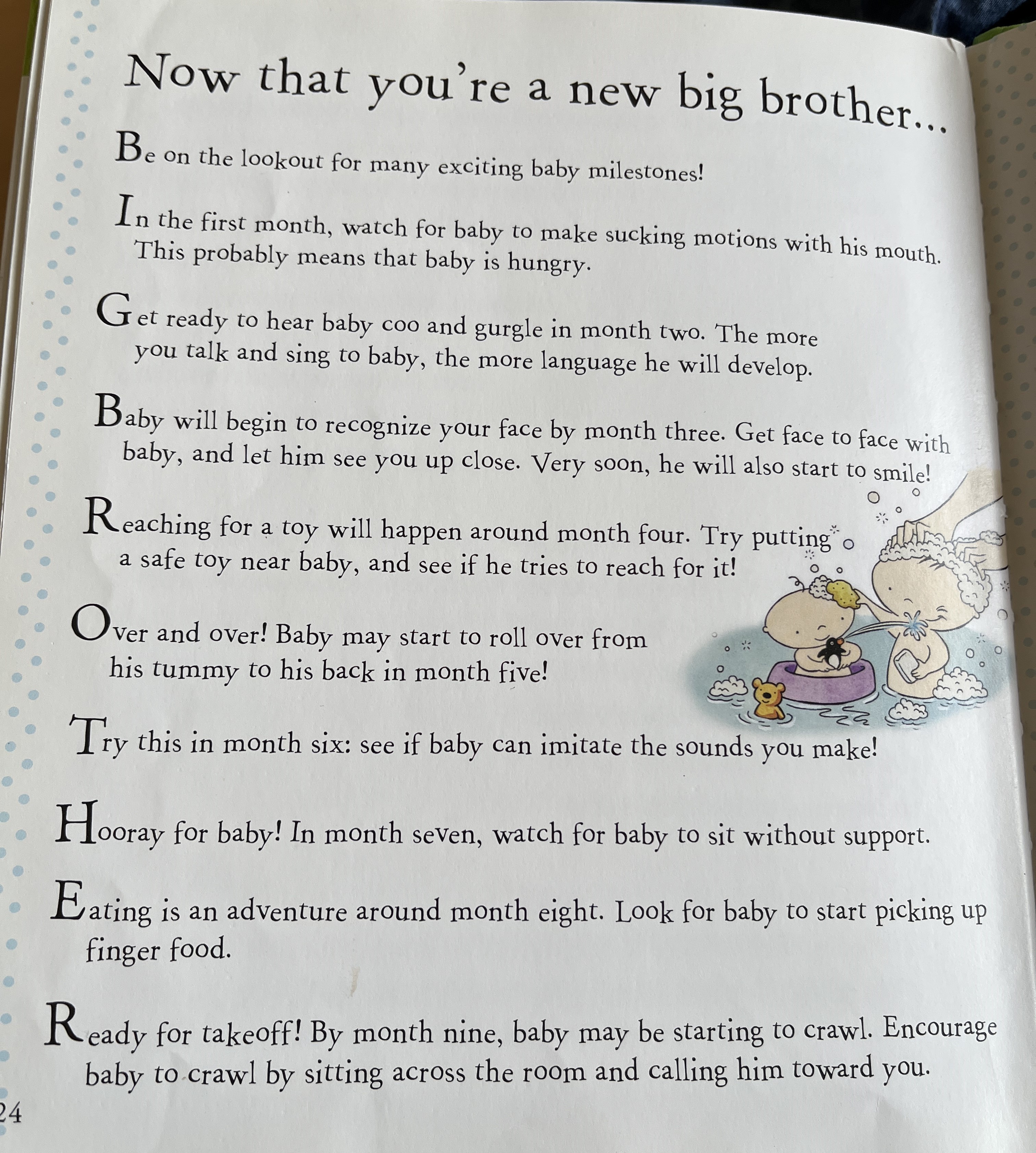
I like these month-by-month tips in the back of Gaydos’ books:
Film
There’s a Baby (DVD) by Penny Simkin (2013). For ages 3 to 8. A children’s film about a baby coming to Maia’s family. At https://pennysimkin.com.
Additional Resources
If you’re looking for more children’s books about sexuality, pregnancy, and how babies are made, check out Books for Children about Sexuality.
About the Links:
Each book includes an Amazon affiliate link to make it easy for you to learn more about each book. If you click through on this link and then purchase anything, I do receive a small referral bonus at no extra cost to you. These books may also be available at your local library. If you would like to preview the content try searching YouTube for “[title of book] read aloud” and there are videos of many of the books in this list. I do encourage you to then go on to purchase the book itself to support the books’ creators.
Note: a similar post also appears on PCNGuide, a blog about pregnancy, childbirth and the newborn written by Janelle Durham, author of this blog.
These books are aimed at children age 3 – 8, and teach many aspects of consent, types of touch, the right to bodily autonomy, and prevention of sexual abuse. You can also check out my post on how to talk to your child about touch and consent.
Most Recommended
If I had to choose just one, I might start with one of these two.
My Body Belongs to Me from My Head to My Toes by Pro Familia and Geisler. (Video) Age 3 – 6. A girl talks about the touch she likes – sitting with friends, hug from Dad, sitting on Grandma’s lap. Then about how she sometimes doesn’t like to be touched. Or touched in certain ways: tickled too much, sloppy kisses. So she says “Stop. Don’t Touch Me. I don’t want you to.” It says if someone doesn’t stop, then tell a trusted person. Ends with “your body belongs only to you.” This book probably has the clearest, most complete message about bodily autonomy. It’s long for a three year old, and not quite as fun a read as some of the books below. [Note this is different than the other “My Body Belongs to Me” by Starishevsky.]
Let’s Talk about Body Boundaries, Consent and Respect by Sanders and Jennings. (Video) Ages 5 – 8. Starts with the idea of body boundaries – draw an imaginary bubble around yourself – no one should come inside that boundary without asking. If someone wants to hug someone, they should ask. The person might say yes – it’s OK to hug because both people are happy about it. The person might say no – respect that. If they say they’re not sure or don’t answer, that’s not a yes, so don’t hug. It’s OK to say no to others – it’s your body and what you say goes. If someone doesn’t respect that, tell a trusted adult. Excellent – but too long – you would want to spread it over multiple readings.
Recommended for Teaching You Can Say No
Here are lots of other ideas, in order from those appropriate for the youngest audience on up. Also check out the table at the bottom which compares them.
Miles is the Boss of His Body. By Schiller and Kurtzman-Counter. (Video) Age 3 – 6. It’s Miles’ birthday. Grandpa pinches his cheek, his brother gives him noogies, his mom gives him a super tight hug, etc. Even the birthday chicken wants to tickle him. Mile yells ‘I’m tired of being touched in ways I don’t like, and I’m the boss of my body.” The family respects and validates that.
Rissy No Kissies. By Howes and Engle. (Video) Age 3 – 6. Rissy is a baby lovebird. Others try to give Rissy kissies. Each time – “‘No kisses!’ Rissy chirruped with a most emphatic squeak.” Her parents worry something is wrong with her – “we know all lovebirds love kisses.” When the chicks at school squeeze too close and she squeaks “no kissies” it hurts their feelings. Rissy worries there is something wrong with her. Her mother says “there is nothing wrong with you. Your body and your heart are yours and you choose how to share.” Rissy says to the others “some birds share their love with kissies but they’re not my favorite things.” She offers that she likes to sing songs, sit close, give / get cards, and high fives. Others respect her wishes.
Yes! No!: A First Conversation About Consent by Madison. (Video preview.) Includes a section in the back with more tips about things parents can talk to their children about, and why it’s helpful. Talks about learning the names of body parts (elbows! penis!), that parents sometimes ask them to do things they don’t want to do (baths and bike helmets) to keep them safe, some people like hugs and some don’t, ask for consent. You can say no, even if it hurts someone’s feelings, and you can ask a grown-up for help saying no.
We Say What’s OK Series by Bowers and Munoz. Age 4 – 6. This series is on consent. The author says there are five key concepts to teach about consent: I listen to my body, I am in charge of my body, I ask permission, I check in, and I accept no. These engaging books feature characters of diverse age, race, and ability. We Listen to Our Bodies (video) talks about tuning into cues in your body that signal that you might be scared, sad, or angry. We Ask Permission (video) is about asking people before we touch them and tuning into body language (of people and of animals) to know if the touch is a positive experience. We Check in with Each Other is about not assuming that just because someone wanted to do something yesterday doesn’t mean they want to do it OK, and about stopping in the middle of something (like a tickle fight) to be sure that they are still OK with it.
My Body: What I Say Goes by Sanders and Hancock. (Video) Ages 5 – 8. Talks about kinds of touch that make them feel safe, what makes them feel unsafe. Early Warning Signs that tell you something is wrong (racing heart, etc.) Have a safety network of adults, including one that’s not in your family, that you can talk to. Private parts – those covered by bathing suit and mouths – includes the vocabulary penis, vulva, etc. If someone touches those, asks you to touch theirs or shows you pictures of private parts, say “stop” and tell a trusted adults. No secrets. Book ends with 5 body safety rules. If you’re looking for a book that explicitly teaches sexual abuse prevention, this does so.
Teach Your Dragon Body Safety by Herman. (Video) Age 5- 8. A dragon shares with his human friend that a girl at school likes to hug him and he doesn’t like it. His friend says it’s OK to say no or ask for a high five. The book then goes on to talk about touches that don’t feel right, private parts, not keeping secrets and having a safety team of people you can tell if someone is touching you in a way you don’t like.
Body Boundaries Make Me Stronger by Cole. (Video) At school, Ben is poking at Nick, then when Nick goes home, he finds out his aunt is coming. Nick tells his parents he doesn’t like the poking and that his aunt hugs too long. His parents let him know you can say no and that other people should respect your body boundary. (Ilustrations show the bubble.) Says no one should touch private parts and you should tell if it happens. Talks about signs that would show you were in danger. And about a safety team.
Recommended for Teaching to Ask for Consent
You may have a kiddo who LOVES to hug and touch others or loves to rough house. Here are books that teach them about the importance of asking first.
Don’t Hug Doug (He Doesn’t Like It) by Finison and Wiseman. (Video) Age 3 – 6. “You can hug a pug. You can hug a bug… but don’t hug Doug. He doesn’t like it.” Shows a friendly, smiling Doug spending time with lots of people, having fun, shaking hands, fist bumping, high fiving, but turning down hugs. “Can you hug these people… There’s only one way to find out. Ask!” Very positive book about all the ways we can connect while respecting people’s personal preference about what types of touch they like.
How to Hug a Pufferfish. By Peterson. (Preview video.) Age 3 – 6. “So you want to hug a pufferfish. Who could blame you?” Shows a super cute pufferfish, talks about all the reasons you might want to give someone a hug – but you don’t want to make a pufferfish puff! “Pufferfish might welcome a hug, under the right conditions.” Pufferfish would like to see you coming, be asked for a hug first, and prefers a slow and gentle hug, or a fin shake. “And you never know, Pufferfish might show you a different way to say I love you.” [Disclaimer: the author is a friend of mine.]
Can I Give You a Squish. By Nelson. (Video.) Age 3 – 6. Kai the mer-boy loves hugs (squishes). He hugs everyone and everything till he tries to give a pufferfish a squish – it puffs, saying it doesn’t like to be squished. Kai feels bad. His friends suggest he tries offering a fin bump, which it likes. Kai learns his friends like tail claps, tentacle shakes and other forms of touch. “Every fish likes their own kind of squish.”
Too Much Touch by Shaffer. (Video) Age 5 – 6. This is more broadly about pushing your agenda ahead of other people’s agendas. Taylor is excited and wants to hug his friends, or wants them to stop swinging to play tag, or stop playing soccer to learn Taylor’s new song. They are unhappy. Then Taylor’s grandparents push things on Taylor and Taylor realizes the importance of asking for consent for engagement with others. Wordy, but teaches a variety of messages..
Additional Books on Topic
No Means No! by Sanders and Zamazing. (Video) Age 4 – 6. Shows people asking to touch (aunt give a kiss, parents offering to help wash her private parts, cousin wrestling, friend asking to hold hands) and girl politely turning things down, and everyone happily moving on to other options, because “if I don’t want a hug or a kiss, No Means No!” “I am strong and I have a voice that is loud and clear. So when I say ‘no’, No Means No.” This is a fine book, but it feels like a lesson-teaching book, and some kids don’t engage with those as well as they engage with more story based books.
Consent Ninja by Nhin. (Video by author) Teaches BOSS method: Boundaries, Object, Speak Up, Share. “When somebody does something that trespasses our boundaries” feels abstract to me. Gives lots of examples. It’s OK but other books are better.
Hands Off, Harry by Wells. (Video) Age 4 – 6. Harry the Alligator likes to act silly in ways that are physically wild, bumping into other kids, sometimes making them spill paint or glue. Despite being given time outs, he keeps bumping into others. They have him wear an inflatable donut ring so he can’t touch others and he learns to respect other’s space and use his hands to help, not hurt. I don’t love this one, because there’s a punitive aspect to how his behavior is handled. It’s gentle, but still…
The Where Hands Go series. (Video) For ages 3 – 5. I’ve only reviewed the first book in the series. What’s good about it: it can be sung to the tune of Heads, Shoulders Knees and Toes (if you fudge the rhythm of a few lines here and there) turning it into a Book that Sings, which can make for an engaging read. However, I don’t like this book: there’s a line at the beginning about “Every night at bath time, she recites a poem…. for me to learn about touches that are bad and those that are good.” And later in the book, it says “When hands begin to stray, then I should run far away…” Talking about safe touch is an important thing to do a few times… just often enough that your child learns the lesson. But the idea of talking to your child every night about the chance that someone could touch them inappropriately is not somethng I would ever recommend. Yes, children need the tools for what to do if something were to happen (teach the idea of “tricky people”) but I want children to generally believe that almost all people are safe and are good, not all predators waiting for their chance.
My Body Belongs to Me by Starishevsky and Padron. (Video) A story of a girl whose uncle’s friend sits down next to her and “touched me in that place that no one else can see.” He tells her to keep a secret. She tells her parents, who say they are proud of her for telling them, and say she could have also told a teacher. She says it’s not her fault that it happened and moves on. I wish there had been a message from the parents that the man’s behavior was wrong and unacceptable – that doesn’t really get addressed. Personally, I would not read this book to my students or to my child because of the discomfort it might cause. But your needs and values may differ.
Hug? by Chua. (Video) A girl hugs a sick cat to make it feel better. Then a dog asks her for a hug. Then LOTS of other animals want to hug her till she’s totally overwhelmed and yells STOP! She says she doesn’t feel well, so the cat asks her if she wants a hug and it makes her feel better. Then lots of animals are shown hugging, and it says hugs are great. The book is fun and silly with great illustrations. But the book description says “There are character education connections here to compassion, tolerance and empathy, and a terrific opportunity for discussions about boundaries.” I don’t see that message come through clearly.
I said no! by King and Rama. This is really lengthy – almost a textbook for a child age 7 – 10. Good content, but too much. The read-aloud video is about 20 minutes long. It could be helpful for a parent to read, just to build a collection of ideas to teach at teachable moments spread over time, not all at once.
Title
Characters
Message
Age
Engaging
My Body Belongs… by Pro Familia
Humans, mostly white
Some touch is nice, some is not as nice. You can tell people ‘don’t touch me.’
4 – 6
Yes
Let’s Talk About
Diverse humans
Consent – ask before touching. You can say no. Tell adult if uncomfortable.
5 – 8
Yes, but long
Don’t Hug Doug
Humans, diverse age, race, ability, size
Not everyone likes to be hugged. Ask first.
3 – 6
Yes!
How to Hug a
Sea creatures
Respect that some people only like touch under certain conditions
3 – 6
Yes!
Can I Give
Merpeople, sea creatures
Ask others how they like to be touched
3 – 6
Yes!
Miles is the…
Human family, diverse skin tone, age
You can tell people you don’t want them to touch you
3 – 6
Yes
Rissy No Kiss
Lovebirds
Some people don’t like kisses, and it’s OK for them to say how they like to connect
3 – 6
Yes
No Means No
Human (white family, diverse classmates)
If someone wants to touch you, you can say no thanks
4 – 6
OK
Hands Off
Alligators
Don’t bump into, poke or push others – learn personal space
4 – 6
Yes
My Body – What I say
Humans, white girl protagonist, diverse others
5 body safety rules – early warning system, private parts, safety net
5 – 8
OK
Teach Your Dragon
Dragon protagonist, humans
It’s OK to say no to hugs and other touches. If someone touches you in a way you don’t like, tell
5 – 8
Yes
My Body Belongs by Starishevsky
Humans. Bi-racial child, white abuser
When someone else touches your private parts, you should tell someone
3 – 6
Worrisome
Hug?
Human girl and animals
Sometimes too many friends want hugs and that’s overwhelming
3 – 4
Yes
I said no
Humans – white boy protagonist, diverse others
Textbook on keeping private parts private
7 – 10
Too long
Learning More
For each book, I include an Amazon affiliate link that takes you to that book on Amazon so that you can read all the details about it and read other reviews. I do get a small referral fee if you click on those links and then purchase something on Amazon. However, I encourage you to use your local library – encourage them to have books like these in their collection! Or to purchase from local, independent booksellers. Learn more about where to find great kids’ books.
For each, I also give a link to a YouTube video of a read-aloud of the book so that you can preview the book in detail. (Note: I don’t know whether the creators of these videos had permission, or if they were violating copyright. So I tried to choose videos without ads, so the video creators don’t gain financial benefit.)
Recently I wrote a post on the Slow to Warm Up child. I looked for some books that might help them to feel seen and also feel inspired to try new things.
Lots of books and videos are about the bold, brave extroverts. But, there are some great stories about slow to warm up kids who overcome their caution and go on big adventures or take on challenges that scare them. Look for stories where a shy or quiet or cautious or worried child tries something new or finds their voice but doesn’t have to change who they are. These stories can help these kids know they’re not alone and give them more confidence about trying new things.
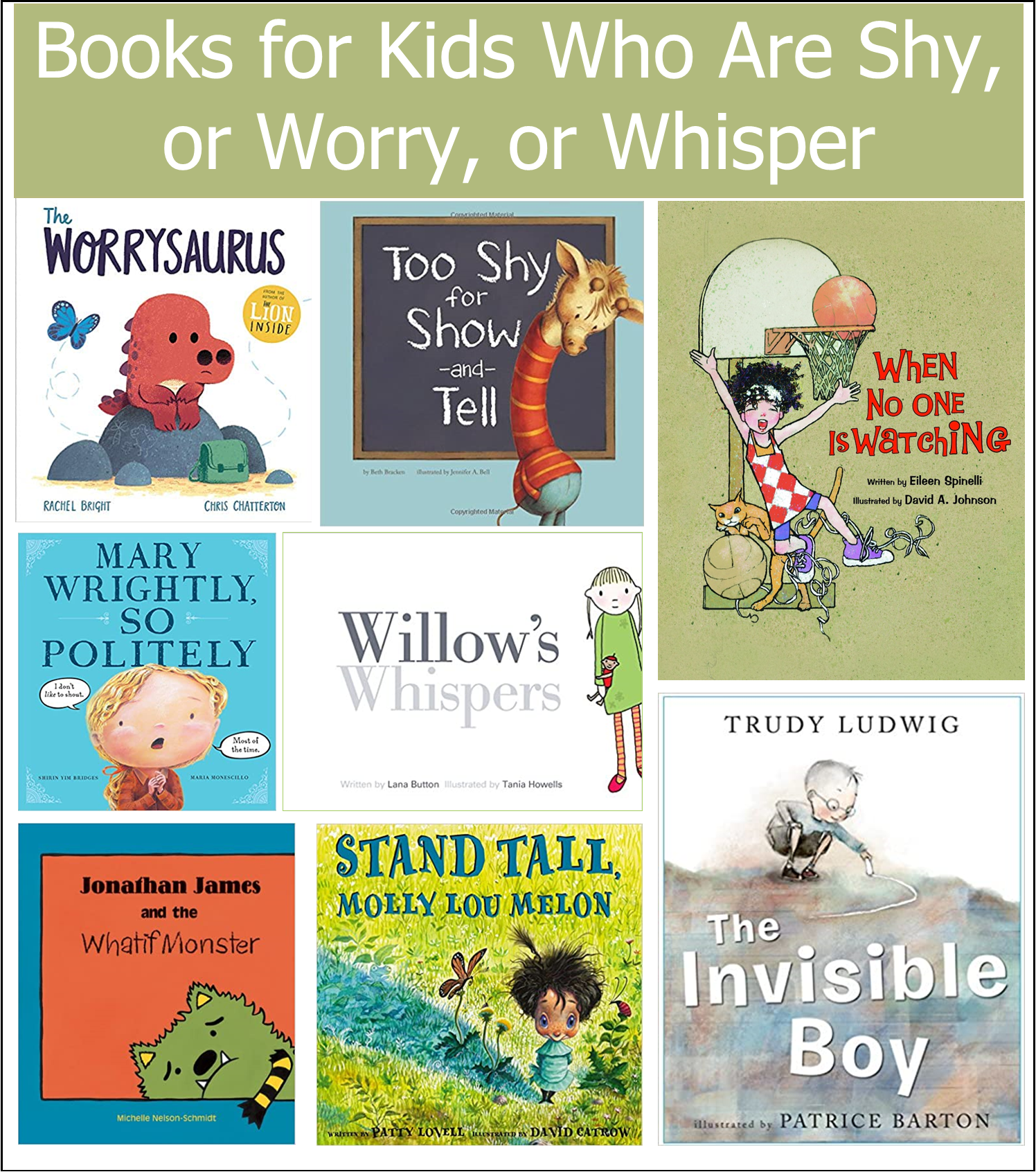
When No One is Watching by Spinelli. (Read-Aloud.) The narrator talks about all the bold, brave, fun things she does when no one is watching. But then she hides all that when any one is looking at her. Until she finds a special friend who she feels comfortable with, and can do everything with.
Stand Tall, Molly Lou Melon by Lovell, illus Catrow. (Read-Aloud.) Molly Lou is short, and has buck teeth, and an unusual voice – all things that might make people judge her but her grandmother teaches her to love all the unique things about herself. When she starts at a new school, she stands up for herself and finds her place.
Too Shy for Show-and-Tell by Bracken, illus Bell. (Read-aloud) Sam is a quiet boy who feels like no one knows anything about him. But he’s afraid to do show and tell. In the end, he does and makes friends. I would not read this to a child who wasn’t scared of doing show and tell (we don’t want to create a fear!) but it would be great for one who was.
The Invisible Boy by Ludwig, illus Barton. (Read-aloud.) This tells about a boy who feels invisible until a new friend notices his drawing skills. Good for an elementary school child who is feeling left out.
Willow’s Whispers by Button, illus Howell. (Read-aloud.) Willow’s voice always comes out in whispers – her teacher can’t hear when she asks for apple juice and gives her orange; a student can’t hear when she says “I’m playing with that” and takes the toy. Willow’s dad supports her, and she finds her voice. Good for 4 – 7 year olds who can’t find their voice.
Mary Wrightly, So Politely by Bridges, illus Monescillo. (read-aloud.) Mary is always polite. But she’s also so very quiet that many people don’t hear her. She learns to speak up loudly (but still politely) when she needs to in order to get a special present for her brother. For 4 – 7 year olds who need to learn to speak up.
What do you recommend?
These books are specifically written for kids who are challenged by their shyness, their worries, or their tendency to make themselves small. There are also quiet kids who like to observe before jumping in – not because they’re shy or worried, just because that’s how they like to do things… I’d love recommendations for books about those kinds of kids – please add comments!
Note: this post contains Amazon Affiliate links. If you click on those links, then purchase an item on Amazon, I do receive a small referral bonus.


 (
(

 More Good Days with Kids