 Sensory Activities to Do:
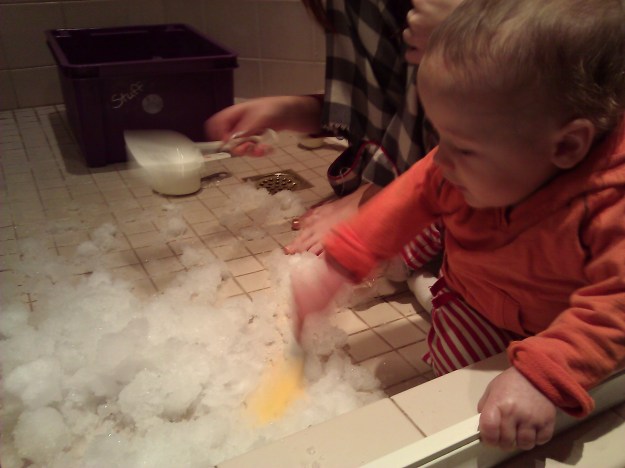
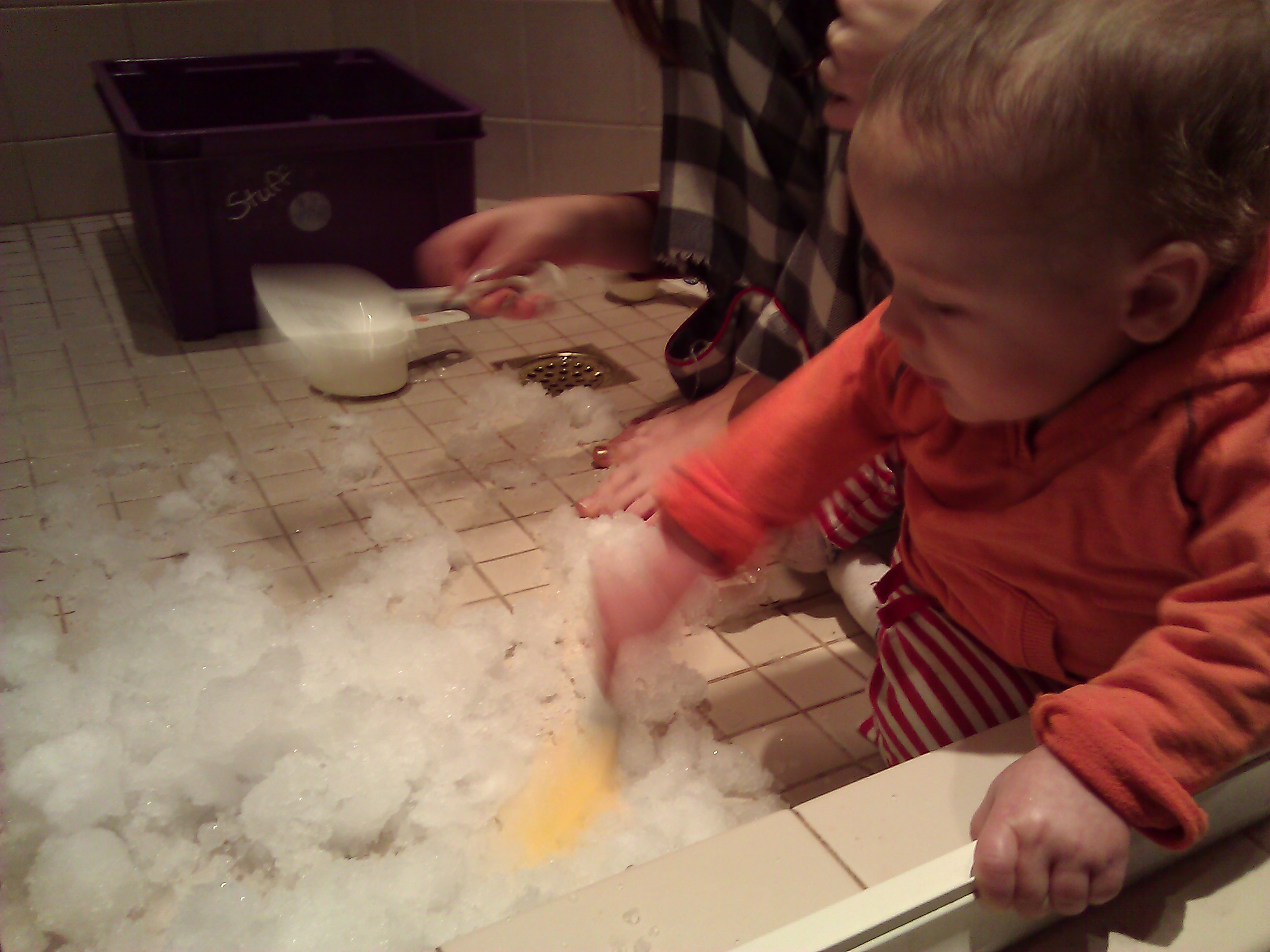
Snow in the Shower. When it snows, parents will often excitedly bundle up their toddler, and take them out to play. Then the child just sits and shivers and looks sadly up at the parent. It’s not as fun as you expected it might be.
Instead, try bringing the snow inside! Make sure your bathroom is nice and warm, then bring a big bucket of snow and dump it on the floor of your shower or bathtub and put your child next to it with shovels and toys. (He can even be fully clothed to stay warm.) As the snow melts, it disappears down the drain, so no clean-up required! When your child is done playing, run a warm bath or shower to warm him back up.
Ice Play
- Hockey rink: freeze a cake pan of water. Make mini “hockey sticks” and use a checker as the puck. Hit the puck back and forth to score.
- Excavation: Use a loaf pan or large bowls to make blocks of ice. Freeze items inside (e.g. plastic penguins or Legos). Set it out on a tray to catch the water as it melts. Give your child a toy hammer and other tools to excavate the toys.
- Melting experiments: Give your child ice, water with pipettes or eye droppers, salt to sprinkle. Let them explore how to get the ice to melt. Add food coloring or liquid watercolors to make it prettier.
Dry Ice Experiments: Check out my post for lots of ideas. Note – this requires close supervision!!
Games to Play:
Indoor Snowball Fight. Make or buy big white pompoms, or soft white balls. Or just wad up a bunch of paper into balls. Or ball up pairs of socks. Fill a basket with them. Then spontaneously start snowball battles anytime you want to! Not only is this tons of fun, I like playing games where I throw (soft) things at my kids. It helps them be a little bolder about ball games later in life – a little more willing to “head” the ball in a soccer game. This also allows them to get out their throwing energy indoors without much risk of damaging anything.
Crafts to Do:
howwelearnathome.cm
Mittens: Cut out 10 paper mittens. Have your child decorate them. (Or for younger kids, have them scribble / finger paint all over a piece of paper, THEN cut out mitten shapes.) Then do the 10 little mittens rhyme together.
Tracks in the Snow. Take some colored construction paper. (Green, brown, or whatever you have.) Squirt white paint onto it. Use a paintbrush to spread it around, smoothing it. Then walk some toy animals or dolls across it. Point out their tracks. Drag a stick across it. Drag across a fork or a comb. Notice the paths they make in the paint. Then spread the paint back out again smoothing it over, and make some more tracks.
Tracks in the Snow, take 2. Make white play-dough. Play with toy animals and dolls in it, and point out the tracks they make. (Source, with pictures.)
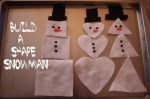
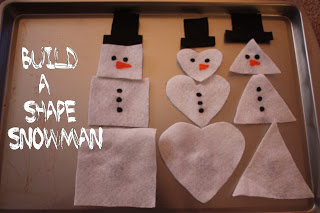
Shape snowmen. Check out original idea here.
Snowy Day. Make a drawing (or find a picture) of an outdoor scene with trees and more. Put out white paint and show your child how to put one finger in, then dot it on the paper to make a snowflake. They make more and more snowflake dots till the landscape is covered in snow.
Rhymes to Say
Up the Mountain rhyme
Sit child on your lap
Up the mountain (run your fingers up one of their arms)
Down the other side (then run fingers down their other arm)
Brr it’s cold out… (hug them tight)
Let’s climb inside! (tickle their neck as you reach your fingers under their collar)
Five little snowmen
Five little snowmen standing in a row (hold up 5 fingers)
Each with a hat (pat head) and a big red bow (pull at neck like a bow tie)
Along came the sun (arms form big circle over head)
and it shone all day (lean sideways)
And one of those snowmen melted away! (put down one finger)
Continue until there are no snowmen left.
Disappearing Snowman
(make a paper snowman; cut as you tell story, making snowman smaller)
On Monday, I made a snowman. Just like that.
On Tuesday, the wind blew some snow away. Just like that.
On Wednesday, it rained on my snowman. Just like that.
On Thursday, the hot sun started to melt it. Just like that.
On Friday, it melted into a puddle. Just like that.
On Saturday, it snowed again. Just like that.
On Sunday, I made another snowman. Just like that.
Three little snowmen. (mime 3 fingers perched on sled made by other hand)
3 little snowmen riding on a sled. One fell off and bumped his head. Mama called…
Songs to Sing
For the first two songs, make your child a paper snowflake and have them put it on their head, their knee, etc.
Little Snowflake Swirling Round (tune: London Bridges)
Little snowflake twirling round
Twirling round, twirling round
Little snowflake twirling round
Lands on my head!
Repeat with different body parts.
It is Snowing (Tune: Frere Jacques)
It is snowing, it is snowing,
All around, all around.
See the pretty snowflakes, See the pretty snowflakes,
Touch the ground. Touch the ground.
Snow is Falling (tune: Skip to My Lou)
Snow is falling, what do I do? Snow is falling, what do I do?
Snow is falling, what do I do? What do I do, my darling
I’ll build a snowman bigger than you! …That’s what I’ll do, my darling!
I’ll ride my sled fast, how about you?… That’s what I’ll do, my darling!
Sing the My Mittens song in those inevitable moments when you’re searching for your child’s missing mittens.
Books to Read:
Amy Loves the Snow by Hoban. Sweet simple story for little ones.
The Snowman Storybook  or The Snowman
 by Raymond Briggs. These are the same story, but the Snowman is wordless – you tell the story in your own words. Beautiful illustrations. Story of a snowman who comes to life. Note: This book has a sad ending. (I think that’s OK – helps to build emotional literacy. But some parents prefer to avoid.)
Red Sled or Red Hat
 by Judge or The Mitten
 by Jan Brett. All three are stories of woodland creatures getting into mischief with children’s belongings. On the long side for toddlers, so save for when they’re feeling calm and patient.
The Snowy Day by Ezra Keats. A little boy in the city enjoys a snowy day. This book, published in 1963, was noteworthy for being one of the first picture books to feature an African-American child. Note: this combines really nicely with the “tracks in the snow” activity above, where you can show how the doll tracks or the track from the stick is like what was shown in the book.
Other books toddlers love: Books that sing – Itsy bitsy snowman, I’m a Little Snowman. Counting Books – Millions of Snowflakes. A Winter Walk in the City. Other: Dr. Seuss’ Winter Things. Biscuit’s Snowy Day. Colors in the Cold. Snow Kisses. Let it Snow;
More ideas (and source citations) at: http://www.pinterest.com/bcparented
For my full collection of theme-based “Fun with Toddlers”, click on “Fun with Toddlers series” in the right hand side bar. These are great for parents or for teachers and librarians doing story-time for toddlers or preschoolers. If you would like theme information in printable handout form to share with students, click here.

 by Hoban. Sweet simple story for little ones.
 or
or  by Raymond Briggs. These are the same story, but the Snowman is wordless – you tell the story in your own words. Beautiful illustrations. Story of a snowman who comes to life. Note: This book has a sad ending. (I think that’s OK – helps to
  or
or  by Judge or
  by Jan Brett. All three are stories of woodland creatures getting into mischief with children’s belongings. On the long side for toddlers, so save for when they’re feeling calm and patient.
 by Ezra Keats. A little boy in the city enjoys a snowy day. This book, published in 1963, was noteworthy for being one of the first picture books to feature an African-American child. Note: this combines really nicely with the “tracks in the snow” activity above, where you can show how the doll tracks or the track from the stick is like what was shown in the book.
 with their names on them (so helpful for me, as I only knew a third of the kids at the party) and construction
  pretty cheap on Amazon.)
 (including a couple s


 More Good Days with Kids