Author Archives: Janelle Durham

Unknown's avatar

About Janelle Durham

I am a parent educator and social worker, and teach music and science to children age 1 - 8.

Love Maps

John Gottman, a prominent relationship researcher, says that successful couples have “Love Maps” of each other’s lives.

These couples have made plenty of cognitive room in their minds for their relationship. They remember the major events in each other’s histories, and they keep updating their information as the facts and feelings of their spouse’s world change. They know each other’s goals in life, each other’s worries, each other’s hopes and dreams. Without such a love map, you can’t really know your partner. And if you don’t really know someone, how can you truly love them? (Source)

I think love maps are VERY powerful.

I know someone who says “Every time my mom calls me, she asks me about the weather. I would love it if someday she said ‘How’s work?’ or, even better ‘I know you’ve been frustrated by budget issues at work – is that getting better?'”

I know lots of parents of school age children whose standard question every day is “So, how was school?” Think how much more powerful these questions would be: “I know you were worried about your math test today – how did it go?” or “You and Chris have been having a great time playing ____ together. Did you have time to do that today?”

Read more about love maps:

http://www.gottmanblog.com/sound-relationship-house/2014/10/28/the-sound-relationship-house-build-love-maps?rq=build%20love%20maps

DIY Water Wall

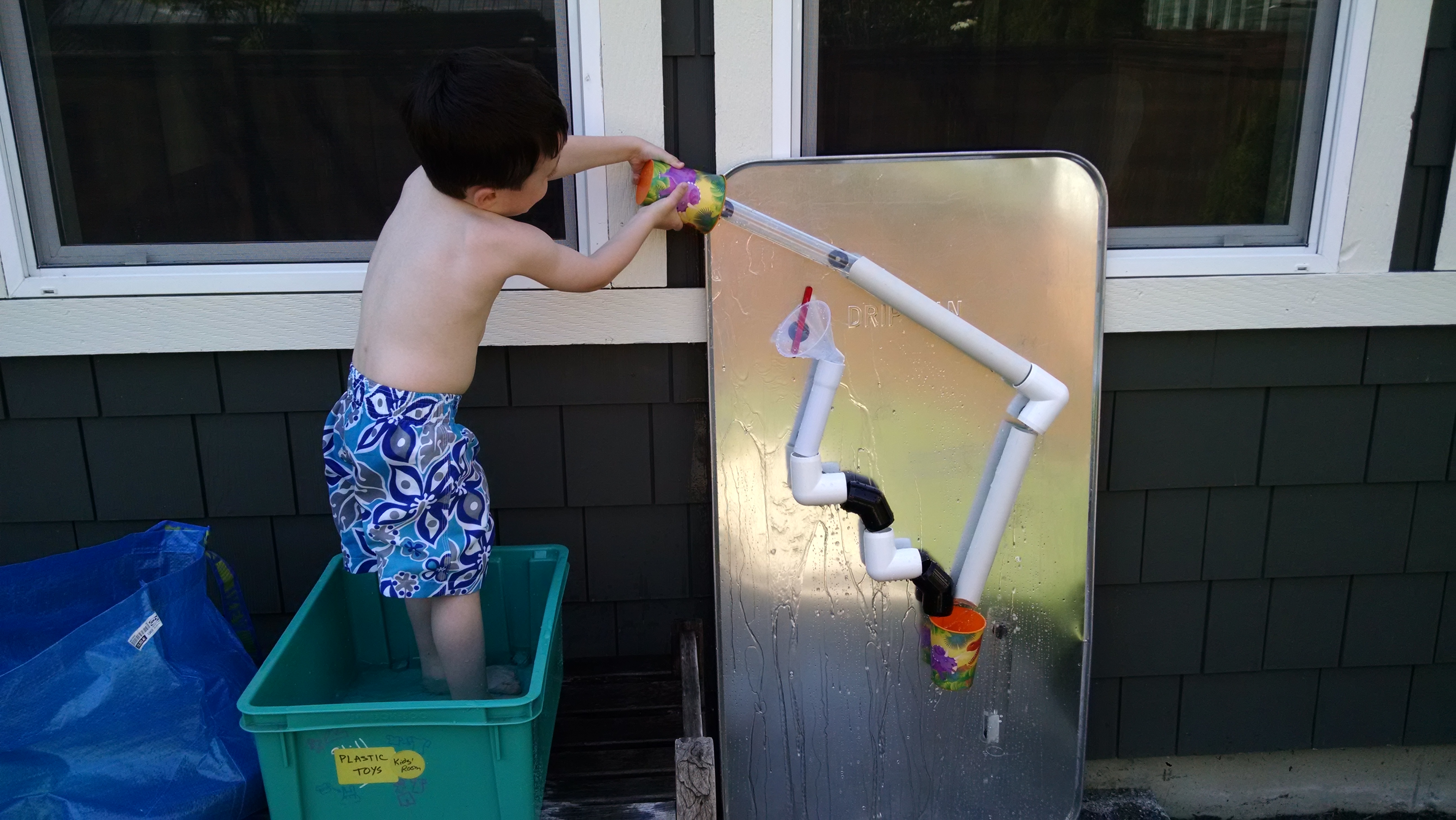
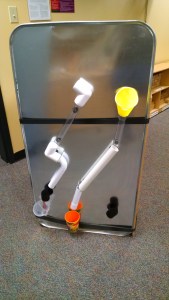
pourWhen I built our ball wall / marble run, my goal was to have a flexible design so the pieces could also be used for water play and for a sensory table. With this week’s nice weather, we were able to test the theory, and it was a great success in terms of fun!

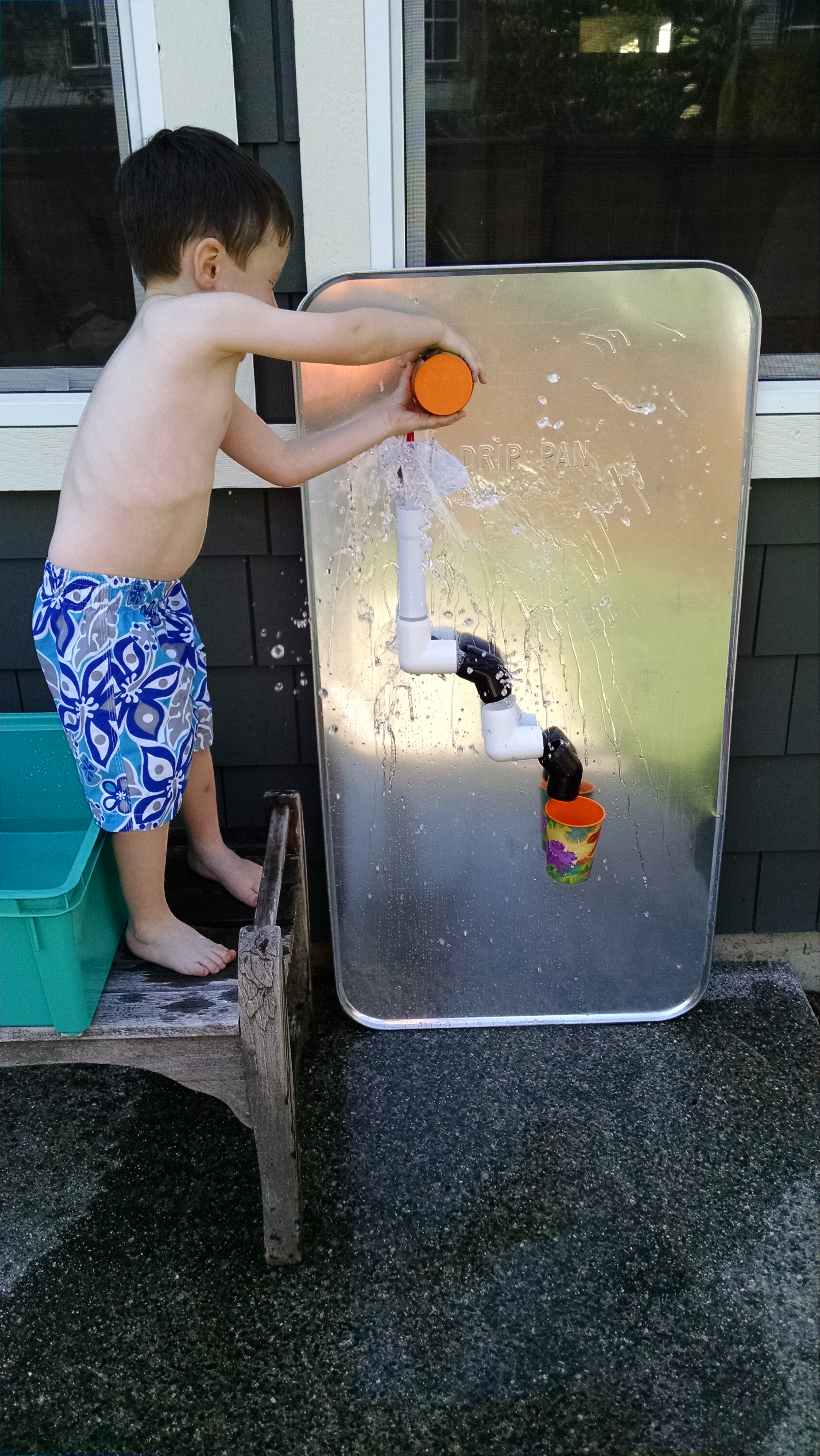
You can see there is some leaking that happens around the joints when two same-dimension connectors or pipes are next to each other (which was fine with my son – he liked that there was water coming out everywhere), but probably 50 – 60% of the volume of the water made it all the way through the maze.

splashThe water works work better when you pour slowly, but my son liked the splash effect he got from pouring quickly.

The end point of our water maze was a plastic cup with two magnets glued on it. Whenever it filled up, we replaced it with the other cup, and poured the captured water back through the maze – we also had a tub full of water nearby.

The best part: when the cup fills up all the way with water, the weight is more than the magnets can support, so it slides to the ground. “Level complete!”

Fun with Toddlers: Duck Theme

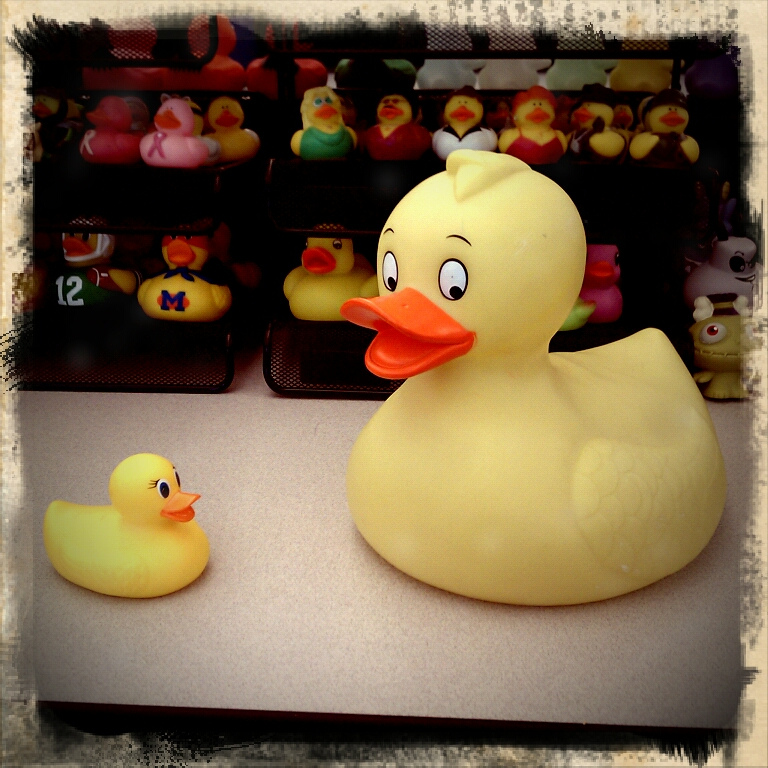
duckEach spring in our classroom, we have a spring theme with rain, raindrops and flowers, and on week 3 of the theme, the ducks appear! There are tons of great picture books about ducks, so in this post, I include lots of book recommendations and ideas for activities to accompany those books.

Songs to Sing

Five Little Ducks Went Out One Day
http://tmas.kcls.org/five-little-ducks-went-out-one-day/

Five Little Ducks went out one day, over the hills and far away.
Mother Duck said, “Quack, Quack, Quack,” but only four little ducks came back.
Four little ducks went out one day… …but only three little ducks came back.
(Repeat counting down to “but no little ducks came back.”)
Sad mother duck went out one day, over the hills and far away
Mother Duck said, “Quack, Quack, Quack.” Five little ducks came running back.

Six Little Ducks that I Once Knew http://tmas.kcls.org/six-little-ducks/

Six little ducks that I once knew, Fat ones, skinny ones, fair ones too!
But the one little duck with the feather on her back,
She led the others with a quack quack quack.
Quack quack quack. Quack quack quack. She led the others with a quack quack quack.

Down to the river they would go, A wibble wobble, wibble wobble, to and fro.
But the one little duck with the feather on her back,
She led the others with a quack quack quack.
Quack quack quack. Quack quack quack. She led the others with a quack quack quack.

Duck Picture Books and Activities they Inspire

Five Little Ducks by Raffi. The words from the song (above) in a book with illustrations. And 10 Rubber Duckies by William Winburn. These are both countdown songs/stories, and they have a really great rhyme and rhythm – easy for kids to predict what will happen next and easy to memorize!

  • Sing the song, and act it out with rubber ducks or handmade puppets. These are great for learning to subtract and learning about zero.
  • You may also use foam numbers – put 5 numbers on the table (or on the wall of the tub). As each duck disappears, take away a number to see how many are left.

One Duck Stuck by Phyllis Root. (Be sure to get the full version, not the board book – it’s abridged, and you miss some of the great language.) Fabulous rhyming, rhythmic words. And a counting book. And lots of fun marshland creatures.

  • Dramatic play: make masks or finger puppets of the animals in the book. One child pretends to be the duck and says “Help, Help, who Can Help.” Other kids (or the parent if you’re playing this one-on-one at home) come to the rescue.
  • Sensory play in muddy muck: give child a bag of dirt (or collect dirt from yard). Spend time exploring the dirt, describing it, looking at it through a magnifying glass. Add a little water. Explore some more. Then add more water till you’ve got gooey mud. Get a toy duck stuck.
  • Find photos of real ducks, real marshes, and real marsh-land creatures.

10 Little Rubber Ducks by Eric Carle. Based on a real-life story of a shipping carton of rubber ducks that fell into the ocean. Ten ducks float off in separate directions and encounter a variety of sea life.

  • Art: Make 10 paper ducks. Label 1 – 10. Your child glues them to a blue paper ocean
  • Numbers: Collect 10 rubber ducks, or use paper ducks. Child rolls dice, counts the dots, puts that many ducks in the tub to show “how many fell into the ocean?”
  • Talk about ordinal numbers and directions: the first duck swam north, the second duck swam south, and so on. Play a game where your child goes in the direction you say: “the little duck swam left, the little duck swam right, the little duck went up the stairs.”

Have You Seen My Duckling? by Nancy Tafuri. A mother searches for her baby.

Little Quack by Lauren Thompson. A book about a duckling who overcomes his fear and learns to swim. It would be a great read in the weeks before starting swimming lessons!

Even more great picture books about ducks: https://homeschool.rebeccareid.com/duck-picture-books/ 

More ideas (and source citations) at: www.pinterest.com/bcparented

photo credit: shot_1305563005476 via photopin (license)

Relationship Skills for Parents

In every relationship – whether with our romantic partners, our children, our parents, our co-workers, or friends – we have good days and bad days. We can have more good days if we know and use effective relationship skills. Here are some I find most helpful, with links to find more details on whichever tools resonate most for you. (You can also find a summary of these in my Relationship Toolbox handout.)

Turning Toward your Partner (based on Gottman)

When someone wants to make a connection, they make “bids for affection.” These can be questions, invitations, non-verbal gestures, glances, or touch – anything that asks you to connect. When someone bids for your attention, there are three main categories of ways that you might respond.

Turn Toward: Act in a responsive, interested, positive, and loving way. Reach out, touch them, look at them, smile. Say “I hear you”, “I want to connect with you,” “I’m interested in you.” Ask a question.

Turn Away: Act in a way that ignores them, or dismisses their bid. Look away, wander away. Don’t respond verbally, or respond in a way that has nothing to do with what they said.

Turn Against: Act in an angry way that rejects them and their bid. Walk away, glare, make threatening movements. Use sarcasm or put-downs, roll your eyes. Do the opposite of what they asked you to do.

In the most successful relationships, partners have a 20:1 ratio. They have 20 positive bids and/or turning toward incidents for every one incident of turning against or away. Can you aim for at least 5:1?

Expressing Appreciation (inspired by Hendricks and Louden)

When juggling day-to-day responsibilities at work, home, and with children, we  we might start feeling disconnected and invisible, or drained and undervalued. One of the best ways to re-fill our tanks is by creating a “culture of appreciation”. Some ideas:

  • Always thank your partner for the things s/he has done. Even if they’re part of his/her “job.” It’s still nice to know that they are noticed and appreciated.
  • When asking your partner to do something, make it a real question (i.e. something they could say no to) not an order disguised as a question. Say please – and thank you.
  • Five minute writing. You each spend five full minutes listing everything you love about your partner – the big things and the little ones. Pour out all the appreciation you haven’t had time to share. Give your list to your partner.
  • Post-its: leave notes around the house, listing what you love about each other.

Speak your partner’s love language (Chapman)

In Chapman’s The Five Love Languages, he argues that different individuals have different “languages” they use to express love, and that we “hear” love best when it’s spoken in our language. Which one of these sounds most like how your partner hears love from you? Which describes how you hear love?

Physical Touch: Feels most loved when you touch: stroke their hair, hold hands, massage, rub their feet, hugging, kissing, sex. Feels most rejected when touch is missing (or if touch is used in anger).

Words of Affirmation: Encouragement and praise are vital. Being acknowledged for work, appreciated for who s/he is, validated for concerns, cheered on for efforts. Sensitive to criticism.

Acts of Service: Wants active support with household tasks, like laundry, washing dishes, running errands, making a to-do list together. Feels unsupported if you don’t pitch in.

Gifts: Loves any special little thing done just for him/her. A card, something special from the grocery store, pictures of the baby texted during the day. Will be especially upset if you forget a birthday, anniversary or other gift-giving occasion.

Quality Time: Wants your Presence – time together, spent talking and connecting, doing activities together. Feels unsupported if you’re off buying gifts or doing tasks instead of spending time together.

Discuss this with your partner. Are you right about what his/her language is? What does s/he think is your language? Sometimes couples discover that if one is feeling unloved, it’s not that their partner wasn’t trying to communicate love, it’s just that they were shouting a lot in the wrong language.

Spend Time with your Partner

Ideally, you will find a way to have a regular date night with your partner. It doesn’t have to be anything fancy. Just a chance to be together, really listen to each other, really see the other person, and remember why you chose to spend your lives together.

But beyond date night, think about ways that even a few minutes a day can make a big difference. In an article by Carolyn Pirak, she recommends making a commitment to spending 40 minutes a day to improve your relationship: When you separate, spend  two minutes saying goodbye. When you reunite, spend 20 minutes talking about your days. Take five minutes to express appreciation to each other. Devote 8 minutes to showing affection. Give five minutes a day to sharing dreams and planning ahead.

Make a plan for special time together this week. Each day, grab some sweet little moments together.

Conflict Resolution / Communicating needs

Many conflicts arise because one or both of you is not getting something that you need. You can start feeling like opponents on opposite sides of an issue or like competitors for scarce resources. Here’s how to start thinking like allies again, and being working things out.

  1. Identify what you need. Hint: if you often find yourself saying “You never do X” or “You always do Y” or “I never get to do Z,” there’s a hint in there somewhere.
  2. Communicate that need to your partner. Be clear, and specific. Use the “I” word – “I need this”, not the “You” word – “Here’s what you need to do.” Help them understand how you feel about this emotionally. “It makes me sad when…” “I feel overwhelmed when…”
  3. Ask for help meeting that need.
  4. Listen to your partner’s opinions and concerns.
  5. Ask your partner what s/he needs and work together to get that need met.

Next time you find yourself in conflict, try these ideas. Even better, try working preventatively. When you’re not in the heat of the moment, explore one areas of conflict, and see what you learn together.

Speak of “We” More than “Me.”

Couples who mostly talk about “we”, “us” and “our dreams” – versus “I”, “my plans,” “you” and “your problems” – tend to have healthier, happier, and longer relationships. Even when they are in conflict, they have lower blood pressure and lower heart rates than those who talk of “me.” Their facial expressions, tone of voice and body language were all more positive. “We” language helps to foster a sense of connection, interdependence, and shared values. It helps us think of each other as allies rather than adversaries.

Just changing your language reminds you of your partnership.

Here’s a printable handout covering this information on Key Relationship Skills.

Sources: Louden’s Couples Comfort Book, Hendricks’ Conscious Heart; Gottman’s Baby Makes Three.

DIY Ball Wall

ballwall

marble run

The theme for this week’s Inventors’ Lab was gravity, so I made a ball wall (aka marble run). This is like those exhibits you find in most children’s museums where where are pipes and joints mounted on magnets. The children can re-arrange them to make any path they choose, then run a marble through them to test their path. They may find that the ball shoots off-course at some point, and need to re-adjust the pipes for the ball to reach its goal. Just playing with these is a great exercise in tinkering and hands-on engineering. My son can play with these for hours, so we decided to make one for home and for class.

I got my original idea from Frugal Fun for Boys.

This was a really easy project once I got the supplies. About three-quarters of the effort was deciding which supplies to buy in what size (and what strength of magnets), so down below, I’ll include my full list, with affiliate links, and the lessons I learned to hopefully make your life easier if you want to replicate. In class, the kids definitely had fun with it!

Note: This marble run is designed for repeated use by lots of kids. I will also be adapting parts of it as the year goes on for water play and sensory play. There are lots of easier / cheaper ways to build a marble run for short term use at home, so I’ll include links to those at the bottom.

ballwall2

Ball wall

Supply List

On Frugal Fun she used regular size marbles, so I needed to adapt her materials a little. In our class, we have children as young as 2.5, so I wanted to use the bigger shooter marbles instead to make them less swallowable.

The materials I used: oil drip pans, 1 1/4 inch PVC joints (45 and 90 degree elbows), 1 1/4 inch PVC pipe, 1 1/4 inch OD clear polycarbonate tubing, a tube with a curved end – it’s part of a p-trap (you can buy the piece separately but I don’t know what it’s called), ceramic magnets, glue, shooter marbles, miscellaneous funnels 1, 2, 3 And a couple dinosaur party cups to catch the balls at the end of the run.

Technical notes / things I learned in the tinkering process

Pipes and joints: Important lesson – 1 1/4 inch PVC pipes are not 1.25 inches around! I think that’s their inside diameter. Outside diameter is 1.66  inches. These pipes and joints are bigger than you need for shooter marbles, You could go down one size, I think. The marbles run just fine through the clear tubing, which has an outside diameter of 1.25 inches, inner diameter of 1 1/8.

Marbles: I liked these shooter marbles (Note: don’t order these… they are regular small marbles, not shooters, despite the description) I also made marble size balls from Model Magic clay, which seemed like a fine idea in advance. They were pretty, they ran through the tubes just fine, and since they were lighter weight, they didn’t knock the tubes out of line as much. But, there were a couple problems. 1) If you mixed them with the marbles, the marbles were heavy enough that if they fell on top of a model magic ball, they’d squish it out of its nice round shape, and then it would start getting caught in tubes. 2) if you step on the model magic balls, they squish flat, and 3) after this accidental discovery, a certain three year old in the class took great pleasure is stepping on all the balls and squishing them flat. If you squish them once or twice, I can re-roll them into a round ball, but after that, they’re pretty much useless.

Funnels: I ordered the widest mouth funnels I could find, but none of these funnels had a wide enough neck for the shooter marble to go through… I sawed the end off the yellow one so a marble would go through, then I taped it to a pipe because at that time I didn’t have a file to file off the rough edges of the cut.)

Magnets: I wanted some that were strong enough that the pipes wouldn’t slip out of place every time you sent a marble through. But, they couldn’t be too strong, as I wanted it to be possible for a three year old to pull the pipe off the metal pan and move it around. The magnets I ordered (linked above) are perfect. I put one on the back of each 45 degree joint, 2 on the back of most items, and three on the 2′ long segment of PVC.

One issue I hadn’t foreseen is that you can’t just lean the pans up against a wall and let the kids play. The first time they grab hold of a pipe to pull it off the metal pan, the metal pan would fall on their head. I could try to teach them to brace with one hand and pull with the other – but that’s not really gonna happen. So, you have to secure the pan. Lots of Pinterest folks who use drip pans for magnet activities mount them on their wall permanently (putting screws through them into the wall) or semi-permanently by putting wide velcro strips on the wall. Neither was an option for me in my classroom, so I used ratchet straps to tie them to a bookcase. The only problem was then you have straps going across the front of the pan. I’m betting you could also use bungee cords… there’s enough of a rim around the pans that the bungee cord could hook to it. But since bungees come in specific lengths, you’d have to know in advance what length you needed.

Or, for home use, don’t buy a drip pan. You can just use your refrigerator to mount your ball wall… just be sure that the marbles can’t roll under the fridge.

This was a very quick and easy project, except for sawing the PVC pipe and clear tubes into the lengths I wanted. Using a hack saw and files to smooth the rough edges was perfectly do-able, but took 15 – 20 minutes per cut, I would guess. Then I learned about Ratcheting PVC Cutters which make the job SO MUCH EASIER!!!

I have also bought some flexible tubing and some T-joints, and plan to experiment with using these items in a water wall and for sensory table play, with either rice or beans.

Easier ways to do a ball wall, and other ideas

Use toilet paper tubes, paper towel tubes and masking tape like Lemon Lime Adventures and Tinkerlab.

Or those same tubes and magnets, like Growing a Jeweled Rose or Teach Preschool.

Or water bottles and magnets, mounted on the fridge instead of a drip pan.

Build a hand-held marble maze in a shoe box lid with craft sticks.

Here’s a collection of links to good options, both DIY and store-bought.

Resource for STEM activities

If you’re looking for 100’s of ideas for hands-on activities to teach science, engineering, and math, check out my other blog, www.InventorsOfTomorrow.com.