Author Archives: Janelle Durham

Unknown's avatar

About Janelle Durham

I am a parent educator and social worker, and teach music and science to children age 1 - 8.

Children’s Books as Windows and Mirrors

Child looking at a mirror with windows showing diverse children

“We read to see two kinds of worlds: our own, and the ones we can’t imagine. We read to see ourselves reflected, and to peek into other people’s lives. … Our kids need to read about people not like them to expand their horizons and their empathy.” (Source)

Here are the topics I discuss in this post. (TL;DR: If you want a much shorter discussion, in a handout form, click here for the PDF.)

Windows and Mirrors

Emily Style (in 1988) coined this metaphor, saying: “education needs to enable the student to look through window frames in order to see the realities of others and into mirrors in order to see her/his own reality reflected… The delightful truth is that sometimes when we hear another out, glancing through the window of their humanity, we can see our own image reflected in the glass of their window. The window becomes a mirror!” In 1990 Rudine Bishop expanded this, saying ““Books are sometimes windows, offering views of worlds that may be real or imagined, familiar or strange. These windows are also sliding glass doors, and readers have only to walk through in imagination to become part of whatever world has been created and recreated by the author. When lighting conditions are just right, however, a window can also be a mirror. Literature transforms human experience and reflects it back to us, and in that reflection we can see our own lives and experiences as part of the larger human experience.”

Whether you’re a parent or teacher or both, it’s important to spend some time seeking out books that will be windows and mirrors for the children you read to.

The Power of Mirrors

Here are a sampling of stories from people of times when they first saw themselves represented in media:

  • “Last week I received my 1st book that depicted a character with a disability.  At almost 28 years old, I’ve never read a book where the protagonist was a person with a disability…. I was thrilled to find a book that allowed children to see someone with a disability be a lead character… To grow up not seeing someone who shares similar looks or abilities as you can make a child or adult feel as if people like themselves are not important…” (Source)
  • “Like a unexpected gift from the cinema gods above, came “Bend It like Beckham,” that had one thing all those other theater-packing, Hollywood hits didn’t have…. A brown girl like me… Jess, wasn’t just the nerdy best friend, the submissive shy girl, or the exotic temptress (all tropes that are far too common for Asian women). She was the main character ― a girl with many layers and quirks…  my 14-year-old self couldn’t help staring at Jess… and seeing a kindred spirit.” (Source. Note: at the bottom of that article are links to more first person essays on representation.)
  • I’ve thought long and hard about the first time I “saw” myself in the media ― really saw myself. If representation simply means the cultural presence of people who physically resemble you, then technically, I’ve seen myself as a housekeeper, a teen mother somewhere in the “inner city,” a child soldier, a slave, a nameless face in a crowd…. The first pop cultural moment that really spoke to me as a black girl was…  “Scary Spice” …. she was unapologetically loud and unapologetically fierce… That resonated with me, a shy and awkward kid always afraid of stepping on toes…” (Source)
  • Star Trek (TOS) was one of the first TV series to feature a black woman in a role as a skilled professional. Whoopi Goldberg, who was later featured on Star Trek TNG, said “when Star Trek came on she was nine years old and she turned the TV on and… ran through the house screaming: Come quick, come quick. There’s a black lady on TV and she ain’t no maid.” (Source… and if you follow that link, you get to read Princess Weekes’ take on “Ten Black Female Characters Who Built Me.”) Levar Burton, who starred in Star Trek TNG said “Star Trek [TOS] was one of the very few representations of the future I encountered as a kid where people who looked like me were represented… it’s hard to underestimate the power that seeing oneself reflected in the popular culture… has. It validates you. Absent seeing yourself represented… you are sent … a message that says ‘you don’t matter.'” (Source) Now, Sonequa Martin, star of Star Trek Discovery says “I understand as a black woman… how important representation is… representation leads to actualization.” (Source)
  • “I never consciously noticed that my personal narrative wasn’t depicted in the popular culture. … Growing up, the only Disney character I felt any relation to was Mowgli, from “The Jungle Book.” With my short brown hair and dark skin, I thought I looked just like him. When “Mulan” came out, I at least had an Asian character to dress up as, but even that was a generous pairing. It wasn’t a glaring absence of representation. But when you have never seen yourself in books or movies or music, the first time you do is stunning.” (source)
  • “To not only see LGBT people on my television screen … but to see them loved by others, or in love, is sometimes emotionally overwhelming because these images are new to me.  I am disappointed, however, that I have to feel such joy just to see someone who looks like me — a joy whites, men, heterosexuals, and other privileged groups do not experience because their representation is the norm and, as a result, their presence is treated as the default.” (Source)

What If the Mirrors Are Missing

“Besides teaching us who we are, books are where we learn whose lives matter enough to read about… Exclusion from this world… constitutes a kind of ‘symbolic annihilation’.” (Source)

Megan Quibell talks about wanting to cosplay at a conference, and the impossibility of finding a recognizable character who uses a wheelchair. She says “We need characters in books who are in wheelchairs or who use a cane or are missing a limb or have some kind of condition or something. But I don’t want ‘problem’ books. I don’t want it to be all about how hard it is being in a wheelchair. I just want something fun for me to read that has someone in a wheelchair as one of the main characters. I really don’t think it’s too much to ask.”

The Power of Windows

“Research on prejudice shows that coming in contact with people who are different – so-called ‘others’ – helps to reduce stereotypes. … we learn about them and get closer to them through their story…. while it may be ideal for children to actually meet people from different backgrounds in person, if that isn’t possible, books can serve as a first introduction to an outside world…. Perhaps the next generation will be less frightened of the ‘other’ if they get to meet them and learn about them from an early age.” (Source)

“Stories that respectfully depict diverse characters can open the door to conversations about how we are similar and different, breaking down stereotypes and deepening children’s ability to empathize.” (Source)

“Research from Harvard University suggests that children as young as three years old, when exposed to racism and prejudice, tend to embrace and accept it…. By age 5, white children are strongly biased towards whiteness. To counter this bias, experts recommend acknowledging and naming race and racism with children as early and as often as possible. Children’s books are one of the most effective and practical tools for initiating these critical conversations; and they can also be used to model what it means to resist and dismantle oppression.” (source)

“Stories also help us understand that the world we live in is not what it should be. Stories can help young children understand that racism very much exists in this country, and that power is unequally distributed based on race, class, and gender. For children from dominant groups, window moments in stories come when the children realize they hold a powerful place in society and that there is something unjust about this.” (Source)

What if the Windows Are Missing

In this section, I share stories and quotes about what it means that boys are rarely asked to read books about girls and women. But there are corollaries – for each quote you can imagine substituting in – what if able-bodied people never read about people with disabilities? what if white children never read about people of color? what if….

I don’t think that most people intentionally teach boys to believe that boys are stronger than girls, but it’s the message they get accidentally all the time… If your son only watches or reads things with strong male characters, they’re learning over and over again that boys are strong. So it isn’t so much that they learn girls aren’t strong, they just never really learn that they are. When a boy regularly reads books with strong girls at the center, he is just getting more exposure to learn that girls are strong too.” (Source)

“[Windows matter] to everyone affected by white male privilege, which is fueled further by generations of little boys growing up seeing the world revolve around them and their interests, even in fiction.” (Source)

“When boys grow up believing stories about women are unimportant they lose far more than the opportunity to read great books… Story is a powerful means by which we see and experience, to some extent at least, the world from another’s point of view. Men and boys who are never encouraged to even try to understand, relate and respect the experiences and stories of girls and women are missing out on those valuable lessons in empathy. Books that present women as little more than side-kicks and decorations, rather than fully-formed agents, also help to create and maintain a culture where women are secondary to — and lesser than — men.” (Source)

“For majority students, the absences of others’ stories implicitly teaches them that their communities are of higher value, the default ‘norm.’ They end up less prepared for navigating differences and are less adept at keeping up with our evolving culture than those with more exposure to lives not their own.” (Source)

When you look at required reading lists from schools, there are plenty of books about male characters that all children are expected to read and benefit from. But if female characters are highlighted at a school assembly, boys aren’t expected to even attend. (Source) The consistent message is that stories about white males are for everyone, but stories about all those other people are to set aside for those populations, or for Black History month or another specific limited purpose. If, like me, you are a parent to a white able-bodied boy, it may be even more important to seek out windows into other experiences, as they may be less likely to encounter them in school.

What Counts as Diversity

When we think about windows and doors, let’s think as broadly as we can: “What do we mean when we say diverse books? Some people think only about race or culture, and surely those are a part of diversity. Others say gender identity or sexual orientation, and again those are a part of diversity. But, what about children who are homeschooled, whose parents divorce, who live in poverty, and even those who have happy two family homes?” (source) Or what about characters who wear glasses or have different types of hair? We can seek out all these things!

So, we want to expose children to books that offer a very wide view of the human experience, right? Unfortunately, it’s not easy to find books that represent all experiences. (The good news is that at the bottom of this post, I give you resources to help you find what is out there!) Let’s look at the…

Lack of Diversity in Kids’ Books

Gender Representation

Approximately half of kids are male and half are female. But that’s not true of children’s book characters!

Amongst the 100 best-selling children’s books of 2017, “twice as many of the characters who were given a speaking part and a main role in the story were male – and, on average, there were three male characters present in each story for every two females featured.” And female characters are missing from a fifth of the books ranked. “Only 40% of characters given a gender were human – the rest were, for example, animals, birds, crayons, vegetables and skeletons. [these creatures were] 73% more likely to be male than female. Furthermore, males were more typically embodied as powerful, wild and potentially dangerous beasts such as dragons, bears and tigers, while females tended to anthropomorphise smaller and more vulnerable creatures such as birds, cats and insects.” (Source)

“Why is there a persistence of inequality among animal characters? There is some indication that publishers, under pressure to publish books that are more balanced regarding gender, used animal characters in an attempt to avoid the problem of gender representation (similar to the disappearance of Blacks during the height of the Civil Rights Movement).” (source)

Race

In 2020, it’s predicted that of US children, 50% will be white, 26% Hispanic, 14% will be black, non-Hispanic, 5.4% Asian-Pacific Islander, and .8% American-Indian or Native Alaskan; 4.4% are multi-racial.) 13% of U.S. residents are foreign-born and about 1 in 4 children has at least one foreign-born parent. (Source)

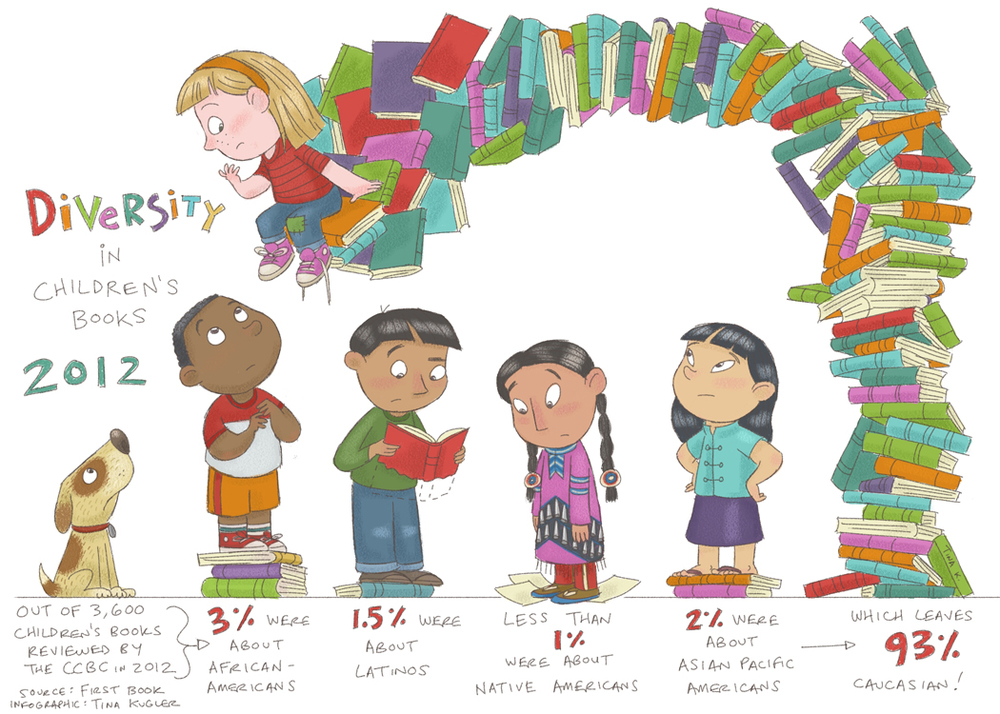
The Cooperative Children’s Book Center keeps statistics on children’s books, and what identities are represented by their protagonists. Here is a comparison of US children vs. lead characters in children’s books in 2012 vs. 2018.

racetrend

It is getting better…. from 2012 – 2018 there was been a significant increase in new children’s books about people of color, but it still has not caught up to their presence in society, and when we factor in all of the classic kids’ books that are still read all the time, we know that the books kids are exposed to are not racially representative.

Many children’s books actually feature non-humans as main characters (animals, trucks, and so on. Here’s how racial representation compares… note how non-human far outstrip Latinx characters. (source)
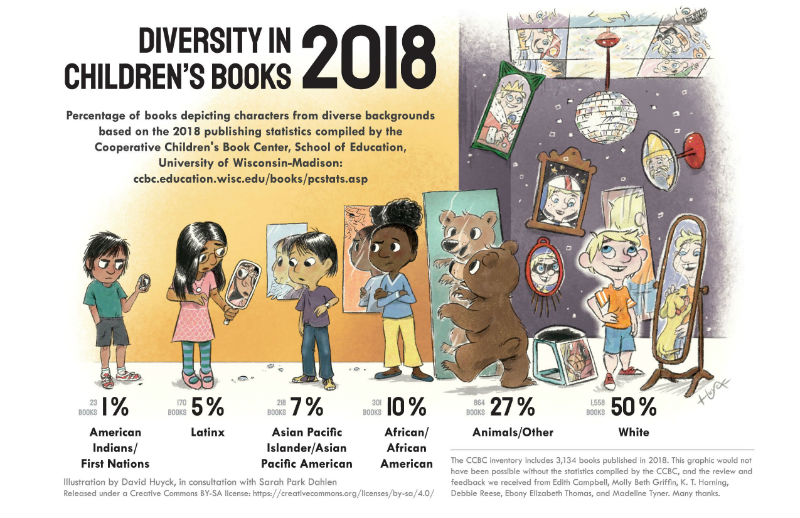
Disability

13% of US students receive special education services. That includes learning disabilities, speech impairments, autism, ADHD, physical disabilities, and healthy impairments. (source)

Of 698 picture books published in 2017, “A child with a disability appeared in only 21 picture books, and only 2 of those were main characters. Most others appeared in background illustrations.” (Source) So, that’s 13% of kids have a disability, and 0.3% of the main characters in newly written kids books do! And of course, in classic books, the percentage would be lower.

LGBT

Approximately 4.5% of the overall US population identify as LGBT. (source) Among young parents and children, the percentage is much higher than that – only 66% of Gen Z identifies as straight. (source) 0.58% of all people may be transgender, but amongst people 18 – 24, it’s 0.66% (source). As many as 12% of children may have at least one LGBT parent. (source)

Of 3,700 books received at the CCBC in 2017, 3.7% had LGBT content. Of those books about half featured an LGBT primary character, about a quarter featured a secondary character, and a fifth had an LGBT family. (Source)

Who Wrote It

It’s important to look not just at who the characters are in a children’s story, but also at who wrote that story. For example, of 340 books about Africans and African-Americans, only 29% of those were written by African-Americans.

When someone not of a culture writes about that culture, we’re more likely to get a stereotyped or superficial depiction of that cultural experience vs. the nuance we would experience in a book written by people from that background. “There’s a long history of majority-group authors (white, abled, straight, cisgender, male, etc.) writing outside their experience to tell diverse stories. Sometimes the characters and stories they create are wonderful! But … Even when portrayals of diverse characters by majority-group authors are respectfully and accurately done, there’s an extra degree of nuance and authority that comes with writing from lived experience. … For instance, I’m a wheelchair user. I’m intimately familiar with enduring and combating ableism, navigating an inaccessible world, exploring disabled identity … I can list a whole host of tiny everyday details about the physical and emotional reality of my disability that secondary research is unlikely to surface.  I have a lifetime of experiences — positive, negative, neutral, and complicated mixtures of all of the above — to draw from when I write a fuller, more authentic wheelchair-using character.” (Source)

An example from popular media is Asian-American representation. Although we’ve made progress since the Fu Manchu and geisha days, the new stereotypes are of the “model minority — competitive, goal-oriented and hard-working (but, notably, lacking in creativity, charm, sex appeal and humor).” But now we have a recent movie on Netflix, Always Be My Maybe which was written, directed, and starred in by people of Asian-American descent. “In its three-dimensional representations of Asians, the film subverts many stereotypes and tropes typically applied to Asians — making Asians feel seen in subtle but powerful ways.” (Source. Also check out “Why Always Be My Maybe’s Asian American underachiever is groundbreaking” and “Always Be My Maybe from an Asian-American Perspective: Details You Might Have Missed.”) 

What to Look For in Books about Diversity

In addition to considering the author’s background and experience, here are some tips for what else to look for, from The Guide for Selecting Anti-Bias Children’s Books, from Learning Through Literature that Offers Diverse Perspectives by Yokota, and Disability in Children’s Literature by Crow.

  • Check the illustrations
    • Look for stereotypical depictions – like Latino men in sombreros
    • Look for tokenism – the one kid in a wheelchair who appears on one page
    • Look for invisibility – what groups never appear in the books you read (examples: single parents, modern rural families, families with an incarcerated parent, people of Arab descent, service industry workers)
  • Consider the author or illustrator’s background and perspective – what qualifies them to tell this particular story?
  • Are cultural details accurate? current? Are details naturally integrated or shoe-horned in? Is the culture portrayed multi-dimensionally?
  • How real are the  characters and their lifestyles – are they token characters or stereotypes, or fleshed out people working in a variety of jobs, with a variety of relationships and interests?
  • Watch for loaded words: sexist words like firemen instead of firefighter, racist words like savage or barbarian, ableist words like crippled or lame
  • Does the book approach diversity challenges only as individual challenges to be overcome or also as human rights issues – addressing social realities like denied access to public transport or housing, and other systematic oppression?
  • Assess the appeal of the story and illustrations. Sometimes in our aim to expose our kids to diversity, we end up reading boring didactic books with sub-par illustrations, and the children learn to avoid or ignore “those kinds of books.” Above all else, choose good books that kids will like! Don’t feel like every book on your shelf needs to teach a diversity message.

Some more things to consider:

How is Identity Relevant to the Story

Author Corinne Duyvis has a very helpful taxonomy of three different ways diverse identities can be included in books and other media:

  • Issue books are where the identity (and the challenges of it) are the core of the story. So, if the protagonist is African-American, the story is about slavery, civil rights, or overcoming racism to excel in a white world. If there is a character with a disability or illness, the story often is how they heroically “overcome” their disability. We do need issue stories… a story about an LGBT teen coming out may be exactly the story an LGBT teen may need to read, and it may also be exactly the story a cis-het teen needs to read to understand and empathize with other’s experiences. But, they shouldn’t be the only stories told.
  • There is incidental diversity – where the person “just happens” to be in a wheelchair, or “just happens” to be deaf. As Duyvis says “Why shouldn’t an Asian character expose a government conspiracy? An autistic boy become a werewolf? A lesbian girl start a school newspaper? And why shouldn’t they be able to do these things without their marginalized identity ever becoming an issue? Many of us do homework, hang out with friends, or play video games pretty much the same way anyone else would. Our lives don’t revolve around being marginalized, and it’s exhausting to only see ourselves reflected in characters whose entire role is to be different.” So it’s exciting to see an increase in incidental diversity.
  • Duyvis doesn’t name her third category, other than calling it a middle ground. I will call it identity, because the character’s race or gender or ability is a key part of their identity and affects how they move through the world no matter what adventure the story will take them on. As Duyvis says: “In real life, though, marginalized people are affected. …it’s not shameful to acknowledge that. It’s a fact that ableism, homophobia, and racism influence countless aspects of people’s everyday lives. Micro-aggressions, stereotypes, internalized prejudice, flagrant bigotry, institutionalised discrimination… There are also other matters to consider: accessibility, hair or skin care, limited dating pools, communities, culture, etc. … There are many ways to incorporate the above elements into books … which can make characters and their backgrounds ring true to the very readers who may identify with them.” And inform those who are seeing them through the window of the book.

When choosing books about diversity, pay some attention to make sure each of these categories is represented.

Author Kim Hood says “… the more memorable characters in classics tended to have a disability that was cured in some way during the story, as if disability was a “burden” rather than a fact of life… a few more modern [books] include … teens with a disability that also make them super heroes… In picture books, I’m happy to see more children with disabilities in illustrations. I sure would like to see more books that include kids and teens in substantial roles, rather than supporting roles for the sake of token inclusion, though. I suppose I want more diverse characters – those that seem to jump off the page because they are so interesting, and who happen to have a disability. I want there to be characters of all abilities, so that kids growing up today are surrounded by the notion that disability is just part of the fabric of normal life, which is exactly what it should be.”

What Role does the Diverse Character Play

Sidekick? Token? In need of rescue? Gay best friend? Sassy black woman who schools the other characters?

We need stories where people of all types play roles of all types.

“Books with kickass heroines teach both girls and boys about what it means to be female… Unyielding soldiers like …Katniss Everdeen, … brave brainiacs like  Hermione Granger, and more brave and bold individuals … act as role models for their girl readers, [and] serve an equally meaningful purpose for young male readers. … The way we educate [boys], the way we parent them …and the books we choose to share with them all have their effects on the type of men the young boys in our lives will grow up to be. If we want them to have respect for women, we should give them stories that feature healthy, stable, and equal relationships between young boys and girls. If we want them to believe women are strong enough on their own to make choices for themselves, we need to give them stories where the girl is the hero and the savior. Instead of exclusively sharing stories of strong boys riding off into the sunset to save damsels in distress, instead of narratives focusing solely on the plights of male adolescence, instead of a constant dichotomy that divides people into two groups, either strong men or weak women, we should be embracing, sharing, and talking about books that star young female heroines, too. It’s time to tell a new story.” (Source)

Relatable Characters / Situations

While it’s great to have books that totally transport a child through a window into a completely different world, sometimes it’s helpful to find a bridge. For example, a book that shows a child starting school – your child remembers starting school, so can relate to the character, even if the character looks different from them. Or find books with multiple characters… some who are like your child and some who are different: “Make a special effort to find picture books featuring cross-ethnic friendships in particular… Researchers have noted that children under the age of 8 are strongly oriented towards their own racial or ethnic group, so seeing a character who looks like them gives them a character to identify with. Then, when they see that character interact with people from different races, the story functions as a source of indirect cross-ethnic contact for the child—with the potential to improve their racial attitudes.” (Source)

Getting Kids to Read Diverse Books

Often kids look at a book about someone “not like them” and say “it’s not for me.” And I get that. I’m kind of ashamed to say that I sometimes do the same thing… I’ll see a movie featuring all African American characters, and think “it’s not for me.” Here’s the thing, I’m straight and cisgender, yet I watch and read stories with queer characters all the time. And I learn important things about the experience of LGBT people by doing that. So sometimes finding something that looks through that window and looks at issues of race and culture as well ends up being a window I look through. Right now, I’m watching Pose, which is about African-American and Latino gay and gender non-conforming characters. That’s a “look-alike” to things I am already in the habit of watching and reading.

Librarians often look for read-alikes. Ask someone what books (or media) they like, and seek out some that are similar in style or content (and may just happen to feature a protagonist that doesn’t look just like them).

Photo of book covers for a book marketed to girls versus a book marketed to boys

This week, I brought two books home to my 8 year old son. One had a picture of a messy boy and a monster on the orange cover. The other had a sparkly cover with pink and purple and the word princess. Any guesses what he said? Yes, even raised in a very liberal household and community with flexible views on gender identity and expression, he still said “that book is for girls.” I said “you’re right, that the cover has lots of things our society markets as ‘girly’. But the reason I got it was because it was recommended by someone who said if you like Diary of a Wimpy Kid books, you’ll like this book. And they also recommended Big Nate which you love, so you can tell they have good taste. And, it’s by the same author as Dragonbreath!” He then cheerfully took on Harriet the Invincible, and really enjoyed it and asked to get more Hamster Princess books. (Although he did say he’ll read them at home, not where other kids might see. 😦 )

Try not to make assumptions about what your child wants to read. “The gender gatekeepers of books are often librarians, teachers and parents who make assumptions about which books are for girls and which books are for boys.” (Source) Author Phillip Pullman says “I’m against anything, from age-ranging to pinking and blueing, whose effect is to shut the door in the face of children who might enjoy coming in. No publisher should announce on the cover of any book the sort of readers the book would prefer. Let the readers decide for themselves.” (Source)

So, do make a wide variety of books available and let your child choose a wide variety, however, try not push too hard on an agenda and go too far in managing what your kids read. “Kids should be free to read what they choose. … let a lot of that be self-directed…the more we try to proscribe kids’ reading habits, the more joy we suck out of it.” (Source)

More tips on how to get boys to read “girls’ books.”

Talk it Over

After you read one of these great books with your kids, talk about it.

Ask them questions like: How are we the same as the people in the book? How are we different? Do they remind you of someone you know? How are they the same or different from that person? If you don’t know anyone like them, why not? What about their life experience is different from yours? What was easier for them to do than it would be for you? What was harder for them to do than it would be for you?

Resources for Learning More

In this post, I intentionally quoted from lots of great articles on this topic. Please click through to some of those “source” links above to read more in-depth.

In this section, I link to sources for book recommendations. At the top, I’ll list resources that cover several categories, then get more specific. (BTW, if you’d like recommendations for books and movies for grown-ups that provide windows into diverse lives, check out Seeking Out Diverse Media.)

Multi-Category

The Teaching for Change website includes The Guide for Selecting Anti-Bias Children’s Books and lots of booklists of recommended books that meet their criteria, on topics like culture and language, gender identity, economic class, and family structures.

Diverse Book Finder – a collection of more than 2000 children’s picture books featuring black and indigenous people and people of color, with a search tool. Also includes other diversities, such as faith, adoption, single parents, etc.

We Need Diverse Books has a pageful of links to other people’s lists of recommended books about various cultures, disability, and LGBTQIA stories.

Books for Littles has books on disability rights, gender equality, racial justice, and wealth inequity. They have some great super-specific lists, like “Don’t Yuck my Yum: Books that dismantle orientalism and food shaming” and “Making Friends is Hard – Reassuring Books for Kids Who Don’t Fit In.”

Recommended Multicultural Books

The Colours of Us is a site all about multicultural kids’ books, and they have LOTS of recommended book lists, such as Hispanic Preschool Books and Asian Baby/Toddler Books. (They also have links to multicultural toys, art supplies, and clothes.) I especially like their Multicultural Books for Babies and Toddlers. Babies and young toddlers LOVE books filled with pictures of babies and toddlers. These books include children of all ethnic backgrounds.

50 Multicultural Books Every Child Should Know. The Cooperative Children’s Book Center is the definitive source on statistics about multicultural books, so they know this field! Books by and about people of color and First/Native Nations individuals: African and African Americans, American Indians, Asian/Pacific and Asian Pacific Americans, and Latinos. Divided by age: preschool, 5 – 7, 7 – 9, 9 – 12.

Diverse voices: the 50 best culturally diverse children’s books. From the Guardian, it focuses on the variety of cultures common in the U.K. so covers primarily Africa, the Middle East,  Europe, and the Caribbean. Categorized into preschool, early elementary, upper elementary, and teen.

African and African-American

Black Picture Books that Aren’t about Boycotts, Buses or Basketball. “Shine light on typically ignored aspects of black life.” Include stories from getting a haircut to becoming an astronaut, from travel across the segregated South to going fishing or from church hats to a New Orleans sanitation worker. (Also check out Ten Picture Books that Are Not About Oppression, which show diverse cultures.)

21 books every black child should read is also a great source, plus, you can always check out all those multi-category and multi-cultural collections listed above.

Native American

Picture Books Portraying Contemporary Native Life. “One of the most persistent stereotypes about Native/First Nations people in North America is that they all lived long ago… talk about communities in the present tense.”

17 #ownvoices books about native Americans. Books written by and about American Indians and Canadian First Nations.

American Indians in Children’s Literature. Includes lists of recommended books including the first 10 Native American books to buy for an elementary school library.

Asian and Asian-American

Start with 13 Books that Celebrate All Things Asian, then read this article evaluating trends in Representations of Asians and Asian-Americans in Recent Picture-Books, which also recommends books, then check out 30 more Asian & Asian American Children’s Books, and the catalog of Lee & Low which is the top publisher of Asian-American kids’ books and published many of the books in those other lists.

Muslim

12 Books to Help Children Understand Islamic Faith and Culture. Include stories of  Muslim kids living in the West, children living in the Arab world, folktales, and books that specifically teach important concepts of Islam.

9 Children’s Books that Celebrate Muslim Faith and Culture. All written by Muslim authors, all showing Islam in a positive light.

Muslim Life in Children’s Picture Books. Examines current trends, and includes recommendations.

Refugees and Immigrants

12 Books About Refugees. Books about refugees from many countries, in a variety of historical periods as well as the present day. About the challenges of the journey and experiences in new and unfamiliar places. These are picture books for elementary age children.

Welcome Immigrants! – and New Picture Books about Immigrants.

Gender

Books for Smart, Confident, and Courageous Girls. A Mighty Girl’s book section features over 3,000 girl-empowering books starring stellar Mighty Girl characters. Choose categories of interest to you, and then filter down to exactly what you’re looking for. You could start with their Top 100 Picture Books or something specific like Top Asian Pacific American books.

11 Books to Talk to Kids about Gender Expression plus there are links to several more kids’ books about gender identity at the bottom of my post on Talking with Children about Gender Identity.

LGBT

Rainbow Book List. From the GLBT Round Table of the American Library Association. They publish a list each year, which includes best books published in the past few years. Includes picture books for ages 3 through elementary, plus middle grade and YA.

30 Children’s Books with LGBT characters. 10 books each for pre-k to 3rd grade, 4th – 7th, and 8th grade and up. Includes queer parents and queer kids, both issue books and incidental books.

Diverse Family Structures

Several of the LGBT books above, plus…

Children’s Books to Embrace Diverse Families, 6 Children’s Books that Celebrate Family Diversity. How to Help Children Understand Diverse Families

Single Parents Children’s Books, Best Children’s Books with Single Parents

Picture Books about Divorce and Having Two Homes and Preschool Children’s Books About Divorce.

Disability

Children’s Books About Special Needs. “Didactic books, or books that just simply explain a disability without a good story, are b-o-r-i-n-g, and as a consequence teach nothing.” Here are engaging picture books that touch on a variety of (dis)abilities, including stuttering, visual impairment, wheelchair use, Down Syndrome, and more, including adapting baseball so a snake can play. Preschool and elementary level.

Disability Visibility for Kids from King County Libraries recommends 88 fiction and nonfiction titles featuring people living with a variety of disabilities, chronic conditions, and neurological diversities. Designed to promote understanding, acceptance and a celebration of differences! Ages 3-12.

Children’s Books: Portrayals of People with Disabilities. Separated into categories like deaf, speech disorders, traumatic brain injury. Search tool to find exactly what you’re looking for.

12 stereotype-busting children’s books starring disabled characters by Rebekah Gienapp. Include a range of characters with disabilities, both children and parents.

Children’s Books About Autism. For autistic children and for neurotypical children, include issue books, incidental books, and identity books. Focus is on books that approach autism as a difference (with its challenges AND its strengths) not as a disability in need of a cure.

Poverty

Picture Books that Illuminate Poverty, Homelessness, and Hunger in America. “As America faces record poverty rates and increasing income disparities, it becomes more and more important that we take action in whatever ways we can. Nothing inspires action quite as much as a good story.” Also: 18 Children’s Books about Poverty and Hunger.

Here is a free printable PDF handout that is a shorter version of the information presented in this post.

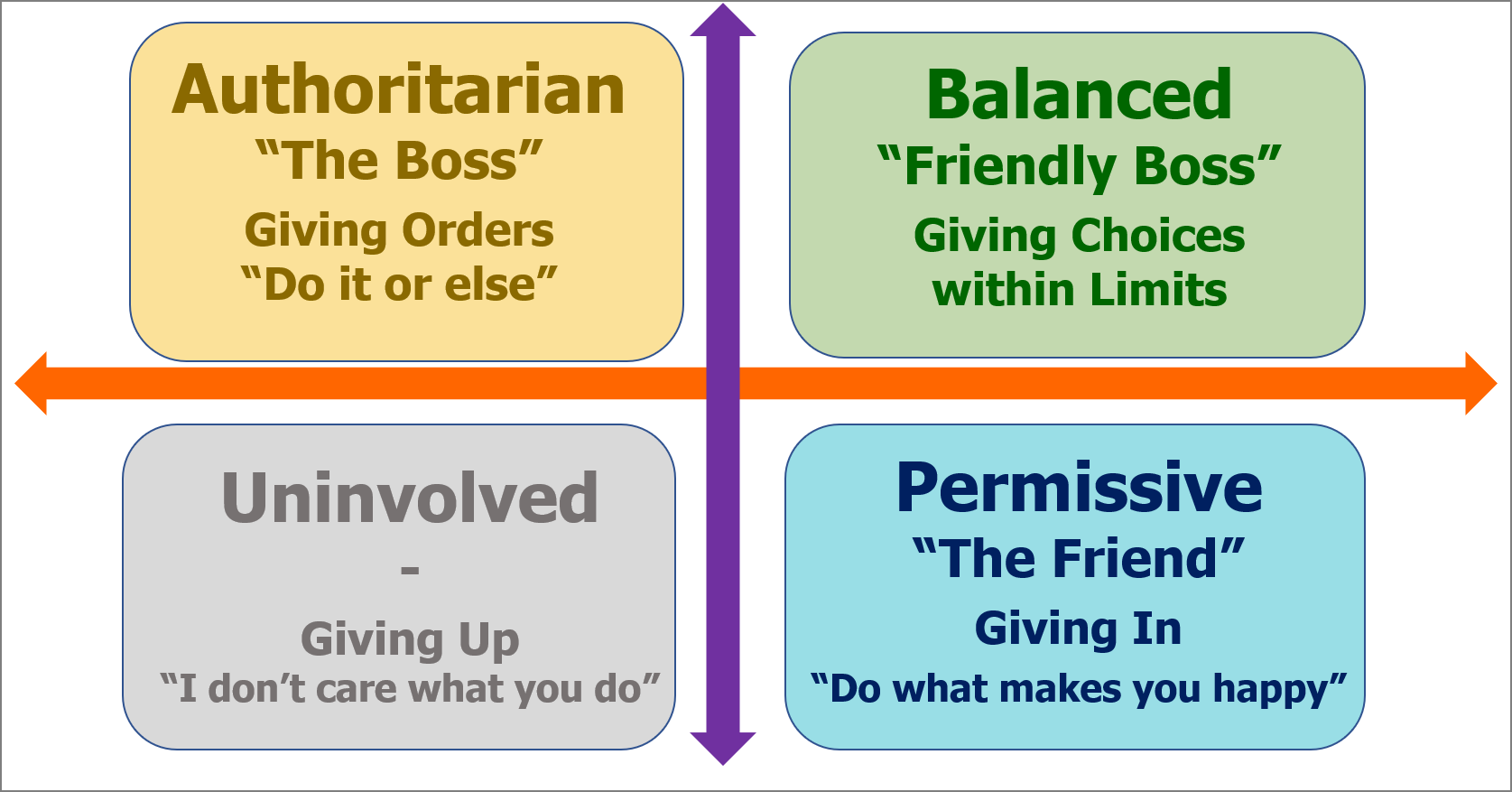
Parenting Style – Offering Choices

TL/DR summary: Giving a child choices (e.g. what to wear, what story to read) can help to build a positive relationship where the child feels valued, empowered, and learns decision-making skills while having fewer power struggles. But if we offer too many choices, the child may feel overwhelmed and the parent may feel out of control. Finding the right balance starts with the parent deciding which options are available (setting limits), then the child choosing between those workable options.

My post on Offering Choices to Children covers the nitty gritty of how to use this discipline tool. This post is more of a philosophical think piece about the long-term impact of how we handle choices in our families. (Note: in this post, I talk a lot about parenting styles. Learn more about the Four Parenting Styles.)

choices grid

Three Approaches to Offering Choices

Several times each day in the life of a parent and a child, there are decisions to be made: what to eat at a meal, what to wear, what to do, which story to read, and on and on. Some parents, who learn toward the authoritarian style of parenting make almost all the choices, telling their child what the required plan is. Some parents who lean toward the permissive style let their children make all the choices. Let’s look at the possible pitfalls of taking either of these approaches to an extreme, then let’s look a more balanced (authoritative) approach.

Giving Orders – The Parent Makes All the Choices

There may be lots of reasons some parents want to make all the decisions. Sometimes it’s just that a parent wants to be in full control (“it’s my way or the highway”), sometimes it just feels faster and easier to make all the decisions rather than waiting on your kid to decide, sometimes it is an parent who has very high expectations for the child and believes they know the best route to achieving those. This has been called Tiger Mom parenting style, named after Amy Chua’s book, in which she describes her choices such as requiring that her children play piano and violin and requiring them to practice, saying “To get good at anything you have to work, and children on their own never want to work, which is why it is crucial to override their preferences… Once a child starts to excel at something… he or she gets praise, admiration and satisfaction. This builds confidence and makes the once not-fun activity fun.”

This parenting style can work well for some parents and for some kids.

But, it can also backfire in a few ways.

  • Some children rebel against this – in the short term, that means lots of power struggles, and in the long-term it can damage the relationship with the parent.
  • Some children feel dis-empowered and discouraged, or some feel that their parent doesn’t care about them.
  • Children raised this way may not learn independent decision-making and initiative.

If you lean toward the more authoritarian style of parenting, it’s import to be aware of these potential pitfalls to help you to avoid them.

Giving In – Parents Let the Kids Make All the Decisions

This style of parenting could also be called permissive or laissez-faire. Dayna Martin, proponent of Radical Unschooling, says ““[This] includes trusting your child in what they choose to learn; you extend that same trust to other areas of your child’s life, like foods, media, television, bedtime. Parenting is supposed to be joyful, and it can be when we learn to connect with, rather than control, our children. The focus of our life is on happiness and pursuing our interests with reckless abandon together.”

Again, this can work well for some parent and for some kids. But, it can backfire.

  • Sometimes children make bad choices, especially if they are given free rein and not much guidance. Like wearing a swimming suit in the winter or eating so much chocolate they get sick. Then parents have to decide whether to let the child live with the consequences of that bad choice – “guess you’ll be cold” – which can be fair or can be cruel depending on how far you take that, or whether to rescue the child from the consequences to keep them happy – which may mean they never learn from their mistakes.
  • I have seen children who don’t do well in school or in peer relationships when they’ve been raised in a very permissive environment and don’t understand limits. The child who takes toys away from others any time she wants them and who eats all the cupcakes on the table will soon alienate their friends.
  • Having to make choices all the time can actually be exhausting and overwhelming for kids. Being asked to make too many choices all the time can lead to meltdowns for little ones. Having choices within limitations can be very calming. Imagine being thirsty and walking into a convenience store in a foreign country where you don’t recognize any of the packaging, and you can’t figure out which of forty options to choose. Wouldn’t it be so much easier and more pleasant if someone said “I know you like juice – here’s the grape juice, the apple juice, and an apple cranberry juice – which one would you prefer?” 
  • Another common backfire for permissive parenting is that the parents may start feeling like they’re out of control. Some parents just end up feeling frazzled all the time, feeling powerless, and not able to see any way to change how things are going with their kids. Other parents, when they start feeling out of control will hit a certain high stress point, then suddenly flip-flop from permissive to strict – going from “you can do whatever you want” to “I’m done, you’re grounded for a month.” This inconsistency is extremely stressful for kids, and can lead to a lot more anxiety in the future over making their own decisions.

Giving Choices – The Balanced Approach

I believe that for most families the optimal approach is the authoritative parenting style. The parent has high expectations for the child and wants them to be successful, so they set clear limits and ensure the child is choosing between options that can be healthy for them (e.g. good nutrition, clothing appropriate to the weather, doing their homework, practicing their chosen sport or instrument). But the parent is also highly responsive to the individual child – ensuring that there are options that the child will enjoy and giving some flexibility for the circumstances of the moment.

Ellyn Satter, author of Child of Mine and How to Get Your Kid to Eat: But Not Too Muchhas some important ideas about the division of responsibility in feeding. The parent is responsible for what, when, and where the child eats. The child is responsible for whether to eat, and how much. The parent puts healthy options on the table, the child makes the decision from there, and the parent can relax, knowing that any choices the child makes can work out OK.

I think a similar approach could apply to almost all decisions, from getting dressed, to choosing a bedtime story, to choosing extracurricular activities to choosing where to go to college and what to major in. The parent first evaluates the possible range of options, and decides what criteria would represent a good option. If they’re working with a young child, the parent might and offer only a limited number of viable options (2 options for a 2 year old, 3 for a 3 year old… “do you want the blue shirt or the red one?”) For an older child, they might say “you can choose amongst any of these options, but here’s our limitations and here’s our criteria. You can only choose things that fit those requirements.” (“It’s cold out today, so choose something warm to wear.”) The parents are the ones “setting the table” with options. The child then is empowered to make the choices within those limits.

I have always told my children “you may be as smart or smarter than I am, but I am wiser than you and will always be wiser than you because wisdom comes from life experience and seeing all the long-term impacts of choices.” So, when I tell them the criteria for a positive choice, that’s coming from all my wisdom. When I let them make the choice, I acknowledge their intelligence and give them decision-making practice for their future.

It’s worth acknowledging that authoritative parenting requires more effort from the parent than authoritarian or permissive parenting does. The authoritarian parent just has to say: here’s the rule – follow it or expect consequences. The permissive parent says: do what you want. The authoritative parent has to say: Here are the options, here’s information on the impact of your choices, let’s talk through how to make the best choice. It’s more work in the short term, but hopefully in the long term yields a child who is capable of making better decisions on their own.

Offering Choices to Children

Picture1

Parents often talk about “offering choices” to children. It can be a very helpful technique for building cooperation with your kids, avoiding power struggles, and helping them learn decision-making skills. But, like all the tools in the discipline toolbox, it helps if you know some basic ideas about how to use a tool in order to get the best results.

What Choices are Available

It is the parent’s job to decide what options are available. Then the child chooses between those options.

On a busy morning when we’re in a hurry to get out of the house, it would be unfair of me to tell my son “pick anything you want to eat for breakfast.” Because if he chose waffles and we ran out yesterday, that’s a bummer. And if then he chose a fruit salad, I’d say “I don’t have time to make that.” If then he said mac and cheese, then I’d say no, and then we have a power struggle on our hands when I describe all the rational reasons these choices are not an option, and he’d say “but you said I could choose anything.”

It’s just setting us up for frustration on both sides. (Or I could just give in and say yes to anything he demanded, but then I’d be cranky and resentful and he’d learn he gets anything he wants if he complains enough.)

Instead, before I offer a choice, I need to decide what acceptable options are. I can’t expect a young child to remember what food we have in the freezer right now, to know how long it would take to prepare food and whether that would make us late to school, or any of those other details I’m taking into consideration. So… first, I think about these things, I think about what options are possible, and then when I say “what do you want for breakfast – cheerios, yogurt, or an apple and peanut butter?” I know that all of these things are possible and that I would be fine with him making any of those choices.

I control what options are on the table, he decides which one of those to choose.

If he then asked for waffles, I could say “sorry buddy, we’re out of waffles – you can choose….” and reiterate the reasonable options. If he said “can I have grapes and string cheese?” I’d say “hmm…. that wasn’t one of my options, so I have to think about that… it is a lot like the apple and peanut butter option, and I know we have those things, so yes, you could choose that.” (Notice, I let him make a choice that wasn’t in the options but I was still the one in control of deciding whether that option was available. I set the limits that would work for us both and gave him some insight into my decision-making.)

How Many Choices to Offer

Some parents make the mistake of offering too many options, which can be overwhelming for a little one. Too many overwhelming choices in one day will lead to meltdowns. A good rule of thumb for little ones is to offer just one decision at a time, and for that decision, offer as many options as the child is years old. A 2 year old chooses between the red shirt and the blue shirt. (And you just put a pair of pants on them without them having to also make that decision.) A 3 year old chooses between cereal, toast, or yogurt. (You decide what dish to use, and where they sit.) A 4 year old has four bedtime stories to choose between. (You decide that they’ll brush teeth before you read the story.)

With More Choices, Offer More Guidance

As the child gets older, you may offer more choices, but give them criteria you would use to help make a good decision. For example, an 8 year old can go to a full closet of options and choose all their clothes (pants, shirt, socks, underwear), but the parent might offer guidance. “I know yesterday was super warm and you wore shorts, but today will be much cooler, so you’ll probably want to choose long pants. And you may want to wear your flannel hoodie this morning till it warms up.” Or “I know you want to play with Legos today. The other two things you need to do before dinner are bring in the trash bins and do your homework. You can choose what order to do them in, but they all need to be done. I’d probably do the trash bins first because it’s quick and easy and you’ve still got your shoes and coat on.”

Talking through this decision-making process helps them build the skills to do this independently later on.

When To Offer Choices (and when not to)

Don’t offer choices to a child in the middle of a huge meltdown. At that point, they’re in their “downstairs brain” and not capable of having a rational discussion and making decisions. I was once in the mall parking lot, and a child was having a massive meltdown, and the mom kept saying “You can’t run in the parking lot. You have three choices – you can ride in your stroller or I can carry you or you can hold my hand while we walk.” This was a kid in full meltdown – he wasn’t processing anything she was saying, even though she said it over and over. It would have been better to say “it’s not safe for you to be here, so I need to carry you” and when the child starts to calm down, then offer the other options.

An even better approach was to offer the choices before the situation and long before the meltdown. While the child was still buckled in his car seat and calm, she could say “Remember in the parking lot, it’s not safe for you to run off. You have three choices….” (Or actually, I would have offered two choices – three is a lot at that age, even when the child is calm.

Don’t offer choices to bribe your child out of a tantrum. Imagine you’re in a store and your child asks you to buy an expensive toy, and you say no, and they meltdown, and then you say “OK, fine – you can have one of these cheap toys – do you want the dog or the monkey?” Your child has now learned an effective technique to bully you into getting them something. Instead, if you’re willing to buy a cheap toy, say that going in. “In the store, if you can behave well while I do my shopping, then I will let you choose one toy. But it has to be something little and it has to cost less than _____.” If you’re not willing, don’t offer. Say “We have to buy a birthday present for your friend today, but we’re not buying anything for you. But if you can behave well, and we can do this quickly, then we’ll be able to play in the playground for a little while when we’re done shopping.”

Again, you’re in control of what options are on the table. They choose between those options.

Let Them Make Bad Choices

Now, we obviously can’t control everything our kids do. And we wouldn’t want to. They need to have plenty of times where they’re making their own decisions (in environments that are reasonably safe for them to do this in.) And when given freedom, sometimes children do dumb things. They make bad choices. You gotta let them do that sometimes. You can’t protect them from all dumb things and from the consequences of all bad choices.

If you rescue them from the consequences, they never learn to make better choices. So, some times, you should let them suffer some consequences. I empathize, but I don’t immediately rescue. (But I do have a plan for how we’ll move out of this.)

For example, my child wanted to wear her slippers to play outdoors. I would say “it’s wet out there – your slippers aren’t waterproof. Your feet will get wet.” One day she begged and begged to wear the slippers to the park before story time. Her feet got wet. I said “I’m sorry, I know you hate wet feet.” But I didn’t fix it. We played in the park with wet feet and she hated it. When it came time for story time, I said “I brought shoes and dry socks along for story time – would you like to change into those now?” Her slippers were too wet to wear when we got back home, so she had to go without the, for a day. After that, she knew not to wear her slippers outside.

Learn more about natural consequences and about other tools in the discipline toolbox.

When Should You Introduce Your Child To [your favorite media]?

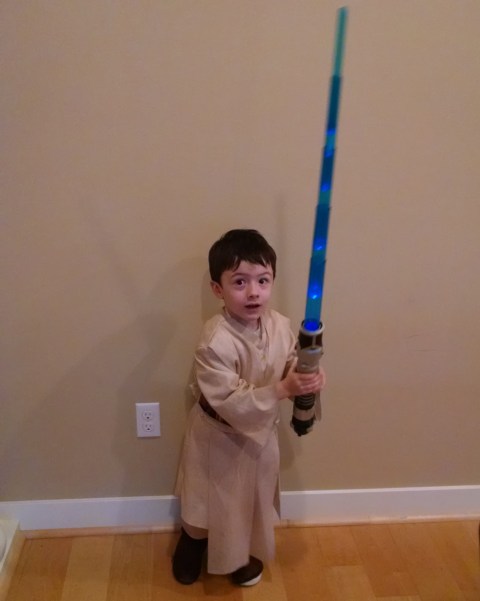
small child with light saber and Ben Kenobi costume

The TL;DR summary:

Don’t rush to introduce your child to your favorite book or movie. Why?

  • There may be mature content the child is not ready for that might frighten or concern them.
  • You’ll all enjoy something more if you wait till they’re old enough to actually get it and enjoy it!
  • There’s plenty of fabulous media aimed at young kids. It’s OK to stay in the kiddie pool for a while… I promise, there will be time later on to introduce all the great stories!

My Rationale for Waiting:

As a parent, I’ve had lots of time to reflect on this. As a parent educator, my students ask me about these topics from time to time, but I’d never taken the opportunity to write up my thoughts till now…

Recently, a friend on Facebook asked for recommendations on which novels to read next to her 5 and 6 year old. Some folks recommended Narnia, A Wrinkle in Time, the Percy Jackson books.

And I said no! Wait! Not yet!

Today, on the /Filmcast, a host (Jeff) was talking about when he would first show Star Wars to his kids, saying “I’ve got years before I can show it to them and really have it land… and be meaningful”. He said “even three is probably way too young… 4 or 5 is probably the right age?”

And I thought: No! Wait! 4 or 5 is way too young!

Whatever your favorite movie / book / play / music is, you may be anxiously awaiting the day you can introduce your child to it. But if you really want to “have it land” and be meaningful for your child, it is better to wait till they’re really ready. It’s hard to be patient, but I think it’s more rewarding in the long run. Here’s why:

Mature Themes

An obvious challenge of introducing too early is mature themes. Sometimes there are scenes that might frighten them (For example, although many first graders are plenty literate to read Harry Potter, I think it’s too scary for a 7 year old.) There’s also language, substances, “bad attitudes” and so on. Some of your favorite media may have more of this mature content than your child is ready for… and you may not remember till it’s too late. (I’ve made this mistake plenty of times. For example, watching Footloose with my tweens… I’d remembered all the dancing… I’d forgotten about the underage drinking… and the playing chicken with tractors… and the boyfriend hitting the girlfriend… the dad hitting the daughter… We pressed pause several times during that movie! This ended up being a good opportunity to start some challenging conversations. But it would have been better if I’d done it with a clearer plan!) I have now learned to refresh my memory first by reading the reviews on Common Sense Media, which does a nice job of clearly detailing all the potential issues so you can decide which feel OK to you and which feel problematic. For example, I’m not really troubled by bad language, or by fantasy combat, but I am really uncomfortable with realistic gun violence. Your concerns may be different.

I’m not saying that you should never take in media with your child that tackles challenging issues. I actually recommend that parents read books or watch movies where characters face a variety of challenges, make difficult decisions, and cope with grief (read my posts on how to talk to your child about death, scary topics, sexuality, and more). Reading sad books or watching sad movies with your child and then discussing them helps to build emotional literacy and build decision-making and problem-solving skills (as they watch characters manage situations that they have not yet had to face.) But, do this intentionally, not by accident. And do it with media that is developmentally appropriate for your child.

Will It Land?

My reason to wait isn’t just about avoiding mature themes. It’s also waiting till they’re ready to grok the material. Really ready to engage, enjoy, and get meaning out of it.

When I was a kid, I hung out in the public library and the church library by myself a lot. (Mom must have been in the building somewhere? I don’t really remember… I remember having full access to any book I wanted to read.) I read the Hobbit and LotR, the Chronicles of Narnia, and Wrinkle in Time all around the same time. Probably 8 or 9? Now, my reading skills were totally up to deciphering all the words (and to looking up tesseract in the dictionary).  I probably understood all of the Hobbit, and much of Narnia. But there was so much I missed. (Yeah, like that Narnia had any relation to Christianity.) And the thing was, once I’d read them, I didn’t want to go back and re-visit them when I was a little older, because I’d been-there-done-that. I didn’t go back to them till my own kids read them. So, my experience was fine, but it could have been better.

With my kids, we’ve mostly waited… With my youngest, we waited till he was 8 to show him Star Wars. Before that time, he’d read Star Wars themed beginning readers, he’d played Lego Star Wars video games with his dad, and he’d dressed up as Obi Wan. He’d even watched parts of the movies at family parties at his uncle’s house. But when we finally sat down to watch the original trilogy, he was ready to follow it, enjoy it, and understand it much better than he would have been at a younger age.

Spoilers

Spoilers float around in popular culture and discussions, so some parents worry that their child will be spoiled about key plot twists. And they will be. My kid knew who Luke’s father was long before he watched Star Wars! So, no, I didn’t have the opportunity to film his reaction to that revelation. (Yeah, that’s its own genre of YouTube videos.) But instead, I got to see his glee at finally learning the whole story related to that fact, and understanding why it is such a famous plot twist.

Although I had seen all the MCU movies, my son had not. I saw Avengers Endgame on opening night. Then I went on a binge of watching every YouTube video and listening to every podcast about the movie and all the Easter eggs. And my son rides in the car with me, and hangs out in the room while I do my morning workout. So, guess what – he knows ALL the spoilers even though he hasn’t see the movie. Over the past month, we’ve started to introduce him to all the movies (starting with Spider Man Homecoming and Ant Man movies, because those felt like the most kid-appealing choices). At 8.5, he’s actually in a really good sweet spot for these movies. Well… for watching them at home! Where we can talk during the movie when needed to explain something to him, we can answer his questions, and we can pause for a break to process if needed. We’re not going to take him to an MCU movie in a theatre this year or maybe next. Being in a dark room with the sound all the way up and having to be quiet and not able to pause can make a movie feel way more intense to young kids. (And if he asks questions he would disturb others.) We’ve also started pulling old Marvel comics out of the stash in the garage to entertain him till then.

We as adults may dislike spoilers, and like the moments of surprise. I find that children often go the other way. They like knowing information ahead of time because it makes them feel smart and powerful, and they may actually get more excited by the story that leads them to a known destination than they do by watching something when they have no idea where it’s going.

Stay in the World of Children for a little while

Another reason to wait on more “grown up” stories is that if we rush to that, we could miss out on the pure and sweet delight of children’s media.

When my oldest was in kindergarten, he came home from a playdate at a friend’s house singing ‘Hit Me Baby One More Time’ by Britney Spears. And telling me about all the music videos he’d watched. Some people might have been offended by the child’s mother letting the kids watch mature content… I didn’t really care about that. But I was sad at all the things that child might have been missing out on.

At that time, my son was listening to kids’ music – and there is SO MUCH great kids’ music out there! His favorite singers at that point were: Tom Chapin, Tom Paxton, Priscilla Herdman, and Anna Moo. So many delightful songs to sing! We decided ‘Oops I did it again’ could wait.

If I’m showing Star Wars to my four or five year old, we’re not making time for Kipper, Toy Story, Lion King, Iron Giant, Ponyo, and Sid the Science Kid. In rushing toward Harry Potter, let’s not skip over Winnie the Pooh, Dr. Seuss, Henry & Mudge, Frog and Toad. Take the time to do kid stuff while they’re kids. You can always watch everything else later on, but it’s hard to talk your teenager into going back to all this great kid content.

Context Matters

As I’ve hinted above, there’s a difference between watching a loud movie in a dark theater full of strangers vs. at home. What your child might be up to in one context might be too much in another context. We love live theatre, but we start with kid focused shows where we practice our “theatre rules”, then we try outdoor theatre where if the kids move or make noise, it’s no more disruptive than the airplane flying overhead. Then we go to school or amateur productions indoors. We wait on those expensive tickets to the Nutcracker or to Lion King’s national tour till we know they’re ready to get the most out of it!

So, if you can’t wait to introduce a particular story, think about what context it is best to introduce it in. For example, if you’re worried about a movie being too scary, you can read the book together in advance (or tell them the story from a plot synopsis), and show them still pictures from the movie ahead of time so they know more about what to expect? (Yes, it’s spoilers, but remember that’s OK for kids.) Would it work better for you to “serialize” a movie and watch it in lots of short 20 minute segments with time to discuss along the way? Could you just skip scenes or fast forward through some for now? Do what you think is best.

For books, often once a child learns to read independently, the parent stops reading to the child as much, and eventually even bedtime stories fall by the wayside. There are all sorts of benefits to continuing to read to an older child (including building their skills at interpreting what they read, increased empathy, and an entryway into those challenging conversations.) When my older kids were tweens and teens, we would listen to audiobooks in the car and then have common ground for a discussion of something we were all engaged in. So, reading to your child or listening to audio books can be a great way to introduce some of your favorite tales.

It’s In the Water

Some things we don’t wait on. Some things are just part of the water that our families swim in. When I was growing up as the youngest of four kids with a dad who loved science fiction, Star Trek was on the screen in the living room every week when I was a toddler, and then reruns were watched for the rest of my childhood. So, the vision of a future of scientific exploration was just a part of my life. Seeing people of all ethnicities working together, seeing a black female officer – was all normal to me. Not the radical experience that Star Trek TOS may have been to some. And I absorbed lots of other science fiction and fantasy from the rest of the family – I think my sister told me shortened versions of some of her favorite fantasy tales. And I think all our kids absorbed the ethos of “with great power comes great responsibility” long before watching Spider Man. My older kids grew up hanging out in the room while I played roleplaying games with friends, and they joined in as they got old enough. My youngest is just starting to join my oldest and his friends in playing Magic the Gathering. So your favorite stories and characters can’t help but be an on-going part of your family’s life.

But, if you’re asking “When do I let my kid read…” or “When should I show my kid….”, or “is it to early to expose my child…” here are my completely personal biased recommendations for when the right time is for some properties (mostly from the geek universe cuz that’s the way I roll.)

Recommended Ages

(For more details on the kid appropriateness of ALL of these properties, use Common Sense Media to learn more.)

  • Chronicles of Narnia – Read to kids (or audiobook) at 8 – 10. Independent read at 10+. The 2005 movie of Lion, the Witch and the Wardrobe is mostly good for ages 6 and up, but there are some scenes that could be frightening for kids under age 10. The 1988 BBC Chronicles of Narnia may work for younger kids, but is very long, so break it up into pieces.
  • DC Movies: Shazam should have been a GREAT kids’ movie. And 90% of it is. But the beginning drags, is confusing and scary, and the intense scenes are really INTENSE. I’d say 12+. Wonder Woman is great for 12+ but I wouldn’t go younger – the World War 1 scenes are scenes of warfare. Aquaman is probably fine for 10 and up, though parts of it would hold no interest for them. (Note: I would not show Man of Steel or BvS to anyone under 15, and I opted out of Suicide Squad myself.)
  • Dungeons and Dragons (and other table-top roleplaying systems): My older kids could play as the kids in a group of patient supportive adults (with an adult DM) starting at about 9 or 10. I’m guessing groups of kids could play at around 12? We’re trying to start a group of 7 – 9 year olds on a simplified D&D now with an adult DM, and thought it was going well, until today’s character design led to a series of meltdowns – one child due to a lost character sheet, one because they were having a hard time understanding the spell options, and one because his character is not as strong as the others. (Being told that he was smarter and had higher dexterity than the others did not resolve the meltdown.)
  • Harry Potter. The series starts on the scary side, and gets much darker as you go along. And for most kids, the movies are scarier than the books.
    • My oldest read the first few books when he was 10, then read the last three as they came out, when he was 10, 12, and 14. He recommends this as the appropriate timing. He says movies starting at age 12 or so.
    • Another approach: Kids read the book when they’re the same age as Harry is in the book – so book 1 when the child is 11, book 2 when the child is 12… When it’s almost time to read book 2, you could watch movie 1 for a reminder of the general plot of book 1. (Tip: never read the book then IMMEDIATELY watch the movie… I did this for Goblet of Fire, and I was painfully aware of every minor variance from book to movie.)
    • Common Sense Media has a helpful Harry Potter Age-by-Age Guide which addresses which books to read and which movies to watch by age, and includes the new properties like the Fantastic Beasts movies.
    • In reality though, I know it might be hard to keep these books away from my youngest for that long, as he’s got lots of friends who have read them. He’s already played Lego Harry Potter and put together Harry Potter Legos, and seen the attractions at Universal Studios, so he is familiar with the characters and the broad story lines. I suspect we will start by listening together to all the books on audio – the audio versions are narrated by Jim Dale and are absolutely stellar! Then he can read the books if he wants, then we’ll watch the movies.
  • The Hobbit – read to a child at 7 – 9. Child reads independently at 9 or 10. But wait on the rest of the Lord of the Rings books till 12 or so. I’d watch the animated version of the Hobbit from 1977 with a 6 – 8 year old, but I’d wait on the Peter Jackson Hobbit movies till age 10 – 12, and wait on the Peter Jackson Lord of the Rings till 12 or higher. (Partially due to the violence but also I don’t think younger kids would follow the plot well.)
  • Magic the Gathering – My oldest is introducing a simplified version to the 8 year old now, and that’s going well.
  • Marvel Cinematic Universe. I’d say start at age 8 with careful forethought and the ability to pause and explain. Older for in-theater. And maybe 10 and up if the child is likely to imitate combat behavior. But also pick and choose – some are more appropriate than others for younger kids. (That’s why we started with Spider Man Homecoming and Ant Man / Ant Man and the Wasp, not Iron Man 1 which starts out with some real-world violence.) In other Marvel: X-men movies for tweens. Deadpool – yeah, it’s R rated for a reason – the violence was uncomfortable for me!
  • Percy Jackson. I’d say 10 and up for the books. The characters are teens, who tweens could identify with well. I saw the first movie, and I’d go 13 and up on that one – read why.
  • Princess Bride. The movie is actually less intense than the book – although the ROUS and the torture scene might be distressing to kids. I would generally say 8 and up, though we took our son to outdoor movies in the park when he was 6 and 7. Scary moments don’t feel too scary when you’re sprawled on a picnic blanket on the grass. The book is probably for 10 and up as independent readers, but the audio book would be great for a 9 – 13 year old on a road trip.
  • Star Trek – If you tell your 6 year old “I have a show you’re going to love!” and  you turn on Star Trek, they may not think it’s for them. But, if the adults are watching Star Trek and the kids are watching along, they’ll probably like (and role play) many aspects while missing other concepts. All the TV series are probably fine to have playing around younger kids, some of the recent movies might be better around older kids. Of the series, TOS and TNG are more accessible to younger audiences and better to start with. They also have a really nice culture of optimism about the future. DS9 and Enterprise skew older; Discovery has some interesting conundrums for teenagers about when do you obey authority and when do you question it.
  • Star Wars
    • For this post, 19 dads were asked when to introduce Star Wars. “Conclusion: Fathers answers ranged from “in the womb” to “never”, with an average suggested age of somewhere between 5 and 6. Fathers also cited innumerable variables to take into consideration which were not consistent from child to child, or from family to family. There was consensus among the sampled fathers that exposure should be determined on a child-by-child basis, taking into account that child’s emotional, intellectual and social development, and always under parental supervision.”
    • My husband and I lean toward waiting till 7 or 8 because we think they’ll appreciate it more then. (If you’re wondering what order to watch movies in, read Machete Order – Explained.)
    • Release dates of new movies may skew your decisions… Someone told me she would have waited till age 8 or 9 to start these movies, but her mom took her to the opening of New Hope when she was 4, and when it turned out Force Awakens was going to come out when her child was 4, she decided to take her. But, they sat in the back row and had a stuffed animal and the iPad so if the child wanted to “opt out” of watching the movie, she could.
  • Studio Ghibli Films – I agree with these recommendations: My Neighbor Totoro and Ponyo for age 5 – 7. Cat Returns and Kiki for age 8 – 10. Spirited Away and Howl’s Moving Castle for tweens. (More recommendations here and here.)
  • The Martian – for ages 11 – 15. I have a whole post on the Martian… which was also inspired by a Jeff Cannata comment on the /Filmcast…
  • Willie Wonka – read the book Charlie and the Chocolate Factory at 6+. Watch the 1971 movie at 7 or so. (There are a few frightening moments of “children in peril.”) I think you can skip the Johnny Depp version.
  • Wizard of Oz – read the book to ages 6 and up. Independent read a little older than that – some archaic words. When I was 4 – 6 and watched the movie, I was terrified of the witch and the flying monkeys and hid behind the couch. But my kids all watched around age 6 – 8 and handled it OK – I had prepped them for the fact that it might feel scary and warned them when those parts were coming up.
  • Wrinkle in Time – Yeah, I read it at 8 or 9. I’d recommended 10 – 12 to get more out of the book. (Although again, you could read it to them younger than that.) The 2018 movie is appropriate for 10+, but it’s not as good as I wanted it to be.

Note: if you have multiple children, this all gets more complicated. Our older two were 3.5 years apart, so if I say something is good for ten year olds, that probably means we ended up watching it when the older one was 12, and the younger one was not quite 9. It worked for us because the older one was OK with “kiddie things” for longer, and the younger one wanted to be as “mature” as possible and had more tolerance for scary content.

What if they hate it?

And what if you’ve waited and waited for something, and then you show it to them, and they hate it?? Or what if they say “meh – it’s OK but not really that great?” Well, it’s a good lesson that our children are different people than we are, and we can all have different opinions. And maybe someday they’ll like it more… and maybe not.

I LOVE the movie Creator, a truly obscure 1985 romantic comedy with Peter O’Toole. It just makes me happier than almost any other movie I’ve seen. I waited till my older kids were in their late teens… it’s an R rated movie with some shower almost-sex and similar mature content. And I showed it to them, and they said “meh… I mean, I’m sorry Mom, I don’t want to make you feel bad, but maybe it’s just not for me?” And you know what? It was disappointing, but it’s OK. I still love the movie.

I had a dad tell me recently that there’s so many GREAT books he wants to share with his 12 year old daughter, but she’s only interested in YA romances and isn’t interested in any of them. I suggested to him that they listen to audiobooks together and that they take turns. She picks out one of her favorites, and he listens and gives it a fair chance and asks her what it is she loves about it. He may well end up liking it and even if he doesn’t, he gains new insights into her. And if he gave her book a fair chance, then hopefully she’ll give his book a fair chance.

Stephen Thompson, of the Pop Culture Happy Hour podcast, has shared stories about how he’s been trying for years to sell his kids on all the things he thinks are great, and now as teenagers, his daughter is into horror movies, which have never been his thing, but she’s sold him on a few of her favorites, and his son has convinced him that some video games are actually enjoyable to play – even if he’s very bad at them. For both parties in these exchanges, it’s a chance to be exposed to new things, to learn to appreciate each other’s perspectives, and to connect over a shared experience. And that’s the real value in sharing our favorite stories.

Please add comments – agreeing or disagreeing with me… and what properties (books, movies, plays… ) have I forgotten that you have strong opinions on?


Children’s Books about Autism

cover images for 9 of the books described in the text

As a parent of autistic children, and as a parent educator and children’s teacher, I wanted to find picture books for young children that could:

  • give autistic children the chance to see their experience reflected in a book
  • offer insights to neurotypical children to help them to understand the autistic perspective better and learn how to interact with autistic peers in a supportive way
  • give adults more insight into the experiences of autistic children (I am a firm believer in the fact that sometimes when an adult is reading a book to their child or hearing a book read at a story-time or in a children’s sermon, they can have “a-ha moments” where they understand things in a new way… somehow the simple evocative words of a children’s story can get past our previous assumptions or biases and give us clearer insights.)

It is important to me that the books talk about strengths of autistic people and the unique contributions that neurodiverse people can make if their needs are accommodated, not just about their challenges or the ‘inconvenience’ of accommodations. It is also important that the books accept that autism is a fundamental part of who the person is, not a disease that can be cured if someone would just learn not to “act autistic”. (Read my post on Autism Acceptance Month, or materials from the Autistic Self-Advocacy Network.)

It is hard for me recommend a single “best book”, because they may serve different purposes. Some may be good for an autistic child, some may be better for neurotypical siblings or classmates. Also, autism presents in a very wide variety of ways, so you can’t read just one book and get whole story of autism.

I’ll divide the list into two chunks: Most Recommended and Other Options. Then I’ll list the books in alphabetical order, with my review, to aid you in finding the right books for your needs. Each book has an Amazon affiliate link* where you can learn more about the book, then you can look for it at your local library or independent bookseller. [KCLS indicates it’s available at the King County Library] The video previews are read-alouds on YouTube – the person who made the video may get ad revenue but unfortunately, the book’s creators get no royalties from videos like these. So, if you preview something and you like it, please purchase a copy so the author and illustrator benefit from the work they have done to bring these stories into the world.

Most Recommended Picture Books

A Friend Like Simon by Gaynor. (Video preview.) Ages 5 – 8. Reviewer Macy McArthur says “…great at showing a neurotypical child’s process of being introduced to someone with autism for the first time, being honest about not understanding his differences/hesitant to befriend him, then to growing comfortable and realizing his autism is just a normal part of Simon [and] easily accepting Simon…” Note: There is a “mean girl” (Hettie) in this book, and then the other children in turn exclude her for being mean to Simon – some reviewers don’t like this aspect of the book.

Autism Is…?  by Wideman… Ages 4 – 7. (Video Preview.) Written by a grandmother of an autistic person. Aimed at autistic children rather than at neurotypical siblings and classmates. Describes a wide array of symptoms rather than stereotyping to a few. Reviewer says “clear, easy to understand, somewhat positive light but also touches on explaining some struggles that come along with autism. It does not use figurative language like some of the other books do, which is very helpful because my daughter, and many others who are on the spectrum, take words literally.”

Ethan’s Story: My Life With Autism by Rice. (Video preview.) Age 3 – 6. Ethan Rice was diagnosed with autism at age 4. He wrote this book at age 7 to help kids understand his challenges and strengths in his own words. Good as an introduction to one child’s experience of autism. Book ends with “this is the way God made me” which might not fit some settings.

The Girl Who Thought in Pictures: The Story of Dr. Temple Grandin by Mosca, illus Rieley. 5 – 8 years. (video preview) [KCLS] Sample text: “Unique from the start, an unusual girl. She loved spinning in circles and watching things twirl. But some things she hated, like certain loud sounds, or bright crowded places, large cities and towns.” The rhyming couplets and simple language makes this accessible for young kids. There’s supplementary material at the back, telling more about Temple’s life and accomplishments. A positive description of autism. Also a good example of how to write engaging biographies for young children.

I Love Being My Own Autistic Self by Landon Bryce. Age 6 to adults. A comic written by an autistic self-advocate with an MS in education. This book offers great insights. Vector, the narrator, says “There are good things about my autism. I have interesting and unusual ideas… I’m very observant… I am able to focus very intensely… sometimes it makes people uncomfortable when I talk about the good parts of my autism… they might think I’m saying I don’t think autistic people need support or treatment, but I think those can be good things… Even though I’m proud of being autistic, autism is very hard for me and I know it can be even harder for other people… it’s hard for me to communicate… I’m scared a lot of the time… I find unexpected changes very upsetting.” We also meet his friends, one of whom has Asperger’s, one is non-verbal autistic, so there are a variety of depictions of the autism experience. We meet his friend Pang, who says things like “if you just tried a little harder, you would seem perfectly normal”, his sister who thinks the best way to help autistic people is to help them be like neurotypical people, and Dr. Chip who wants to prevent or cure autism. Vector says “I think we can help people like my friend Marko by … paying attention to the things they say without using words… I think we need to accept everyone for who they are in order to really help them. I want Marko’s life to be easier but I want it to be his life.”

Sometimes Noise is Big: Life with Autism by Coelho, illus Robinson. Ages 4 – 7. (Video) Sample text: “Sometimes noise is really big, even when it is small for everyone else. Sometimes I am so excited that I need to scream and run in circles to let it out.” Book description: “Flipping the perspective for neurotypicals, this book explains in simple terms some of the sensory issues experienced by children with autism. It shows situations which can be overwhelming and the ways that somebody with autism might react when there is too much going on.” Helpful to parents, caregivers and peers for explaining the perspective of an autistic person.

We’re Amazing 1,2,3! A Story About Friendship and Autism (Sesame Street) by Kimmelman, illus Nelson. Ages 3 – 6. (video) [KCLS] Book description says: “Elmo introduces his longtime friend Julia to Abby… Elmo explains that Julia has autism, so she does things a little differently. Julia sometimes avoids direct eye contact, flaps her arms when she’s excited, and is sensitive to some noises. But Abby soon learns that she also has a lot of things in common with Julia. All kids want love, friendship, and to have fun!” You could also check out My Friend Julia. (Video). [KCLS]

Wiggles, Stomps, and Squeezes Calm My Jitters Down by Parker, illus. Burgess. (Video) Ages 3 to 6. Tells the experience of a child with sensory processing challenges and what helps them to cope: “I need a squish, I need a squeeze, I can’t explain why. I get jitters down deep inside and it makes me want to run! Round and round I zoom, touching every wall. That’s what calms my jitters down.” Also shows a good depiction of a meltdown. I appreciate how the mother embraces the child’s needs. Could be a good readaloud for a child with sensory issues, or for classmates to see the world from that child’s perspective.

Other Options for Picture Books

A Day With No Words by Hammond, illustrated by Cosgrove. (Video preview.) Age 4 – 6. [KCLS] An exploration of nonverbal communication, helping kids understand that words aren’t the only way to connect. This book is lovely, and would be most relevant if your child or someone they know is nonverbal.

A Manual for Marco: Living, Learning, and Laughing With an Autistic Sibling by Abdullah, illus by Tejpar and Abdullah.* (Video Preview) Ages 7 – 9. The story is told from the perspective of an 8 year old girl with an older, autistic brother. She makes a list of all the things she likes and does not like about her brother’s autism and when she’s done, she realizes she has written a “manual” for understanding her brother. Endnotes with additional tips. Engaging way of giving a factual overview about autism and how to interact with an autistic child.

All My Stripes: A Story for Children with Autism by Rudolph & Royer, illus Zivoin. 4 – 8 years. (Video Preview) [KCLS] The main character is a zebra with autism, who comes home from school distressed by how the other children view him, and his challenges with interacting with them. “They were talking about a video game I play … I started talking about all the things I knew … but since I was staring at the floor, nobody knew I was talking to them… I started talking louder… How come all anyone sees is my autism stripe?!” His mother tells him she sees many stripes (his caring stripe, his honesty stripe and his curiosity stripe). He feels better, saying “[My autism stripe is] just part of me… I love each stripe, because without them, I wouldn’t be me.” Nice book for autistic children or NT, about the strengths and challenges of autism. Great illustrations! Includes a lengthy reading guide for adults where they walk through each of the ideas presented in the book and talk about it in detail to further explain how they reflect the experience of an autistic child. Also includes a lengthy note to parents and caregivers about signs of autism, information about evaluation, treatments, and advocacy for support at school. Downside is that the metaphor of the zebra and stripes might be hard for a literal minded autistic child to engage with.

Andy and His Yellow Frisbee by Thompson. Ages 6 – 8. (Video preview.) Tells a story of Andy who is non-verbal and spends his recess time spinning a yellow Frisbee round and round. A girl who is new to school notices him. Andy’s sister is protective of him, but clearly accepts and cares for him. Several reviewers praised this book as an effective way of demonstrating acceptance of autism and finding commonalities between Andy’s frisbee and the neurotypical child’s decision to bring a teddy bear to school with her as a comfort item. One reviewer found it stereotypical and another felt Andy was treated as a “novelty act.”

Hello Roar, Little Dinosaur by Reeves, illus Morris. Written by a mom of an autistic person. Described as celebrating the fantastic characteristics and qualities found in kids with autism. There is more info about this series on their website: http://www.roar-littledinosaur.com/index.html

I See Things Differently: A First Look at Autism by Thomas. 4 – 7 years. (Video preview.) [KCLS] Written for NT children to introduce autism and the ways that autistic children may behave because their brains work differently. If it’s the choice that’s available in your library – I think it does an OK job of explaining autism in a way that, on the surface, is sensitive and caring. But if I were choosing a book to buy, it wouldn’t be this one, because it has a bit of an us vs. them feel to it… here’s what we can learn about those people. The author also seems to have a subtle bias that people with autism are often unhappy. This shows in the illustrations and the words: “do you know what it feels like to be worried or nervous or scared… people who have autism feel these things a lot… people with autism may find big crowds or loud noises very frightening… they may move their bodies in ways that look strange to you… being with more than one person at a time may be upsetting… With love and support… people with autism can learn to feel a little happier and safer each day.” A few illustrations do show happy children playing with a car or lining up pencils or flapping while working on a puzzle or sitting in just the right chair, but none of the words talk about happiness in autistic children. (Check out The Obsessive Joy of Autism for insight on the upsides to autism.)

Ian’s Walk: A Story about Autism by Lears, illus Ritz. Age 6 – 8. (Video preview) [KCLS]  Julie wants to go to the park with her big sister, but her little brother wants to come along. Ian is autistic, and on the walk, she notices how different he is – he doesn’t like smelling the things she likes to smell, the noises that bother her don’t bother him but he seems to hear things she can’t, he wants to lay on the ground instead of throwing cereal to the ducks with her. Then Ian gets lost and Julie knows how to find him because she knows what he likes best. On the way home they walk the way Ian likes to walk and Julie doesn’t try to change him, she just waits patiently. Sweet, conveys all the ambivalent emotions siblings may feel, including loyalty and love, so a good choice for siblings to see some of their own experiences reflected.

Leah’s Voice by Demonia, illus Turchan. 6 – 8 years. (Inspired by two real-life sisters.) [KCLS] Logan is excited to have her friend Abby over for a playdate, but Abby doesn’t understand why Logan’s older sister Leah doesn’t say hi till Logan reminds her to, and why Leah gets up and walks away in the middle of a game. Abby tells Logan that she doesn’t like being around Leah. The parents sit Logan down because they’ve decided that Logan is old enough now to tell her that Leah is autistic. (Side-note: ideally, this is something they should have been speaking about all along, not saving up for “the Talk”.) They describe it as “a disorder that makes it hard for Leah to talk to us and sometimes things upset her that wouldn’t upset you or me.” They say “it’s not something that will go away, but we see Leah handle things better all the time.” The book ends with a focus on how Leah is good at creating art. I think the best audience for this book would be a child in Abby’s situation – where one of the child’s friends has a sibling with autism, and the book could help give the “Abby” some empathy and insight into “Leah and Logan’s” life.

Looking after Louis by Ely, illus Dunbar. 6 – 9 years. (Video) [KCLS] Tells about Louis, a new boy at school. A few children try to connect with him – he tends to echo words and not connect in the way they expect. But then one day a boy named Sam engages Louis in a soccer game – if his foot touched the ball, he shouts “Great Game Louis”. Louis draws a picture of the game. Louis, a boy, and Louis’ aide go out to play more soccer. Although the book doesn’t call Louis autistic or educate about general tendencies of autistic children, it is a specific story that illustrates how an autistic child would be integrated into a mainstream classroom where they would be asked to participate in some activities to the best of their ability but also exceptions to the rules would be made to accommodate their challenges.

Lucy’s Amazing Friend: A Story of Autism and Friendship by Workman, illus Raynes. Age 6 – 9. A girl named Lucy sees Daniel, who is autistic, non-verbal and has an aide at school. She befriends him. The teacher describes Daniel in somewhat deficit terms “People with autism sometimes have a hard time speaking and understanding things that come easy to us.” In the sample pages, the other children shun Daniel and think he’s weird. The description says that Lucy tries to change their minds, but I don’t know if she is successful at that or if she remains his only friend.

Maybe Autism Is My Superpower by Ben Blanchet, illus by Lily Blanchet. “After seeing a superhero movie, Ben Blanchet, a thirteen-year-old boy who has autism, decided that maybe autism is his superpower. This book details a fascinating conversation between a mom and her son who has autism. Ben describes the unique ways he hears, sees, and thinks about the world around him.” There’s not an age guideline or a sample text, so I don’t know what age it is aimed at. Reviewers find it a positive approach to seeing the unique strengths of ASD through the eyes of an autistic person.

Masterpiece by Hoffman, illus Mello. (Video)  Ages 4 – 8. [KCLS] Samuel loves blue and says everything is better in blue. In class, when children do art, they use all the colors. Samuel’s drawing is only blue. The kids question this, but the teacher points out that he used all the colors of blue and his art is as special as everyone else’s. The story doesn’t reference autism, but the special interests and Samuel’s flapping and wearing headphones and the fact that he does not speak in the book could lead into a conversation on autism.

My Brother Charlie by Peete & Peete, illus Evans. Age 5 – 9. (Written by a mom and sister to an autistic boy.) (Video) [KCLS] Callie and Charlie are twins. Charlie is autistic. This book is written by a mother and a sister of an autistic person, and it shares a sweet and compassionate story that I think will appear to siblings of autistic children. Although she talks about the challenges – “it’s harder for Charlie to make friends. Or show his feelings. Or stay safe.. And there are days it’s hard to be Charlie’s sister – he can ruin the best playdates.” She also talks about all of Charlie’s special strengths – “he knows the name of all the presidents! He’s a fish in the water. He has a special way with animals.” And about the way they connect to each other – “he laughs when we lock fingers in a holding-hands game. That’s Charlie’s I love you.”

My Brother Daniel by Berger, illus Deveau. By a parent of an autistic child. Tells about a little boy coming to terms with his brother’s autism – Daniel flaps, spins, and shouts, and the brother wants people to also notice his strengths.

My Brother is Autistic by Mallinos, illus by Fabrega. Available in English or Spanish. 6 – 9 years. [KCLS] A story of a boy whose brother Billy is autistic. In the lunchroom, another boy steals a cookie from Billy. Billy has a big meltdown that embarrasses his brother who runs from the room. The teacher tells the class about people with autism who were successful or famous, then explained the challenges of being autistic. As Billy and his brother walk home, they play together. This is not a book I would use to introduce autism to NT or autistic kids because it’s more focused on deficits and not on what kinds of support would help autistic kids become successful adults. I might use it with a sibling who was coping with embarrassment at school if I thought it would be helpful for them to have a story to relate to.

My Friend Has Autism by Tourville, illus Sorra. 5 – 8 years. (Video) [KCLS] At first glance, this is a sweet story about a neurotypical kid who is friends with an autistic boy named Zack, with whom he shares a huge interest in model airplanes. Our narrator is patient with Zack’s different needs: “When I go to Zack’s house, I bring my own models. It bothers Zack when other people touch or play with his models. Each plane has to be in just the right place.” However, there are problematic issues with this book. Amazon reviewer supremeox says “[on] the third page [was] an offensive and unacceptable message… ‘Did you know? Autism is a brain-based disorder. With autism, parts of the brain don’t grow the way they should. No one knows why some kids have autism. There is no cure.’ … Right away the message is that the autistic person is defective…. it promotes the idea that autism is a disease. Autism is not a disease, it is an alternate brain development.”  Amazon reviewer Christina N, who is autistic, says “The basic message is to like this kid, ALTHOUGH his brain doesn’t work right. There is nothing wrong with autism. Sometimes it’s hard to be autistic. But I want my friends to like me BECAUSE I am different and because of my personality in general, not ALTHOUGH I am different. ” If you read this to a child, I would not read all those boxed notes aloud.

My Friend with Autism by Bishop and Bishop. Age 4 – 8.  Written by a mother of an autistic person. Book description: “Written for classmates of spectrum students and the classmates’ parents… explains in positive ways that children with autism are good at some things, not so good at others – just like everyone else! ‘Notes for Adults’ offer parents more detailed information.” Amazon review by Scotty’s mom says “The book is primarily a picture book, in black and white drawings that can be used as a coloring book. The text is very well written, with particularly good points about ASD kids: lack of understanding of social cues and emotions, hypersensitivity to sound and light, poor ability in talking, and the need and desire for friendship nonetheless. I highly recommend this book for elementary grade teachers to read to and with the class.”

Nathan’s Autism Spectrum Superpowers by Yarborough, illus. Merheb. (Video) 7 – 10 year olds. [KCLS] Description says “The superhero of this book, Nathan, explains about his Autism Spectrum Superpowers… Each “superpower” includes a Helpful Hints for Friends section that gives ideas on how to help a child with autism in different situations. Nathan’s superpowers include his Supersonic Hearing, a Super Sniffer, Regular Routine Retention, Actual Factual Literal Powers, and many more. This book also contains a Reaction Regulator scale to help your child regulate emotions and a place where they can list their own Energy Drainers and Energy Builders.” Originally written by a mother for her son. A few reviewers voice concerns about “big words” and think the book would not appeal to kids. But, I know several autistic kids that like big words and would find this book engaging as it describes their experience of the world.

Next Level: A Hymn in Gratitude for Neurodiversity by Doyon, illus Juanita. Age 4 – 6. [KCLS] Written as a parent’s message to their neurodiverse child, where the message is ‘other people might not appreciate you but I do.’ “You may not speak with their words or look into their eyes, may never sit still… they shake their heads sadly, look sideways and sigh… the world is our dance floor, the wind’s playing our song, and when you start moving, I follow along.”

Noah Chases the Wind by Worthington, illus Cowman. Ages 3 – 7.  (Video) [KCLS] Noah is a child with sensory integration disorder (and maybe autism?). The book description says “He sees, hears, feels, and thinks in ways that other people don’t always understand, and he asks a lot of questions… His books usually provide him with the answers he needs, until one day, there’s one question they don’t answer—and that is where Noah’s windy adventure begins.” The wind picks him up and flies him high above the clouds. It’s a lyrical fantasy story, featuring a neuro-diverse main character, though it doesn’t directly address autism as the other books on this list do. Kirkus review says “An invitation to wonder, imagine and look at everything (humans included) in a new way. ”

Since We’re Friends: An Autism Picture Book by Shally, illus Harrington. 4 to 8 years. (Video) [KCLS] “Sometimes Matt doesn’t understand what the coach is saying. It’s hard for him to listen when the gym is really loud. Since we’re friends I show Matt what to do… when the pool is suddenly closed for repairs, Matt is furious. He doesn’t like it when our plans suddenly change… Since we’re friends, I think of a new plan…” I really like that it shows how Matt’s friend does simple things to accommodate Matt without trying to change him or make him act not autistic. This is a good book for neurotypical peers – one parent voices concern that it might not be best for autistic kids because they may not all be lucky to have friends who are this willing to accommodate.

The Superhero Brain: Explaining autism to empower kids by Land. Ages 4 – 8. (Video) The description says “This story speaks to children who have autism, and explains to them what it means in a way that leaves them feeling empowered and able to make their dreams come true. The story refers to sensory issues as “special powers” and explains how living with autism can be awesome and at the same time also feel tricky sometimes.” Reviewer Lena says “While every child with autism is different, the book touches on some common challenges around sensitive hearing, taste, smell… in an acknowledging and empowering way. It inspires to go look for your own abilities and what you are good at. At the same time it acknowledges that it will not always be easy, and you need love and support.” Short and simple text. There are multiple editions – “girl, dark skin”, “boy, light skin”, etc.

Tacos Anyone? An Autism Story by Ellis. Age 4 – 7. Bilingual English/Spanish book. About a brother who doesn’t understand his non-verbal sibling and can’t figure out how to play with him. A therapist explains that the brother is autistic and how to relate to him.

Understanding Sam and Asperger Syndrome by van Niekerk illus Venter. Ages 5 – 8. (Video) [KCLS] Tells about Sam, who doesn’t like loud noises, likes certain foods served certain ways, likes to play the same thing over and over on his cello, and has big meltdowns. After a trip to the fair, he sneaks out alone at night to go back to the ferris wheel. The family takes him to the doctor and he is diagnosed with Asperger’s. The doctor talks about how kids may have different strengths and challenges, and that working together as a team to understand Sam will make it easier for Sam and everyone else. Book ends with ten tips for kids on how to be a good friend to someone with Asperger’s. From the School Library Journal review: “Because of the interesting story line, the positive approach, and the notion that others can learn to help Sam instead of expecting him to change, this is an excellent introduction to the topic.”

Uniquely Wired: A Story About Autism and Its Gifts by Cook, illus DuFalla. Age 6 – 10. (Video) [KCLS] Told from the perspective of Zak, “I have autism. Some people say I have a disability. I don’t see it that way… I am uniquely wired… I have an incredible brain and I have a lot of gifts to share.” He talks about his passion for watches – “you might get tired of listening to me tell you about watches but I will never get tired of talking about them.” He explains how/why he doesn’t like scratchy tags, hugs, or eye contact. “I’m not being rude when I look away. I’m just trying to protect myself….” “Sometimes I flap my arms… it helps me calm down my brain and organize what I am thinking.” I honestly LOVE all the sections of the book where Zak is talking about himself, why he likes what he likes, and why the things that bother him bother him. They’re great! What I don’t love so much: the pages where other people are holding gift boxes showing all the gifts they get from interacting with Zak. For example, his sister is angry that Zak can take his watches to bed but she can’t take her toys to bed – “because of Zak, I have learned that fair doesn’t always mean equal and that’s okay. Thank you Zak for sharing your gifts with me!” They’re just cheesy and distracting. As Amazon reviewer TobysMommy says “having other characters saying thank you for sharing your gift and making me learn that… is really weird. Most of them don’t sound like gifts and kids won’t be fooled. Presenting other things as gifts would have been better, like being on time for things, being organized, calming oneself down, being gentle with younger children/animals, having an eye for detail, etc. And of course my autistic son still isn’t grasping the gifts metaphor at all. He thinks the boy is literally giving the people gifts in those boxes – sigh…”

“Why Is He Doing That?” A Children’s Book Educating Autism Awareness by Cuellar. Age 4 – 8. (Video) Each two page spread talks about things Gerald does that might seem unusual to other kids, then explains why he does them, then ends with “Gerald is different, just like everyone else.” Sample text: “Sometimes Gerald asks the same question too many times! Sometimes the teacher becomes frustrated with all of Gerald’s repeated questions. One girl asked “Why is he doing that?” Gerald has autism. Children with autism need to know what is going to happen next. He needs to hear the answer over and over.” There’s things I really like about this book, based on the sample – like how it explains why things are helpful to Gerald, but it also does talk about how he’s frustrating to others and says “he does odd things” rather than “does things which may seem odd to others.”

What it is to be me, by Wine. Ages 4 and up. Written by a mother of a child with Asperger’s, written from his perspective of what it means to have Asperger’s.

Why Johnny Doesn’t Flap: NT is OK! by Morton, illus Merry. Ages 5 – 9. (Video) [KCLS] Flips the standard approach of all these books around… Reviewer Julia Bascom says “reminds us that “normal” is in the eye of the beholder.” Description from the back of the book: “My friend Johnny is different from me. We have fun together, but sometimes he acts pretty strangely. …he can’t seem to stick to a routine, he stares right into your eyes… Johnny is neurotypical. I like Johnny, and I think being NT is OK.” Sample text “when something exciting happens, Johnny doesn’t respond like you would expect. He doesn’t flap his arms or jump up and down. He just moves the sides of his mouth up and slightly widens his eyes. Maybe be doesn’t know much about how to express emotions, but that’s OK.” Reviewer Steve Koppelman says “A wonderful, hilarious and impeccably written book that works as a children’s book, as parody, and as a terrific autism self-advocacy polemic all in one.” I’m not sure that young kids would get the irony vibe.

Note about age guidelines – these are the ages for a neurotypical child. If you are choosing a book for an autistic child who has cognitive delays, adjust accordingly.

Note: Although I’m lucky enough to have access to an AMAZING public library system, they don’t have all these books, so some books I have not actually read, and can only base my comments here on product information, “look inside” previews and reviews available on Amazon. I have starred the books that I have not personally read in full.

Books for Tweens and Teens

In researching this list, I came across lots of recommendations for books for older children – tweens and teens. Here’s a few recommendations – you can learn more about them in Reading Rockets list of Children’s Books Featuring Characters with Autism and the ABA Program Guide’s 30 Best Children’s Books about the Autism Spectrum.

Non-Fiction / Guidebooks for Teens and Tweens

A Is for Autism F Is for Friend: A Kid’s Book for Making Friends with a Child Who Has Autism by Keating-Velasco.* 8 – 12 year olds. Description: “provides an inside look at the life of Chelsea… and explains that although she sees other kids playing and wants to join them, social interaction can be tricky for her.” Amazon reviewer Zosia Zaks says “I think these pages do a good job of explaining how we’d like to be friends but what makes it so hard to do so, and what simple accommodations could make being friends easier.”

The Survival Guide for Kids with Autism Spectrum Disorders (And Their Parents) by Verdick and Reeve, illus Lobyluch. Tips for school challenges, how to make and keep friends, self-care.

The Autism Acceptance Book: Being a Friend to Someone With Autism by Sabin. Age 8 – 12. An activity book about being a friend to someone with autism.

The Asperkid’s (Secret) Book of Social Rules: The Handbook of Not-So-Obvious Social Guidelines for Tweens and Teens with Asperger Syndrome by O’Toole. Author and her three children have Asperger’s. Easy to understand explanations of social rules that may not be obvious to tweens on the spectrum.

The Asperger Children’s Toolkit by Musgrave. Ages 8 – 12. For autistic children, to be used with a caregiver. Workbook with “cut and keep” activities.

How to Be Human: Diary of an Autistic Girl by Frenz. Age 8 – 12. Written and illustrated by an autistic teen who tells about challenges learning to read facial expressions, make friends, juggle social cues, and handle peer pressure.

Different Like Me: My Book of Autism Heroes by Elder, illustrated by Thomas.* 8 – 12 year olds. Told through the voice of an 8 year old autistic character. Describes the lives of people who found it difficult to fit into society, including Albert Einstein, Andy Warhol, Sir Isaac Newton, Dian Fossey, and more. Brief basic biographies (you can always google more info on any of the people described.) Many reviewers report that it was inspiring to have role models in many fields who were successful despite challenges. (Saying that these people had “autism” is speculation, but they are people who display some of the typical characteristics.)

Everybody is Different: A Book for Young People Who Have Brothers or Sisters with Autism by Bleach. A book for siblings that answers common questions.

How to Talk to An Autistic Kid by Stefanski (an autistic kid). A guide for typical kids to increase understanding of autistic kids and encourage NT’s to befriend them.

The Reason I Jump: The Inner Voice of a Thirteen-Year-Old Boy with Autism by Higishida. Written by a non-verbal autistic person who uses an alphabet grid to answer common questions people have about those on the spectrum.  In her review of the book, Dr. Temple Grandin stated, “Everybody who is working with nonverbal individuals with autism should read it.”

Novels for Tweens and Teens featuring Autism

  • A Boy Called Bat by Arnold, illus by Santoso. A novel about an autistic boy who “adopts” a baby skunk.
  • Slug Days by Leach, illus Bender. Follows a girl on the spectrum named Lauren and provides insight into the way she sees the world.
  • Rules by Cynthia Lord – Humorous and heartwarming about family life with an autistic sibling.
  • Autism – the Invisible Cord – a Sibling’s Diary by Cain. A 14 year old character talks about her frustrations, hopes, and love for her brother.
  • The Categorical Universe by Phee. A novel about a 12 year old on the spectrum.
  • A Whole New Ballgame by Bildner illus by Probert. A new teacher changes all the routines, which is stressful for a character with autism.
  • Al Capone Does My Shirts by Choldenko. Mystery / historical fiction novel about a boy with an autistic sister.
  • Anything but Typical by Baskin. A story from the POV of an autistic boy who struggles with in-person social interactions, but writes online stories and builds an online friendship with a girl.
  • A Friend for Henry by Bailey, illus Song. A story about an autistic boy who is looking for a friend.

…And SO many more! See the Reading Rockets link above!

More Resources

For more on autism, read my posts Autism 101Autistic? ADHD? SPD? Or Just “Quirky”? and Autism Acceptance Month.

National Autism Resources has a list of children’s books that are primarily about teaching behavioral skills to kids on the spectrum, such as: Calm Down Time, Hands are Not for Hitting, The Conversation Train, When My Worries Get Too Big, and Why Does Izzy Cover Her Ears?

If you like book recommendations, check out my other posts: Books Toddlers LoveBooks that Sing, Books for kids about STEMBooks for Children about SexualityTwenty Recommended Parenting Books,and books about teaching STEM to kids.

*If you click on affiliate links and then purchase something on Amazon, I get a small percentage of the funds.