Tag Archives: toddlers

Mixed Age Play

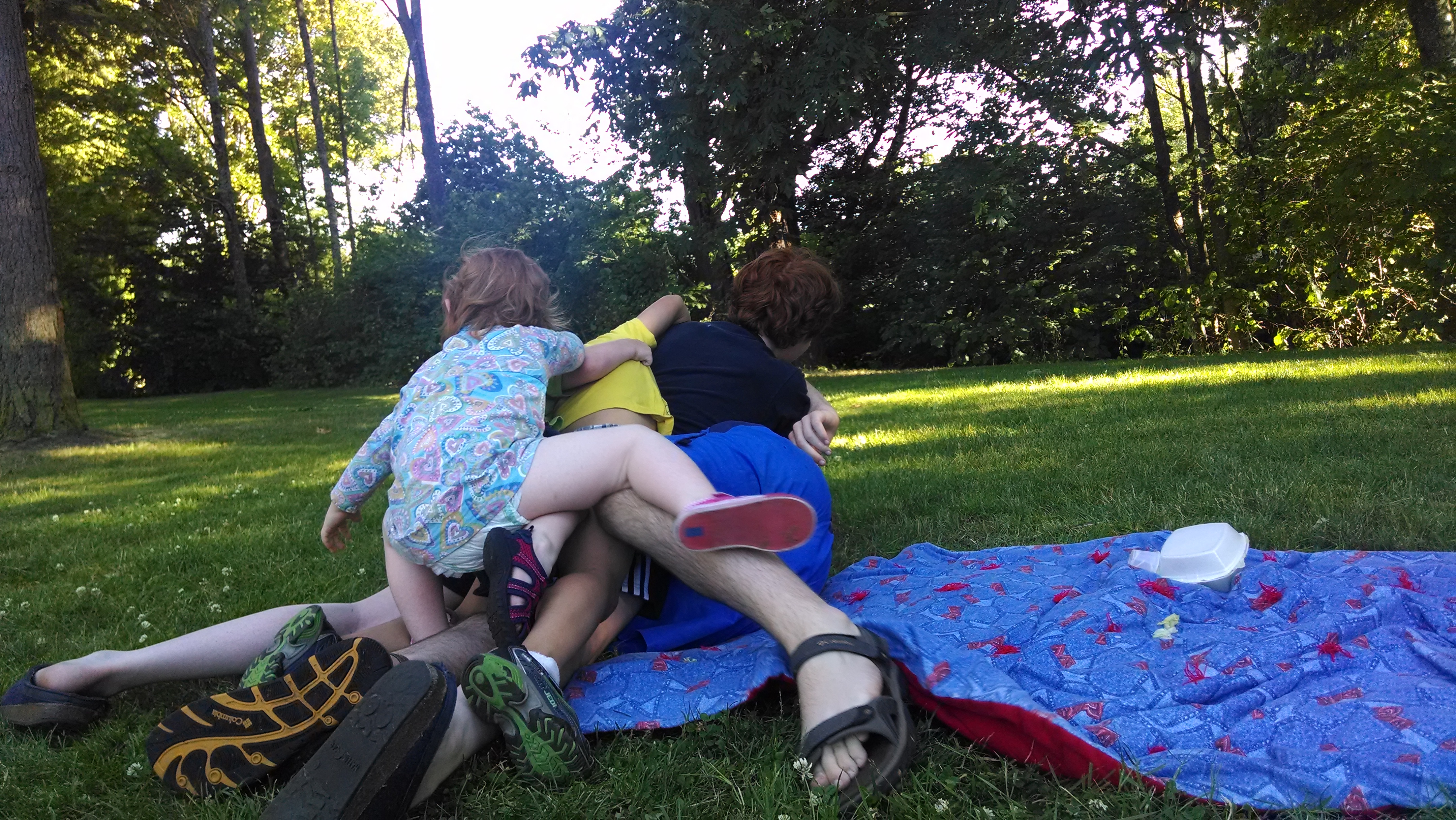
A 16 year old buried under a puppy pile of 7 year old, 3 year old, and 2 year old buddies...

A patient and tolerant 16 year old buried under a puppy pile of 12 year old, 7 year old, 3 year old, and 2 year old buddies…

I’m working now on a longer post about the benefits of multi-age classrooms. (To be posted September 2) but I wanted to share some observations from my recent personal experiences with multi-age play.

Modern American kids tend to spend much of their time in age segregated activities: schools, sports teams, and extra-curriculars where all the kids were born within a one year age span. During the school year, much of what my child does is with his own age cohort.

But this summer, my three-year-old has had lots of opportunities for mixed age play:

  • Lots of spontaneous play on public playgrounds with whatever strangers happen to be there… he tends to play most with kids age 2 – 6.
  • Monthly social for a club we’re involved in. We gather in a gym, and there tend to be about 5 kids…. last month they were 3, 5, 7, 9, and 12 years old. My son has played with each of them a few times before.
  • Play time on the playground at church. There’s usually about a dozen kids, ranging in age from 3 – 12. We’ve known them for six months.
  • “Dinner in the park with friends” – we gather with two other families once a week in the park. Our 7 kids are 20, 17, 16, 12, 7, 3, and 2 years old. And they’ve all known each other since birth.

As I watched him play in each of these settings, here’s what I observed (and also what is described by authors and researchers in this area.)

What do I love about mixed age play?

Benefits for younger kids:

  • They get exposed to new ways of thinking. My son doesn’t yet do a lot of imaginary play on his own, but when playing with older kids, suddenly, he’s talking about how they’re pirates on a pirate ship. Or he’s serving up “ice cream cones” made of bark.
  • They learn new ways of moving. My son has learned how to use all the playground equipment – even the challenging stuff – by watching the older kids do it. He learned how to do somersaults recently.
  • They learn new skills. My second child (like many younger siblings) learned to read, write, tie her shoes, dress herself, and more by watching her big sibling do it. I’ve heard countless stories of kids potty training after attending a camp or class where older kids routinely use the potty.

Benefits for older kids:

  • They learn to be flexible. At the social we attend, I watched the kids play an improvised ball game with invented rules. The older kids had teams, and were always trying to move the ball toward their team’s goal. But they understood that the younger ones couldn’t remember or follow the rules reliably. So, the littlest kids could kick the ball any direction they wanted to, and the older ones just worked with the chaos of that.
  • They learn to explain and enforce rules. But the older kids also did set limits sometimes on what was allowed and what wasn’t allowed. They had to figure out how to explain it so the little kids could understand.
  • They learn empathy, to be gentle and watch out for little ones. At church, I watched kids on the swings figure out that if big kids are walking near them, it’s OK because they know to be careful, but if little kids start to wander near, they call out a warning and they slow down their swings.

Benefits for parents:

  • Can give parents a break: If there are responsible (or semi-responsible) older kids around, the parents of the little ones may be able to sit back a little. For example, when we’re with our friends in the park, often the teens and tween supervise the 3 little ones while the parents relax and talk.

What can be challenging about mixed age play?

  • Kids get exposed to new ways of thinking: Sometimes things they might not have otherwise thought of…. In the movie Boyhood, there’s a scene where the 6-year-old and the older neighbor boy are flipping through a lingerie catalog ogling the models in their lacy bras. The 6-year-old probably would not have pursued “girly magazines” as young without that influence.
  • They learn new ways of moving: I still remember when my oldest was 6 or so, a girl who was probably 12 years old was shimmying up the pole of the swing-set till she was 15 feet in the air. My daughter watched her very intently, then pulled off her socks and shoes and scaled the pole. Something that would have never occurred to her to do on her own. And that was much higher in the air than I wanted her to be!
  • They learn new skills. I learned how to work pocket knives, matches, and other cool tools from my older brothers. Probably much younger than my parents might have wished I learned those skills.
  • Big kids aren’t always nice. We’ve had two incidents with my little guy this summer. One was at a playground where there was a group of 4 girls who were probably 9 or 10 years old. When we arrived, they played happily with my son and were having a great time. Then they decided they were bored of the “baby” and wanted him to go away. He had a hard time understanding what had changed. Another was at a different playground where there was a large group of older boys (age 7 or 8 maybe). My son was following them around, and laughing and engaged with them, but when we moved close we discovered that what was happening was they were asking him to say things like “I’m really stupid” and then laughing at him when he did. He didn’t get that it was mean – he thought it was a fun game. But clearly it was bullying and not appropriate behavior for those kids. (Their camp counselor was not providing sufficient supervision to even notice, much less intervene in the situation.)
  • Parents of older kids don’t always pay attention. When my child is the youngest one, he may be getting into situations that are more dangerous than he might typically be in (see above under “learn new ways of moving”). So, I have to supervise more closely than I normally would. But the parents of the older kids may be used to not having to do much supervision at all of their child, and may not realize that a) their child might need guidance on what is and is not appropriate play when younger kids are involved, and b) the parent who is supervising the youngest one then kind of gets stuck supervising all the kids by herself and managing all the needed interventions.
  • Unfair Expectations: In mixed age settings, it can be easy for adults to expect the younger children to have the same capabilities as the older children. When my younger daughter was 8, she was placed in a class where most of the kids were 10 years old. Academically, it was a good fit. She was one of the most advanced in the class. Socially, she did fine. She had a big sister, so she was used to playing with older kids. But emotionally it was hard. If something upset her, she had a hard time calming herself down. Parents who volunteered in the class sometimes had a hard time managing it, because they were used to their older children. Even the teacher failed to manage it well – reporting to us that our child was just much less emotionally mature than the other kids in the class. It was as if she’d forgotten that all those other kids had 25% more life experience than our daughter.

I think it’s important to be aware of these possible pitfalls, but don’t let it deter you from multi-age play.

I grew up as the youngest of four kids, with piles of kids of all ages in the neighborhood, at church, in 4-H, Girl Scouts, etc. I want my kids to have that experience of all the benefits  that mixed age play can give. And for that, I’m willing to take the challenges – think of them as learning experiences…

Great Resources for Songs for Kids

Each week in my class, we have a circle time where we sing lots of great songs that toddlers love. Here is my lesson plan for a full year’s worth of Circle Time for Toddlers.

Circle time is a lot of fun for the children in the room and for the parents, but beyond that, singing songs with your children helps your child to learn in many ways, and enhances your connections as a family. Singing builds:

  • Musical skills
  • Mathematical and spatial skills
  • Vocabulary
  • Memory
  • Connections to traditions
  • Emotional Intelligence
  • Attachment

Learn more about music and development.

Here are a few of my favorite resources for kids’ songs:

King County Library has videos of librarians singing LOTS (hundreds!) of classic children’s rhymes: http://kcls.org/content/. If you’re trying to remember any childhood song, this is a great place to look! They include versions in multiple world languages (e.g. Russian, Urdu, Spanish, Vietnamese…)

Jbrary is a YouTube channel featuring two children’s librarians singing songs and finger rhymes from library story times: www.youtube.com/user/Jbrary/videos.

Nancy Stewart has lyrics and audio recordings (.mp3) of lots of traditional songs, including “songs every child should know” and campfire songs: http://singwithourkids.com/song-library.htm. She also recommends books which include songs, or have rhythmic text that can be sung, to reinforce music and early literacy skills: http://singwithourkids.com/bookshelf.htm.

Nancy Kopman has lots of great songs for toddler classes and preschools.  https://nancykopman.com/learning-centre/#parents

Let’s Play Music was developed by Sara Mullett. It includes over 150 songs – each has lyrics, sheet music, a video of the tune being played on a xylophone, and activities / motions to go along with the song. http://www.letsplaykidsmusic.com

Math Songs: https://familymath.stanford.edu/activities/singing-together/

Music Connections offers some great posts on teaching rhythm and a steady beat to kids age birth to five: A Parent’s Guide to Beats and Rhythms, Developmental Progression of Steady Beat, and “Catching” a Steady Beat with Very Young Children.  This includes tips like: help your child experience steady beats by singing with them, dancing with them, or tapping on their knees in rhythm. When they’re doing repetitive movements, like tapping on something, sing or dance along in a steady rhythm that’s similar t o their rhythm. Have them walk or march to a beat.

Bounces, Lifts, Tickles and Rhymes for Baby. A nice collection from Storytime Shenanigans.

YouTube has a huge collection of animated videos featuring traditional and new children’s songs, in a wide range of languages. For example, if you look for alphabet songs, not only would you find countless versions of the traditional alphabet song, you’d find many variations in melody (like ABC Rap), plus many elaborate alphabet songs (Animal Alphabet, Alexander Alligator, etc.), you can even find several different songs each dedicated to a single letter of the alphabet. (Even Q has 8 or more songs!)

I prefer the other resources to YouTube personally, because many of the things on YouTube are so over-produced – too much visual stimulation, overly ornamented music, and sometimes just a frenetic cheerfulness (a la Barney) that can wear on me.

As with everything on YouTube, the quality ranges tremendously, and there are some that are frankly inappropriate for children; however, it’s worth searching through and finding some of the great ones and setting up your own playlist. I will includes links to some good ones on my “favorite songs” page. Most kids love watching the videos along with the song, but if you’d rather not expose your child to videos, you can easily find a free program online which will allow you to convert videos into .mp3 audio files. (I use YTD Video downloader)

More Music Resources

On this site, you can also find:

Why “More Good Days”

Why More Good Days? Because it’s a theme that weaves throughout my teaching in various ways:

  • When working with pregnant people and discussing nutrition, exercise, and so on, I say “I’m going to tell you all the ideas I know of for increasing your chances of a healthy pregnancy and birth, but I’m not telling you that you have to do every one of these things! I’m giving ideas, and you’ll do as many of them as you can make work in your life. And some days you’ll eat perfectly, and other days you’ll grab beef jerky and raisins at the 7-11 because that’s the only way you can get “lunch” that day. It’s OK. Babies are resilient – they won’t suffer for a few bad days here and there. We just shoot for more good days than bad… the more healthy choices the better.”
  • When teaching breastfeeding, if people raise concerns about not “succeeding” at breastfeeding, I say “I’m going to give you all the ideas I can to help increase your chance of reaching your goals, and I’m going to give you lots of resources for where you can go for help, and you’re going to do the best you can. Hopefully you reach or exceed your goals for how long you nurse baby. But sometimes life happens, and parents don’t nurse as long as they had hoped. I want you to remember that even a few days of breastmilk has health benefits for baby, and the more days of breastfeeding they get, the better for them and for you. So focus on those good days and how much good you did for baby on those days.”
  • When teaching newborn care or teaching parents of babies and toddlers, I tell parents “You’re not going to be a perfect parents. None of us are. There will be days (or at least moments each day) when you feel like a fabulous parent – like you’re really succeeding at this whole parenting gig! And there will be days when you’re a crappy parent. Days when you find yourself saying or doing something that you never thought you’d say or do. Days when you just really feel like you screwed up. When you have those days – or those moments each and every day – keep moving on. Seek out advice and new ideas on how to do better, seek out support for yourself on this path, and learn about what resources there are for you and your child. You’ll continue trying to do the best you can every day, and you hope that in the long run, when you look back, you’ll say that there have been more good days than bad.”
  • When working with parents of teenagers who have been battling their kids, I say “how do you hold limits firmly yet compassionately? Yesterday, you tell me you were yelling at your kid… can you go back to them and say “I’m sorry I yelled – that was not appropriate. However, your behavior was a problem and you do need to do better. How can we work together to improve things?”

So, really “more good days” is about finding a balance. Doing the best you can. Finding more information, support and resources to help you do better. And forgiving yourself for the bad days.

I also think that part of what determines whether something is a ‘good day’ or a ‘bad day’ is our attitude. Some days feel like there’s problem after problem, and every little thing pushes us closer to the edge, and we find ourselves saying “what a crappy day! Why does this keep happening? I hate my life!!” Other days, everything feels easy and fine, and all those little annoyances slide right off.

Here is a blog entry from the day in 2013 when I named this blog:

Yesterday morning with my son, I was relaxed and mellow and all was fine with the world, and then… he pooped in the bathtub. But, it was OK. I cleaned him up, I cleaned up the bathtub, and then he pooped in the potty, which is always worthy of celebration. It was all fine – it was a good day.
But then yesterday afternoon, it was so hot in the house that he couldn’t go down for his nap in his room upstairs (we live in Seattle – we have no air conditioning because we only need it five days a year – but yesterday was one of those days!!). So, he’s “napping” on the couch. But he’s not. And I’m trying to work. But I’m not. And he’s making a mess with all his toys, and I’m asking him to clean it up. And he’s not. And I should be calm and reasonable in asking him to clean it up and go back to his couch. But I’m not. And now, it is a terrible, horrible, no-good, very bad day.
And really, it was all about my attitude. But even knowing that, it’s hard to shift out of it in the moment.
But, we did shift out of it – we had a fabulous evening in the splash park and watching outdoor Shakespeare with the whole family.
And it was so joyful for me to watch my three year old in the water, trying out all his new skills from swimming class and laughing and playing with all the other toddlers. And it was so joyful for me to watch my 20 year old – my theater major son – enjoying the show – laughing at some beautiful moments of physical comedy.
In the end, it was a very good day.

Every day, parents have experiences like these. The good moments, the bad moments. Parenting can definitely be “all joy, and no fun.” In the hard moments, we wonder why we put ourselves through it. And then in the joyful moments, we realize that there’s really nothing better than watching a child learn and grow.
We had our two older children, and thought for years (13 years!) that we were done. Then we decided that we loved parenting enough that we wanted to do it again. Before getting pregnant, my husband and I had lots of long conversations about what we were getting into, and all the non-fun parts of parenting that were ahead. But we decided it was worth it for the joy. And what a joy our little boy is.
And every day, I work to find the same balance I encourage in my students. Doing the best I can. Finding more information, support and resources to help me do better. Forgiving myself for the bad days. And hoping that in the long run, there are more good days than bad.

Videos and Podcasts about Brain Development

With two jobs and a toddler at home, I don’t have a lot of time to read. I’m guessing you may not have much time to read either!

But, with a smartphone or tablet that can play videos and mp3 sound recordings, there’s a whole world of free educational opportunities on the Internet. I can listen to these while driving, working out, doing dishes, or walking to the store. Here are some good options for learning more about brain development and toddlers:

Podcast:

The Zero to Three podcast series is fabulous: “Each podcast features an interview with an expert that focuses on how to apply the research of early childhood development to your daily interactions with your baby or toddler.” Creating Healthy Connections: Nurturing Brain Development From Birth to Three featuring Alison Gopnik, Ph.D. is just one of the great podcasts you’ll find there: http://www.zerotothree.org/about-us/funded-projects/parenting-resources/podcast/

YouTube videos:

Infant Brain development: A brief video on brain development including animations of how brain wiring occurs. (3:15)

Nurturing your child’s Early Brain development: Chaya Kulkarni, Director of Infant Mental Health Promotion at Toronto’s Hospital for Sick Children, tells why it’s so important to nurture your child’s early brain development, and how to do it. 11:07

Early learning and the Brain: Discusses research into early brain development at the University of Washington Institute for Learning and Brain Sciences (I-Labs). Very accessible presentation about what research can show us.5:42

Wiring the Brain for Success: Early Childhood and Developmental Psychology Expert, Dr. Becky Bailey shares her insights on how neuroscience reveals optimal situations that will wire our children for success. Focus is on how children must first master their survival skills (brain stem), then emotional skills (limbic system), then executive skills (frontal lobe.) 17:48

How Parenting Affects Your Child’s Brain: Child and family therapist Jennifer Kolari explains how positive parenting, safety, and love stimulate the production of oxytocin in a child’s brain and how that benefits the child and the parents. 9:23  More from Jennifer Kolari.

Brain development and Nurturing Children’s Growing Minds: If you want to dive deep into this topic: Victoria Tennant did a presentation to foster parents (some number of years ago) about neurobiology of the brain, the effect of abuse and neglect on a developing brain and what you can do to help a child be all that he/she was meant to be. (Part 1 is over an hour.)

Cheap Dates with Toddlers: Rock Shops and Plant Nurseries

rocks

[This series includes lots of “toddler date” ideas for something fun and simple to do with your toddler. The big picture ideas apply to any locale. Specific examples are from the Eastside of Seattle.]

When we were having a house built years ago, I went to look at slate for the patio, and discovered a great toddler activity. Kids LOVE rock yards! You can wander around amongst all the huge boulders, and piles of slate rock, and bins of river rocks, looking at all the colors and forms of rocks. We went many times over the years, and each time I would let them pick just a few bits of broken rock from the ground to take home as a souvenir. I have always had a fondness for Marenako’s in Preston, what my daughters called the “Rock Shop”. You can also check out Rock Mountain outside Redmond. They’re also a plant nursery and aquatic nursery supply.

Plant nurseries are also nice places to go walking and exploring. Many have koi ponds where you can watch the “fishies” swimming. You can pick a packet of seeds to take home as a souvenir of that trip, and then you have a rainy day project and the on-going interest of a growing plant to enjoy. Check out Wells Medina Nursery, just northeast of downtown Bellevue.

Find more fun rock-themed activities for kids.