Tag Archives: toddler

Brain Development Poster

brain mapThis is a poster I developed for class about the stages of brain development, and what parents can do to create an environment that aids brain growth. Click on the picture for a full screen view.

To learn more about how to help your child’s brain develop to its full potential, check out: https://gooddayswithkids.com/2013/10/29/brain-development/ and at https://gooddayswithkids.com/2015/06/22/hands-on-is-brains-on/

Note: the brain illustration is copyright Macmillan Cancer Support 2012. The text boxes about what part of the brain it is, its sensitive period, and how you can help are my work.

Finding a Balance of Learning Methods

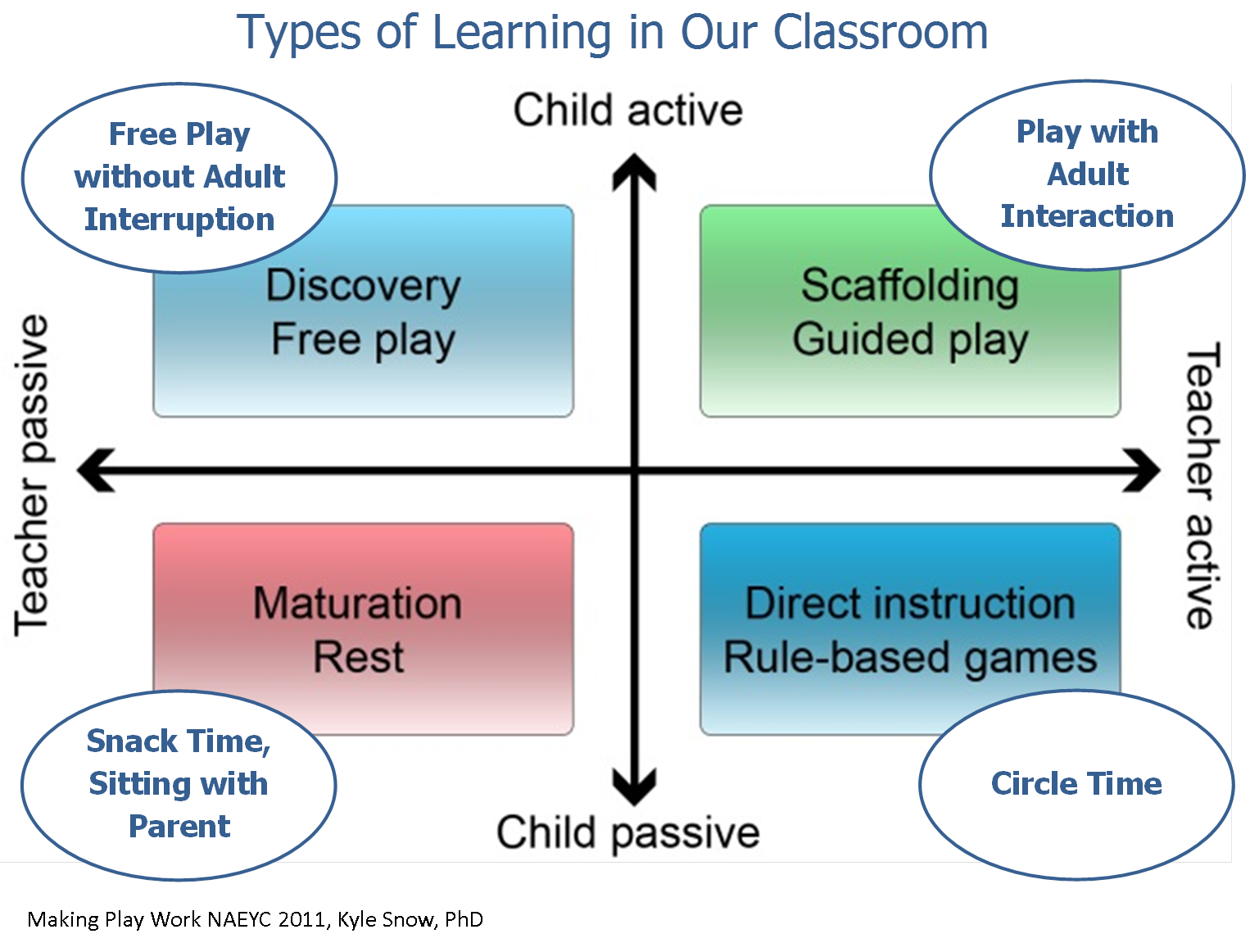
BalancedLearningChildren learn in a variety of ways.Parents and teachers can help them learn by varying our schedule and activities so they have a chance for some guided learning, some self-directed learning and some down time to process it all.

In this diagram by Kyle Snow, he divides four types of learning up by whether the teacher and child are active or passive. (His diagram shows the rectangles of types of learning – I have added the circles.) Whatever classes or daycare your child attends, it’s worth thinking about whether there are opportunities for all four types of learning.

Here’s how we use the four types of learning in my toddler classes with Bellevue College Parent Education.

Direct Instruction

Direct instruction is what we think of when we say “Teaching.” This is an adult telling information to a child, or doing an instructive demonstration of how to do something. Direct instruction from a parent or a teacher is a good way to convey core information and build “crystallized intelligence” – the database of information we carry around.

In our toddler classes, we offer little snippets of direct instruction throughout the day, doing simple things like showing a child how to pour rice in the sensory bin. But the main structured learning happens in circle time when we read stories, sing songs, and play with felt boards. We encourage all children to participate in the group activity together. (At the beginning of the year, we often have some wanderers, but by the end of the year most are engaged most of the time.)

Scaffolding / Guided Play and Free Play

The best way to build “fluid intelligence” – the kind that helps us adapt to new situations and learn new skills, is hands-on play and interaction with real world experiences.

We always have multiple stations set up around the rooms, and children have the ability to choose what to play with, how to play with it, and for how long. Sometimes the children play independently, exploring and discovering on their own. (Free play.) Sometimes, the parents or teachers are asking questions, giving suggestions, or modelling ways to extend the play and involve new concepts. (Guided play – read more about the teacher or parent’s role in play-based learning here.)

Rest

Children also need down time. Quiet time, with little to no input, so their brain can process all the new information, and cement the connections that help them remember what they have learned. Since our program is just two hours long, we don’t have a lot of down time built in – we hope that children are coming in well-rested, and that they have a chance to nap afterwards. (More on toddler sleep here.)

During class, we do have a book corner where parent and child can snuggle and read for a while. Children are also welcome to come sit with their parents during our parent ed sessions. Snack time also serves as down time for many kids.

Four Types of Learning at Home

Think about your family schedule for a moment. Do you have times when you’re teaching your child? Times when they are playing with you nearby, giving occasional suggestions or playing along? Times when they’re playing independently? Quiet time? A nice mix of these will help them learn and grow.

Some parents say “my child NEVER plays alone. He always wants me to play with him.” It’s wonderful when our children like us and want to spend time with us. But, it’s also good for them to learn to play on their own too. Can you choose some times each day where you say no to them and encourage them to play alone for a while. They may resist at first, but if given a moment to “get bored” and frustrated, most can find something to do. (You can plan ahead for these times by setting up “Invitations to Play” that you think will capture their attention.)

Play-Based Learning

What is play-based learning?

The teacher or parent sets the stage with engaging and fun activities. Then the child explores through play: observing, experiencing, wondering, exploring, and discovering. The teacher or parent is nearby to observe, ask questions, make suggestions, or play along with the child. But the child decides which activities to do, which toys to play with, what to do with them, and for how long.

[The video linked above, by Jessica Lubina, is a nice quick overview of the concept.]

What is play?

Play can be defined as anything that has these characteristics:

  • Child-Led. Freely chosen. The child is in control. He makes the plan.
  • Process, Not Product. Play is done for its own sake, not to accomplish a task. It involves lots of exploring of possibilities, experiments, trial and error, and repetition.
  • Creative. The child can adapt items, create something new or experience things in a new way.
  • Spontaneous. It’s flexible and open-ended, and it changes and evolves as play time goes on.
  • Fun. The player looks happy and engaged.

Does a child really learn by “just playing”?

We know the brain builds connections when it is exposed to novel experiences, and then allowed to repeat them again and again till it achieves mastery. This process builds two 2 forms of intelligence: memory – crystallized intelligence – the database of information that we access, and improvisation – fluid intelligence – what allows us to adapt that information to new situations. (Medina)

Direct instruction from a parent or teacher can be a great way of adding information to the database of crystallized intelligence. But, the best possible way for children to build fluid intelligence is by hands-on, engaged, self-guided improvisation… in other words, by playing.

What play-based learning is not:

  • Specialized toys. Despite what marketers tell you, learning does not require scientifically designed educational toys and apps or flash cards. Simple, open-ended toys will do.
  • Uninvolved babysitters. Some schools have co-opted the phrase “play-based learning” as a justification for sitting back and letting kids do whatever they want to do with no forethought by the teachers, and no input along the way. We’re talking about a more engaged process.

Benefits – Kids who learn by playing gain:

  • Physical competence. Free play allows a child to practice emerging skills till they are mastered.
  • Self-direction. The child gets to make decisions, make plans, and see them through.
  • Creativity. Experiments show that children who are taught “the right way” to use a toy will use it in limited ways. Kids who are allowed to freely explore develop many more creative uses.
  • Problem-solving. When a child creates her own plan for play, she doesn’t foresee challenges that will come up that an adult might see. This offers lots of chances for problem-solving.
  • Language skills. Play requires asking and answering questions, giving commands and acting on them, and explaining your goals to the person you are playing with.
  • Conflict resolution skills. There’s lots of negotiation that goes on in cooperative play.
  • Emotional intelligence. Dramatic play helps children understand emotions, learn how to express emotions, and distinguish between real emotions and “pretend” emotions.
  • Symbolic play. If a child can use a stick to simulate an ice cream cone, it helps her later understand that numbers on a page represent how many objects they have, and that letters represent sounds, and musical notes on a page indicate where to place her fingers.
  • Better memory. Kids are motivated to remember things they need to know for a play scenario.
  • Reduced stress. Play is fun. Children play when they feel safe. We are all more capable of learning new things when we are having fun and feeling safe.

Teacher’s Role / Parent’s Role

The adult plans an environment and schedule which promotes learning. Children learn best when they feel safe, so familiar routines, consistent rules, and respectful caregivers are essential components. The adults offer meaningful experiences that are stimulating, invite exploration and engage kids. The teacher often has outcomes in mind: knowledge, skills, abilities and understandings children will acquire. But they have not determined an exact path the child must take to get that knowledge.

As Teacher Tom says: “One thing I don’t do is decide what the children will learn… That’s not the job of a teacher… that’s the job of the children. My job is to create an environment, then play with them in it, helping them, but only when they really need it.” Some roles an adult may play are:

  • Stage manager: Sets the stage. Creates an “invitation to play” that combines familiar objects and activities (for repetition/mastery) with novel objects to explore and discover.
  • Observer. Observe quietly. Be there so if they look up with an “a-ha” moment, or an “I did it”, you’re there to reflect that success back to them. A good rule of thumb is to observe for at least 3 minutes before talking. Then make suggestions or ask questions to extend their thinking, or encourage reflection. But don’t change their play, or tell them what their results need to be.
  • Recorder: Ask them to describe what they are doing. (Remember, ask about the process, not the product they’ll end up with.) Write it down to share with a parent or friend later.
  • Facilitator: Help get them the tools they need to accomplish their play plan. Help clear away the “clutter” that gets in the way of their play. Ask more, answer less.
  • Mediator: For children age 3 and up, it’s best to sit back and let kids work out their own conflicts and learn from doing so. But sometimes, especially with younger children, an adult helps resolved conflicts by offering new materials or suggesting alternatives, and modelling flexible thinking needed for peer interactions.
  • Interpreter: help children understand what is meant by another’s words and actions.
  • Participant in play: You follow their lead, respect their individual style of play. Don’t try to make the game your own. Simply be one of the kids who is playing! (As the “big kid” in the group, you can role model respect, creativity, flexibility.)
  • Tools of the Mind style. Kids develop a plan for their pretend play. Teacher offers instruction in pretend play – suggestions specific to the scenario. Kids play. When play comes to an end, the teacher discusses it with them and asks about what they did.
  • Reggio Emilia – inquiry-based or project-based learning style. When your child demonstrates interest in a topic, you collect resources related to it: books, videos, tools, resources for dramatic play related to it. The child chooses a project and must plan their actions, gather information, and develop new ideas. The teacher / parent observes, participates, guides the play when needed, asks questions, and encourages deeper thinking.

A key element of play-based learning is Scaffolding. Development advances and learning occurs when children are challenged to do something just one step beyond their current mastery, and then allowed to practice newly acquired skills. Adults and older children help them make the step by giving a hint, modelling the skill, or adapting materials or activities, and then allowing them to continue to play.

Resources

Read: Brain Rules for Babies, by John Medina.

Collections of resources on Play & Learning: www.naeyc.org/play and www.zerotothree.org/child-development/play/

Watch: The Power of Play documentary: https://vimeo.com/20964066

If you ever find yourself wondering about our class: “Why aren’t they teaching my child anything?? All they do is play!” watch this video to remember everything kids learn when they are playing: www.youtube.com/watch?v=GNlW7YIX7pk

Additional Sources Used:

The Playing Learning Child: Towards a pedagogy of early childhood. Samuelsson & Carlsson. 2008  Scandinavian Journal of Education.  http://www.tandfonline.com/doi/pdf/10.1080/00313830802497265

The Role of Play in Today’s Kindergarten, Lori Jamison. http://lorijamison.com/blog/wp-content/uploads/2011/06/The-Role-of-Play-in-Todays-Kindergarten.pdf

References to Play in NAEYC Position Statements: http://www.naeyc.org/files/naeyc/file/ecprofessional/Play%20references%20in%20NAEYC%20position%20statements_10%2009%20update.pdf

Play in the Preschool Classroom: Its Socio-emotional Significance and the Teacher’s Role in Play, Godwin S. Ashiabi1,2 Early Childhood Education Journal, Vol. 35, No. 2, October 2007. http://leadershiplinc.illinoisstate.edu/play-based-learning/documents/play_in_the_preschool_classroom.pdf

Go Play – Promoting Your Child’s Learning Through Play www.zerotothree.org

Teaching a Play-Based Curriculum by Teacher Tom. http://teachertomsblog.blogspot.com/2012/04/teaching-play-based-curriculum.html

What is child-led play? On nature-play.co.uk

An Invitation to Play

inviteChildren learn through:

  • being introduced to new ideas and activities (novelty)
  • having the chance to experiment, explore, test & re-test (repetition to achieve mastery)

In play-based learning, a parent or teacher’s role can be to set the stage with new materials, or with familiar materials combined in new ways. Then it’s the child’s role to play: experiment, explore, test and re-test.

“Invitations to play” is one way of approaching these tasks. Parents often say “my child has so many toys that they don’t even play with.” If all the toys are tidily put away in baskets, it’s hard for a child to decide what basket to pull off the shelf. If all the toys are randomly scattered about the floor, it’s hard to decide what to play with first.

We can better engage the child with a little intention. Like instead of just a box of magna-tiles sitting next to a box of toy cars on the shelf, I could set up a magna-tile garage on the table with supplies nearby to build more garages. Instead of just having a toy kitchen with all the things that are there every day, I could create new play ideas by scribbling out a menu for a cat cafe, and place a couple stuffed cats there. Even just setting a puzzle on the table with one piece sitting loose next to the puzzle is more engaging than seeing an assembled puzzle sitting there. When you look at the table, you know what to do!

Read more about invitations to play

Today, I set up an invitation to play for my 3 year old.(I knew I had a busy day with lots of work to do, so wanted something ready to go that would keep him busy for a while.)

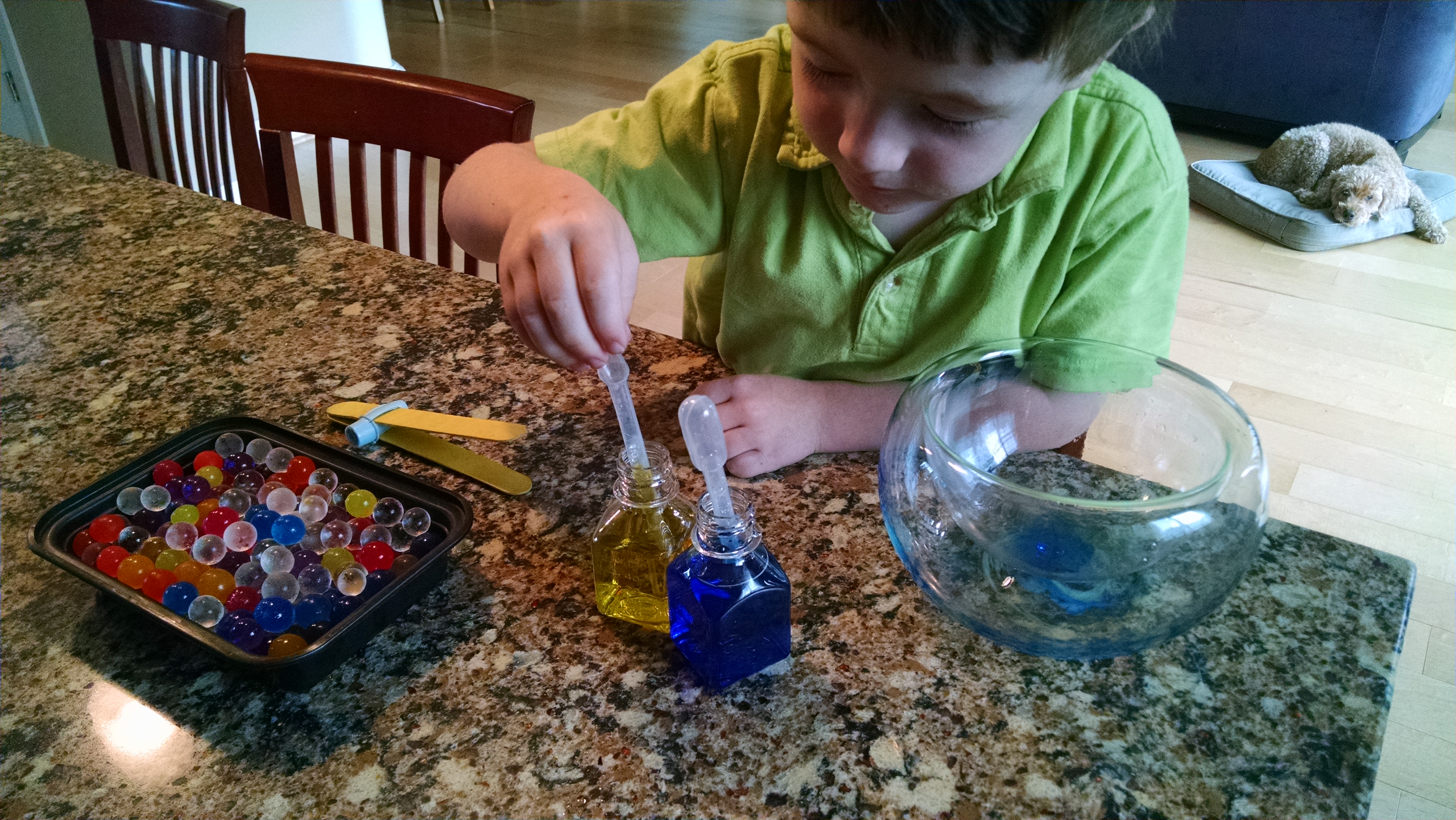
Yesterday, we did “science experiments” with a new set of tools: pipettes and water mixed with liquid watercolors. We would give him two containers of colored water, with pipettes, and a glass vase to mix the colors in.

,Today I set out two colors of water, pipettes, and a glass bowl to mix them in, instead of the vase. I had his container of water beads nearby. When he came into the room, he immediately settled into playing with the pipettes and water, which occupied him for quite a while. When his interest started to wane, I pulled over the water beads and tongs. I didn’t even need to say anything. He immediately started adding water beads. After he’d added them all and taken them all back out, he said “I’ll never do that again.” Apparently he prefers his water beads as a separate activity.

When he ran out of yellow water in his container, I said “Well, you put lots of yellow water in the bowl. Let’s just take some yellow back out of the bowl.” When the pipette pulled up green water from the bowl, I said “Hey! Where’s my yellow water!” That then led to a long play time of trying to pull up blue water or yellow water, and him learning that once things are mixed, they often can’t be unmixed.

This activity gave him chances to further explore materials he’s learned about recently, and combine them in new ways, thus deepening his knowledge of all the materials, and gaining a new insight about color mixing. And, it gave me a chance to get some work done…. Wins all around.

Water Beads vs. Boba (Edible Tapioca Balls)

Water beads are FABULOUS to play with (see my last post) but bad to ingest (non-toxic, but not healthy, even potentially deadly…. again, see my last post). So, if you’ve got a little one who ALWAYS puts everything in their mouth and swallows it, they’re not a safe option.

I’d seen a recommendation to use boba – tapioca pearls like are used in bubble tea. I decided to do a side-by-side comparison.

The products

My water beads were BioGel from Creation Station. The boba was Rainbow Tapioca Pearls, ordered from Amazon. On a pound-for-pound basis, the boba was half the cost, but I had to buy a larger quantity than I would need for sensory play for one kid.

Ease of Preparation

Boba – boil water, add boba, cook for five minutes or more, drain.

Water beads – put them in water. Let them sit for six hours.

Water beads win, but both pretty easy.

Appearance

boba

Boba for sensory play

water beads

Water beads for sensory play

As you can see, water beads are MUCH prettier than the boba. The boba was fine on its own – interesting shape, some shine, nice color. But doesn’t begin to compare to the beauty of the water beads!

Play-ability

Boba – they’re pretty sticky – stick to your hands and stick to each other – so easier to play with if you float some in water. Interesting to touch, fun to “chase” around the water and catch, fun to squish between your fingers into blobs of goop. Held my son’s attention for about 5 minutes – if he’d used these before the water beads, they might have been more interesting.

Water beads – VERY fun to play with – on their own or in water. Can be scooped, poured, picked up with tongs, and so on. (See my other post, or ideas on Pinterest.) Kept my son’s attention for a week of on-going play and exploration.

Again, the water beads are the clear winner.

Taste

Boba – bland but chewy – I told my son they were edible but the water beads absolutely were not. He popped a couple in his mouth and ate them, but not a lot. (He loves them in bubble tea, but not as much in this context, which is probably a good thing. (I generally try to keep “sensory items” and “food” in separate categories to minimize confusion.)

Water beads – tasteless and no smell, so no motivation to eat, luckily. Note: my son did not taste them, because I told him they were not edible. I did taste them (licked one), for the purposes of this review – I wanted to know if they would appeal to toddlers. FWIW: My dog also was unimpressed. We dropped one on the floor, he picked it up, carried it in his mouth for a few seconds and spit it out. This is a dog who eats lots of stuff he shouldn’t (like socks), so these must really be unappealing.

Mess and clean-up

Boba – need to wash your hands and whatever surface you played on after use – starchy, gooey.

Water beads – no clean-up needed. I dry my hands after playing with them. But my son (who is a kid who HATES being wet after water play) doesn’t even bother to dry his damp hands when he’s done.

Storage

Boba – we didn’t have them around for long – they just weren’t interesting enough to keep around. I imagine they dry out and stick together, may go bad?

Water beads – they’ve been sitting uncovered on the counter for a week, no maintenance needed.  I rinsed them after a week, just for kicks. Don’t know if they were dirty.

Conclusion

Water beads are a far superior sensory material. For me, personally, with my child I will use them in the future, and not boba. If you’ve got a kid who mouths and eats everything, then the boba may be a better option for you.

Update: here are alternate directions for making tapioca water beads… I have not tested it, but it’s worth taking a look at, because they claim it works for them: https://thecraftathomefamily.com/edible-water-beads/?fbclid=IwAR3oXVvI1TUktv3l824wwp_8FT6h4aLmbhYRCBHxIAVboD4zb3RhpZaCcRw