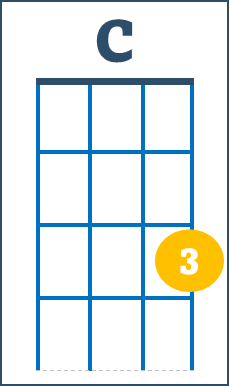
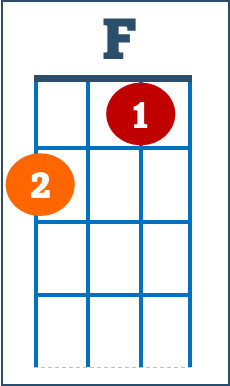
If you’ve been working your way through my Uke School tutorials, you should know how to play C, F, and G7 chords, so let’s try some three chord songs!
Twinkle Tune and variants
There are LOTS of songs you can sing to Twinkle Twinkle Little Star.
(C) Twinkle, twinkle, (F) little (C) star (G7) How I (C) wonder (G7) what you (C) are Up a(F)bove the (C) world so (G7) high, (C) Like a (F) diamond (C) in the (G) sky (C) Twinkle, twinkle, (F) little (C) star (G7) How I (C) wonder (G) what you (C) are
(C) Two little eyes to (F) look a(C)round (G7) Two little (C)ears to (G7) hear each (C) sound One little (F) nose to (C) smell what’s (G7) sweet (C) One little (F) mouth that (C) likes to (G7) eat. (C) Eyes and ears and (F) nose and (C) mouth. (G7) Eyes and (C) ears and (G7) nose and (C) mouth.
(C) ABCD (F)EF (C)G (F)HI (C)JK (G7)LMNO (C)P QR (F)S (C)TU (G7)V (C)W (F)X (C)Y and (G7)Z. (C)Now I know my (F)AB (C)C’s. (F)Next time (C)won’t you (G7) sing with (C) me.
(C) Snowflake, snowflake (F) fancy (C) free. (G7) Snowflake (C) snowflake (G7) dance with (C) me First on my (F) head (C) then on my (G7) toes (C) then on my (F) nose where the (C) cold wind (G7) blows (C) Snowflake snowflake (F) turn a(C)round. (G7) Snowflake (C) snowflake (G7) touch the (C) ground.
More C F G7
You are my (C) sunshine, my only sunshine. You make me (F) happy when skies are (C) gray. You’ll never (F) know dear how much I (C) love you, Please don’t take my (G7) sunshine (C) away.
Happy (C) birthday to (G7) You, Happy birthday to (C) You, Happy Birthday dear (F) [name] Happy (C) birthday (G7) to (C) you.
(C)This old man, he played one, (F) he played knick knack (G7) on my thumb, with a (C) knick knack paddywhack, give a dog a bone, (G7) this old man came (C) rolling home.
(C) Bumping up and down in my little red wagon (G7) Bumping up and down in my little red wagon (C) Bumping up and down in my little red wagon (F) Won’t you (G7) be my (C) darling
(C) Head Shoulders Knees and Toes, Knees and Toes Head Shoulders Knees and (G7)Toes, Knees and Toes And (C) Eyes and [C7] Ears and (F) Mouth and [F7] Nose (G7) Head Shoulders Knees and (C)Toes, Knees and Toes
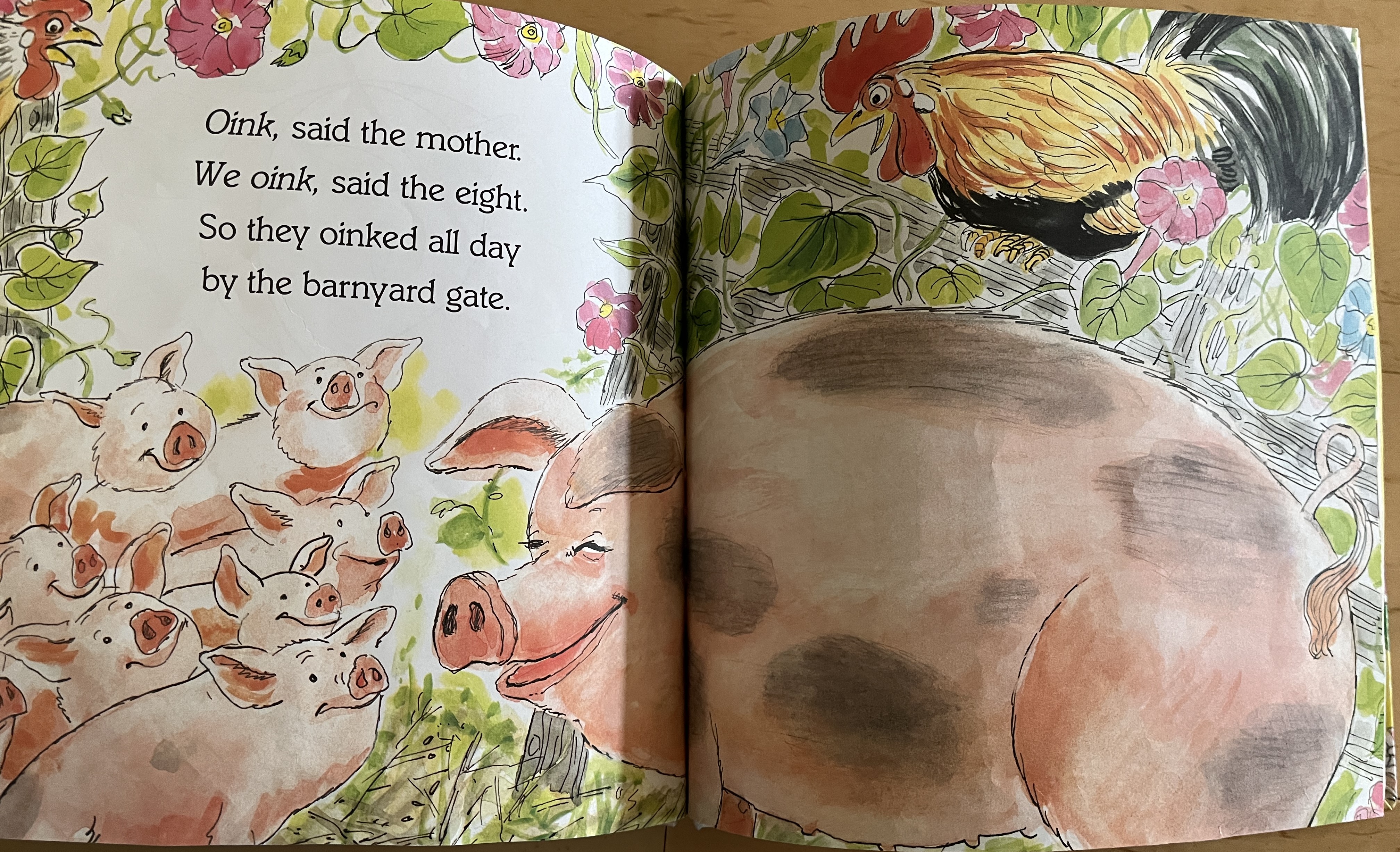
I learned about the idea of “books that sing” from Nancy Stewart (Learn more about Books that Sing.) These are books that can be sung aloud, rather than read aloud – they may be illustrated versions of traditional songs, or may be new compositions. I built a year-long preschool music curriculum that included 4 of these books each month. Here are some of the books that I found and used.
Farm Theme
Old McDonald – Cabrera and others
Old Mikamba had a farm – Isadora
Barnyard Dance – Boynton – make up your own tune to this musical rhyming book
Mary Had a Little Lamb – Hoberman or Borgert-Spaniol
Pickin Peas by Macdonald – may be too long for preschoolers
Jingle Bells. Notes on the versions – Jeffers – words don’t go quite in the order kids expect and it does include Santa and Mrs. Claus; the version illustrated by Darcy May is simple and straightforward all the words in the right order, shows bob tail and sleigh and other new vocabulary well; Kovalski – not the best writing, so I might tell a new story to the pictures; Trapani – highlights Xmas traditions around the world, so may not be suitable for a non-secular setting
Stars/Moon Theme
Twinkle – several versions! I like Cabrera, Taylor and Litwin versions better than Borgert-Spaniol
Whether you’re a librarian planning story time, a preschool teacher looking for new songs or a parent of a toddler who is tired of the same five songs, here are resources for learning new children’s songs.
The very best resources I know of are:
Tell Me a Story from the King County Library System – searchable collection of hundreds of videos of children’s librarians singing songs and showing the motions
Jbrary – two children’s librarians (Lindsey Krabbenhoft and Dana Horrocks) have created a huge collection of videos of children’s songs (with motions) and also have lists of favorite books, ideas for storytime, etc.
Sing with Our Kids, where Nancy Stewart has created a song library which includes lyrics and .mp3 audio recordings of lots of great traditional kid songs, and a collection of “Books that Sing” – picture books that you can sing aloud.
And here are resources I have created that you are welcome to use:
For a preschool, here’s a full year music time curriculum with shaker songs, rhymes, songs, and recommended “books that sing” for 9 monthly themes – include ukulele chords. Here are the books-that-sing that I use.
my full lesson plan for a year’s worth of Toddler Circle Times. It includes lots more songs and rhymes, gathered around 9 monthly themes.
for an infant-wobbler class, here are all the baby songs I do during the year. (here are the same songs with the ukulele chords, and here are 11 x 17 posters of the lyrics to print and use in class)
collection of fun science themed songs for ages 3 – 6 which reinforce STEM concepts
I learned the idea of “books that sing” from Nancy Stewart. These are books that can be sung instead of read. I built a year-long preschool music curriculum (download it from that link!) that included 4 of these books each month. And here is the list of books that I use. For each month’s theme, I include shaker songs, finger rhymes and songs, as well as the books.
Here is a detailed preview of the books we use in April.
I looked for books featuring a springtime theme. I considered Inch by Inch, the Garden Song, which is quite good. (I use it in my kids’ science class when we talk about plants.) I thought long and hard about Dancing Feet by Lindsey Craig and Mark Brown (video) which would be so easy to make up a jazzy tune to sing it to. Or, since we’re in Seattle, there’s Singing in the Rain, the lyrics from the movie with illustrations by Hopgood. (video) But, I’ve been trying to choose books where the children know the tune so they can sing or hum along.
I decided to check for books of “Over in the Meadow” and “Five Little Ducks.” Turns out that there are at least five versions of each song! Let’s check them out:
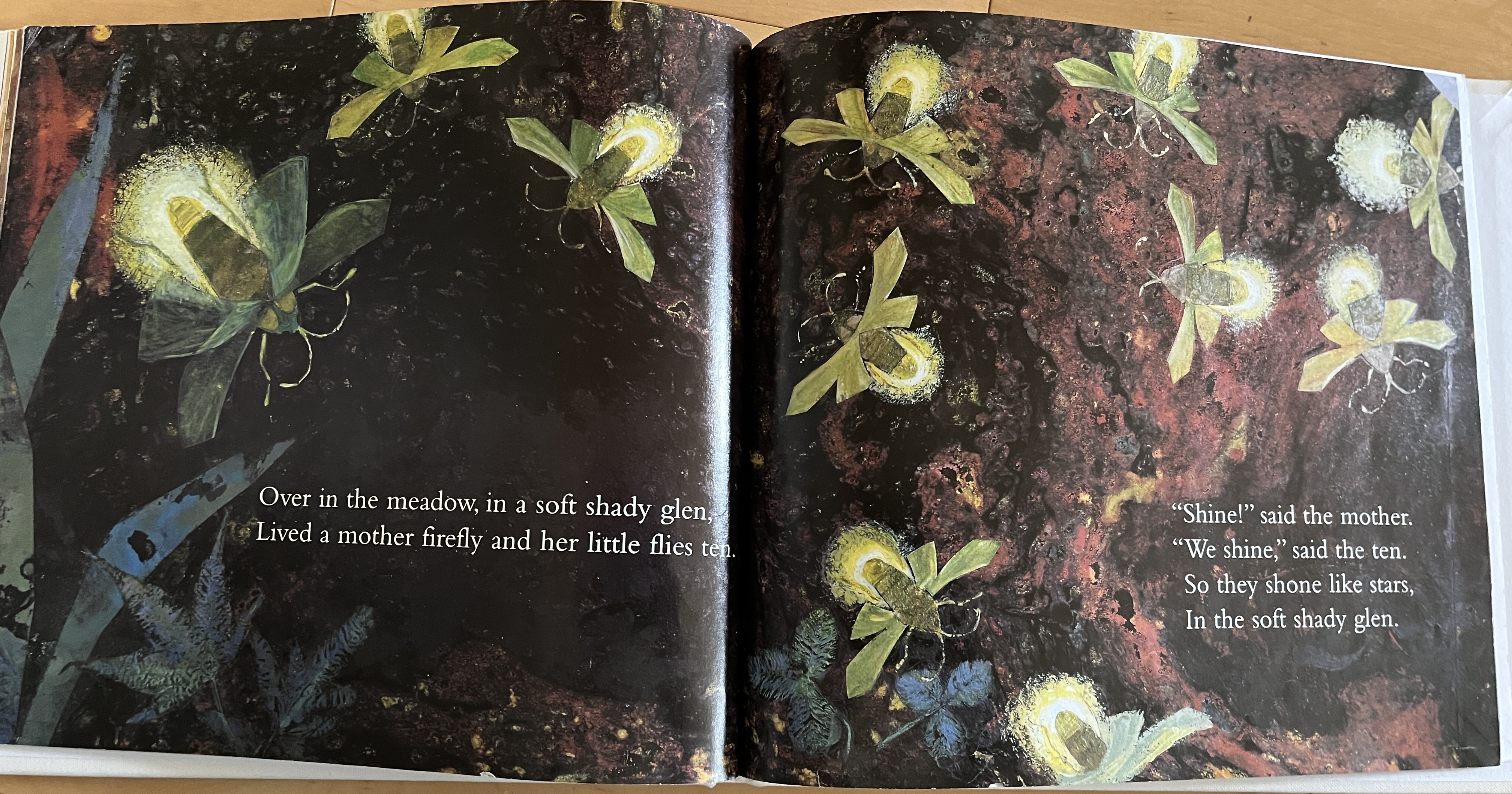
Over in the Meadow
This is a classic counting song. If you’re not familiar with the tune, you can hear it in this video, which is from the Barefoot Books version of this book that sings. We didn’t have a copy of that one at my library but you can find it on Amazon*.
Over in the Meadow – Jane Cabrera. Each two-page spread has a verse and all the animals for that verse to count. In this book, at the end, it says “over in the meadow while the mothers are away, can you count the babies? they’ve all come to play.” You can then play an I-spy style to find and count all the animals in one scene. My library has the Wonderbook version where you can play the music to sing along to. But, the recording is a little bland and slow to my taste – I’d rather sing it myself.
Over in the Meadow illus by Rojankovsky. Copyright 1957, featuring lovely pastel sketches. At the end of the book, there is a nocturnal scene where many of the animals appear. It includes an owl chasing a frightened looking bunny which might trouble a few particularly sensitive children. Includes sheet music of the tune on the last page.
Over in the Meadow illustrated by Anna Vojtech. The illustrations are lovely. I like that in addition to the main illustration where you can count the animals “hiding” in the scene, and then below the verse, there’s a picture of just the baby animals. I’m dubious about verse 10 with the little beavers ten. “Beave said the mother, we beave said the ten…”
Over in the Meadow, illus by Paul Galdone. (c. 1986. not available on Amazon.) Although I don’t love the illustrations, an interesting aspect is that it has one page that shows the digit and the written out number, then a second page to finish the verse.
Over in the Meadow, illus by Ezra Jack Keats. Nice naturalistic illustrations. Only minor quibble is that sometimes it’s hard to tell the difference between the parent and the babies, which makes it harder for the kids to count the babies accurately.
Another counting rhyme. This one counts down from five to zero. And then rather than leaving poor mama duck bereft, all five little ducks come back at the end. Here’s the tune. Or another version. There is also a Raffi recording of it.
Five Little Ducks, by Denise Fleming. In this version, instead of Mama Duck calling the babies back, Papa Duck does. It also adds in days of the week and instead of just going over the hills and far away, they go other places. Monday – through the woods, Wednesday past the paddock, Thursday – across the fields, Friday – down the road. Saturday they come back. Then, Mama Duck discourages them from leaving the nest, because on Sunday “we all rest.” At the end of the book, there’s a paragraph of information on each of the animal types depicted.
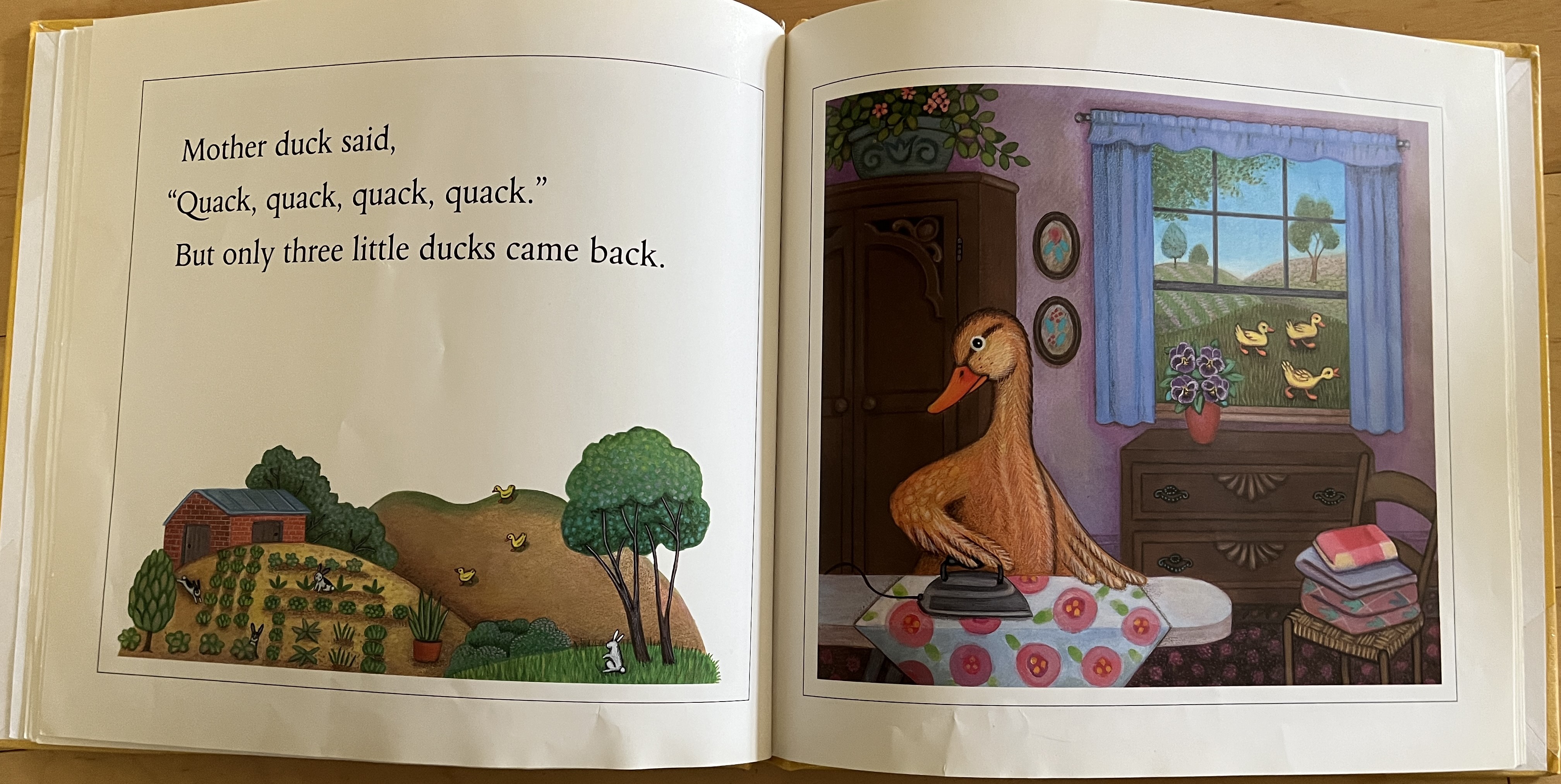
Five Little Ducks illus by Pamela Paparone. Shows Mother duck doing all sorts of work around the farm: gardening, hanging laundry, ironing, picking apples, but also painting a picture. A nice feature is the pages that show the correct number of little ducks either walking away up the hill or coming back down the hill, plus they’re seen in another scene, so there’s lots of opportunities to count the same number to get a good grasp that three is three, no matter how they’re arranged on the page.
Five Little Ducks illus by Aruego and Dewey. Part of the Raffi Songs to Read series. My least favorite illustrations. But the end is unique. After all the ducks are gone, and none of the little ducks come back, we see Mama in Autumn, Mama in winter, and going out in spring to find all five little ducks who have all had babies of their own! One has five babies, one has four, one has three, one has two, and one has just one baby. Also has the sheet music at the end.
And that’s not all! There are more versions available – see them on Amazon.
How I Use Books that Sing
Sometimes I introduce the song first, teaching it and helping the kids get the hang of it first before introducing the book. This is helpful if either I think the song is brand new to everyone OR if the words in the books have a lot of variations from the typical words. (For example, I would want them familiar with the Over in the Meadow tune before introducing Over in the Ocean. When I read Over in the Ocean, since the words are so different than they know, I would have them hum the tune along with me as I sing the words in the book. It turns out three year olds are great at humming tunes!)
With these books, since most of them align really closely with the traditional words and since I have SO MANY books to choose from this month, I’m just going to teach the songs by reading the books, saving the ones with the most word variations (like the Papa Duck version) for last.
*Note: I am an Amazon associate. If you click on any book name below, it will take you to Amazon where you can read a full description of the book. If you end up buying anything after clicking through, I get a small referral bonus at no cost to you.
I teach a parent-child class where the toddlers are 12 – 30 months in September. Each week, we do a circle time for music and stories. I tell the parents that not only does music have many benefits for children’s learning, and not only do rhymes and songs help teach language skills, circle time is also a chance for children to begin to practice key skills for kindergarten readiness: the ability to sit still, to listen to a teacher, to notice and do what the other people around them are doing, and to stop doing something when asked. (We do the shaker song every week, “oh you shake and you shake and you shake and you stop” and I talk about how huge this is for practicing impulse control.) My secret agenda is that teaching parents things to do with their children builds connections. Plus, of course, circle time is fun!
At the beginning of the year, I make sure parents know that their children will not yet be good at sitting still and paying attention for the full circle time, but the more we practice, and the more we model that behavior for them and encourage them to try, the better they’ll get. At the beginning of the year, circle time is about 10 minutes long. By the end of the year, it’s 20 – 25 minutes.
I always go in the same order each time, just adding more pieces to each segment as we go along. That way the children learn the ritual, and are better able to participate because they can predict what will happen next.
Greeting Songs – each week we do the “I roll the ball to [name] song” and one other greeting song which uses the child’s name and gives each child a moment in the spotlight.
Lap Songs – when we bounce children in a rhythm, it helps to instill rhythm in them at a fundamental level. It also helps to build their vestibular system. These songs are also super fun, and get lots of giggles going.
Finger Rhymes – these teach a lot of vocabulary, and also teach children to notice patterns… “after dad says ‘with a one step and a two step’, he’s going to tickle me.”
“Theme Activity” – I always have some small toys, puzzle pieces, or decor items tied into the theme gathered in my red gift bag. We sing “what’s in the red bag, the red bag, the red bag…” song. The kids come running over to find out. I give each one an item to take back to their parent – they talk about it together, then we do a few rhymes or songs that are related, then they bring them back to me.
Book (we start these about halfway through the year)
Shakers – we do the shake and stop song, sometimes some other songs, sometimes we turn on recorded music and dance and shake to the music.
Active Songs, with or without parachute. Moving around the room in rhythm to the music is great at building coordination, rhythm, and large muscle skills.
I’ve gathered the ideas for my circle time rhymes and songs from many great sources. I have lots of favorite songs (here are links to lyrics and to videos showing hand motions). I have some favorite toddler books I share.
I have a full year’s worth of circle time plans for my toddler class – it’s organized by theme, and we do each set of songs for about 4 – 6 weeks. Themes include: fall, winter, spring, farm, zoo, stars, transportation, ducks, and beach.
For my science class for 3 – 6 year olds, we do two completely different circle times each week – opening circle teaches a rhythm activity, a discussion of the day’s topic, and a non-fiction book. Closing circle teaches a song, we read a fun imaginative fiction book related to the day’s theme, and we often do a group game to reinforce the day’s learning. You can find about 35 topics worth of circle time plans at www.InventorsOfTomorrow.com.
Do you have any great tips for how to help circle time go well, any favorite songs, or favorite resources for finding more ideas?







 More Good Days with Kids