Tag Archives: sensory

Interoception

While you may be familiar with the five senses (hearing, sight, taste, smell, touch), there are more than that, including: vestibular (am I balanced), proprioceptive (where is my body in relation to the things around me, and interoception.

Interoception is your perception of your own internal states: are you hot or cold? are you hungry or thirsty? do you need to pee? poop? move your body to a more comfortable position? are you sick? is your heart racing?

Developing Interoception

When a baby is born, they display the most basic of “feelings”. They are content, or they are distressed. That distress is often caused by an internal experience, such as hunger, fatigue, or pain. But they do not yet have the life experience to interpret what those sensations mean, and what would fix them.

That’s where parents and caregivers come in. We do our best job of guessing what they might need and meeting that need. If we guess right more often than not, they soon learn that when they feel this particular set of internal cues and then they eat, they feel better. Eventually they learn to label it as hunger, and someday they learn that they can eat before the hunger pangs hit to ward off that feeling.

Learning to tune into and trust our internal cues helps us to take care of our bodies. For example, stopping eating when you’re full honors those cues, and can be helpful for developing healthy eating habits. Being told “you have to finish all the food on your plate” teaches you to ignore those cues and keep on eating.

Interoception and Emotions/Behavior

As we get older, noticing and interpreting internal cues is so helpful for taking good care of our bodies, but having interoceptive intelligence also helps us with emotional and behavioral regulation.

We’ve all experienced being “hangry.” When you’re hungry, the smallest irritation sets off a disproportionate wave of anger. We know that when a child is tired, they get cranky or sad. Letting a child move and change positions during group time can help them be comfortable and help them pay attention. When a child just can’t sit still in a class, it is often worth asking whether they need to pee.

If your child is having lots of tantrums, it’s easy to interpret those as behavioral choices. But it’s worth asking yourself – is it possible that instead they are sensory meltdowns? When a sensory meltdown happens, the best way to calm it is with co-regulation. You as the caregiver stay as calm as you can, speaking quietly, holding them gently until they get back to calm. The bridge from them needing your help to calm themselves to being able to calm themselves down to them being able to notice internal distress and dispel a meltdown before it happens is interoception.

How can we help build a child’s interoception?

For babies: notice their cues, do the best you can to interpret them and respond to them promptly. This helps your baby learn how their body signals tell them what they need and how those needs can be met.

If we ignore bodily issues, we teach them to ignore them. If we change a wet or dirty diaper promptly it helps them realize that when they pee or poop something happens – that will help with potty training later. But if you often delay diaper changes, they learn to just ignore the situation, and are hard to talk into potty training later.

For toddlers and children, start to interpret their experience. “I notice you’re wiggling a lot, I wonder if you need to pee.” “You’re all sweaty now – I bet you’re hot. Do you think taking your coat off would help?” As with teaching emotional literacy, rather than telling them how they feel, phrase it with curiosity and questions that encourage them to tune in to those inner signals for themselves. “Hmmm… it’s been a long time since we ate, I wonder if you are feeling hungry yet?”

You can also share your own experience: “whoo – I’m really cranky right now… you know what I think is going on? I think I’m hungry and I notice that I get really cranky when I’m hungry.”

Don’t dismiss their experiences. If they hurt themselves, instead of saying “you’re fine”, say “it seems like that really hurts, huh? I’m pretty sure it will feel better soon, but what would help you now?”

When they’re younger, we might teach common experiences, like “if your stomach growls, it means you’re hungry.” As they get older, we can talk about how everyone has unique body experiences: “if you’re feeling worried, where do you feel it in your body? When you feel that way, what could you do to feel better.”

Understanding their own internal needs helps them to meet those needs, and helps reduce the chance that those needs will distract them from learning and from behaving well.

Learn More about Interoception and Sensory Regulation

(Side note: Enteroception with an e is a subset of interoception, and refers specifically to the senses of your gastrointestinal system – hunger, fullness, and urge to have a bowel movement.)

Water Beads vs. Boba (Edible Tapioca Balls)

Water beads are FABULOUS to play with (see my last post) but bad to ingest (non-toxic, but not healthy, even potentially deadly…. again, see my last post). So, if you’ve got a little one who ALWAYS puts everything in their mouth and swallows it, they’re not a safe option.

I’d seen a recommendation to use boba – tapioca pearls like are used in bubble tea. I decided to do a side-by-side comparison.

The products

My water beads were BioGel from Creation Station. The boba was Rainbow Tapioca Pearls, ordered from Amazon. On a pound-for-pound basis, the boba was half the cost, but I had to buy a larger quantity than I would need for sensory play for one kid.

Ease of Preparation

Boba – boil water, add boba, cook for five minutes or more, drain.

Water beads – put them in water. Let them sit for six hours.

Water beads win, but both pretty easy.

Appearance

boba

Boba for sensory play

water beads

Water beads for sensory play

As you can see, water beads are MUCH prettier than the boba. The boba was fine on its own – interesting shape, some shine, nice color. But doesn’t begin to compare to the beauty of the water beads!

Play-ability

Boba – they’re pretty sticky – stick to your hands and stick to each other – so easier to play with if you float some in water. Interesting to touch, fun to “chase” around the water and catch, fun to squish between your fingers into blobs of goop. Held my son’s attention for about 5 minutes – if he’d used these before the water beads, they might have been more interesting.

Water beads – VERY fun to play with – on their own or in water. Can be scooped, poured, picked up with tongs, and so on. (See my other post, or ideas on Pinterest.) Kept my son’s attention for a week of on-going play and exploration.

Again, the water beads are the clear winner.

Taste

Boba – bland but chewy – I told my son they were edible but the water beads absolutely were not. He popped a couple in his mouth and ate them, but not a lot. (He loves them in bubble tea, but not as much in this context, which is probably a good thing. (I generally try to keep “sensory items” and “food” in separate categories to minimize confusion.)

Water beads – tasteless and no smell, so no motivation to eat, luckily. Note: my son did not taste them, because I told him they were not edible. I did taste them (licked one), for the purposes of this review – I wanted to know if they would appeal to toddlers. FWIW: My dog also was unimpressed. We dropped one on the floor, he picked it up, carried it in his mouth for a few seconds and spit it out. This is a dog who eats lots of stuff he shouldn’t (like socks), so these must really be unappealing.

Mess and clean-up

Boba – need to wash your hands and whatever surface you played on after use – starchy, gooey.

Water beads – no clean-up needed. I dry my hands after playing with them. But my son (who is a kid who HATES being wet after water play) doesn’t even bother to dry his damp hands when he’s done.

Storage

Boba – we didn’t have them around for long – they just weren’t interesting enough to keep around. I imagine they dry out and stick together, may go bad?

Water beads – they’ve been sitting uncovered on the counter for a week, no maintenance needed.  I rinsed them after a week, just for kicks. Don’t know if they were dirty.

Conclusion

Water beads are a far superior sensory material. For me, personally, with my child I will use them in the future, and not boba. If you’ve got a kid who mouths and eats everything, then the boba may be a better option for you.

Update: here are alternate directions for making tapioca water beads… I have not tested it, but it’s worth taking a look at, because they claim it works for them: https://thecraftathomefamily.com/edible-water-beads/?fbclid=IwAR3oXVvI1TUktv3l824wwp_8FT6h4aLmbhYRCBHxIAVboD4zb3RhpZaCcRw

Water Beads

Let’s talk about one of my favorite sensory items. On Pinterest and blogs, you’ll find lots of posts about “water beads” and using them as a sensory item for toddlers and preschoolers. For safety reasons, I don’t recommend them for children under three. (See safety note below.)

What are water beads?

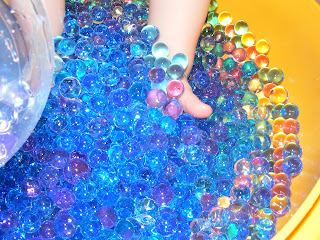
Water beads are a water absorbing polymer designed to be used in flower vases. They look like tiny plastic balls till you put them in water for 6 – 8 hours, then they swell up to gelatinous marbles. They stay hydrated for days, even uncovered.

They are really interesting and appealing to touch – they feel cool, wet, squishy but not squash-able (resilient), malleable. Fun to just run your fingers through. They’re interesting to look at – really beautiful – brightly colored, shiny, reflective, and they pick up all the light in the room (they look great on light tables). They bounce. Luckily, they don’t taste like anything at all or smell like anything yummy, so not a lot of motivation to eat, which is good. (See safety note below.)

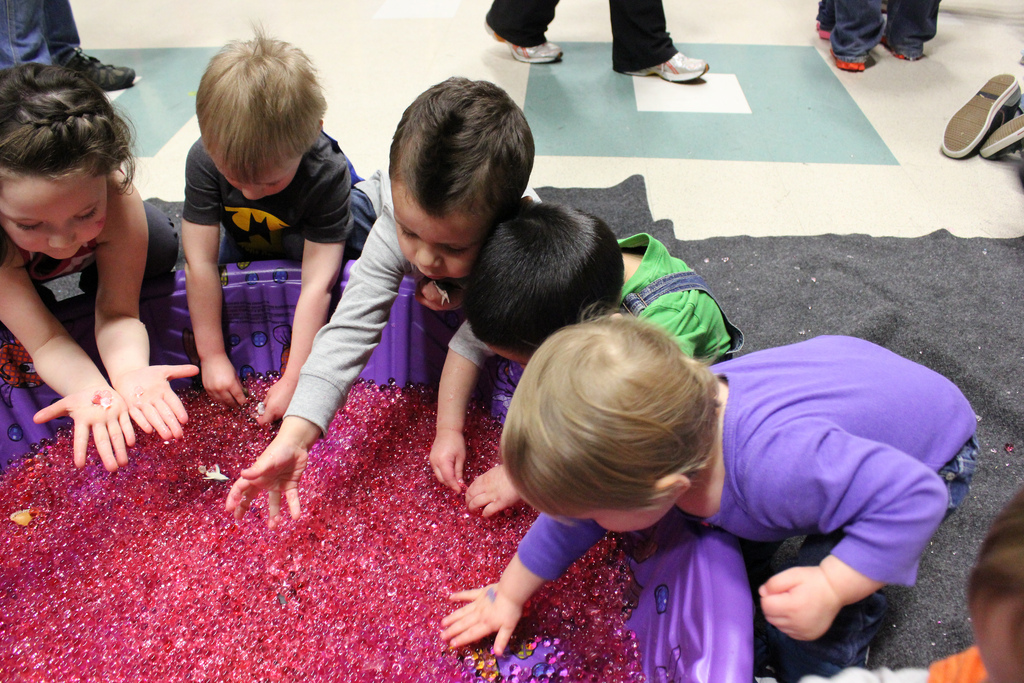
water bead tub

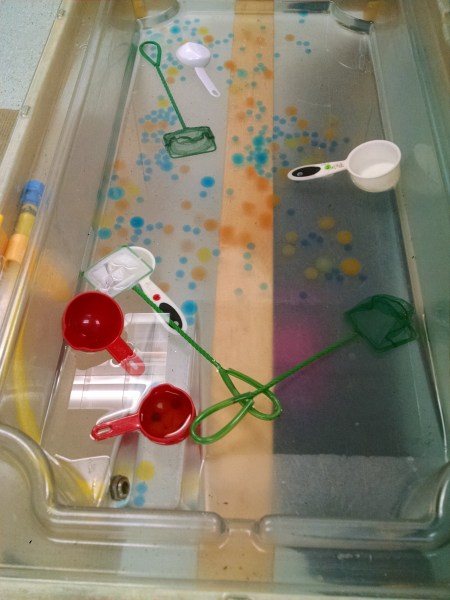
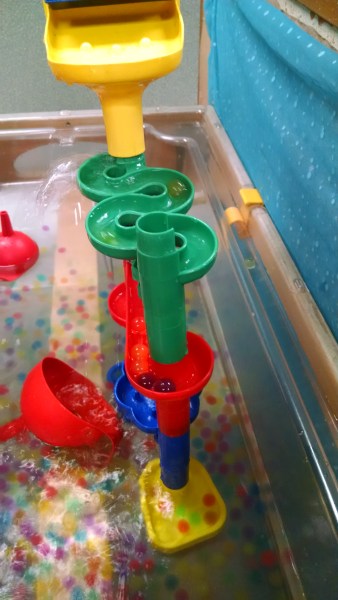
We usually use them in containers by themselves and let the kids sift their hands through them, but they’re also fun in a water table (use fish nets to catch them!).We’ve also used them with the marble maze.

img_20160326_132519369  img_20170204_134548438

Where do you get them?

They are sold in floral departments of stores, or at dollar stores, or can be ordered online (search for “water beads” or one site said to search for “polymers”). Orbeez is a good brand. I ordered  MarvelBeads Water Beads Rainbow Mix, 8 oz (20,000 beads) and have been working my way through the package for a few years! (One ounce of beads makes one gallon when they’re full size, so I usually only use a small amount per class.) They can be re-used. (see below)

Important Safety Note

Water beads are non-toxic, but that doesn’t mean they’re good to eat! If a child swallowed dry ones, they could swell in their belly.

You should never give a child jumbo size water beads! (Those that are the size of a marble when dry and swell to the size of a pingpong or golf ball.) These can cause intestinal blockages which can require surgery or can be deadly. (Some jumbo beads were recalled in 2012 but they continue to be sold. Learn more about the hazards.)

So, you should only use the beads that start out tiny and only swell to marble size. They should only be used with close supervision. If your child is under age 3 or an older child who tends to mouth things, avoid them or consider some of the more baby-proofed options for water bead play described on Playing and Learning Begins at Home, such as putting them inside a transparent plastic container with a lid. Or, make edible boba (tapioca beads) instead… see this post for my comparison. Or, Fun at Home with Kids recommends basil seed.

Set-Up, Containing Mess, and Clean-Up

They do need to be soaked before use. For class, we tend to start soaking them about 90 minutes before class starts. (They get bigger if you soak them 6 hours, but they’re a little sturdier when they’re not full size.)

They do bounce and they do roll. Some parents say that their kids dump the container all over the floor and it’s a pain to clean them up. My son kept them all up on the counter, and if one dropped to the floor, he would scramble down to rescue it and return it to the container as soon as possible. In my classes, I find most kids try to keep them in the sensory bin / water table but there’s always a few escapees that we try to chase down before they get stepped on and squished. Some parents at home have had success with putting the container of water beads inside another container (like a bowl of beads inside a cake pan) and that helps catch some of the strays.

If you soak these beads for a very long time (like leaving them in water for a few days) they do get a lot more fragile and start to break apart. So if I’m using them in the water table at class, I scoop them out of the water and let them dry a bit overnight. (Apparently some brands are always pretty fragiles and kids squish them into mushy blobs. The Biogel is more resilient than that.)

If you leave them in an open bowl, they’ll stay wet / expanded for days (weeks in humid Seattle.) If you want to dry them out to store, you need to spread them out on a cookie sheet so they aren’t touching each other and it still takes days to lose all the moisture.

Play Value

When my son was three, I got our first package, and they were a huge hit! They sat in a container on the kitchen counter all week, and every breakfast and snack time, he played with them – mostly moving them from one container to another and back again. Sometimes pretending that they’re dinosaurs chatting each other up. Sometimes just rolling them around with one hand while he reads a book, or running his fingers through them when watching a video. He used tongs and spoons to move them back and forth. For very little money, they were entertainment that lasted a long time. They’re also great in classes.

Want to see lots of posts on water beads and sensory play?

Just search online! Or, go to our BC Parent Ed Pinterest board of water bead ideas.

My favorite summary is on Artful Parent. And here’s “10 Ways to play with Water Beads

Photo credit, beads in hand: 10MFH via photopin; Tub: LizMarie_AK via photopin